
An undetected refrigerant leak doesn’t just waste money on recharges—it silently degrades compressor performance, drives up your electric bill, and eventually kills your entire HVAC system. The difference between catching a pinhole leak early and waiting until the coil is bone-dry can be thousands of dollars in repair costs or a full system replacement.
I’m Min — the co-founder and writer behind Gadgets Feed. I spend hours analyzing sensor types, sensitivity ratings, and real-world field reports to separate the detectors that genuinely find leaks from those that just beep at clean air.
Whether you are a homeowner chasing a slow pressure drop or a service tech needing shop-floor reliability, the right best ac leak detector saves your refrigerant charge and your sanity in one pass.
How To Choose The Best AC Leak Detector
Refrigerant leaks are invisible to the naked eye and often hide inside evaporator coils, service valve Schrader cores, or braze joints buried behind insulation. Choosing the right detector means matching sensor technology to the leak rate you are chasing, the refrigerants you work with, and the environment you are searching in.
Sensor Technology: Heated Diode vs. Infrared vs. Semiconductor
The heated diode sensor found in the Inficon TEK-Mate is the gold standard for technicians because it resists false alarms from soap residues, oils, and cleaning sprays. Infrared sensors like the Elitech ILD-200 offer rapid response with a 10-year sensor life, making them ideal for frequent users. Semiconductor sensors are budget-friendly and adequate for gross leaks above 0.5 oz/yr, but they drift with humidity and require frequent zeroing.
Sensitivity Rating and Leak Size
Manufacturers rate sensitivity in ounces per year (oz/yr). A detector rated at 0.14 oz/yr will catch a pinprick leak losing a tablespoon of refrigerant monthly. For comparison, a 0.5 oz/yr rating may miss tiny weepers that cause gradual performance loss. Mid-range units typically offer 0.11 to 0.25 oz/yr, while premium units push below 0.10 oz/yr.
Probe Design and Reach
A rigid tip is fine for open linesets and exposed coils, but a flexible 14- to 18-inch gooseneck allows you to snake around compressor mounts, under heat exchangers, and into ductwork penetrations. The UEi CD100A’s 18-inch flexible probe with a tip light is particularly useful for dark crawl spaces and confined attic units.
Battery Life and Power Source
Rechargeable lithium-ion units like the Sensyx SFD201 eliminate the cost of disposables but require charging discipline. Detectors running on C or D cells (Elitech CPU-1G, Inficon TEK-Mate) can last an entire work week on a single set, provided you turn the unit off between searches. Always check if batteries are included in the package.
Quick Comparison
On smaller screens, swipe sideways to see the full table.
| Model | Category | Best For | Key Spec | Amazon |
|---|---|---|---|---|
| Elitech ILD-200 | Infrared Sensor | Precision detection with long sensor life | 0.14 oz/yr sensitivity; 10 yr IR sensor | Amazon |
| Inficon TEK-Mate | Heated Diode | Proven field reliability with no false alarms | 0.25 oz/yr; 100 hr sensor life | Amazon |
| UEi CD100A | Combustible Gas | Finding combustible gas leaks in tight spaces | 18″ flexible gooseneck with tip light | Amazon |
| Sensyx SFD201 | Semiconductor | Rechargeable dual-purpose refrigerant and combustible gas | Rechargeable lithium; large color LCD | Amazon |
| Mastercool 53351 | UV Dye Kit | Visual leak tracing with UV dye | 50W UV light; includes dyes and glasses | Amazon |
| Elitech CPU-1G | Corona Discharge | Entry-level halogen sniffer with 7 sensitivity levels | 0.11 oz/yr; 14″ flexible probe | Amazon |
| Leak Saver Direct Inject | Sealant & Dye | Permanently sealing small system leaks | 3-in-1 sealant + UV dye + moisture remover | Amazon |
In‑Depth Reviews
1. Elitech ILD-200 Infrared Refrigerant Leak Detector

The Elitech ILD-200 uses an infrared sensor that delivers a 0.14 oz/yr maximum sensitivity without the drift issues common in heated diode or corona discharge designs. Its three-level adjustable sensitivity (High/Medium/Low) lets you start coarse to locate the general area then dial down to pinpoint the exact weep. The 2.8-inch color screen shows a peak-hold bar graph that stays locked on the strongest reading, allowing you to move the probe slowly toward the leak source while watching the display climb.
This unit detects all common halogen refrigerants including R-22, R-410A, R-134A, R-1234yf, R-404A, and blends like AZ-50 and MP39. The infrared sensor has a claimed 10-year lifespan, which is significantly longer than the ~100-hour life of a heated diode tip. Response is near-instantaneous, and the lack of a heated element means it won’t set off false positives when exposed to cleaning solvents or oil residue. Warm-up takes roughly 30 seconds before calibration.
At this price point, you are paying primarily for the IR sensor longevity and the large display. The unit does not include a carrying case, and the probe tip is rigid rather than flexible, which can make snaking around compressor bases slightly awkward. Users report it finds leaks in minutes that other sniffers missed entirely, and several have used the detection results to successfully claim warranty replacements from equipment manufacturers.
Why it’s great
- Infrared sensor rated for 10 years of regular use
- Peak-hold display clearly shows leak direction on the screen
- Detects all halogen refrigerants including HFO blends
Good to know
- Rigid probe tip limits access in very tight spaces
- No carrying case included for transport protection
2. Inficon TEK-Mate 705-202-G1 Refrigerant Leak Detector

The Inficon TEK-Mate is the standard-issue leak detector for professional HVAC service techs who need a tool that works reliably shift after shift. Its heated diode sensor is A2L-certified and detects all CFCs, HCFCs, HFCs, and HFOs without triggering false alarms from soap bubbles, contact cleaner, or compressor oil. The automatic background adjustment continuously zeroes the sensor to the ambient environment, so you don’t have to manually recalibrate as conditions change.
Sensitivity is rated at 0.25 oz/yr, which is sufficient for finding the majority of serviceable leaks in residential and commercial systems. The unit runs on two D-cell alkaline batteries that provide roughly 8 hours of continuous runtime, and the rugged carrying case keeps the sensor, filters, and spare batteries organized. The 100-hour sensor life means you will need to replace the tip after heavy use, but replacement sensors are readily available.
Technicians report that the TEK-Mate finds leaks that cheaper sniffers missed, and the lack of a mute button is a common point of criticism—the audible alarm can be loud in a quiet residential setting. The warm-up cycle sometimes feels long, but once locked, the detector holds steady. For a tech who needs a tool that simply works without fussing with settings, this is the pick.
Why it’s great
- Auto-zeroing eliminates manual calibration during a search
- Resists false alarms from soap, oil, and cleaning chemicals
- Rugged carrying case protects the sensor and batteries
Good to know
- No mute button for the audible alarm
- Heated diode sensor has a 100-hour lifespan before replacement
3. UEi CD100A Combustible Gas Leak Detector

The UEi CD100A is a specialized combustible gas detector rather than a dedicated refrigerant sniffer, which makes it the go-to tool for technicians who also deal with natural gas, propane, methane, butane, and other flammable gases. Its 18-inch flexible gooseneck probe reaches deep into furnace vestibules, behind gas range connections, and inside confined crawl spaces where rigid probes cannot go. The tip light illuminates dark equipment cavities so you can see the fitting while the detector ticks.
Operation is straightforward: turn it on, let it warm up for 10 seconds in fresh air, then move the probe slowly along suspect gas lines. The tick rate increases audibly and visually as concentration rises, and the sensor recovers quickly after exposure. Sensitivity is extreme—users report it detects concentrations below 50 ppm, which means it will flag micro-leaks that professional plumbers might call insignificant. This over-sensitivity can cause false positives from outgassing plastics, hand sanitizer, or even breath.
The unit runs on three AA batteries and delivers about 15 hours of runtime. The gooseneck is reasonably durable but will bend permanently if torqued too hard. No instruction manual is included in the box, so first-time users should download it online. Despite its quirks, the CD100A is widely regarded as the most cost-effective way to find gas leaks in both residential and RV applications.
Why it’s great
- Extremely flexible 18-inch gooseneck reaches tight service areas
- Tip light illuminates dark equipment for one-person operation
- Fast recovery between sniffs so you don’t wait for sensor to clear
Good to know
- Extreme sensitivity can trigger false positives from breath or plastics
- No instruction manual included in the package
4. Sensyx SFD201 Rechargeable Refrigerant & Combustible Gas Detector
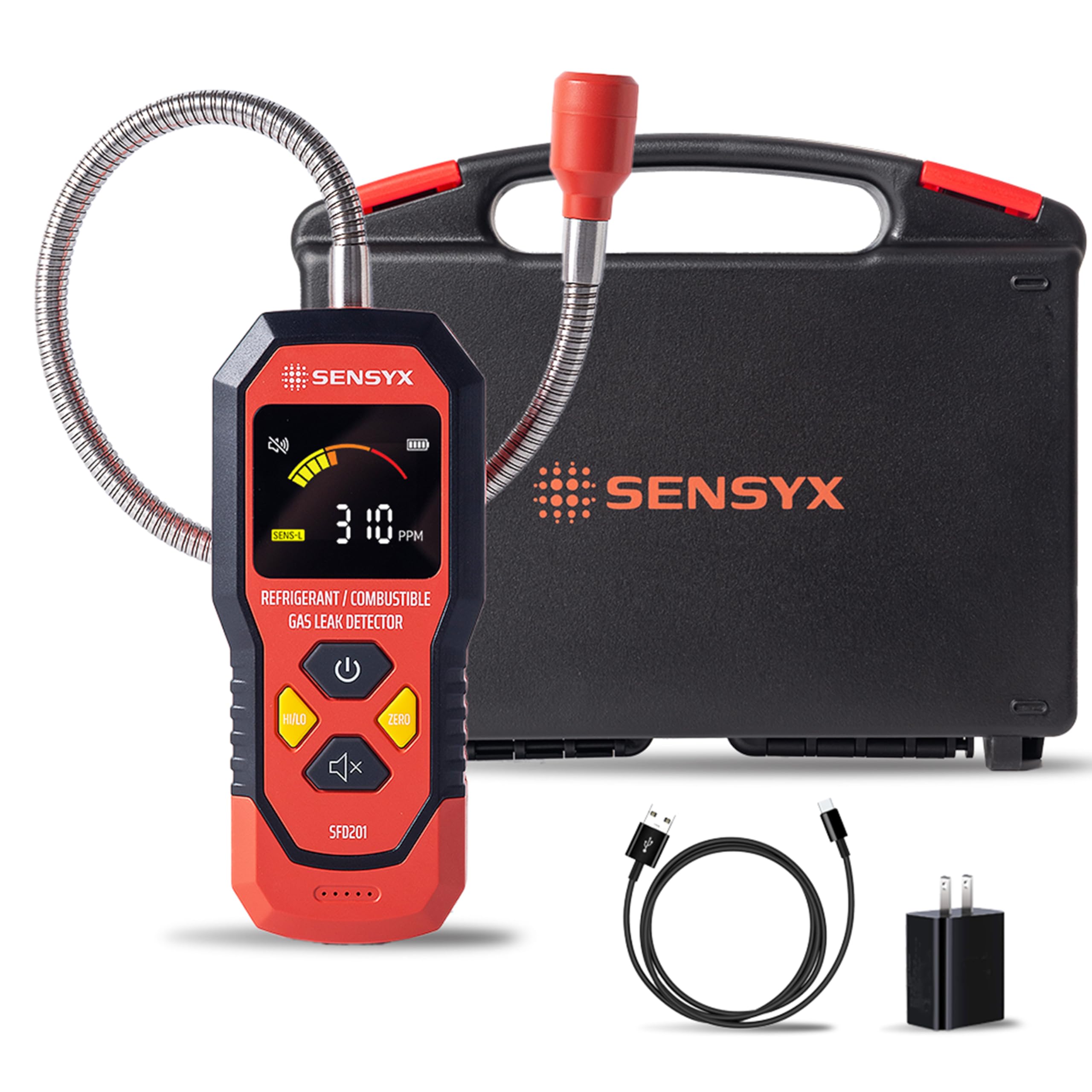
The Sensyx SFD201 packs a Japan-made heat dioxide semiconductor sensor into a compact, rechargeable package that detects both halogen refrigerants and combustible gases like methane, propane, and isobutane. This dual-purpose capability eliminates the need to carry separate tools for refrigerant and gas searches. The large color LCD screen shows leak level in real-time bar graphs, and the mute function silences the audible alarm when working in noise-sensitive environments.
Sensitivity is adjustable between High and Low modes. High mode catches very fine leaks but can produce false positives if the unit is calibrated indoors where cleaning products or outgassing plastics are present. The manual recommends calibrating in the same room as the search, not outside, to match ambient conditions. The rechargeable lithium battery charges via USB-C and supports prolonged cordless operation without the ongoing cost of disposable alkalines.
The unit is compliant with the UL1484 safety standard. A carrying case is included, which protects the sensor between jobs. Some users note the sensor drift warning light can be triggered by rapid humidity changes, and the sensitivity can overwhelm first-time users who expect only the largest leaks to register. For the price, the SFD201 offers a rare combination of refrigerant and combustible gas detection in one slim tool.
Why it’s great
- Detects both halogen refrigerants and combustible gases in one unit
- Rechargeable lithium battery with USB-C charging
- Large color LCD with mute function
Good to know
- High sensitivity mode can produce false positives in contaminated air
- Calibration must be done in the same room as the search
5. Mastercool 53351 Professional UV Leak Detection Kit

The Mastercool 53351 takes a fundamentally different approach to leak finding: instead of sniffing gas concentration, it injects fluorescent dye into the system and uses a 50-watt high-intensity UV light to make the leak glow visibly. This method is particularly useful for locating slow leaks that may not produce enough refrigerant concentration for a sniffer to detect, or for confirming the exact drip point after a sniffer has narrowed the search area.
The kit includes one 1-oz cartridge of universal oil-based fluorescent dye (good for roughly 10 applications) and one 1-oz engine coolant dye for cooling system diagnostics. It comes with an R-134a hose and coupler, an R-12 adapter for legacy systems, 4 oz of dye remover, 25 service labels, and UV-enhancing safety glasses. The UV light is powered by the vehicle’s 12V battery via a long cord, so there are no internal batteries to deplete.
The dye is permanent once injected—even after flushing, residual fluorescence can remain in the system. The dye injector does not fit R-134a service ports directly for some users, requiring an adapter. The UV light lens may loosen after repeated heat exposure in the engine bay. For a technician who needs to document the exact leak location for warranty claims or customer reports, the visual confirmation of UV dye is invaluable.
Why it’s great
- Visual leak confirmation eliminates guesswork for pinpoint accuracy
- Includes both refrigerant and coolant dyes plus all adapters
- UV light runs off vehicle battery, no internal batteries to die
Good to know
- Dye permanently stains system components and coolant color
- UV light lens may loosen after repeated engine bay heat exposure
6. Elitech CPU-1G HVAC Leak Detector

The Elitech CPU-1G is a traditional corona discharge (coronal sensor) leak detector that punches above its price class with a max sensitivity of 0.11 oz/yr—beating many mid-range units. It responds to refrigerant in roughly 3 seconds and warms up in 6 seconds, making it one of the fastest-starting detectors on this list. Seven adjustable sensitivity levels allow you to start on a coarse setting to locate the general area, then dial up to maximum for pinpointing the exact pinhole.
The 14-inch flexible stainless steel probe comes with two alternative sensor tips and can be positioned around obstacles without losing its shape. The modular sensor design means you can swap the sensor element without replacing the entire unit. Power comes from two C alkaline batteries, which are included in the box. A 24/7 US-based technical support line is available by phone and email.
Some users report that the high sensitivity setting can produce false positives if the air is contaminated with refrigerant vapor from previous searches. The audible alarm is loud and lacks a mute function. A few units have arrived with loose handles or shipped in under-protected packaging. For the money, the CPU-1G offers an exceptionally low detection threshold that allows it to compete with units costing significantly more.
Why it’s great
- 0.11 oz/yr sensitivity outclasses many higher-priced competitors
- 7 sensitivity levels for coarse-to-fine leak hunting
- Flexible 14-inch probe with replaceable sensor element
Good to know
- Audible alarm cannot be muted during operation
- High sensitivity can trigger false positives in contaminated air
7. Leak Saver Direct Inject Ultimate 3-in-1

The Leak Saver Direct Inject is not a detection tool in the traditional sense—it is a chemical sealant that simultaneously fixes small refrigerant leaks and confirms their location via UV dye. The 3-in-1 formula combines a polymer-free organosilane sealant with moisture remover and fluorescent dye. When injected into the system, the sealant reacts with air and moisture at the leak site to form a permanent plug, while the UV dye allows you to find the sealed location with a UV light.
This product works with all common refrigerants including R-410A, R-22, R-134A, R-1234yf, R-404A, and R-600a, and is safe for TXVs, capillary tubes, Schrader valves, and manifold gauges. It is compatible with systems up to 5 tons and can be used in central air conditioners, automotive AC, ductless mini-splits, heat pumps, and commercial refrigeration. The sealant is injected directly using a basic manifold gauge set or the brand’s Leak Shot injection kit.
The sealant is intended for leaks where the full refrigerant charge is not lost within 7 days—larger holes should be mechanically repaired first. Some users report the sealant successfully stopped leaks that had persisted for months, saving thousands in repair costs. The UV dye is permanent and will remain in the system, which can make future leak detection easier but also complicates system flushing. This is a repair aid, not a diagnostic sniffer, but it solves the problem rather than just finding it.
Why it’s great
- Permanently seals small refrigerant leaks without system disassembly
- Contains UV dye for leak location confirmation after sealing
- Safe for all common refrigerants, oils, and system components
Good to know
- Only suitable for leaks where full charge is not lost within 7 days
- UV dye permanently stains system components after injection
FAQ
Can an AC leak detector find a leak through insulation or ductwork?
Why does my leak detector beep even when there is no refrigerant leak?
What is the difference between a refrigerant sniffer and a combustible gas detector?
How often should I replace the sensor or filter on my leak detector?
Final Thoughts: The Verdict
For most users, the best ac leak detector winner is the Elitech ILD-200 because its infrared sensor delivers high sensitivity, fast response, and a 10-year lifespan that makes it a long-term investment rather than a disposable tool. If you need a detector that can also find natural gas and propane leaks, grab the Sensyx SFD201 for its dual-purpose capability and rechargeable battery. And for the professional technician who demands the proven reliability of a heated diode sensor with auto-zeroing, nothing beats the Inficon TEK-Mate.