
A recovery machine that stalls on a hot rooftop or takes forever to pull a single charge of R134A is a direct hit to your productivity. The difference between a unit that recovers vapor at a crawl and one that pulls a full system cleanly in minutes comes down to the compressor horsepower, cylinder count, and condenser design. Choosing the wrong AC machine R134A means more time on the job, more wear on your gear, and unnecessary frustration.
I’m Min — the co-founder and writer behind Gadgets Feed. I’ve spent the last weeks cross-referencing manufacturer spec sheets, customer field reports, and verified test results across nine different recovery units to separate the fast, durable machines from the slow, failure-prone ones you should skip.
This guide breaks down the critical specs — from 1 HP dual-cylinder compressors to 550 PSI auto shut-off thresholds — so you can confidently choose the best ac machine r134a for your shop or service van without wasting money on a unit that underdelivers.
How To Choose The Best AC Machine R134A
Not all recovery machines handle R134A the same way. A unit built for occasional home use will struggle under the daily demands of an automotive shop or commercial HVAC work. The key decisions boil down to compressor power, cylinder configuration, safety features, and portability.
Compressor Horsepower and Cylinder Count
The single most important spec on any AC machine R134A is the compressor. A 3/4 HP single-cylinder motor is adequate for light duty — recovering a single car AC over the weekend. But if you are pulling refrigerant from multiple systems daily, a 1 HP dual-cylinder compressor cuts recovery time by roughly half. The VIVOHOME 1 HP and VEVOR 1 HP models both use twin-cylinder oil-less compressors that handle both liquid and vapor R134A far faster than their single-cylinder counterparts. The Fieldpiece MR45 spins its compressor at 3,300 RPM for instant pull-down.
High-Pressure Auto Shut-Off and Safety
Every serious recovery machine must have a high-pressure shut-off switch. The standard threshold is 550 to 558 PSI — if internal pressure exceeds that limit, the machine stops automatically to prevent tank rupture or compressor damage. Cheaper units sometimes omit this feature or use an unreliable mechanical switch. Look for models like the VIVOHOME 3/4 HP and the VEVOR 1 HP that include both overpressure protection and overcurrent breakers. The Robinair RG3 shuts off at 550 PSI, and the Inficon Vortex Dual uses a robust metal-knobbed valve system that holds up under repeated high-pressure cycles.
Self-Purge and Filtration Systems
After each recovery job, residual refrigerant left inside the machine expands as it warms up, damaging seals and the compressor over time. A self-purge function — available on all VIVOHOME, VEVOR, Inficon, and Appion models — lets you clear the internal lines by routing remaining refrigerant into the recovery tank. Dual-stage filtration is equally critical. Replaceable filter driers remove moisture and acid, while inlet-port screens trap metal shavings and debris. Machines without these features require more frequent internal repairs.
Portability and Weight
If you haul your recovery unit between roofs, attics, and customer driveways, weight matters. The Robinair RG3 weighs just 18 pounds — the lightest of all nine units reviewed — making it the easiest to carry for mobile technicians. The Hilmor Brushless DC model also sits at a manageable 25 pounds with a built-in hoist point for hands-free lifting. At the heavier end, the VIVOHOME 1 HP dual-cylinder comes in at 33 pounds, and the PBAUTOS single-cylinder is just under 30 pounds. A heavier unit with a larger condenser may cool faster, but the trade-off is shoulder fatigue over a long workday.
Quick Comparison
On smaller screens, swipe sideways to see the full table.
| Model | Category | Best For | Key Spec | Amazon |
|---|---|---|---|---|
| Fieldpiece MR45 | Premium Twin Cylinder | Professional daily use | 1 HP / 3,300 RPM / 22 lbs | Amazon |
| Appion G5TWIN | Premium Twin Cylinder | Ultra-fast recovery | Twin Cylinder / 24 lbs | Amazon |
| Inficon Vortex Dual | Premium Twin Cylinder | High-temp environments | 1 HP Dual Piston / 29.8 lbs | Amazon |
| VEVOR 1 HP | Mid-Range Dual Cylinder | Fast liquid recovery | 1 HP / 7.7 lb/min liquid | Amazon |
| VIVOHOME 1 HP RR500 | Mid-Range Dual Cylinder | Versatile field use | 1 HP Twin Cylinder / 33 lbs | Amazon |
| Robinair RG3 | Mid-Range Single Cylinder | Lightweight portability | 1/3 HP / 18 lbs | Amazon |
| Hilmor 1950536 | Mid-Range Brushless DC | Digital display & portability | Brushless DC / 25 lbs | Amazon |
| VIVOHOME 3/4 HP VH471 | Value Single Cylinder | Home shop / light duty | 3/4 HP / 29.7 lbs | Amazon |
| PBAUTOS RR250 | Budget Single Cylinder | Entry-level / occasional use | 3/4 HP / 29.76 lbs | Amazon |
In‑Depth Reviews
1. Fieldpiece MR45

The Fieldpiece MR45 sits at the top of the professional tier for good reason. Its 1 HP twin-cylinder oil-less compressor spins at 3,300 RPM — double the speed of most competitors — and the microchannel condenser compresses more refrigerant per cycle. This translates to recovery speeds that let you walk away and let the machine finish the job unattended. The unit weighs only 22 pounds, making it lighter than many single-cylinder machines that deliver half the performance.
The digital display shows real-time pressure readouts that match digital manifold gauges within a single PSI, eliminating the guesswork of analog needles. Water resistance is built in, so accidental rain exposure on a rooftop doesn’t kill the electronics. The MR45 is A2L-compatible, future-proofing your investment as the industry shifts toward mildly flammable refrigerants. Users report pulling over 12 pounds of R410A in under 20 minutes without the unit breaking a sweat.
The ceramic cylinder construction reduces friction over the long term, extending the compressor’s service life considerably. Fieldpiece backs this unit with responsive customer support — one buyer who triggered a motor fault error after six months received a replacement within 48 hours. The only catch is that the MR45 is not officially compatible with R22, so if you still service older residential systems, verify compatibility before buying or keep a backup unit.
Why it’s great
- Unattended operation saves labor time on every recovery call
- Water-resistant housing handles outdoor job sites reliably
- Digital gauge matches manifold accuracy within 1 PSI
Good to know
- Premium price reflects professional-grade build
- Not certified for R22 — check refrigerant list before purchase
2. Appion G5TWIN

The Appion G5TWIN is the speed king of portable recovery machines. Its twin-cylinder, twin-condenser configuration — backed by a 7-inch, 10-blade turbine fan moving 600 CFM of cooling air — pulls liquid and vapor R134A faster than any single-cylinder unit on this list. The refrigerant-isolated crankcase prevents liquid slugging damage, a common failure point on lesser machines that can’t handle direct liquid intake. At 24 pounds, it is lighter than the VIVOHOME 1 HP by nearly 10 pounds while delivering faster recovery rates.
Experienced technicians who have owned seven or eight recovery machines over their careers consistently rank the G5TWIN as the fastest and most comfortable to set up. Replacement parts like capacitors and relays are widely available and inexpensive, so you are not stuck buying a whole new unit when a minor component fails. The self-purge valve clears residual refrigerant after each job, protecting the compressor from expansion damage during storage.
The G5TWIN handles R410A liquid and vapor without breaking a sweat, making it a solid choice for both automotive R134A and residential split-system work. Users report it almost pulls a vacuum on its own, which speaks to the compressor’s efficiency. The trade-off is the price — it sits in the premium bracket — but the speed gain pays for itself if you do multiple recoveries per day. One buyer noted the machine was stolen on a job site, which indirectly confirms its desirability among pros.
Why it’s great
- Twin-cylinder and twin-condenser design delivers benchmark recovery speed
- Lightweight at 24 lbs for a dual-cylinder machine
- Refrigerant-isolated crankcase prevents liquid damage
Good to know
- Premium investment justified by speed and durability
- Blow-molded case is functional but not as rugged as metal-frame alternatives
3. Inficon Vortex Dual 714-202-G1
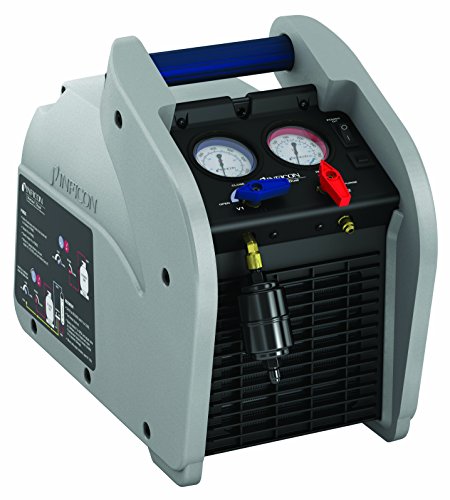
The Inficon Vortex Dual uses a 1 HP dual-piston compressor paired with a microchannel condenser that maintains exceptional heat exchange even when ambient temperatures climb past 100°F. This makes it the go-to choice for roof work in direct sun where lesser machines would trip thermal overload. The two-valve operation with self-purge is intuitive — no confusing toggle switches — and the large analog gauges are easy to read from a standing position. The unit ships with a detachable power cord, a filter dryer, and a heavy-duty blow-molded case that protects it during truck transport.
Users consistently report flawless performance after two years of daily use, recovering over 12 pounds of refrigerant in 15 to 20 minutes. The Vortex Dual is compatible with both R410A and R22, which gives it an edge over the Fieldpiece MR45 for technicians who still service older residential systems. The metal knobs and durable housing inspire confidence on rough job sites. Inficon offers a three-year replacement warranty with US-based tech support via phone and email, providing peace of mind that budget brands cannot match.
The downside is weight: at 29.8 pounds, it is heavier than the Robinair RG3 by nearly 12 pounds. If you carry your recovery machine up ladders all day, the extra heft becomes noticeable. The compressor is also louder than the Fieldpiece MR45’s brushless-style motor, though no recovery machine in this class qualifies as quiet. For shop use or jobs where you can set the unit on a stable surface, the Vortex Dual is a long-term investment that holds up.
Why it’s great
- Microchannel condenser handles extreme ambient heat without stalling
- Three-year replacement warranty with US-based tech support
- Works with R22 and R410A — versatile across system types
Good to know
- At 29.8 lbs, it is heavier for mobile carry
- Audible noise level is higher than brushless DC competitors
4. VEVOR 1 HP Dual Cylinder Recovery Machine

The VEVOR 1 HP dual-cylinder recovery machine hits a sweet spot for technicians who want twin-cylinder speed without paying premium brand prices. Its 1 HP brush motor drives a maximum liquid recovery rate of 7.7 pounds per minute — 59% faster than single-cylinder competitors. The built-in fan and condenser layout keeps the unit cool during extended pull-downs, and the high-pressure auto shut-off kicks in reliably at 558 PSI. Users who were initially skeptical reported perfect performance across four system recoveries, including R454B mini-splits.
The self-cleaning purge function is straightforward — turn the knob to PURGE after every job, and the machine safely discharges leftover refrigerant into the recovery tank rather than venting it to atmosphere. The reusable filter screen traps debris at the intake port and can be cleaned without buying replacement cartridges every few weeks. The 30.8-pound weight is manageable for rolling on a dolly but starts to feel heavy if you are hauling it up flights of stairs.
Compatibility covers R134A, R22, R410A, R404A, R1234YF, and R32, making it one of the most versatile units in the mid-range category. The instruction manual is basic, and the valve labeling could be clearer for first-time users — but the machine itself performs reliably out of the box. For the price, you get dual-cylinder recovery speeds that cost hundreds more from Fieldpiece or Inficon. If your budget does not stretch to premium brands, the VEVOR 1 HP is the next best thing.
Why it’s great
- 7.7 lb/min liquid recovery rate outperforms single-cylinder units drastically
- Self-cleaning purge extends compressor life significantly
- Broad refrigerant compatibility covers R32 and R1234YF
Good to know
- Instructions are sparse — some setup trial and error expected
- Heavier than the Robinair RG3 by 12+ pounds
5. VIVOHOME 1 HP Dual Cylinder RR500

The VIVOHOME RR500 upgrades over the brand’s 3/4 HP model with a 1 HP motor spinning at 1,750 RPM and a twin-cylinder oil-less compressor that handles both vapor and liquid R134A recovery without slowing down. The larger condenser dissipates heat faster, which matters when you are pulling down multiple automotive systems back-to-back. The dual-stage filtration — a replaceable filter drier plus an interior mesh intake filter — keeps moisture and metal particles out of the compressor windings, directly extending the machine’s service life.
A standout feature at this price point is the Auto/Manual LP Bypass mode. In AUTO mode, the machine maximizes refrigerant recovery efficiency. In MANUAL mode, it protects the compressor from damage when pulling against very low suction pressures. This gives experienced technicians full control over the recovery process without having to monitor the gauges constantly. The three-knob control layout (Inlet/Outlet/Function) is logically arranged and comes with beginner-friendly instructions that actually make sense — a rarity in this category.
The RR500 weighs 33 pounds, making it one of the heavier mid-range machines. The ergonomic non-slip handle helps, but you will still feel the weight after carrying it around a busy shop all day. One user blew the high-pressure gauge due to a rookie mistake, and VIVOHOME’s customer service sent a replacement gauge quickly — a good sign for post-purchase support. For its feature set — dual cylinder, LP bypass, dual-stage filtration — the RR500 delivers professional-grade performance at a mid-range price that undercuts premium brands by hundreds.
Why it’s great
- Auto/Manual LP bypass mode gives pro-level control over recovery cycles
- Twin-cylinder compressor recovers vapor and liquid R134A efficiently
- Dual-stage filtration protects compressor from moisture and debris
Good to know
- 33-pound weight is on the heavier side for daily carry
- Purge mode design vents residual — check local regulations before use
6. Robinair RG3

The Robinair RG3 is the lightest recovery machine in this lineup at just 18 pounds, with a footprint 40% smaller than the brand’s previous generation units. For mobile technicians who carry their gear up ladders, through crawl spaces, and across rooftops, that weight savings translates directly into less fatigue by the end of the day. The single-cylinder 1/3 HP oil-less compressor is not the fastest — vapor recovery at 16 ounces takes 12 to 15 minutes — but it is dependable and simple to operate with just two valves and a high-pressure shut-off at 550 PSI.
The cross-flow fan and condenser layout is optimized for shorter cycle times within the constraints of a 1/3 HP motor. Liquid recovery is noticeably faster than vapor, which matters when you are pulling the bulk charge from a car AC system. The rugged plastic case protects the internals from drops and bumps, and the IEC connector with a detachable power cord makes replacement cheap if the cord gets damaged.
The trade-off is clear: if you are recovering refrigerant from multiple large systems daily, the RG3 will feel slow compared to the 1 HP dual-cylinder units. One user noted that recovering 7.9 pounds of R410A in high heat required some patience, though the machine handled the load without excessive strain or overheating. The RG3 is best suited for DIY homeowners doing occasional car AC repairs or light commercial work where speed is not the primary metric. If portability trumps raw recovery speed, this is the unit to grab.
Why it’s great
- At 18 lbs, it is the lightest machine — ideal for rooftop and mobile work
- Simple two-valve operation with no complicated menus or settings
- Robinair durability means many units last a decade or more
Good to know
- 1/3 HP motor is slower on vapor recovery than larger machines
- No built-in oil separator — factor in external filtration if needed
7. Hilmor 1950536 Brushless DC

The Hilmor 1950536 uses a brushless DC motor — a notable departure from the brushed AC motors found on most recovery machines. Brushless motors generate less heat, run more efficiently, and eliminate brush replacement maintenance over the unit’s lifespan. The digital LCD screen provides precise pressure readouts that are easier to read in low-light attic conditions than analog gauges. Built-in hoist points on the frame allow hands-free carrying using a strap or rope, a thoughtful touch for technicians working alone on a roof.
The integrated power cord wrap keeps the cord from tangling inside your service van, and the compact dimensions — 9.6 inches wide by 5.4 inches deep by 13.3 inches tall — mean it takes up very little space in a crowded tool bag. At 25 pounds, it is lighter than most dual-cylinder machines while retaining solid recovery performance. One user reported pulling 5 pounds of refrigerant in just a few minutes, which puts it in line with faster single-cylinder units. The motor technology gives it a quieter operation profile compared to traditional reciprocating compressor machines.
The main concern reported by buyers is quality control at the retail level. Several units arrived with visible signs of prior use — oil marks on the hose connections and printer prints indicating the machine had been turned on. This appears to be an Amazon warehouse issue rather than a Hilmor manufacturing defect, but it is worth noting before ordering. If you receive a fresh unit, the Hilmor is a well-engineered machine that combines modern motor tech with practical field features. For technicians who value quiet operation and a digital interface, the 1950536 delivers.
Why it’s great
- Brushless DC motor runs cooler and eliminates brush maintenance
- Digital LCD screen gives accurate real-time pressure data
- Hoist points and cord wrap improve field ergonomics
Good to know
- Quality control at retail — some units ship with signs of prior use
- Premium price for the motor tech without a proportional speed gain
8. VIVOHOME 3/4 HP VH471

The VIVOHOME VH471 is the machine that established VIVOHOME as a serious player in the recovery tool space. Its 3/4 HP single-cylinder oil-less compressor pulls both vapor and liquid R134A reliably, and the high-powered fan keeps the condenser cool during extended operation. The automatic shut-off at 558 PSI and overcurrent protection guard against the two most common failure scenarios — overpressure tank damage and electrical overload from a bad extension cord. The dual-stage filtration system removes moisture and particulates before they reach the compressor, and the filter drier is replaceable without special tools.
For the price, the VH471 includes everything needed to start recovering immediately: a pressure hose, filter drier, extra gaskets, and a manual that covers multiple setup configurations. The ergonomic non-slip handle and waterproof feet make it stable on wet surfaces. Users who have owned recovery machines in the past — some of whom paid thousands for older units — describe the VH471 as offering professional-quality build at a fraction of the historical cost. The corrosion-resistant housing holds up to the chemical exposure that comes with refrigerant work.
The catch is speed. Vapor recovery is slow — approximately 12 to 15 minutes to recover 16 ounces of R134A vapor. Liquid recovery is much faster, but if you are doing a full recovery on a system that is mostly vapor, you will spend more time waiting. The noise level at 70 decibels is typical for a single-cylinder machine, which means hearing protection is advisable in an enclosed shop. For home mechanics who service their own cars once or twice a year, the VH471 is a great value. For daily commercial use, the slow vapor pull becomes a bottleneck.
Why it’s great
- Includes hose, filter, and gaskets right out of the box
- Dual-stage filtration effectively protects the compressor from contaminants
- Corrosion-resistant housing handles workshop chemical exposure
Good to know
- Slow vapor recovery — 16 oz takes 12–15 minutes
- Noisy operation at 70 dB — plan for hearing protection
9. PBAUTOS RR250
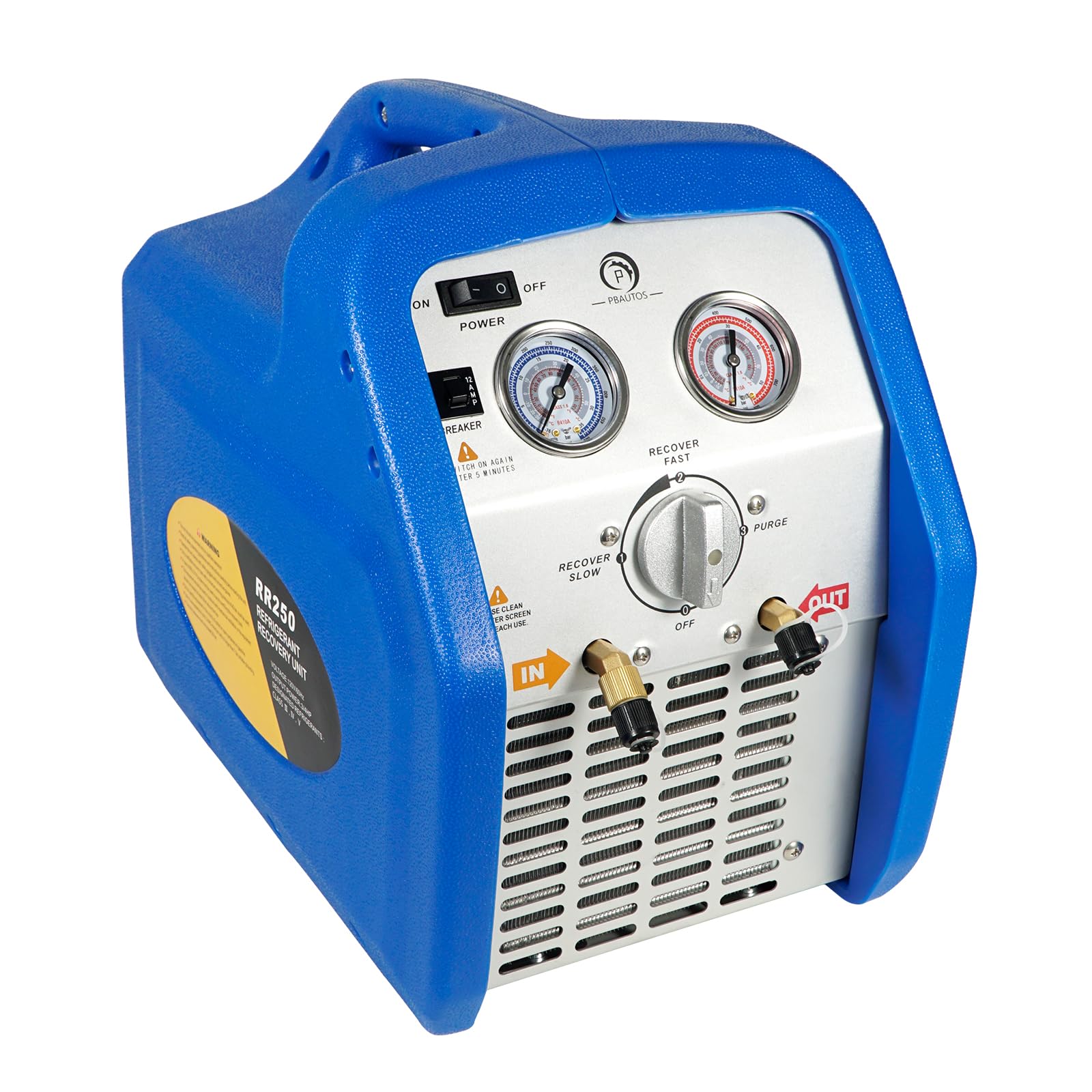
The PBAUTOS RR250 is the entry-level option for buyers who need a functioning AC machine R134A on a tight budget. It uses the same 3/4 HP single-cylinder oil-less compressor architecture as the VIVOHOME VH471 but at a lower price point. The built-in intake pressure gauge (blue) and discharge pressure gauge (red) have clear scales that are easy to read at a glance. The automatic shut-off kicks in above 558 PSI, and the overload protector resets automatically after five minutes if tripped — a nice safety net for first-time users who might accidentally deadhead the compressor.
The self-purge switch allows you to clear residual refrigerant after each job, which is a feature often missing from budget machines. The included filter drier removes moisture from the air stream, and the filter is replaceable when it becomes saturated. Users who bought the RR250 for occasional home use report consistent performance with no leaks and no quality issues. One buyer who uses the machine every single day for professional work was impressed with the build quality and speed, suggesting the RR250 can handle daily use despite its budget positioning.
The machine supports all Category III, IV, and V refrigerants, including R12, R134A, R22, R410A, R404A, and R507. However, the manufacturer explicitly states it is not approved for explosive, flammable, or corrosive refrigerants, so do not attempt to use it with R290 or R600A. The 29.76-pound weight is comparable to the VIVOHOME 3/4 HP model, and the compact dimensions with the ergonomic handle make it easy to transport. The main trade-off is build refinement — the plastic components and gauge quality do not feel as robust as the Robinair or Inficon units, but at this price point, the RR250 is a capable starter machine.
Why it’s great
- Budget-friendly entry point for home AC and auto recovery
- Self-purge function prevents internal refrigerant damage
- Overload protector resets automatically after 5 minutes
Good to know
- Build quality and gauge precision are below professional-grade standards
- Not certified for flammable refrigerants like R290 or R600A
FAQ
Can I use an AC machine R134A to recover R410A as well?
Why do some recovery machines cost more than others for the same horsepower rating?
How often should I replace the filter drier on my recovery machine?
Final Thoughts: The Verdict
For most users, the best ac machine r134a winner is the Fieldpiece MR45 because it combines a 1 HP twin-cylinder compressor with water resistance, a digital gauge, and unattended operation — all in a 22-pound package that is faster than anything at its weight. If you want the fastest possible recovery speeds for daily commercial use, grab the Appion G5TWIN. And for a budget-friendly entry point that still includes a self-purge function and broad refrigerant compatibility, nothing beats the PBAUTOS RR250.