
Choosing the wrong viscosity or oil type for your air conditioning or air compressor pump is the fastest way to shorten its service life, reduce cooling efficiency, and rack up costly repair bills. Whether you are maintaining a home workshop compressor, servicing a vehicle’s AC system, or keeping industrial equipment running, the lubricant you pour in directly dictates operating temperature, wear rates, and component longevity.
I’m Min — the co-founder and writer behind Gadgets Feed. I’ve spent countless hours analyzing technical specifications, cross-referencing OEM recommendations, and studying real-world customer feedback to separate the oils that truly protect pumps from those that merely lubricate.
After diving deep into viscosity grades, synthetic versus conventional base stocks, and additive packages, I’ve assembled a definitive guide to the best ac oil compressor options available today so you can make a confident, informed purchase.
How To Choose The Best AC Oil Compressor
The oil you choose must match both the compressor type and the operating environment. A rotary screw compressor demands a different viscosity and additive package than a reciprocating piston pump, and an automotive AC system requires a specific polyalkylene glycol (PAG) oil rather than a general-purpose compressor lubricant. Ignoring these distinctions leads to increased wear, higher operating temperatures, and premature failure.
Viscosity Grade: ISO 32, ISO 46, or ISO 100
Viscosity determines how well the oil film separates moving metal surfaces under load. Lighter ISO 32 oils are used in small reciprocating compressors and some rotary screw units operating in cold climates. ISO 46 is the most common grade for medium-duty rotary screw, vane, and reciprocating compressors, balancing fluidity and film strength across a wide temperature range. Heavier ISO 100 oils are reserved for high-temperature, high-pressure reciprocating compressors and some industrial units. Using an oil that is too thin causes metal-to-metal contact; using one that is too thick creates drag, increases startup wear, and raises operating temperatures.
Synthetic vs. Conventional (Mineral) Base Oil
Conventional mineral oils are petroleum-based and sufficient for light-duty or intermittent-use compressors. However, they break down faster under high heat, oxidize to form sludge and varnish, and lose viscosity in extreme cold. Full synthetic oils, made from chemically engineered base stocks, resist thermal breakdown, flow freely at sub-zero temperatures, and maintain film strength beyond 140°F. Synthetics also reduce carbon buildup on valves and extend oil change intervals significantly — often four to five times longer than mineral oils.
Non-Detergent Requirement for Air Compressors
Air compressors must use non-detergent oils. Detergent additives are designed to hold combustion byproducts in suspension in engine oils, but air compressors have no combustion cycle, so detergent oils foam excessively, trap moisture, and accelerate wear on pump bearings and valves. Every compressor oil on this list is non-detergent where applicable. Automotive AC compressor oils (PAG and POE) are inherently non-detergent by design.
Quick Comparison
On smaller screens, swipe sideways to see the full table.
| Model | Category | Best For | Key Spec | Amazon |
|---|---|---|---|---|
| TRIAX Kompressor ISO 46 | Full Synthetic | Severe-duty industrial & home compressors | ISO 46 SAE 20, flash point 220°C | Amazon |
| Ingersoll Rand 38436721 | Synthetic All-Season | Reciprocating compressors, OEM spec | 1L, 4x longer life vs petroleum | Amazon |
| DEWALT D55001 | Full Synthetic | Noise reduction & cooler operation | ISO 100 SAE 30, 32 oz | Amazon |
| TSI Supercool P46-32D | PAG 46 with UV Dye | Automotive AC (R134a) compressors | PAG 46 viscosity, 32 oz | Amazon |
| TSI Supercool P100-8D-6CP | PAG 100 with UV Dye | Automotive AC, high-viscosity demand | PAG 100 viscosity, 8 oz 6-pack | Amazon |
| Milton 1002 | Conventional Mineral | Budget-friendly fleet & plant use | ISO 100, 1 gallon | Amazon |
| Universal AC RO 0900B | Mineral Refrigerant Oil | Basic automotive AC top-off | 8 oz mineral oil, vehicle specific | Amazon |
In‑Depth Reviews
1. TRIAX Kompressor ISO 46 Full Synthetic

The TRIAX Kompressor ISO 46 is a full synthetic, industrial-grade oil engineered for severe-duty rotary, vane, screw, and reciprocating compressors. Its advanced high-temperature formula delivers up to 1000% higher load-bearing capacity than conventional oils, creating a thick, durable film that prevents metal-to-metal contact even under extreme heat and pressure. Real-world users report it works flawlessly in everything from Craftsman home units to commercial shop compressors.
This oil’s defining advantage is its true multi-viscosity performance across an extraordinary range: it flows reliably at -49°F and maintains film strength above 140°F, eliminating the need for seasonal oil changes. It reduces operating temperatures by up to 30% and actively repels moisture to protect internal components from rust and emulsion. With a flash point of 220°C, it resists burnoff and odor even during prolonged continuous duty.
The non-detergent formulation is OEM-recommended and fully compatible with Ingersoll Rand, Atlas Copco, Quincy, DEWALT, Sullair, and most other brands. Users consistently praise its clarity, lack of odor, and the noticeable drop in operating noise after switching from conventional oil. For those who demand maximum protection and extended service life — over 20,000 hours in many cases — this is the definitive choice.
Why it’s great
- Full synthetic with 1000% higher load-bearing capacity
- Operates from -49°F to 140°F without viscosity breakdown
- Reduces pump temperature by 30% for cooler, quieter running
- Wide compatibility across dozens of compressor brands
Good to know
- Not for use in oxygen or LNG compressors
- Higher upfront cost than conventional mineral oils
2. Ingersoll Rand 38436721 All Season Select

The Ingersoll Rand 38436721 is the OEM-specified lubricant for the brand’s reciprocating compressors, but its synthetic all-temperature formula performs superbly in any reciprocating pump. Engineered to last four times longer than petroleum-based lubricants, it resists carbon buildup on valves and maintains stable viscosity whether the compressor is running in a freezing garage or a hot industrial bay.
Real-world testing confirms that this synthetic oil runs approximately 20°F cooler than generic ISO 100 mineral oils in older compressors. Users report that the oil remains nearly clear with no visible particulates even during break-in periods, indicating superior thermal stability and oxidation resistance. The 1-liter bottle provides exactly two oil changes for most 60-gallon single-stage compressors.
While the price per quart is higher than many competitors, the extended drain interval and reduced valve cleaning requirements offset the cost over the compressor’s life. It’s an especially smart choice if you own an Ingersoll Rand pump, but equally effective on other brands where OEM-grade synthetic protection is desired without compatibility risks.
Why it’s great
- Four times longer service life than mineral oils
- Reduces carbon deposits on compressor valves
- Consistent performance in both hot and cold conditions
- OEM spec for Ingersoll Rand reciprocating compressors
Good to know
- Premium pricing compared to conventional alternatives
- Specifically optimized for reciprocating, not rotary screw
3. DEWALT D55001 Compressor Oil

The DEWALT D55001 is a full synthetic SAE 30 (ISO 100) non-detergent oil designed for reciprocating piston compressors. Users switching from conventional 20W or 40W mineral oils report dramatic improvements: reduced operating noise to a whisper, cooler running temperatures, and easier startup on 110V circuits without tripping breakers. The distinctive blue color makes it easy to distinguish from other fluids in your workshop.
This oil is particularly effective in portable compressors like the Makita MAC700 and Chicago Pneumatic RCP220P, where it eliminated hard-starting issues and lowered inrush current draw. The synthetic base resists thermal breakdown and oxidation, keeping the oil looking fresh even after 2.5 hours of continuous use — a clear sign of superior stability versus conventional oils that darken quickly.
As a non-detergent formulation, it won’t foam or trap moisture, which is critical for air compressor longevity. Some users note that switching from mineral to synthetic may require an early re-change to flush out residual deposits, but the long-term benefits in wear reduction and valve cleanliness justify the switch. It’s a mid-range synthetic option that punches well above its price point in performance.
Why it’s great
- Full synthetic reduces noise and operating temperature noticeably
- Non-detergent formula prevents foaming in compressor pumps
- Improves cold-start and reduces breaker trips on 110V circuits
- Blue color aids visual leak detection and fluid identification
Good to know
- ISO 100 viscosity may be too thick for cold-weather-only compressors
- Switching from mineral oil may need an early follow-up change
4. TSI Supercool P46-32D PAG 46 with UV Dye

The TSI Supercool P46-32D is a high-performance synthetic PAG oil formulated specifically for R134a automotive AC systems. Its 46 viscosity rating makes it the most common grade for modern vehicle compressors, and the addition of anti-wear agents and friction modifiers directly enhances compressor efficiency while reducing wear rates that extend the unit’s service life. The integrated UV dye simplifies leak detection, letting you pinpoint failed seals or hose cracks with a simple UV light.
This oil’s antioxidant package actively protects the AC system against sludge and deposit formation, which can restrict refrigerant flow and reduce cooling capacity over time. With a flash point of 442°F, it resists breakdown in the high-temperature environment inside a compressor housing. The 32-ounce bottle provides ample oil for multiple AC service jobs or a complete system recharge on larger vehicles.
Mechanics and DIY users alike praise its leak-detection capability, noting that the UV dye makes even pinhole leaks immediately visible. It meets OEM performance specifications and works with most R134a compressors from Toyota, Honda, Ford, GM, and others. For anyone servicing mobile AC systems, this is the all-around standard for reliability and protection.
Why it’s great
- PAG 46 is the standard viscosity for R134a automotive AC systems
- Integrated UV dye enables fast, accurate leak diagnosis
- Anti-wear and antioxidant additives extend compressor life
- Meets OEM performance specifications for broad compatibility
Good to know
- Not compatible with R12 or R1234yf systems without proper conversion
- UV dye can stain surfaces if spilled — use caution when filling
5. TSI Supercool P100-8D-6CP PAG 100 with UV Dye
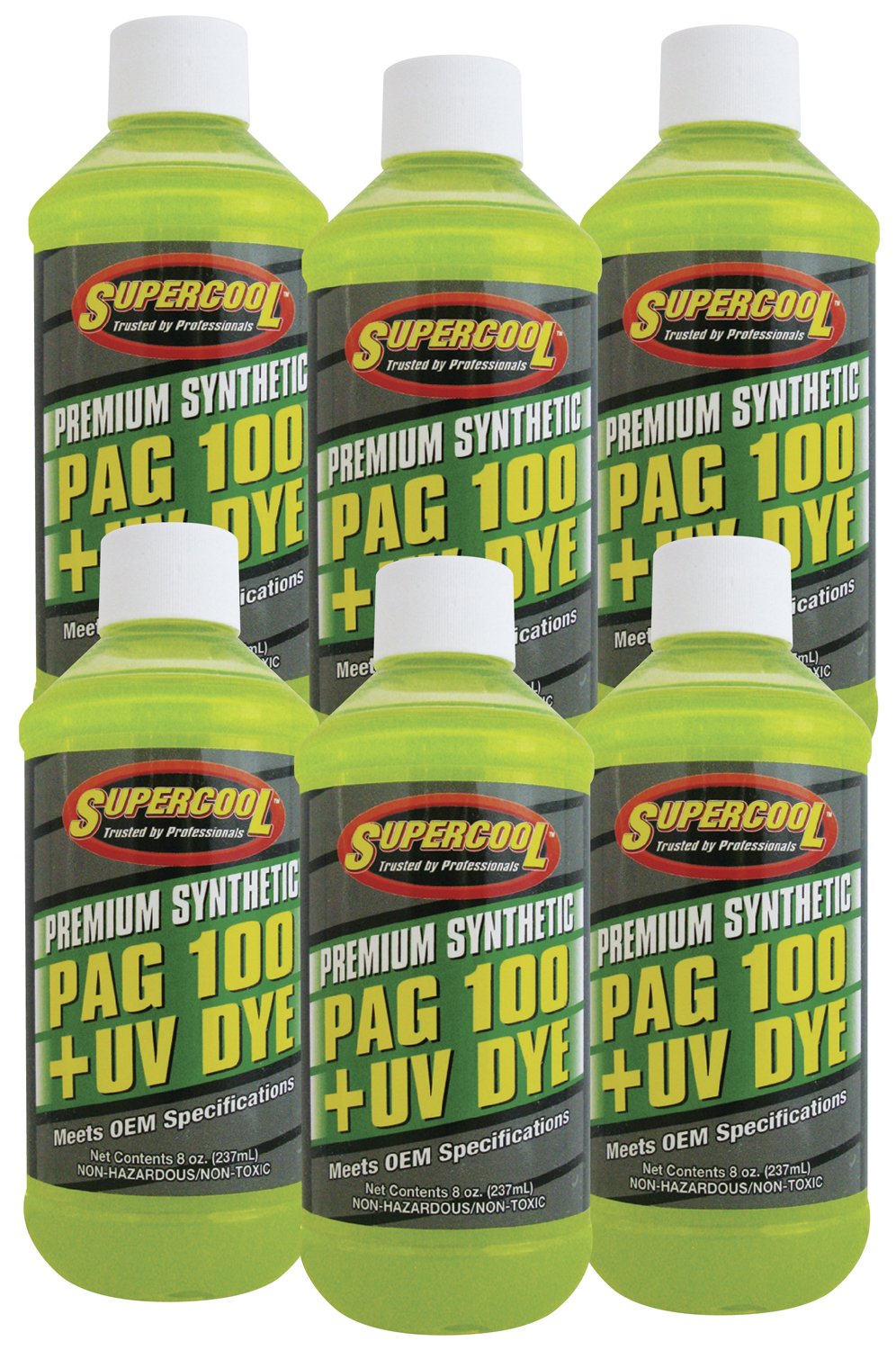
The TSI Supercool P100-8D-6CP is engineered for R134a AC systems that require a higher PAG 100 viscosity — typically found in larger compressors, extended line sets, or systems operating under higher thermal loads. The higher viscosity provides a thicker lubricating film that better handles elevated pressures and temperatures, reducing wear in demanding applications. Like its PAG 46 sibling, it contains anti-wear agents, friction modifiers, and antioxidants to protect against sludge and deposit formation.
The integrated UV dye is exceptionally bright, making leak detection straightforward even in dark engine bays or tight underhood spaces. Users report that the dye reveals leaks on condenser hoses, evaporator cores, and shaft seals within minutes of UV illumination. The six-pack of 8-ounce bottles gives you a convenient supply for multiple service jobs without committing to a single large container that may degrade after opening.
Some users note that the bottles lack graduated markings, making precise measurement a bit more challenging than with calibrated containers. However, the quality of the oil itself is consistently praised, with mechanics noting that it “works great” across a variety of vehicles. For anyone servicing an AC system that specifically calls for PAG 100, this is a reliable, leak-detection-equipped choice.
Why it’s great
- PAG 100 viscosity for high-load or high-temperature AC systems
- Very bright UV dye for quick and reliable leak detection
- Six-pack format is convenient for multiple service appointments
- Antioxidants prevent sludge and deposit accumulation
Good to know
- Bottles lack graduated markings for precise measurement
- Not applicable if your system requires PAG 46 or POE oil
6. Milton 1002 High Performance Conventional Air Compressor Oil

The Milton 1002 is a conventional (petroleum-based) ISO 100 compressor oil that delivers reliable performance at a fraction of the cost of synthetic alternatives. It’s formulated for fleet and plant maintenance — exactly the kind of high-volume, cost-conscious environment where a quality mineral oil meets the basic lubrication needs of reciprocating compressors. The full-gallon container provides exceptional value for those who maintain multiple compressors or perform frequent changes.
Users who have switched to this oil report that their compressors run slightly cooler than with other conventional oils, and those using it across multiple units appreciate the consistent quality. It’s a non-detergent formulation, so it won’t foam or trap moisture inside the pump. For light-duty home shop compressors or intermittent-use industrial equipment, this oil provides more than adequate protection without the premium of synthetic lubricants.
The main trade-off is service life — conventional oils break down faster under high heat than synthetics, so you will need to change it more frequently. Some users also note that it is petroleum-based rather than synthetic, which may matter if you operate in very cold or very hot environments. But for straightforward, budget-friendly lubrication of standard reciprocating pumps, this gallon jug is hard to beat on a per-ounce basis.
Why it’s great
- Excellent value for the price with a full gallon of oil
- Non-detergent formula prevents foaming in compressor pumps
- Proven reliability for fleet and plant maintenance applications
- Works well for home shop and light-duty reciprocating compressors
Good to know
- Conventional mineral oil requires more frequent changes than synthetics
- ISO 100 viscosity may be too thick in freezing conditions
7. Universal AC RO 0900B Refrigerant Oil

The Universal AC RO 0900B is a basic mineral-based refrigerant oil designed for simple automotive AC compressor top-offs and recharges. It is vehicle-specific fit, meaning the oil is formulated to match the requirements of particular makes and models — typically older vehicles that still use mineral oil in their AC systems. It’s an OE replacement oil branded by UAC, giving it a baseline of quality assurance for basic service needs.
Users have found this oil effective in Chevrolet Silverados and other GM trucks, reporting that it works well for simple maintenance tasks. Some note that its utility extends beyond AC use — the mineral oil base can serve as a general-purpose lubricant in other applications around the shop. The 8-ounce bottle is small, but adequate for a single compressor oil charge on most vehicles.
The main limitations are its narrow compatibility window. Mineral oil is not compatible with R134a systems that require PAG oil — mixing them can cause compressor failure. Similarly, it is not suitable for newer R1234yf systems. If you are servicing a vehicle that specifically calls for mineral refrigerant oil, this is a functional entry-level option, but for modern AC systems, you should choose a PAG or POE oil with the correct viscosity and UV dye integration.
Why it’s great
- Affordable option for basic AC compressor oil top-offs
- OE replacement quality from a known brand (UAC)
- Works well in GM trucks and other older vehicle AC systems
Good to know
- Mineral oil is incompatible with modern PAG/POE R134a systems
- No UV dye included for leak detection
- Small 8 oz bottle may not be enough for larger system flushes
FAQ
Can I use motor oil in my AC compressor?
What is the difference between PAG 46 and PAG 100 oil?
How often should I change my air compressor oil?
Can I mix synthetic and conventional compressor oil?
Final Thoughts: The Verdict
For most users, the best ac oil compressor winner is the TRIAX Kompressor ISO 46 because it delivers full synthetic protection across a -49°F to 140°F range with exceptional load-bearing capacity, making it suitable for everything from home workshop pumps to industrial rotary screws. If you need a top-tier OEM-recommended synthetic for your reciprocating compressor, the Ingersoll Rand 38436721 is the benchmark for extended service life and carbon control. And for servicing modern automotive AC systems with integrated leak detection, nothing beats the TSI Supercool P46-32D PAG 46 oil.