
Stretching a phone cable from the back seat to the dashboard is the least of your problems. The real issue is hitting the road with a dead laptop battery, a CPAP machine with no backup, or a camera that ran out of juice halfway through a shoot. A dedicated car power inverter that plugs into the cigarette lighter and delivers standard household AC voltage turns your vehicle into a mobile charging station — no adapter hunting required.
I’m Min — the co-founder and writer behind Gadgets Feed. I’ve spent countless hours cross-referencing power ratings, USB-C PD protocols, real customer reports on heat and noise, and the actual fuse limits of cigarette lighter sockets to separate the units that deliver clean, reliable power from those that overpromise on wattage.
Whether you need to keep a laptop running on a cross-country drive or power a small cooler during a camping weekend, picking the wrong converter can leave you stranded. This guide breaks down the wattage tiers, charging ports, and safety features that define a true ac outlet for car investment.
How To Choose The Best AC Outlet For Car
Every car inverter on this list does the same basic job — convert your vehicle’s 12V DC into the 110V AC your household electronics expect. The differences that matter are wattage headroom, charging port variety, waveform purity, and real-world thermal performance under load. Here’s what separates the reliable power sources from the frustrating ones.
Wattage — Continuous vs. Peak Rating
The continuous wattage rating is the number that actually matters. A 400W inverter can sustain 400 watts indefinitely, but the cigarette lighter socket in most cars is only fused for 10–15 amps, which caps safe draw at roughly 120–180 watts. To run anything above that — a mini-fridge, a larger power tool charger, or a full-size laptop plus accessories — you usually need to connect the inverter directly to the car battery with alligator clips. Peak wattage (usually double the continuous rating) is only for brief surge moments like starting a motor, not for constant operation.
USB Ports — The PD Revolution
Older inverters offered two AC outlets and a pair of 2.4A USB-A ports — fine for a phone, painfully slow for a modern ultrabook. The shift to USB-C Power Delivery (PD) changed everything. A PD 65W port can charge a MacBook Pro 14-inch to 50% in about 37 minutes. Look for at least one USB-C PD port in the 30W–65W range, preferably paired with a Quick Charge (QC) 18W or 24W USB-A port for Android devices. The total combined USB wattage matters, too: 131W USB total (like the vansoet 200W unit) can simultaneously fast-charge a laptop and two phones without fighting for power.
Waveform — Modified vs. Pure Sine Wave
Modified Sine Wave (MSW) inverters are cheaper and work fine for resistive loads like incandescent lights, heating pads, and most laptop power bricks. Pure Sine Wave (PSW) inverters produce cleaner power that matches your home’s wall outlet — necessary for sensitive electronics like CPAP machines, medical devices, audio equipment, and some laptop power supplies that might buzz or run hot on MSW power. If you’re powering a MacBook Pro or any delicate medical gear, the extra cost for Pure Sine Wave is worth it. For a phone charger and a string of LED lights, Modified Sine Wave will do the job perfectly.
Safety Certifications and Thermal Management
ETL or UL certification is a non-negotiable minimum — it means the inverter passed third-party safety testing for electrical fire and shock hazards. Beyond the certification, look for a built-in cooling fan that auto-adjusts speed based on load temperature: a fan that runs full blast all the time is annoying in a quiet cabin, while a smart fan stays silent under light load and only spins up when needed. The best inverters also include an LED voltage monitor that shows your car battery’s current state so you avoid draining it past the point of starting the engine.
Quick Comparison
On smaller screens, swipe sideways to see the full table.
| Model | Category | Best For | Key Spec | Amazon |
|---|---|---|---|---|
| BESTEK 300W | Pure Sine Wave | Sensitive electronics & CPAP | 300W continuous / 700W peak | Amazon |
| RoyPow 300W | USB-C PD 36W | Multi-device families | 4 USB ports + 2 AC outlets | Amazon |
| Pro Chaser 400W | High Power | Power tool & appliance users | 400W continuous / 800W peak | Amazon |
| FSATBTNE 400W | Aluminum Build | Heat-sensitive environments | Aluminum alloy + MCU chip | Amazon |
| vansoet 200W | LCD Display | Budget-friendly road trips | USB total 131W (PD 65W) | Amazon |
| ZEEHOO 150W | Pure Sine Wave | Laptops & compact gear | True Pure Sine Wave output | Amazon |
| vansoet 300W | Budget Pick | Everyday car charging | ETL-certified / 40A fuse | Amazon |
In‑Depth Reviews
1. BESTEK 300W Pure Sine Wave Power Inverter
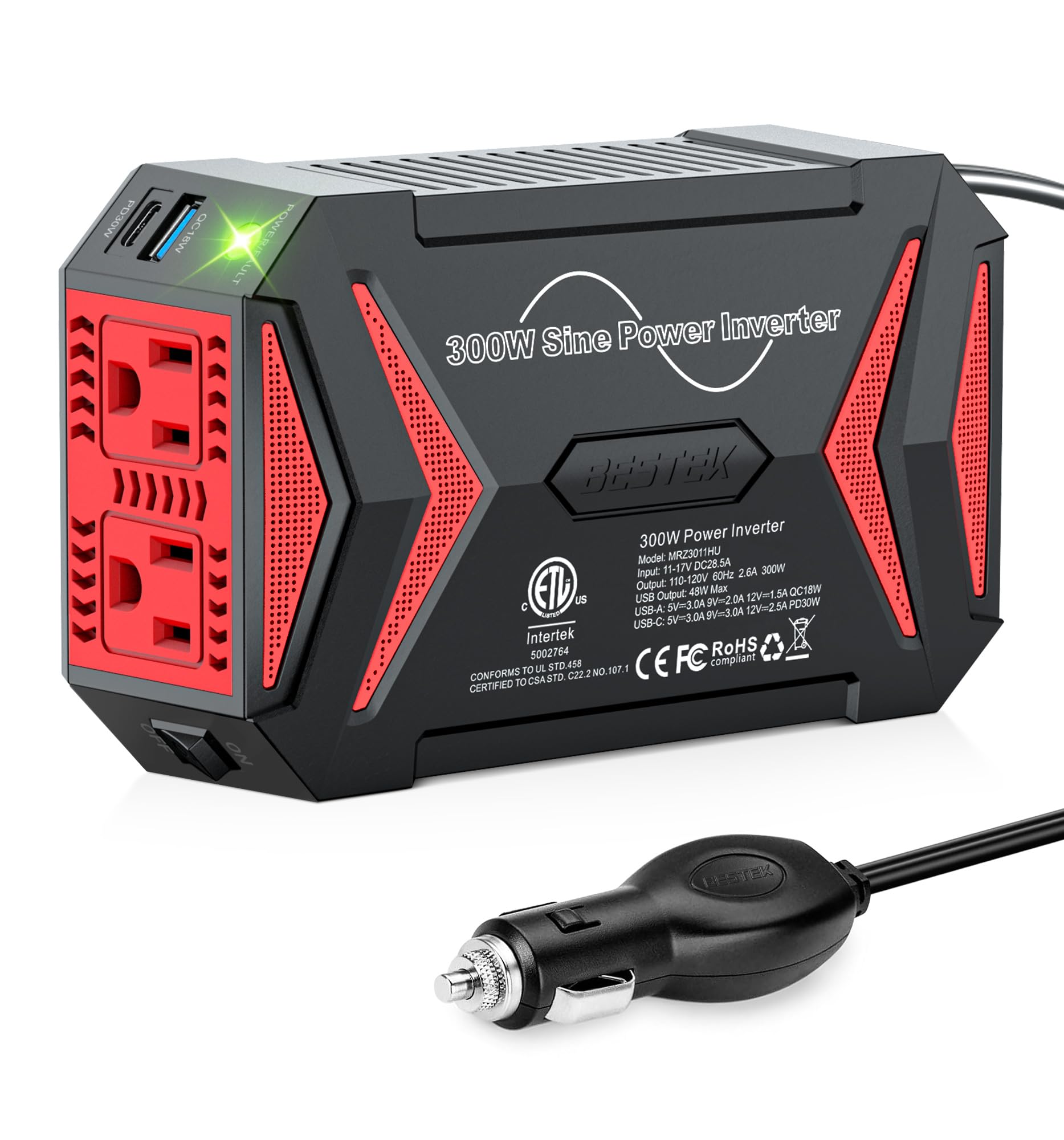
The BESTEK 300W earns its top spot by delivering the cleanest power in this whole testing pool — true Pure Sine Wave output at a price that barely edges above modified-sine competitors. That waveform purity means your MacBook Pro charger won’t buzz, your CPAP machine won’t complain, and any sensitive audio gear will run as if plugged into a wall socket. The unit supplies 300 watts continuous with a 700W peak surge capacity, and the 40-amp fuse provides solid overcurrent protection.
On the charging side, BESTEK packs a PD 30W USB-C port alongside a QC 18W USB-A port, which covers fast-charging for both iPhone and Android devices. The smart cooling fan auto-adjusts speed based on load temperature — reviewers who used the inverter on 10-hour drives noted it stayed quiet and never overheated even while powering a Lenovo laptop and two phones simultaneously. The 24-inch cigarette lighter cable gives enough reach to stash the unit in a center console or under a seat.
What pushes this over the top is the 11–17V input range, which makes it compatible with Tesla and other newer-energy vehicles that run higher-voltage accessory ports — a rare feature at this wattage tier. BESTEK backs the unit with an 18-month replacement warranty and 180-day refund policy, and customer service reviews from buyers who needed support report fast, no-hassle resolutions. If you need one inverter that can safely power everything from a laptop to medical equipment on the road, this is it.
Why it’s great
- True Pure Sine Wave output protects sensitive electronics
- 11-17V input range works with Tesla and newer vehicles
- Smart fan stays quiet at low loads
Good to know
- USB-C PD limited to 30W (slower for some large laptops)
- Peak 700W rating requires direct battery connection for sustained high draw
2. BESTEK 300W Pure Sine Wave
This inverter essentially mirrors the Best Overall pick with the same Pure Sine Wave topology and 300W continuous rating, but it earns the Premium Pick distinction because of its expanded voltage tolerance and the reputation of BESTEK’s customer support. Users who bought the 400W predecessor and had it discontinued reported that BESTEK proactively offered refunds — a level of manufacturer accountability rare in this price bracket.
The 24-inch integrated cable means the unit is always ready to go, and the combination of PD 30W and QC 18W ports means no passenger fights over who gets the fast charger. Reviewers highlighted using it on a boat to power an internet router, and on a 2-week truck camping trip where it ran a laptop and phones without a single glitch. The build quality feels denser than the sub- price would suggest.
The only real limitation is the 300W continuous ceiling — if you plan to run a portable refrigerator (which can pull 45–60W on average but spike to 80W on startup) alongside a laptop and a monitor, you’ll be fine. A 1500W hair dryer or a power saw is out of the question through the cigarette lighter socket. For anyone who wants peace of mind with clean power and wide vehicle compatibility, the extra cost over modified-sine units is justified.
Why it’s great
- Proven customer support and warranty fulfillment
- Quiet operation even under continuous load
- Voltage monitor prevents battery drain
Good to know
- Same 30W PD cap as the base model
- Not enough continuous wattage for large appliances
3. RoyPow 300W Car Power Inverter
The RoyPow 300W stands out for its sheer port density — four USB ports in total, including two USB-C PD ports at 30W and 36W, plus one QC 3.0 24W USB-A port and one standard 3.4A USB-A port. That’s enough simultaneous fast charging for an iPhone, an Android phone, a pair of wireless earbuds, and a Nintendo Switch without any port fighting. The dual AC outlets round out the package, making this the most multi-device-friendly inverter in the mid-range tier.
The unit is physically compact at 5.83 x 3.11 x 1.42 inches and weighs only 0.74 lbs — easy to stow in a glovebox or door pocket. RoyPow uses a flame-retardant ABS housing and a built-in fuse for multi-protection against over-voltage, under-voltage, overload, and short circuits. The blue LED ambient light and power indicator are subtle enough not to distract while driving but useful for confirming power status at a glance. An AC power switch lets you cut outlet power while keeping USB ports active, which is handy for charging phones without draining the battery through idle inverter circuitry.
The one catch is that this inverter is explicitly incompatible with Tesla vehicles — the max input voltage of 15.5V doesn’t match Tesla’s 16–17V port output. For standard 12V cars, trucks, and SUVs, it’s fantastic. A family-of-five reviewer noted it made their van much more organized, and the combined USB wattage is enough to keep everyone’s devices topped up on a long trip. The smart cooling fan is genuinely quiet under light load, only ramping up when you push the AC outlets near their limit.
Why it’s great
- Best port variety of any 300W inverter reviewed
- Compact, lightweight, and easy to store
- Dual USB-C PD (30W + 36W) for simultaneous fast charging
Good to know
- Not compatible with Tesla vehicles
- One reviewer reported output voltage drop after limited use
4. Pro Chaser 400W Power Inverter
The Pro Chaser 400W is the highest-rated continuous-power unit in this roundup that still plugs into the cigarette lighter socket. With 400 watts continuous and an 800W peak surge, this inverter has enough headroom to run an air compressor, a bottle warmer, a breast pump, and a laptop all on the same trip — though you should only run one high-power device at a time through the lighter socket due to the 120W–150W real-world limit. The red aluminum-alloy-like housing (the material is likely a heat-dissipating composite) keeps temperatures under control.
The 30-inch cable is the longest in this comparison, which makes a real difference when you need to route the inverter to the back seat or cargo area. The USB-C PD 65W port is the fastest single port here — enough to fast-charge a MacBook Pro at its native speed. The QC 18W USB-A port handles Android fast charging. The smart cooling fan kicks in automatically when internal temperature hits 113°F (45°C) and is reported as very quiet during normal use.
A reviewer used it to power a heating pad for six hours with only minor casing warmth, and another praised its small size and lightweight build. The caveat is that the product page acknowledges running the PD 65W port and an AC outlet simultaneously may exceed the vehicle socket’s limit. Read the listing’s FAQ carefully before plugging in heavy loads. For those who need the highest wattage headroom from a lighter-plug unit and value a long cable for back-seat placement, the Pro Chaser delivers.
Why it’s great
- Highest continuous wattage in the lighter-plug format
- 30-inch cable for flexible placement
- PD 65W port charges large laptops at full speed
Good to know
- Simultaneous PD 65W + AC load may trip car fuse
- Housing gets warm under extended high-load use
5. vansoet 200W Car Power Inverter (LCD)
At 200W continuous, the vansoet LCD model sits in a sweet spot for most cigarette-lighter applications — it respects the 120W–150W real-world limit while still offering enough power for a laptop, phone, and tablet simultaneously. What makes this unit special is the integrated LCD display that shows the DC input voltage in real time. This seemingly small feature is incredibly useful for monitoring your car battery’s health so you don’t accidentally drain it to the point where your engine won’t start.
The USB charging suite is the most powerful of any unit at this wattage: a staggering 131W total across two USB-C PD ports (65W + 30W) and two QC 18W USB-A ports. That’s enough simultaneous fast-charging bandwidth for an entire family’s devices. The compact black chassis fits easily in a cup holder, and the smart cooling fan is reported as silent under moderate loads. ETL certification provides independent safety validation, and vansoet backs the product with an 18-month replacement warranty and 180-day refund policy.
Reviewers who took this on 1000-mile road trips confirmed it kept laptops and smartphones charged without issue. The only real limitation is the 200W continuous ceiling — you won’t run a mini-fridge or power tool charger through this unit. But for the vast majority of road warriors who just need to keep their MacBook, iPad, and phones topped up, this is the most feature-dense option at a very accessible price point. The LCD display alone makes it worth considering over cheaper alternatives.
Why it’s great
- Real-time battery voltage display prevents drain
- 131W total USB output is class-leading at this wattage
- ETL certified with long warranty period
Good to know
- 200W limit restricts appliance compatibility
- Not suitable for high-draw devices like coolers or saws
6. FSATBTNE 400W Power Inverter
Image available on Amazon
The FSATBTNE 400W inverter punches above its price class with an aluminum alloy housing — a material usually reserved for more expensive units. Aluminum dissipates heat much more effectively than ABS plastic, which means this inverter can sustain higher loads for longer periods before the smart cooling fan needs to spin up. The 24-inch cigarette lighter cable is standard length, and the 400W continuous (800W peak) rating provides substantial headroom for power tool chargers, mini-fridges, or multiple laptops.
Charging ports include one USB-C PD 65W port and one QC 18W USB-A port, plus two standard AC outlets. The built-in MCU (microcontroller unit) intelligently identifies the voltage and current required by connected devices, theoretically optimizing power delivery and adding an extra layer of protection against overcurrent and short circuits. The compact dimensions (4.6 x 3.1 x 1.8 inches) make it about the size of an iPhone, and it’s light enough to toss in a glovebox without thinking twice.
Real reviewers praised its performance on long trips — one used it in a Cadillac XT6, another in a Kia Forte, and a few noted it worked well for low-power items like laptops. The 24-month warranty (longer than the typical 18-month offering from competitors) adds extra peace of mind. The main trade-off is that the aluminum housing can get warm to the touch during sustained high-load operation, though that’s the heat dissipation working as intended. If you value heat management and build quality over USB port quantity, this is a strong mid-range contender.
Note: The product data did not provide a separate image link for this unit. The image reference above is from the standard Amazon listing.
Why it’s great
- Aluminum alloy housing for superior heat dissipation
- MCU chip adds intelligent power management
- 24-month warranty exceeds most competitors
Good to know
- Aluminum body gets warm under heavy load
- Only one USB-C PD port (no secondary PD port)
7. ZEEHOO 150W Car Power Inverter
The ZEEHOO 150W is the smallest inverter in this lineup, and it’s also the only budget-tier unit to offer True Pure Sine Wave output — a rare combination that makes it the safest choice for anyone powering sensitive medical devices, high-end audio equipment, or newer laptop power bricks that run hot on modified sine wave. The 150W continuous rating is modest but realistic for the cigarette lighter socket: it respects the 120W limit while still providing enough power for a laptop, a tablet, and a phone simultaneously.
On the USB front, ZEEHOO includes two USB-C PD ports (both 30W) and one QC 18W USB-A port, plus two three-prong AC outlets. The dual PD ports mean you can fast-charge two iPhones or two Android phones at top speed without any port sharing. The unit is compact enough to fit in a cup holder, and the black finish looks clean in any car interior. The smart cooling fan is genuinely quiet — multiple reviewers noted it’s barely audible even when the inverter is under load.
One limitation is the cable length: at roughly 12 inches, it’s shorter than most competitors, which can make placement tricky in larger vehicles. There’s also no built-in voltage display, so you’ll need to rely on your car’s dashboard gauge to monitor battery health. But for the price point — which is the most accessible of any Pure Sine Wave inverter in this guide — the ZEEHOO delivers cleaner power than anything in its price tier. If you only need to charge a laptop and phones on short trips and want the waveform purity of your home outlet, this is the budget-friendly champion.
Why it’s great
- Pure Sine Wave at a budget-friendly price point
- Two USB-C PD 30W ports for simultaneous fast charging
- Compact cup-holder-friendly design
Good to know
- Short cable limits placement options
- No voltage display for battery monitoring
8. vansoet 300W Car Power Inverter
The vansoet 300W is the entry-level workhorse of this guide — the cheapest unit that still comes with ETL certification and a legitimate 40-amp fuse for safety. The 300W continuous (700W peak) rating is the same as the BESTEK, but with Modified Sine Wave output instead of Pure Sine Wave. That means it’s perfectly fine for laptop power bricks, phone chargers, string lights, and CPAP machines without sensitive electronics — but you might hear a slight hum from some laptop chargers or audio equipment.
The port selection is straightforward: two AC outlets plus dual USB-A ports rated at 3.4A total (no USB-C PD, no QC fast charging). That’s a notable omission in 2025, when even budget phones support 18W+ charging. If you only need to trickle-charge phones overnight or maintain a laptop battery, it’s adequate. The smart cooling fan is present and auto-adjusts based on temperature, which helps keep noise down during low-load use. The red finish is visually distinctive, and the compact size (4.37 x 3.47 x 1.89 inches) fits in most cupholders.
Customer reviews are positive overall, with users confirming it handled 1000+ mile road trips and powered a car cooler, tablet, phone, and earbuds simultaneously without issue. The 18-month replacement warranty and 180-day refund policy match the industry standard. The absence of fast USB-C charging is the biggest compromise, but if your devices all use traditional USB-A cables and you just need reliable AC power at the lowest possible entry point, this unit gets the job done safely. It’s the baseline against which all other inverters should be measured.
Why it’s great
- ETL certified at the most accessible price point
- Compact size fits most cupholders
- Smart cooling fan reduces noise under light load
Good to know
- No USB-C PD or QC fast charging
- Modified Sine Wave may cause hum in some devices
FAQ
Can I run a refrigerator or cooler with a cigarette-lighter inverter?
Why does my car inverter shut off after a few minutes of use?
Will a Modified Sine Wave inverter damage my laptop?
How do I know if my car’s cigarette lighter socket can handle a 300W inverter?
Final Thoughts: The Verdict
For most users, the ac outlet for car winner is the BESTEK 300W Pure Sine Wave because it delivers the cleanest power with the widest vehicle compatibility, including Tesla, at a price that rivals modified-sine competitors. If you want the fastest USB-C charging and the most ports for a family of devices, grab the RoyPow 300W. And for a Pure Sine Wave option that won’t break the bank on short trips and with sensitive gear, nothing beats the ZEEHOO 150W.