
Our readers keep the lights on and my morning glass full of iced black tea. As an Amazon Associate, I earn from qualifying purchases.
Specs are compiled from manufacturer listings and verified buyer reviews and can change over time — please confirm the key details on the product page before buying.
You want a battery that ends the wall-socket argument — one box that puts a real 110V plug in your hand, not another USB brick dressed up as one. The catch is that these are not all the same animal: some run 300 watts, some cap out at 100, and a few quietly die after two charges. This guide cuts straight to the eight AC-outlet power banks worth your money, tells you in plain English who each one actually suits, and flags the limits before you buy — so you pick the right box on the first try.
I’m Min — the founder and writer behind Gadgets Feed. This guide is built by comparing the manufacturers’ published specifications and the patterns across verified customer reviews, so you get each pick’s real strengths and trade-offs instead of marketing spin.
Run a CPAP overnight, keep a laptop alive at a campsite, or just beat the next blackout — the right setup depends on watts, watt-hours, and weight together. If you want the box that rewards most buyers across all three, the DaranEner NEOZ is the safest pick for most homes and trips, a compact ac outlet power bank that most owners count on daily.
Our Picks at a Glance


How To Choose The Best AC Outlet Power Bank
A power bank with a built-in AC outlet is a different device from the one in your phone bag. It holds a battery big enough to run real appliances through a standard 110V socket — that is the whole point, and it is also where most buyers get the sizing wrong. Get four things right and you will pick well.
Start with what you actually plug in
Write down the two or three things you want to run away from a wall. A laptop, a phone, and a fan are cheap in power terms. A CPAP, a mini-fridge, a projector, or a modem-and-router stack draws more. Every unit here lists a continuous watt rating — match your single biggest device to that number, not the total. A CPAP without a humidifier is a light load; a mini-projector is not.
Then size the battery, not the phone number
Watt-hours (Wh) is the real fuel gauge; milliamps (mAh) alone hides voltage, so two “24000mAh” units can store different amounts of energy. Higher Wh means longer run time before a recharge. For overnight CPAP use or a weekend of phone top-ups, choose the higher Wh figure in the table — it is the number that actually buys you hours.
Check the plug format and the carry weight
Look for a real 3-prong or 2-prong AC outlet and a surge rating (the brief extra wattage a motor or heating element pulls at startup). That surge headroom is what stops a device from tripping the box the second you switch it on. Then check the weight and footprint, because a heavy box stays on a shelf while a light one actually travels with you. Ultralight units are the ones you stuff in a backpack; the heavier ones live in a car or by the bed.
Battery chemistry and recharge speed
LiFePO4 is the chemistry to prefer for long-term reliability — it holds up over far more charge and discharge cycles than standard lithium-ion. Lithium-ion tends to be lighter for the same Wh. On recharge time, a unit that refills in around an hour or two is far more usable than one that takes all night, especially if you are topping up between trips.
Quick Comparison
These three specs — outlet watts, stored energy (Wh), and carry weight — are the fastest way to sort the field. Scan the row that matches your biggest device and your carrying habits.
| Model | Best For | AC Output | Capacity (Wh) | Weight | Amazon |
|---|---|---|---|---|---|
| DaranEner NEOZ 192Wh★ Best Overall | All-round home and camping | 300W (600W surge) | 192Wh | 5.7 lb | Amazon |
| SinKeu 24000mAh 88WhBest Value | Budget travel backup | 110V / 65W | 88.8Wh | 1.4 lb | Amazon |
| GENSROCK 120WCamping Choice | Camping with small gear | 120W (220W peak) | 88Wh | 2.3 lb | Amazon |
| SinKeu E150 122.8Wh | CPAP and emergency standby | 150W | 122.8Wh | 4 lb | Amazon |
| EnginStar R150 155Wh | Outage standby and camping | 110V / 150W | 155Wh | 4 lb | Amazon |
| Daran R-100 89.6Wh | Laptops and remote work | 100W | 89.6Wh | 2.5 lb | Amazon |
| Paopaoyu P5 27000mAh | Airline travel with CPAP | 100W | 98Wh | — | Amazon |
| MARBERO M82SGE | Compact camping and power cuts | 80W (120W peak) | 88Wh | 2.3 lb | Amazon |
In‑Depth Reviews
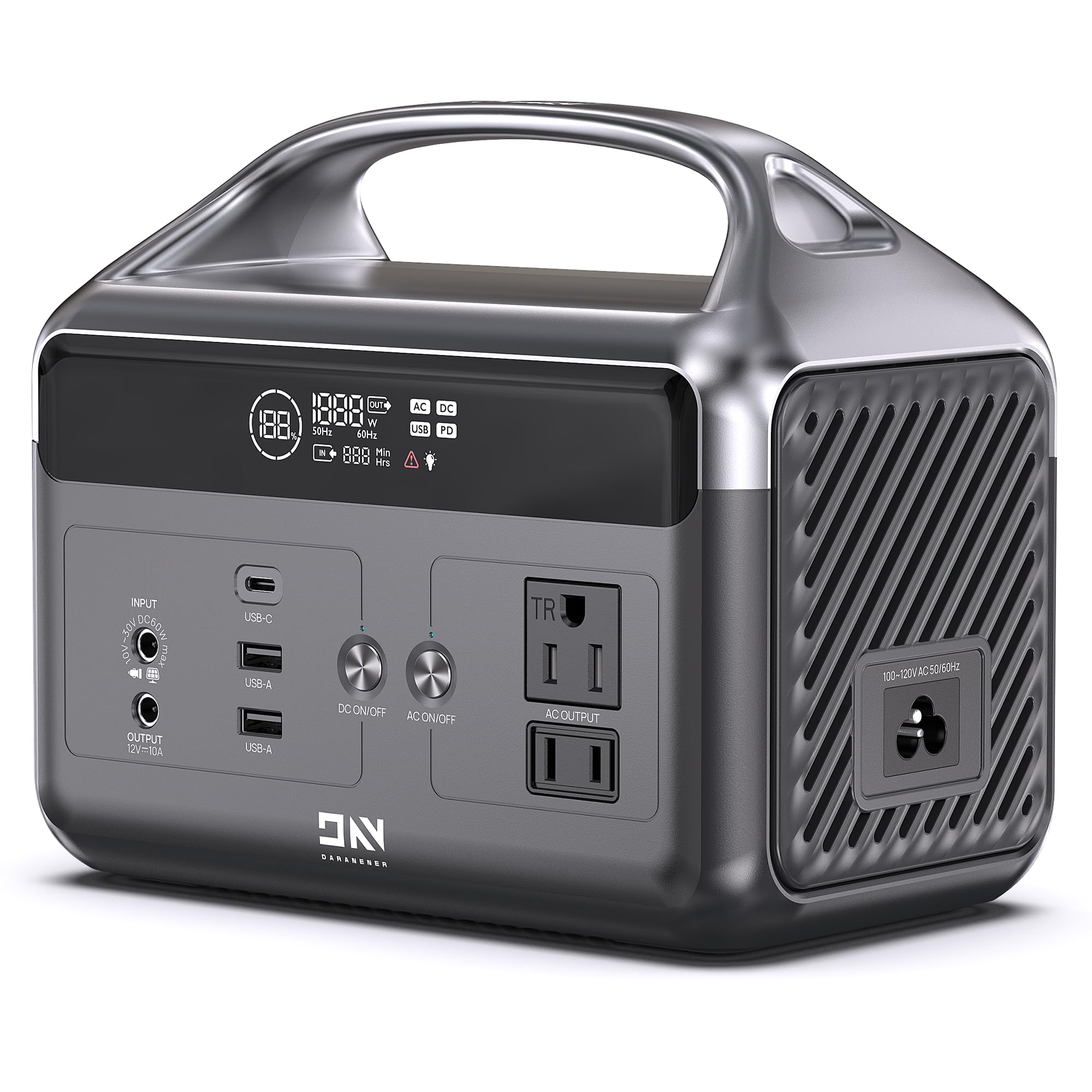
1. DaranEner Portable Power Station, 192Wh LiFePO4 Battery Backup
Our pick — over 4★ from 400+ verified ratings; the strongest balance of quality and price.
The one box that runs a fan all evening and still shows a charge at bedtime.
If you want a portable power bank with a real AC outlet that can genuinely run appliances, this is where the list starts. Its 300W continuous output — with a 600W surge for the brief startup spike a motor pulls — is the highest here. That means it can feed a CPAP through the AC socket, top up an e-bike, or keep a modem, monitor and lamp alive at once. Buyers report two phones plus a small AC fan ran about seven hours with the display still above 70 percent.
What wins people over is performance, by a clear margin. Buyers keep coming back to how quietly and reliably it does its job, from camping trips to blackout nights. The 192Wh LiFePO4 battery holds up across 3500-plus charge cycles, and it recharges from an AC wall outlet at up to 100W, from a car charger, or from a solar panel up to 60W DC input. It also charges six devices at once across two AC outlets, USB-C PD 60W, two USB-A 18W ports, and a 12V DC output.
Here is the honest catch: the battery-life and value scores come in mixed, so treat the run time as “enough for essentials,” not “runs the whole house.” A 75W fan can pull the tank down in about two hours, and output wattage softens as the battery depletes. It is also the heaviest pick here at 5.7 lb — almost exactly four times the 1.4 lb SinKeu travel bank — but for the wattage and capacity you get, that weight is the trade you make. The crowd favorite and Best Overall — 4.4 stars across 400+ ratings.
What earns its keep
- Highest AC output here at 300W continuous, so laptops, CPAP units and fans all run off a real 110V socket.
- Pure sine wave current protects sensitive electronics from interference.
- LiFePO4 cells rated for 3500-plus cycles, plus an integrated four-mode LED light with SOS.
What to plan around
- At 5.7 lb it is the heaviest pick on this list — fine in a car, less so in a daypack.
- Not built for high-power appliances such as rice cookers, hair dryers or mini-fridges that exceed 300W.
Reach for this if: you want one box that covers camping, travel and home emergencies without juggling wattage worries.
Look elsewhere if: you need the lightest possible pack for carry-on travel — the 1.4 lb SinKeu below is built for exactly that.
2. SinKeu 24000mAh Portable Charger Power Bank, 88Wh with AC Outlet
Featherweight travel power with a 110V socket you barely notice you packed.
This is the lightest pick on the whole list by a wide stretch. At 1.4 lb — versus 5.7 lb for the DaranEner above — it slips into a bag and disappears, which is why portability is exactly what owners single out. The tank measures 24000mAh, or 88.8Wh, and a 110V/65W AC outlet lets it feed laptops and small essentials that a plain USB pack never could. That combination is why it earns value honors: a real AC socket for occasional bigger jobs without the weight penalty.
The ports are built for juggling: one USB-A and USB-C at 5V/3A and 9V/2A, a DC output rated 9V to 12.6V at 10A max, plus the AC socket. An LED digital display tracks remaining power so you are not guessing mid-trip. It is UL, CE, FCC and RoHS certified, with a multi-protect system guarding against the usual over-charge and short-circuit risks. Owners also run a breast pump through an outage on the AC side, and charge a Samsung about four and a half times on USB at roughly 11 percent a charge.
The recurring gripe is battery life, and it is worth taking at face value: the AC outlet drains the tank fast, so it is best treated as an emergency socket rather than your daily workhorse for heavy plugs. One buyer’s experience, offered plainly — “Was hoping for a better battery life it goes from 99 to 67 very quickly charging one item.” The AC adapter can also feel loose in the socket, so give it a nudge when you plug in. For the money and the weight, though, it is a fair travel companion.
Why it earns the value spot: a genuine 110V AC outlet inside a 1.4 lb shell is a rare combination, and the multi-port layout keeps phones, tablets and laptops topped up on the road.
The fit note to respect: the AC socket is for occasional use — plan your heavy draw around a bigger tank.
Your pick when: low carry weight and a real AC socket matter more than long run time.
Skip the AC here if: you plan to run a projector or anything power-hungry off the plug regularly.
3. GENSROCK Portable Power Station 120W, Power Bank with AC Outlet 24000mAh
A rugged little carry-handle box built for campsite gear and drone batteries.
Campers and drone flyers get the most out of this one. The 88Wh capacity (24000mAh at 3.7V) and 120W running output, with 220W peak for the startup surge, feed everything from phones and iPads to cameras, radios and mini fans under 120W. Eight output ports — including two Quick Charge 3.0 USB ports and one USB-C at 18W — mean several devices can charge while the AC side handles something bigger. Available capacity converts to a useful proxy too: the built-in 5W LED light runs around 15 hours, and a smartphone recharges six times or more.
The physical package is what makes it a campsite favorite. At 2.3 lb inside a 6.6 x 4 x 3 inch shell with a sturdy carry handle, it is easy to lug from car to tent. Owners mention powering a projector for hours, charging three drone batteries from 25 percent without draining the tank, and running a CPAP through the AC socket. A 24-month guarantee rounds out the value. Power is the aspect owners appreciate most by a clear margin, and it delivers.
What to know before you commit: the tank is modest, and the capacity mark is mixed — one buyer’s unit sat dead after being stored and would not take a charge for over 24 hours. If you will run it often and hard, expect to recharge between sessions, and it is not built to feed high-energy appliances. Treat it as a dependable camp and small-gear box rather than a whole-evening appliance runner.
It’s the right call for: campers, drone pilots and anyone who wants a tough little box with a handle for small gear.
Hold out if: your plans involve appliances that pull more than 120W.
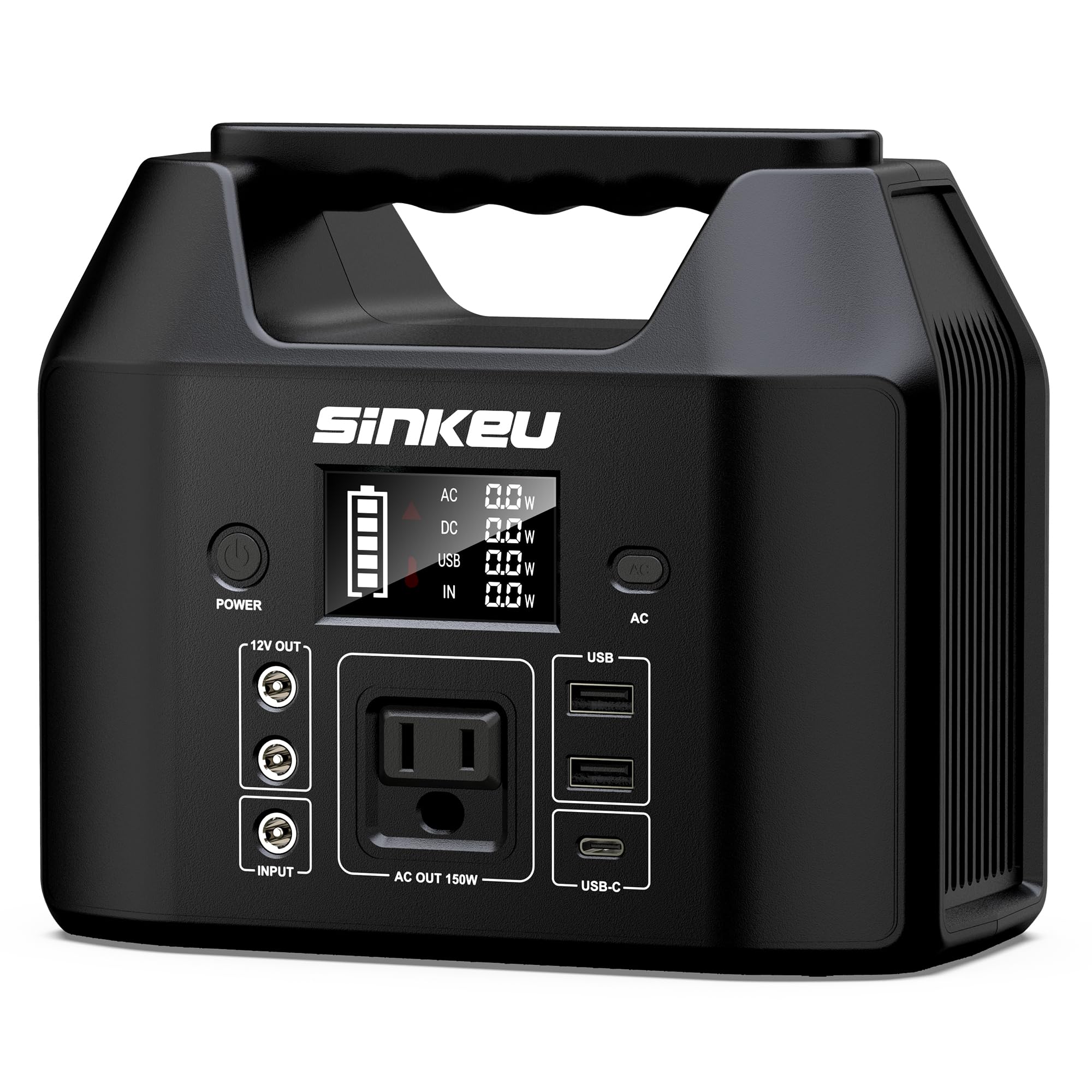
4. SinKeu Portable Power Station 122.8Wh, 150W with AC Outlet
The overnight box that keeps a CPAP breathing and still fits under a van seat.
For anyone who sleeps on a CPAP away from a wall socket, this is the quietly reassuring pick. A 122.8Wh LiFePO4 battery (38400mAh at 3.2V) feeds a 150W continuous AC output, enough for a laptop, tablet, phone, drone or a mini-fridge under 100W. It carries 3500-plus life cycles and pass-through charging, so it can top itself up while powering a device — a genuinely handy feature when you are parked somewhere with a single outlet. Reliability is the trait buyers appreciate most, and it holds up.
The footprint is a big part of why it travels well. At 4 lb in a 7.5 x 4.5 x 6.5 inch frame, it drops under a van seat and rides easily in a tote or backpack. Customers note the AC side running a CPAP a full night without the humidifier and heat, with charge to spare. There is a three-mode LED light on board — steady, strobe and SOS — plus a digital display showing live power status, and multi-protection against overloading, overcharging, overheating and short circuits.
The honest fit note: while most buyers find it holds a full night, the charging-life aspect is mixed, with some units reported not to hold a charge well over time. If your routine leans on heavy draw every single night, upsize. Also worth knowing: the AC socket needs a moment to engage — press AC, wait a beat for the internal fan to spin, then double-tap the AC button to wake the output.
Where it shines: a full night of CPAP on one charge from a box you can stash under a seat — plus airline-friendly form and a clear status display.
What to weigh: the charging-life reports vary, so nightly heavy users should consider a larger tank.
Made for: CPAP users, van-lifers and road-trippers who need reliable overnight power in a packable frame.
Not your box if: you need to run larger appliances all night long.
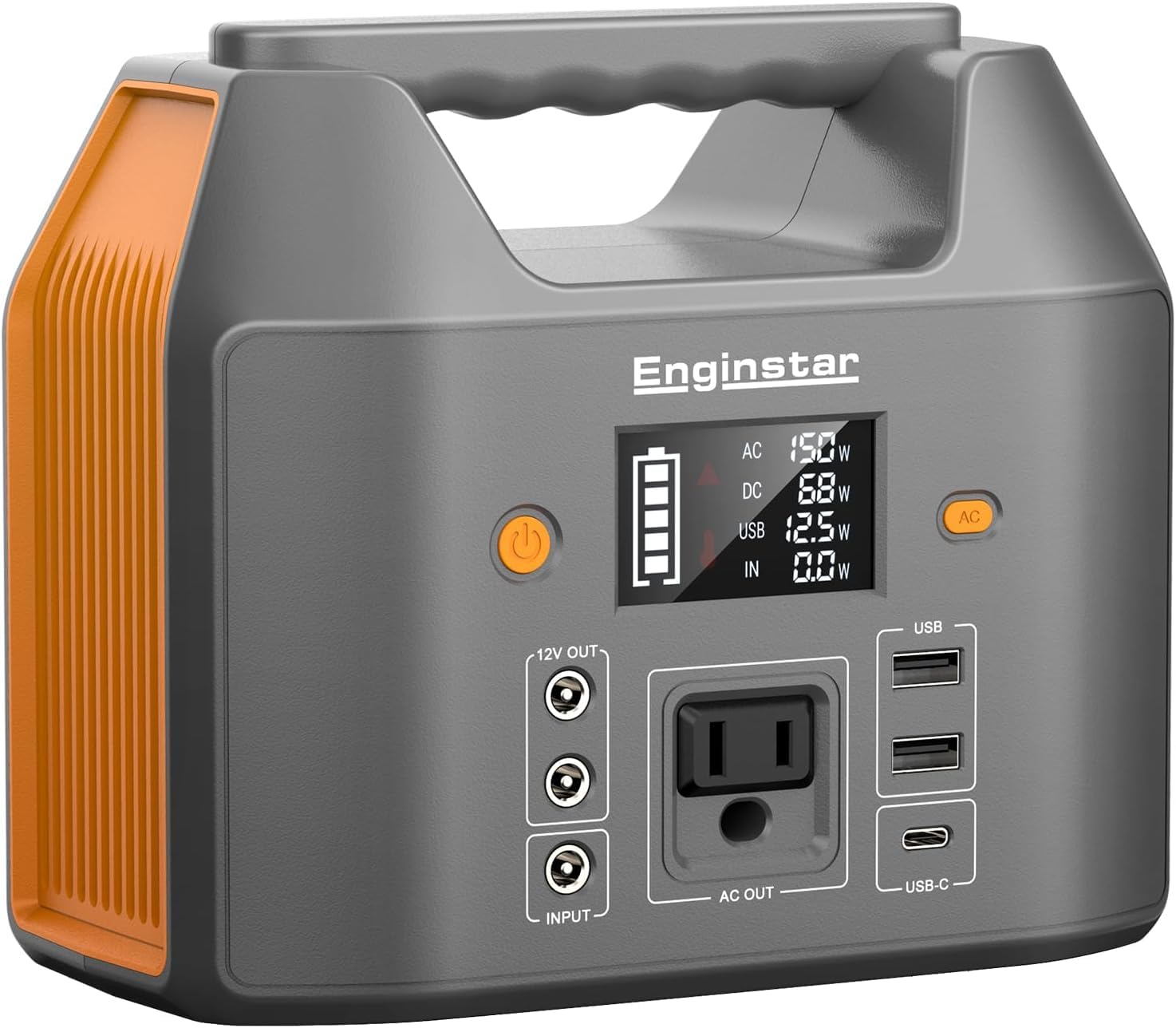
5. EnginStar Power Bank with AC Outlet 150W, 155Wh/42000mAh
The blackout box that quietly holds its charge for days until you need it.
This is built for the household that loses power a few times a year and wants a dependable box waiting on the shelf. A 155Wh lithium-ion pack — 42000mAh — feeds six devices at once through one 110V/150W AC outlet, two DC sockets at 9V to 12.6V and 10A max, two USB ports at 5V/3.1A, and one USB-C at 5V/3A and 9V/2A. In real terms, that is over 10 smartphone charges, up to 2.5 laptop charges, or a 5W LED lamp running for 25-plus hours. Power quality is the thing buyers praise most here, and it shows in steady, clean output.
Three ways to refill keep it practical anywhere: a wall outlet at home, a 12V car socket on the road, and any compatible 12V to 25V solar panel out in the field. A smart battery management system guards overloading, overcharging, over-discharging, overheating and short circuits across 1000 charge and discharge cycles. Owners use it for phones, tablets, and inflating an air mattress on camping trips, and many note it holds its charge between blackouts.
What to plan around: the charging-capacity mark is mixed, so expect a slower top-up than the punchier AC boxes above — one buyer notes it can take a while to refill, so charge it at home before you head out. Heavy plugs can also drain it faster than the capacity figure suggests. Keep your biggest load modest and it does its job reliably.
A solid match for: homes that want a set-and-forget standby box plus a camping companion in one.
Think twice if: you need to run power-hungry appliances for long stretches — the AC output caps at 150W.
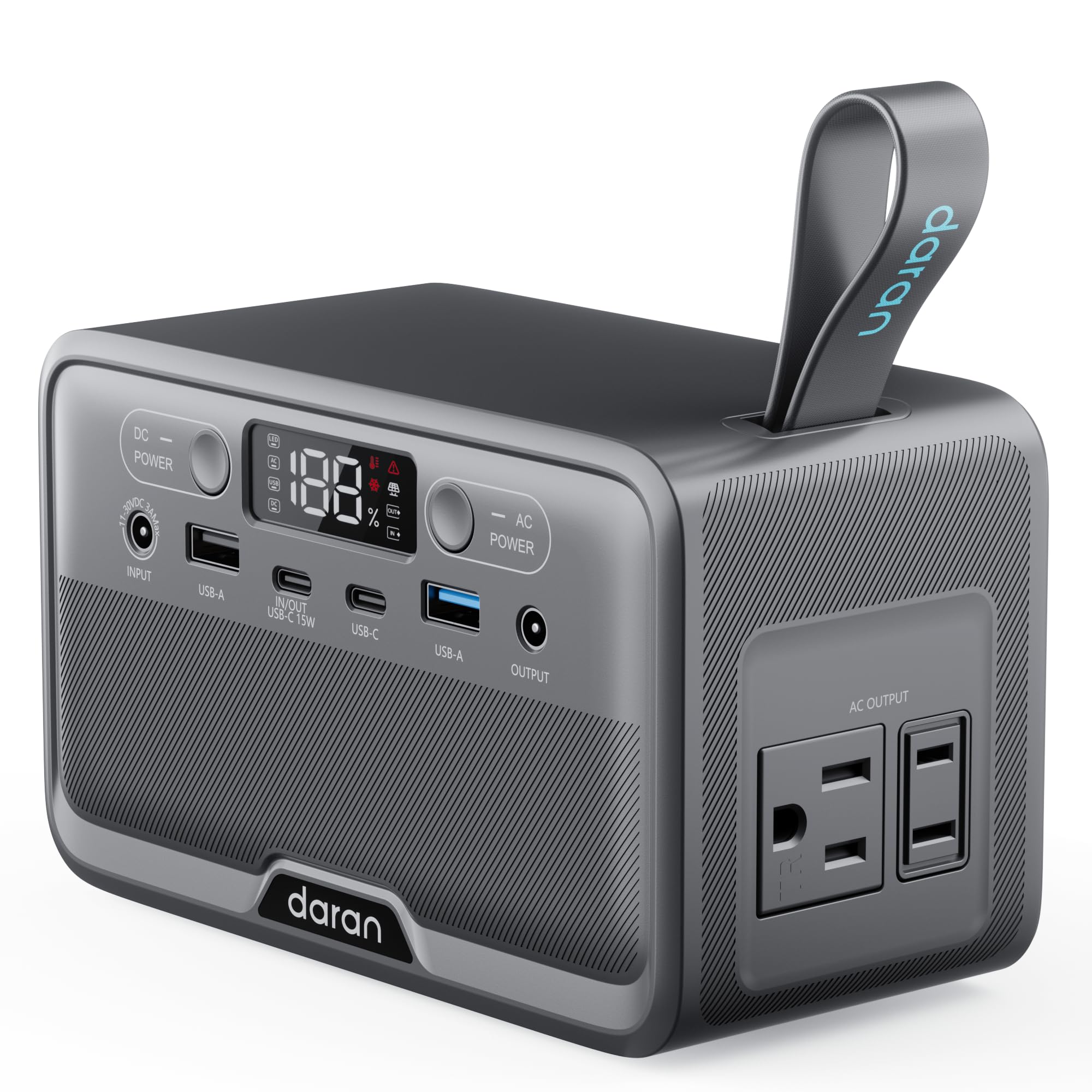
6. Daran Portable Power Station 89.6Wh LiFePO4, 100W Solar Power Bank
Phone-sized, silent, and refilled before your coffee goes cold.
Remote workers and students should start here. The Daran R-100 is about the size of a smartphone — 6.5 x 3.3 x 4 inches — and weighs 2.54 lb, with a soft carry handle, so it slides into a backpack or glovebox. A 89.6Wh LiFePO4 battery drives a 100W output across seven ports: two AC sockets, two USB-C (45W and 15W), two USB-A (18W and 15W), and DC5521 ports rated up to 60W. That means a laptop, phone, camera and mini-fridge can all ride along without a wall in sight.
What buyers trust most is reliability, and the value score backs it up. It has a rare trick for its size: it can charge itself while powering a device at the same time — a pass-through function owners use as a mini UPS. Fast charging refills it from 0 to 80 percent in about 1.5 hours, and its fanless design keeps it silent for sleep, study or campsite quiet. The four-level LED light with a steady and SOS mode handles the dark, and a long-press activation guards against accidental switching. LiFePO4 cells here are rated for 3500-plus cycles.
The main thing to size against is the 100W ceiling — do not expect it to run big appliances. Charging speed is a mixed mark, and one buyer found the fan a little loud when refilling on AC. Others note it ran a 12-volt fridge or a ham radio for around 12 hours.
Where it wins
- Fits like a phone in a pack at 2.54 lb, with seven ports including two AC sockets.
- Refills to 80% in around 1.5 hours and can charge itself while powering a device.
- Fanless, silent operation and LiFePO4 cells rated for 3500-plus cycles.
Keep in mind
- Only suitable for devices drawing within 100W.
- The fan can be noticeable when charging on AC, which can bother light sleepers using it as a UPS.
Your best bet when: you want laptop-grade power that packs like a phone and stays quiet.
Not enough if: you need to push past the 100W ceiling or run bigger draw for hours.
7. Paopaoyu Portable Power Bank with AC Outlet, 98Wh/27000mAh

Sized under the airline limit, built to carry a CPAP through a long-haul night.
Frequent flyers get the cleanest fit here. The 98Wh capacity sits under the 100Wh limit airlines commonly cap portable batteries at, so it rides in the cabin, and the 27000mAh pack drives a 100W AC outlet plus four outputs total — a 65W PD Type-C port, a 12W USB port and an 18W USB port. That 65W Type-C port works both ways: it fast-charges your laptop on the way out and refills the bank itself in about 1.5 hours. Owners have run a CPAP with the humidifier on high for four to five hours, and one buyer’s Alaska trip powered a CPAP a full eight hours across multiple nights.
Power capacity is the trait buyers value most, and it shows in the spread across 5VDC to 110VAC. A three-protection suite — over-charging, over-voltage, over-current and short-circuit, with FCC, CE and RoHS certifications — keeps it safe when the AC socket hits its limit and drops into protection mode automatically. The package includes a handy carry case, so it packs like a travel accessory rather than a gadget brick.
The trade-offs are worth knowing up front. Reliability and battery life come in as mixed marks overall, so heavy daily use is not its design brief — this is a travel and occasional-emergency box. Some owners wish a dedicated AC adapter came in the box, since the wall refill relies on USB-C charging.
Why travel buyers reach for it: an airline-friendly 98Wh shell with a CPAP-worthy AC outlet and a 65W PD port that refills both your laptop and the bank itself.
Where it fits, honestly: a travel and standby specialist, not a run-it-all-day power source.
It wins for: flyers and CPAP users who want a security-friendly box with fast laptop charging.
Not your fit if: you need long, continuous heavy draw far above the 100W AC ceiling.
8. MARBERO Portable Power Bank with AC Outlet, Peak 120W/110V

A true pocket-sized power bank that still gives you two AC sockets and a full-size plug.
Here is the lightest, most bag-friendly way into AC power. At 2.3 lb in a 4.6 x 3.1 x 6.5 inch shell, the MARBERO rides in a backpack or suitcase without complaint. Inside sits a 24000mAh lithium-ion pack feeding two output sockets — 2-pole and 3-pole — each rated for 80W running and 120W peak, plus two USB 3.0 ports at 18W QC, two USB 5V/2.4A ports, one USB-C at 18W PD2.0, and a DC port at 12V to 16.8V and 13A max. In plain terms, that is a laptop, phone, camera and a small fan all able to ride along on a trip or through a blackout.
Owners keep coming back to performance and how little space it takes up. It carries a 3-level brightness LED light with steady and SOS modes, and two ways to refill — a wall outlet in roughly five hours, or a MARBERO solar panel (not included) in the field. Buyers have run 45W laptops, fans and camera chargers off the AC outlet through a camping weekend. An auto-shutoff kicks the AC outlet off when nothing is plugged in, which saves charge.
The main thing to size against is the watt ceiling — do not plug in anything above 120W, and the AC output is best for small devices rather than sustained power. The battery-life mark is mixed, so treat it as a handy compact box rather than an overnight appliance runner. For a light, travel-first pick at the value end, it holds its own.
Why the budget pick earns its place: two AC outlets and a genuine travel-friendly frame at 2.3 lb, with multi-port charging for small devices.
The honest fit note: small devices only — anything above the 120W peak is off the menu.
Pick this when: you want the lightest, most affordable way to get AC power in a pack.
Look up the list if: your devices run above the 120W peak or you need longer endurance.
Understanding the Specs
Watt-hours (Wh) vs milliamps (mAh)
Wh is the honest fuel gauge — it combines capacity and voltage into the energy you can actually draw. mAh alone can mislead, because the same 24000mAh figure means different stored energy depending on the cell voltage. When you compare two boxes, look at Wh first: higher Wh runs your gear longer before a recharge. On this list, capacity ranges from 88Wh up to 192Wh, and that difference is what separates a quick top-up from an all-evening run.
AC output watts and surge peak
The watt rating is the ceiling for anything you plug into the AC socket. Continuous watts is what a device runs at steadily; the peak, or surge figure, is the brief extra pull a motor or heating element needs at startup. Pick a box whose continuous number sits above your biggest single device. The 100 / 150 / 300W tiers here map directly to what you can run: a phone-and-laptop tier, a CPAP-and-fan tier, and a run-the-appliances tier.
LiFePO4 vs lithium-ion
LiFePO4 is the chemistry to prefer for long-term reliability — it holds up across far more charge and discharge cycles than standard lithium-ion, so the pack stays useful for years. Lithium-ion tends to be lighter for the same Wh, which is why the lightest travel pick uses it. If you value lifespan and cycle count, lean LiFePO4; if you value shaving every gram, lithium-ion is the trade.
Recharging speed and methods
A box you can refill in about an hour to two is far more usable than one that takes all night. Most units here refill from an AC wall outlet, a car socket, or a solar panel in the field — check the input wattage where it matters. For overnight trips, plan to charge at home before you leave; a 100W AC input refills much faster than a slow car socket.
FAQ
Can an AC outlet power bank actually run a CPAP overnight?
What is the difference between 100W, 150W and 300W AC outlets?
Why do some units use LiFePO4 and others lithium-ion?
Can I bring an AC outlet power bank on a plane?
How long does it take to recharge these power banks?
Will a 100W power bank run a mini-fridge?
Should I pick a lighter power bank or a higher-capacity one?
Can I charge devices while the power bank itself is charging?
Final Thoughts: The Verdict
For most buyers, the ac outlet power bank to beat is the DaranEner NEOZ 192Wh — it packs the highest AC output on the list at 300W, a durable LiFePO4 battery rated for 3500-plus cycles, and enough capacity to run essentials through a whole evening. The trade is its 5.7 lb weight, so if you travel light, step to the SinKeu travel bank at 1.4 lb for a real AC socket you barely notice. And for CPAP nights and road trips, the SinKeu E150 at 122.8Wh is the quietly reassuring choice that fits under a seat.
Before you buy, match one number to your life: your biggest device’s watt draw. Get that right and any of these eight will keep you powered — get it wrong and the best box in the world will still trip the moment you plug in.
How We Picked
We do not accept paid placement. Every pick is matched to a real buyer and a real use-case; we do not hands-on test units.
Sources & Methodology
Specifications: manufacturer listings and product documentation. Review insights: verified customer reviews, as of September 2026. Pricing: not shown on this page (it changes often); check the current price via the retailer link.
As an Amazon Associate, Gadgets Feed earns from qualifying purchases. This does not affect which products we feature.