
The moment your laptop hits 10% and there’s not a wall outlet in sight, the only thing standing between you and a dead screen is one specific piece of gear: a battery pack with a genuine AC socket. Standard USB power banks simply cannot deliver the 110V or 120V alternating current that most laptops, CPAP machines, mini projectors, and camera battery chargers require. That is the precise gap an AC power bank fills — it brings a wall plug into your backpack.
I’m Min — the co-founder and writer behind Gadgets Feed. I’ve spent hundreds of hours cross-referencing wattage ratings, battery chemistries, recharging speeds, and real-world durability reports to separate the units that deliver on their spec sheets from the ones that fizzle out after two cycles.
Whether you need to power a laptop through an 8-hour flight delay or keep a CPAP machine running during a power outage, finding the right portable generator with an AC outlet is a decision that comes down to capacity, peak wattage, and build quality. This guide breaks down the best ac power bank options available so you can make an informed choice without guesswork.
How To Choose The Best AC Power Bank
Not all portable power stations with an AC outlet are built equally. The most common mistake buyers make is assuming a higher peak wattage means longer runtime. In reality, the watt-hours (Wh) and the efficiency of the inverter determine how long your gear stays on. Below are the critical factors you need to evaluate before hitting “add to cart.”
Match Wattage to Your Devices — Continuous vs. Peak
The AC outlet on these power banks has two wattage numbers: a continuous (rated) wattage and a peak (surge) wattage. Continuous wattage is what the inverter can deliver indefinitely. Peak wattage handles the initial startup spike of devices like mini-fridges or CPAP machines but only lasts a few seconds. If your laptop charger draws 65W, a unit rated for 100W continuous offers headroom; pushing a 150W device into a 100W-rated bank will trip the overload protection immediately.
Capacity Measured in Watt-Hours (Wh), Not Just mAh
Standard power banks advertise capacity in milliamp-hours (mAh), but for AC power banks, watt-hours (Wh) are the true metric because they account for voltage conversion. A 24,000mAh battery at 3.7V equates to roughly 88.8Wh. That tells you exactly how long a 65W laptop will run: about 88.8Wh ÷ 65W = roughly 1.36 hours of AC output, minus inverter efficiency losses of about 10–15%.
Recharge Speed and Input Options
An AC power bank that takes 8 hours to refill itself is a liability. Look for units that support 30W DC input or 45-65W USB-C PD input, cutting recharge time to 1.5-4 hours. The best options also accept solar panel charging (13V-16V input range) for off-grid trips, giving you a self-sustaining power loop.
Battery Chemistry: LiFePO4 vs. Lithium-Ion
Standard lithium-ion (Li-ion) batteries offer high energy density at a lower cost but degrade faster, typically rated for 500-800 cycles. Lithium iron phosphate (LiFePO4) cells are heavier but deliver 3,500+ cycles and greater thermal stability — a safer choice for emergency kits you might store for months. The trade-off is a slightly larger footprint for the same capacity.
Quick Comparison
On smaller screens, swipe sideways to see the full table.
| Model | Category | Best For | Key Spec | Amazon |
|---|---|---|---|---|
| GENSROCK H120 | Premium | Multi-device workstation | 2× AC outlets (150W peak) | Amazon |
| HOWEASY H120 Max | Premium | High-speed laptop charging | 65W PD input/output, 135W continuous | Amazon |
| DARAN 89.6Wh | Premium | Long-life & air travel | LiFePO4, 3500+ cycles | Amazon |
| ZeroKor 120W | Mid-Range | Camping entertainment | 2× AC outlets (120W peak) | Amazon |
| Powkey 24000mAh | Mid-Range | Weekend camping trips | 88.8Wh, 65W AC, 1.3 lbs | Amazon |
| SinKeu HP500S | Mid-Range | Laptop & phone backup | OLED display, 86.58Wh | Amazon |
| SinKeu HP500S Pro | Budget | Budget-friendly start | 110V/65W AC, 24000mAh | Amazon |
In‑Depth Reviews
1. GENSROCK Portable Power Bank (H120)

The GENSROCK H120 earns the top spot by delivering two genuine 120W AC outlets (150W peak) and an 88.8Wh capacity in a chassis that weighs just 2.3 lbs. That dual-AC configuration is rare in this size class — most competitors offer only a single AC socket — making this unit capable of powering a MacBook and a small desk lamp simultaneously without tripping the inverter. The 8-port layout includes dedicated QC3.0 and Type-C outputs, so you can charge a phone and a drone while the AC ports run your laptop.
The built-in BMS system actively monitors voltage, current, and temperature, and the thermal cooling fan engages only when needed, keeping noise down during light loads. Users consistently report that the 88.8Wh capacity delivers roughly 1.5 hours of continuous 65W laptop runtime, which aligns well with the spec sheet. The two lighting modes (steady and SOS) add practical value during outages or night camping.
The main limitation is that the DC output ports shut off automatically if the AC outlets and DC ports are used simultaneously — a quirk that matters if you planned to run a 12V car accessory alongside AC gear. Additionally, the unit lacks USB-C PD input for fast self-recharging, relying instead on the included barrel-style AC adapter. For most users, the sheer port count and dual-AC flexibility outweigh these small compromises.
Why it’s great
- Two dedicated AC outlets (150W peak) allow simultaneous laptop and small appliance power
- Extremely lightweight at 2.3 lbs for an 88.8Wh unit with dual AC
- 8 total output ports means zero daisy-chaining required for a multi-device setup
Good to know
- DC output deactivates when AC and DC ports are used at the same time
- No USB-C PD input for fast self-recharging — uses included barrel adapter
- Cooling fan can be audible under sustained AC load
2. HOWEASY H120 Max (98Wh)
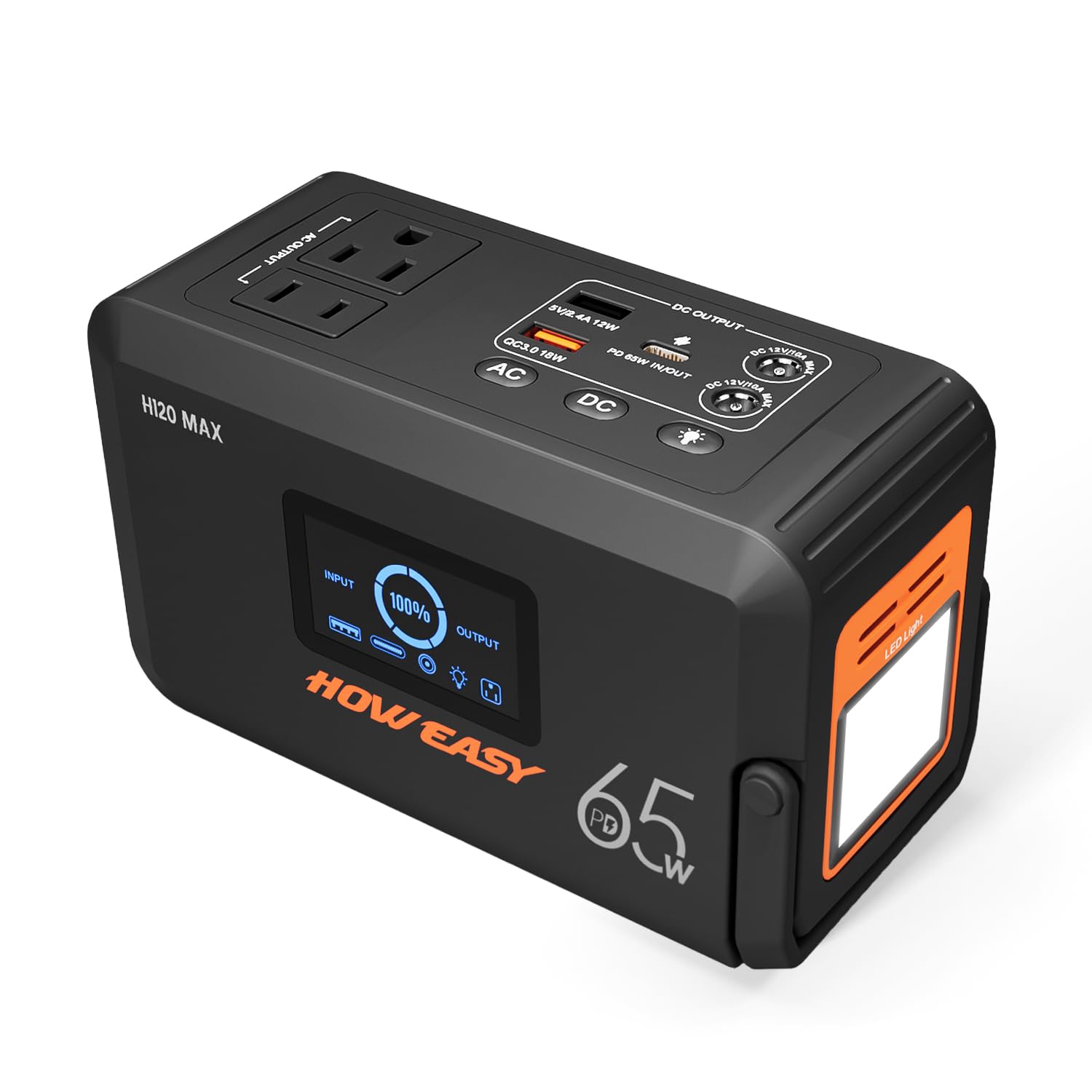
The HOWEASY H120 Max pushes the boundary of what a sub-100Wh portable station can do by offering 135W continuous AC output (270W peak) and a 65W USB-C PD port that works both as output and as a blazing-fast self-recharge input. That 65W PD input means you can refill the 98Wh capacity from 0% to 80% in roughly one hour — a huge advantage over the 4-hour standard DC recharge times of cheaper models. The dual AC outlets handle two devices at once, and the 7-port layout covers everything from QC3.0 phones to 12V DC accessories.
The 98Wh capacity puts this unit right at the FAA’s 100Wh airline threshold, making it legal for carry-on luggage on most flights. Users report that the 65W PD port charges a typical 13-inch laptop to 80% in about one hour, which aligns perfectly with the manufacturer’s claim. The multi-mode LED flashlight (low/medium/high/SOS) is genuinely versatile for camping or emergency signaling. The unit also supports solar panel input (15V-24V), so it can act as a hub for off-grid power harvesting.
One notable negative reported by owners is that there is no true physical on/off switch — the DC button shuts off most outputs but the unit may still draw a small parasitic drain over weeks of storage. The cooling fan is also on the louder side compared to fanless LiFePO4 competitors, which can be distracting in a quiet room. Finally, the 100W continuous AC rating limits usage to devices under that threshold — a 150W projector will instantly trigger the overload protection.
Why it’s great
- 65W USB-C PD input refuels the 98Wh battery from 0-80% in about one hour
- 135W continuous AC (270W peak) provides headroom for demanding laptop chargers
- FAA-compliant 98Wh capacity is legal for airline carry-on baggage
Good to know
- No true power-off switch leads to slow parasitic battery drain during storage
- Cooling fan is noticeably loud under sustained AC load
- 135W AC limit may be insufficient for 150W+ appliances
3. DARAN 89.6Wh LiFePO4 Power Station
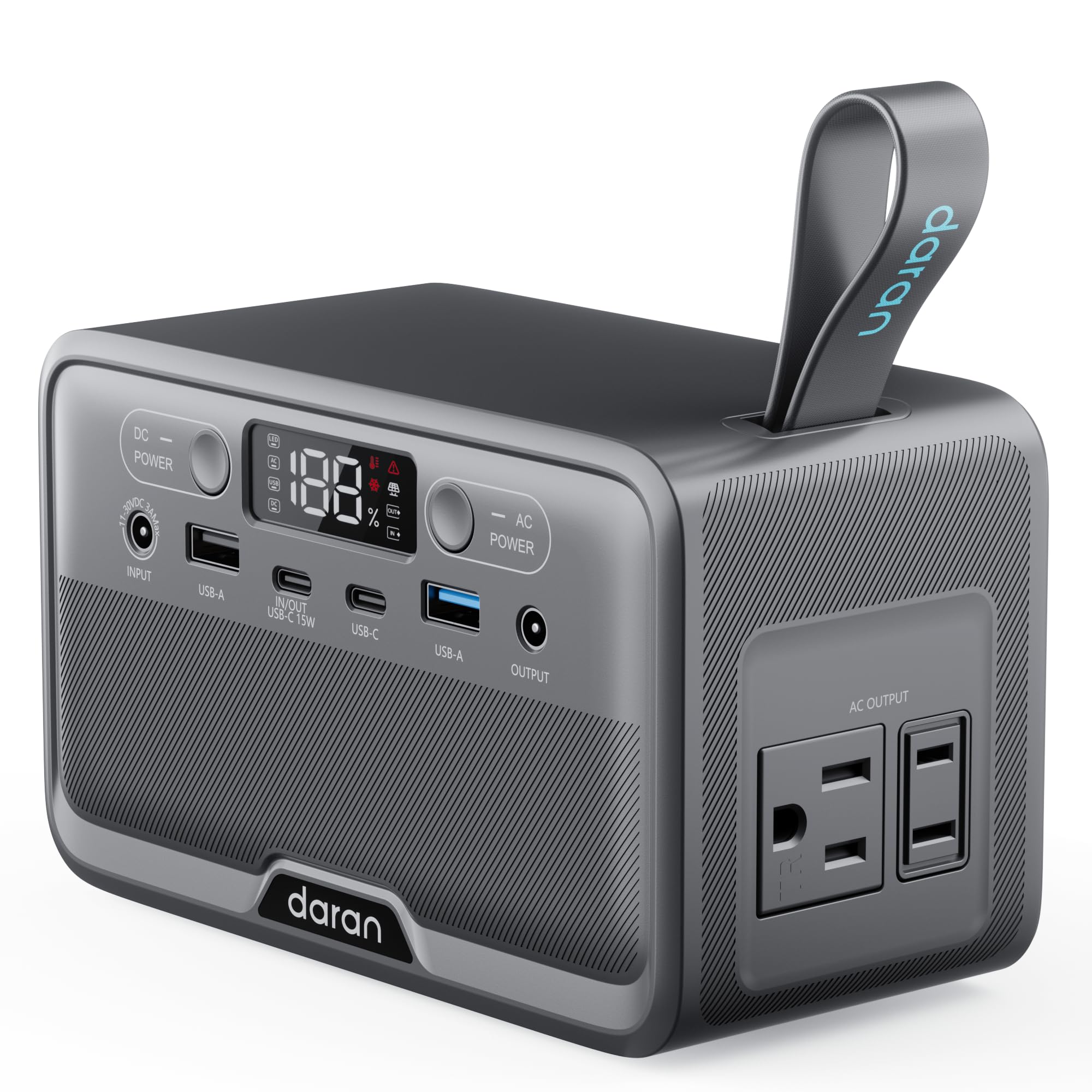
The DARAN 89.6Wh station breaks from the pack by using lithium iron phosphate (LiFePO4) cells rated for over 3,500 charge cycles — roughly 4-5 times the lifespan of standard lithium-ion units. For buyers who plan to keep this power bank in an emergency kit for years, that longevity alone justifies the premium. The 100W continuous AC output (200W peak) is sufficient for 65W laptop chargers, camera batteries, and CPAP machines. The unit also features two USB-C ports (45W and 15W), two USB-A ports, and a DC5521 barrel output.
Recharge speed is another standout: the DARAN supports 0-80% charge in just 1.5 hours via USB-C PD or AC wall input, and it can be charged via solar panels as well. The fanless operation is a rare feature — there are no spinning fans to disturb sleep during tent camping or power outages. The 4-level LED flashlight includes both steady and SOS modes. At 2.54 lbs and roughly the size of a thick smartphone, it is genuinely pocketable for a power station with AC outlets.
The 100W AC continuous output is the primary trade-off — this unit cannot power 120W+ devices. Users also note that the LCD display is basic and lacks a battery percentage readout (only bar segments), which makes estimating remaining runtime less precise. A few owners reported that the cooling fan, while silent during DC-only use, does activate audibly during AC charging and can be distracting in a quiet home environment.
Why it’s great
- LiFePO4 cells deliver 3,500+ cycles — ideal for long-term emergency preparedness
- Fanless operation keeps the unit completely silent during DC-only use
- 0-80% recharge in 1.5 hours via USB-C PD input
Good to know
- 100W continuous AC limit may struggle with 120W+ devices
- LCD display uses bar segments instead of a precise percentage readout
- Slightly heavier than equivalent-capacity Li-ion units at 2.54 lbs
4. ZeroKor 120W Portable Power Station

The ZeroKor 120W station packs a 97.6Wh cell into a 2.2 lb package that includes two 120W AC outlets, a DC port, a QC3.0 USB port, and a USB-C port. The dual-AC configuration is a standout at this price tier, allowing simultaneous power to a laptop and a small fan or projector. The 97.6Wh capacity is within the FAA carry-on limit, making it a viable travel companion. Users consistently highlight the unit’s ability to run a projector and speakers for a full movie (roughly 2 hours) without hitting the low-battery warning.
Recharge flexibility is strong: the ZeroKor accepts AC wall input, USB-C, car charging, and solar panel input (13V-16V range). The display shows remaining power, AC output status, and DC output status simultaneously, so you always know what’s drawing current. The built-in LED flashlight offers a reading mode plus SOS for emergencies. Many owners specifically praise the robust build quality — the orange-and-gray chassis resembles premium brands like Jackery but at a significantly lower investment.
There is a notable downside: at least one verified user reported that the unit only outputs 5V on the USB-C port despite being marketed with higher voltage profiles, which severely limits fast-charging capability. Additionally, the AC and DC button controls can be confusing — the DC output requires a long-press to activate, and the manual provides minimal explanation of the logic. Owners also note that the fan, while quiet during native 5V usage, becomes clearly audible under AC load.
Why it’s great
- Two 120W AC outlets in a 2.2 lb, FAA-compliant package
- Runs a projector and speakers for a full 2-hour movie without draining
- Versatile recharge options including solar panel input for off-grid use
Good to know
- Some units shipped with USB-C limited to 5V output only
- AC/DC button logic is unintuitive — requires long-press and offers little feedback
- Cooling fan becomes audible during sustained AC power draw
5. Powkey 24000mAh AC Power Station

The Powkey 24000mAh station is one of the lightest units (1.3 lbs) to include a genuine 110V/65W AC outlet, making it a compelling option for backpackers and hikers who count every ounce. At 88.8Wh, it can charge an iPhone roughly 8 times or a 12-inch MacBook about twice before needing a refill. The three charging inputs — AC wall adapter, 12V car cigarette lighter, and solar panel (13-16V) — give it the versatility to be recharged in virtually any environment.
The 65W AC outlet is limited to devices under that threshold, which covers most ultrabooks and tablets but will struggle with gaming laptops or power tools. The two USB outputs include a QC3.0 port for fast Android charging, and the DC output (9-12.6V/10A max) can power car accessories like mini fridges or tire inflators. The LED display provides a clear readout of remaining battery bars, and the unit accepts a 30W DC input for a full recharge in under 4 hours.
Durability is the primary concern here: several user reports indicate the unit stopped charging devices after only 2-3 cycles, suggesting inconsistent quality control on the inverter board. The lack of a USB-C PD port means you are limited to the barrel-style DC input for self-charging, which is slower and less convenient than modern USB-C alternatives. The neon green color scheme is also divisive — some find it helpful for locating in a dark tent, while others find it unattractive.
Why it’s great
- Only 1.3 lbs makes it the lightest unit on this list with a genuine AC outlet
- Three recharge methods (AC, car, solar) provide flexibility for any trip
- 88.8Wh capacity delivers roughly 2 full charges for a 12-inch MacBook
Good to know
- Multiple reports of units failing after 2-3 uses indicate inconsistent QC
- No USB-C PD port — slower barrel adapter is the only self-charge method
- 65W AC limit is insufficient for gaming laptops or 100W+ devices
6. SinKeu 23,400mAh AC Power Bank (HP500S Pro)

The SinKeu HP500S Pro stands out for its OLED display, which provides real-time battery percentage that is readable even in bright daylight — a notable upgrade over the dim LCD panels on most competitors. At 86.58Wh with a 120V/65W AC outlet, this unit sits squarely in the capacity bracket that can handle a full laptop charge plus multiple phone top-ups. The QC3.0 USB outputs and a 9-12.6V DC port cover the full range of modern devices from phones to cameras to portable monitors.
Owners consistently praise the build quality, noting that the casing feels denser and more premium than similarly-priced units. The included accessories — AC home charger, car charger, and cigarette lighter adapter — mean you don’t have to buy anything extra for full functionality out of the box. The unit accepts 30W DC input for a full recharge in approximately 4 hours, and multiple reviews confirm that the battery retains its charge remarkably well over months of storage.
The primary drawback is runtime: several users report that under continuous AC load, the battery drains faster than expected, lasting only about 2 hours before needing a recharge. This aligns with the 86.58Wh ÷ 65W = ~1.33 hours calculation (minus inverter losses), so the expectation should be set accordingly for high-wattage use. The Micro USB connector type listed in the specs is also an oddity — most users will need to use the included barrel adapter rather than a standard USB cable for self-charging.
Why it’s great
- OLED display delivers clear battery percentage readout in direct sunlight
- Premium build quality with a dense, solid-feeling chassis
- Full accessory kit included (AC home charger, car charger, lighter adapter)
Good to know
- Continuous AC runtime is roughly 2 hours under 65W load
- Micro USB connector listed is confusing — barrel adapter is the main input
- No USB-C PD support for faster self-recharging
7. SinKeu 24000mAh AC Power Bank (HP500S)

The SinKeu HP500S is the entry-level sibling of the Pro model, offering the same 24000mAh (88.8Wh) capacity and a 110V/65W AC outlet at a more budget-friendly price point. The black-and-red color scheme is more understated than the green Powkey, and the LCD display shows remaining battery bars clearly. Like its Pro counterpart, it includes QC3.0 USB outputs, a 9-12.6V DC port, and the full accessory kit (AC charger, car charger, cigarette lighter adapter).
Real-world performance mirrors the Pro version closely: owners report successfully charging a Surface laptop from 30% to 86% in under 2 hours, draining the station to only 1% in the process. USB charging is notably more efficient — an iPad charged from 0% to 28% in 1 hour reduced the station’s battery by just 7%. The unit also demonstrated excellent shelf stability, holding 45% charge after two months of storage. For budget-conscious buyers, the core functionality (AC outlet, 88.8Wh capacity, QC3.0 fast charging) is identical to pricier models.
The main downgrade from the Pro model is the LCD display instead of OLED, which is harder to read in direct sunlight and provides bar segments rather than a precise percentage. Users also report that the “carry bag” included is a basic nylon pouch rather than a padded case, offering minimal protection. The same 2-hour runtime limitation under continuous AC load applies, and some reviews mention the cooling fan being audible during charging.
Why it’s great
- Core AC functionality (110V/65W, 88.8Wh) matches premium rivals at a lower entry point
- Excellent battery retention over months of storage
- Full accessory kit included, minimizing hidden costs
Good to know
- LCD display uses bar segments rather than a precise OLED percentage readout
- Included carry pouch is basic nylon with minimal padding
- Continuous AC runtime capped at approximately 2 hours under 65W load
FAQ
Can I take an AC power bank on a plane?
Why won’t my AC power bank run my hair dryer or coffee maker?
How often should I recharge my AC power bank if I don’t use it?
Final Thoughts: The Verdict
For most users, the best ac power bank winner is the GENSROCK H120 because it delivers two genuine AC outlets and 8 total ports at just 2.3 lbs, offering unmatched versatility for multi-device setups. If you want the fastest self-recharge times and 65W PD support, grab the HOWEASY H120 Max. And for long-term emergency preparedness where battery longevity matters most, nothing beats the DARAN 89.6Wh LiFePO4 with its 3,500+ cycle life and fanless operation.