
Our readers keep the lights on and my morning glass full of iced black tea. As an Amazon Associate, I earn from qualifying purchases.
Specs are compiled from manufacturer listings and verified buyer reviews and can change over time — please confirm the key details on the product page before buying.
When your car’s AC starts blowing warm air, a shop visit can cost hundreds. An AC recharge machine puts that control back in your garage — you pull out the old refrigerant, pull a deep vacuum, and refill the system yourself. The trick is picking the right combination of pump, gauges, and features for the cars you work on.
I’m Min — the founder and writer behind Gadgets Feed. This guide is built by comparing the manufacturers’ published specifications and the patterns across verified customer reviews, so you get each pick’s real strengths and trade-offs instead of marketing spin.
Below, we break down the standout models, from a shop-grade fully automatic unit to budget-friendly gauge sets that get the job done, to help you choose the best ac recharge machine for your needs.
Our Picks at a Glance


How To Choose The Best AC Recharge Machine
Before you pick, understand the three core jobs an AC recharge machine does: recover old refrigerant from the system, evacuate moisture and air by pulling a vacuum, and then allow you to recharge with fresh refrigerant. Some machines are dedicated to just one step; others bundle everything. Here is what to look for.
Recovery vs. Manifold Gauge Set
A recovery machine uses a compressor to actively pull refrigerant out of a system and store it in a tank. A manifold gauge set lets you read pressures and control the flow of refrigerant but cannot recover on its own. If you need to legally remove refrigerant, you need a dedicated recovery machine. A gauge set alone is for diagnostic checks and recharges on systems you know are empty.
Pump Speed and Stages (CFM and Dual-Stage)
The pump is rated by CFM — cubic feet per minute — which tells you how fast it pulls air out. A 4 to 5 CFM pump is enough for most cars and small home AC units. A dual-stage pump pulls a deeper vacuum (measured in microns) than a single-stage pump, which matters for removing moisture from a system that has been open to the air for a while.
Refrigerant Compatibility
Not every machine works with every refrigerant. Older cars (pre-2015) use R134a. Newer cars (post-2015) and many newer home AC systems use R1234yf or R410A. Check the machine’s compatibility list. Some gauge sets cover R134a, R22, R410A, and R1234yf all in one unit, while others are single-refrigerant.
Build and Portability
A recovery machine can weigh 18 to 33 pounds. If you carry it between jobs, weight and a comfortable handle matter. Manifold gauge sets are lighter — around 8 to 9 pounds. For a garage setup, a heavier pump with a sturdy case is fine. For mobile work, lighter is better.
Quick Comparison
| Model | Best For | Refrigerant | Pump Motor | Weight | Amazon |
|---|---|---|---|---|---|
| Robinair RG3★ Best Overall | Standalone Recovery | CFC, HFC, HCFC, R-410A | 1/3 HP | 18 lbs | Amazon |
| Airtek AC-DualShop Grade | Shop-Grade Automation | R134 and HFO1234yf | — | 275 lbs | Amazon |
| VIVOHOME Dual-Stage KitDual Stage | Deep Vacuum Performance | R12, R134a, R22, R410a | 1/2 HP, 5 CFM, 2-Stage | 30.8 lbs | Amazon |
| OMT Gauge Set | R1234yf Recharge | R1234yf, R404a, R134a | — | 8.4 lbs | Amazon |
| Lichamp Gauge Set | Multi-Refrigerant Value | R134, R22, R32, R410 | — | — | Amazon |
| Rogvoc Digital | Digital Diagnostics | R22, R410A, R134A, 1234YF | — | — | Amazon |
| PB Motor TECH Kit | All-in-One Starter Kit | R134a, R12, R22, R502 | 1/3 HP, 4.5 CFM | 19.03 lbs | Amazon |
| Rogvoc Digital (Alt) | Digital Superheat/Subcool | R22, R410A, R134A, 1234YF | — | — | Amazon |
| VIVOHOME Single-Stage Kit | Well-Rounded Bundle | R12, R134a, R22, R502, R410a | 1/3 HP, 4 CFM | 19.36 lbs | Amazon |
| OMT Vacuum Pump Kit | Garage All-Rounder | R134a, R22, R410a | 1/3 HP, 4.5 CFM | 21.9 lbs | Amazon |
| VIVOHOME RR500 Recovery | Standalone Recovery Pro | R32, R1234yf, R454B, R134a, R22, R410A | 1 HP Dual Cylinder | 33 lbs | Amazon |
In‑Depth Reviews
1. Robinair RG3 Portable Recovery Machine
Our pick — over 4.5★ from 950+ verified ratings; the strongest balance of quality and price.
The compact workhorse that pros and serious DIYers trust for fast refrigerant recovery.
This is a dedicated recovery machine — it pulls refrigerant out of a system and stores it, something a gauge set alone cannot do. At just 18 pounds, the Robinair RG3 has a compact footprint, which makes a real difference when you are hauling it up a ladder or between job sites. The crowd favorite here is remarkable: over 4.6 stars from 900+ owners, with the most common praise centered on its functionality and build quality.
The 1/3 HP oil-less compressor handles both liquid and vapor recovery, and it works with all common CFC, HFC, and HCFC refrigerants including R-410A. Buyers report that it “recovered 7.9 lbs R-410 from a 2-ton heat pump in high heat without strain,” which speaks to its real-world stamina. The auto shut-off kicks in if pressure rises above 550 PSI, adding a layer of safety.
It is not a complete recharge kit — you will need a separate vacuum pump and manifold gauge set. The recovery speed gets mixed feedback: some find it fast, others say it is moderate for a single-cylinder machine. It also lacks an oil separator. For low-volume jobs and DIY recovery, this is the gold standard for portability and reliability.
Why it wins
- Oil-less compressor handles liquid and vapor recovery
- Compact and lightweight at 18 lbs for a recovery machine
- Auto shut-off at 550 PSI for safety
- Broad refrigerant compatibility including R-410A
Know before you buy
- Recovery speed is moderate — not the fastest single-cylinder unit
- Requires separate vacuum pump and gauge set to complete a recharge
Grab it if: you need a reliable, portable recovery machine for residential and automotive AC work, and you already have or plan to buy a separate gauge set and vacuum pump.
Look elsewhere if: you want an all-in-one kit that includes gauges and a vacuum pump, or you need the fastest possible recovery speed for high-volume professional use.
2. Airtek AC-Dual Fully Automatic Machine
Enter the refrigerant info, walk away, and come back to a fully recharged system.
This is a completely different beast from a gauge-and-pump kit — it is a professional shop-grade machine that handles recovery, recycling, evacuation, and recharge in a fully automatic cycle. It services both R134a and HFO1234yf systems, and switching between them takes about 10 minutes. The machine comes with two empty refrigerant tanks attached, one for each refrigerant type.
It recovers 95% of the refrigerant and handles oil injection for non-EV and hybrid vehicles, with software control to prevent injecting the wrong oil. Owners praise its speed and ease of use, calling it “faster than Robinair” and noting it has been reliable over 30 cycles. It supports domestic and foreign vehicles, including electric and hybrids, and comes with local professional customer support via an 800 number.
The main trade-off is the size — at 275 pounds, this is a permanent shop fixture, not a portable tool. The cost is also significant, but for a working shop that sees a mix of R134a and R1234yf vehicles, it pays for itself quickly. A single negative review mentions a shipping issue and a unit that did not work, but the overwhelming consensus is that this machine is a serious value for a dual-unit system.
Why it stands out
- Fully automatic — enter data and walk away
- Dual refrigerant support (R134a and R1234yf) with 10-minute switchover
- 95% recovery rate and oil injection for non-EV/hybrids
- Includes two tanks and local customer support
Know before you buy
- 275 lbs — not portable, requires a dedicated shop space
- High cost compared to gauge-and-pump kits
Best for: professional shops that service both R134a and R1234yf systems and want a hands-off, automated recovery and recharge process.
skip it if: you are a home DIYer or mobile mechanic — the size and cost are overkill for occasional use.
3. VIVOHOME 1/2 HP 5 CFM 2-Stage Vacuum Pump Kit
A dual-stage pump that pulls a deeper vacuum than single-stage alternatives, giving you drier, cleaner AC systems.
This kit sits at the top of the all-in-one game. The 1/2 HP dual-stage vacuum pump delivers 5 CFM flow and pulls down to an ultimate pressure of 22.5 microns. That extra stage matters when you are opening a system that has been exposed to air — it removes moisture more thoroughly than a single-stage pump can. The kit includes a 4-way manifold gauge, a leak detector, two R134a can taps, two bottles of vacuum oil, and four color-coded hoses rated at 800 psi working pressure and 4000 psi burst.
Owners mention using it successfully on a Ford Explorer AC after an engine swap and on a DIY 3-zone mini split, finding leaks and retesting. The separate valves for vacuum and refrigerant make multi-can filling straightforward. The build quality is high — the pump stays quiet and only gets slightly warm even after extended use.
The biggest downside is the weight. At 30.8 pounds, this is a heavy kit to haul around. Some owners note that vacuum performance is mixed on very demanding applications, and a few mention leakage issues with the hoses. For a home garage or a small shop that wants a single, capable kit for both cars and small home AC units, this is a strong contender.
What you gain
- Dual-stage pump reaches 22.5 microns for deep moisture removal
- Separate vacuum and refrigerant valves for easy operation
- Compatible with R12, R134a, R22, and R410a
- Includes two bottles of vacuum oil and full accessory set
What to note
- Heavy at 30.8 lbs — not ideal for frequent mobile work
- Mixed reports on hose leakage and vacuum performance in extreme cases
Perfect for: a dedicated home garage or small shop that wants a single, powerful kit for deep vacuum work on cars and mini splits.
Think twice if: you need to carry your kit between job sites regularly — the weight adds up fast.
4. VIVOHOME RR500 1 HP Dual Cylinder Recovery Machine

A 1 HP twin-cylinder recovery machine that handles modern refrigerants like R1234yf and R454B.
If the Robinair RG3 is the gold standard for portability, the RR500 is the muscle option. Its 1 HP, 1750 r/min motor with a twin-cylinder, oil-less, air-cooled piston compressor moves refrigerant fast. The larger condenser boosts cooling efficiency, and the high-speed fan aids in rapid vapor and liquid recovery. Uniquely for this price tier, it covers R32, R1234yf, R454B, R134a, R22, and R410A — including the newer A2L refrigerants that many older machines cannot handle.
Customers note it works well for non-professionals and that customer service is responsive, replacing a blown high-pressure gauge for free. The auto/manual low-pressure bypass mode gives you control over maximizing recovery or protecting the compressor. Safety features include high-pressure automatic shut-off at 558 PSI, overcurrent protection, and a pressure warning lamp panel.
It is heavy at 33 pounds, though the ergonomic non-slip handle helps. You still need a separate gauge set and vacuum pump to complete a recharge. It also does not include a tank. For someone who already owns gauges and a pump but needs a dedicated recovery machine that works with the latest refrigerants, the RR500 is a smart buy.
Standout features
- 1 HP twin-cylinder for fast recovery
- Works with modern refrigerants including R1234yf, R454B, and R32
- Auto shut-off at 558 PSI and overcurrent protection
- Dual-stage filtration with filter drier and mesh intake filter
Limitations
- Heavy at 33 lbs
- Does not include a refrigerant tank or gauge set
Reach for this if: you work on modern vehicles and systems using R1234yf or R454B, and you already have a separate gauge and vacuum pump.
Look elsewhere if: you want a single all-in-one kit that includes everything to recover, evacuate, and recharge.
5. Orion Motor Tech 4.5 CFM Vacuum Pump Kit
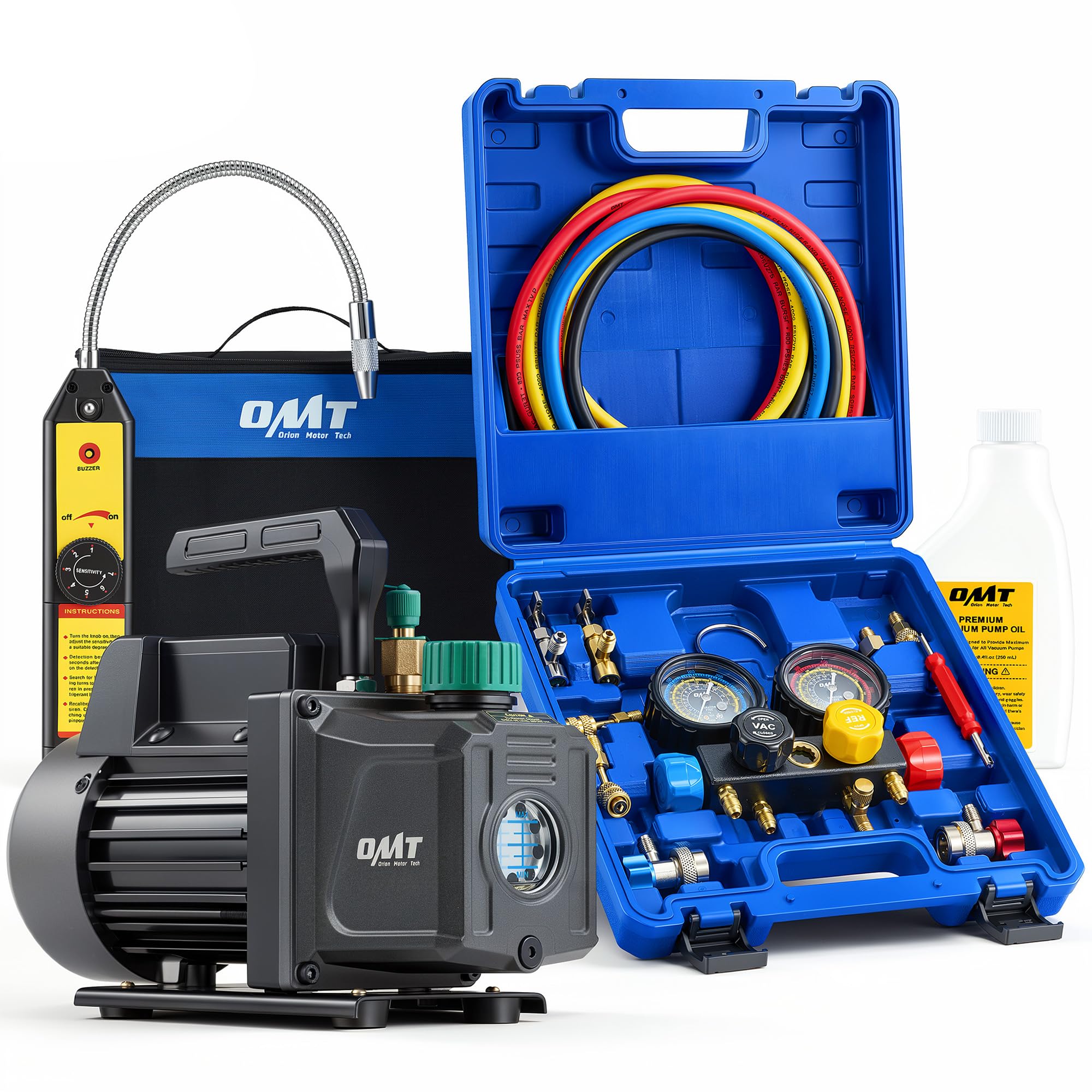
A quiet, fast 4.5 CFM vacuum pump that two reviewers point out fixed their car ACs with no complaints.
This is among the most popular all-in-one kits out there, with over 900 ratings. The 1/3 HP all-copper motor pulls a vacuum quickly, and owners consistently highlight how quiet it is compared to other pumps in this class. The 4-way manifold gauge set provides real-time pressure readings, and the four-layer color-coded hoses handle up to 800 psi working pressure (4000 psi burst).
It comes with an electronic leak detector, R134a can taps with quick couplers, R410a adapters, vacuum oil, and a carrying case. A practical touch: the tethered brass safety caps prevent oil leaks during transport. It works with R134a, R22, and R410a, covering most cars and home mini split systems.
The durability gets mixed marks. A few shoppers say the yellow plastic knob breaking and some mention leakage issues. One owner noted the R134a adapter was poorly threaded. It is also not powerful enough for large house HVAC systems — one owner says “not big enough for a large house HVAC system but it might work.” For light-duty garage use on cars and small home units, it is an excellent value.
Strong points
- Quiet and fast 4.5 CFM pump with all-copper motor
- Includes leak detector, adapters, and carrying case
- Hoses rated to 800 psi working pressure
Watch for
- Plastic knob durability and occasional adapter threading issues
- Not suitable for large house HVAC systems
Best for: home garage DIYers working on cars and small mini splits who want a quiet, complete kit at a fair price.
Not for: heavy commercial use or large residential HVAC systems.
6. VIVOHOME 4 CFM 1/3 HP Vacuum Pump Kit
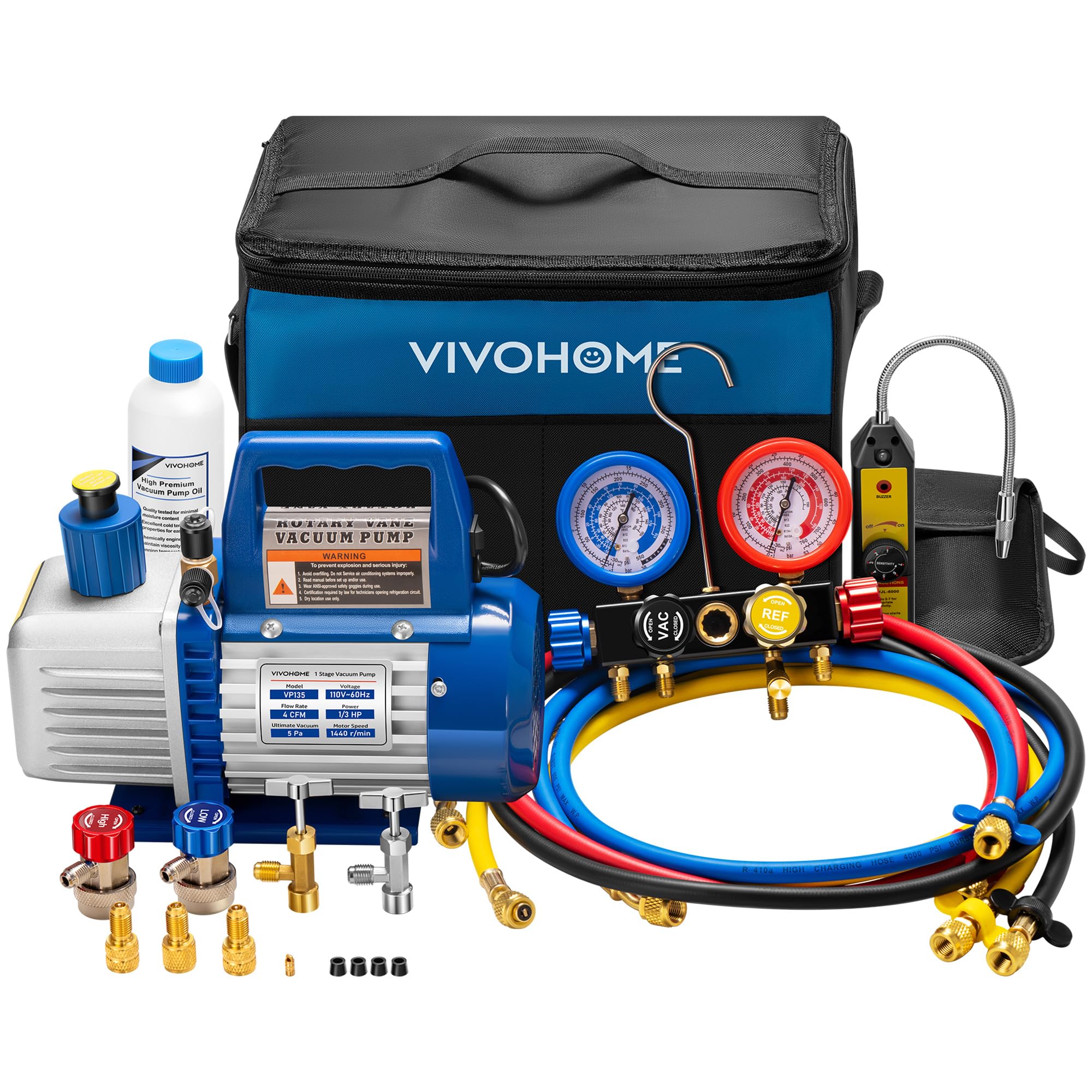
A 4 CFM single-stage kit with a leak detector that one ex-HVAC tech says works well for the price.
This kit runs on a 1/3 HP four-pole pure copper motor operating at 1440 RPM, which gives it stable, reliable performance for evacuation and recharging. The single-stage pump is not the deepest-pulling option, but it is more than enough for routine automotive AC work and small home systems. The manifold gauge set features a 4-way design with color-coded hoses — red for high pressure, blue for low, yellow for refrigeration, and black for vacuum — rated to 800 psi working and 4000 psi burst.
It includes a leak detector, two R134a can taps (self-sealing and puncture style), a 330 ml bottle of vacuum oil, and SAE adapters. Buyers report it successfully pulled a vacuum on a 2006 Jeep Liberty with no leaks. An ex-HVAC technician notes the pump works well and the leak detector is effective if moved slowly and kept out of direct heat.
The main caveat is that the manifold set lacks dummy ports for hose sealing, which some experienced users prefer. For a first-time buyer who wants everything in one box, this kit delivers solid quality and good value.
What works
- Runs at 1440 RPM for stable, reliable operation
- Includes both self-sealing and puncture-style can taps
- Good leak detector and separate vacuum/refrigerant ports
What is missing
- Manifold lacks dummy ports for hose sealing
- Single-stage pump is not for deep-vacuum jobs
Grab it if: you are new to AC work and want a complete, well-reviewed kit with all the essential accessories.
Think twice if: you are an experienced tech who needs dummy ports or a dual-stage pump for deep moisture removal.
7. PB Motor TECH 4.5 CFM 1/3 HP Vacuum Pump Kit
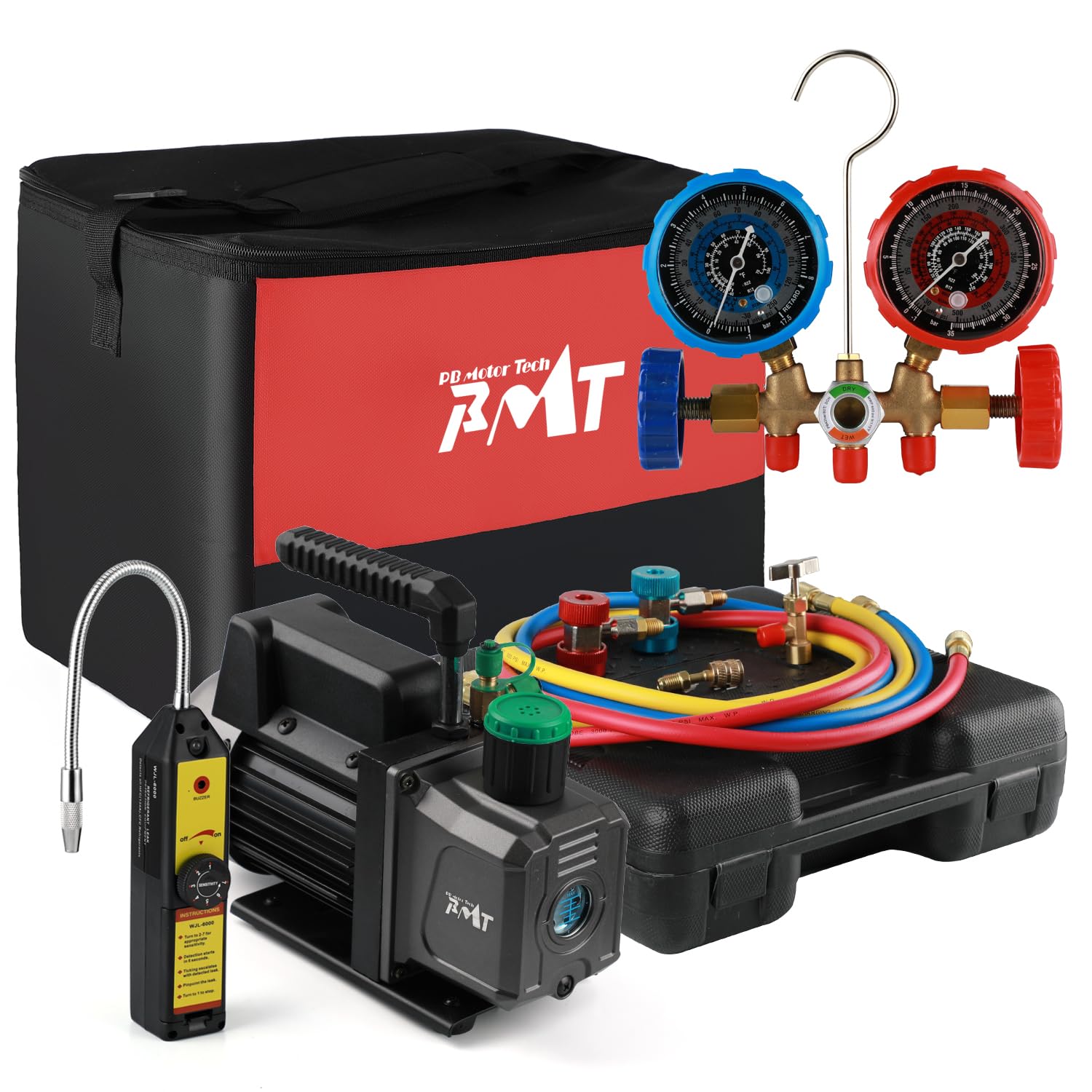
It saved one owner a mint — they charged their own AC and a few friends’ cars after one YouTube session.
This kit bundles a 1/3 HP single-stage vacuum pump that pulls at 4.5 CFM with a 3-way manifold gauge set. The gauge is accurate to ±1.6%, and the color-coded hoses are rated at 600 psi working pressure and 3000 psi burst. It covers R134a, R12, R22, and R502, which covers most older and modern cars.
The accessories list is generous: a leak detector, R134a puncture can tap, quick couplers, a 1/2″ to 1/4″ SAE adapter, Teflon tape, gloves, a plastic case, and a storage bag. One owner used it after a compressor failure on their Toyota Sienna and reported it worked well. Another says it worked easily after watching YouTube, and they saved money doing their own AC and helping friends.
The downsides: the kit does not include vacuum pump oil, so you must buy that separately. It also lacks a purge valve on the yellow hose, which can let air into the system. One owner had a refrigerant valve leak, though the seller gave a full refund. For the price, this is a strong starter kit if you are okay sourcing oil and understanding the hose limitation.
Why it works
- 4.5 CFM pump with ±1.6% accuracy gauge
- Generous accessory set including leak detector and storage bag
- Well-reviewed for DIY use on cars
Heads up
- No vacuum pump oil included
- No purge valve on the yellow hose — can let air into the system
Reach for this if: you are a DIYer who wants an affordable, complete kit to start doing your own AC work and does not mind buying oil separately.
Look elsewhere if: you want a kit with a purge valve or oil included from the start.
8. OMT 4-Way AC Manifold Gauge Set

A lightweight 8.4-pound gauge set with the quick couplers and can taps you need for both R1234yf and R134a systems.
If you work on newer cars that use R1234yf refrigerant, this kit is built for you. It includes dedicated quick couplers and self-sealing can taps for both R1234yf and R134a, plus two 1/4″ male to 1/2″ female adapters with left-hand and right-hand threads. The aluminum body and pure copper fittings resist rust and corrosion, and the oil-filled gauge core dampens vibration for steady readings — the calibration screws keep accuracy within 1.6%.
The four-layer PVC hoses are rated to 800 psi working pressure with a 4000 psi burst rating. The set measures 12.6 x 11.81 x 3.74 inches and weighs 8.4 pounds, while the Robinair RG3 weighs 18 pounds, making the OMT set genuinely portable. Owners say it works well, the gauges are easy to read, and it paid for itself after a single recharge.
The included accessories get mixed feedback — some owners note the case is too small for the hoses, and the R134a canister adapter was missing for a few buyers. Leakage is also a mixed point. For someone who exclusively works on R1234yf cars (or wants one set that covers both old and new), this is a solid buy.
Standout features
- Dedicated couplers and taps for R1234yf and R134a
- Aluminum body with oil-filled gauges accurate to 1.6%
- Lightweight at 8.4 lbs — easy to carry
Watch for
- Case may be too small for hose storage
- Mixed reports on accessory completeness and hose leakage
Best for: owners of newer cars with R1234yf systems who need a dedicated, accurate gauge set with the right fittings included.
Not for: those who need a vacuum pump or recovery machine — this is a gauge set only.
9. Lichamp HVAC R410A Manifold Gauge Set
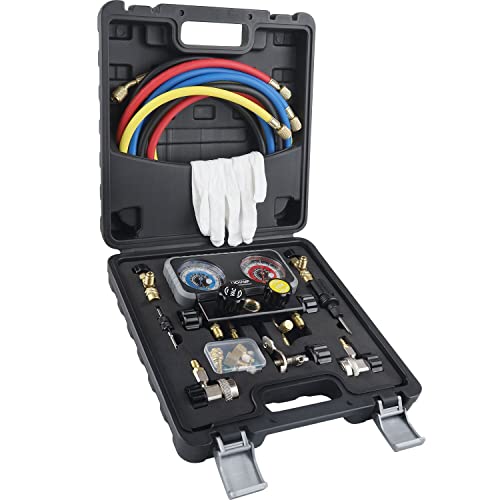
As buyers put it: “an set for 410a — hard case, vacuum line, no leaks, purges well.”
This is the set that covers the most ground for the least money. The 3-way gauge works with R134, R22, R32, and R410 refrigerants, making it a universal option for both car and home AC systems. The dials are extra-large and color-coded — red gauge rated at 800 psi max, blue at 550 psi max — with a sight glass to see liquid refrigerant flowing during charging.
The kit includes four 5-foot hoses, adjustable R134a adapters, R410a liquid safety valves, an adjustable can tap, tank adapters, a swivel adapter, a calibration screwdriver, and a valve core remover. It ships with gloves and a hard case. Owners praise its versatility and solid quality, though the gauges get mixed marks for precision — they hold pressure well but are not the most accurate for fine measurements.
The recurring gripes are around sealing: some owners find the gauge connections loosen back up, and leakage is a noted issue. For a budget-friendly set that covers multiple refrigerant types and includes nearly every adapter you might need, it is tough to top. Just double-check all connections before use.
Why it sells
- Covers R134, R22, R32, R410 in one set
- Includes hard case, gloves, and a full set of adapters
- Large, easy-to-read color-coded dials with sight glass
Trade-offs
- Gauges are not the most precise
- Sealing and leakage are recurring concerns
Grab it if: you need one gauge set that covers multiple refrigerants on a tight budget and are comfortable checking connections for leaks.
pass on it if: you need lab-grade precision or plan to use it daily in a professional shop.
10. Rogvoc 3-Way Digital Manifold Gauge

A digital gauge that stores 93 refrigerant types in its memory and runs leak tests automatically.
Analog gauges are reliable, but a digital gauge like this one adds capabilities that make diagnostics much faster. It has built-in data for 93 refrigerants, so you just select the gas and it shows the correct pressure-temperature relationship. It can run vacuum tests to check for leaks and record the duration of the test. The 32-bit precision data acquisition unit keeps readings stable and accurate to ±0.5% full scale.
The pressure test range is 0 to 6000 Kpa with a resolution of 1 Kpa, and the vacuum test range goes from -101 Kpa to 0 Kpa. It includes two thermometer clamps for superheat and subcooling calculations, and the TFT LCD display is readable in dim light. The back hook lets you hang it on a panel or louver, freeing up your hands.
Quality gets mixed feedback — some say it is better than expected, while others note it is not the best. Durability is the main concern: one owner reports the clamps broke after 10 uses, and the hose end seals are a hard material that can cause hoses to loosen. For a DIYer who wants the convenience of digital readings and built-in refrigerant data, this is a useful tool, but it may not survive heavy daily use.
Key benefits
- 93 built-in refrigerant data tables
- Automated leak test with duration recording
- TFT LCD display for low-light readability
Concerns
- Clamp durability reported as weak
- Hose end seals can loosen over time
Best for: tech-savvy DIYers who want digital precision and built-in refrigerant data without spending on a pro-level unit.
Not for: rough daily shop use where heavy durability is a must.
11. Rogvoc Digital Manifold Gauge (2nd Version)
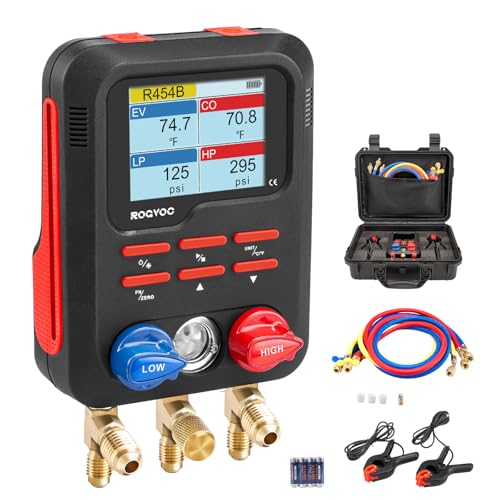
A digital gauge that automatically calculates and displays superheat and subcooling readings in real time.
This is the same Rogvoc digital platform but with a refined build. It retains the 93-refrigerant memory and the full range of digital tests — pressure, vacuum, leak detection, and condensation-evaporation pressure. The headline feature is the auto superheat and subcooling calculation: clip the two thermometer clamps onto the lines and the display shows you the numbers without any manual math.
Owners love the color TFT display and call it “way better than expected for the price.” One reviewer used it flawlessly for an R-410A recharge relying on the subcool reading. The hose handles have a knob design that lets you tighten them securely to prevent loosening — a direct fix for the issue reported on the earlier Rogvoc model.
A single critical review says the unit was not accurate and equalization was very slow. Some owners also mention the seal rings are loose and may cause leaks. For the money, especially considering that two temperature clamps alone can cost around separately, this is a compelling value for anyone who wants digital diagnostics on their AC work.
What impresses
- Automatic superheat and subcooling calculation
- Color TFT display that is easy to read in any light
- Excellent value — two temp clamps alone cost more
Potential issues
- Accuracy and equalization speed criticized in a small number of reviews
- Seal rings reported as loose
Reach for this if: you want the diagnostic power of auto superheat/subcooling calculations without paying pro prices.
Think twice if: you need absolute precision or work in a high-volume shop where any inaccuracy costs time.
Understanding the Specs
CFM and Pump Stages
CFM stands for cubic feet per minute — it measures how fast a vacuum pump pulls air out of an AC system. A higher CFM means faster evacuation. A 4 to 5 CFM pump is standard for cars and mini splits. A dual-stage pump pulls a deeper vacuum (measured in microns) than a single-stage pump, which is important for removing moisture from a system that has been open to the air.
Recovery Machine vs. Manifold Gauge Set
A recovery machine uses a compressor to actively remove refrigerant from a system and store it in a tank. This is required by law before opening a system for repaira manifold gauge set only lets you read pressures and control the flow of refrigerant. If you need to legally recover refrigerant, you need a recovery machine. A gauge set alone is for diagnostics and recharging systems you know are empty.
Refrigerant Compatibility
Not all machines work with every refrigerant. Older cars use R134a. Newer cars (post-2015) use R1234yf. Home AC systems often use R410A or R22. Always check the machine’s compatibility list to make sure it supports the refrigerant your system uses. Some gauge sets cover multiple refrigerants, while others are single-refrigerant only.
Hose Pressure Ratings
Hoses are rated by working pressure and burst pressure. 800 psi working pressure with a 4000 psi burst rating is common for automotive and residential HVAC use. Higher ratings mean a larger safety margin, especially when working with high-pressure refrigerants like R410A.
FAQ
Can I use a manifold gauge set alone to recharge my car AC?
What is the difference between a single-stage and a dual-stage vacuum pump?
Do I need a recovery machine if I only work on my own car?
Will a vacuum pump and gauge set work with R1234yf?
How long does it take to vacuum an AC system?
What size vacuum pump do I need for a car?
Can I leave the vacuum pump running overnight?
What does “oil-less” mean on a recovery machine?
Why do some hoses have different colored ends?
Do I need a separate leak detector if my gauge set can test for leaks?
Final Thoughts: The Verdict
For most buyers, the ac recharge machine winner is the Robinair RG3 because it sets the standard for portable, reliable refrigerant recovery in a compact 18-pound package. If you want a fully automated shop-grade experience that handles both R134a and R1234yf without any manual steps, grab the Airtek AC-Dual. And for a deep-pulling all-in-one kit with a 2-stage pump and all the accessories, the VIVOHOME 2-Stage Vacuum Pump Kit is the one to reach for.
How We Picked
We do not accept paid placement. Every pick is matched to a real buyer and a real use-case; we do not hands-on test units.
Sources & Methodology
Specifications: manufacturer listings and product documentation. Review insights: verified customer reviews, as of July 2026. Pricing: not shown on this page (it changes often); check the current price via the retailer link.
As an Amazon Associate, Gadgets Feed earns from qualifying purchases. This does not affect which products we feature.