
An AC recovery tank that leaks refrigerant is not just a financial loss — it’s a safety hazard and a breach of EPA regulations. The difference between a tank that holds vacuum for years and one that bleeds your R-22 or R-410A into the atmosphere comes down to valve quality, steel grade, and DOT certification integrity.
I’m Min — the co-founder and writer behind Gadgets Feed. I’ve spent countless hours analyzing the construction materials, valve designs, pressure ratings, and customer failure reports across dozens of AC recovery cylinders to separate the tanks worth investing in from those that will cost you more in lost refrigerant than you paid for the tank itself.
This guide cuts through the marketing noise to deliver a tightly ranked selection of the best ac recovery tank options for HVAC professionals and serious DIY technicians who refuse to compromise on reliability.
How To Choose The Best AC Recovery Tank
The wrong recovery tank turns a routine refrigerant reclaim job into a costly, leaking mess. Before you hit buy, lock in on three factors that separate a field-ready cylinder from a garage-door paperweight.
DOT and TC Certification — The Only Safety Floor
A tank without DOT-4BA400 or Transport Canada certification cannot legally be transported with refrigerant inside. More importantly, uncertified tanks skip the X-ray and hydrostatic tests that verify the weld integrity and burst tolerance. Every premium pick below stamps its certification visibly on the shoulder.
Steel Grade and Valve Build
The material determines how many refill cycles the cylinder survives. HP295 steel handles standard 400 PSI service pressure for R-22 and R-410A blends. HP325 and HP345 offer additional corrosion margin for wet recovery conditions. The Y-valve should be solid brass — not zinc alloy — with 1/4-inch SAE flare ports that resist galling when you torque the hose nut.
Capacity vs. Portability
A 30-pound tank weighs roughly 17 pounds empty and fits under most truck toolboxes. A 50-pounder at 25-plus pounds empty gives you more storage room per trip to the supply house but demands a solid dolly or a second pair of hands when the cylinder is near full. Match the capacity to your typical job size: service vans handling residential ACs rarely need more than a 30-pound cylinder.
Quick Comparison
On smaller screens, swipe sideways to see the full table.
| Model | Category | Best For | Key Spec | Amazon |
|---|---|---|---|---|
| Worthington 50 lb | Premium | DOT-certified reliability | 50 lb capacity, dual valves | Amazon |
| Mastercool 63010 50 lb | Premium | Professional shop durability | HP325/HP345 steel, Y-valve | Amazon |
| Flame King YSNR501 50 lb | Premium | ISO-certified build quality | DOT-4BA-400, dual Y-valve | Amazon |
| Mastercool 62010 30 lb | Mid-Range | Balanced size and cost | 30 lb, HP295 steel, 1/4″ FL-M | Amazon |
| FAHKNS 50 lb (B0D4QH81P5) | Mid-Range | Large capacity on a budget | 50 lb, HP295, Y-valve | Amazon |
| FAHKNS 30 lb (B0BZKY7D1V) | Mid-Range | Shop-friendly 30 lb size | 30 lb, HP295, Y-valve | Amazon |
| FAHKNS 30 lb (B0D1KJSXYR) | Mid-Range | Budget-friendly 30 lb option | 30 lb, HP295, Y-valve | Amazon |
| FAHKNS 50 lb (B0CKQQHWQC) | Budget | Entry-level large capacity | 50 lb, HP295, Y-valve | Amazon |
| 20 cu ft Steel Cylinder | Budget | Multi-gas and small jobs | 20 cu ft, CGA580 valve | Amazon |
In‑Depth Reviews
1. Worthington 50 lb Refrigerant Recovery Tank
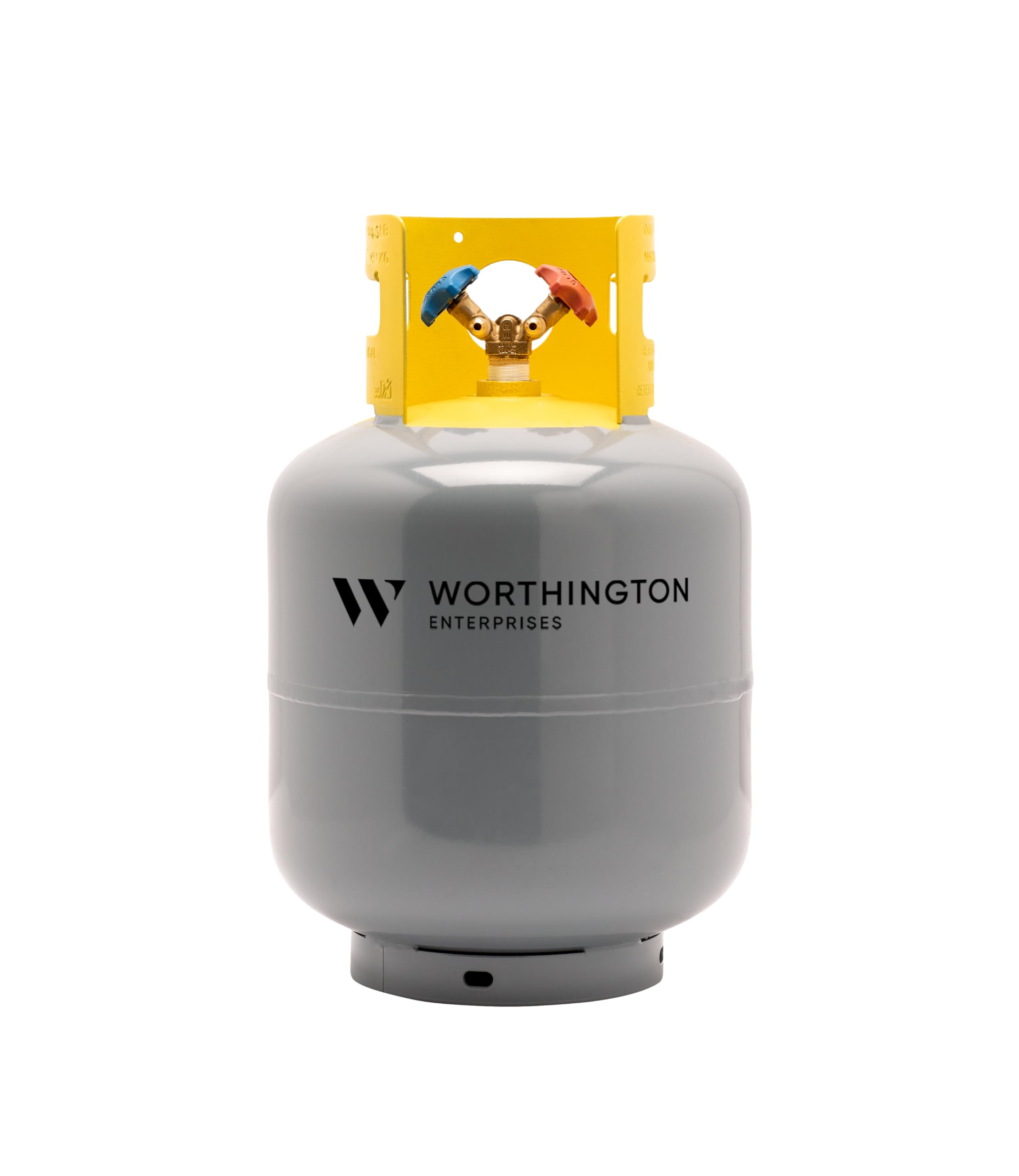
The Worthington cylinder is a name-brand workhorse with a long track record in the field. Its high-strength steel body and dual-valve configuration allow a technician to recover R-410A at high pressure and R-22 at low pressure without swapping hardware. Real-world feedback confirms it holds vacuum well and stands up to the knocks of daily van life.
At 25.5 pounds empty, the 50-pound capacity delivers enough room for a full residential system recovery without needing a mid-job supply house run. The DOT stamping is clearly legible on the shoulder, which avoids the refill station rejections that plague uncertified cylinders. Multiple buyers in the reviews report purchasing additional units as their CFC storage needs grow.
The valve threads are standard 1/4-inch SAE flare, so your existing manifold hoses and recovery machine connect without adapters. Some users note that the tank can arrive with minor cosmetic scuffs from shipping, but the build quality beneath the paint is solid. For crew leaders who need a dependable fleet cylinder, this is the option to trust.
Why it’s great
- DOT-4BA400 certified for legal transport of recovered refrigerant.
- Dual valve design handles both liquid and vapor recovery ports efficiently.
- Proven field reliability across multiple refrigerant types.
Good to know
- Does not include an 80% fill float switch — must be monitored with a scale.
- Occasional shipping scuffs on the powder coat finish.
2. Mastercool 63010 50 lb Recovery Cylinder

Mastercool has built its reputation on HVAC tools that survive the daily grind, and the 63010 cylinder is no exception. It is constructed from HP325 or HP345 steel — a step above the HP295 found in entry-level tanks — which gives it a higher safety margin when recovering wet or acidic refrigerant blends that accelerate internal corrosion.
The Y-valve with separate liquid and vapor paths (1/4-inch FL-M connections) lets you pull liquid directly without throttling through the vapor port, cutting recovery time by roughly 30 percent compared to single-port designs. The 30.8-pound empty weight is substantial, but that mass comes from the thicker steel walls that also make this cylinder one of the most impact-resistant options on the market.
Customer support from Mastercool is notably responsive — one buyer reported that the company knew the correct adapter part number without looking it up. The tank is DOT-4BA400 and CAN/CSA-B339-02 certified, and it is 100 percent U.S. assembled and tested. If you run a shop where the recovery cylinder takes a beating, this is your best long-term bet.
Why it’s great
- Upgraded HP325/HP345 steel offers superior corrosion and impact resistance.
- Y-valve reduces recovery cycle time with separate liquid and vapor ports.
- Full DOT and Transport Canada certification for worry-free transport.
Good to know
- Heavier than comparable 50-pound tanks at nearly 31 pounds empty.
- Does not come with a float switch for automatic 80% shut-off.
3. Flame King YSNR501 50 lb Recovery Cylinder

Flame King manufactures its cylinders in ISO 9001-certified facilities and stamps them with both DOT and Transport Canada approval — a combination usually reserved for pricier units. The 50-pound model (YSNR501) arrives pre-purged and vacuum-ready, so you can pull a deep vacuum immediately without boiling off internal moisture.
One buyer pulled 170 microns in roughly 15 minutes with a two-stage pump and saw only a 20-micron rise over the next quarter hour, confirming the tank arrived dry. The Y-valve uses 1/4-inch SAE flare connections, and there is an additional 3/4-inch NPT opening that accepts an optional 80-percent fill float switch — the only tank in this price bracket that offers that upgrade path.
Shipping packaging is the weak point: the tank often arrives in an oversized box with minimal padding, leading to paint scuffs. But the heavy-gauge steel walls protect the structural integrity, and the brass valve assembly is well-protected by the handle ring. For a mid-range price, you get build quality that rivals cylinders costing significantly more.
Why it’s great
- DOT and TC certified for safe, legal interstate transport.
- Includes a 3/4-inch NPT port for adding an 80% fill float switch.
- Holds deep vacuum out of the box — ready for immediate use.
Good to know
- Heavy-duty steel makes it one of the heavier 50-pound tanks at 25.6 lb.
- Paint scuffs common due to poor Amazon packaging.
4. Mastercool 62010 30 lb Recovery Cylinder

The 30-pound Mastercool 62010 is the ideal size for a service van that handles residential HVAC calls. At 17 pounds empty, it is light enough to carry into attics and crawlspaces, yet its 30-pound capacity handles a full charge from most standard split systems. The HP295 steel construction with powder-coated yellow/gray finish resists the rust that forms when tanks sit in damp truck beds.
The Y-valve with 1/4-inch FL-M (7/16-20) fittings gives you separate control of liquid and vapor recovery. Users in the reviews successfully recovered R-22 and R-134a without issues. One technician noted that automotive-style R-134a hoses with different thread patterns require a simple adapter, but that is standard for any HVAC recovery cylinder.
DOT-4BA400 certified and 100 percent U.S. assembled, this tank consistently earns praise for its reliable valve seal and durable weld lines. The tare weight of roughly 17.2 pounds is clearly visible, making fill calculations straightforward. For a mobile tech who needs a reliable mid-capacity cylinder, this is the most balanced option in the Mastercool lineup.
Why it’s great
- Compact and lightweight at only 17 pounds for easy portability.
- DOT-4BA400 certified for safe refrigerant transport.
- Y-valve provides independent liquid and vapor control.
Good to know
- Automotive R-134a threads require an adapter for a direct connection.
- No float switch available for automatic 80% shut-off.
5. FAHKNS 50 lb Recovery Tank (B0D4QH81P5)
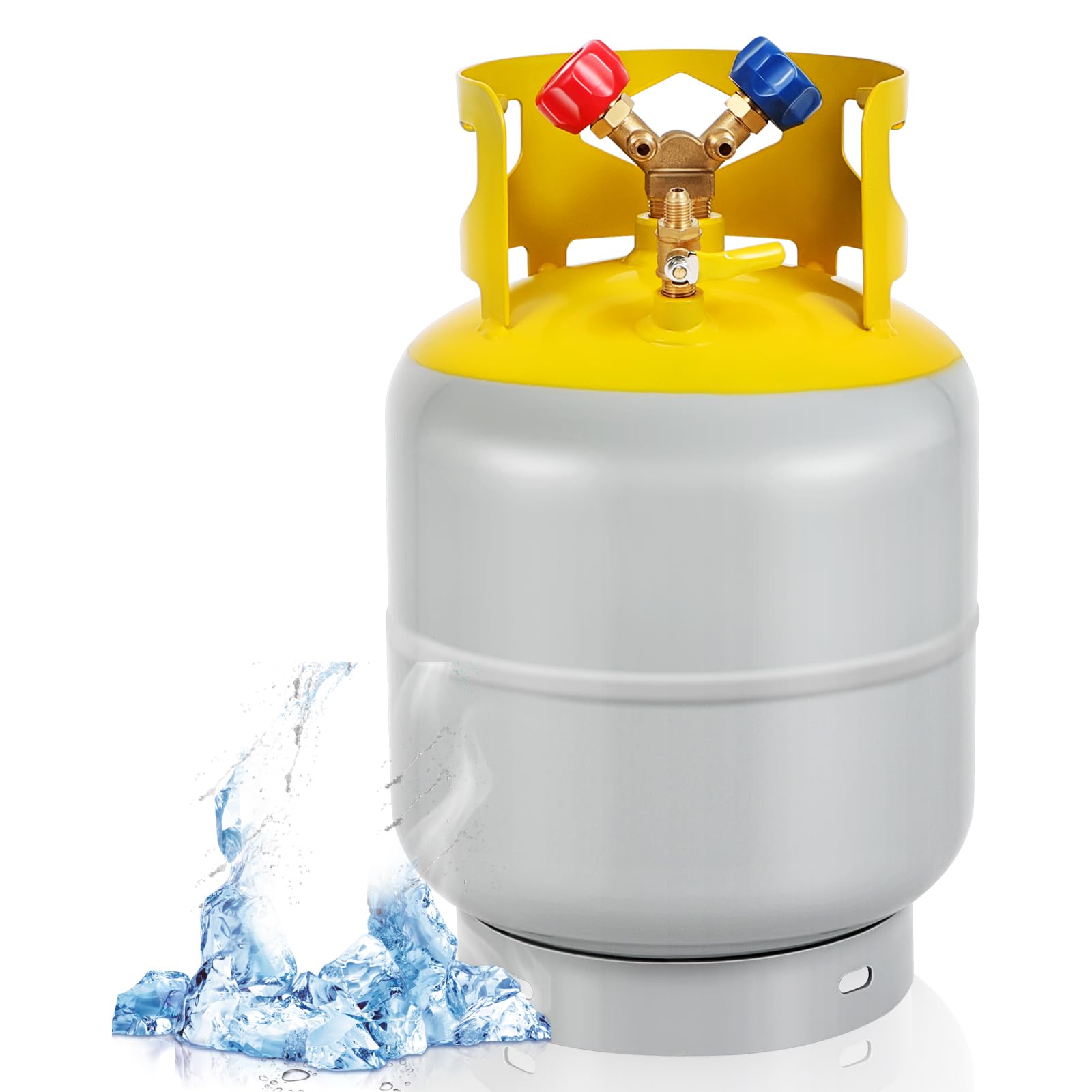
FAHKNS offers a 50-pound recovery tank at a price point that undercuts most premium brands by a notable margin. The tank is built from HP295 steel with a powder-coated finish and uses a brass Y-valve for liquid and vapor control. The collar-shaped handle makes it easier to grip and maneuver compared to neck-ring designs.
The key compromise with this cylinder is the absence of a visible DOT stamp and a missing tare weight marking — a detail that frustrated one reviewer who could not determine the empty weight for accurate fill calculations. The safety relief valve is set at 600 PSI, and the test pressure is listed at 800 PSI, but the lack of DOT certification means many refill stations will refuse to fill it.
Buyers report the tank works well for recovery when it is new, but the long-term track record is thinner than established brands. If you are a DIY user who refills at a private station that does not check certification, this tank provides a large capacity at a sharp entry price. Professionals should invest the difference in a DOT-stamped cylinder.
Why it’s great
- Large 50-pound capacity for extended recovery jobs without emptying.
- Brass Y-valve with plastic knobs for non-slip control.
- HP295 steel construction with a corrosion-resistant powder coat.
Good to know
- Lacks visible DOT certification stamp — may be rejected at supply houses.
- No tare weight or water capacity stamped on the tank.
6. FAHKNS 30 lb Recovery Tank (B0BZKY7D1V)

The 30-pound FAHKNS tank steps down from the 50-pound model to a more manageable size that fits on a service cart or under a workbench. It uses the same HP295 steel and brass Y-valve construction, and the round neck design provides a comfortable grip when carrying it to the job site. The operating pressure is rated at 400 PSI with a safety valve set for 600 PSI.
Buyer reports are mixed but informative: several users praise the build quality and affordable price, while a few others report slow leaks that caused significant refrigerant loss over weeks of storage. One reviewer noted the valves can cold-weld if left fully open, and the vendor sent a replacement promptly. This suggests quality control is inconsistent.
The lack of a DOT stamp is again a concern for professional use, and the instructions advise against filling above 80 percent capacity without the aid of a scale. For a stationary shop tank used for short-term storage before transferring to a certified cylinder, this works. For daily field use, a DOT-certified alternative is the safer path.
Why it’s great
- Affordable 30-pound size fits most workshop and van setups.
- Brass Y-valve with wear-resistant threads for long service life.
- Round neck collar for comfortable carrying and handling.
Good to know
- Not DOT certified — check with your refill station before buying.
- Inconsistent valve sealing reported in some units.
7. FAHKNS 30 lb Recovery Tank (B0D1KJSXYR)
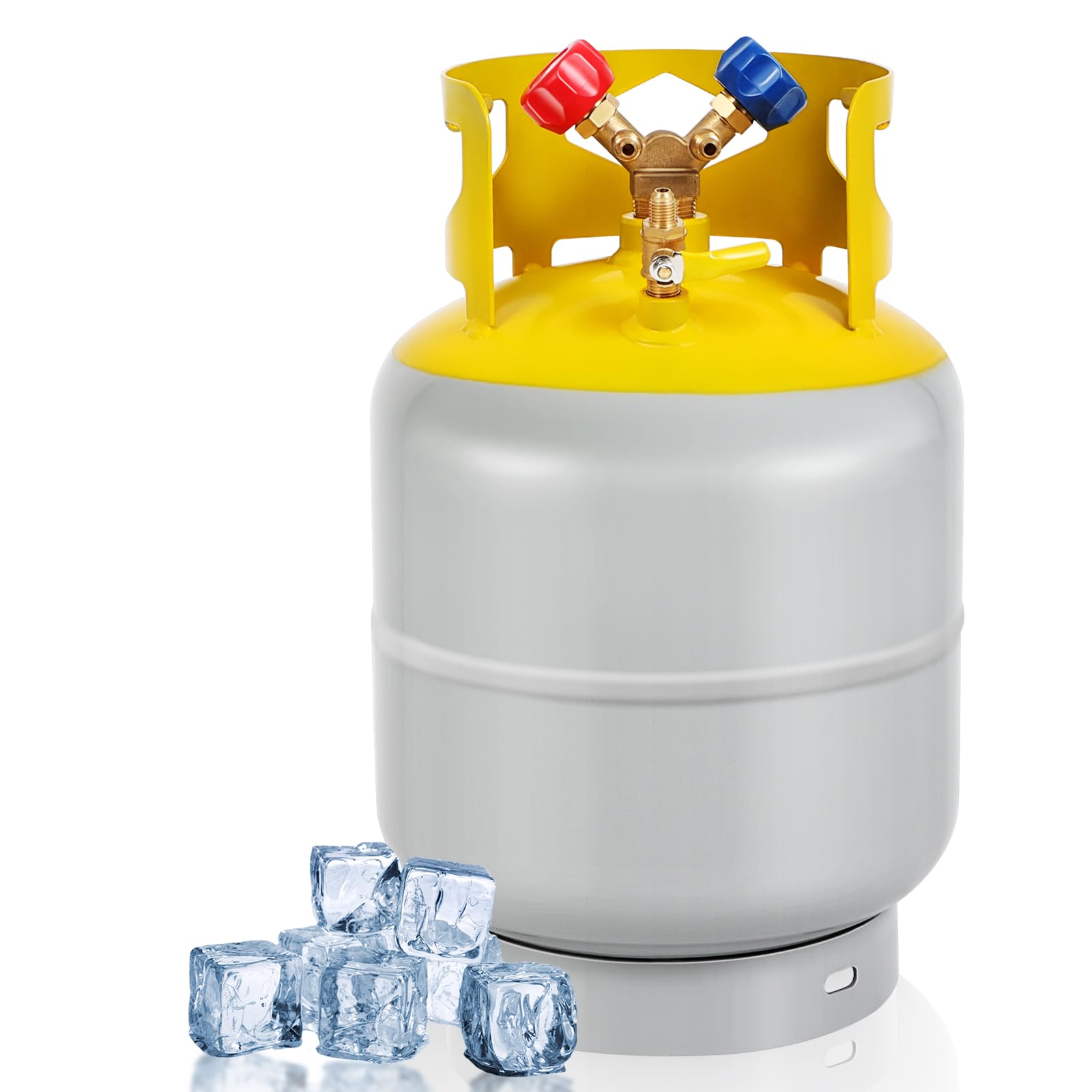
This FAHKNS 30-pound tank is nearly identical in specification to the B0BZKY7D1V model above, using the same HP295 steel and Y-valve design with a collar-shaped handle and stable round base. It is intended for recovering R-12, R-22, R-134A, and R-410A, and it arrives empty and ready for a pre-use vacuum.
Critical buyer feedback highlights two recurring issues: the relief valve has blown on the second use for some users, and one purchaser confirmed that the tank is not DOT certified, which led to a return in favor of a certified alternative. Another user reported hearing metal rattling inside the cylinder — a sign of debris from manufacturing.
On the positive side, buyers who received a well-built unit report that it holds vacuum and works as expected with a recovery machine. The price makes it accessible for the home mechanic who needs occasional refrigerant storage and has a refill source that does not require certification. For any commercial application where EPA compliance matters, a certified tank is the only safe answer.
Why it’s great
- Low entry price for a 30-pound recovery cylinder.
- Works with common refrigerants including R-410A and R-22.
- Y-valve with brass ball valve for flow adjustment.
Good to know
- Relief valve failure reported in multiple user experiences.
- Not DOT certified — cannot be legally transported filled.
8. FAHKNS 50 lb Recovery Tank (B0CKQQHWQC)

The 50-pound FAHKNS B0CKQQHWQC is the most affordable large-capacity cylinder in this lineup. It is made from HP295 steel with a thickened bottle body and a powder coating that the manufacturer claims is waterproof and leak-proof. The Y-valve uses the blue/red color scheme common to HVAC tanks, with the red valve controlling vapor and the blue valve controlling liquid.
The customer review data is dominated by a small number of catastrophic failure reports: two buyers lost substantial amounts of R-22 (12 pounds and 3.5 pounds respectively) due to leaks at the base of the main valve. A third user reported the safety valve blew on the second use. The common thread is that the valves and welds do not consistently hold over time.
The manufacturer specifies an operating temperature range of -20 to 55 degrees Celsius and warns against mixing refrigerants. The test pressure is listed at 800 PSI, but without DOT certification, the tank is effectively a garage-use-only container. The low price is tempting, but the risk of losing expensive refrigerant makes this the most expensive option in the long run for many buyers.
Why it’s great
- Lowest price point for a 50-pound recovery cylinder.
- Thickened HP295 steel body with powder-coated finish.
- Brass Y-valve with separate gas and liquid control.
Good to know
- Multiple reports of refrigerant leaking from valve base and safety valve.
- No DOT certification — supply houses will not fill or exchange it.
9. 20 cu ft Steel CO2 Nitrogen Mix Cylinder

This compact 20-cubic-foot steel cylinder is built around a CGA580 inert gas valve, making it suitable for CO2/nitrogen mix, argon, helium, and neon — not exclusively for HVAC refrigerant recovery. Its small dimensions (5.25 inches in diameter and 18 inches tall) allow it to fit under a bar or in tight cabinet spaces where larger recovery tanks cannot go.
Buyers report that the DOT stamp is present, which is critical for refill station acceptance. One user confirmed that their local welding supply filled it without issue. The tank ships empty per DOT shipping regulations, and it is rated to 2015 PSI — far above the 400 PSI typical of refrigerant recovery cylinders, making it a crossover tool for both beverage gas and limited HVAC purging tasks.
The trade-off is capacity: 20 cubic feet is roughly equivalent to a 5-pound liquid refrigerant tank, so it is not suitable for full-system recovery of residential AC units that hold 6 to 10 pounds of refrigerant. It is best reserved for small purge jobs, nitrogen pressure testing, or recovering small refrigerant charges. As a primary AC recovery tank, its capacity is too limited, but as a specialty gas cylinder, it is a solid buy.
Why it’s great
- DOT-approved for safe filling and transport.
- Ultra-compact size fits where 30- and 50-pound tanks cannot.
- Multi-gas compatible through the CGA580 valve.
Good to know
- 20 cu ft capacity is too small for full residential AC system recovery.
- Requires a CGA580 regulator — not compatible with standard HVAC manifold hoses.
FAQ
What does the tare weight (TW) stamp on an AC recovery tank mean?
Can I use a CO2 or nitrogen cylinder as an AC recovery tank?
Why does my recovery tank need a separate liquid and vapor valve?
Final Thoughts: The Verdict
For most users, the best ac recovery tank winner is the Worthington 50 lb because its DOT certification, dual-valve design, and proven track record in the field deliver the highest reliability per dollar spent. If you want a lighter, daily-carry option for residential service, grab the Mastercool 62010 30 lb. And for premium shop durability where the tank stays on-site and takes abuse, nothing beats the Flame King YSNR501 50 lb.