
Nothing ruins a summer afternoon faster than warm air pouring from your vents. The fix usually involves either an expensive service call or facing a shelf full of confusing cans with different fittings and chemistry. The right refrigerant is not a universal purchase — it is a precise match between your system, the leak situation, and the tool you own.
I’m Min — the co-founder and writer behind Gadgets Feed. I have combed through thousands of refrigerant product pages, customer reports, and compatibility specs to isolate the cans and kits that actually solve a home AC problem without leaving you with half a can of useless gas.
After filtering for safety, ease of use, and real-world results, this is the definitive guide to choosing the best ac refrigerant for home. These picks cover leak sealers, direct-charge cans, and the manifold gear needed to do the job right.
How To Choose The Best AC Refrigerant For Home
Home AC systems are not all the same. A window unit running R-290 cannot take R-134a. A central system using R-410A needs a different approach than an older R-22 machine. Start by reading the label on your condenser unit — it tells you the exact refrigerant type. The rest is about matching the format (can, sealer, or gauge set) to your skill level and the specific problem you face.
Refrigerant Type: R-410A vs. R-22 vs. R-290 vs. R-134a Replacement
R-410A is the modern standard for residential split systems. R-22 is phased out but still in older units — you need a drop-in replacement, not virgin R-22. R-290 (propane) is common in smaller appliances and window units. R-134a replacement blends are for automotive and some older home refrigerators. Using the wrong type damages the compressor.
Format: Straight Refrigerant vs. Leak Sealer vs. Leak Sealer Combo
Straight refrigerant cans are for topping off a system with a known slow leak you plan to fix later. Leak sealers contain a polymer-free organosilane that reacts with moisture at the leak site to create a permanent plug. Combo products mix refrigerant with sealer and UV dye — convenient if you suspect a leak but have not located it. Do not use a sealer if the system is completely empty; it requires charge to circulate.
Tool Compatibility: Self-Sealing vs. Piercing Cans and Manifold Gauges
Modern cans use a self-sealing valve (SSV) that stores unused gas when detached. Older piercing cans require a full discharge to remove. You also need the correct adapter — K-28 for R-290 cans, 1/4-inch flare for most other residential refrigerants. A digital manifold gauge eliminates guesswork when charging by showing exact pressure and temperature for 88 refrigerants.
Quick Comparison
On smaller screens, swipe sideways to see the full table.
| Model | Category | Best For | Key Spec | Amazon |
|---|---|---|---|---|
| Leak Saver R290 3-Pack | Refrigerant | R-290 window & fridge charging | 8 oz upright cans, self-sealing | Amazon |
| ZeroR R134a Replacement | Refrigerant | Home fridge & auto top-off | 6 oz SSV can, 14-inch hose | Amazon |
| Elitech Digital Manifold DMG-2SE | Tool | Diagnostics & precision charging | 88 refrigerants, ±1% FS accuracy | Amazon |
| Leak Saver Direct Inject 3-in-1 | Sealer | Sealing slow leaks up to 5 tons | 3-in-1 sealant + UV dye | Amazon |
| WISSCOOL Manifold Gauge Set | Tool | DIY charging & evacuation | 3 hoses, two can tap types | Amazon |
| A/C Pro ACP-105 Max-Seal | Refrigerant + Sealer | Automotive AC recharge + stop leak | 12 oz, MAX-SEAL 2-in-1 | Amazon |
| Enviro-Safe R134a Replacement 4-Pack | Refrigerant + Sealer | Multiple auto & home top-offs | 4 cans, 8 oz each, stop leak | Amazon |
In‑Depth Reviews
1. Leak Saver R290 Refrigerant 3-Pack

This three-pack of 8-ounce R-290 cans is the most convenient solution for anyone working with propane-based systems like window ACs, dehumidifiers, and mini-fridges. The self-sealing tops (ICOR K28 style) allow upright charging, which eliminates the messy tilting and gas loss associated with older cans. Each can stands on its own while the system pulls the charge — a small detail that makes the process significantly cleaner.
Leak Saver designed these specifically for R-290 equipment, so the pressure curve matches properly. The 8-ounce size is ideal for small appliances where overcharging is a real risk. Three cans give you 24 total ounces, enough for multiple service calls or a single replacement on a larger residential unit. Made in the USA and EPA-approved under 40 CFR Part 82.17.
The catch: the K-28 adapter is sold separately. If you already own a 7/16-inch self-sealing can tap, you are ready. If not, factor that cost into your purchase. Customer reports note the fitting difference from R-134a taps, so avoid guessing.
Why it’s great
- Self-sealing tops prevent gas loss when disconnecting
- Upright charging position simplifies the process
- Excellent value in a 3-pack for multi-use scenarios
Good to know
- K-28 adapter not included
- Only for R-290 systems — not universal
2. Elitech Digital Manifold Gauge DMG-2SE
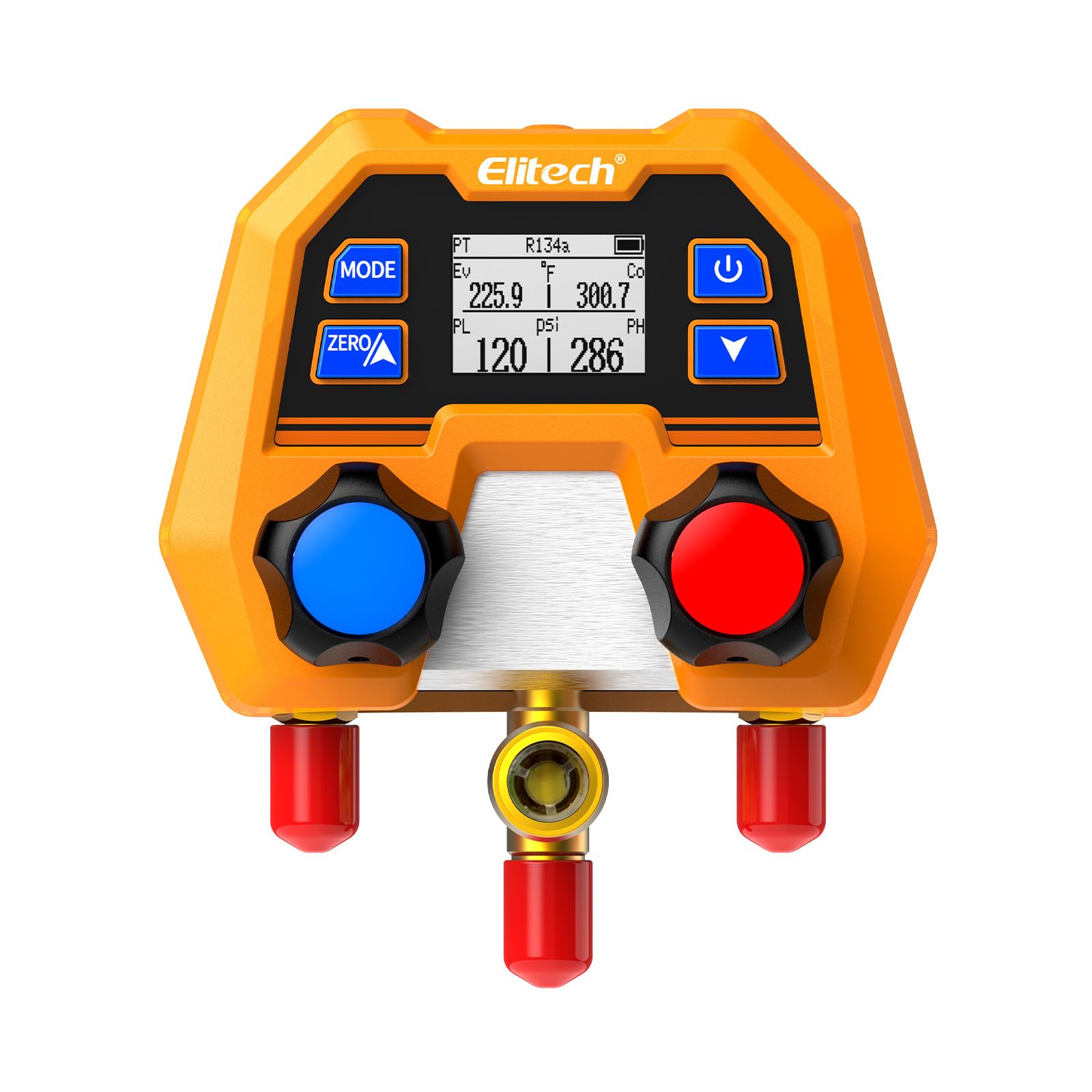
Digital manifolds have largely replaced analog sets in professional circles, and the Elitech DMG-2SE brings that capability to the home DIYer without the premium price tag. It supports 88 different refrigerants including R-410A, R-454B, R-32, R-1234yf, and R-134a — meaning one gauge covers both your central AC and your car. The accuracy sits at ±1% full scale, which is tighter than most analog gauges.
The backlit LCD screen makes night work or dark mechanical rooms much easier. Auto shut-off and data hold prevent battery drain during long diagnostic sessions. The housing is shock-resistant, and the brass valve block is heavy-duty. Multiple reviews confirm the DMG-2SE holds calibration and does not leak at the fittings — two failure points common in cheaper digital units.
One quirk: the auto shut-off timer is relatively short, which can interrupt a long pressure test. The resolution is 1 PSI, fine for charging but not ideal for micro-leak detection. Still, for the price, this is the smartest tool upgrade a home AC owner can make.
Why it’s great
- Covers 88 refrigerants in one tool
- Backlit display for low-light use
- Durable construction with brass valve block
Good to know
- Auto shut-off can interrupt long tests
- 1 PSI resolution limits ultra-fine pressure work
3. Leak Saver Direct Inject Ultimate 3-in-1

When you have a slow refrigerant leak that a technician could not find even with an electronic sniffer, this 3-in-1 formula is your best shot. The polymer-free organosilane sealant reacts with moisture and air at the leak site to create a permanent plug. Unlike some older sealants, Leak Saver is safe for TXVs, capillary tubes, and Schrader valves — no clogging risk. The included UV dye helps pinpoint large leaks under a blacklight.
This product works with all common residential and automotive refrigerants including R-410A, R-22, R-134a, R-1234yf, R-404A, R-290, and R-600a. It injects directly via a manifold gauge set or the Leak Shot injection kit. One dose covers systems up to 5 tons, which covers the vast majority of home central AC units. Over 4 million units sold since 2015 with strong field performance.
Installation requires a manifold gauge — this is not a screw-on can. You need a 1/4-inch flare adapter for standard systems, a 5/16-inch adapter for mini-splits, and a 134a-to-1/4-inch adapter for automotive. The sealant works best when the system still holds some charge, so do not use it on a completely flat system.
Why it’s great
- Permanently seals slow refrigerant leaks
- Safe for all system components including TXVs
- UV dye helps locate large leaks
Good to know
- Requires manifold gauge set for injection
- Not intended for completely empty systems
4. ZeroR AC Recharge Kit R134a Replacement
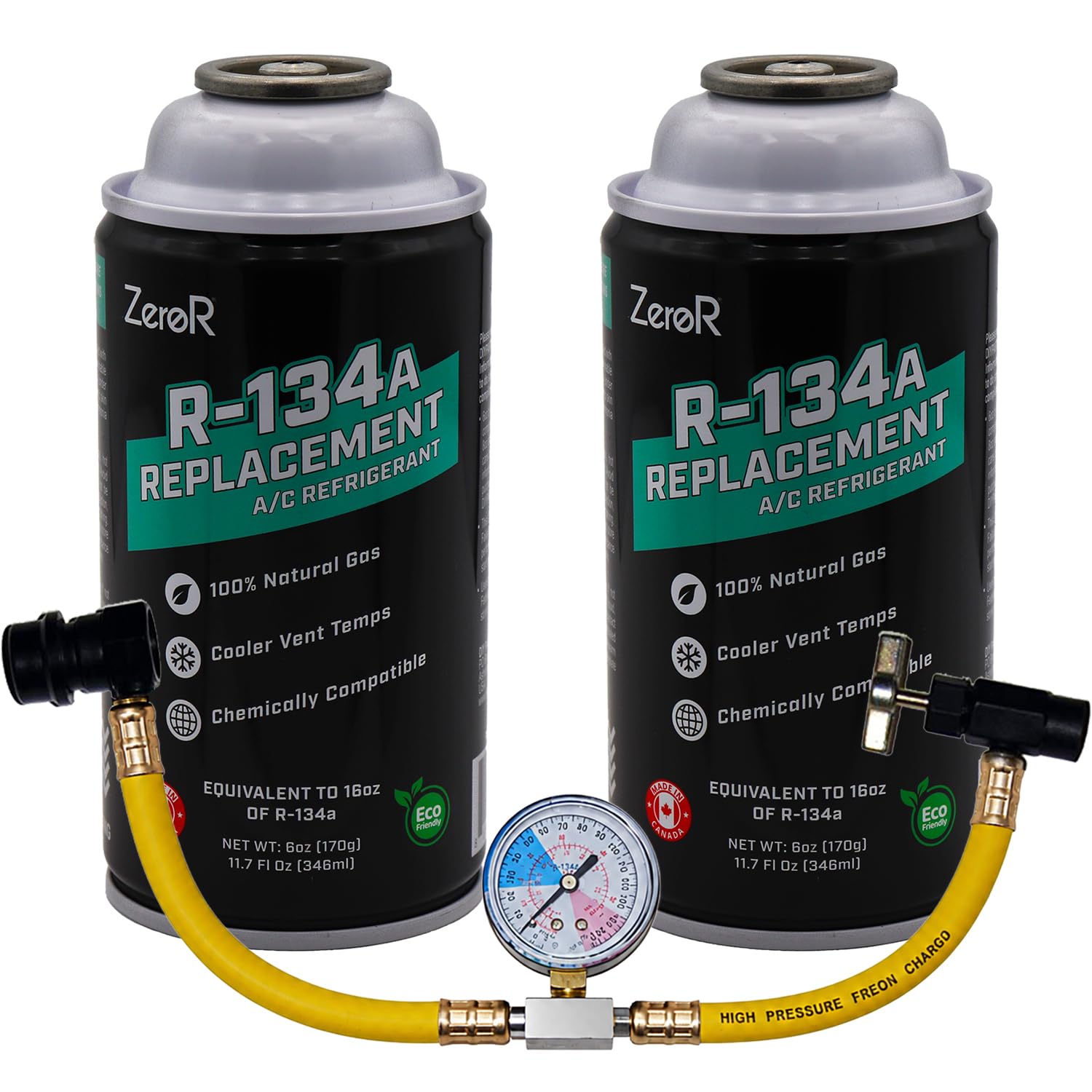
ZeroR offers a straightforward hydrocarbon blend that works as a drop-in replacement for R-134a systems. Each 6-ounce can (11.7 fluid ounces) delivers the same cooling capacity as larger R-134a containers because the blend is lighter per volume. The kit includes a 14-inch SSV charging hose, so you can start immediately if your system uses the standard self-sealing valve format.
The formula is 100% natural, ozone-safe, and has near-zero global warming potential. It operates at lower head pressures than R-134a, which can improve compressor efficiency and reduce wear. Users report vent temperatures dropping from 62°F to 46°F with a single can in automotive applications. The included hose adapter is surprisingly high quality for a kit at this price point, with solid threading and no leaking.
The SSV cans require an SSV-compatible tool — piercing-style taps will cause the gas to leak slowly. One verified buyer had a compatibility issue with their L-port fitting. Check your service port type before buying. Also, this is labeled for non-MVAC use, so verify local regulations if using in a vehicle.
Why it’s great
- Complete kit with hose and adapter included
- Lower head pressure improves compressor life
- Excellent cooling performance per can
Good to know
- SSV cans need compatible tool — check your setup
- Not for MVAC use — verify local rules
5. WISSCOOL HVAC Manifold Gauge Set

If you prefer analog gauges but want a complete kit that includes everything needed for charging and evacuation, the WISSCOOL set is a strong contender. It comes with three 5-foot color-coded hoses rated to 600 PSI working pressure and 3000 PSI burst. The package includes both a flat piston can tap for self-sealing cans and a piercing can tap for older puncture-style cans — you do not need to buy adapters separately.
The gauge faces are clear and easy to read, with calibration screws that allow field adjustment to maintain 1.6% accuracy. The brass and aluminum construction feels solid, and the sight glass lets you see liquid refrigerant flowing during charging. Users transitioning from DIY to more serious work appreciate having the valve core key wrench and the 1/4-inch male-to-1/2-inch female adapter included.
The gauge faceplates are plastic, which is a compromise at this price point. One reviewer noted better options exist if you are willing to spend more. The hoses are PVC — fine for occasional use but less flexible in cold weather than rubber. Still, for the home user who wants a turnkey solution instead of piecing together parts, this set delivers.
Why it’s great
- Includes both piercing and SSV can taps
- Three 5-foot color-coded hoses included
- Sight glass for real-time refrigerant flow check
Good to know
- Plastic gauge faceplates feel less durable
- PVC hoses stiffen in cold conditions
6. A/C Pro ACP-105 Refrigerant With Max-Seal

For automotive AC systems, the A/C Pro ACP-105 is the most recognized consumer-grade recharge can on the market. The 12-ounce can contains R-134a blended with MAX-SEAL chemistry that includes sealing agents for rubber O-rings, gaskets, and hoses. No-corrosion additives reduce moisture and acid buildup, which can prevent metal leaks from worsening. The three-step process is simple: attach the included hose, connect to the low-side port, and follow the pressure gauge.
Field results are consistent. A user with a 16-year-old car that had not had AC in three years saw a full recovery after a single can, with vent temperatures dropping to comfortable levels even in 100°F+ heat. Another report showed a drop from 62°F to 46°F after adding only 4 ounces. The stop-leak feature is effective on minor seepage but will not fix a blown compressor seal or a large hole.
The can is designed for automotive low-side ports only — it does not fit residential AC service valves without an adapter. The included hose is short and works best when you have clear access to the port. Some users report the gauge needle jumps erratically if the can is not held upright. The formula is also flammable, so keep it away from open flames and sparks during use.
Why it’s great
- Proven stop-leak formula that seals minor leaks
- Includes anti-corrosion additives for system protection
- Simple DIY application with clear instructions
Good to know
- Automotive-only — not for home AC systems
- Flammable — requires proper handling
7. Enviro-Safe R134a Replacement with Stop Leak 4-Pack
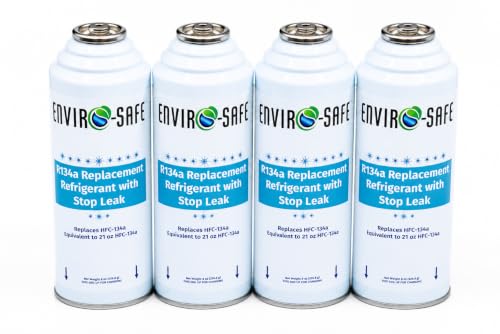
This 4-pack from Enviro-Safe (sold by cmebiz) delivers the most refrigerant per dollar in this roundup. Each 8-ounce can is equivalent to 21+ ounces of R-134a due to the hydrocarbon blend’s thermodynamics, meaning four cans give you roughly 84 ounces of cooling capacity. The formula includes a stop-leak additive, so you get recharge and leak defense in one product.
The hydrocarbon blend operates at lower head pressures than standard R-134a, which translates to improved compressor efficiency and potentially longer compressor life. A verified user replaced a condenser, vacuumed the system, and used three cans to refill a minivan — the AC ran significantly colder afterward. The product is EPA-approved in all 50 states and has been on the market for over 27 years, making it one of the most established hydrocarbon blends available.
The cans use a standard thread, but one report indicates the valve does not always self-seal properly when detached, leading to gas loss. Another user reported the can would not pump into their hose at all. Since this is a budget-tier product, quality control on the valve can vary between batch runs. If you buy, test the first can immediately and check for a proper seal before committing to all four.
Why it’s great
- Excellent value with 4 cans per purchase
- Equivalent to 21+ ounces of R-134a per can
- Stop-leak additive included in every can
Good to know
- Inconsistent valve sealing reported
- Some cans may not pump into certain hoses
FAQ
Can I use R-134a refrigerant in an R-410A home AC system?
How many ounces of refrigerant does a typical home central AC need?
Is it safe to use hydrocarbon refrigerant blends indoors?
Final Thoughts: The Verdict
For most users, the best ac refrigerant for home winner is the Leak Saver R290 3-Pack because it combines self-sealing convenience, upright charging, and the exact 8-ounce size suited for home window units and small appliances. If you want a digital manifold gauge that eliminates guesswork across 88 refrigerants, grab the Elitech DMG-2SE. And for sealing a slow systemic leak without replacing the entire coil, nothing beats the Leak Saver Direct Inject 3-in-1.