
Our readers keep the lights on and my morning glass full of iced black tea. As an Amazon Associate, I earn from qualifying purchases.
Specs are compiled from manufacturer listings and verified buyer reviews and can change over time — please confirm the key details on the product page before buying.
Your car’s AC blowing warm air usually means one thing: the system lost its refrigerant. The fix is a recharge, and the right kit turns a shop visit into a driveway job you can finish in an afternoon. This guide breaks down the recharge kits, gauges, and vacuum pumps that actually get the job done without a mechanic’s diploma.
I’m Min — the founder and writer behind Gadgets Feed. This guide is built by comparing the manufacturers’ published specifications and the patterns across verified customer reviews, so you get each pick’s real strengths and trade-offs instead of marketing spin.
You can recharge your car’s AC yourself with the right gear, whether you just need a quick top-off or a full system evacuation. Here are the best options for DIYers, from simple can-and-gauge kits to complete vacuum pump setups.
Our Picks at a Glance
How To Choose The Best AC Refrigerant Recharge
Your choice depends on two things: the refrigerant your car uses and how much work you plan to do. If your system just lost a little gas, a quick top-off kit works fine. If you are fixing a leak or replacing a compressor, you need a full vacuum pump and gauge set to do the job properly.
Know your refrigerant type first
Cars built around 2014 and later mostly use R1234yf, while older vehicles run R134a. These two gases use different quick-connect fittings, so a kit for the wrong type will not even attach to your low-side port. Check your owner’s manual or the sticker under the hood before you buy a single can.
Decide between a top-off can and a full service kit
A simple can with a hose and gauge tops off a system that is low but still holding pressure. A full service needs a vacuum pump to pull air and moisture out before you add fresh refrigerant. If your system has been open to the air for a while, a vacuum pump is not optional — it is the only way to do the job right.
Quick Comparison
| Model | Best For | Refrigerant Types | Pump Flow | Hose Length | Amazon |
|---|---|---|---|---|---|
| VEVOR 4.5 CFM Set★ Best Overall | Full home & auto service | R134a, R22, R12, R410A | 3.5 CFM | 3.94 ft | Amazon |
| Lichamp Gauge SetBest Value | Budget top-off | R134a & R1234yf | — | 5 ft | Amazon |
| ENVIRO-SAFE 3 CansFast Top-Off | Quick R134a top-off | R134a replacement | — | — | Amazon |
| cmebiz R134a 3 Cans | R134a top-off | R134a replacement | — | — | Amazon |
| Arctic Air 1234yf 2 Pack | R1234yf top-off | R1234yf | — | — | Amazon |
| ZeroR Eco 4 Cans | Eco-friendly R134a top-off | R134a replacement | — | 24 in | Amazon |
| Arctic Air 3 Cans & Hose | R1234yf with hose | R1234yf | — | — | Amazon |
| ZeroR Premium Repair Kit | Leak repair & recharge | R134a replacement | — | 24 in | Amazon |
| OMT 3.5 CFM Set | Professional auto service | R134a, R12, R22, R502 | 3.5 CFM | — | Amazon |
In‑Depth Reviews
1. VEVOR 4.5 CFM AC Vacuum Pump and Gauge Set
Our pick — over 4.5★ from 150+ verified ratings; the strongest balance of quality and price.
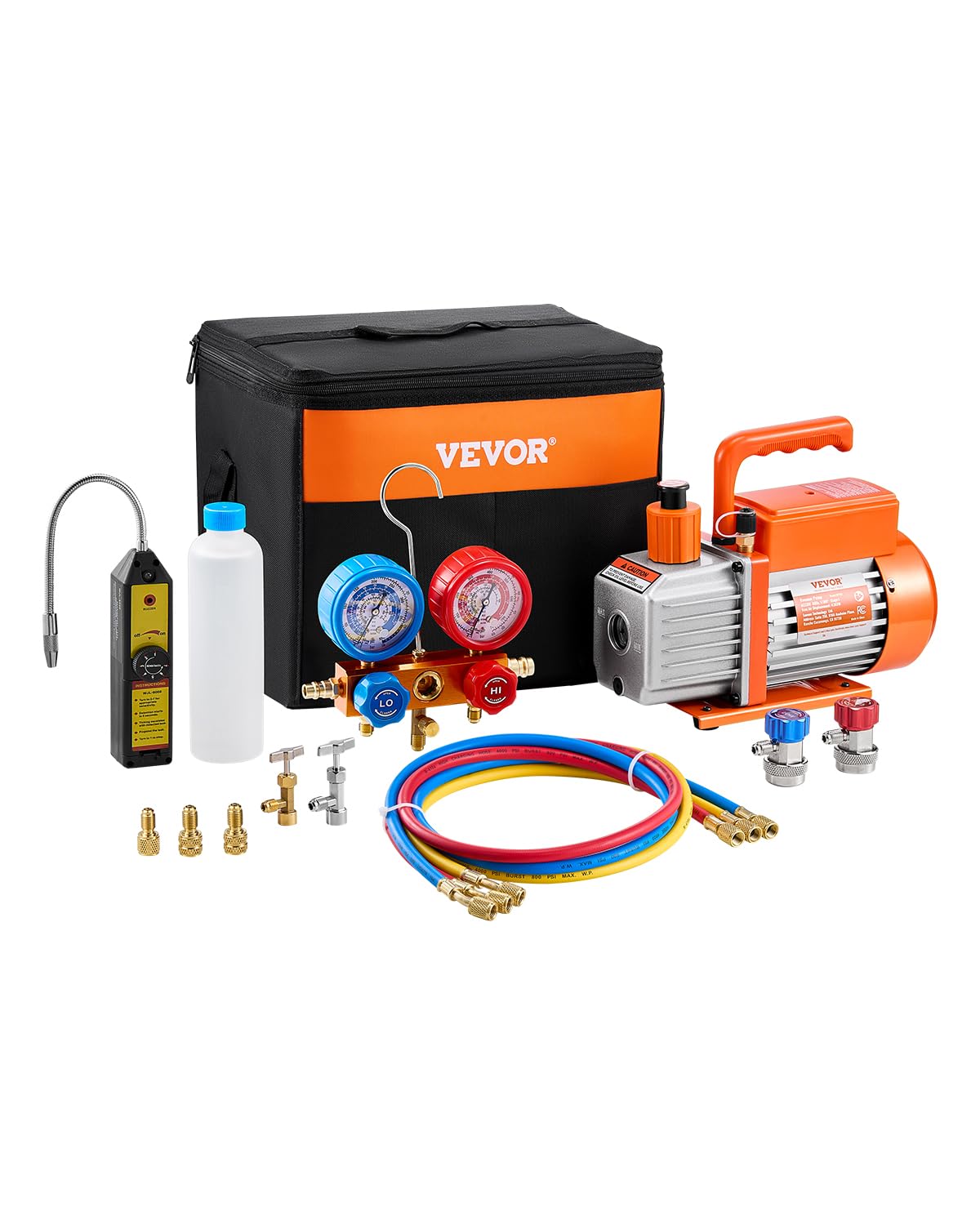
This all-in-one kit bundles a 3.5 CFM vacuum pump, manifold gauges, and a leak detector for full professional-grade AC service.
This setup lets you do the job like a professional shop, not just top off a can. The single-stage vacuum pump reaches an ultimate vacuum of 5 Pa (a measure of how completely it removes air and moisture from the lines before you add fresh refrigerant), which prevents a recharge from failing a week later. Buyers report it handled a full vehicle AC service on the first try, with one buyer relying on YouTube tutorials and still getting everything working.
The manifold gauge reads pressure with ±1.6% accuracy, and the color-coded hoses in red, blue, and yellow make it obvious which line goes where. The kit works across R134a, R22, R12, R502, R410A, R404A, and R407C, so it covers cars, home mini-splits, and refrigeration work. It even ships with an R410A adapter, two can taps, quick couplers, and a carrying bag to keep it all together. At 15.87 pounds it is not a featherweight, but that weight is the pump doing real evacuation work.
The included leak detector sniffer is a genuine bonus — it flagged a leak that the owner then fixed, turning a frustrating diagnosis into a solution. The crowd favorite aspect is functionality, and the quality earns steady praise too, which tracks with the “excellent quality” and “great value” notes that show up again and again in the reviews. The 4-stage pure copper motor and 0.27 qt oil capacity point to a pump built to run more than once.
Strong vacuum basics
- Pulls a deep 5 Pa vacuum so recharges actually hold
- Works with seven refrigerant types, from R134a to R410A
- Everything is in the box: hoses, leak sniffer, oil, adapters, bag
Hose gauge limits
- At 15.87 pounds it is heavy to haul around
- Overkill if you only need a quick can top-off
choose if: you want one kit that does vehicles, mini-splits, and full evacuations without a shop visit.
avoid if: your AC just needs a half-can top-up — a simple gauge kit is lighter and cheaper for that job.
2. Lichamp R1234yf Refrigerant Recharge Kit
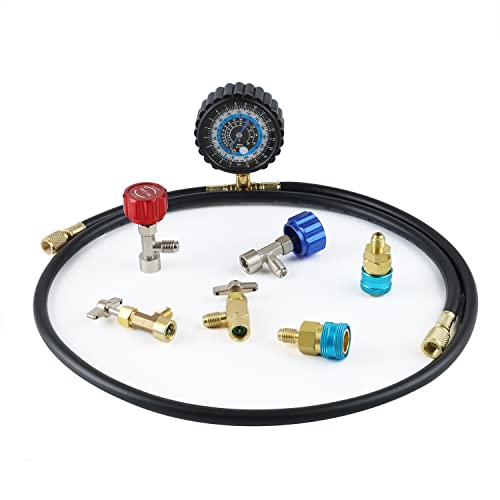
This affordable gauge set includes separate couplers and taps for both R134a and R1234yf, plus a 5-foot hose.
If you just want to read your low-side pressure and screw in a can, this is the entry point. It ships with everything for both gas types: separate quick-connect couplers and can taps for R134a and R1234yf, plus a gauge with a clear 250 psi blue dial. The hose stretches a generous 5 ft, rated for a 4000 psi burst pressure and 800 psi working pressure, so it reaches awkward ports without kinking. At 1.8 pounds, it is a feather compared to the 15.87-pound VEVOR — a difference you feel when you are leaning over an engine bay.
The functionality earns the most positive mentions, and the completeness gets called out too — owners like having all the attachments in one box. The honest catch is the R134a quick coupler: several owners mention it arrives faulty and needs a nudge with a screwdriver to seat properly. Customers note “Does good job for R1234YF recharge, but R134a Quick Coupler is faulty” — meaning it works if you are patient, but it is not plug-and-play on that side.
For the price, this is a solid starter kit. If you expect to do full vacuum-and-recharge services down the road, buyers openly suggest stepping up to a manifold gauge set with hoses. But for a simple top-off on a car that just lost a little gas, the Lichamp gets you there cheaply.
grab for: a first-time top-off on a modern R1234yf car without paying for a full manifold setup.
wait for: the R134a coupler — it can need manual persuasion to lock on.
3. ENVIRO-SAFE R134a Replacement w/ Stop Leak
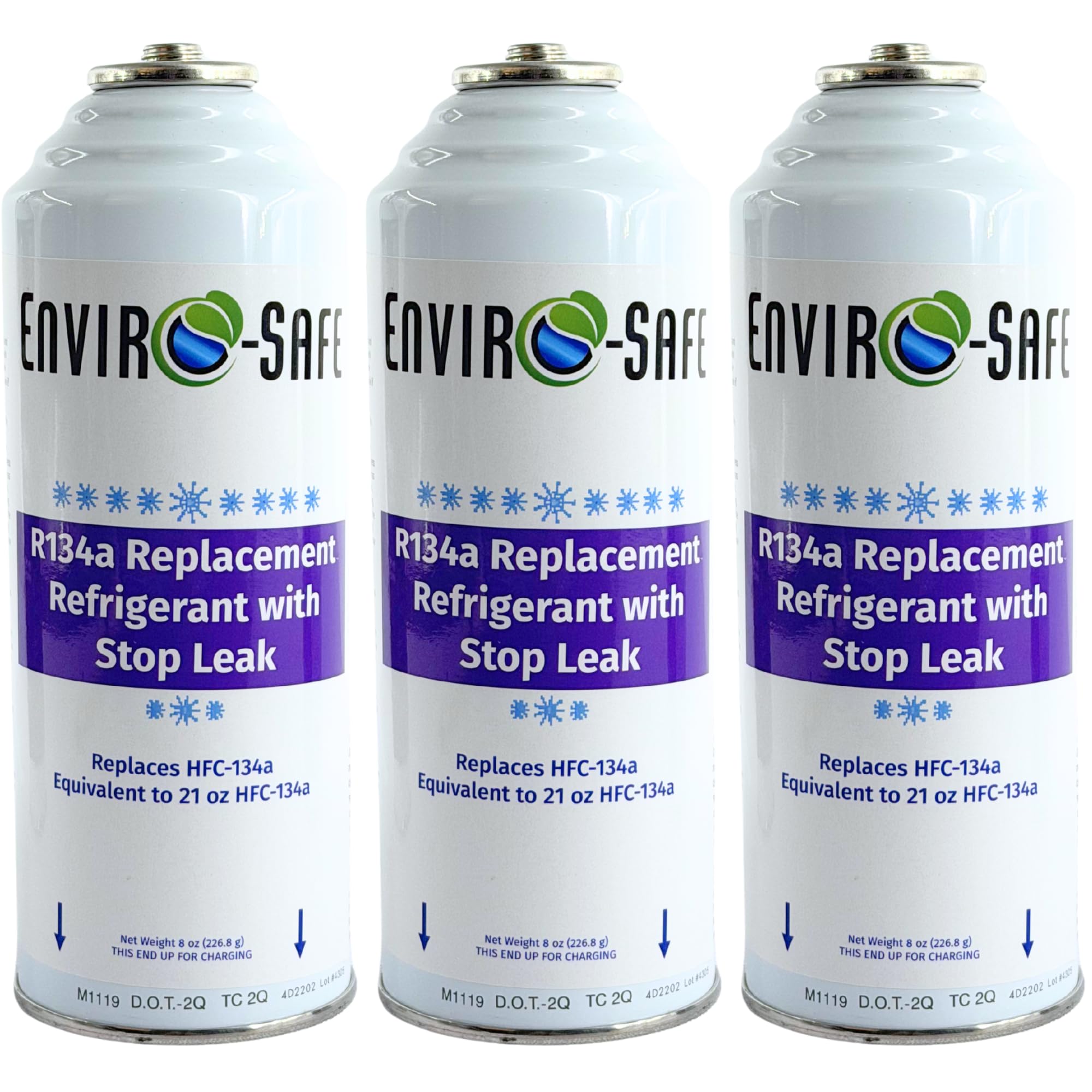
This three-can R134a kit with a piercing valve delivers a quick top-off and includes stop-leak additive for minor pinhole leaks.
This is the grab-and-go answer for a car that just needs its refrigerant topped up. Each can equals 21 oz of R134a, and the kit comes with three cans plus a piercing valve, so you have enough juice to top off a couple of vehicles or one that was pretty low. The formula runs at lower head pressure for efficiency and includes a stop-leak additive to seal minor pinhole leaks in the system. Reviewers point out “Excellent product, works perfectly, ICE cold air!” — the exact reaction you want on a hot day.
The maker says this is the original Enviro-Safe refrigerant introduced over 29 years ago, and the “Made in America” label adds confidence. The functionality and cooling performance get the most positive mentions, with truck owners reporting it worked great and delivered real cold air. The catch shows up in installation: a few shoppers say the can does not always go in smoothly, and there is some back-and-forth on whether it is a great deal or a waste of money. That split opinion is worth honoring — this works best when the system is low but not completely empty.
If your AC blows warm but still cycles the compressor, this is a fast, affordable fix. If your system is bone dry from a major leak, no stop-leak can is going to save it — you need the vacuum pump route instead.
Seals minor leaks: a quick R134a top-off with stop-leak insurance, from a brand with three decades of history.
Not for big leaks: an empty system with a big leak — that needs a pump and a real repair first.
4. cmebiz R134a Replacement 3 Cans

This three-can R134a kit with a piercing valve is built for topping off systems with slow leaks that need periodic refills.
This three-can kit with a piercing valve is built for the most common AC situation: a system that holds most of its gas but has a slow leak that siphons it away over months. One owner’s Jeep has exactly that problem, and the kit got the AC working again — the exact scenario this product is designed for. The refill is easy to use, and buyers report getting the A/C cooling down with no problems after a simple hookup.
The honest reality is that experiences split down the middle here. Some owners call the quality good, while others describe it as poor, and the ease of use gets the same mixed treatment. The key warning from experienced buyers is blunt: do not attempt this if you do not understand high-pressure AC systems, because a mistake can be dangerous. Make sure this matches your car’s refrigerant type before you hook up anything.
This is a workable budget top-off, but the mixed owner feedback means it is not the first can I would reach for. It shines for a slow leak that just needs regular topping, and the three-can pack gives you refills for later.
best for: vehicles with a known slow leak that need periodic top-offs without a shop trip.
skip it: you are new to AC systems and want the reassurance of clearer instructions and more consistent owner feedback.
5. Arctic Air R1234YF Support 2 Pack
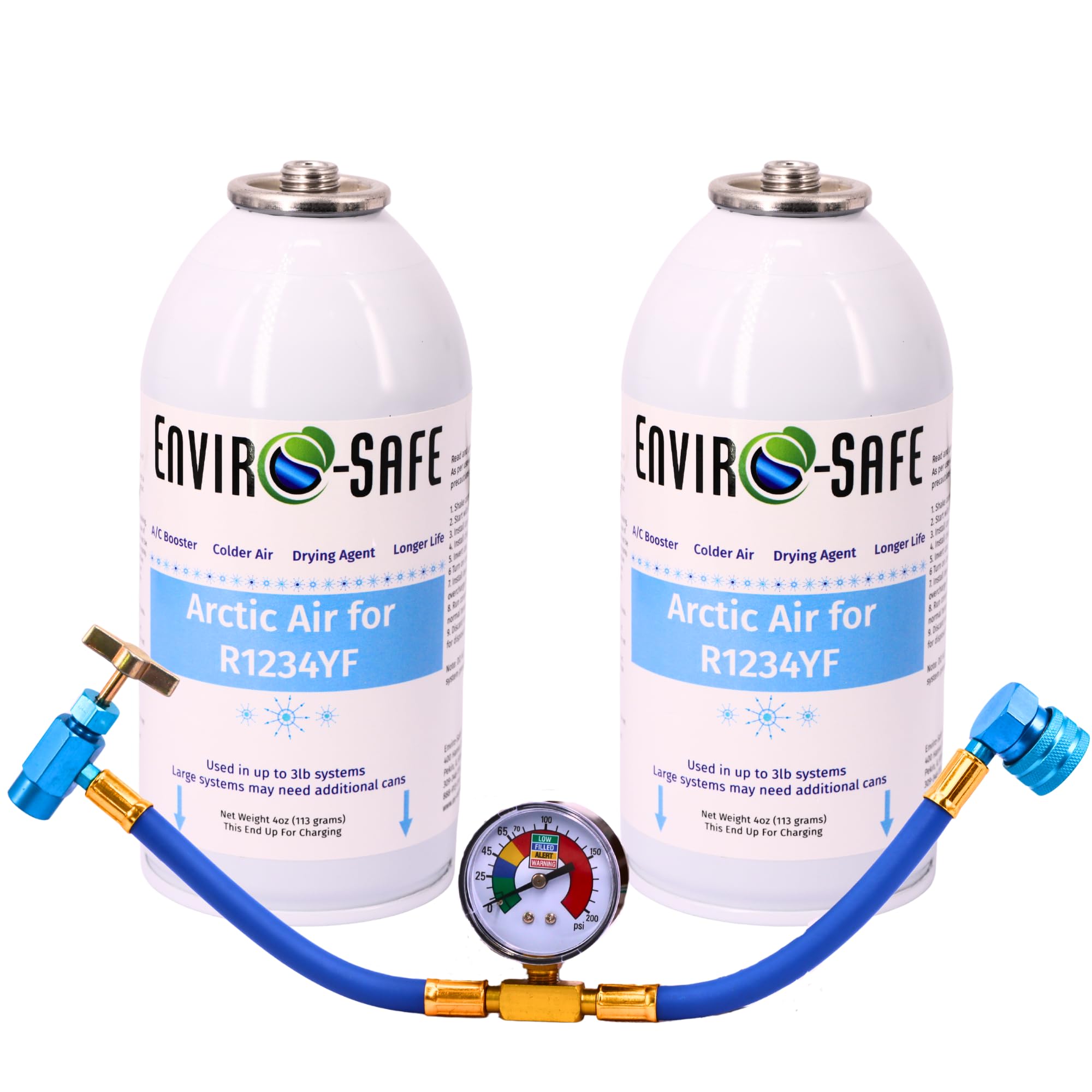
This two-can R1234yf kit features a brass gauge rated to 3000 psi, designed for easy top-offs on 2014-and-newer vehicles.
If your car is 2014 or newer, it almost certainly runs R1234yf, and this two-can kit with a brass gauge is built specifically for it. The gauge is the standout — buyers call it easy to read and operate, and the directions on the can are simple enough to follow without a manual. On top of recharging, the formula doubles as a system booster that removes moisture and lubricates the compressor, so it is doing maintenance while it fills.
The gauge handles up to 3000 psi, and the four-ounce cans are sized for a quick top-off rather than a full fill. Owners mention this is the easiest refrigerant they have put in, with one buyer noting it costs a fraction of the dealer route and works better than anything else they tried. The functionality and ease of use get the most positive mentions, which matches the “user friendly” and “worked as expected” notes in the reviews.
The honest caveats: the quality and value split opinion, and a few owners hit fit problems on specific cars — one 2020 Kia had a cramped low-pressure port that the short hose could not reach properly. If your port is easily accessible, this is a clean, simple recharge. If your engine bay is tight, measure your port access before committing.
choose this: a straightforward R1234yf top-off with a gauge that actually makes sense to read.
look elsewhere: your low-side port sits in a tight spot — the short hose has failed on some cramped installs.
6. ZeroR Eco-Friendly R134a Recharge Kit
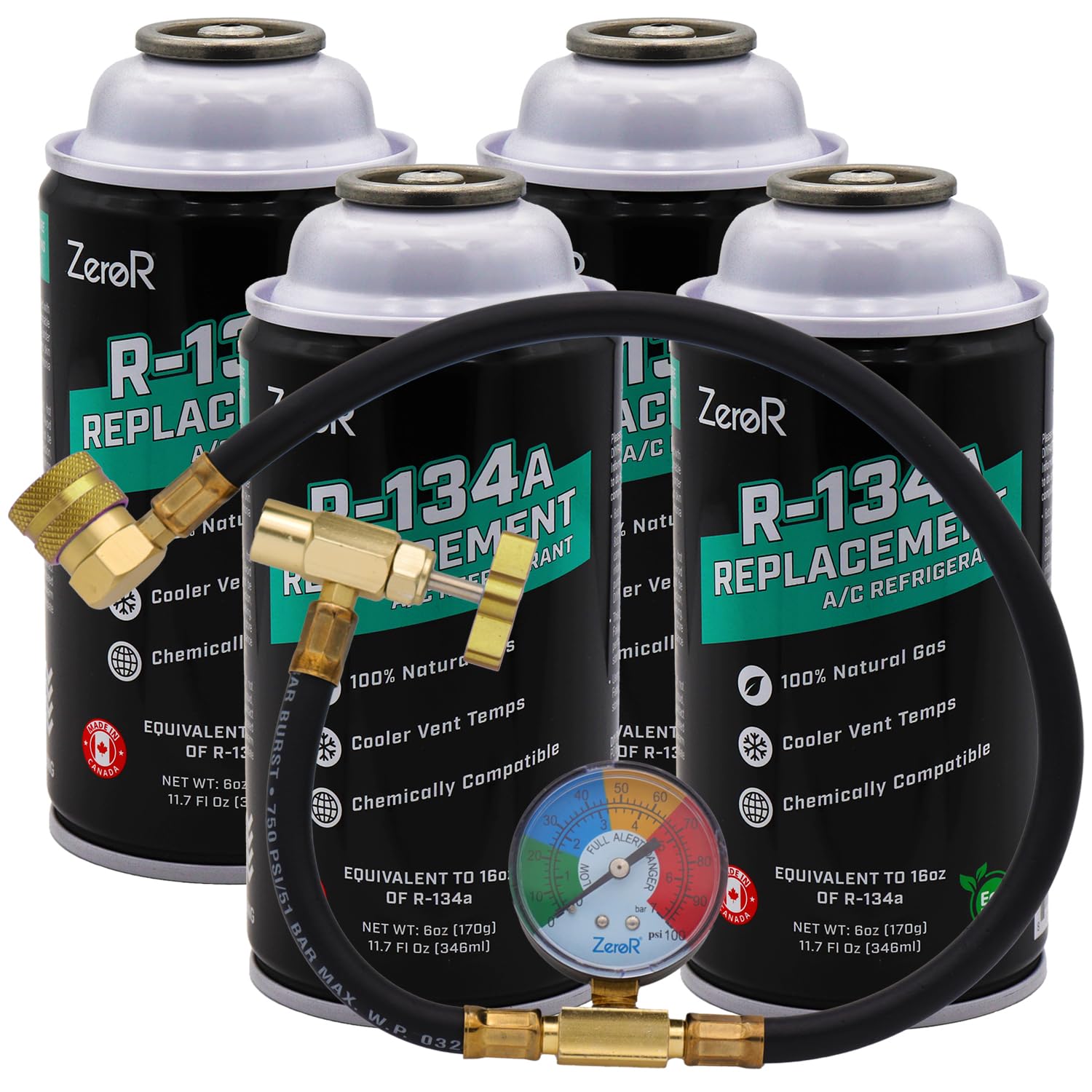
This four-can kit uses a natural hydrocarbon blend that is ozone-safe and works with existing R134a systems, plus a 24-inch hose.
This four-can kit takes a greener route: a 100% natural hydrocarbon blend that is ozone-safe and avoids global warming potential, chemically compatible with existing R134a systems. The 24-inch charging hose is the practical upgrade here — it reaches low-side ports that shorter hoses cannot, and it works with self-sealing valve (SSV) cans so you can store leftover gas instead of wasting it. Customers note it fit perfectly on a 2010 Chevy HHR and an 03 Ford Explorer Sport Trac, blowing cold with no leaks afterward.
The ease of use gets the most positive mentions, and that tracks with the “worked great, fast shipping, perfect fit” notes that dominate the happy reviews. But the picture is genuinely split: the quality, functionality, and value all draw mixed feedback, and a handful of owners hit real problems. One buyer warns it did not work at all, and another flags leakage and a fit mismatch. The recurring complaint is important — some owners received cans that leaked or systems that did not cool as expected.
If you want an eco-friendly option that works on a properly prepped system, this is a strong candidate. Just verify the can’s SSV requirement before you hook up a piercing tool, and confirm your system is low but not empty for best results.
Eco-friendly R134a kit: you want a natural, ozone-safe R134a replacement with a long 24-inch hose for tight ports.
Slow recharge pace: owner experiences split sharply, so test on a system you are confident is just low, not damaged.
7. Arctic Air R1234YF 3 Cans & Hose

This three-can R1234yf kit with a hose provides a maintenance top-off for nearly-full systems, with each can holding 4 ounces.
If your newer car runs R1234yf and you want a little more gas in the tank than a two-pack provides, this three-can kit with a hose is the middle ground. Reviewers point out following a YouTube guide for their Honda and getting the AC working great, ready for warm weather — the exact outcome this product promises. A mechanic’s spouse even used it to get a car back up and running after an expensive compressor replacement, calling the kit affordable compared to the other parts.
The reality here is more cautious than the happy reviews suggest. The functionality, quality, and value all draw evenly mixed feedback, and the most common negative is the quantity — owners note the cans hold just 4 oz each, which is a top-off amount, not a full charge. Some shoppers say fitting issues, and one owner flagged a misleading label that made the product hard to use with standard 1234yf hoses.
This works best as a maintenance top-off for a system that is mostly full. If your AC is completely dead from empty, four ounces per can is not going to bring it back — you would need the full vacuum-and-fill route instead.
best for: topping off a nearly-full R1234yf system so it blows cold again without a shop visit.
not enough: an empty system — 4 oz cans are for boosts, not full recharges.
8. ZeroR Premium Repair & Recharge Kit
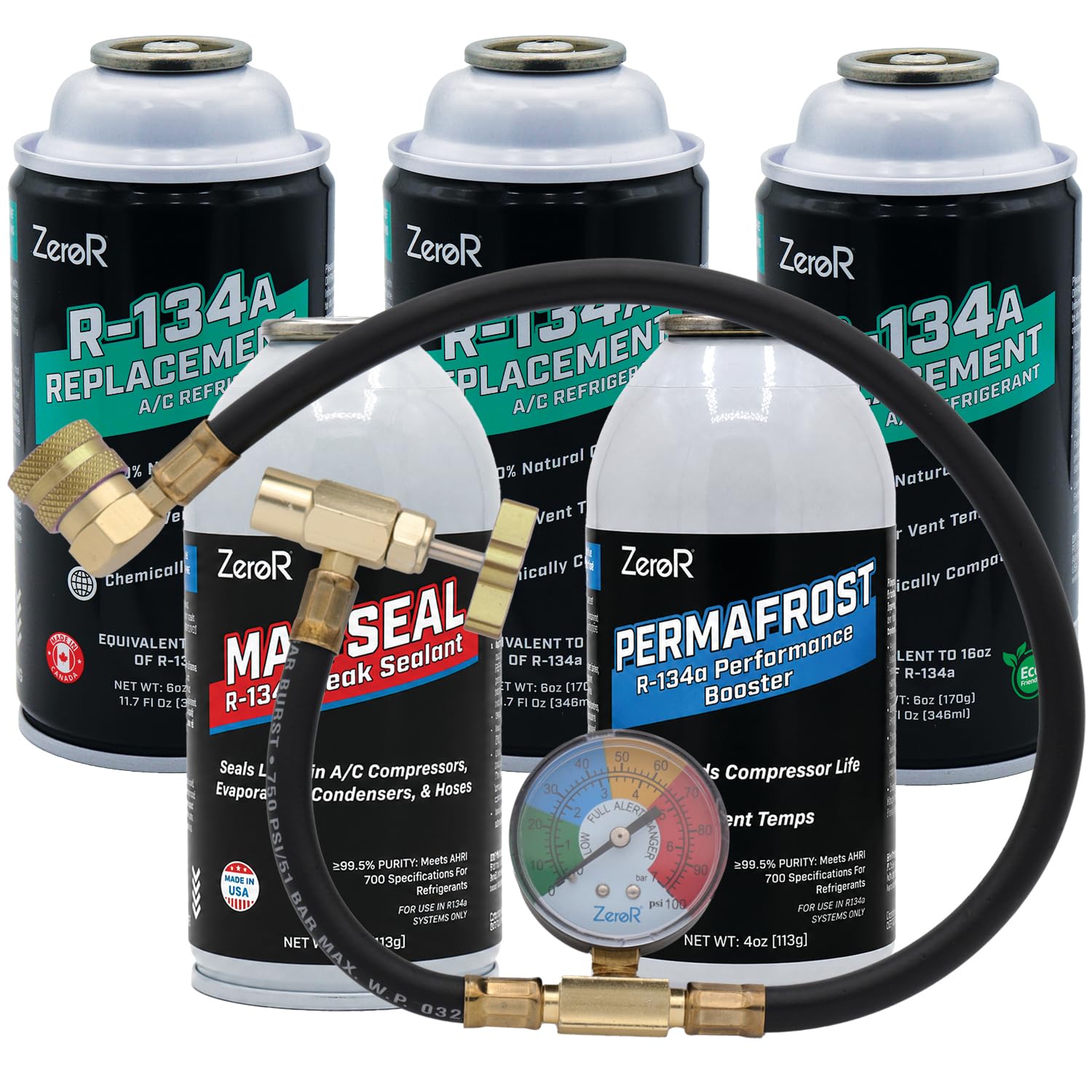
This kit combines Max Seal leak repair, R134a Permafrost refrigerant, and a 24-inch hose with gauge for a complete single-system service.
This is the most complete single-system solution on the list. It combines Max Seal to repair minor leaks in evaporators, condensers, and fittings, plus R134a Permafrost that removes damaging moisture and reduces friction, and a 24-inch charging hose with can tap and gauge. The kit is designed for one system repair, and buyers report it delivered “Blowing ICE COLD 🥶❄️🧊 3°C/39°F” — real temperature relief even after the system ran completely dry. The longer 24-inch hose is a genuine upgrade for reaching low-side ports that a standard 12-inch hose cannot touch.
The refrigerant itself is a 100% natural gas, and one owner notes it is propane-based, which means it removes more heat for its mass than the freons it replaces while being far kinder to the environment. The oil and dryer can is a smart addition for old systems that may be running dry. The main complaint is a real one: this is not R134a, so you cannot top off a system that still has R134a in it — the gases are not compatible. One owner learned this the hard way after using two 12 oz cans.
For a new-to-you vehicle with unknown AC history, this kit provides everything you could need in one box. The only challenge, as one owner put it, is figuring out the right order of operations — but that is what the internet is for.
perfect for: a full repair-and-recharge on a vehicle whose AC history is unknown, with leak and moisture issues handled together.
critical warning: do not pour this into a system that still holds R134a — it is a complete replacement, not a top-off.
9. OMT 3.5 CFM AC Vacuum Pump and Gauge Set

The workhorse 3.5 CFM pump that recharged two cars in one afternoon.
Orion Motor Tech’s kit is the professional-grade route for DIYers who take AC service seriously. The 1/4 hp vacuum pump with an all-copper motor evacuates at 3.5 CFM, and the aluminum alloy casing dissipates heat while resisting corrosion — a pump built to run long. The 3-way manifold gauge gives precise real-time pressure readings, with color-coded four-layer hoses rated to 600 psi working pressure and 3000 psi burst.
The kit includes R134a self-sealing and puncture-style taps, quick couplers, vacuum oil, and three hoses, all packed in a durable case and bag. Owners appreciate the built-in cooling fan, the sight glass for checking oil levels, and the bottom drain valve for quick oil changes — small touches that make regular use less of a chore. The compatibility list covers R134a, R12, R22, and R502, so it handles both auto and indoor HVAC systems.
The honest trade-off is the learning curve: the instructions are thin for first-timers, and owners openly relied on YouTube to figure out the setup. One buyer’s self-sealing tap failed and needed replacing, and the couplers can be tricky unless fully closed. But the pump itself runs flawlessly, and the gauges read accurately — the fundamentals are solid, and the price undercuts shop visits dramatically.
Lighter vacuum pump: the DIYer who wants a real vacuum pump for full AC services and can learn from videos, not manuals.
Lower CFM power: budget a few dollars for a replacement can tap if yours arrives less-than-perfect.
Understanding the Specs
CFM (Cubic Feet per Minute)
This spec tells you how quickly the vacuum pump removes air from your AC lines. A 3.5 CFM (cubic feet per minute) pump clears a car’s system in under an hour, which is a reasonable time for a home garage. Higher CFM evacuates faster, but 3.5 CFM balances speed and cost for most DIYers.
Ultimate Vacuum (Pa)
This is how deep the pump can pull the pressure down, measured in Pascals. A pump that reaches 5 Pa removes nearly all air and moisture from the lines. Moisture is the enemy of AC systems — it forms acid that eats the compressor from the inside. Deeper vacuum equals a healthier recharge.
Refrigerant Compatibility
R134a is the standard for cars built roughly 1995-2014, while R1234yf is used in 2014-and-newer vehicles. The quick-connect fittings are different between the two, so a kit for one will not attach to the other. Some kits cover multiple types like R12, R22, and R410A for home HVAC work — check your system’s sticker before buying.
PSI Ratings
PSI measures the pressure the hoses and gauges can handle. Working pressure is what they handle continuously; burst pressure is the point of no return. A hose rated 800 psi working pressure is plenty for car AC systems, which typically run well below that. Higher burst pressure just means more safety margin.
FAQ
Which refrigerant does my car need, R134a or R1234yf?
Can I use an R134a replacement can in a system designed for R1234yf?
How do I know if my AC just needs a top-off or a full vacuum service?
What does a vacuum pump actually do for my AC system?
Is a stop-leak refrigerant a permanent fix for a leaking AC?
What is the difference between piercing and self-sealing valve (SSV) cans?
How much refrigerant does a typical car AC system hold?
Can I recharge my AC myself or should I hire a shop?
Final Thoughts: The Verdict
If you want one dependable pick, the ac refrigerant recharge winner is the VEVOR 4.5 CFM Set because it bundles a real vacuum pump, accurate manifold gauges, and a leak detector into one carry bag — everything a full service needs. If you just want a fast top-off on a nearly-full system, the ENVIRO-SAFE 3 cans is the easiest route. And for newer R1234yf cars that just need a boost, the Arctic Air 2-pack with its brass gauge is the one to reach for.
How We Picked
We do not accept paid placement. Every pick is matched to a real buyer and a real use-case; we do not hands-on test units.
Sources & Methodology
Specifications: manufacturer listings and product documentation. Review insights: verified customer reviews, as of August 2026. Pricing: not shown on this page (it changes often); check the current price via the retailer link.
As an Amazon Associate, Gadgets Feed earns from qualifying purchases. This does not affect which products we feature.