
You’ve pulled the car into the garage on a scorching afternoon, cranked the A/C to max, and felt nothing but humid air. The compressor kicks on, but the system isn’t building pressure — you’ve got a refrigerant leak. Before you resign yourself to a dashboard-out evaporator replacement or a compressor job, there’s a chemical option that might just get you back to blowing ice cold. Automotive A/C stop-leak treatments have matured significantly, moving away from the clog-prone goo of the past toward polymer-free formulas that actively seek out and seal pinhole leaks in condensers, evaporators, and O-rings without gunking up your expansion valve.
I’m Min — the co-founder and writer behind Gadgets Feed. I spend my weeks digging through technical data sheets, consumer test results, and real-world owner feedback across dozens of automotive repair categories to identify which chemical sealers actually deliver on their promises without causing secondary damage.
After analyzing the chemical compositions, user success rates, and compatibility specifications of the top formulas on the market, I’ve zeroed in on the seven most reliable options to help you find the best ac sealer for cars that won’t wreck your compressor or wallet.
How To Choose The Best AC Sealer For Cars
Not all stop-leak products are created equal, and the wrong one can turn a simple recharge into a compressor replacement. The key is matching the sealer’s chemistry to your car’s refrigerant type, leak location, and system age. Here’s what separates the effective sealers from the system-killers.
Polymer-Free vs. Particle-Based Formulas
Older sealers relied on solid particles that would jam up at the leak site, but those particles also clogged expansion valves and orifice tubes. Modern polymer-free formulas use organosilanes or similar reactive chemicals that bond with moisture at the leak point to form a flexible seal. If you own a car with a variable-displacement compressor or a thermal expansion valve (TXV), you must choose a polymer-free sealer — anything with solid particles is a gamble you don’t want to take.
Compatibility With Your Refrigerant and Oil
Most modern cars use R-134a or R-1234yf refrigerant with PAG oil. Some older systems run R-12 with mineral oil. The best AC sealers explicitly list compatibility with all common refrigerants and both PAG and mineral-based lubricants. A mismatch can cause the sealer to separate, not circulate, and fail to reach the leak entirely. Check the label for specific refrigerant compatibility — “works with all” is a strong signal.
UV Dye Integration
A sealer that includes UV dye serves double duty: it seals small leaks while helping you locate larger ones that the sealer cannot handle. If the leak is too large for chemical sealing, the dye will pinpoint the exact spot under a UV light, saving you a separate dye injection step. This feature alone can justify a slightly higher price point for DIY diagnosticians.
Application Method
Some sealers come in a pressurized can with a hose adapter for direct connection to the low-pressure service port — no gauge set required. Others require a manifold gauge or a dedicated injection tool. If you don’t own a vacuum pump and manifold gauges, a can with a push-button dispenser is far more practical. Professional-style injectable sealers offer more control but demand more equipment.
Quick Comparison
On smaller screens, swipe sideways to see the full table.
| Model | Category | Best For | Key Spec | Amazon |
|---|---|---|---|---|
| Leak Saver Ultimate 3-in-1 | Premium | Complete system treatment | UV dye + moisture remover integrated | Amazon |
| A/C Zero Leak 4 oz | Mid-Range | Evaporator and gasket leaks | Polymer-free non-hardening formula | Amazon |
| BlueDevil Red Angel | Premium | Permanent chemical weld | No solid particulate matter | Amazon |
| RED TEK ProSeal22 | Mid-Range | Slow leak prevention | Remains as liquid lubricant | Amazon |
| Leak Saver Direct Inject Small System | Mid-Range | DIY injectable application | Made in USA, 4 million+ units sold | Amazon |
| A/C Pro Super Seal | Premium | Sealing metal and rubber leaks | Push-button dispenser included | Amazon |
| ATP Automotive AT-205 Re-Seal 2-Pack | Entry-Level | Multiple system seal rejuvenation | 8 oz per bottle, 6 quart capacity | Amazon |
In‑Depth Reviews
1. Leak Saver Direct Inject Ultimate 3-in-1

The Leak Saver Ultimate 3-in-1 takes the top spot because it combines a proven polymer-free organosilane sealer with two practical add-ons that every DIY mechanic needs: moisture remover and UV dye. The moisture remover helps dry out the system before the sealer circulates, which improves the chemical reaction at the leak site. The UV dye means you don’t need a separate injection step if the leak is too large for the sealer to handle — you can diagnose it immediately with a UV light.
Rated for systems up to 5 tons, this formula easily covers any passenger vehicle. It works with R-134a, R-1234yf, R-12, and all common PAG and mineral oils. The 3.2-ounce can is designed for use with a manifold gauge set or Leak Saver’s injection kit. Over 4 million units sold since 2015 gives this product a real-world track record that few competitors can match.
Users report success on tiny leaks that professional leak detectors couldn’t find, with some noting the UV dye revealed the exact leak location after 11 days of circulation. The sealer is safe for all system components including TXVs, Schrader valves, and compressors — no clogging issues reported in verified reviews.
Why it’s great
- Triple-function formula seals, dries, and dyes in one shot
- Polymer-free chemistry safe for modern TXV systems
- Massive real-world validation with millions of units sold
Good to know
- Requires a manifold gauge set or injection kit for installation
- Not designed for automotive systems that lose full charge in under 7 days
2. A/C Zero Leak, Fluorescent Yellow 4 oz

The ComStar A/C Zero Leak stands out with its thick 4-ounce liquid volume — nearly double what many competitors offer — using a silicone-based, polymer-free formula that remains permanently flexible. This non-hardening characteristic is critical for automotive systems where vibration and thermal expansion can crack rigid sealants. The fluorescent yellow tint gives you visual confirmation during injection, and the formula works with R-134a, R-1234yf, and R-12 systems using PAG, POE, or mineral oil.
Multiple verified reviews show this product sealing evaporator core leaks on vehicles like the 2008 Chevy Trailblazer and Hyundai H100 van where other stop-leaks had failed. Users report ice-cold A/C lasting months after a single 2-ounce treatment. The sealer is designed to prevent clogging of expansion valves and filter driers, which makes it a safer choice for preventive maintenance in high-mileage vehicles.
This product is best suited for slow leaks where the system still holds some refrigerant. It can be injected using a standard charging hose or manifold gauge. The non-hardening nature means it circulates continuously, ready to seal future leaks without needing a reapplication.
Why it’s great
- Flexible seal withstands vibration without cracking
- Large 4-ounce bottle provides generous treatment volume
- Proven success on evaporator core leaks
Good to know
- Some users report difficulty injecting through Schrader valves
- May not seal leaks larger than a pinhole
3. BlueDevil Products Red Angel A/C Stop Leak

The BlueDevil Red Angel uses a unique chemical-weld approach that forms a permanent seal at the leak site without injecting any solid or particulate matter into your A/C system. This is critical because solid particles are what clog expansion valves and ruin compressors. The 2-ounce bottle is compact but potent — it’s formulated to seal leaks in both R-12 and R-134a systems, covering older and newer vehicles alike.
The formula is designed specifically for condensers, evaporators, hoses, gaskets, and O-rings, which covers the vast majority of automotive A/C leak locations. Users have reported six months of leak-free operation in Florida summer conditions on old cars with previously problematic systems.
BlueDevil backs this product with a guarantee, which speaks to their confidence in the formulation. The main caveat — and it’s a real one — is that pinhole evaporator leaks may eventually return after a year or more, as some users reported. This is true of all chemical sealers; none are a permanent fix for a corroded evaporator core with multiple failure points.
Why it’s great
- Chemical weld forms a permanent seal without solid particles
- Safe for recovery equipment and will not clog the system
- Guaranteed by the manufacturer
Good to know
- Small 2-ounce bottle treats systems up to 2 tons only
- Some evaporator leaks resealed only temporarily
4. RED TEK ProSeal22 A/C Seal Treatment
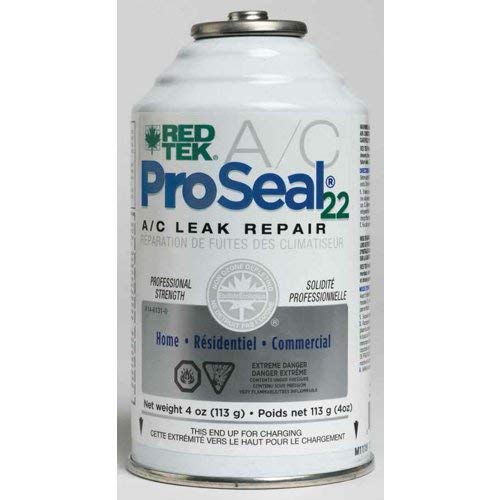
The RED TEK ProSeal22 is engineered for one specific job: sealing very slow refrigerant leaks without ever leaving a solid deposit in your system. It remains as a liquid lubricant that circulates continuously, ready to reactivate and seal any new leak that develops. This makes it ideal for older systems that lose a charge over the winter but you’d rather not tear apart for a full rebuild. The 2-fluid-ounce active dose treats systems up to 2 tons.
Compatibility covers R-22, R-134a, and R-1234yf alongside mineral, ester, and PAG lubricants. The upper temperature rating of 200 degrees Fahrenheit ensures it won’t degrade under normal under-hood heat. Users report success on pinhole leaks in A-coils that formerly required an annual recharge — one reviewer noted the leak stopped completely over a two-month monitoring period and held through the following winter.
This product is non-returnable due to its classification as a hazardous material, so be certain about your leak diagnosis before purchasing. It works best when the system can still hold a vacuum for at least 24 hours — if you’re losing pressure rapidly, this sealer may not have time to react.
Why it’s great
- Liquid lubricant formulation never hardens or clogs
- Compatible with R-1234yf newer systems
- Long-term sealing confirmed by multiple-year user reports
Good to know
- Non-returnable due to hazardous material classification
- Slow-acting — may take up to 2 months for complete seal
5. Leak Saver Direct Inject AC Leak Sealer Small System

The Leak Saver Direct Inject for small systems (up to 1 ton) is essentially the same proven formula as the Ultimate 3-in-1 but in a smaller, more targeted package ideal for passenger cars and small SUVs. It uses the same polymer-free organosilane chemistry that reacts with air and moisture at the leak site to form a permanent seal. With over 4 million units sold since 2015, this is the formula with the deepest real-world testing in the category.
Compatibility spans every common automotive refrigerant including R-134a, R-1234yf, and older R-12 systems, plus all PAG and mineral oils. Note that automotive systems require a standard 134A to 1/4-inch charging adapter for injection. The product does not require messy syringes or pressurized cans — it injects directly through a manifold gauge set or the Leak Saver injection kit.
Verified user reviews show success on mini-split and automotive systems, with one owner reporting a permanent seal on a DIY mini-split that was losing charge. Some negative reviews note that it cannot fix systems that lose the full refrigerant charge within 3 days — that’s a fundamental limitation of any chemical sealer, not a product flaw.
Why it’s great
- Proven formula with millions of successful applications
- Safe for all system components including TXVs and Schrader valves
- Proudly made in the USA
Good to know
- Limited to systems under 1 ton — may not cover large dual-zone setups
- Requires charging adapter for automotive low-side port
6. A/C Pro AC Super Seal R-134a Stop Leak Treatment
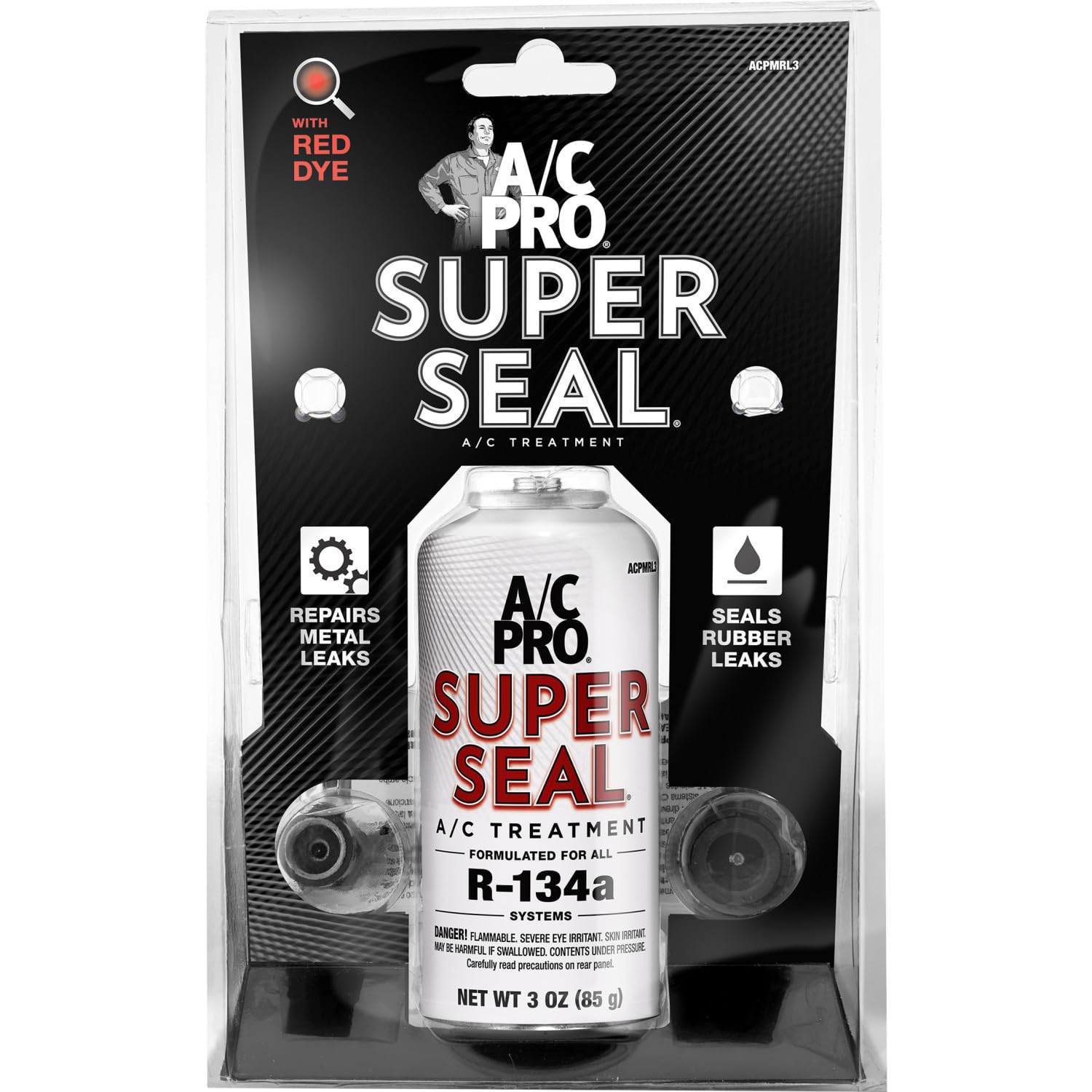
The A/C Pro Super Seal is the most user-friendly option on this list, and it’s the one to buy if you don’t own a manifold gauge set. It comes with a push-button dispenser that connects directly to the low-pressure service port — no additional tools required. The 3-ounce aerosol can contains a stop-leak formula designed to seal both metal and rubber leaks, covering the two most common failure points in automotive A/C systems.
This product is specifically formulated for R-134a systems and includes additives that prepare the system for a refrigerant recharge. Users report success on slow leaks in vehicles like a 2013 sedan with low-side line and condenser leaks, and even a 30-year-old Land Cruiser that finally held a charge after years of problems. The formula is compatible with common A/C lubricants and does not require a vacuum pump for application.
The trade-off for that convenience is a stricter target: R-134a only, no R-1234yf or R-12 compatibility. Some mechanics warn that the formula can create sludge buildup over time if the leak is never fully sealed, though long-term user reports (5.5 years on a BMW 135i) contradict that claim. It’s best used as a diagnostic-first solution for slow leaks in R-134a systems.
Why it’s great
- No tools required — push-button dispenser connects directly
- Seals both metal and rubber A/C components
- Proven long-term results on slow evaporator leaks
Good to know
- Only compatible with R-134a systems
- Some users report sludge formation with improper use
7. ATP Automotive AT-205 Re-Seal Stops Leaks, 8 Ounce Bottle (2 Pack)

The ATP AT-205 Re-Seal is a different breed of sealer — it’s a rubber seal rejuvenator that works by restoring the flexibility of dried-out O-rings and gaskets throughout your vehicle, including A/C compressor seals. It’s not a dedicated A/C stop-leak in the same sense as the other products here, but it’s an excellent preventative option for high-mileage cars where multiple systems are starting to seep. The 2-pack gives you two 8-ounce bottles, enough to treat a 6-quart system each.
This product is compatible with conventional and synthetic oils, ATF, gear oil, power steering fluid, and hydraulic oil. It does not contain petroleum distillates, so it won’t over-swell or break down seals — a common failure of aggressive seal swellers. Users report success stopping engine oil leaks, power steering pump leaks, and even rear main seal leaks on vehicles like the Ford Explorer and Dodge Ram 1500.
For A/C use specifically, this product is best paired with a dedicated A/C stop-leak. Use the AT-205 to rejuvenate the compressor shaft seal and O-ring gaskets, then use a polymer-free sealer to address any pinhole leaks in the evaporator or condenser. It’s not a one-stop A/C fix, but it’s an incredibly versatile maintenance additive for any aging vehicle.
Why it’s great
- Rejuvenates rubber seals rather than plugging holes chemically
- Safe for transmissions and power steering systems too
- 2-pack provides excellent value for multi-vehicle owners
Good to know
- Not formulated specifically for A/C refrigerant leaks
- Best used as preventive maintenance, not for active leaks
FAQ
Can AC sealer fix a completely empty system?
Will AC sealer clog my expansion valve?
How long does AC sealer take to seal a leak?
Can I use AC sealer with R-1234yf refrigerant?
Final Thoughts: The Verdict
For most users, the best ac sealer for cars winner is the Leak Saver Direct Inject Ultimate 3-in-1 because it combines a proven polymer-free sealer, integrated UV dye, and moisture remover in one package that works with R-134a, R-1234yf, and R-12 systems. If you want the easiest DIY application without any gauge tools, grab the A/C Pro Super Seal. And for a budget-friendly value option that handles evaporator core leaks where others fail, nothing beats the ComStar A/C Zero Leak.