
Our readers keep the lights on and my morning glass full of iced black tea. As an Amazon Associate, I earn from qualifying purchases.
Specs are compiled from manufacturer listings and verified buyer reviews and can change over time — please confirm the key details on the product page before buying.
You want to walk into a cool living room without having left the air conditioner running all afternoon. An AC smart controller fixes exactly that: it puts your cooling on your phone, on a schedule, and on a sensor that knows when the house is empty. The tricky part is that “smart AC controller” covers two very different boxes — a wall thermostat that replaces your existing unit, and a small IR hub that talks to a remote-controlled mini-split or window unit. Wire the wrong type into your system and it simply won’t work. This guide separates the two, names the wiring each one needs, and tells you which pick fits which home.
I’m Min — the founder and writer behind Gadgets Feed. This guide is built by comparing the manufacturers’ published specifications and the patterns across verified customer reviews, so you get each pick’s real strengths and trade-offs instead of marketing spin.
You’ll find nine controllers below, grouped by what they actually control. Each entry lists its wiring needs and app ecosystem up front. Your best match depends on your HVAC type and whether a C-wire (the common wire that powers a thermostat) is already behind your old unit. Check that one detail before you shop for an ac smart controller — it’s the fastest way to narrow the field.
Our Picks at a Glance


How To Choose The Best AC Smart Controller
The buying decision starts with one question you can answer in thirty seconds: does your air conditioner have a wall thermostat, or does it answer to a handheld remote? Wall thermostats get replaced by a smart thermostat. Ductless mini-splits, window units, and portable ACs almost always get an IR hub that aims a beam at the unit like a remote control would. Mixing those two up is the most common return reason in this category.
Check your wiring before anything else
A C-wire is the constant-power wire a smart thermostat needs to stay awake. Some models require it outright and refuse to run on batteries; others work without one in most homes. If you pull your old thermostat off the wall, count the labeled wires — a terminal marked C means you’re clear. Models that list RH, RC, W, Y, G and C are built for that exact setup.
Match the system type, not just the brand
Single-stage systems (one heating stage, one cooling stage) are the easy case. Multi-stage systems, heat pumps, and 120-240V line-voltage setups need a thermostat that explicitly lists them. A unit built only for 1 heat/1 cool conventional systems will misbehave on a heat pump, and the manufacturer will tell you so plainly.
Decide how much automation you actually want
Basic app control lets you change temperature from the couch. Scheduling lets you set weekday and weekend patterns. Geofencing uses your phone’s location to switch to away mode when you leave. Presence sensors go a step further and detect whether a person is actually in the room. Each layer adds convenience and cost, so pick the level you’ll genuinely use.
Pick your smart home ecosystem early
Alexa, Google Home, Apple Home, SmartThings, and IFTTT each behave differently with thermostats. If your house already runs on Apple Home, a Matter-certified thermostat saves you a bridge. If you’re all-in on Alexa, most picks here cover it. Buy for the ecosystem you have, not the one you might build later.
Quick Comparison
| Model | Best For | Type | System Compatibility | Connectivity | Amazon |
|---|---|---|---|---|---|
| Riseem WiFi Thermostat★ Best Overall | Simple single-stage replacement | Wall thermostat | 1 Heat / 1 Cool conventional, C-wire required | 2.4GHz Wi-Fi | Amazon |
| MoesGo WiFi RF IR Universal RemoteBest for Mixed Appliances | Mixed IR and RF appliances | IR/RF hub | Air conditioners, TVs, fans, RF blinds | 2.4GHz Wi-Fi, IR 38KHz, RF 433/315MHz | Amazon |
| SwitchBot Hub 2Smartest Sensor Hub | Room climate sensing plus IR control | IR hub + thermo-hygrometer | Air conditioners and IR appliances | 2.4GHz Wi-Fi, Bluetooth, Matter | Amazon |
| Honeywell Home X2S | Multi-stage and heat pump homes | Wall thermostat | Up to 2 Heat / 2 Cool conventional or 2 Heat / 1 Cool heat pump | Wi-Fi, Matter certified | Amazon |
| Cielo Breez Lite | Ductless mini-split and window AC | IR hub | 20,000+ ductless mini-split, window, portable AC models | Wi-Fi, 2.4GHz | Amazon |
| Sensi Smart Thermostat ST55 | DIY install without a C-wire | Wall thermostat | Most common home HVAC | Wi-Fi | Amazon |
| Google Nest Thermostat | Hands-off energy tweaks | Wall thermostat | Works without C-wire in most homes | 2.4GHz and 5GHz Wi-Fi, Bluetooth LE | Amazon |
| Cielo Smart Thermostat Eco | Heat pump and geothermal homes | Wall thermostat | 2 Heat / 2 Cool conventional, heat pump with aux, geothermal | Wi-Fi | Amazon |
| Aqara Smart Thermostat W200 | Apple Home households | Wall thermostat + hub | About 85% of HVAC systems incl. heat pumps, boilers, PTAC | Dual-band 2.4/5GHz Wi-Fi, Bluetooth, Matter 1.4 | Amazon |
In‑Depth Reviews
1. Riseem WiFi Thermostat for Home (Single-Stage 1 Heat / 1 Cool)
Our pick — 4.5+★ from 900+ verified ratings; the strongest balance of quality and price.
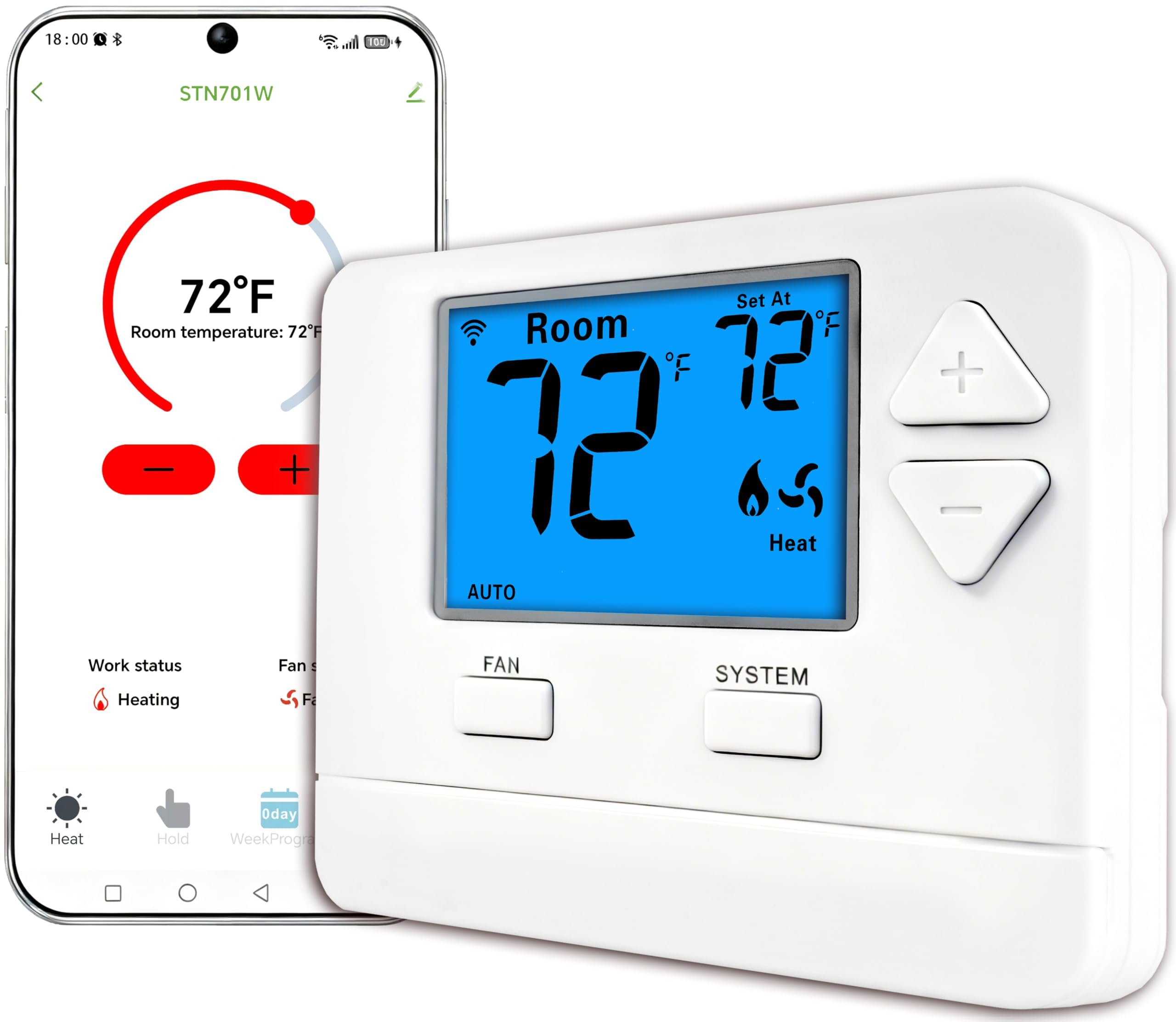
A basic single-stage thermostat that keeps temperature within 2F and reads from across the room.
If your home runs one heating stage and one cooling stage and you already have a C-wire behind the old unit, this is the most straightforward swap on the list. The claim that matters is the 2F temperature tolerance — your room holds steady instead of drifting between warm and chilly. The backlit LCD screen with large up and down buttons is built for the hallway at 6 a.m., and the whole thing weighs 6.24 ounces, so mounting it is a two-screw job with the included anchors.
What wins people over here is plain reliability. Owners consistently point to the function and the install as the two things that went right — a five-minute hookup and a thermostat that just does its job. The 7-day programming lets you set different temperature periods for weekdays and weekends, and the app lets you check on the HVAC system in real time from anywhere. For a single-stage home that wants app control without a learning curve, the pitch is unusually clean.
The catch is compatibility, and it’s a big one. This is a 1 Heat / 1 Cool conventional thermostat only. It does not work with multi-stage systems, heat pumps, heat-only or cool-only setups, 120-240V line-voltage systems, PTAC units, mini-splits, or RV air conditioners, and it cannot run on batteries — the 24V C-wire is mandatory. The Wi-Fi is 2.4GHz only, so a 5GHz-only router needs a separate band enabled. Check your wiring terminals against RH, RC, W, Y, G and C before you buy; anything else is the wrong thermostat.
What earns its place
- Keeps temperature within 2F for steady comfort
- Backlit LCD with large buttons that reads clearly from across a room
- 7-day scheduling plus real-time HVAC monitoring in the app
- Six-point terminal layout (RH, RC, W, Y, G, C) matches most single-stage homes
Where it stops
- Conventional 1 Heat / 1 Cool only — no heat pumps, multi-stage, or line-voltage
- Requires a 24V C-wire; batteries are not an option
- 2.4GHz Wi-Fi band only
Reach for this if: your system is a plain single-stage furnace-and-AC combo with a C-wire already in the wall.
Look elsewhere if: you own a heat pump or a mini-split — no amount of app setup will make this one talk to them.
2. MoesGo WiFi RF IR Universal Remote Controller
One hub that fires infrared at your AC and radio signals at your blinds and ceiling fans.
Most IR hubs control appliances that see the beam. This one also speaks RF at 433/315MHz, which covers motorized curtains and ceiling fans that infrared can’t reach. The IR side taps a library of 5,000+ codes at 38KHz, and the hub handles up to 12 devices with a 10-meter rated range. The physical remote has 48 buttons — that’s where the 24x gap over the SwitchBot Hub 2’s 2-button setup lives, and it matters if you like a tactile pad alongside the app.
Setup is where the honest story sits. The functionality is the most-discussed topic in its reviews and the verdict is mixed — plenty of owners get it working, and a meaningful share find certain remotes simply don’t respond. Compatibility is the least forgiving part of the experience, so check the app’s device list against your AC brand before you commit. The DIY copy function lets the hub learn from your original remote for oddball devices like LED fireplaces and heaters, though those learned devices only work from the phone, not from Alexa or Google Home.
Voice control through Alexa or Google covers the common commands: change A/C temperature, turn on fans, switch TV channels, and open the blinds. Infrared is line-of-sight and blocked by walls, so plan on one room per hub, while the RF signal travels further. That split is useful — the hub can sit in the living room and still trip an RF curtain in the bedroom. It’s the pick for tinkerers consolidating IR and RF remotes into one app who can accept some trial and error.
Where it shines: the 48-button remote and RF support make it the most versatile hub here when your appliances span past the AC.
The honest trade-off: expect friction — some remotes don’t pair, and the app itself draws split opinions, so this rewards patience over plug-and-play.
Made for: the household with a remote-controlled AC, an RF ceiling fan, and motorized blinds all wanting one command center.
Not the one if: you want a guaranteed five-minute setup with zero code hunting.
3. SwitchBot Hub 2 (2nd Gen)
It reads your room’s heat and humidity, then fires the AC command when the numbers drift.
Pick this one if you want your air conditioner to react to the actual room, not a clock. A Swiss-made chip in the cable measures temperature and humidity to ±1.8% RH (relative humidity) and ±0.36°F, and that data can trigger scenes. So the AC can kick on when humidity crosses a line you set, not when a schedule says so. A light sensor adjusts screen brightness automatically, so the panel stays readable in a dark bedroom without blazing.
The hub is small at 36 grams, but it’s a capable IR blaster too. Smart Learning pulls in remotes for TVs, air conditioners, and more, and you control them from the app, from voice commands, or from an Apple Watch. Two physical buttons on the unit handle automation scenes for anyone in the house who doesn’t want to open an app — handy for older family members. Matter support ties SwitchBot locks, curtains, and blind tilts into HomeKit with a Hub 2 in place.
The wrinkle is the ecosystem. Compatibility is the single most-discussed topic in its feedback and it stays mixed — Matter support rolls out device by device rather than all at once, so check that your specific SwitchBot gear is covered. Value draws split opinions too, which makes sense given that this is a hub-plus-sensor rather than a plain blaster. For homes already running SwitchBot devices or Apple Home, the combo of room sensing and IR control is hard to replicate at this size.
Why it stands out: a ±1.8% RH / ±0.36°F sensor feeding automatic AC triggers is a genuinely different approach from a fixed schedule.
Worth checking first: confirm your SwitchBot devices are on the Matter list before you count on HomeKit control.
The pick for: Apple Home or SwitchBot households that want the AC to respond to real room conditions.
Skip if: you’re not already in the SwitchBot ecosystem — a standalone IR hub will do the same AC job with less setup.
4. Honeywell Home X2S Smart Wi-Fi Thermostat
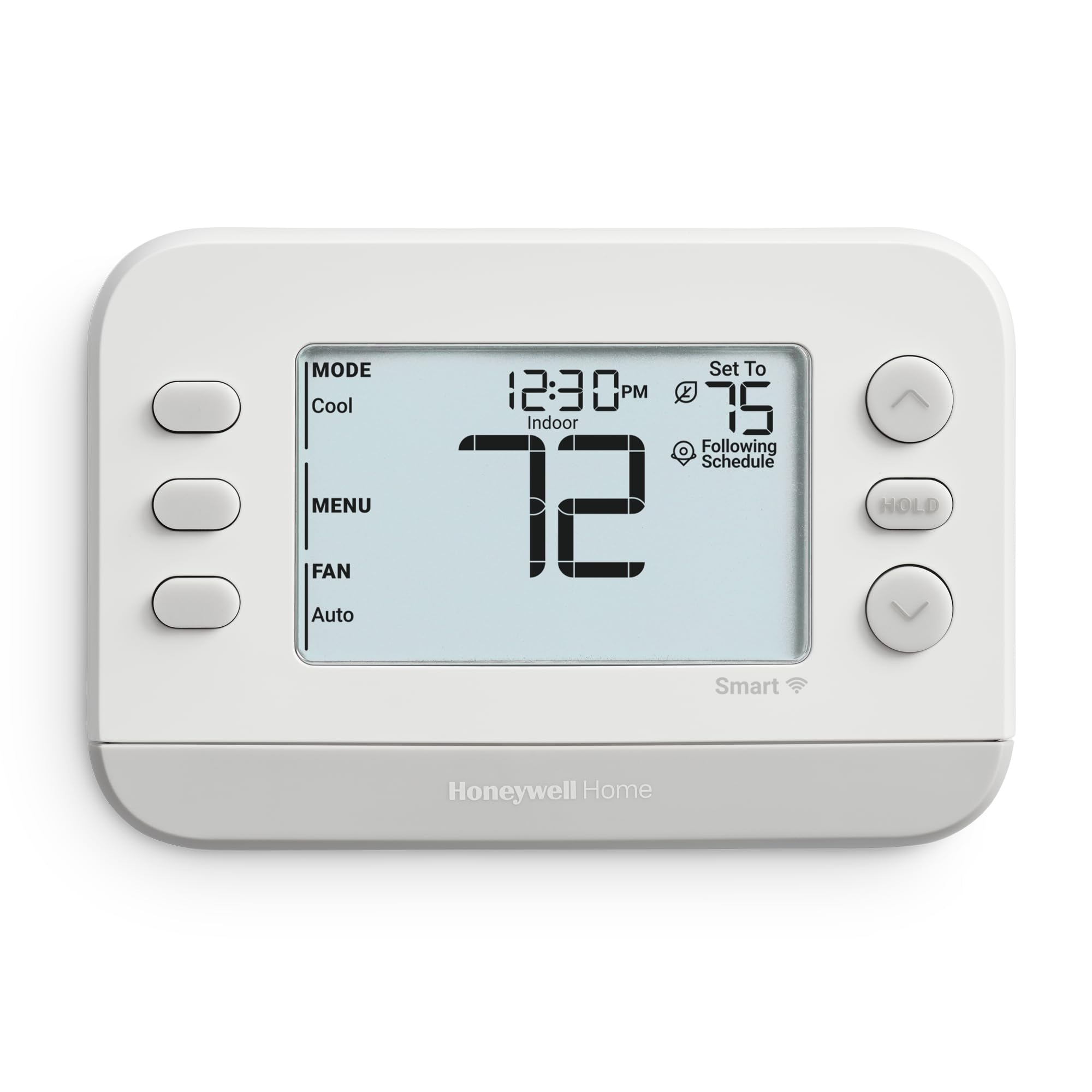
The replacement thermostat that takes multi-stage and heat pump systems the Riseem above can’t touch.
Count the wires behind your old thermostat and this one probably covers the count. It handles up to 2 heat and 2 cool conventional systems, or a 2 heat / 1 cool heat pump, and it’s built as a direct replacement for the RTH6580. That breadth is the whole point: where a single-stage thermostat shuts down on a heat pump, this one is designed for it. Homeowners who need a second heating stage for a cold-climate setup finally have a mainstream option.
Scheduling is unusually customizable. You can program in 5-1-1 day, 5-2 day, 7 day, or 1 week increments, or switch off programming entirely if you’d rather manage everything from the app. Auto-away handles the away case automatically, a change-filter reminder nags you before airflow suffers, and the display can show indoor humidity. It’s Matter certified, so it talks to the major smart home platforms directly rather than through a proprietary bridge, and there’s a 2-year warranty behind it.
What buyers notice is how easy it goes in — installation is the most-praised trait here by a wide margin, with functionality close behind. The recurring note is Wi-Fi and app behavior, which lands as a fit caveat rather than a blocker: worth checking your router setup and app version before you blame the thermostat. A 32°F low-heat setpoint adds margin for cooler rooms. If your home has a second stage or a heat pump and you want a familiar thermostat look, this is the safer wiring bet than a single-stage model.
Why it makes the list
- Covers 2 heat / 2 cool conventional and 2 heat / 1 cool heat pump systems
- Flexible scheduling in 5-1-1, 5-2, 7-day, 1-week, or non-programmable modes
- Matter certified for direct platform control, backed by a 2-year warranty
- Auto-away, filter reminders, and humidity display built in
Worth knowing
- Wi-Fi and app behavior draws some mixed feedback — verify your router and app version
- More programming options mean more setup steps than a simple weekday/weekend pair
Best suited to: homes with a second heating stage or a heat pump that need real compatibility, not a workaround.
Think twice if: your system is a simple single-stage setup — you’d be paying for stages you don’t have.
5. Cielo Breez Lite Smart AC Controller
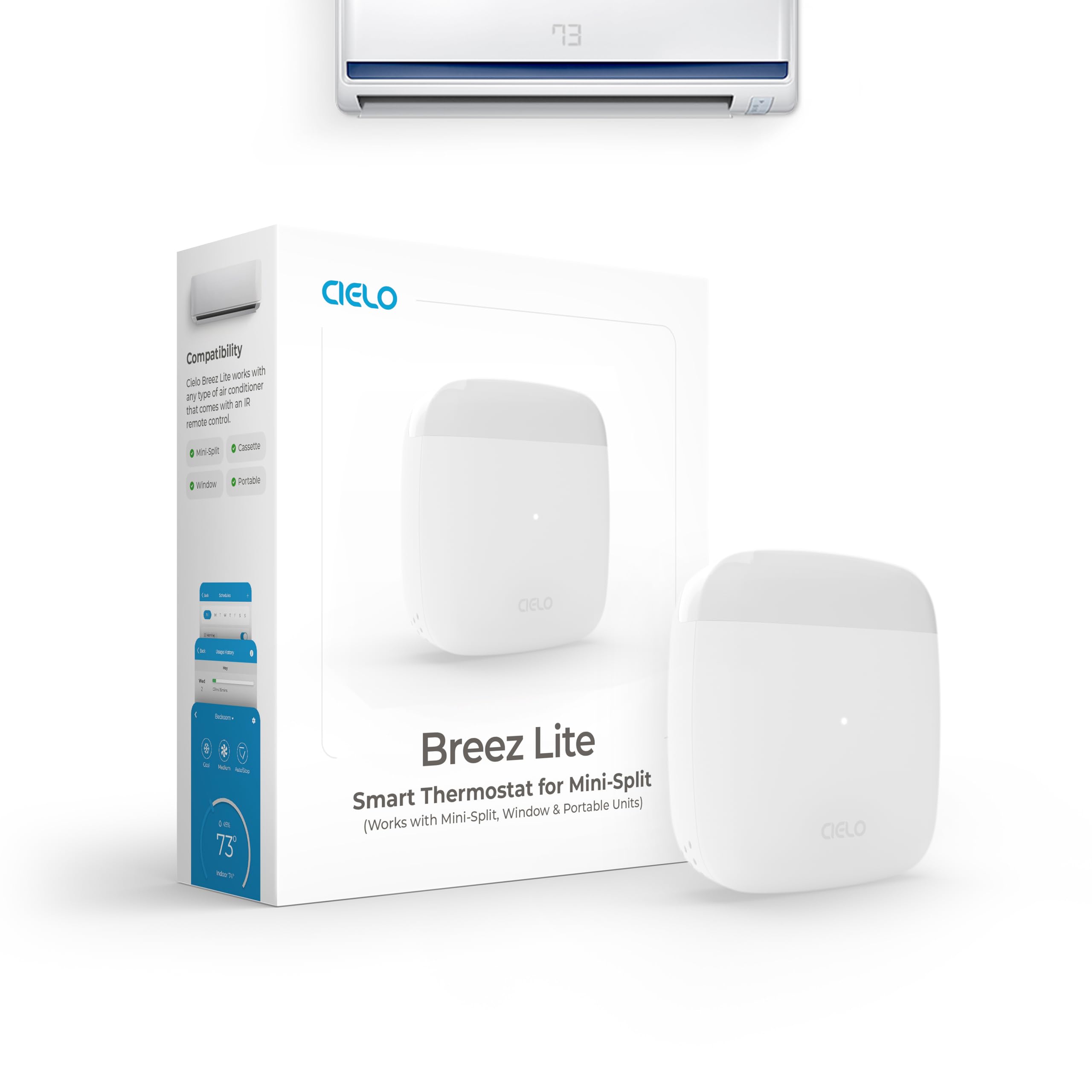
Turns a remote-controlled mini-split, window, or portable AC into a phone-controlled unit in about a minute.
Ductless air conditioners don’t have thermostat wiring, so a wall replacement is out. This little white box (1.28 ounces, ABS shell) sits within 6-12 feet of the AC and in line of sight, then mimics your remote’s commands from the app. It covers 20,000+ ductless mini-split, window, and portable AC and heat pump models and detects your remote automatically during setup. No tools, no wiring, and no monthly subscription.
Setup is the thing everyone raves about, and it’s the top category of feedback by a wide margin — three units going in instantly is a real pattern here. Once running, you get weekly scheduling, geofencing that drops to away mode when you leave, Comfy Mode for temperature balance, usage history, and an air filter status readout. Built-in temperature and humidity sensors feed those automations, and adding multiple Breez Lites to one account creates HVAC zones across rooms.
The honest note: connectivity draws mixed feedback, with some units dropping off Wi-Fi and needing a reconnect. Voice control through Alexa, Google Assistant, and Siri Shortcuts works, and SmartThings and IFTTT are supported too. The trade-off is that this is an IR device — it needs to see the unit, so placement in a corner or behind furniture will cost you. Support is reachable by phone and email Monday through Friday, which is more than most hubs on this list offer.
The value read: a ductless setup gets full app and voice control with zero wiring and no subscription, which is the whole reason it earns its place.
One thing to plan for: give it a clear line of sight and a stable 2.4GHz signal, or expect to reconnect it now and then.
Grab this if: you have a mini-split, window, or portable AC with a handheld remote and no thermostat wiring.
Don’t bother if: your AC is wired to a wall thermostat — you need a thermostat, not an IR blaster.
6. Sensi Smart Thermostat ST55
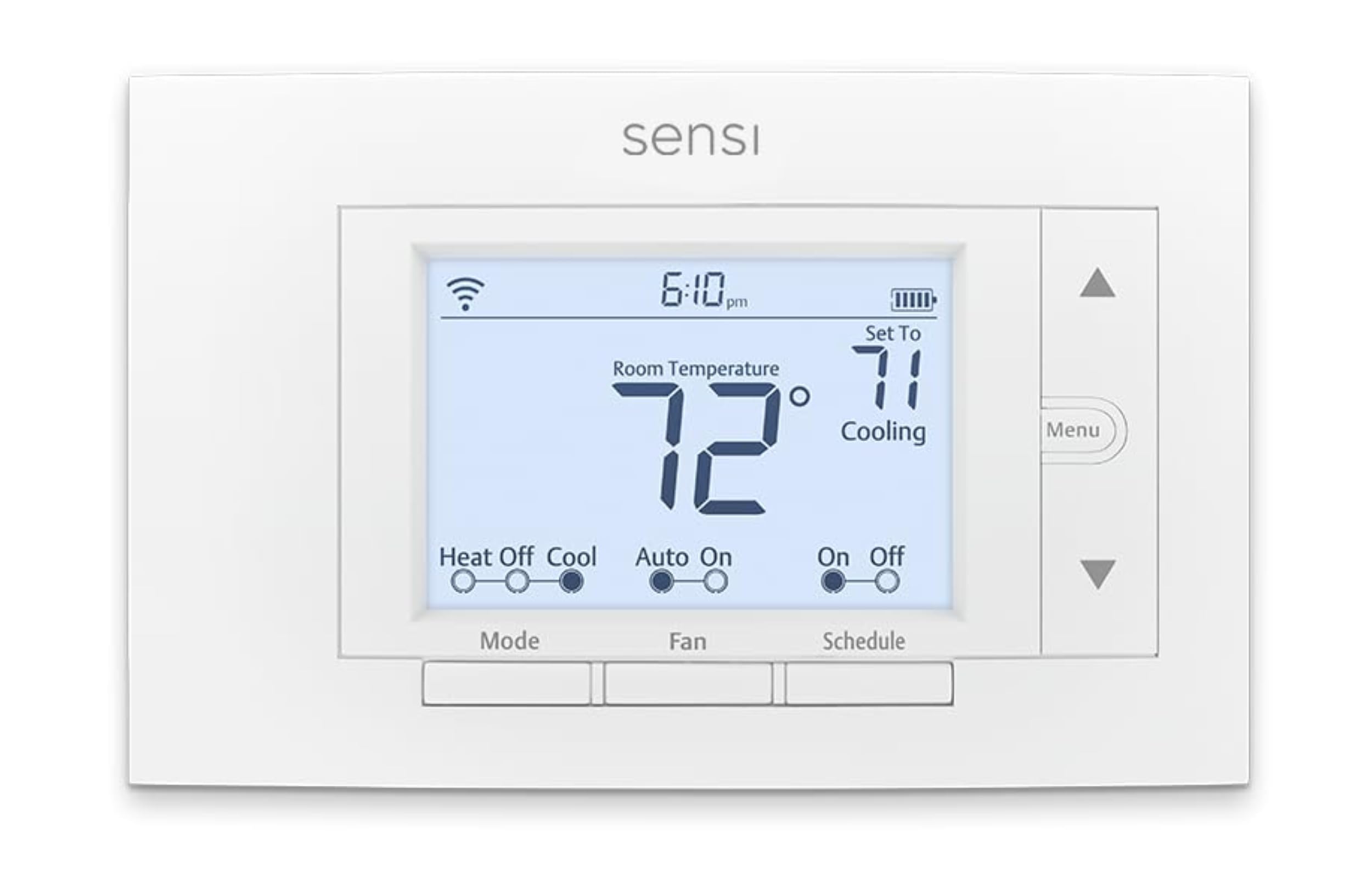
The thermostat built for homes with no C-wire — and walls you’d rather not patch.
Most of the wall thermostats here want a C-wire. This one doesn’t — in most applications the Sensi ST55 installs without one, which removes the single biggest obstacle for older homes. It slides into the same footprint as a traditional thermostat, so there’s no patching and painting after the swap. A built-in level and step-by-step app instructions handle the alignment, and the unit runs on two AA batteries.
The Energy Star certification comes with a manufacturer claim of about 23% HVAC energy savings through flexible scheduling, remote access, and usage reports. Take that as a manufacturer claim backed by the certification, not a guarantee for every home. What owners actually report is straightforward: it installs easily, the app is easy to follow, and temperature control holds. Usage reports, equipment alerts, and filter-change reminders add a maintenance layer that most simple thermostats skip.
Two honest caveats. First, Wi-Fi connectivity is a mixed area — worth confirming your network setup works with it before you commit, since the app is how you control everything. Second, reliability is mixed too, with a minority reporting early failures alongside a large majority running without issue. On privacy, Sensi states it won’t sell your personal information to third parties, which is a point worth weighing if that matters to you. For a no-C-wire, battery-powered thermostat install, this is the low-friction pick.
What makes it easy
- No C-wire needed in most applications, running on two AA batteries
- Fits the same wall footprint as a traditional thermostat — no patching
- Energy Star certified, with a stated ~23% HVAC energy savings figure
- Usage reports, equipment alerts, and filter reminders built in
Weigh these
- Wi-Fi and reliability both draw mixed feedback — check your network fit
- Energy savings are a manufacturer claim, not a household guarantee
The obvious choice if: your wall has no C-wire and you want to avoid drywall work entirely.
Look past it if: you need verified, app-driven custom scheduling above all — the flexible tiers on the models around it may suit better.
7. Google Nest Thermostat

The thermostat that turns itself down when you leave and nudges you when it spots a better schedule.
The Nest Thermostat’s selling point is what it does without you. It turns itself down when you leave the house, so you’re not cooling an empty room, and its Savings Finder looks for ways to tweak your schedule and suggests the changes in the app. It connects on both 2.4GHz and 5GHz Wi-Fi, unlike several picks here that are locked to 2.4GHz, and Bluetooth Low Energy handles local setup. That dual-band support makes it easy on modern routers.
It’s Energy Star certified and works with Google Assistant and Matter-certified voice assistants, so it fits a modern Google Home setup cleanly. Control is available from a phone, laptop, or tablet, and the small 4.96-ounce body takes up minimal wall space. For households that already live in Google’s ecosystem, everything lives in one app — the check-in on HVAC health sends alerts if something doesn’t look right, which saves a service call for the small stuff.
Read the reviews carefully, though. Reliability is the most-discussed topic and it’s mixed; connectivity and compatibility are honest weak spots too, with wireless dropouts reported. Installation and temperature control both draw split feedback. The C-wire situation matters here as well: it’s designed to work without one in most homes, but heating-only, cooling-only, zone-controlled, and heat pump systems will need a C-wire or a power accessory. Run Google’s online compatibility checker before you buy — that step alone prevents most of the frustration.
The appeal: dual-band Wi-Fi, auto-away, and HVAC alerts make it a strong fit for a Google Home household that wants to set it and move on.
Worth a hard look first: mixed reliability and connectivity reports mean you should verify the C-wire and compatibility before ordering.
Suits you if: you’re already in Google Home and want the least manual scheduling of any thermostat here.
Pass if: you’re on a heat pump or zone system and don’t want to add a C-wire accessory.
8. Cielo Smart Thermostat Eco

A heat pump and geothermal thermostat that ships with the C-wire adapter most competitors make you buy.
Where the Cielo Breez Lite above handles ductless ACs, this one is built for central HVAC — and it covers almost every flavor. It works with 24V systems including gas, electric, oil, hot water, heat pump, and geothermal. The wiring handles 2 heat and 2 cool conventional stages, a heat pump with auxiliary heat, and O/B reversing valve wiring. If a home lacks a C-wire, a free adapter is in the box, so you don’t hit the hidden accessory cost that trips up other installs.
Energy Star certified, the Eco lives in the Cielo app for iOS and Android. Scheduling is preset for Home, Away, and Asleep modes or fully custom, and Energy Consumption Insights breaks down your heating and cooling patterns so you can spot where the money goes. Vacation Mode holds the house against extreme temperatures while using minimal energy, and geofencing handles away control automatically. It’s one of the few picks here that lists Home Assistant and IFTTT support alongside the usual Alexa, Google Assistant, Siri Shortcuts, and SmartThings.
Effectiveness is what stands out in the feedback — the thermostat works immediately with the AC system, and the app-based programming is straightforward. Customer support also earns credit: the manufacturer states 98% of calls are answered in under two minutes by a real person Monday through Friday. The trade-off is scale: with far fewer owners than the biggest names here, the long-term durability story is thinner. For a heat pump or geothermal home that wants a no-subscription app and a free C-wire adapter, the fit is clear.
Why heat pump owners should look
- Works with heat pump, geothermal, and 24V gas/electric/oil/hot water systems
- Free C-wire adapter in the box removes a hidden install cost
- Energy Insights, Vacation Mode, and geofencing built into the free app
- Supports Alexa, Google, Siri, SmartThings, IFTTT, and Home Assistant
Keep in mind
- A smaller owner base means a thinner long-term track record
- Preset scheduling is easy, but custom zone control takes a bit more setup
Built for: central HVAC homes with a heat pump or geothermal loop that want flexible wiring and a free C-wire adapter.
Not needed if: you’re on a simple single-stage system — the extra compatibility is wasted.
9. Aqara Smart Thermostat W200

A 4-inch touchscreen thermostat that doubles as a smart home hub and a front-door camera monitor.
This is the most feature-loaded controller on the list, and it starts with the display: a 4-inch full-color touchscreen with curved glass and waterfall corners. Behind it sits a built-in mmWave radar sensor (a motion sensor that detects actual human presence, not just passing movement), so the screen wakes as you approach and the thermostat knows when a room is truly occupied. That’s a different class of automation than a schedule or a phone’s location.
Installation is broader than you’d expect for a premium unit. It works with about 85% of HVAC systems — furnaces, air conditioners, heat pumps, boilers, and PTAC units — and if there’s no C-wire, an Aqara C-Wire Adapter (sold separately) supplies stable power. A trim kit is included to cover old wiring. Matter 1.4 support means it connects directly to Apple Home, Google Home, Amazon Alexa, and Samsung SmartThings and runs locally, so it keeps working even if a cloud service changes. Dual-band 2.4/5GHz Wi-Fi handles the connection.
Two features are specific to Apple users. Adaptive Temperature uses your iPhone and activity states (home, sleep, away, extended away) to adjust automatically, but it needs a home hub like an Apple TV or HomePod and a device running version 26 or later. Clean Energy Guidance nudges temperatures toward cleaner grid times and is available only in the contiguous U.S. The caveat: the temperature control draws mixed feedback, and while functionality and HomeKit compatibility are praised most, a small share find it disappointing. It’s the most capable pick here — mmWave presence, a built-in hub, and Matter 1.4 — and also the one that demands the most setup knowledge.
The headline feature: mmWave presence detection plus a built-in Zigbee hub and Thread border router make it a control center, not just a thermostat.
Before you buy: confirm you have an Apple hub and a compatible iPhone version for Adaptive Temperature, and budget for the C-Wire Adapter if your wall lacks one.
The match for: Apple Home and Aqara households that want presence sensing and Matter-native control in one panel.
Skip if: you’re not ready for ecosystem setup — this rewards a tech-comfortable home, not a plug-and-play one.
Understanding the Specs
The C-Wire
A C-wire (common wire) is a constant-power wire that keeps a smart thermostat running. Without it, many models won’t boot at all, and the Riseem here requires one in every case. Others, like the Sensi and Nest, are designed to work without one in most homes — but heating-only, cooling-only, zone, and heat pump systems often still need it. Some premium picks, like the Cielo Eco, include a C-wire adapter in the box; the Aqara sells one separately. Pull your thermostat off the wall and count a terminal marked C before anything else. That one detail prevents most returns.
System Compatibility
Single-stage (1 heat / 1 cool) is the simple case. Multi-stage (2 heat / 2 cool), heat pumps with auxiliary heat, geothermal, boilers, PTAC units, and 120-240V line-voltage systems each need a thermostat that explicitly lists them. Wiring terminals spell it out: RH, RC, W, Y, G, and C signal a conventional setup, while O/B, W2, and Y2 signal more. An IR hub handles none of this — it just mimics a remote. Match the type to your system, and check the terminal list on the spec sheet, not the marketing photos.
Wi-Fi Bands and Pairing
Many controllers connect on 2.4GHz Wi-Fi only. A 5GHz-only router will not see them, so you’ll need a separate 2.4GHz band on your network. Models that support both bands, like the Nest and the Aqara, make setup easier. IR hubs need to sit within a clear line of sight — Cielo recommends 6-12 feet from the AC — because an infrared beam is blocked by walls. RF signals travel further. Pairing trouble is almost always a band mismatch or a signal-strength issue, not a defective unit.
Automation Layers
Scheduling handles the predictable week. Geofencing uses your phone’s location to switch to away mode when you leave. Presence sensing goes further: the Aqara uses mmWave radar to detect a real person, and the SwitchBot uses temperature and humidity to trigger the AC automatically. Each layer trades setup effort for less manual control. An IR hub like the Breez Lite uses temperature and humidity sensors for its automations. Pick the layers you’ll actually use; more automation isn’t automatically better if you never configure it.
FAQ
Do I need a C-wire for a smart thermostat?
Can a smart AC controller work with a mini-split or window AC?
Will a smart thermostat work with a heat pump?
Do these controllers need a monthly subscription?
What is the difference between an IR hub and a smart thermostat?
Can I control the AC with Alexa or Google Assistant?
Does a 2.4GHz-only controller work on my Wi-Fi router?
How long does installation take for a smart AC controller?
Which smart thermostat works with Apple Home?
Do I have to replace my whole thermostat to make my AC smart?
Final Thoughts: The Verdict
For most homes with a plain single-stage furnace-and-AC setup and a C-wire in the wall, the Riseem WiFi Thermostat is the pick. It holds temperature within 2F, installs in about five minutes, and pairs a bright backlit LCD with 7-day scheduling in the app. Its 4.5+ star rating across 900+ ratings makes it the crowd favorite among single-stage replacements. If your system is a mini-split or window AC instead, reach for the Cielo Breez Lite — no wiring, a minute-long setup, and coverage of 20,000+ ductless models. And if you want the AC to react to actual room conditions rather than a clock, the SwitchBot Hub 2 brings a ±1.8% RH / ±0.36°F sensor into the mix. Start with your wiring type — C-wire thermostat or IR hub — and the field narrows fast.
How We Picked
We do not accept paid placement. Every pick is matched to a real buyer and a real use-case; we do not hands-on test units.
Sources & Methodology
Specifications: manufacturer listings and product documentation. Review insights: verified customer reviews, as of November 2026. Pricing: not shown on this page (it changes often); check the current price via the retailer link.
As an Amazon Associate, Gadgets Feed earns from qualifying purchases. This does not affect which products we feature.