
Your thermostat’s brain is often in the wrong place — reading the temperature of a hallway wall instead of the room where you actually sit. That single-degree mismatch can leave you shivering under a blanket in summer or sweating through a winter evening, all while your HVAC system runs exactly as programmed. An AC temperature sensor fixes this by placing the sensing right where you need it.
I’m Min — the co-founder and writer behind Gadgets Feed. I’ve spent hundreds of hours researching smart home sensors, parsing LoRa versus Wi-Fi protocol tradeoffs, and comparing thermostat integration ecosystems to find the units that actually stabilize your home’s microclimates.
Whether you want to tame a hot upstairs bedroom, protect a wine cellar, or automate a greenhouse, choosing the right best ac temperature sensor means understanding range, accuracy, and how the device communicates with your gear. This guide breaks down the top options for every scenario.
How To Choose The Best AC Temperature Sensor
An AC temperature sensor isn’t a one-size-fits-all accessory. The right pick depends on your HVAC system’s compatibility, your need for remote monitoring, and the physical environment you’re trying to control. Focus on these three factors to narrow your search fast.
Protocol and Range
The way a sensor talks to its hub determines where you can place it. Wi-Fi sensors need a strong 2.4 GHz signal and can crowd your network if you install many. Zigbee sensors, like the Honeywell C7189R1004, pair directly with compatible thermostats for a seamless handshake. LoRa-based sensors, such as the YoLink line, use a long-range, low-power protocol that punches through metal, concrete, and freezer insulation — reaching up to a quarter-mile in open air. If you’re placing a sensor inside a refrigerator, a garage far from the router, or a basement with thick walls, a LoRa or Zigbee solution will beat a standard Wi-Fi sensor every time.
Accuracy and Refresh Rate
For HVAC control, a sensor that updates every few minutes is fine — your AC won’t cycle on a one-second temperature blip. But for specialized environments like a wine cellar, reptile enclosure, or fermentation chamber, you need high precision and fast refresh. Look for a ±0.5°F accuracy rating or better, and check whether the sensor reports at 2-second intervals (like the GoveeLife units) or polls every 10 to 60 minutes (typical for battery-conserving LoRa sensors). Also confirm whether the sensor can be mounted or placed in the specific location — waterproof probes are essential for freezers, humidifiers, and outdoor use.
Control Mode: Smart Thermostat vs. Plug-In Controller
Some AC temperature sensors are purely passive — they report data back to a smart thermostat, which then decides when to kick on the cooling. This works best if you already own a compatible thermostat from Honeywell, ecobee, or Levoit. The other option is an all-in-one plug-in controller, like the meross Smart Temperature Controller or the Inkbird ITC-608T. These devices sit between your AC unit or heater and the wall outlet, directly cutting power when the target temperature is met. A plug-in controller is ideal for window AC units, portable heaters, chest freezers, or any appliance that uses a mechanical thermostat and lacks its own smart connectivity.
Quick Comparison
On smaller screens, swipe sideways to see the full table.
| Model | Category | Best For | Key Spec | Amazon |
|---|---|---|---|---|
| meross Smart Temperature Controller | Plug-In Controller | Window AC & Heater Automation | 15A / 1800W Load | Amazon |
| Honeywell C7189R1004 | Wireless Sensor | Thermostat Room Averaging | Zigbee Protocol | Amazon |
| GoveeLife 2.0 WiFi 3-Pack | WiFi Hygrometer | Multi-Zone Monitoring | ±0.54°F Accuracy | Amazon |
| GoveeLife Refrigerator Thermometer 2-Pack | Freezer Probe | Fridge & Freezer Alerts | -40°F to 158°F Range | Amazon |
| YoLink Smart 3-Pack + Hub | LoRa Sensor | Extreme Range & Freezers | 1/4 Mile Range | Amazon |
| Inkbird ITC-608T | Dual Stage Controller | Dual Temp/Humidity Control | Dual Waterproof Probes | Amazon |
| Levoit Aura 400S Thermostat | Smart Thermostat | Whole-Home HVAC Control | Up to 16 Sensors | Amazon |
In‑Depth Reviews
1. meross Smart Temperature Controller 15A
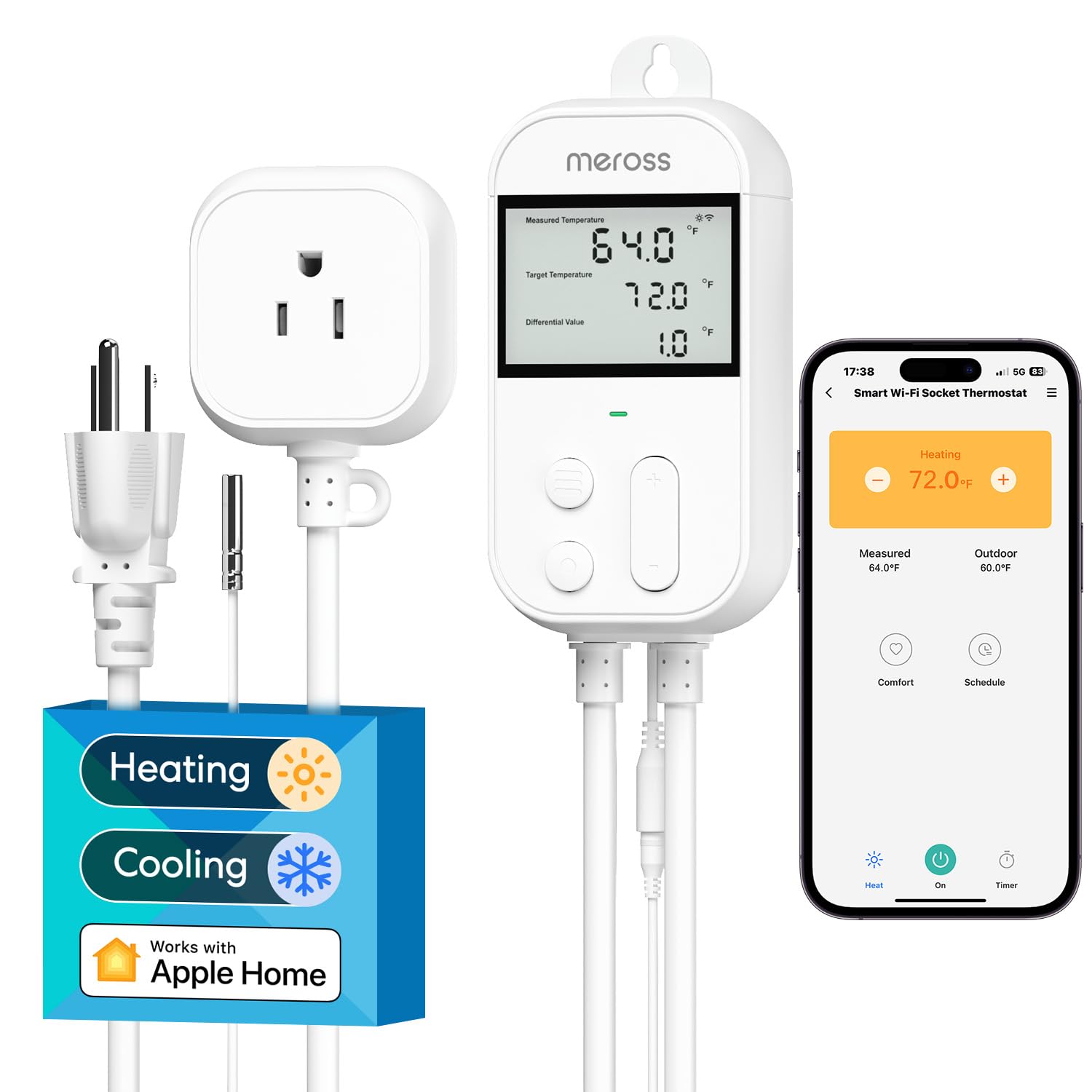
The meross Smart Temperature Controller is a plug-in outlet that bridges the gap between dumb appliances and a smart home ecosystem. It handles a maximum load of 15A and 1800W at 120V, making it suitable for window AC units, space heaters, or even converting a chest freezer into a fermentation chamber. The included stainless steel probe is 79 inches long and waterproof, giving you the flexibility to place the sensor inside the appliance while the controller stays at the wall.
Setup through the Meross app is straightforward, with native support for Apple Home, Alexa, Google Home, and SmartThings. You can create heating and cooling schedules with up to 12 periods per day, enable compressor protection delay to prevent damage to your AC on restart, and view historical temperature data alongside power consumption tracking. The LCD display is backlit for easy reading in low light, though it may turn off after a period of inactivity to save power — simply hold the Mode button for 3 seconds to wake it.
For users who want to control an old knob-based window AC or an infrared heater via voice commands or a smartphone app, this is the cleanest solution. The compressor delay and child lock features add safety, and the sensor failure alarm ensures you’ll know if the probe stops working. Some users report the app interface feels non-intuitive during the initial schedule setup, and the Wi-Fi connection can occasionally drop if placed far from the router.
Why it’s great
- Works with Apple Home, Alexa, Google Home, and SmartThings
- 15A/1800W capacity suits most window ACs and heaters
- Includes a long 79-inch waterproof probe for flexible placement
- Power monitoring tracks kWh usage and cost
Good to know
- App interface can be confusing for setting up schedules
- Wi-Fi connection may be unreliable at longer distances from the router
- Screen turns off after inactivity, requiring a button press to wake
2. Levoit Aura 400S Smart Thermostat

The Levoit Aura 400S is a full replacement smart thermostat that brings room-to-room temperature sensing to your central HVAC system. It connects via Wi-Fi and Zigbee, allowing you to pair up to 16 Levoit remote sensors (sold separately). The thermostat reads the average temperature from all connected sensors or lets you prioritize a specific room, solving the common problem of a hallway thermostat ignoring a hot upstairs bedroom. The 4-inch IPS touchscreen is bright and adjusts automatically based on ambient light.
Installation averages 30 minutes with the included C-wire adapter, and the free VeSync app handles the guided setup. The thermostat supports 24/7 scheduling, smart scenes that can trigger Levoit humidifiers and air purifiers, and an Eco Level setting that trades precise temperature control for energy savings. It also sends notifications if it detects a system malfunction or if the indoor temperature drifts outside your preferred range.
The Aura 400S is a strong choice for homeowners looking to modernize their entire HVAC control and integrate with the Levoit ecosystem. However, the display has a small font that can be hard to read from across the room, and some users report a false “cooling malfunction” alert during normal operation. The app interface, while feature-rich, feels overly complex for simple daily temperature adjustments.
Why it’s great
- Pairs with up to 16 remote sensors for room-by-room comfort
- 4-inch IPS touchscreen with auto-brightness
- Includes a C-wire adapter for simple installation
- Integrates with Levoit smart humidifiers and air purifiers
Good to know
- Display font is small and difficult to read from a distance
- False “cooling malfunction” alerts can be annoying
- App interface is less intuitive for basic temperature changes
3. YoLink Smart Wireless 3-Pack + Hub

The YoLink Smart Wireless Thermometer Hygrometer 3-Pack solves the range problem that plagues Wi-Fi sensors. Instead of using your home Wi-Fi, it operates on a LoRa-based protocol that can transmit up to a quarter-mile in open air. This makes it the go-to choice for sensors placed inside a metal freezer, a detached garage, a basement, or even an outdoor chicken coop. The included hub connects to your router via Ethernet, and each sensor runs on two AA batteries for up to five years without replacement.
Temperature accuracy is rated at ±0.36°F between 32°F and 129°F, and ±0.72°F from -4°F to 32°F, with humidity accuracy at ±3% RH. The sensors have no display — data is read exclusively through the YoLink app, which supports push notifications, text/SMS alerts (15 free per month per hub), and email alerts. Apple users can enable Critical Alerts to bypass silent mode, a vital feature for freezer failure warnings. Integration with Alexa allows voice queries for temperature, and IFTTT applets can trigger automations when thresholds are crossed.
The tradeoff for this incredible range is polling frequency — the sensors update every 10 to 60 minutes depending on conditions, which means you won’t get second-by-second readings. The app is functional but not as polished as the Govee interface, and the sensor bodies are larger than typical Wi-Fi hygrometers. For users who need to monitor a freezer in the basement or a greenhouse 500 feet from the house, this is the most reliable option available.
Why it’s great
- LoRa range of up to 1/4 mile through walls and metal
- 5-year battery life on two AA batteries
- Critical Alerts bypass silent mode on iOS
- Works inside freezers and refrigerators reliably
Good to know
- Polling interval is 10 to 60 minutes, not instant
- Sensors have no display — must check the app for readings
- Larger physical size than typical indoor hygrometers
4. GoveeLife 2.0 WiFi Hygrometer 3-Pack
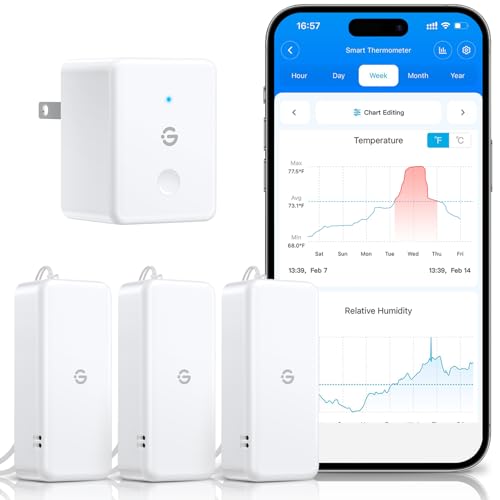
The GoveeLife 2.0 WiFi Hygrometer 3-Pack delivers Swiss-made sensor accuracy at a price that makes it easy to monitor multiple rooms. Each unit reads temperature with ±0.54°F precision and humidity within ±3% RH, refreshing data every 2 seconds. The system requires a gateway (included) that supports up to 10 sensors on a 2.4 GHz Wi-Fi network, giving you a full picture of your home’s microclimates for a fraction of the cost of a professional system.
The included GoveeLife app is one of the best in the category — it graphs temperature and humidity over the past 20 days locally and allows you to export up to two years of historical data. You can set custom high/low thresholds and receive push notifications or email alerts when conditions drift out of range. The sensors themselves are compact and include a lanyard for hanging, plus a 2-year battery life that minimizes maintenance.
This pack is ideal for monitoring rooms served by different AC zones, a wine cellar, a basement, or a guitar case. The only catch is the initial setup: the instructions are sparse, and several users needed customer support to successfully pair the sensors with the Wi-Fi gateway. Also, the system only works on 2.4 GHz networks, so users with mesh routers may need to temporarily enable the 2.4 GHz band during pairing.
Why it’s great
- High-precision Swiss sensor with ±0.54°F accuracy
- Excellent app with 2-year data export and trend charts
- 3-pack covers multiple rooms or zones affordably
- 2-second refresh rate for near-real-time monitoring
Good to know
- Initial pairing can be tricky without detailed instructions
- Only supports 2.4 GHz Wi-Fi networks
- Gateway must stay plugged in for remote access
5. Inkbird ITC-608T Temperature Controller

The Inkbird ITC-608T is a wired dual-stage temperature and humidity controller built for specialized environments where precision matters more than smart home integration. It features dual waterproof sensors that can control both heating and cooling devices simultaneously, or one temperature sensor and one humidity sensor for combined control. The temperature range spans -40°F to 212°F, making it suitable for everything from a reptile enclosure to a home-brewing fermentation chamber to a meat storage cooler.
This unit is ETL listed, meaning it has passed rigorous safety testing for handling loads up to 15A and 1800W at 120V. The front panel shows both PV (process value) and SV (set value) on separate displays, with a backlit screen for visibility in dim rooms. You can program up to 12 time stages per day, set compressor delay to protect cooling equipment, and calibrate the sensors if needed. All settings are retained through power outages — a critical feature for sensitive environments.
The Inkbird ITC-608T is not wireless and does not connect to an app, which limits its appeal for users who want phone alerts. The menu navigation takes some trial and error to master, and the included instructions are dense. For users who need reliable, wired dual-stage control for a terrarium, fermenter, or greenhouse, this is the workhorse option that won’t fail when the Wi-Fi goes down.
Why it’s great
- Dual waterproof sensors for heating and cooling control
- ETL listed for safety at 15A / 1800W
- Retains all settings through power loss
- Wide temperature range from -40°F to 212°F
Good to know
- No Wi-Fi or app connectivity — wired only
- Menu navigation can be confusing initially
- Instructions are dense and could be more user-friendly
6. GoveeLife Refrigerator Thermometer 2-Pack

The GoveeLife Refrigerator Thermometer 2-Pack is purpose-built for food safety monitoring, with a slim probe and cable that fits easily under a freezer door seal or inside a hot tub. The probe measures temperatures from -40°F to 158°F with ±0.9°F accuracy, and the LCD display on the main unit shows the current temperature at a glance. Each pack includes a Wi-Fi gateway that supports up to 10 sensors — including the GoveeLife hygrometers — all managed through the same app.
The standout feature is the smart anti-false alarm system. You can set a delay of 1 to 10 minutes before the alarm triggers, which prevents the app from notifying you every time you open the refrigerator to grab a snack. The app also stores two years of free data, showing temperature trends and allowing you to export CSV files for commercial or lab use. The magnetic mount and included holder keep the probe secure inside the freezer without creating a tangled mess.
This is the best choice for anyone who needs to remotely monitor a garage freezer, a backup fridge, or a hot tub. The gateway must remain plugged in and connected to 2.4 GHz Wi-Fi at all times; if the power goes out, the gateway goes down and you lose remote visibility. Some users also report that the Wi-Fi connection can be intermittent, requiring a power cycle of the gateway to reconnect. For , the peace of mind it provides for food safety is well worth the occasional hiccup.
Why it’s great
- Slim probe fits easily under freezer door seals
- Smart anti-false alarm with adjustable delay
- 2 years of free data storage and export
- Magnetic mount and holder keep the probe secure
Good to know
- Gateway loses connectivity during power outages
- Wi-Fi connection can be intermittent and need a reset
- Only supports 2.4 GHz networks
7. Honeywell C7189R1004 Wireless Indoor Sensor

The Honeywell C7189R1004 is a no-frills wireless temperature sensor that pairs with compatible Honeywell thermostats to average room temperatures or use the remote sensor as the primary reading point. It comes factory calibrated, so there’s no setup beyond mounting it on a wall and linking it to your thermostat via the push-button control. The compact Premier White design blends into any room decor and includes two AAA batteries plus mounting hardware in the box.
This sensor communicates using Zigbee, so it doesn’t rely on your home’s Wi-Fi network — it connects directly to the thermostat. This makes it extremely reliable and simple to integrate for users who already own a compatible Honeywell thermostat. The typical use case is placing one or two sensors in upstairs bedrooms that are always hotter than the main floor, allowing the thermostat to average the temperatures and call for cooling until the bedrooms reach a comfortable level. Users report dropping upstairs temperatures by 5°F or more without any HVAC modifications.
The C7189R1004 is limited to temperature-only sensing — it does not measure humidity — and it doesn’t offer any smartphone app or remote alerts. It also cannot be scheduled to use the remote sensor at night and the main thermostat during the day; your thermostat either averages all sensors or uses the remote sensor exclusively. For under , this is the simplest path to balancing hot and cold spots in your home if you’re already in the Honeywell ecosystem.
Why it’s great
- Factory calibrated, no adjustments required
- Uses Zigbee for direct thermostat pairing, no Wi-Fi needed
- Compact design blends into any room
- Effectively balances hot and cold spots across zones
Good to know
- No humidity sensing or smartphone app
- Cannot schedule sensor usage by time of day
- Only works with compatible Honeywell thermostats
FAQ
Can I use an AC temperature sensor with a window air conditioner?
What is the difference between a temperature sensor and a thermostat?
How do I place a temperature sensor for accurate readings?
Final Thoughts: The Verdict
For most users, the best ac temperature sensor winner is the meross Smart Temperature Controller because it combines broad smart home compatibility with the ability to directly control a window AC or heater. If you want whole-home zoning and room-by-room comfort, grab the Levoit Aura 400S Thermostat. And for extreme-range monitoring inside a freezer or detached building, nothing beats the YoLink Smart Wireless 3-Pack.