
The difference between a weld that holds and a weld that looks like a bird’s nest often comes down to one decision: the AC TIG machine you choose. Aluminum welding demands precise control over cleaning action, wave balance, and frequency — get those wrong and you’re fighting contamination, arc wander, and burnt-through material on every joint.
I’m Min — the co-founder and writer behind Gadgets Feed. Over dozens of hours analyzing inverter topologies, duty cycle charts, and real owner experiences across AC/DC TIG units from to near , I’ve mapped exactly which features separate a capable aluminum welder from a frustrating one.
Whether you’re patching a boat hull or fabricating an aluminum frame, this guide to the best ac tig machine focuses on the square wave controls, pedal responsiveness, and duty cycle performance that matter most for quality aluminum welds at home or in the shop.
How To Choose The Best AC TIG Machine
An AC TIG machine is a precision tool, not a brute-force welder. The ability to weld aluminum cleanly rests on three pillars: the AC waveform design, the amperage control responsiveness, and the duty cycle sustainability. Understanding these fundamentals prevents costly mistakes.
AC Waveform and Balance Control
Pure sine wave AC leaves too much time in the electrode-positive (EP) cycle, overheating the tungsten and wasting energy. Serious AC TIG machines use modified square waves that let you adjust the balance between electrode-negative (EN) for penetration and EP for oxide cleaning. An adjustable AC balance — typically ranging from 20% to 80% EN — lets you fine-tune cleaning action without sacrificing weld pool control. Machines that lock this parameter limit your ability to weld dirty or anodized aluminum effectively.
Pulse Capability and Frequency Range
Pulse TIG reduces heat input by cycling between a high peak current and a lower background current, which allows the puddle to cool slightly between pulses. This matters enormously for thin aluminum sheet (under 1/8 inch) where warping and burn-through are constant risks. Look for adjustable pulse frequency — 0.5 Hz to 200 Hz is a practical range — and the ability to set pulse duty cycle as a percentage of peak time. Machines offering triangular or soft square wave forms in AC mode give you additional control over arc focus and penetration profile.
Duty Cycle and Cooling Architecture
Duty cycle is measured as minutes of welding per 10-minute period at a given amperage. A machine rated 60% at 200A can weld for 6 continuous minutes before needing a 4-minute cooldown. Higher duty cycle numbers — especially at the top of the amperage range — indicate better thermal management through larger heat sinks, active fan cooling, or fan-on-demand systems. For fabrication work where you run multiple passes on thicker aluminum, a 60% duty cycle at max amps is the practical minimum. Entry-level units often drop to 20% at full output, which forces long pauses and slows project progress.
Foot Pedal Ergonomics and Interface
The foot pedal is your primary amperage control during TIG welding. A pedal with a smooth, progressive rocker action gives you precise heat control from a feather touch to full power. Look for a machine that includes a pedal in the box — many do, but some mid-range units force you to buy one separately. The pedal connector type matters: proprietary plugs (common on certain brands) lock you into that ecosystem, while standard 5-pin or 6-pin connectors offer more flexibility for replacements or upgrades.
Quick Comparison
On smaller screens, swipe sideways to see the full table.
| Model | Category | Best For | Key Spec | Amazon |
|---|---|---|---|---|
| Everlast PowerTIG 255EXT | Premium | Professional Fabrication | 250Hz AC Pulse / 3A DC min | Amazon |
| Lincoln Electric Square Wave 205 | Premium | Reliable Brand Performance | Auto-Set / 205A max | Amazon |
| Everlast PowerTIG 210EXT | Premium | Advanced Waveform Control | 3 AC waveforms / 9 Presets | Amazon |
| Weldpro 200A AC/DC Pulse | Mid-Range | Pulse Control Value | 0.5-200Hz Pulse / 40% Duty Cycle | Amazon |
| ARCCAPTAIN TIG200P ACDC | Mid-Range | Waveform Variety | Square/Triangular wave / 7-in-1 | Amazon |
| Everlast PowerTIG 200DV | Mid-Range | Dual Voltage Reliability | 5A DC min / Lift Start | Amazon |
| AHP AlphaTIG 203Xi | Mid-Range | Best Duty Cycle for Price | 60% @ 155A / 110/220V | Amazon |
| YESWELDER TIG-200P ACDC | Mid-Range | Compact Pulse TIG | 16.5 lbs / 7-in-1 modes | Amazon |
| PrimeWeld CT520DP | Mid-Range | 3-in-1 Combo Value | 50A Plasma / 200A TIG | Amazon |
| LOTOS TIG200ACDC | Value | Budget Entry AC/DC | 200A Square Wave / Foot Pedal | Amazon |
| TOOLIOM 6-in-1 | Value | Multiprocess Versatility | 6-in-1 / 200A TIG / Plasma | Amazon |
In‑Depth Reviews
1. Everlast PowerTIG 255EXT

The Everlast PowerTIG 255EXT is a serious step up in capability for anyone who needs to weld aluminum consistently at a professional level. It delivers 255 amps of AC/DC TIG power with four selectable AC waveforms — sine, triangular, soft square, and advanced square wave — giving you the flexibility to shape the arc to the exact material and joint configuration. The advanced pulse reaches 250 Hz in AC mode and 500 Hz in DC, which allows tight heat control on thin aluminum sheet down to 1/16 inch without warping the surrounding metal.
What sets this unit apart from mid-range options is the low-amp performance: it fires reliably at 3 amps DC and 5 amps AC, making it suitable for foil-thin materials and delicate repair work. The machine also handles 6010 cellulose electrodes in stick mode, which is rare among AC/DC inverter welders at this price tier. It includes both an air-cooled 9-series torch and a water-cooled 20-series torch setup (water cooler sold separately), plus a 400-amp ground clamp, stinger, regulator, and foot pedal.
The 85-pound weight means it’s a shop machine, not a portable unit, but the heavy-gauge case and fan-on-demand cooling justify the heft. Owners consistently report arc quality comparable to Miller Dynasty units costing two to three times more. The only real downsides are the full-speed fan noise and the lack of included tungsten, but these are minor against the overall value.
Why it’s great
- Four AC waveforms plus advanced pulse for precision aluminum work
- Operates down to 3A DC and 5A AC for ultra-thin materials
- Stick mode supports 6010 electrodes, rare at this price
Good to know
- Heavy at 85 lbs — not ideal for mobile use
- Fan runs full blast continuously during operation
- No tungsten included in the accessory kit
2. Lincoln Electric Square Wave 205
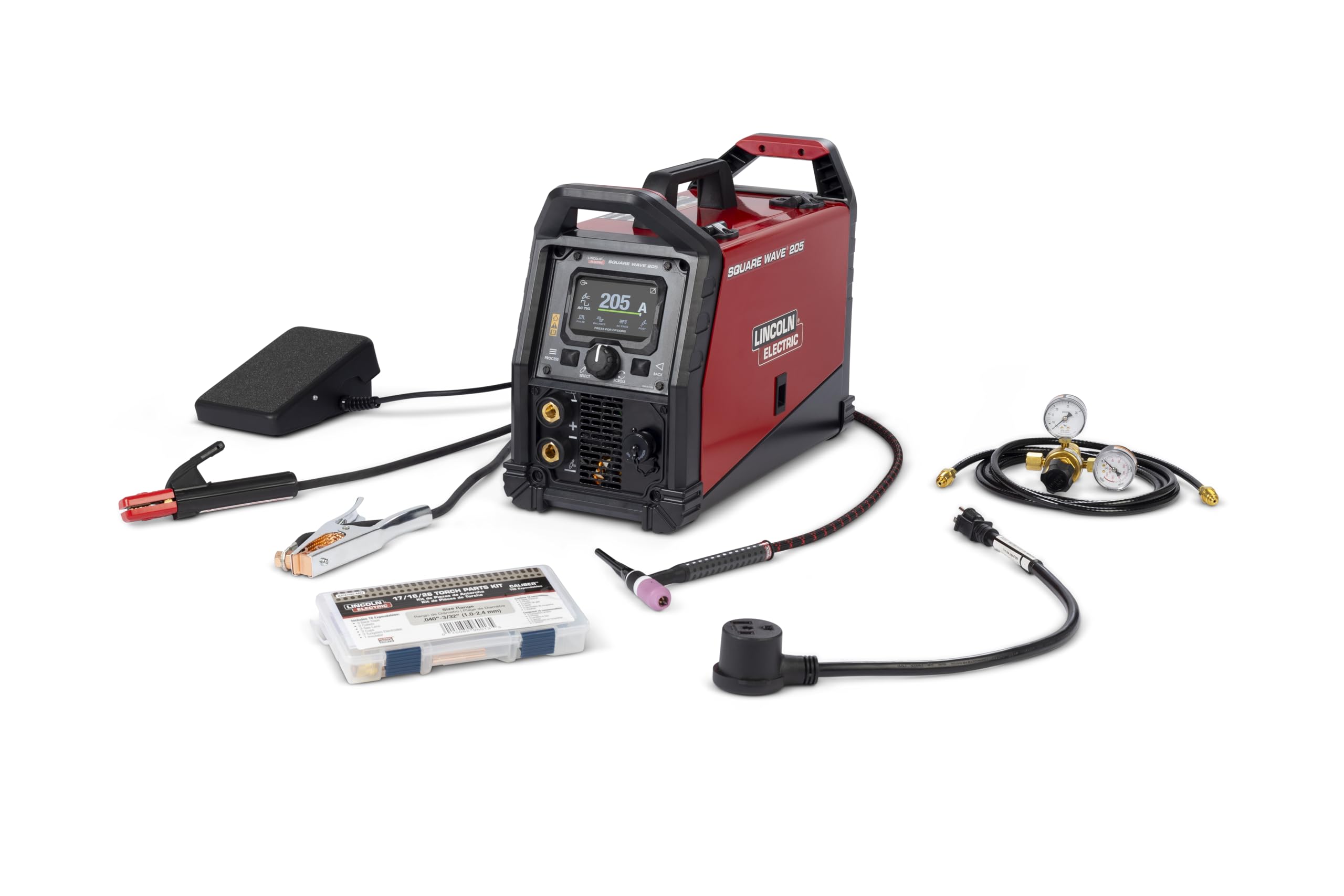
Lincoln Electric brings its decades of industrial welding expertise into a compact, hobbyist-friendly package with the Square Wave 205. This machine prioritizes ease of use without stripping out the features that matter for aluminum: AC balance, frequency control, and high-frequency arc starts are all present and adjustable. The Auto-Set feature simplifies parameter selection for beginners, while experienced welders can switch to manual mode and dial in every variable including upslope and downslope times.
The 205-amp maximum output covers most home-shop aluminum thicknesses up to about 3/8 inch, and the included 30-amp to 110V adapter means you can run it on standard household power for light work. Owners consistently praise the high-frequency start reliability — no arc wandering or failed ignitions even at low amperage settings on aluminum. The pulse feature delivers clean beads on thin sheet, and the AC balance adjustment lets you tune the cleaning action precisely to the base metal condition.
The machine is relatively portable at under 50 pounds, with molded handles that make it easy to carry between garage and truck bed. The fan is noticeable when running but cycles down during idle thanks to thermal management. For someone who wants the backing of a major welding brand without paying industrial prices, the Square Wave 205 delivers a polished experience.
Why it’s great
- Auto-Set simplifies setup for beginners
- Reliable HF start with no arc wandering
- Includes 30A to 110V adapter for household use
Good to know
- Fan can be loud at full speed
- Pulse feature may feel basic for advanced users
- Finger current control is an extra purchase
3. Everlast PowerTIG 210EXT

The Everlast PowerTIG 210EXT bridges the gap between enthusiast and professional by offering advanced pulse capabilities and waveform selection at a price that undercuts the major brands by a wide margin. It provides 210 amps of welding current with three AC waveform choices — triangular, advanced square wave, and soft square wave — each offering a distinct arc characteristic for different aluminum alloys and thicknesses. The advanced pulse mode in AC allows you to increase travel speed on thin material while reducing total heat input and warpage.
A standout feature is the programmable memory, which lets you save up to nine complete welding parameter sets including amperage, balance, frequency, pulse settings, and pre/post flow times. This eliminates setup time when switching between material types or joint configurations during a project. The machine supports both HF start and lift arc, giving you flexibility for different torch setups and environments where high frequency could interfere with sensitive electronics.
At 60 pounds, it’s a solid shop machine that ships with a #26 TIG torch, a #9 flex torch, foot pedal, stick stinger, ground clamp, regulator, and a 110V adapter. Owners note that the included torches are serviceable but upgrading the gas lens improves aluminum weld appearance significantly. The 5-year warranty provides long-term peace of mind that’s rare at this price point.
Why it’s great
- Three AC waveforms for tailored arc characteristics
- 9 programmable memory slots save time on repeat jobs
- 5-year warranty for long-term security
Good to know
- Included gas whip may degrade over time; consider replacement
- Stock torch benefits from gas lens upgrade
- Not the most portable option at 60 lbs
4. Weldpro 200A AC/DC Pulse
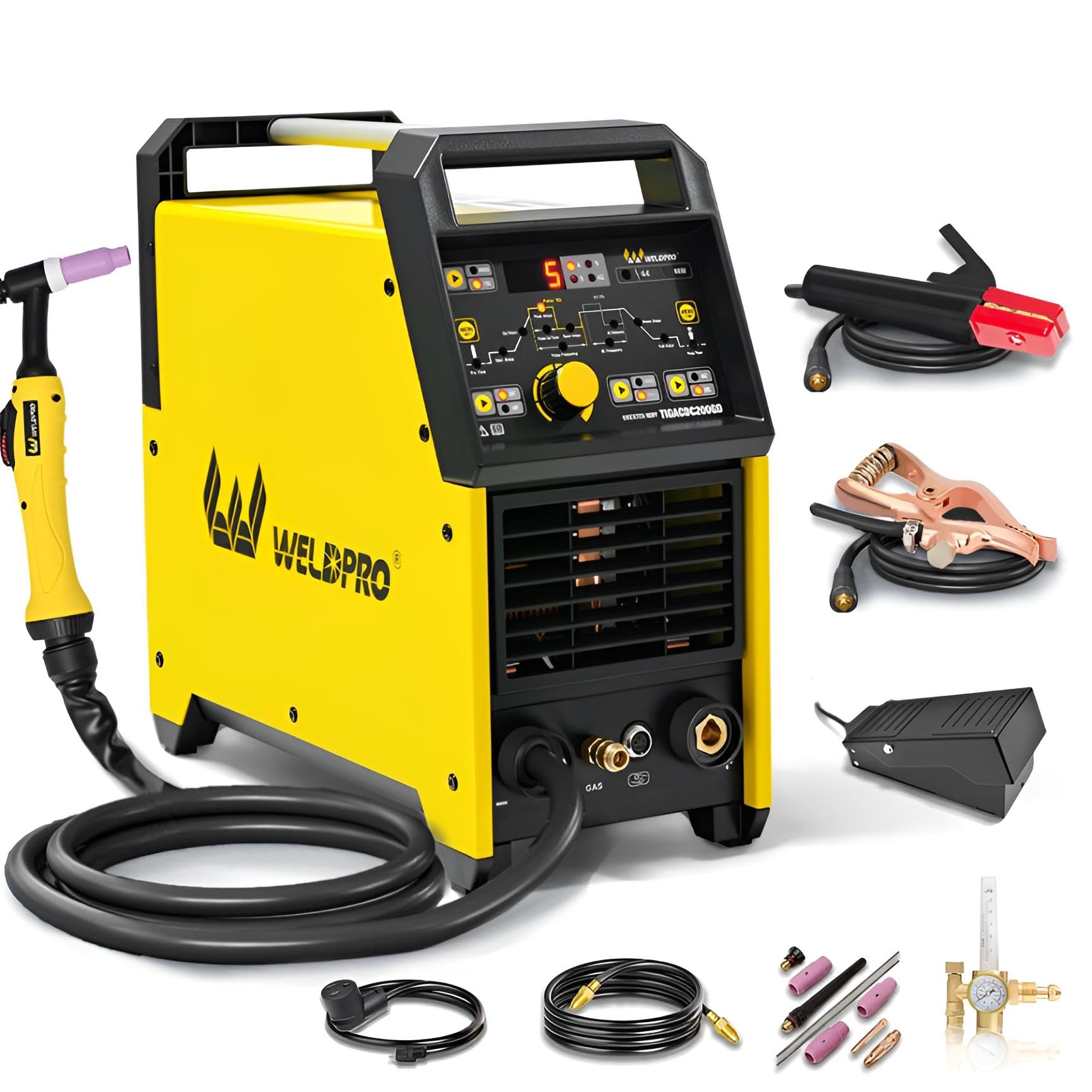
The Weldpro 200A AC/DC Pulse machine punches well above its price tier by packing adjustable AC balance, frequency, and a full 0.5 Hz to 200 Hz pulse range into a compact, portable chassis. It supports five welding modes — AC TIG, DC TIG, AC Pulse TIG, DC Pulse TIG, and Stick — giving you the flexibility to handle everything from aluminum boat repairs to thin-gauge stainless exhaust work with a single machine. The high-frequency non-contact arc start fires reliably on aluminum without contaminating the tungsten.
One of the most appreciated features among owners is the included CK17 flex torch, which is a notable upgrade over the rigid torches that ship with most budget-friendly units. The foot pedal provides smooth, progressive amperage control, and the large HD LED display makes it easy to read settings even in bright shop lighting. The 40% duty cycle at 200A is adequate for most hobbyist and light fabrication work, though extended welding sessions above 140A will require periodic cooldown pauses.
The machine auto-detects 110V and 220V input, so you can plug into a standard household outlet for practice or smaller work and switch to a 220V circuit for full power. Owners are consistently surprised by the build quality, with the case, torch, and ground clamp all receiving positive feedback for a unit in this price bracket.
Why it’s great
- Full pulse range from 0.5 to 200 Hz for thin material work
- CK17 flex torch is a premium inclusion
- Auto-sensing dual voltage for home and shop use
Good to know
- 40% duty cycle at max amps limits heavy production runs
- Gas-cooled torch gets hot during extended welding
- AC balance convention may differ from Miller machines
5. ARCCAPTAIN TIG200P ACDC

ARCCAPTAIN positions the TIG200P ACDC as a feature-packed 7-in-1 machine that includes AC TIG, DC TIG, AC Pulse TIG, DC Pulse TIG, AC Pulse TIG Square wave, AC Pulse TIG Triangular wave, and Stick modes. This breadth of waveform control is unusual at this price, and it gives you the ability to switch between a soft square wave for general aluminum fabrication and a triangular wave for focused heat input on thin or heat-sensitive alloys. The large LED display shows all parameters in real time, and the MCU digital control system keeps the arc stable across the full amperage range.
The machine weighs just 26.5 pounds, making it one of the lightest full-featured AC/DC pulse TIG units on the market. That portability comes without sacrificing control: you get pre-flow, initial current, upslope, peak current, base current, downslope, crater current, post-flow, pulse duty, AC frequency, AC balance, and pulse frequency all as adjustable parameters. The proprietary XS12 foot pedal connector is a limitation, and the included pedal is bulky, but the overall weld quality on aluminum — especially with the square wave setting — earns consistent praise from owners.
Professional welder testimonials note that the DC stainless performance rivals machines costing twice as much, and the AC aluminum output produces clean, consistent beads with proper cleaning action when balance is set correctly. The 5-year quality service from the manufacturer adds a safety net that many budget-friendly machines lack.
Why it’s great
- 7 distinct welding modes for maximum process flexibility
- Square and triangular wave options for tailored heat input
- Ultra-light 26.5 lb design for easy transport
Good to know
- Proprietary XS12 pedal connector limits compatibility
- Included ground clamp may need upgrading for sustained high-amp use
- Pedal is bulky compared to aftermarket options
6. Everlast PowerTIG 200DV

The Everlast PowerTIG 200DV is a workhorse dual-voltage machine that focuses on reliable performance and clean arc characteristics rather than chasing the highest feature count. It delivers 200 amps of AC/DC TIG power with a low start amperage of 5 amps in DC and 20 amps in AC, which makes it suitable for welding thin materials without burn-through. The lift-start function is included for situations where high-frequency start might interfere with nearby electronics, giving you a second ignition method without needing to swap torches.
Pre-flow and post-flow gas control are fully adjustable, and the arc force control (DIG) helps stabilize the arc during stick welding, reducing spatter and improving bead consistency on less-than-clean base metals. The IGBT inverter technology keeps the machine relatively compact at 60 pounds, and the fan-on-demand feature is a welcome touch that reduces noise when the machine is idling. Owners consistently note that the arc smoothness on both AC aluminum and DC stainless exceeds what they expected at this price.
The 200DV lacks the pulse functionality found on the 210EXT and 255EXT, so if advanced pulse aluminum welding is a priority, you’ll want to step up to those models. But for general fabrication, repair work, and learning to TIG aluminum, the 200DV offers a clean, stable arc with enough adjustability to handle most common materials and thicknesses.
Why it’s great
- Low 5A DC min for precise thin-material work
- Fan-on-demand reduces noise during idle
- Clean arc stability across AC and DC modes
Good to know
- No pulse functionality for advanced aluminum control
- Dual voltage but not auto-sensing; requires manual switching
- Heavier than some competitors at 60 lbs
7. AHP AlphaTIG 203Xi

The AHP AlphaTIG 203Xi has been a staple in the mid-range AC/DC TIG market for years, and the 2024 update brings electronic HV start to eliminate the physical point gap that older units required for HF start maintenance. This machine delivers 200 amps of welding power with a duty cycle that outpaces most competitors at the same price: 60% at 155 amps means you can weld for 6 minutes out of every 10 at a current that handles 1/4-inch aluminum comfortably. The 110V/220V dual voltage input with included adapter makes it suitable for both home garages and shop environments.
The included Nova foot pedal has a 25-foot cord, giving you plenty of reach around larger projects without needing an extension. The Nova Rotaflex 9/17 TIG torch is flexible and well-regarded, and the floating-ball brass argon regulator provides accurate gas flow readings. Stick welding performance is notably strong — owners report smooth arcs on 6010, 6011, 6013, 7018, and 308L electrodes, with adjustable frequency control on AC stick for aluminum alloy rods.
The LCD screen provides clear visibility of settings, and the pre-flow, post-flow, upslope, downslope, and pulse controls are all independently adjustable. The main downsides are the cheap ground clamp that most owners replace quickly and the long-term support concerns as AHP has changed ownership structures over the years. But for someone who wants a high-duty-cycle machine with real pulse control and proven longevity, the AlphaTIG 203Xi remains a strong option.
Why it’s great
- 60% duty cycle at 155A is among the best in its price range
- New HV start eliminates point gap maintenance
- Excellent stick welding performance on multiple rod types
Good to know
- Ground clamp is low-quality; plan to replace it
- Digital readout may not match knob position on 120V
- Long-term support is uncertain after ownership changes
8. YESWELDER TIG-200P ACDC
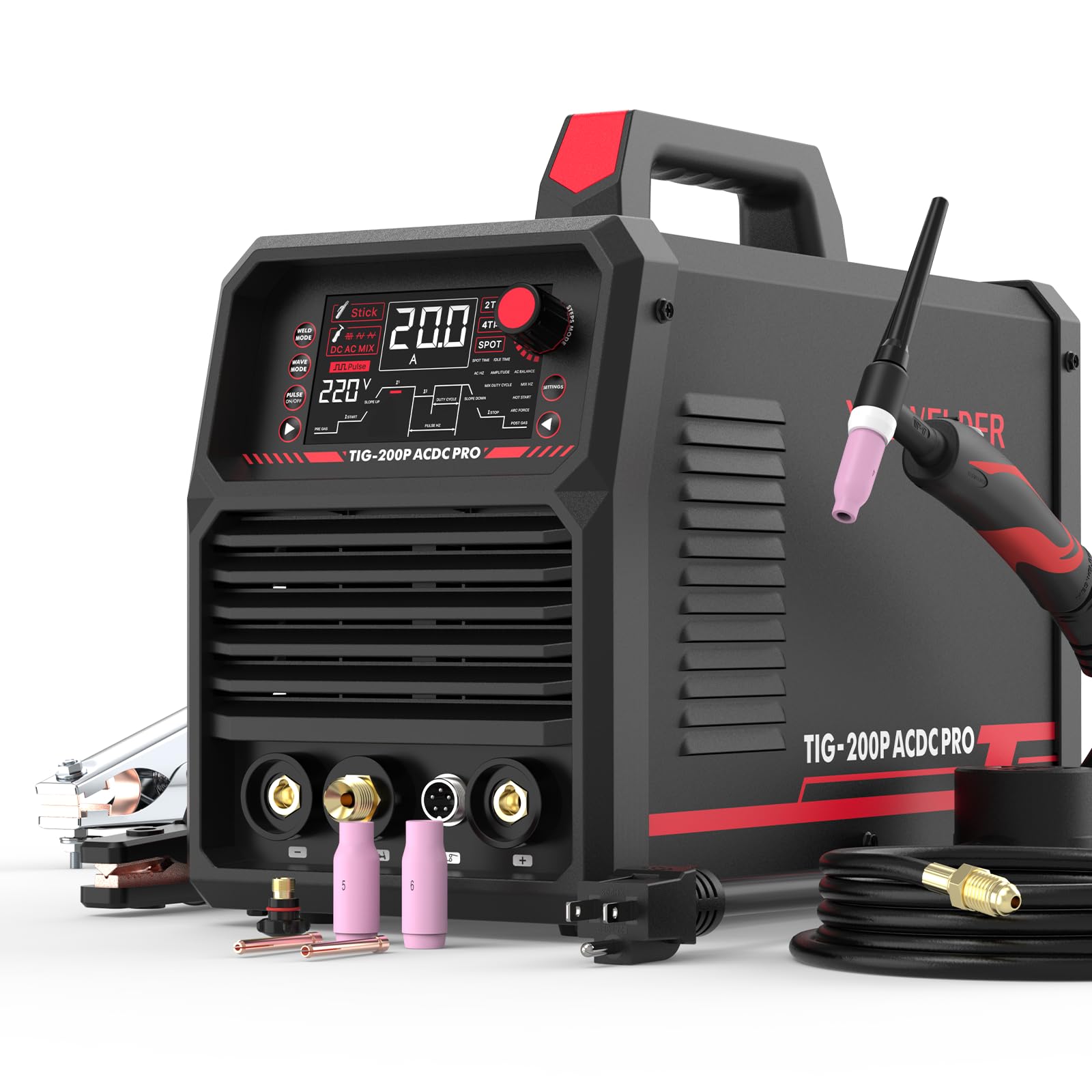
The YESWELDER TIG-200P ACDC packs 200 amps of AC/DC welding power into a chassis that weighs only 16.5 pounds, making it the lightest full-featured AC TIG machine in this guide. The weight savings come from a compact IGBT inverter design that doesn’t sacrifice core functionality: you get AC TIG, DC TIG, AC Pulse TIG, DC Pulse TIG, and Stick modes — plus a mix TIG mode and spot welding — all controlled through a large LED display that shows parameters clearly even in bright conditions. The auto-sensing dual voltage input (110V/220V) means you can plug into any outlet without manual switching.
The software-controlled square wave, triangle wave, and sine wave options give you real AC waveform control for aluminum welding, which is impressive at this weight and price. The pulse functionality includes adjustable peak and base current, frequency, and duty cycle, allowing you to fine-tune heat input for thin aluminum sheet. The hot start feature ensures reliable arc initiation without sticking, and the auto memory function saves your settings between power cycles.
Owners with TIG experience note that the aluminum weld quality is genuinely good — one 50-year welding veteran said the aluminum TIG results from this machine were the best he had ever seen. The included 13-foot WP-26 TIG torch is serviceable, though upgrading to a flex torch improves maneuverability. The primary concerns are quality control consistency: a small number of owners report unit failures, and the default AC startup mode instead of remembering the last mode is a minor annoyance.
Why it’s great
- Incredibly lightweight at 16.5 lbs for true portability
- Software-controlled square, triangle, and sine wave AC options
- Auto-sensing dual voltage with no manual switching
Good to know
- Doesn’t save AC/DC mode; defaults to AC on power-up
- Some early units had quality control issues
- 120V adapter may not deliver full 200A for stick welding
9. PrimeWeld CT520DP
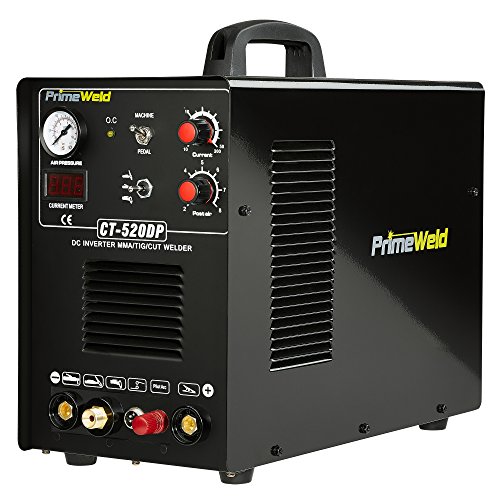
The PrimeWeld CT520DP is a 3-in-1 machine that combines a 50-amp plasma cutter with a 200-amp AC/DC TIG welder and a 200-amp stick welder into a single unit weighing just 32 pounds. The plasma cutter uses pilot arc technology, which means it can cut through rusty, painted, or uneven surfaces without needing to ground directly to the material — a significant advantage when cutting scrap or salvage material. Clean cuts on 1/2-inch steel are achievable, and the 60% duty cycle at max amps across all functions allows sustained use.
The TIG side includes high-frequency start for non-contact arc initiation on aluminum, and the stick mode handles 6011 and 7018 electrodes competently. The updated version includes separate argon and air inlets, eliminating the need to swap hoses when switching between welding and cutting. The included AG60P plasma torch has a swivel head that improves access angles, and the 6-50P plug with 110V adapter gives you flexibility at different job sites.
Owners consistently praise the plasma cutter performance, particularly on 1/4-inch steel where cuts are clean with minimal dross. The TIG arc is described as consistent and smooth, though some owners recommend upgrading the TIG torch for better gas coverage on aluminum. The 3-year warranty and US-based customer service add confidence, though a few owners have reported issues with included regulator quality.
Why it’s great
- Pilot arc plasma cuts painted or rusty surfaces without clean ground
- Separate argon and air inlets avoid hose swapping
- Lightweight 32 lb design for 3-in-1 capability
Good to know
- Included regulator may leak; consider immediate replacement
- TIG torch benefits from upgrade for better gas coverage
- Not a pure TIG machine; choose if plasma cutting is core need
10. LOTOS TIG200ACDC

This machine delivers 200 amps of AC square wave current for aluminum welding along with DC TIG and DC stick modes, all packaged with a foot pedal and argon regulator included in the box. The high-frequency start provides non-contact arc initiation on aluminum, and the foot pedal gives real-time amperage control that is essential for learning to TIG aluminum by feel.
The dual voltage input handles both 110V and 220V automatically, and the built-in cooling system keeps the unit stable during extended welding sessions. Owners consistently note that the arc is strong and tight for the price, with good performance on both aluminum and steel TIG. The stick mode is usable up to 5/16-inch material with 6011 and 7018 electrodes, making it a functional backup option for outdoor work where gas shielding is impractical.
The limitations are typical of budget-friendly machines: you must power cycle the unit to switch between TIG and stick modes, the foot pedal cord is excessively long, and the amp dial numbers don’t correspond exactly to the digital display. The included documentation is minimal, and setting AC balance correctly requires understanding that the “Clearance Effect” knob controls the EN/EP ratio. But for someone entering AC TIG welding on a tight budget, the LOTOS provides a functional path to learning aluminum welding without a huge investment.
Why it’s great
- Included foot pedal and argon regulator for immediate setup
- Strong square wave arc for aluminum at entry-level price
- Decade-proven design with large owner community
Good to know
- Must power cycle to switch between TIG and stick modes
- Documentation is sparse; learning curve for AC balance
- Amp knob numbers don’t match digital display
11. TOOLIOM 6-in-1
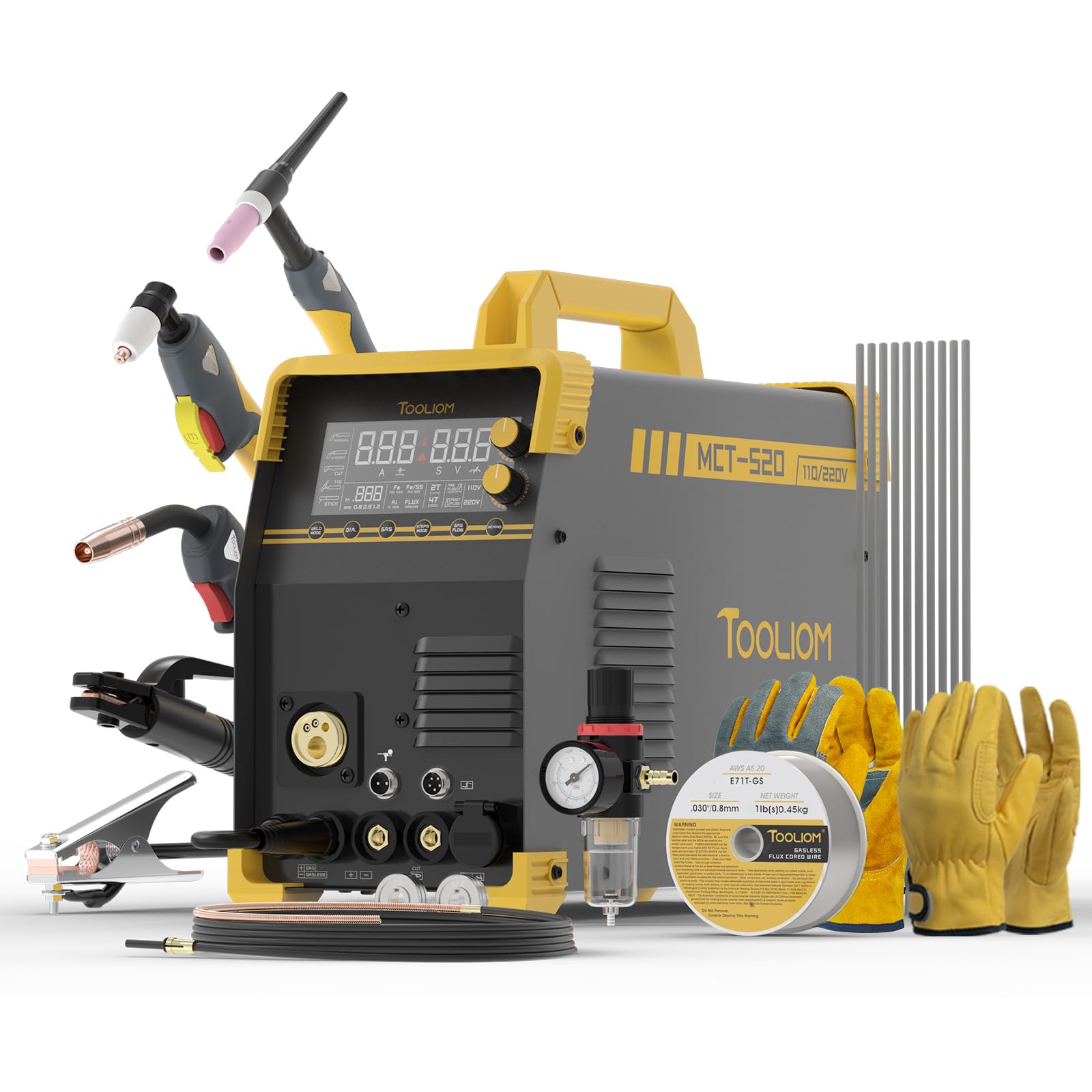
The TOOLIOM 6-in-1 is the most versatile machine in this guide, combining MIG, Flux Core, Spool Gun, Plasma Cutter, TIG, and Stick welding into one 47.9-pound unit. For someone who needs to do multiple processes in a small shop or mobile setup, this eliminates the need to buy three separate machines. The TIG function delivers up to 200 amps with high-frequency start for clean aluminum arc initiation, and the plasma cutter uses 20-50A of adjustable output to cut up to 5/16 inch on 110V or nearly 3/8 inch on 220V.
The MIG side includes both synergic mode — where voltage adjusts automatically based on wire speed — and manual mode for experienced operators who want full parameter control. The spool gun compatibility allows aluminum MIG welding with the correct gun (sold separately), adding another option for thicker aluminum fabrication. The digital control panel displays real-time current and settings, and the built-in safety system monitors for over-current, over-voltage, and over-heating conditions.
Owners are generally impressed with the plasma cutter’s clean cuts and the TIG arc quality given the machine’s multiprocess nature. The downside is that a jack-of-all-trades machine cannot match the refined arc characteristics of a dedicated TIG welder like the Everlast or Lincoln units in this guide. If TIG aluminum is your primary process, a dedicated machine will serve you better. But if you need one machine that does everything reasonably well, the TOOLIOM delivers remarkable versatility.
Why it’s great
- 6 processes in one machine saves shop space and money
- Plasma cutter with pilot arc handles 5/16 inch cuts on 110V
- Synergic MIG simplifies setup for beginners
Good to know
- Not a dedicated TIG machine; arc refinement is lower than pure TIG units
- Spool gun for aluminum is sold separately
- Requires separate air and argon sources for different processes
FAQ
Can I weld aluminum with a DC-only TIG machine?
What is the practical difference between square wave and sine wave AC for TIG?
What tungsten electrode should I use for AC aluminum TIG welding?
Final Thoughts: The Verdict
For most users, the best ac tig machine winner is the Lincoln Electric Square Wave 205 because it balances beginner-friendly Auto-Set functionality with the adjustable AC balance and pulse controls that experienced welders need for consistent aluminum work, all backed by a trusted brand. If you want maximum waveform control and advanced pulse capability for production fabrication, grab the Everlast PowerTIG 255EXT. And for the most versatile multiprocess solution that includes plasma cutting alongside capable AC TIG, nothing beats the TOOLIOM 6-in-1.