
Our readers keep the lights on and my morning glass full of iced black tea. As an Amazon Associate, I earn from qualifying purchases.
Specs are compiled from manufacturer listings and verified buyer reviews and can change over time — please confirm the key details on the product page before buying.
An AC to DC charger (a power supply that converts household wall current into the low-voltage direct current your gear needs) lets you plug 12V or 24V equipment—LED lights, a security camera, a Raspberry Pi, or even your whole RV’s electrical system—straight into a standard wall outlet. You get steady, safe power every time you flip the switch, without worrying about a battery going flat or hunting for the right adapter.
I’m Min — the founder and writer behind Gadgets Feed. This guide is built by comparing the manufacturers’ published specifications and the patterns across verified customer reviews, so you get each pick’s real strengths and trade-offs instead of marketing spin.
Matching voltage, amperage (the current, measured in amps), and safety features to your specific device is what makes a ac to dc charger work for you.
Our Picks at a Glance

How To Choose The Best AC To DC Charger
Picking the right AC to DC charger is about matching three core numbers: input voltage (the wall voltage it accepts), output voltage, and output amperage. A charger that supplies 24V to a 12V device can damage it instantly, while a charger that provides too few amps (current) might not power your device at all. Here is what to look for.
Output Voltage Must Match Your Device Exactly
The output voltage (DC) of the charger must be exactly what your device expects. If your LED strip is rated for 12V, you need a 12V power supply, not a 24V one. A mismatch can cause immediate damage or simply fail to switch the device on. Many universal chargers offer selectable voltage, which adds flexibility for different gadgets.
Amperage: The Rule of Headroom
Your charger’s amperage rating is the maximum it can supply. A device will only draw the amperage it needs, so a 10A charger is safe to use with a device requiring 5A. The real trick is to leave some extra capacity—many buyers recommend a 20% to 25% safety margin so the charger runs cool and the device never hits the current limit.
Safety Protections Are Not Optional
A good charger includes automatic overload cut-off, over-voltage cut-off, thermal cut-off, and short circuit protection. These keep you and your electronics safe if something goes wrong downstream. For battery chargers, a multi-stage profile (bulk, absorption, float—three phases that fill a battery safely) is essential to prevent overcharging and extend battery life.
Quick Comparison
| Model | Best For | Output Amps | Output Voltage | Safety Protections | Amazon |
|---|---|---|---|---|---|
| LiTime 12V 20A★ Best Overall | LiFePO4 Battery Charging | 20A | 14.6V | FCC/CE/RoHS, 0V Activation | Amazon |
| PowerMax PM4 55ATop Performer | RV & Boat Power | 55A | 12V (adjustable 13V-16.5V) | Reverse Polarity, Overload, Thermal Shutdown | Amazon |
| PowerMax PM3-45 | RV Replacement | 45A | 12V | 3-Stage Charging, Overload | Amazon |
| Yaheeda 12V 600W | High-Power 12V Conversion | 50A Peak | 12V | Overload, Short Circuit, Thermal | Amazon |
| DROK 0-48V | Variable Voltage Projects | 10A | 0-48V Adjustable | Overload, Over Voltage, Short Circuit | Amazon |
| SoulBay 36W Universal | Multi-Device Replacement | 3A Max | 3V-12V Adjustable | Over Voltage, Over Current, Short Circuit | Amazon |
| ALITOVE 24V 3A | LED Strip & Camera Power | 3A | 24V | Overload, Over Voltage, Thermal | Amazon |
In‑Depth Reviews
1. LiTime 12V 20A Lithium Battery Charger
Our pick — over 4.5★ from 900+ verified ratings; the strongest balance of quality and price.
The dedicated LiFePO4 charger that fills a 100Ah battery in about five hours.
If you have a 12V lithium-iron-phosphate (LiFePO4) battery for an RV, solar setup, or off-grid home, this charger is built specifically for that chemistry. It delivers 20 amps at 14.6V, which is the exact absorption voltage LiFePO4 batteries need to reach a full charge. Buyers confirm it charges a 100Ah battery from empty to full in roughly five hours, using a three-stage smart charging process that prevents overcharging and holds the battery at 100% in the float stage. Unlike the PowerMax PM4 55A which works with multiple battery types, this one is laser-focused on lithium.
The unit does not come with a display, but it uses LED indicators for clear monitoring. It also handles a deeply discharged battery with 0V activation—a feature that wakes up a battery that has been drained so far the internal BMS (battery management system) protection has kicked in. The aluminum housing and built-in cooling fan keep it cool even during a full cycle, and one owner reported the unit did not even get warm after a full charge.
One critical note from the manufacturer: this charger is not waterproof, so it is not suitable for marine environments like boats, ships, or trolling motors. It also requires the correct Anderson 50A or M8 terminal connection, so check that your battery terminals match before buying.
What Stands Out
- 20A/14.6V charging matches LiFePO4 chemistry perfectly.
- 0V activation revives BMS-protected batteries.
- Aluminum housing and cooling fan prevent overheating.
- UL-tested with FCC/CE/RoHS certifications.
Heads Up
- Not waterproof—keep it dry.
- Uses a specific Anderson 50A connector, not standard barrel jacks.
Best for: anyone with a 12V LiFePO4 battery who wants a dedicated, fast, and safe charger for off-grid or RV use.
Not for: wet environments or boats where moisture is a given.
2. PowerMax PM4 55A
The all-in-one powerhouse that keeps your RV or boat running without a hiccup.
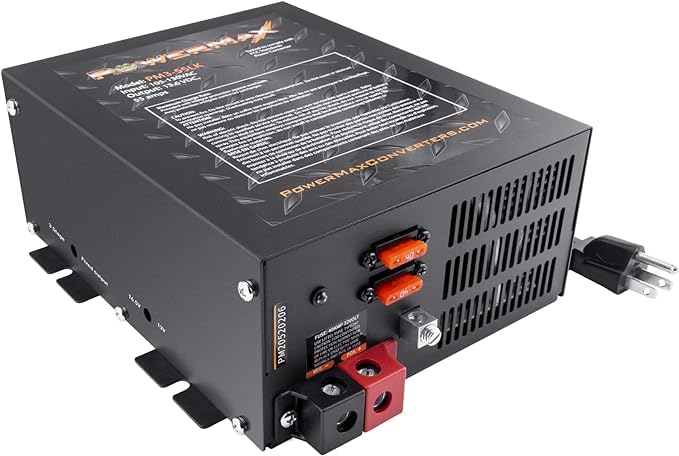
This is the most versatile pick for anyone who needs to power an entire 12V system and charge a battery at the same time. It delivers a steady 55 amps (55A) of clean DC power—enough capacity to run lights, a fridge, and everything else in a medium RV all at once. It uses a full four-stage smart charging process—bulk, absorption, float, and equalization—to keep lithium, AGM (absorbent glass mat), gel, or lead-acid batteries healthy. You can even adjust the output between 13V and 16.5V to match the exact needs of a lithium battery without the risk of overcharging, something the fixed 12V PowerMax PM3-45 cannot do.
Unlike smaller adapters, this unit is built for a permanent install. Buyers report that the installation takes about 10 minutes with no rewiring needed, and it is designed to handle rugged conditions in RVs, boats, and off-grid setups. One reviewer noted it works flawlessly separating house and chassis batteries—one set lithium, the other lead-acid—for a live-aboard RV.
The main trade-off is that it is larger than a simple wall wart (wall plug adapter), and at 6.4 pounds, it is meant to be mounted, not tossed in a drawer. The 4-stage charging is great for battery longevity, but if you only need to power a single LED strip, this is overkill.
Where It Excels
- 55 amp capacity—most in this list—runs an entire RV or boat.
- Adjustable voltage (13V to 16.5V) works with lithium straight from the start.
- 4-stage smart charging prevents overcharging and extends battery life.
- Buyers confirm a simple 30-minute install with no rewiring.
The Catch
- Heavier and bulkier than standard adapters.
- Not designed for small single-device applications.
Reach for this if: you have an RV, boat, or off-grid system needing both converted power and smart battery charging.
Look elsewhere if: your job is just to power a single 12V camera or LED strip—a smaller adapter will save space and money.
3. PowerMax PM3-45
A direct RV converter upgrade that solves battery overcharging at a fair price.
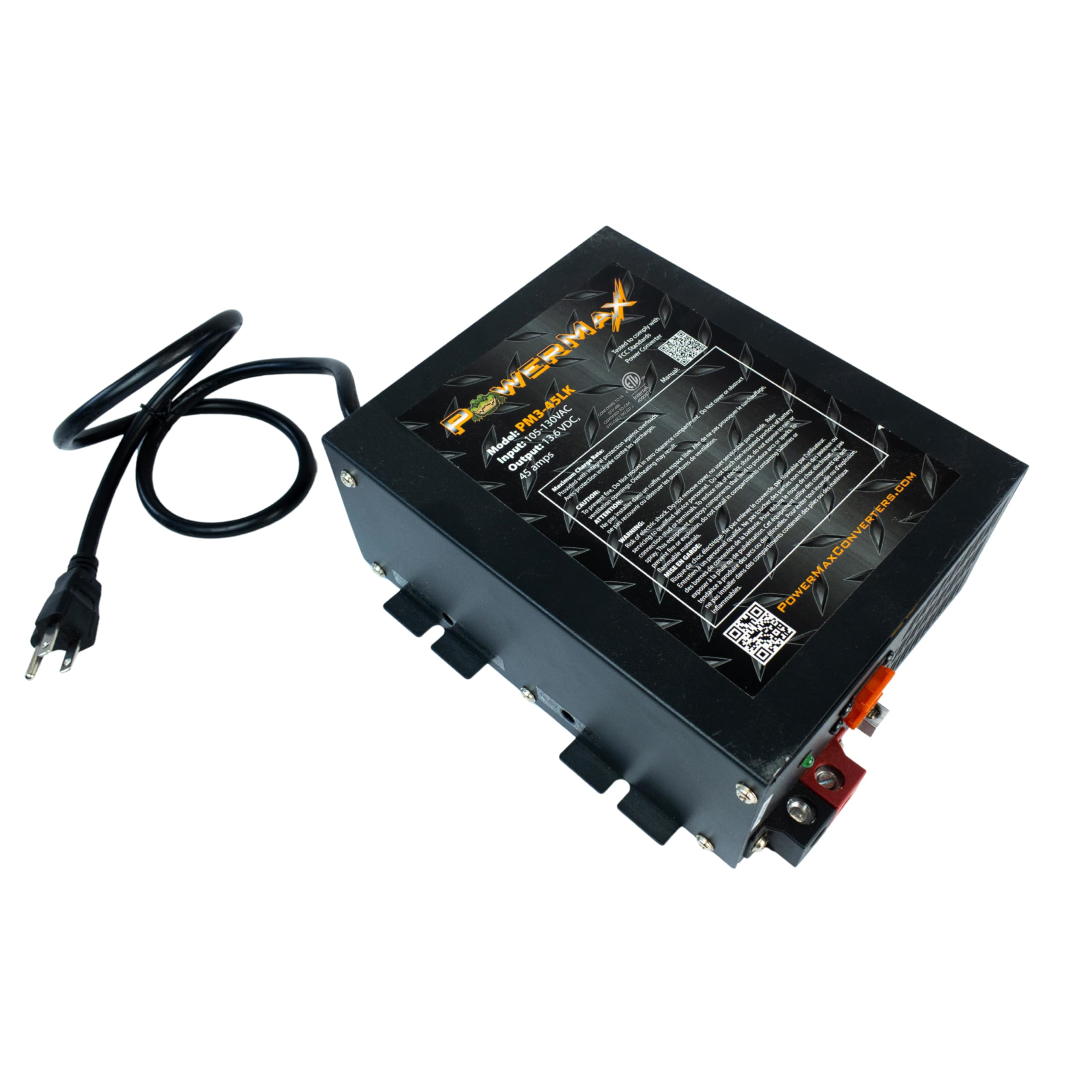
This 45-amp converter does double duty: it supplies stable 12V power for your RV’s DC electronics and runs a three-stage charging cycle (bulk, absorption, float—a smart process that fills the battery quickly then tops it off safely) to keep your batteries healthy without boiling them. Owners mention it works as a replacement for older units like the IntelliPower PD9145A, and one buyer mentioned the smart three-stage cycle charged from 12.4V up to 14.47V before dropping to a safe 13.4V float, with no electrolyte spill.
The unit is built with one of the quietest fans in the industry, so it is a good option for inside a living space. The installation is straightforward: you connect two wires and mount it, which several buyers confirm takes about 10 minutes. The PM3-45 is also a popular choice for powering automotive scan tools and reprogramming ECUs (engine control units), because it delivers clean, constant voltage—unlike a partially charged car battery.
At 45 amps, it is slightly less powerful than the PM4 55A, but it is still plenty for a mid-size RV. The main limitation is that the output voltage is fixed at 12V, so if you later upgrade to a lithium battery that needs a higher absorption voltage, you will want the adjustable model.
What Makes It a Value
- Three-stage charging dramatically extends battery life.
- Known for quiet operation—less hum inside the RV.
- Easy install with no new wiring needed.
- Reviewers praise it as a perfect replacement for outdated converters.
Trade-Off
- Fixed 12V output, not adjustable for higher lithium voltages.
- 45-amp rating may be tight for a large RV with many 12V loads.
Grab this for: a budget-friendly, quiet upgrade to an old or failing RV converter that was overcharging your battery.
Skip it for: lithium setups that need a higher bulk charge voltage (13.8V to 14.6V) than a fixed 12V unit provides.
4. Yaheeda 12V 600W Converter

A big-amp AC-to-DC converter that lets you ditch the battery on a gate controller or scissor jack.
This unit is a straightforward high-power converter that takes 110V AC (or 220V) and gives you up to 50 amps (50A peak) of 12V DC. It is not a smart battery charger—it is a pure power supply. That makes it ideal for powering a 12V pump, LED strip, car stereo, or electric scissor jack directly from the wall, as one buyer did to replace an old hydraulic jack setup. The same reviewer noted he chose this model specifically to derate his 20A scissor jack for reliability, running it well below the 50A peak.
The build quality gets consistent praise: a solid aluminum alloy shell, a built-in EMI filter (which reduces electrical noise), and 100% full-load burn-in testing. It includes a red on/off switch for safe power start/stop, plus wire lugs and a metal clip in the box. One buyer solved a recurring winter problem by using this converter to power a gate controller directly, eliminating the lead-acid battery that died every cold season.
The most common buyer complaint is that it lacks an internal fuse—one reviewer accidentally shorted the positive and negative wires and the unit burned out. If you buy this, plan to add an inline fuse on the 12V output for protection. Also note that the dimensions show a compact 1.9″D x 4.4″W x 8.5″H, considerably larger than a standard wall wart (a small plug-in adapter).
What It Does Well
- 50A peak capacity powers substantial 12V loads.
- UL-listed safety standard.
- Includes wire lugs, metal clips, and a power cord for quick setup.
- Buyers call it quiet and reliable for long-term use.
One Drawback
- No internal fuse—add an inline fuse to avoid burnout on short.
- Cannot be used with dimmable lights or adjustable-speed motors.
Reach for this if: you need to replace a 12V battery in a fixed setup (gate, pump, jack) and want a reliable, fusable power supply.
Look elsewhere if: you want a full-featured smart charger with battery profiles—this is pure conversion, not a charger.
5. DROK 0-48V 10A Power Supply

The flexible variable-voltage converter that powers everything from 5V circuits to 48V landscape lights.
This supply is the most adjustable in the list: you can tune the output from 0V all the way to 48V, with a 0.1V precision. That makes it useful for testing electronics, powering a 12V car radio in the workshop, or running a 24V CCTV system—all from the same box. The amperage is fixed at a maximum of 10A, but the load determines what it actually draws.
Buyers have found creative uses for it. One enthusiast soldered cords directly to cordless tool battery terminals to power drills and sanders, avoiding the cost of new battery packs. Another reviewer tested stability under load: the output remained accurate within 0.06V on the gauge, though the single-turn voltage pot (the knob you turn to set voltage) is not the easiest to fine-tune. The unit runs cool—one buyer ran it for two hours at 75°F at 5A and the fan never even kicked on.
The catch is that the maximum output voltage depends on your input. On standard 120V AC, you only get about 36V max; to reach the full 48V, you need a 240V input. Also, there is no digital display—you read the voltage from a small analog-style gauge, which some buyers find hard to fine-adjust.
Where It Shines
- 0-48V range covers 5V, 12V, 24V, 36V, and 48V devices.
- Voltage precision of 0.1V for sensitive electronics.
- Overload, over-voltage, and short-circuit protections built in.
- Buyers call it stable and reliable for bench work.
The Limit
- On 120V input, max voltage is 36V—48V requires 240V.
- Single-turn voltage pot makes fine adjustments tricky.
Use it for: a workshop bench supply where you need to test devices at different voltages.
Pass on it if: you need a fixed 12V supply for high-amp gear—the 10A limit may be too low for a large RV or 12V pump.
6. SoulBay 36W Universal AC Adapter

The one-adapter-to-rule-them-all that covers 3V to 12V with eight interchangeable tips.
This universal adapter is the household fix for all those small electronics that lost their original power brick. It covers voltages from 3V to 12V (in 1.5V or 1V steps) and includes eight different connector tips, ranging from the common 5.5×2.5mm barrel down to a small 2.5×0.7mm plug, plus a Micro-USB and screw-on LED terminal.
The output delivers up to 3 amps (3A). That is enough for most routers, speakers, external hard drives, LED strips, and CCTV cameras. One buyer specifically noted it provides “clean 3A power for Raspberry Pi” and eliminated the low-voltage warning (the lightning bolt icon) that appeared with weaker adapters. The voltage is set with a small key included in the package—there is no switch to accidentally bump.
The limiting factor is the 36W total power. At 3V, you can pull the full 3A, but you cannot run a 12V device that draws more than 3A. It also does not include a polarity-reversing barrel; one customer observed the two-wire screw adapter is useful if you need to swap the positive and negative.
Why It Is Useful
- Eight tips cover 95% of common household electronics.
- Multiple voltage options in one box.
- Reliable 3A output—verified to run a Raspberry Pi without under-voltage warnings.
- Safe protections: over-voltage, over-current, short circuit, over-temperature.
Where It Falls Short
- Max 36W—too weak for high-power devices like a printer or monitor.
- Polarity is fixed per tip; you need the screw adapter to swap.
Grab it for: lost power supply replacements around the house for routers, external drives, and other 3-12V gadgets under 3A.
Skip it for: any device that needs more than 3A or a dedicated battery charging profile.
7. ALITOVE 24V 3A 72W Adapter

A simple, reliable 24V brick for LED strips and cameras that just works.
If you need a straightforward 24V power supply for a COB (chip-on-board) or 5050 LED light strip, a security camera, or a wireless router, this adapter is a no-frills solution. It accepts universal input from 100V to 240V and provides a stable 24V output at up to 3 amps (72W). The 5.5×2.1mm barrel jack is standard for many LED controllers, and the adapter comes with a free female DC connector so you can attach wires without soldering.
Customers note it is a perfect replacement for a failed original power supply. One reviewer installed it on a water softener after the included unit died from power interruptions and called it “more sturdy.” Another said it worked great for powering a COB LED light strip, and a third paired it with an HK audio stomp box. A single reviewer cautioned that the unit lacks overcurrent protection for amplifier applications: they recommended using a supply with 2-3x the required total RMS watts if driving speakers.
At just 3A, it is not suitable for any high-amp 24V gear. But for its target use—LED strips and cameras—it is a cost-effective, 4.6-star-rated adapter that buyers find reliable in the long run.
What It Delivers
- Universal input (100-240V) works anywhere.
- Comes with a free female DC connector for quick wire attachment.
- Safety protections: overload, over-voltage, thermal cut-off, short circuit.
- Buyers confirm it works “just right” for LED ribbon lights.
One Caution
- Not a heavy-duty power supply—needs 2-3x headroom for audio amplifiers.
- Plastic enclosure, not as heat-dissipating as metal.
Best for: replacing a failed 24V wall wart for LED strips, cameras, or routers.
Not for: powering large audio amplifiers or any motor that pulls close to its 3A limit for extended periods.
Understanding the Specs
Output Voltage
Output voltage is the DC voltage the charger supplies. It must be exactly what your device requires. A 24V charger connected to a 12V device can destroy it. Some chargers, like the SoulBay and DROK, let you adjust the voltage, which is useful when you power different gadgets from the same power supply. When using a battery charger, the output voltage often matches the battery’s nominal voltage, but a lithium charger (like the LiTime) may output a higher absorption voltage (14.6V) to fully charge the battery.
Output Amperage
Amperage (current, measured in amps) is how much current the charger can deliver. A device will only draw the current it needs, so a 20A charger is safe for a device that draws 5A. The key number is the charger’s maximum rating—if your device draws more amps than the charger can supply, either the device won’t work, or the charger overheats and shuts down. A safe rule is to leave 20-25% headroom: if your load needs 8A, get a 10A charger. The ALITOVE adapter, for example, supplies 3A max, so it is suited for LED strips that draw about 2.4A, not for a 10A pump.
Smart Charging vs. Fixed Power Supply
A fixed power supply always outputs its rated voltage. That is fine for powering a camera or LED strip. A smart battery charger, like the PowerMax PM4 or LiTime, uses a multi-stage profile (bulk, absorption, float) to safely fill a battery without overcharging. If you connect a plain power supply directly to a battery, you risk overcharging and damaging it. For battery maintenance, look for a charger that includes three or four stages and matches your battery chemistry (LiFePO4 vs. lead-acid).
Safety Protections
Every charger in this list includes overload, over-voltage, and short-circuit protection. These are not nice-to-have—they prevent the charger from catching fire or damaging your device if something goes wrong downstream. The term “thermal cut-off” means the charger automatically shuts down if it gets too hot, which is common when running near its maximum amperage for hours. For applications where wires can accidentally touch (like a workshop), an inline fuse is a wise addition, as one user highlighted about the Yaheeda converter.
FAQ
Can I use a 24V AC to DC charger on a 12V device?
What does it mean when a charger has a “3-stage” or “4-stage” smart charging profile?
Can I use an AC to DC converter as a battery charger?
How do I know what amperage I need for my LED strip or camera?
What is the difference between a barrel connector and a screw terminal?
Will a higher-amp charger damage my device if it draws less current?
Can I adjust the voltage on any AC to DC charger?
What does “0V activation” or “wake up” mean on a lithium battery charger?
How long does a 20A charger take to charge a 100Ah battery?
Final Thoughts: The Verdict
Across the board, the ac to dc charger winner is the PowerMax PM4 55A because it handles everything from full RV power conversion to smart 4-stage battery charging in one durable unit. If you want a dedicated solution for a LiFePO4 battery, grab the LiTime 12V 20A. And for budget-friendly replacement or universal household power, the standout is the SoulBay 36W Universal Adapter.
How We Picked
We do not accept paid placement. Every pick is matched to a real buyer and a real use-case; we do not hands-on test units.
Sources & Methodology
Specifications: manufacturer listings and product documentation. Review insights: verified customer reviews, as of July 2026. Pricing: not shown on this page (it changes often); check the current price via the retailer link.
As an Amazon Associate, Gadgets Feed earns from qualifying purchases. This does not affect which products we feature.