
An RV air conditioner isn’t just a comfort upgrade—it’s survival gear when you’re parked under a July sun with no escape. Choosing the wrong unit means sweltering nights, a generator that never stops screaming, or a system that simply doesn’t fit your rig’s roof opening. This guide breaks down every rooftop cooling option that actually works in a real RV, based on verified owner experiences and hard specs.
I’m Min — the co-founder and writer behind Gadgets Feed. Every unit here has been scrutinized through real owner feedback, verified product specs, and direct comparisons of noise ratings, BTU output, and physical dimensions that matter when you’re up on a ladder with four bolts and a prayer.
Whether you’re upgrading a vintage Airstream or outfitting a new fifth wheel, this guide cuts through the marketing spin to find the best ac unit for rv that matches your power setup, roof layout, and tolerance for installation hassle.
How To Choose The Best AC Unit For RV
RV air conditioners are deceptively simple machines, but the wrong choice will leave you roasting or wrestling with an installation that doesn’t fit. Focus on four things: BTU rating versus your rig’s square footage, physical dimensions for your roof opening, whether you need ducted or non-ducted airflow, and the total electrical draw your system can handle.
BTU: Size Matters But More Isn’t Always Better
A 13,500 BTU unit is the standard for most 20-30 foot RVs. Jump to 15,000 BTU for longer rigs or hotter climates. The 18,000 BTU options exist but pull significantly more amps—make sure your generator or shore power can handle the startup surge. Oversizing can short-cycle the compressor and fail to dehumidify properly.
Ducted vs. Non-Ducted: How the Cold Air Travels
Non-ducted units dump cold air directly below the unit, which works fine for small campers and vans but creates hot spots in longer fifth wheels or Class A motorhomes. Ducted units push air through ceiling channels to reach every room. If your RV already has ducting, stick with a ducted-compatible unit to avoid tearing down the ceiling.
Heat Pump: Four-Season Versatility
A built-in heat pump provides electric warmth during cool spring and fall mornings without firing up your propane furnace. It’s not a replacement for deep-winter heating (most stop being effective below 40°F), but it saves propane and keeps the RV comfortable during shoulder-season camping without the dry heat of a furnace.
Quick Comparison
On smaller screens, swipe sideways to see the full table.
| Model | Category | Best For | Key Spec | Amazon |
|---|---|---|---|---|
| TOSOT 16000 BTU | Mid-Range | Best All-Around Performance | 16,000 BTU / 43 dB / Heat Pump | Amazon |
| Dometic FreshJet 3 | Mid-Range | Lightweight Dometic Replacement | 13,500 BTU / 21 SEER / 4 dB quieter | Amazon |
| Coleman-Mach 15 (Textured White) | Premium | Medium-Profile Fit with High Output | 15,000 BTU / Medium-profile | Amazon |
| Coleman-Mach 15 (Arctic White) | Premium | Proven Reliability for Hot Climates | 15,000 BTU / 5,600 BTU heat | Amazon |
| Furrion Chill Cube 18K | Premium | Variable Speed for Efficiency | 18,000 BTU / R32 refrigerant | Amazon |
| RecPro 15K with Heat Pump | Premium | Ducted/Non-Ducted Versatility | 15,000 BTU / 55 dB / Heat Pump | Amazon |
| Coleman 48204C869 | Mid-Range | Budget-Friendly 15K Upgrade | 15,000 BTU / 320 CFM / Copper coils | Amazon |
| ASA Electronics Advent Air | Budget Entry | Affordable 13.5K for Moderate Climates | 13,500 BTU / Metal base pan | Amazon |
In‑Depth Reviews
1. TOSOT 16000 BTU RV Air Conditioner

The TOSOT 16000 BTU hits a trifecta that’s rare in RV cooling: more power than the standard 13.5K units, whisper-quiet operation at 43 dB, and a built-in heat pump for shoulder-season warmth. Real owners report dropping interior temps from 105°F to 70°F in direct sun, while running on a Honda 3000W generator without tripping breakers. The non-ducted design fits the standard 14.25″ x 14.25″ roof cutout, and the WiFi control via the Gree+ app lets you pre-cool the cabin before you even reach the campsite.
The 12,500 BTU heat pump covers chilly mornings without needing the propane furnace, and the unit works across ambient temps from 23°F to 115°F. Multiple reviewers confirm that the installation is straightforward—two people and a couple of hours—thanks to the included hardware and clear guide. The lower profile sits noticeably flatter than older Dometic or Coleman units, which helps with both aerodynamics and aesthetics.
The only lingering question is long-term reliability. TOSOT is a newer name in the RV space, and while early adopters are thrilled, parts availability outside Amazon could be a headache. The unit ships in two boxes, so wait until both arrive before scheduling installation. Overall, this is the strongest value proposition for anyone wanting premium features without a luxury price tag.
Why it’s great
- Significantly quieter than stock Dometic units at only 43 dB
- 16,000 BTU delivers faster cooldown in extreme heat
- Built-in heat pump eliminates propane use in mild weather
- WiFi and remote control for pre-cooling convenience
Good to know
- Non-ducted design limits even airflow in long RVs
- Long-term parts availability uncertain for a newer brand
- Ships in two packages—both must arrive before install
2. Dometic FreshJet 3 Series 13.5K BTU

Dometic’s FreshJet 3 is a direct answer to owners frustrated with the noise and weight of older Brisk Air II models. At 14% lighter, it’s noticeably easier to muscle onto the roof, and real-world measurements show a startup draw around 2,000W and continuous draw of 1.6-1.7kW—manageable on a 3,000W generator. The 21 SEER rating makes it one of the most energy-efficient rooftop units available, which matters for extended boondocking or running on solar.
Backward compatibility with existing Dometic and competitor air distribution boxes means most owners can swap the upper unit only and keep their existing thermostat and ceiling assembly. Install times reported by buyers average around 45 minutes to 1.5 hours for the upper unit alone. The noise reduction is immediately noticeable: multiple users describe it as “much quieter” than their previous unit, with one measuring a 4 dB improvement over the Brisk Air II.
The catch is packaging. Several units arrived with cracked shrouds or broken mounting tabs due to insufficient protection during shipping. Buying from a seller with a solid return policy is essential. Also, this unit is the upper-only option—you’ll need the lower control box if your RV doesn’t already have one. For those who already have a compatible Dometic plenum, this is a clean, efficient upgrade that delivers measurable improvements in noise and power draw.
Why it’s great
- Plug-and-play replacement for most Dometic systems
- 21 SEER efficiency reduces generator runtime
- Lightweight design simplifies solo roof installation
- Demonstrably quieter than Brisk Air II
Good to know
- Packaging often insufficient—inspect immediately upon arrival
- Works best as an upper unit replacement for existing setups
- WiFi not built-in; requires separate thermostat upgrade
3. Coleman-Mach 15 Signature Series (Textured White)
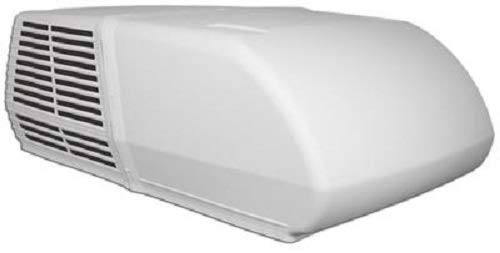
The Coleman-Mach 15 Signature Series is the medium-profile workhorse that fits RVs where a low-profile unit leaves too little clearance for the ceiling, but a full-height shroud looks awkward. At 15,000 BTU, it’s the highest cooling output in Coleman’s non-ducted lineup, and owners confirm it keeps 31-foot Airstreams and Fleetwood Wilderness campers frosty even in 98°F weather. The textured white shroud hides scratches and dirt better than gloss finishes, a small detail that matters after years of road grime.
Installation is the standard rooftop dance: three people on separate ladders to lift the 80+ pound unit onto the roof, then four bolts and wiring that takes about two hours total. The hardest part is always the lift, not the wiring. Multiple buyers emphasize that the unit is loud when running—it’s a non-ducted design sitting just four feet from the bed in many RVs—so be prepared for consistent white noise while sleeping.
Quality control reports are mixed. One buyer found two of three compressor mounts unattached due to defective hardware, while others report flawless operation. The shroud feels flimsy to some, but the cooling performance is universally praised. This is a solid choice if you need the raw power of 15,000 BTU in a medium-profile form factor and you’re comfortable inspecting the unit thoroughly upon delivery.
Why it’s great
- 15,000 BTU provides serious cooling for larger RVs
- Medium-profile design suits many roof configurations
- Textured finish hides road wear and UV damage
- Straightforward installation for experienced DIYers
Good to know
- Non-ducted means loud at sleeping distance
- QC reports vary—inspect compressor mounts before install
- Upper unit only; requires lower control panel purchase
4. Coleman-Mach 15 48204 Series (Arctic White)

The Arctic White variant of the Coleman-Mach 15 is an upper-unit-only replacement that has been cooling RVs for years with a proven track record. Its 15,000 BTU cooling capacity and 5,600 BTU electric heat element make it a genuine two-season machine. One owner reports that a single unit keeps their 33-foot Class A RV “frigid cold” in south Florida summer—high praise given the brutal humidity and direct sun exposure typical of that region.
Installation mirrors the standard Coleman process: pull the old upper unit, drop the new one into the existing 14×14 opening, and tighten four bolts. The pre-installed foam seal creates a watertight connection without extra sealant. Owners replacing faulty units that only dropped temps by 4-5°F report the Mach 15 delivers a 15-20°F drop, a massive improvement for anyone who has suffered through a weak OEM system. The unit is taller than older Mach 3 models, so check clearance if your RV has a low-profile cover.
The biggest headache is that this is upper unit only—you must buy the lower control panel separately if your RV doesn’t already have one. Some buyers missed this detail and ended up with a paperweight until they ordered the missing parts. Also, two-piece shroud design is convenient for access but fragile when lifting. Overall, this is the safest bet for anyone who wants a proven, widely-available upper unit with no software or WiFi complications.
Why it’s great
- Proven cooling performance even in extreme Florida heat
- Electric heat element adds warmth without propane
- Drop-in replacement for existing Coleman roof holes
- Reliable scroll compressor with long track record
Good to know
- Upper unit only—lower panel sold separately
- Two-piece shroud is fragile for roof lifting
- Taller profile than older Mach 3 units
5. Furrion Chill Cube 18K BTU

The Furrion Chill Cube 18K represents the bleeding edge of RV air conditioning with its variable-speed compressor and R32 refrigerant, a more environmentally friendly and efficient gas than traditional R410A. The variable-speed technology eliminates the abrupt start-stop cycling of standard RV ACs—instead, the compressor ramps up and down smoothly, reducing amp spikes and keeping the temperature more stable. Owners report it cools a 37-foot fifth wheel effectively with a single unit, which is impressive for a 30-amp system.
At 72.4 pounds, it’s about 10% lighter than many 15K units, making roof installation slightly less back-breaking. The aerodynamic shroud reduces wind resistance and improves gas mileage while driving—a marginal benefit, but one that adds up over thousands of miles. The dry mode pulls excess humidity without overcooling, a feature that matters in coastal or humid camping areas. The wireless thermostat included in the separate distribution kit lets you control the temperature from wherever you’re sitting.
The variable compressor comes with a trade-off: some units produce a resonant vibration that shakes the entire RV, especially during ramp-up and ramp-down. One buyer returned their unit due to this issue. Also, the Chill Cube requires a separate Air Distribution Box (ADB) sold separately, adding cost and complexity. For those willing to deal with the ADB requirement and the small risk of vibration, the efficiency and cooling power are unmatched in this class.
Why it’s great
- Variable-speed compressor reduces amp draw and noise spikes
- R32 refrigerant is more efficient and eco-friendly
- 18,000 BTU can cool large RVs with a single unit
- Dry mode helps with humidity control
Good to know
- Requires separate ADB kit—not included
- Some units produce noticeable compressor vibration
- Taller profile may not fit low-roof RVs
6. RecPro RV Air Conditioner 15K with Heat Pump
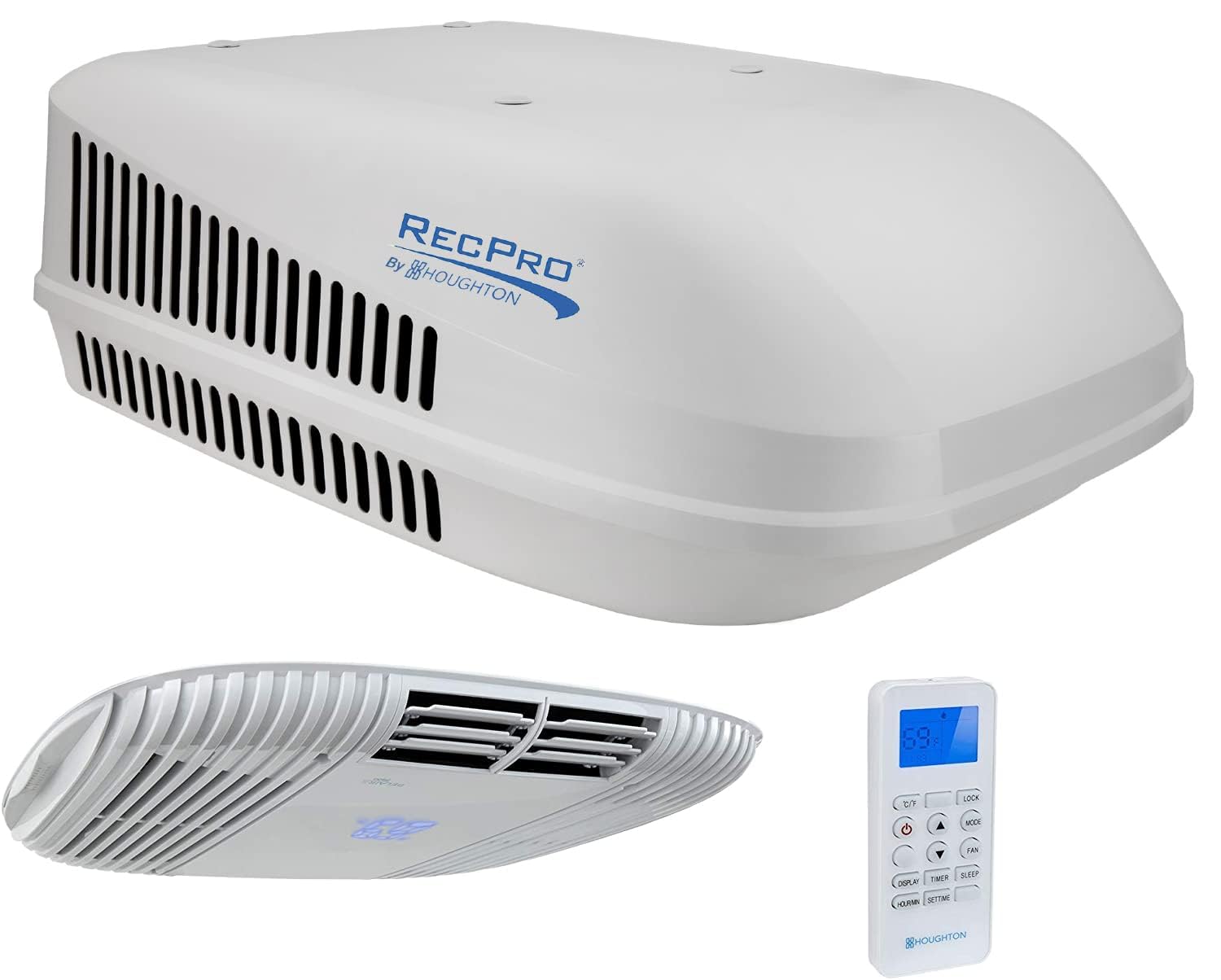
The RecPro 15K with heat pump is the Swiss Army knife of RV air conditioners—it works in both ducted and non-ducted configurations, includes a heat pump for four-season use, and operates at a reasonable 55 dB. Owners consistently praise the customer service, with one reviewer noting RecPro quickly resolved a minor issue after installation. The low amp draw design means you can run the AC alongside other appliances on a 30-amp service without tripping breakers.
The heat pump is the standout feature. Multiple owners mention it eliminates the need for a separate space heater or propane furnace during shoulder-season camping. The remote control and LED touchscreen on the ceiling panel eliminate the need for a separate thermostat and wiring. At 80 pounds, it’s not the lightest unit, but the installation is described as straightforward for two people. The unit is manufactured in Australia, which surprised some buyers but signals a different engineering approach than typical Chinese-sourced units.
The main compromise is that the heat pump fan runs continuously 24/7 when heating, which can be annoying for light sleepers. Measured dB levels range from 55 to 65 dB depending on the reviewer’s meter position—not silent, but quieter than most Dometic units it replaces. The timer feature has a quirk where setting the clock activates the timer inadvertently, though removing the remote battery resets it. For the price, this is a compelling all-in-one package with the best customer support reputation in this comparison.
Why it’s great
- Works in both ducted and non-ducted RV systems
- Integrated heat pump saves propane in mild weather
- Excellent customer service reputation
- Touchscreen controls eliminate thermostat wiring
Good to know
- Heat pump fan runs continuously, can disrupt sleep
- Timer operation has a minor clock-setting bug
- Heavier than some competitors at 80 lbs
7. Coleman 48204C869 RV Air Conditioner

The Coleman 48204C869 is the no-frills, black-shrouded workhorse that delivers 15,000 BTU of cooling at the most approachable price point in this list. It uses copper evaporator and condenser coils, which offer better heat transfer and corrosion resistance than aluminum. With 320 CFM airflow and a 1/3 HP fan motor, it pushes cold air effectively in both ducted and non-ducted configurations, though it’s best suited for RVs where the drop-in location aligns with the main living area.
Installation follows the standard Coleman playbook: remove four bolts, lift the unit onto the roof, connect wiring, and replace. The hardest part is always the roof lift—plan for three people or a mechanical assist. Owners report excellent cooling performance, with one reviewer noting it “blows really cold.” The unit is an upper-only component, so your RV needs the lower control assembly, or you must purchase it separately.
The primary risk here is seller reliability. One buyer reported the unit failed after three weeks and the seller refused to address it. Buying from a reputable source with good return policies is critical. Also, the unit is large and heavy, so measure your roof clearance and have help ready. For anyone on a tighter budget who needs 15,000 BTU output and trusts the Coleman brand, this is the most direct path to a cool RV without premium features you don’t need.
Why it’s great
- 15,000 BTU at the most accessible price point
- Copper coils offer better durability than aluminum
- Solid 320 CFM airflow for effective cooling
- Proven Coleman compressor reliability
Good to know
- Seller reliability varies—choose a trusted source
- Upper unit only; lower control assembly needed
- Heavy unit requires multiple people for roof lift
8. ASA Electronics Advent Air 13,500 BTU

The ASA Electronics Advent Air is the entry-level champion that proves you don’t need to spend a fortune to stay cool in moderate climates. At 13,500 BTU, it’s the standard cooling capacity for most 20-30 foot RVs, and real owners confirm it keeps trailers comfortable in Arizona’s 115°F+ heat when paired with a 3,500W generator. The rigid metal base pan is a surprising durability feature at this price point—many budget units use plastic that warps over time.
Installation is a direct swap for older Dometic upper units, with several buyers reporting it’s an “exact replacement” for the white Dometic shroud. The three-speed fan gives you flexibility between noise and airflow, and the washable filter reduces ongoing maintenance costs. The optional plug-in heat strip adds basic warmth for chilly evenings, though it’s not as effective as a dedicated heat pump.
The catch is significant: this is the roof unit only. No ceiling assembly, no controls, no manual, no wiring diagram, and no mounting bracket included. Multiple buyers were burned by this omission, thinking they were getting a complete system. Also, quality control issues surface occasionally, with one unit arriving with a crushed white cover and a defective motor. For experienced RV owners who already have a ceiling assembly and just need a drop-in upper unit, this is a great value. For first-timers, it’s a risky trap.
Why it’s great
- Budget-friendly price for solid 13,500 BTU output
- Rigid metal base pan outlasts plastic alternatives
- Direct replacement for many Dometic upper units
- Three fan speeds help balance noise and cooling
Good to know
- Roof unit only—no ceiling controls or brackets included
- Inconsistently packed; inspect immediately upon arrival
- Not a complete system for first-time installers
FAQ
Can I install an RV rooftop AC unit myself?
What’s the difference between ducted and non-ducted RV AC units?
How many amps does an RV air conditioner draw?
Does a heat pump replace my RV furnace?
Final Thoughts: The Verdict
For most users, the best ac unit for rv is the TOSOT 16000 BTU because it combines the highest cooling capacity in its class, whisper-quiet 43 dB operation, and a built-in heat pump—all at a price that undercuts premium brands. If you want a lightweight, energy-efficient swap for an existing Dometic system, grab the Dometic FreshJet 3. And for maximum cooling power with variable-speed efficiency, nothing beats the Furrion Chill Cube 18K.