
Our readers keep the lights on and my morning glass full of iced black tea. As an Amazon Associate, I earn from qualifying purchases.
Specs are compiled from manufacturer listings and verified buyer reviews and can change over time — please confirm the key details on the product page before buying.
Idling your truck all night just to stay cool wastes fuel and hammers your engine. A dedicated 12V or 24V DC air conditioner runs straight off your house battery, so you can sleep in comfort with the engine off and the windows up. Match the unit’s BTU rating to your cab size and your battery bank’s capacity.
I’m Min — the founder and writer behind Gadgets Feed. This guide is built by comparing the manufacturers’ published specifications and the patterns across verified customer reviews, so you get each pick’s real strengths and trade-offs instead of marketing spin.
Picks are matched by DC power and vehicle fit, so similar units serve the same purpose even if dimensions vary. Here is the breakdown of the top-rated ac unit for truck options, ranked for how well they balance cooling power, noise, and battery draw.
Our Picks at a Glance
How To Choose The Best AC Unit For Truck
Before buying, assess your truck’s space, battery capacity, and usage plans. A unit sized for a wide sleeper can drain a small van battery, so balance all three factors.
Match the BTU to the Space
BTUs measure how much heat the unit removes per hour. A compact sleeper or van cabin is usually fine with a 10,000 BTU unit, which several of these picks deliver. A 12,000 BTU unit cools faster but draws more current, requiring a larger battery bank.
Check Your Electrical System, Not Just the Truck
These units draw 40–60 amps at 12V when the compressor runs hard. That means your truck needs a sturdy lithium house battery bank, not a small starter battery. Check your battery’s amp-hour (Ah) rating (a measure of how much energy it stores); for all-night cooling, you’ll typically want several hundred amp-hours available so you don’t wake up to a dead battery.
Choose the Right Mounting Style
Rooftop units sit flush on top of the cab or camper shell, keeping interior space clear, but they require a 14″ x 14″ roof cutout. Split and under-dash units keep the compressor and condenser outside, lowering the profile but taking up space inside the cabin. Consider which better fits your truck’s structure and how much work you want to put into installation.
Quick Comparison
| Model | Best For | Cooling Power | Key Spec | Noise Level | Amazon |
|---|---|---|---|---|---|
| Outequip 12V AC★ Best Overall | Quiet, efficient 12V cooling | 10000 BTU | 960W draw, 43 lbs | “Quieter than roof vent” | Amazon |
| Treeligo 11000BTUHeat & Cool Combo | Cooling and heating combo | 11000 BTU | 4000BTU Heat, 50 lbs | Below 45 dB | Amazon |
| Aspligo 10000BTU SplitSplit Value Pick | Semi trucks and tractors | 10000 BTU | 59 lb split system | 50 dB internal | Amazon |
| Aspligo Under Dash | Heat and cool, under dash | 10000 BTU | 550-600W, R134A | Not specified | Amazon |
| Treeligo 12000BTU Split | Larger cabs, high airflow | 12000 BTU | 350 CFM, 960W rated | “Very quiet operation” | Amazon |
| Gidrox 10000BTU | Smart app and eco modes | 10000 BTU | 350W eco draw | 40 dB in Sleep mode | Amazon |
| Countrymod 10000BTU | Rooftop, standard cutout | 10000 BTU | 0.3 kWh per hour | 45-55 dB | Amazon |
| Outequip AC w/ Heater | Cooling plus mild heat | 10000 BTU | 4500 BTU PTC heater | “Very quiet inside/out” | Amazon |
In‑Depth Reviews
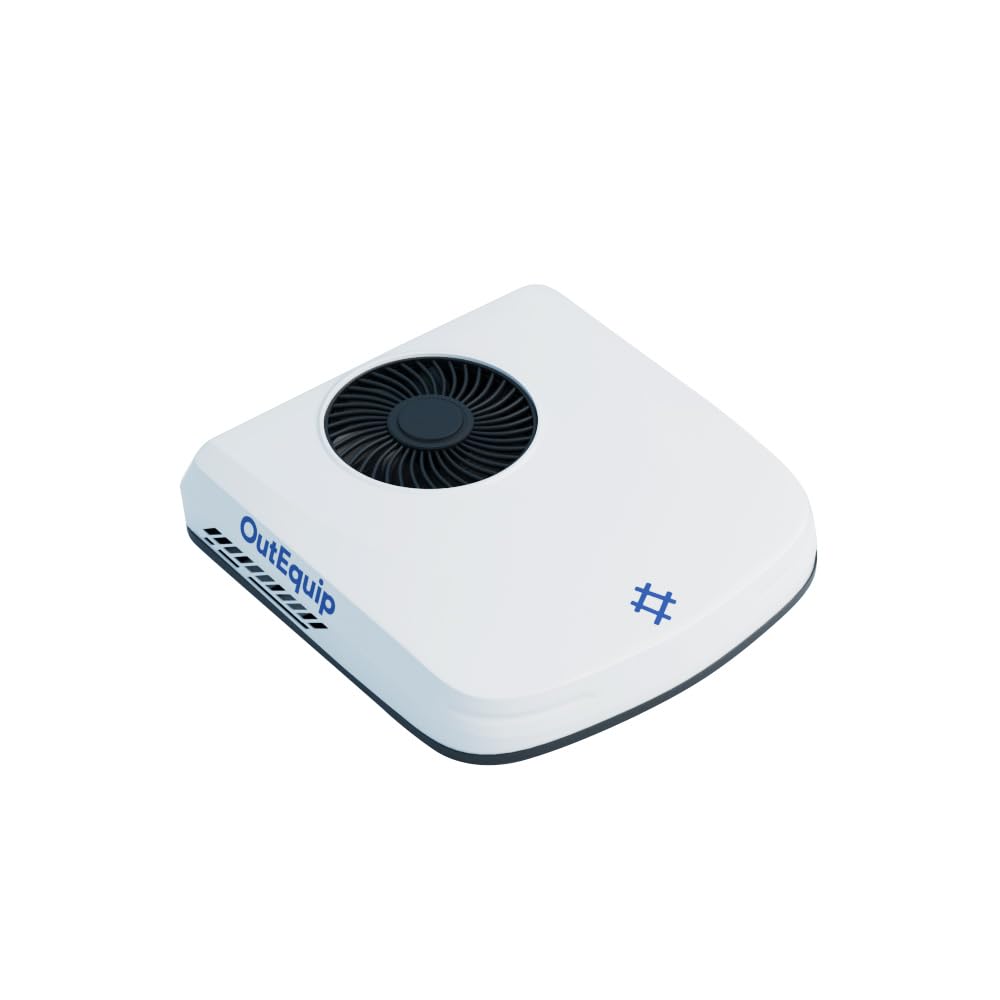
1. Outequip RV Air Conditioner, 12V 10000 BTU Rooftop
Our pick — over 4.5★ from 90+ verified ratings; the strongest balance of quality and price.
The featherweight roof unit that kills cab heat without waking the neighbors.
The Outequip delivers 10,000 British thermal units (BTUs) of cooling, which means it pulls heat out of a sleeping cab at a rate that owners say makes a noticeable difference within 15 minutes. It runs directly off your truck’s 12V system, so you do not need an inverter or a generator humming in the background. The whole rooftop unit weighs just 43 lbs, and multiple owners describe a one-person installation with no structural modifications needed.
What wins people over is the cooling performance, with the quiet operation running a close second. Buyers report it is “quieter than a roof vent” while still holding a comfortable temperature in brutal Texas heat. It uses a brushless copper motor fan and a rotary scroll compressor, and the smart remote lets you switch between eco, sleep, and turbo modes without getting out of the driver’s seat.
The energy draw is what makes it a realistic overnight companion. Owners mention it pulls about 50 amps while actively cooling, then drops to around 30 amps once the cabin reaches the set temperature. On a 480Ah battery bank, that translates to roughly 8 hours of cooling; bump up to 600Ah and you get closer to 10 hours, which is enough for a full night’s sleep.
Owners’ Top Praises
- Cooling performance is the most-praised feature, with dozens of owners noting fast, strong cold air
- Quality build using UV-stabilized ABS and a zinc-coated condenser
- Genuinely quiet operation, even compared to a standard roof vent
Installation Notes
- Clearance needed: fits a 7.5″ roof opening, 28″W x 28″L footprint
- Some found the gasket/bolt torque instructions unclear, causing a slight tilt
- You need a converter with enough amps to feed it while parked
Reach for this if: you want a light, quiet, efficient 12V rooftop unit that a single person can install and that sips battery power overnight.
Think twice if: your roof space is smaller than 28″ x 28″, or you need a unit that also provides heating.
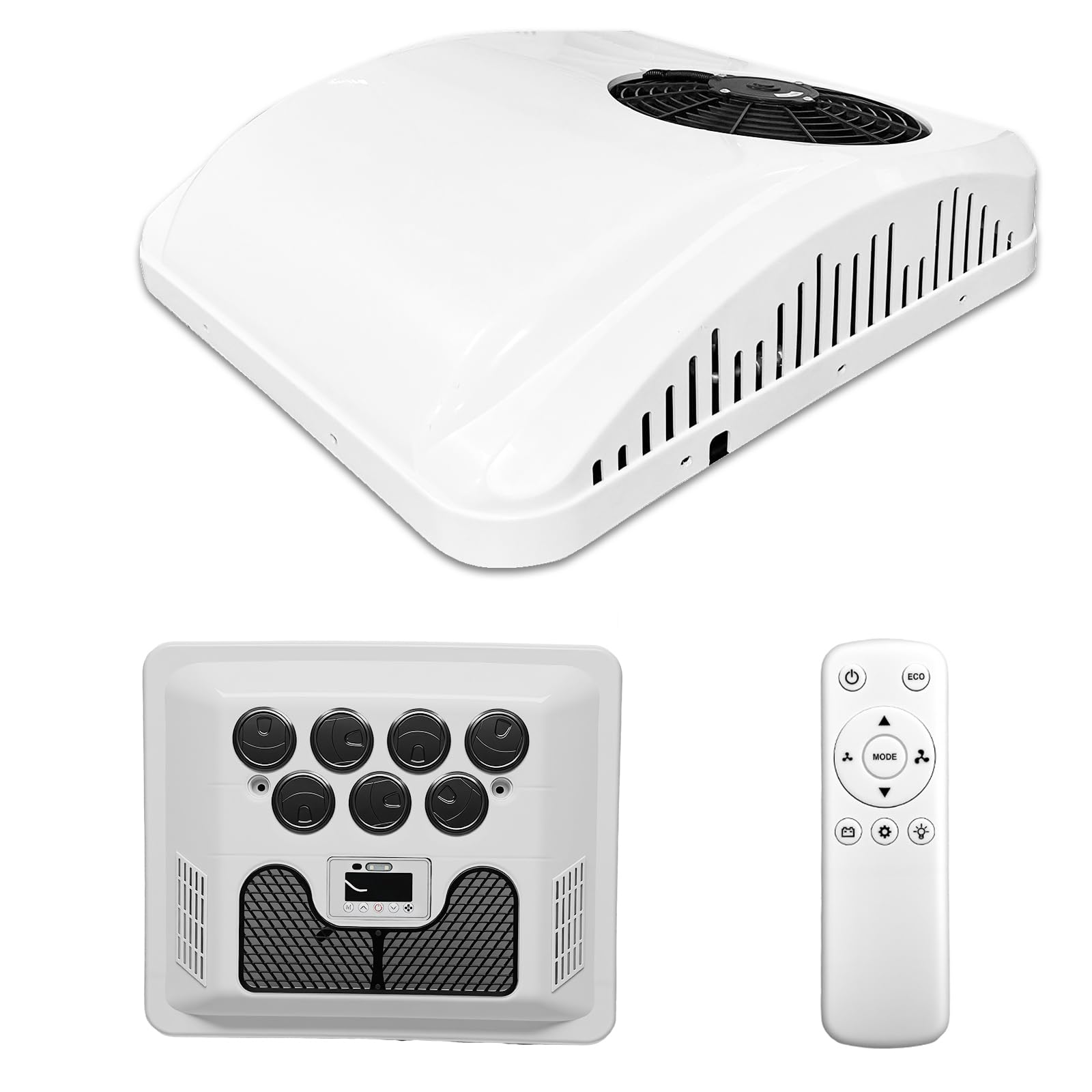
2. Treeligo 11000BTU 12V DC Rooftop with Heating
A rooftop unit that keeps you cool in summer and warm on cold nights.
The Treeligo is one of the few 12V rooftop units that also delivers heat, offering 11,000 BTUs of cooling plus a 4,000 BTU heater, which owners say warms a small cabin in mild cold. It pushes more cooling power than the Outequip above — 11,000 vs 10,000 BTUs — so it shaves a bit off the time to reach a comfortable temperature. The unit reportedly adjusts the indoor temperature within 5 minutes of kicking on.
It’s built for off-grid use, running steadily on an RV battery without needing a generator. Rated power is 1000W with an operating current of 30-60A, and customers note it works well with a 12V 300Ah battery. The inverter compressor and low-noise internal structure keep operating noise below 45 decibels (decibels measure sound level), so it won’t disturb sleep during an overnight stop.
The catch is the buying experience. The support team is responsive — one owner reported their fan issue was resolved via email quickly — but a couple of owners had units that stopped working with error codes on the display, leaving them frustrated. It is factory pre-charged with R134a refrigerant and POE 68 oil, so you can install it and get cooling right away rather than paying a shop to charge it.
Best for: the driver who wants year-round comfort from a single rooftop unit, with enough battery bank to handle its 30-60A draw.
Watch out: while most installations go smoothly, a small number of owners found the unit would not cool well in very high humidity conditions.
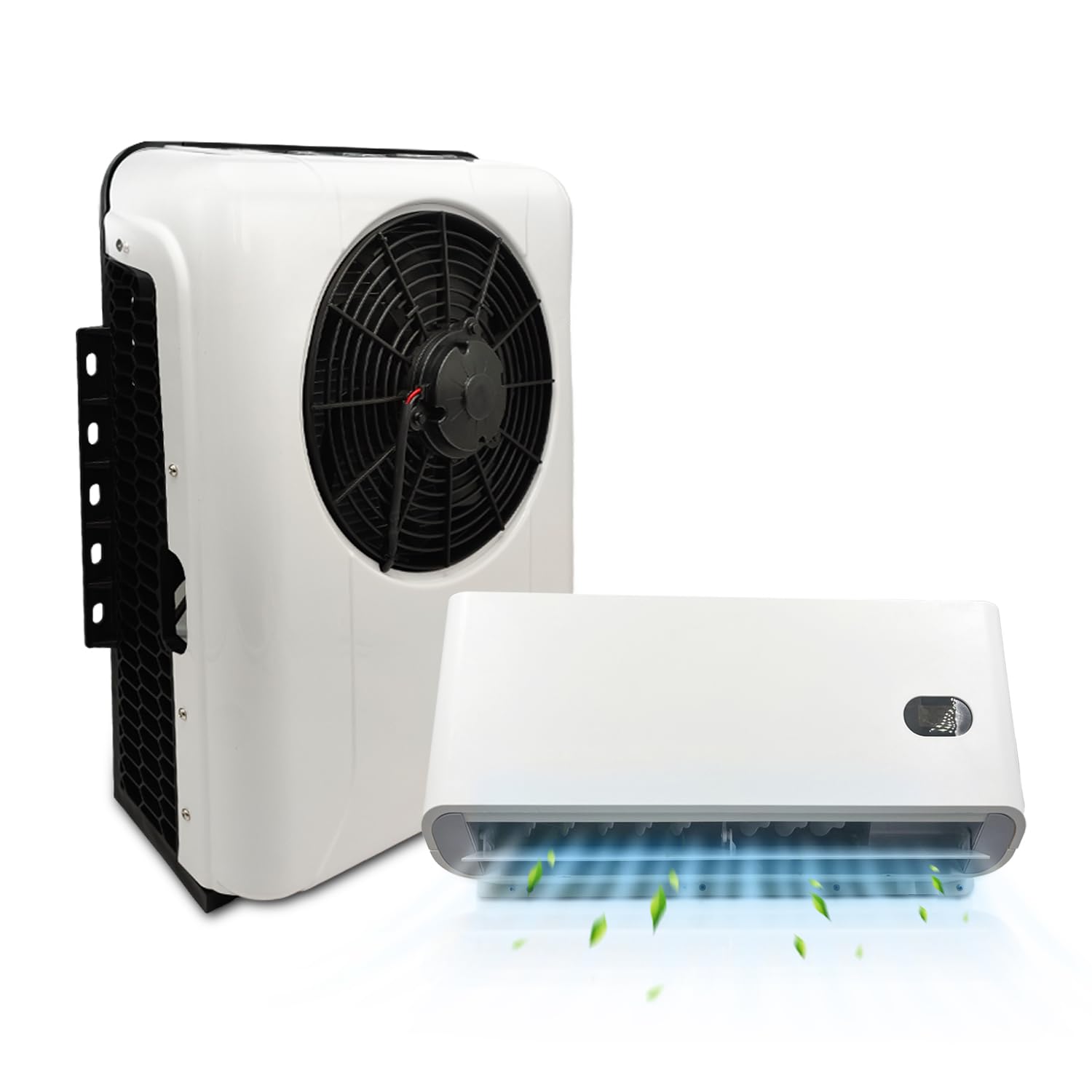
3. Aspligo 12V 10000BTU Split Air Conditioning
A dedicated split system built for semi trucks and tractors that runs entirely off 12V.
The Aspligo split unit separates the noisy compressor from the interior blower, so the part inside your cab stays calm at 50dB while the work happens up top. It delivers 10,000 BTUs of cooling — the same output as our top pick — and owners note it draws modest power while holding a comfortable cabin temp with no engine idling. It’s built to fit a long list of vehicles, including semi trucks, RVs, light trucks, and even forklifts.
Battery-friendly operation is the standout. One owner reported using only about 45% of two 300Ah LiFePO4 batteries across a hot summer day and night, which suggests the inverter-style compressor doesn’t hammer your battery. It has low-voltage protection to prevent draining your batteries dead, which is a critical safety feature when you rely on the same bank to start your truck.
Installation is more involved, taking DIY owners roughly five to six hours to complete. It ships without refrigerant — you’ll need about 500-550g of R134a, which is not included — so budget for a professional charge if you’re not equipped. The instructions note you’ll need over 350Ah of battery to get about 3 hours of daytime cooling or 6 hours at night.
Reach for this if: you drive a semi or tractor and want a proven split design that sips battery power. Most reviewers point out solid cooling and low power draw.
Think twice if: you want to avoid charging refrigerant yourself, or you’re not comfortable with a multi-hour install.
4. Aspligo 12V 10000BTU Under Dash AC Kit

A complete under-dash kit that delivers heating and cooling from a compact 12V package.
The Aspligo under-dash unit is a full split system that mounts inside your cabin, an alternative for trucks where a rooftop cutout isn’t practical. It produces 10,000 BTUs of cooling and also heats, making it a year-round solution for cabs, vans, boats, and off-road vehicles. The internal unit measures 15.89 x 13.58 x 6.12 inches, so it will slide under most dashes without eating up the whole cabin.
It draws 40-60A from your electrical system and runs at a rated 550-600W, which keeps the load manageable for a decent battery bank. The integrated design combines the receiver dryer, condenser fan, and condenser to cut down on potential leak points. Owners describe it as a bargain versus buying a comparable system new, with good build quality and solid packaging.
This is the pick for a fleet mechanic or a confident DIYer. The basic instructions are manageable for “experienced mechanics only,” according to one owner, though a complete novice also reported success installing it in their van. Delivery is worth knowing about: the internal and external units ship separately in two packages that may arrive at different times.
Who It Works For
- Provides both heating and cooling from a single 12V system
- Compact internal unit fits under most dashes
- Integrated design reduces potential refrigerant leak points
Who Should Pass
- Installation is not for the faint of heart; it’s best left to seasoned mechanics
- Two-box shipping means you may wait for the second package
- Lower owner ratings reflect a handful of units arriving damaged
Best for the mechanic: someone comfortable mounting a compressor and condenser, who wants heat and cool in one under-dash unit.
skip it if: you want a quick bolt-on install or you’d rather not chase down a defective unit past the return window.
5. Treeligo Universal 12V DC Mini Split, 12000 BTU
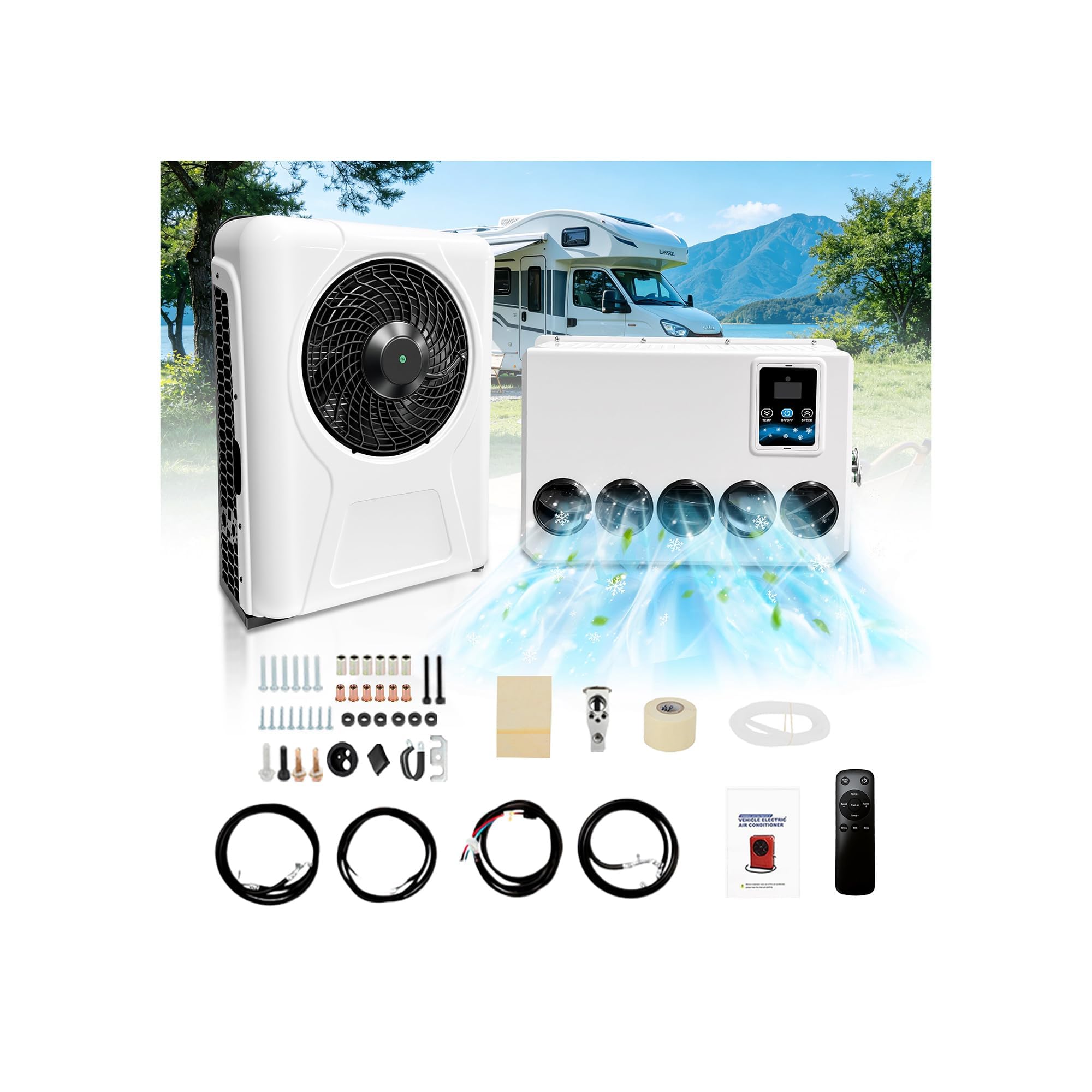
The high-flow split that dumps 12,000 BTUs of cold air into the biggest sleeper cabs.
That’s a lot of cold air volume, and it’s why owners with larger cabs report the cabin cools down “within minutes.” It’s tailor-made for semi trucks, tractors, and UTVs where a small rooftop unit just won’t cut it.
The split design keeps the interior footprint small at 17.95 x 6.22 x 12.6 inches, while the outdoor unit handles the heavy lifting. Rated power is a modest 960W with a stable 40-60A working current. It also includes a 360° omnidirectional air circulation design, which means the cold air is directed around the cabin to avoid hot corners and cold spots.
Cooling performance is where this unit shines — shoppers say it blows “42 degree air” even on a simple deep-cycle battery, and one owner called it capable of running them out of the truck. The recurring minor frustrations are that the display is Celsius-only and the drain hoses exit from the right side only, which can complicate a reversed install.
Choose this for: maximum cooling power and airflow for a bigger sleeper, with a split design that keeps cabin space open.
Consider the tradeoff: the right-hand-only hose routing and the Celsius-only controls may frustrate some setups.
6. Gidrox 10000 BTU 12V DC Rooftop AC with APP
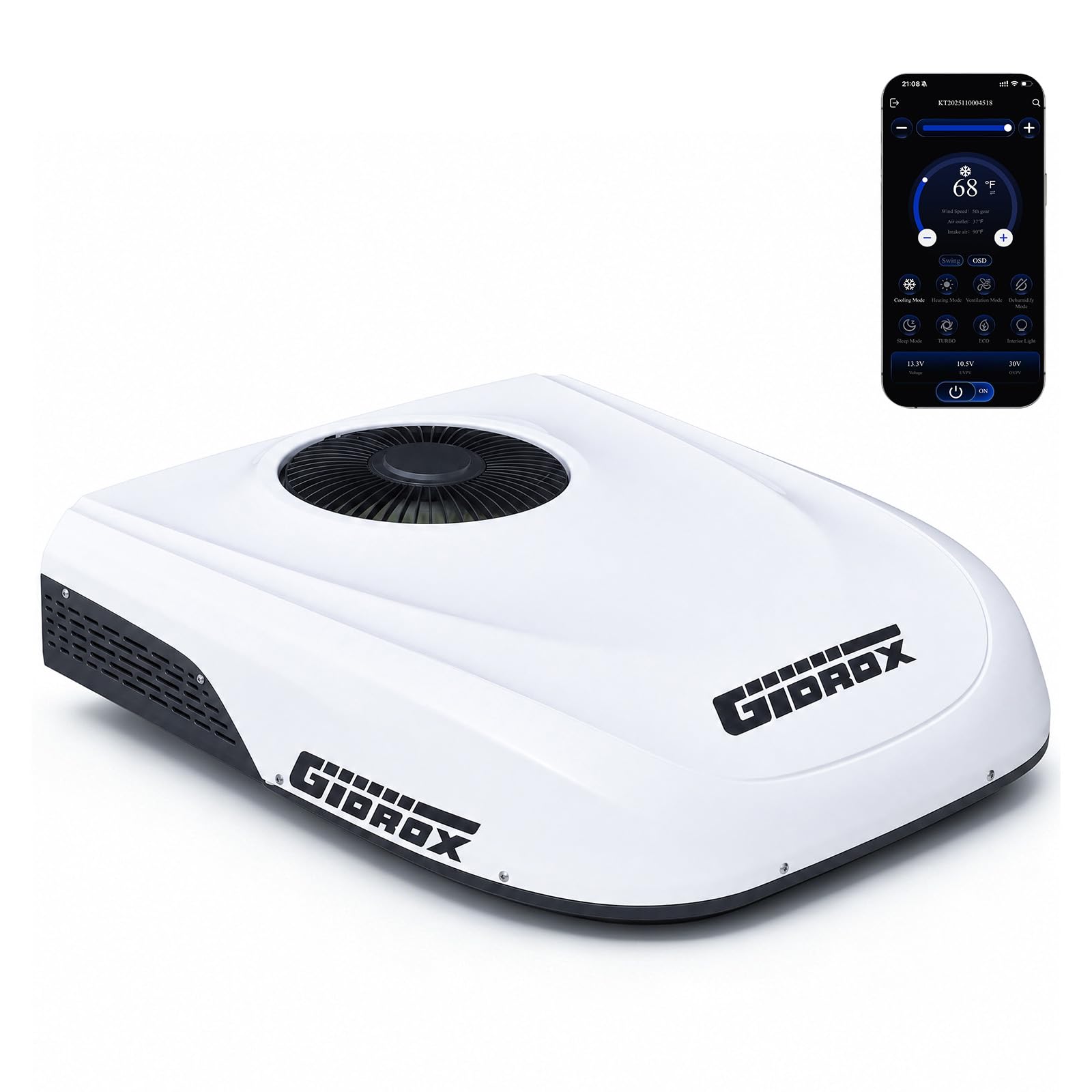
A Bluetooth-connected rooftop AC with a whisper-quiet 40dB sleep mode.
The Gidrox rooftop unit brings smart control to your truck’s cooling, letting you adjust the temperature from a smartphone app over Bluetooth, an infrared remote, or the physical buttons on the unit. It pushes 10,000 BTUs of rapid cooling using inverter technology, so it cools the cabin quickly in about 3 minutes and then maintains a steady temperature without constantly cycling on and off.
Efficiency is the headline here. At 54 lbs, it’s light enough for one person to handle, and it sips power: owners measured around 350 watts in eco mode and a whisper-quiet 40 decibels (a sound level similar to a library) in sleep mode. A 400Ah battery can support all-night use, making it a solid fit for van life or a weekend camper where you want to wake up rested.
The flatter, lower profile fits the standard 14″ x 14″ roof cutout, and it includes a 19.7 ft power cable. The smart modes are genuinely useful — turbo for fast cool, eco for efficiency, and sleep for quiet. The main tradeoff is that eco mode locks the temperature at 79°F and there’s no battery cutoff setting, so a really hot night might drain more of your bank than you planned.
What Impresses Owners
- App, remote, and panel controls give you flexibility wherever you sit
- Nights are genuinely quiet at 40 dB in sleep mode
- Well-suited for a 14″ x 14″ roof cutout with included hardware
Planning For
- Eco mode is locked at 79°F unless you exit it to adjust
- No built-in battery cutoff, so monitor your voltage
- The manual is vague on wiring details
Reach for this if: you like controlling everything from your phone and want one of the quietest sleep modes available.
Look elsewhere if: you need precise temperature control in eco mode or you want a built-in low-voltage shutdown.
7. Countrymod 12V DC Rooftop AC, 10000 BTU
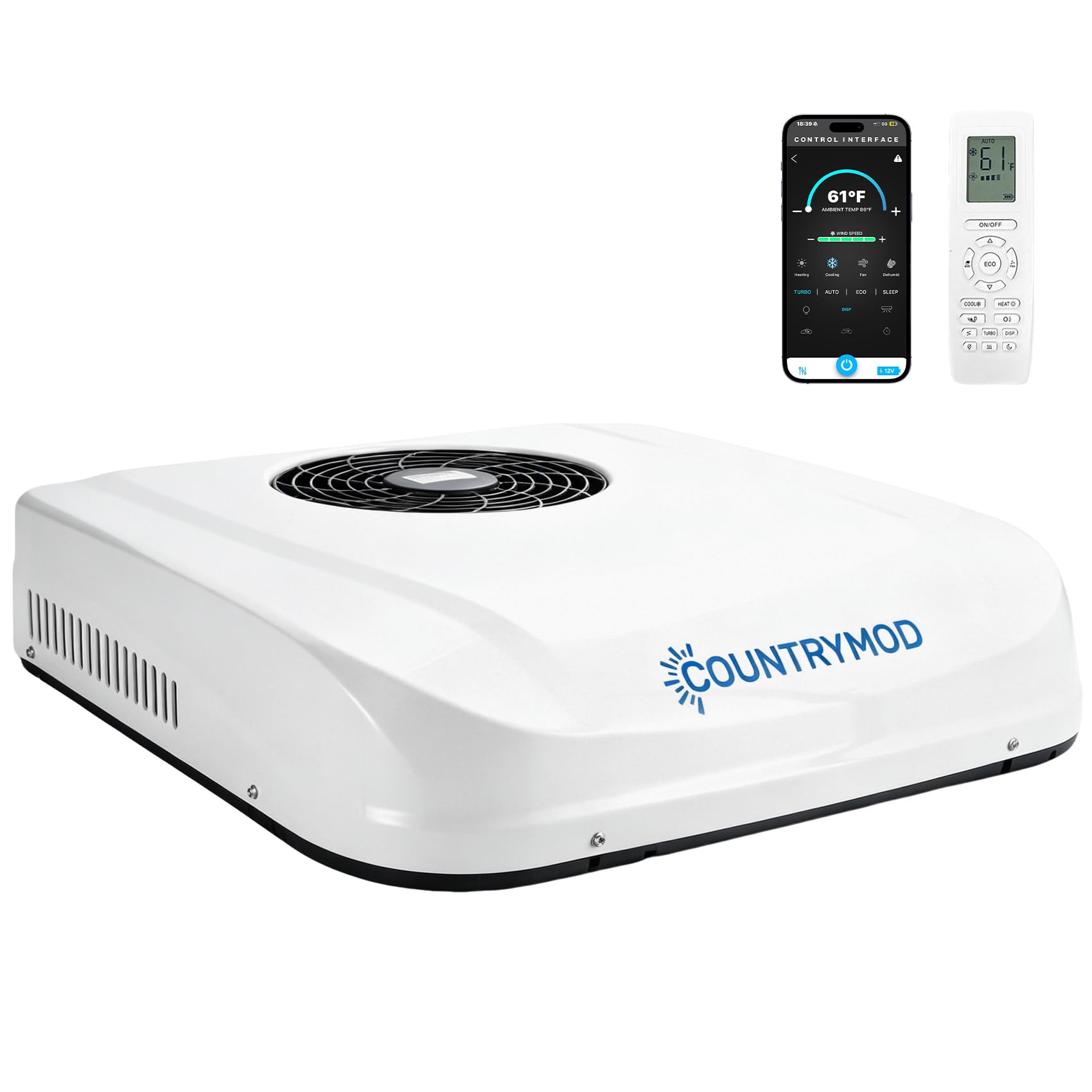
A rooftop unit that runs on less than 50 amps and stays quieter than your standard roof vent.
The Countrymod unit is designed around efficiency, consuming just 0.3 kWh per hour (kWh, a unit of energy, means kilowatt-hours) while delivering 10,000 BTUs of cooling. The brand claims a battery life of up to 10 hours, and owners confirm the real-world draw stays under 50 amps. In a poorly insulated black van, it still manages to cool the whole space down, which says a lot about its performance.
Owners consistently praise the build quality and low power consumption. It uses a horizontal compressor design, which lowers the center of gravity and reduces vibration compared to a traditional vertical setup. The noise level sits at a gentle 45-55 decibels, which the marketing describes as a “slight wind sound” — owners agree it’s just a low hum in the background.
Installation is straightforward for a standard 14″ x 14″ vent opening, and it’s ductless, so you don’t need major modifications. The one recurring note is that the instructions could be clearer, and you may need longer bolts for an arched roof. It also requires a lithium battery setup (LiFePO4), so it’s not a drop-in for every truck with a basic lead-acid bank.
The efficiency pick: if you’re running off a solar and lithium setup, this unit’s low draw means you can cool all night without stressing the bank.
Be prepared: you’ll need lithium batteries and possibly longer roof bolts, and the manual isn’t the best teacher.
8. Outequip RV AC w/ Heater, 12V 10000 BTU
The rooftop unit that adds a 4500 BTU heater, so one install covers all four seasons.
This Outequip takes the same strong 10,000 BTU cooling platform as our top pick and adds a 4,500 BTU PTC heater (PTC stands for Positive Temperature Coefficient, a type of self-regulating heating element). It’s designed for mild temperatures and small spaces, so it will take the chill off a spring or fall night, but it is not a substitute for a real furnace in extreme cold. Owners describe it as very quiet inside and out, cooling effectively even in a 2020 Ford Transit.
Installation is the most-praised feature of this unit, with owners saying the clear instructions and included hardware make for a smooth DIY job. It runs off your 12V system with an inverter compressor, and one owner reported minimal battery drain while keeping a van comfortable in South Carolina heat and humidity. It also comes with a remote and a Bluetooth app for easy control.
The dual-voltage flexibility is a bonus: some owners have successfully swapped the 12V unit for a 24V version with responsive customer service, making it adaptable to different truck electrical systems. It’s a premium-priced pick, but the combination of easy install, low power draw, and heating makes it a genuinely versatile year-round choice.
Why Owners Love It
- Easiest install in this list, with accurate instructions and included wire
- Quiet operation with low power draw, even at max cooling
- Heating and cooling from one rooftop unit saves roof space
What To Know
- The heater is for mild cold only, not arctic conditions
- Likely needs a 14″ x 9″ roof cutout, per one owner
- A few noted the lid screws are stiff and connectors are fragile
Pick this if: you want a single rooftop unit that cools effectively and adds mild heating, with the easiest install of the bunch.
Pass if: you face truly freezing winters and need serious heat output, or a tighter budget is your priority.
Understanding the Specs
BTU — Cooling Power
BTU, or British thermal unit, measures how much heat an AC can remove in an hour. Higher is stronger, but it also means more electrical draw. For a truck sleeper, 10,000 BTUs is a solid starting point, while 12,000 BTUs better serves a larger cab or very hot climates.
Amps & Battery Draw
Amps (amperes) measure the electrical current the unit pulls from your battery. A unit drawing 50 amps running flat out will drain a battery faster than one drawing 30 amps. Always check your battery’s amp-hour (Ah) rating to ensure you have enough reserve for overnight use.
Inverter vs Fixed Compressor
An inverter compressor varies its speed to match the cooling demand, rather than cycling on and off like a fixed-speed compressor. This is gentler on your battery because it maintains a set temperature with less power once the cabin is cool, and it’s noticeably quieter.
Decibel (dB) Rating
Noise is measured in decibels (dB). A lower number is quieter. For sleeping, look for a unit rated around 40-50 dB. The difference between a 40 dB sleep mode and a 55 dB unit is the difference between a library and a normal conversation, which matters when you’re parked overnight.
R134a Refrigerant
R134a is the chemical refrigerant that carries heat out of the cabin. Some units ship pre-charged, meaning you can install and run them immediately. Others arrive empty, requiring you to buy the correct amount (often 500-550g) and have it charged professionally.
Rooftop vs Split vs Under Dash
Rooftop units mount flush on the roof and save interior space. Split units separate the compressor, mounting it outside while the blower stays inside. Under-dash kits fit beneath the dashboard. Your choice depends on your roof structure and how much cabin space you can spare.
FAQ
Can a 12V AC unit run off my truck’s standard battery?
How many BTUs do I need for a truck sleeper?
What size of battery bank do I need to run an AC all night?
Can I install an AC unit myself, or do I need professional help?
What’s the difference between a rooftop unit and a split system?
Do these AC units also provide heating?
Why is an inverter compressor better for my battery?
Some units say they need rechargeable refrigerant. What does that mean?
Will a truck AC unit fit any roof size?
Final Thoughts: The Verdict
For most drivers, the ac unit for truck winner is the Outequip 12V 10000 BTU because it runs quietly, sips battery power, and weighs just 43 lb — light enough for one person to install alone. Owner feedback consistently praises its cooling performance above all. If you want mild heating too, the Outequip with heater is the same platform but adds a 4500 BTU PTC heater (a ceramic heater that warms quickly) for cool nights. For semi truck drivers who need maximum airflow, the Treeligo 12,000 BTU split is the power pick — it dumps cold air fast into a bigger sleeper. Whichever you choose, match the unit’s amp draw to your battery bank before spending money; a great AC on a weak battery is just an expensive paperweight.
How We Picked
We do not accept paid placement. Every pick is matched to a real buyer and a real use-case; we do not hands-on test units.
Sources & Methodology
Specifications: manufacturer listings and product documentation. Review insights: verified customer reviews, as of August 2026. Pricing: not shown on this page (it changes often); check the current price via the retailer link.
As an Amazon Associate, Gadgets Feed earns from qualifying purchases. This does not affect which products we feature.