
Our readers keep the lights on and my morning glass full of iced black tea. As an Amazon Associate, I earn from qualifying purchases.
Specs are compiled from manufacturer listings and verified buyer reviews and can change over time — please confirm the key details on the product page before buying.
If you have a horizontal sliding window, you already know the struggle: most window ACs are built for tall, double-hung windows, and getting them to fit a side-to-side sash often means ugly gaps, DIY wood, or worse — a unit that won’t seal and just leaks hot air. The good news is that the category has caught up, and the best options today either use a clever U-shaped saddle that rests on the sill or slim casement-style designs that slide right into the track.
I’m Min — the founder and writer behind Gadgets Feed. This guide is built by comparing the manufacturers’ published specifications and the patterns across verified customer reviews, so you get each pick’s real strengths and trade-offs instead of marketing spin.
Whether your priority is near-silent sleep or blasting a big room, the right ac units for horizontal windows come down to three specs: BTU, quietness, and the exact sill dimensions it demands.
Our Picks at a Glance
How To Choose The Best AC Units For Horizontal Windows
Horizontal sliding windows are the tricky one. Unlike double-hung windows that open vertically, these sashes slide side-to-side. The classic boxy window AC simply wasn’t built for them, so you have to look for units with a specific shape, width range, and installation style.
Shape: U-shaped vs. boxy vs. casement
This is the single biggest decision. A U-shaped AC (sometimes called a saddle unit) rests on the window sill with the compressor hanging outside and the window closing above it. This keeps noise out and lets you open the window for fresh air. A standard boxy unit needs a thick sill and often has gaps on the sides of a slider, while a casement-style AC is tall and narrow — a perfect match for crank-out or sliding windows.
Width and height, not just BTU
Every unit lists a window width range and a minimum opening height. For a slider, the width range is what you measure first. Grab a tape measure and check the track opening left to right, then look at the sill height. If a unit says it fits 22″–36″ wide, your window must fall inside that. Sill height matters too — a U-shaped unit needs a sill deep enough to sit on.
Quietness and energy use
Noise is measured in dB or dBA, with lower numbers being quieter. A reading near 40 dBA is genuinely calm, while anything over 50 dBA will hum loudly in a bedroom. For energy, look for an “inverter” compressor — it speeds up and slows down instead of cycling on and off, which saves power and reduces noise. An ENERGY STAR rating is a solid short-cut too.
Quick Comparison
| Model | Best For | Cooling (BTU) | Room Size | Noise Level | Amazon |
|---|---|---|---|---|---|
| Midea U Shaped 10,000 BTU★ Best Overall | Ultra-quiet smart cooling | 10,000 | 450 sq ft | 32 dBA | Amazon |
| Electactic 10,000 BTUBest Value | Fast cooling on a budget | 10,000 | 450 sq ft | 51 dB | Amazon |
| GE Profile ClearView 8,300 BTUBest Window View | Full window view + smart home | 8,300 | 350 sq ft | 40 dB | Amazon |
| Electactic U-Shaped 10,000 BTU | Saddle design at a value price | 10,000 | 450 sq ft | 45 dB | Amazon |
| ROVSUN 12,000 BTU Inverter | Big rooms on a standard plug | 12,000 | 520 sq ft | 42 dBA | Amazon |
| Perfect Aire 10,000 BTU Casement | Sliding and crank-out windows | 10,000 | 450 sq ft | — | Amazon |
| LG 14,000 BTU Dual Inverter | Large rooms + smart app | 14,000 | 700 sq ft | 44 dB | Amazon |
| Keystone 23,200 BTU Heat/Cool | Huge rooms with heat too | 23,200 | 1,500 sq ft | — | Amazon |
In-Depth Reviews
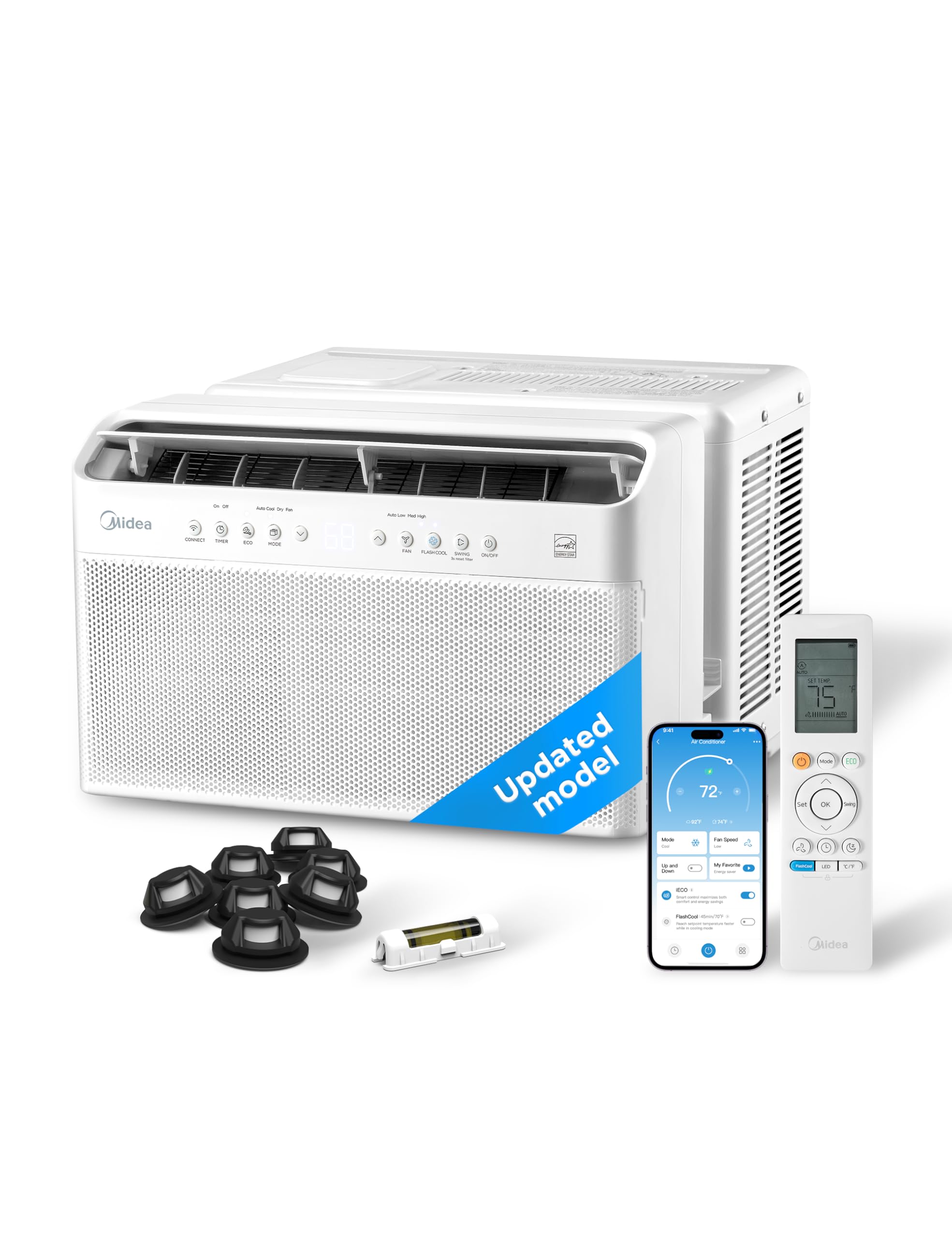
1. Midea 10,000 BTU U Shaped Smart Inverter Window Air Conditioner
Our pick — over 4★ from 500+ verified ratings; the strongest balance of quality and price.
The crowd-favorite saddle design that finally makes a window AC feel invisible.
This is the unit that redefined what a window AC can be, and its U-shaped frame is a genius fit for horizontal sliders. The window slides down into the notch above the unit, which pushes the noisy compressor outside — that’s why it runs at a barely-there 32 dBA, roughly ten times quieter than a traditional boxy unit. You get 10,000 BTU of cooling, enough to handle a 450-square-foot room, and the shape means you can lift the window for fresh air without hacking the installation.
What wins people over is the quiet and the inverter tech behind it. Rather than a fixed-speed compressor that rattles on and off, the inverter gently scales power — buyers report it drops from around a 700W startup down to 75-150W just to hold the temperature, which pairs with Midea’s claim of over 35% energy savings. It’s Wi-Fi enabled, so you can control it from bed, and it works with Alexa and Google Assistant for voice commands. The crowd favorite here has over 500 ratings, and the noise level is by far the most-discussed perk, followed closely by its cooling performance.
The catch is the fit. The U-shape is brilliant for the right window, but owners note it’s genuinely harder to install in side-sliding windows than in vertical ones. It needs a window width between 22″ and 36″ and a minimum height of 13.75″. An occasional unit has arrived with shipping damage, which is worth knowing if you buy one sight unseen.
What wins owners over
- 32 dBA operation is whisper-quiet, ideal for bedrooms
- Inverter tech keeps power draw low while holding temp
- Window can still open for fresh air and a clear view
The fit notes
- Harder to mount in side-sliding sashes than vertical ones
- Needs careful sealing on the side gaps
- Heavy enough that a solo lift is tough
Reach for this if: you want a bedroom-quiet unit with smart controls and don’t mind a slightly fiddly first install.
Look elsewhere if: your window is narrower than 22 inches or you want a tool-free drop-in setup.
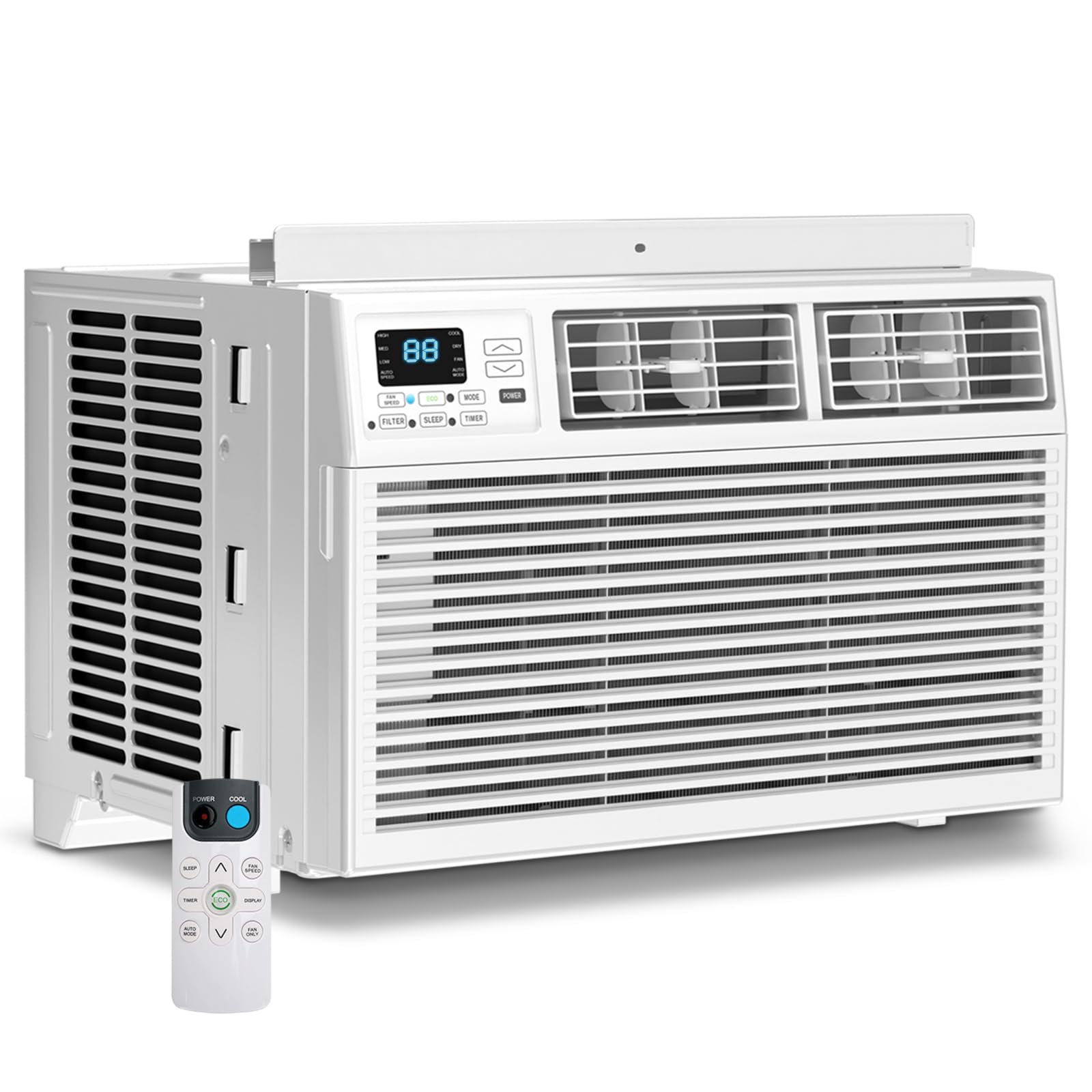
2. Electactic 10,000 BTU Window Air Conditioner
A fast-cooling workhorse that delivers serious chill without the premium price.
Electactic brings a simple pitch: 10,000 BTU of cooling for a 450-square-foot space, with a temperature range you control from 61°F up to 88°F. Owners mention it can pull a room down from 89°F to 60°F in under 2 hours, and that raw cooling muscle is the biggest single thing owners praise. It also covers 29% more floor area than the GE Profile ClearView below, which maxes out at 350 square feet.
You get six modes — Cool, Dry, Fan, Auto, Sleep, and Eco — plus a 24-hour timer and a washable mesh filter. The self-draining system handles condensation automatically, so you don’t have to empty a bucket. It’s rated at 51 dB, which is audible but more like a gentle breeze than a roar.
Be ready for some quirks, though. It fits single and double-hung windows 23 to 36 inches wide, but owners with sliders had to buy extra window panels for a sealed fit. The noise gets mixed feedback — some find it ultra-quiet, others say it’s “pretty noisy” like heavy rain. To access the remote’s battery, you’ll need a tiny screwdriver or a penny.
Smart buy for: anyone who wants maximum cooling per dollar and doesn’t need smart-home features.
Fair warning: noise is a coin-flip, and the remote battery cover is needlessly fiddly.
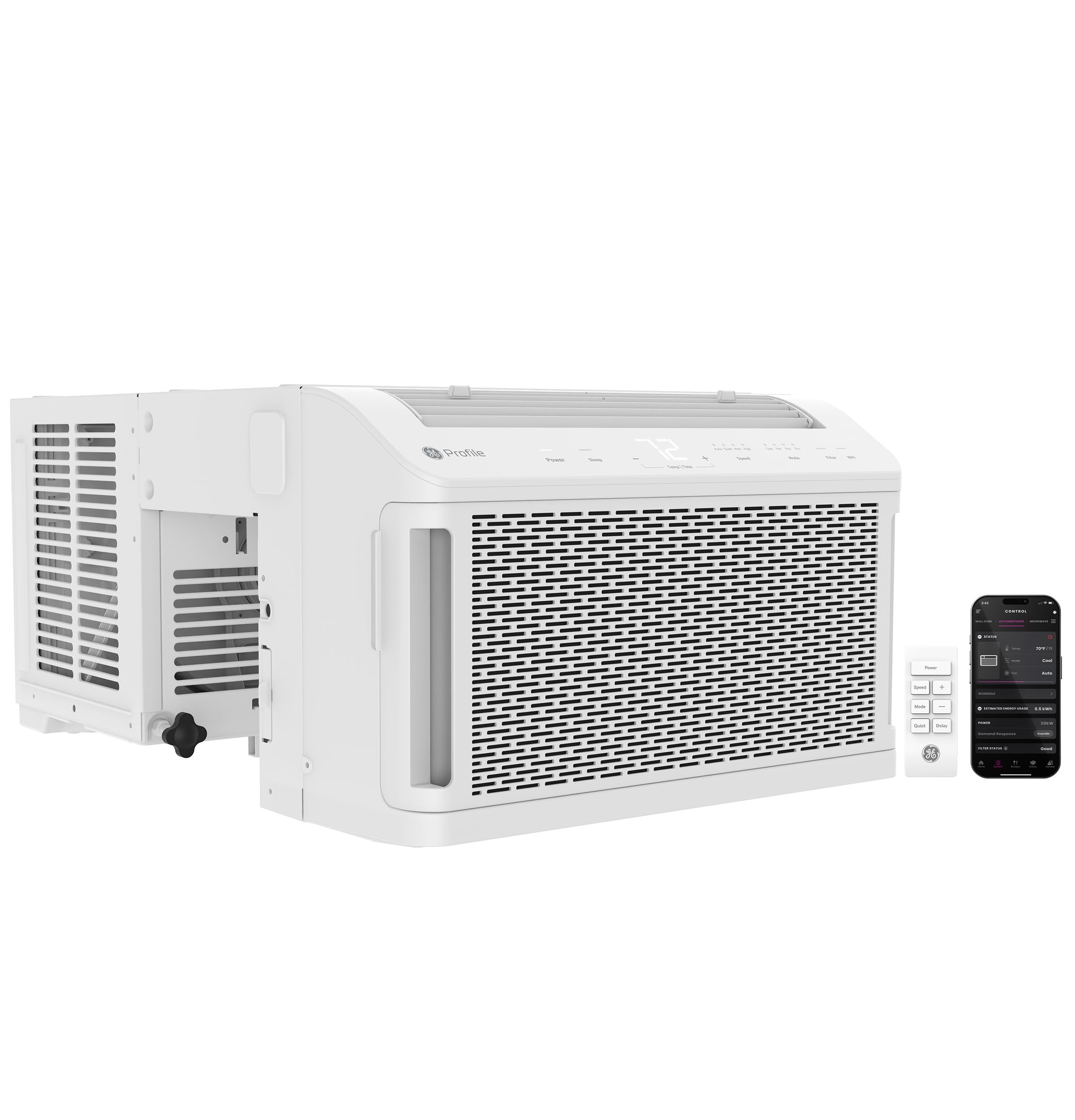
3. GE Profile ClearView 8,300 BTU Window Air Conditioner
The saddle design that keeps your whole window view while it chills the room.
If losing half your window bugs you, this is the pick. The ClearView’s saddle shape drops the compressor outside, so the window panel stays mostly clear — buyers mention it doesn’t block their kitchen view and still lets the window open and close freely. It cools up to 8,300 BTU, covering 350 square feet, and runs at a genuinely quiet 40 dB. That’s a step quieter than the Electactic boxy unit above, though it also covers about 29% less floor area.
There’s an exclusive “flex-depth” design that expands to fit walls between 4.5″ and 13.75″ thick, which is a lifesaver for unusual sill depths. It’s Wi-Fi enabled too, working with GE’s SmartHQ app plus Alexa and Google Assistant. A built-in pump collects condensation from the indoor side and pumps it outside, so there’s no dripping to worry about. It fits windows 20″ to 40″ wide with a 13-inch minimum opening height.
The honest trade-off: this one has the most polarized owner feedback of the group. Noise splits opinion — some call it relatively quiet, others report excessive loud noises. Reliability is the most-discussed aspect and it’s flagged as mixed. A couple of owners had units arrive with defects like a broken water pump or a mildew smell. It’s a great design when it works, but it asks for a bit of luck on quality control.
Perfect for: anyone who prizes natural light and a working window over raw BTU muscle.
Think twice if: you need rock-solid reliability from the start — some units arrive faulty.
4. Electactic U-Shaped 10,000 BTU Window Air Conditioner

A saddle-shaped value play that brings the U-design down in price.
This is the budget-friendly route into the U-shaped club. Like the Midea, it parks the noisy compressor outside the window for a quieter home — here rated at 45 dB, noticeably louder than Midea’s 32 dBA but still calmer than a boxy unit. It delivers the same 10,000 BTU for a 450-square-foot room and lets you dial the temperature from 62°F to 86°F across six modes: Cool, Dry, Fan, Auto, Sleep, and Energy Saver.
Installation is a big selling point. It’s built for double-hung and sliding windows with a minimum 16-inch opening, a 24″ to 48″ width range, and up to an 11-inch sill height — and it needs no brackets or extra tools. Owners say the window still opens with it in place, the cooling is fast and consistent, and nighttime operation is quiet enough that one called it “whisper quiet,” quieter than a living room fan. The CEER rating of 11 points to solid energy efficiency, and a few buyers even report their electric bill dropping.
The unit is heavy, though — one owner pegged it at 60 lbs, so plan for two people on install day. The most-discussed negative is drainage: condensation collects inside and needs periodic draining. One long-term owner found that tedious enough to call the whole unit not worth it, but most find the cleaning and emptying manageable.
Best for: budget-conscious buyers who want the quiet saddle design and a wide-window fit.
The catch: it’s a heavy lift, and you’ll be draining condensation by hand.
5. ROVSUN 12,000 BTU Window Air Conditioner With Inverter Compressor

The mid-size inverter that stretches to a 520-square-foot layout on standard power.
ROVSUN splits the difference between the 10,000 BTU units above and the giant LG below. It packs 12,000 BTU into a window unit that runs on a regular 115V outlet, cooling up to 520 square feet. The inverter compressor is the headline: ROVSUN claims 35% more energy savings than a traditional unit, backed by a 15.0 CEER rating. Heat output is listed as 3,516.85 watts, confirming its serious lifting power.
Owners consistently praise the cooling — one ran it in near-100°F heat and found it “cools well,” while another watched it tame a 600-square-foot room plus hallways. It’s quiet, too, at 42 dBA in sleep mode, and the dehumidifier function gets called out as working extremely well on damp days. The pre-installed side panels save installation time, fitting windows 25″ to 36″ wide with a 14.5-inch height.
There are fewer owners here — the review count is modest — so the picture is less proven. The recurring gripe is the thermostat, which one reviewer noted “is NOT calibrated to Earth”: set it to 80°F and the unit reads the room cooling to the mid-70s. An occasional unit also arrives with bent fins. It’s a strong value if you accept a slightly quirky temperature sensor.
Grab it if: your room is bigger than 450 square feet but you’re stuck on a regular wall plug.
skip it if: exact thermostat accuracy matters to you — the sensor reads a few degrees cool.
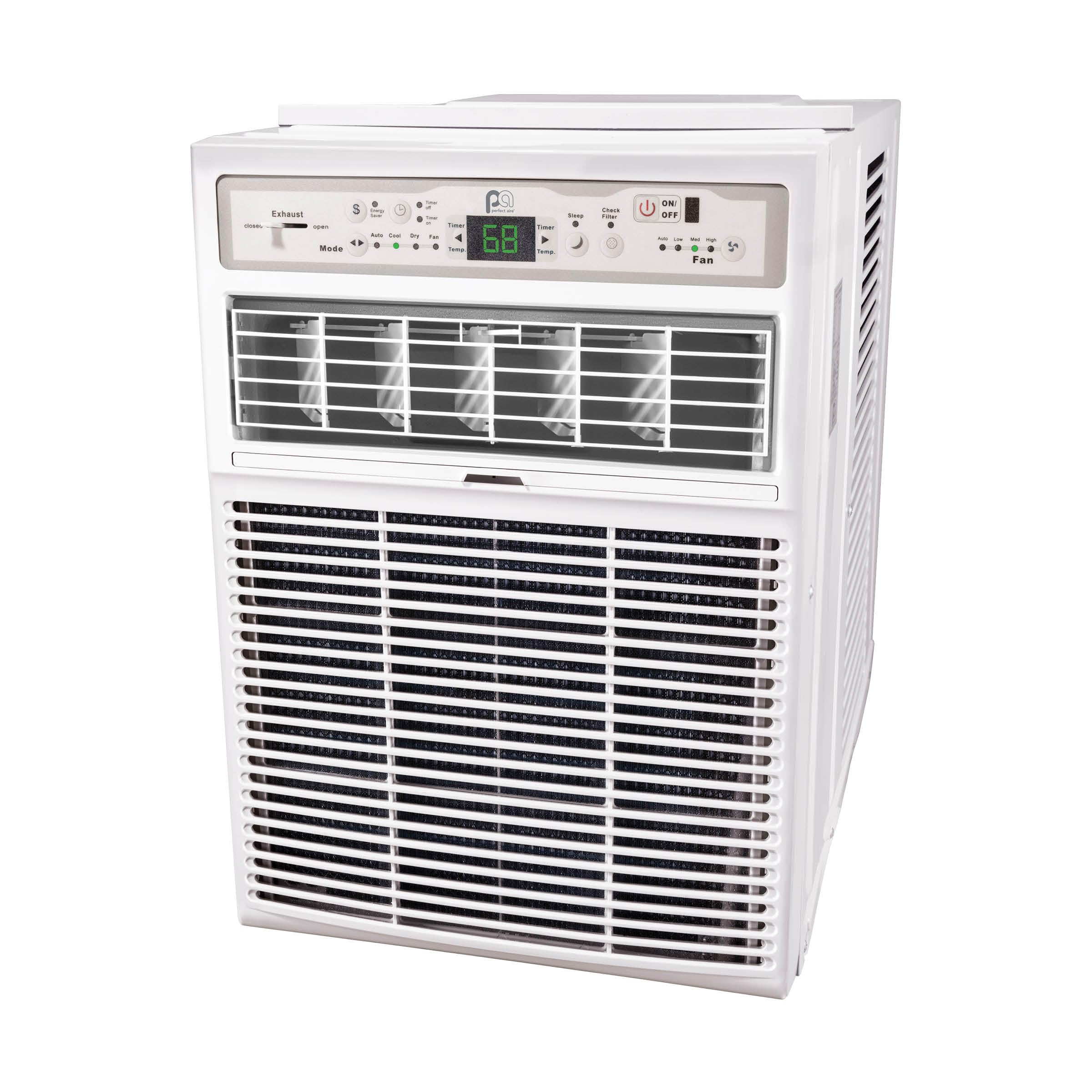
6. Perfect Aire 10,000 BTU Casement Window Air Conditioner
The tall, narrow casement classic that was literally built for sliders and crank-outs.
While most of this list uses a U-shape, this one attacks the problem differently. It’s a casement-style unit — tall and slim — designed specifically for sliding or crank-out windows. The included kit has expandable accordion panels that accommodate a 15½” to 16¼” window width and a 21¼” to 39½” height, so it slots into track-style openings without the gaps a boxy unit would leave. It cools 10,000 BTU across 450 square feet.
The standout feature is the “Follow Me” remote. It doubles as a portable thermostat with a 26-foot range, sensing the temperature where you actually sit rather than at the unit. A soft-touch digital LED display and three cooling and fan speeds round it out, plus a 24-hour programmable timer. Owners in Sacramento call it “perfect” for brutal summers, and One owner says it outperforms every portable AC they used across four years.
The honest warning is about installation. This is not a quick drop-in — owners describe needing DIY sill modifications, drilling a drain hole, and sealing gaps, with a constant water drip from the drain you’ll route outside. Two people are almost mandatory, and the instructions get mixed reviews for clarity. If you’re handy, it’s a beast; if not, budget for a skilled handyman.
Perfect for: unusual or non-standard sliding windows where boxy units just won’t work.
Plan for: a project — this needs DIY cutting, drilling, and sealing to install properly.
7. LG 14,000 BTU Window Air Conditioner Dual Inverter

The 700-square-foot powerhouse with a dual inverter that moves serious air.
LG brings the biggest cooling numbers here that still run on a standard setup. This is a 14,000 BTU unit covering up to 700 square feet — comfortably the largest single-space capacity shy of the Keystone monster below. It’s Energy Star Certified and uses a DUAL Inverter compressor alongside LG’s BLDC motor to hold noise down to 44 dB in sleep mode. Owners describe it as “whisper quiet” when it’s settling in.
Smart control is baked in. The LG ThinQ app works over Wi-Fi for remote adjustments, and it’s compatible with Google Assistant and Amazon Alexa for voice. A slide-out washable filter makes the monthly cleaning quick, and a slide-in-and-out chassis is supposed to simplify mounting in double-hung windows sized 27″ to 39″ wide by 16″ high. One owner bought it as a fourth unit in a year, running two of them to cool 1,400 square feet at 72-74°F while watching the electric bill drop.
But the installation experience draws real criticism. The most-discussed aspect of all reviews is performance, and it’s flagged as mixed — some find it fantastic, others hit issues. Buyers describe the mounting as “generic installation slop”: a misleading manual, power cable interference, unusable screw holes on window lips, and no bracket solution. It’s heavy with no grips, and an occasional unit has a fan that rattles.
Choose this if: you have a genuinely large room and want app control plus serious BTU output.
Be prepared: the install is a known weak point — set aside time and expect fiddly side panels.
8. Keystone 23,200 BTU Window Air Conditioner With Heat
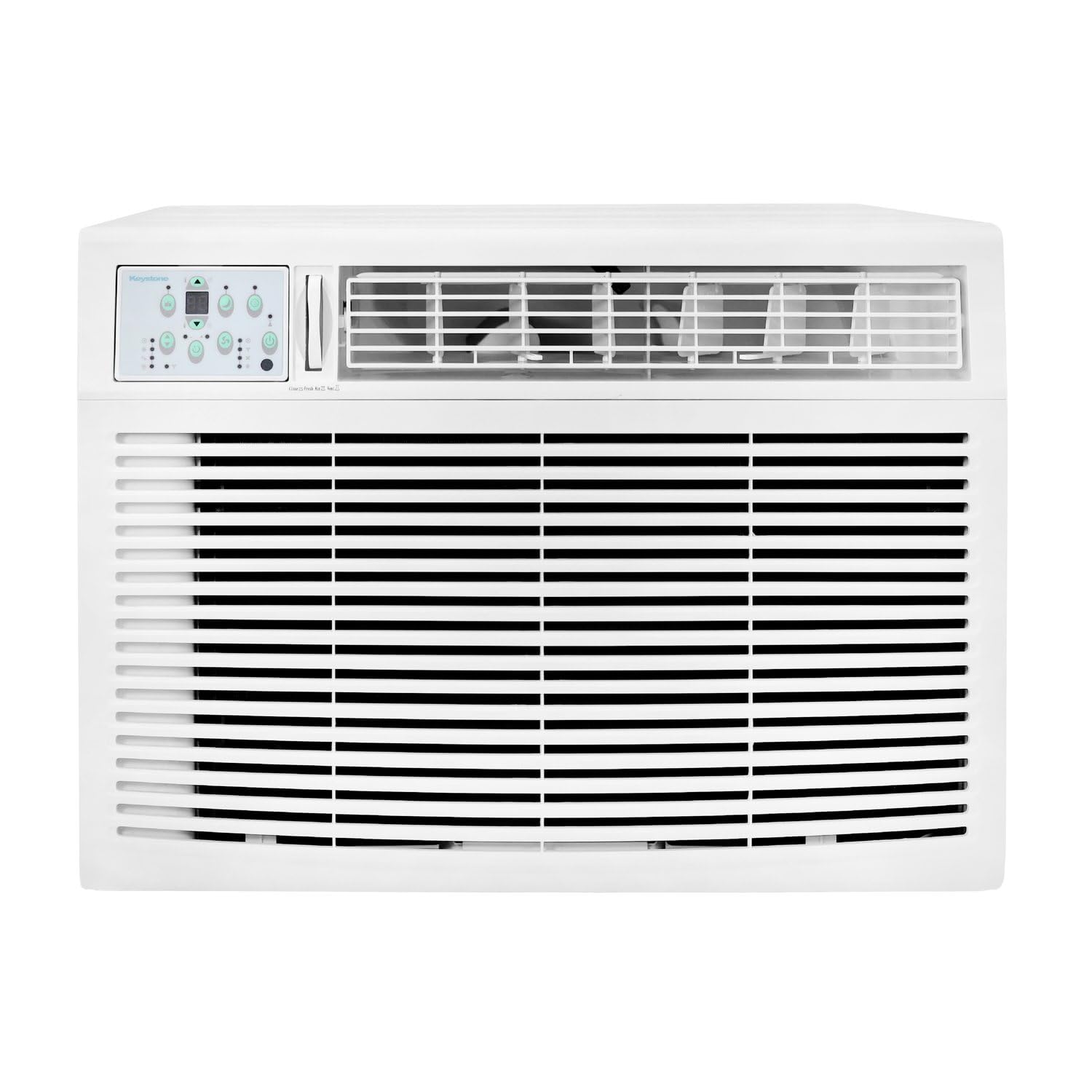
A year-round giant that chills 1,500 square feet and heats it too.
This Keystone is in a completely different class of scale. It delivers 23,200 BTU of cooling and 16,000 BTU of supplemental heating, covering up to 1,500 square feet — bigger than every other unit here combined, giving it four-season usefulness. One owner runs it in a tiny home where it “heats and cools fine,” and a buyer in Arizona’s brutal summers swears it keeps the whole house comfortable while keeping the electric bill low.
The smart remote adds a clever trick: it takes the temperature of the room you’re in, shows it on an LCD screen, and pings the wall unit every 3 minutes to adjust cooling. You also get dehumidification and fan circulation. Just note the heating mode is meant for outdoor temps between 23 and 76 degrees, and it’s supplemental — not a primary heat source when it’s freezing outside.
The big caveat is the plug. This runs on 230V, and one owner was stunned to find the 25-amp plug with a round ground didn’t match their outlet — and that plug is hard to find in stores. If your home doesn’t have the right 230V circuit, this unit won’t work without electrical work. It also demands a minimum window height of 19.5 inches, which rules out shallow sills.
Ideal for: oversized rooms, garages, or tiny homes needing both serious cooling and backup heat.
Check first: your outlet voltage — the 230V plug and wide window requirement will make or break the deal.
Understanding the Specs
BTU and room size
BTU stands for British Thermal Units — a measure of cooling power. More BTU means more muscle. A rough rule of thumb is you want about 20 BTU per square foot of room. The units here range from 8,300 BTU (for a 350-square-foot room) up to 23,200 BTU (for 1,500 square feet). Buy too little and the unit runs all day; buy too much and it short-cycles and feels clammy.
dBA vs dB and inverter compressors
Noise is measured in decibels, with dBA meaning the reading is weighted to how humans actually hear. Lower is better — 32 to 40 is genuinely quiet, while 50-plus starts to intrude. An “inverter” compressor changes speed smoothly instead of clicking on and off, which is why inverter units both hold temperature better and run quieter than traditional fixed-speed compressors.
FAQ
Can I install a regular window AC in a horizontal sliding window?
What is the difference between a U-shaped and a casement AC for sliders?
How do I measure my sliding window for a new AC?
What size AC do I need for my room?
Why is the U-shaped AC so much quieter than a boxy one?
Do I need a special electrical outlet for a high-BTU window AC?
Can the window still open with a U-shaped AC installed?
How much maintenance do window ACs need?
Final Thoughts: The Verdict
For most people, the winner for ac units for horizontal windows is the Midea U Shaped because it pairs 10,000 BTU of cooling with a genuinely silent 32 dBA operation and a design made for sliders. If you want nearly the same quiet saddle shape for less, grab the Electactic U-Shaped. And if you’re cooling a huge or multi-purpose space, the Keystone is the one to reach for — just verify your outlet can handle it.
How We Picked
We do not accept paid placement. Every pick is matched to a real buyer and a real use-case; we do not hands-on test units.
Sources & Methodology
Specifications: manufacturer listings and product documentation. Review insights: verified customer reviews, as of August 2026. Pricing: not shown on this page (it changes often); check the current price via the retailer link.
As an Amazon Associate, Gadgets Feed earns from qualifying purchases. This does not affect which products we feature.