
Our readers keep the lights on and my morning glass full of iced black tea. As an Amazon Associate, I earn from qualifying purchases.
Specs are compiled from manufacturer listings and verified buyer reviews and can change over time — please confirm the key details on the product page before buying.
When your car’s AC blows warm air, the hardest part is finding where the refrigerant leaks out. A UV dye solves that: you add it to the system, and under a UV light, the leak glows so you can pinpoint the exact spot to fix. Here are the dyes that actually earn their place in your toolbox.
I’m Min — the founder and writer behind Gadgets Feed. This guide is built by comparing the manufacturers’ published specifications and the patterns across verified customer reviews, so you get each pick’s real strengths and trade-offs instead of marketing spin.
The best ac uv dye turns a frustrating hunt for a refrigerant leak into a quick visual scan, saving you time and money.
Our Picks at a Glance


How To Choose The Best AC UV Dye
To pick the right dye, you first need to match it to your car’s AC system. Most cars use R-134a refrigerant, but newer models use R-1234yf, so check which one your vehicle takes before buying.
Dye Only vs. Dye with Sealant
A dye-only product is purely a diagnostic tool, so it simply circulates and collects at the leak site. A product with a leak sealant tries to plug small leaks, which can work temporarily but might mask the real problem or, in some cases, clog components. Most professionals prefer a dye-only option so they can locate and properly repair the leak.
Compatibility with Oils and Tools
Your AC compressor uses specific lubricants, and the dye must be compatible with them to circulate correctly. Most quality dyes are safe for PAG, ester, and mineral oils. You also need to consider how you’ll get the dye in — some bottles have a self-measuring design, while others require a manifold gauge or an injection kit.
Quick Comparison
| Model | Best For | Refrigerants | Size | Applications | Amazon |
|---|---|---|---|---|---|
| TSI Supercool D8★ Best Overall | Best Overall | R134a, R12 | 8 oz | 32 vehicles | Amazon |
| A/C Pro CertifiedNewer Systems | Newer Systems | R-1234yf | 1 oz | — | Amazon |
| Leak Saver UV DyeEasiest to Use | Ease of Use | All (except ammonia) | 2.39 oz | — | Amazon |
| FJC 2480 PAG Oil | Oil & Dye Combo | R134a | 1 Quart | — | Amazon |
| TSI Supercool 39241B | Stop Leaks | R134a | 1 oz | 1 vehicle | Amazon |
| ZeroR UV Dye | 3-Pack Value | R134a, R12, R22 | 3 Cans | 3 vehicles | Amazon |
| LEAKFINDER LF1800 | Professional Use | R-134a, R-1234yf | 8 oz | 64 vehicles | Amazon |
| UView ExtenDye | Shop Favorite | R-134a | 8 oz | 64 vehicles | Amazon |
| Mastercool Kit | Complete Kit | R134a, R12 | 1 oz Dye | — | Amazon |
In-Depth Reviews
1. TSI Supercool D8 A/C UV Dye Green
Our pick — over 4.5★ from 300+ verified ratings; the strongest balance of quality and price.
This 8 oz bottle treats 32 vehicles, making it a cost-effective choice for frequent repairs.
This dye earns the best overall spot because it treats 32 vehicles from a single 8 oz bottle, while most 1 oz options handle just one car. The self-measuring design lets you dispense the right dose without extra tools, so you save money and time on every refill.
It is effective in both R134a and R12 systems, so it covers older and mid-2000s cars comfortably. It works with PAG, ester, and mineral oils, which covers the lubricants in virtually every compressor you will touch, and it does not contain solvents, so it will not harm your A/C system or recovery equipment.
Buyers report a simple process: inject 1 ounce of the dye into the system, charge the unit, and then scan with a UV light to find the leak. The reviews describe the dye as making leak detection easy, and the formula’s glow shows up clearly under the right light.
The Long-Term Edge
- Self-measuring bottle simplifies the dosing process
- Large 8 oz size means 32 vehicle treatments
- Safe for R134a and R12 plus PAG, ester, mineral oils
The Commitment
- You need a separate UV light for detection
- Large size is overkill for a single DIY repair
Reach for this if: you want a high-volume, professional-grade dye that will cover years of repairs and multiple cars.
Look elsewhere if: you are doing one quick fix and want the smallest, cheapest single-use option.
2. A/C Pro Certified Leak Detector Dye
The go-to dye when your car runs on the newer R-1234yf refrigerant.
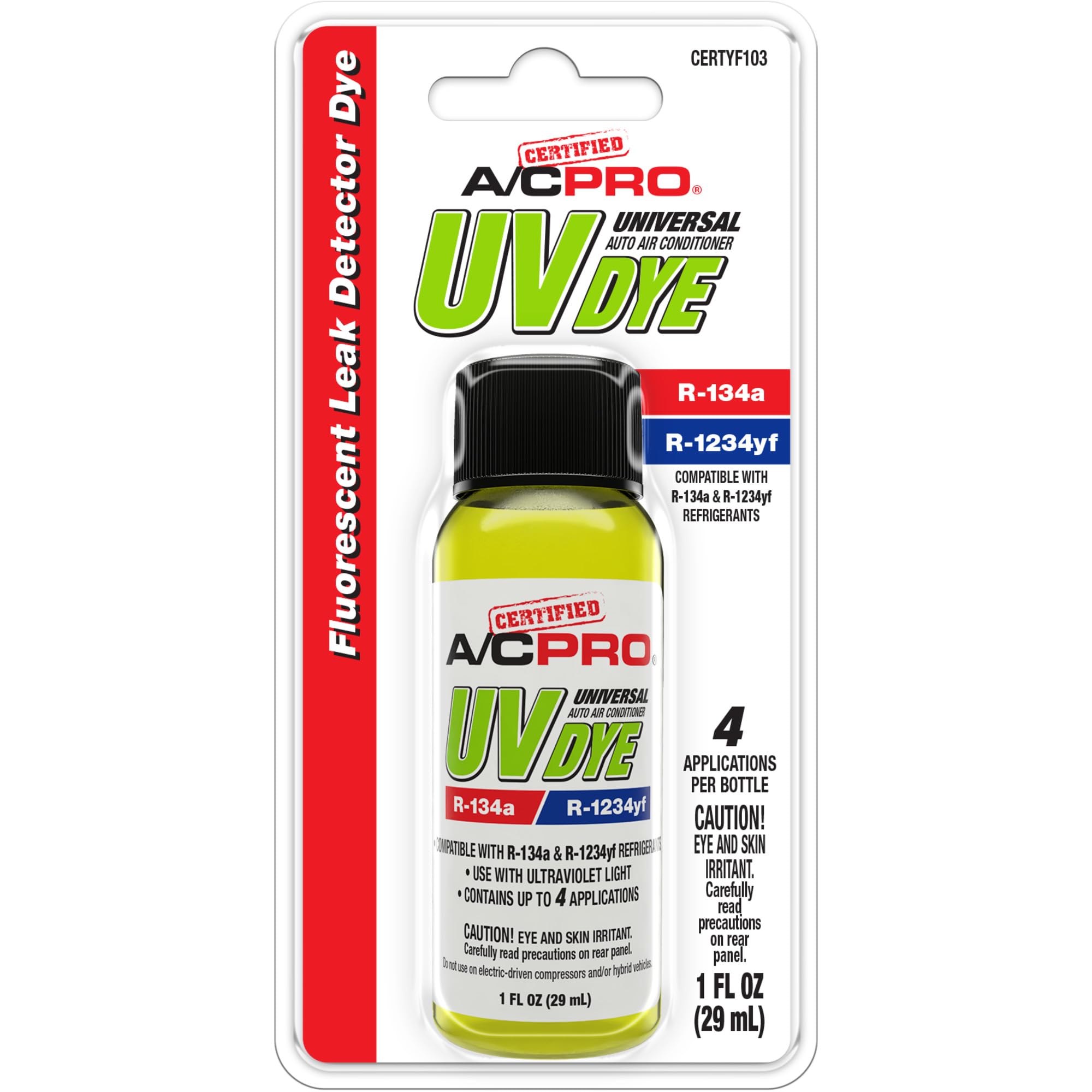
If you drive a newer vehicle, the refrigerant is likely R-1234yf, and this dye is built specifically for that system — a match that generic dyes cannot claim. The 1 oz bottle is small, but it is perfectly sized for a single-car application, and it weighs just 1.76 ounces, making it far more portable than bulk shop bottles.
The formula meets SAE requirements, ensuring professional-grade quality. It glows brightly under a UV light for easy identification, though you will need to supply the flashlight separately since it is not included.
Owners mention it “Saved a small fortune” by tracking down a leak from a blown o-ring without paying a shop for diagnosis. The same reviewers advise using a true 365nm black light, noting that while a 395nm light works, the 365nm makes the dye glow far more vividly.
Pinpoint accuracy: this dye is specifically formulated for R-1234yf, so it is the right tool for late-model cars. The catch is that it is not the one to grab for a classic R12 or R134a system.
Choose this for: a modern car with R-1234yf where you need a single, correct dose of dye.
Skip it for: older vehicles running R12 or R134a, where the TSI Supercool D8 is a better match.
3. Leak Saver UV Dye
The easiest-to-inject dye that works across home, auto, and commercial systems.
This is the dye that removes the intimidation factor from leak detection, with the ease of use being the thing everyone raves about — it is the single most-cited strength in the owner feedback. It is a dye-only formula, meaning there is no leak sealant mixed in, so it is safe for all manifold gauges, hoses, expansion valves, and Schrader valves.
The compatibility list is huge: it works with all systems and refrigerants except ammonia, including R410A, R22, R134A, r1234yf, R404A, and more. That makes it a versatile option whether you’re working on a car, a central air conditioner, a ductless mini-split, or a commercial refrigerator up to 5 tons.
Customers note the product arrives “packaged and sealed very well” and is “easy to hookup and dispense.” At 2.39 ounces and 6.5 x 9.6 x 0.6 inches, it is 86% more compact than bulkier shop options, so it slips into a toolbox without taking up space.
Universal appeal: this is the most flexible dye here, spanning automotive and home HVAC. The trade-off is that it is not the cheapest per-ounce option, and you still need a UV light for the glow to appear.
Grab this if: you want one dye that works across a car, a fridge, and a mini-split without checking compatibility.
Think twice if: your only AC is an R134a car and you want the absolute lowest cost per treatment.
4. FJC 2480 PAG Oil with Fluorescent Dye

A full quart of PAG oil that already has the UV dye mixed in, saving you a step.
This product does double duty: it is a 1-quart bottle of PAG oil that already contains fluorescent leak detection dye, so you can top off your compressor oil and add a leak tracer in one pour. It is compatible with mineral, ester, paraffin, and PAG oils, making it flexible across different compressor types.
The 2.1-pound bottle provides a generous quantity, far exceeding small 1 oz vials, and works with standard UV lights. For anyone servicing their own car, this saves time over the traditional method of separate dye injection, as you are replacing oil that may be low while adding the tracer at the same time.
Reviewers point out it “works well as advertised, cheaper than buying it through the local parts house.” The reviews consistently describe it as working as it should, making it a reliable, no-fuss option that fits a standard DIY workflow.
Time-saver: this combines two maintenance tasks into one bottle, which is genuinely convenient. The catch is that it is specifically PAG oil, so it is not the right pick if you need a standalone dye for a system that does not need an oil top-up.
Best for: DIYers who are already low on compressor oil and want to combine a top-up with leak tracing.
Not for: anyone who only needs a pure dye without adding oil to the system.
5. TSI Supercool Total Leak Stop and UV Dye

A 1-ounce aerosol that both stops small leaks and leaves a UV tracer behind.
This product is engineered to stop small leaks in evaporators, condensers, hoses, gaskets, and seals, making it a fix-it product rather than a pure diagnostic tool. The 1 oz can treats 1 vehicle, and it comes with an adapter so you can connect it directly without a separate injection kit.
The formula specifically does not contain polymers, meaning it is designed not to harm or clog AC system components, reclamation, or recovery machines — a genuine concern with many stop-leak products. Its patented HFC-free aerosol technology separates it from other stop-leak products.
Shoppers say mixed results: some say it “worked perfectly” and sealed a leak so well they never recharged for a whole summer, while others note it is a temporary fix and the leak still needs proper repair. Quality gets solid marks, though a few units arrived with fluid leaked out in shipping.
Handy fix: this is a great companion to a UV dye if you have a known small leak you want to seal. The catch is that it is not a pure diagnostic dye, and sealants can mask a problem that needs a proper repair.
Reach for this if: you want a one-can solution that patches a small leak and confirms it with a UV glow.
Be cautious if: you strictly want a diagnostic dye, because the sealant changes what this product does.
6. ZeroR AC UV Dye Leak Detector

Three cans of concentrated dye that work with the common R134a thread-on fitting.
This 3-can pack gives you enough concentrated fluorescent dye for three full-size autos or trucks, which is the standout value here. Each can has the R134a thread on the top, so it screws directly onto your charging hose without needing a specialized injector tool.
The dye is highly concentrated and produces a fluorescent yellow that works best with a black light and UV glasses. It is fully compatible with mineral, ester, and PAG oils, and it is rated for R134a, R12, and R22 systems, giving it broad coverage across older and mid-generation vehicles.
Feedback is split: it works well when the system is prepped properly, with owners describing the glow as “like a radioactive leak on the Simpsons” when paired with the right UV light. However, some buyers report the cans leaked in shipping or the dye did not glow for them — a reminder that a proper 365nm light is key.
Bulk value: three cans for the price of some single bottles is the headline here. The catch is the mixed shipping experience and the need to verify your UV light is the right wavelength for the best glow.
Grab this if: you want a multi-can pack for a household with several cars, or you want spares on the shelf.
skip it if: you want a guaranteed leak-free, single-bottle experience without any shipping risk.
7. LEAKFINDER LF1800 UV Dye

The brightest shop-grade cartridge from Tracer Products, handling up to 64 vehicles.
This is the dye that professionals buy, and the reason is the brand behind it: Tracer Products brings over 65 years of expertise to this professional-grade dye. This 8 oz cartridge services up to 64 vehicles, offering the longest lifespan here.
It is compatible with R-134a, R-1234yf, and other refrigerants, and it fluoresces green, working with all leak detection flashlights. It circulates through the system and glows under UV light to reveal even micro leaks.
Shops that use it daily confirm it is “the only A/C dye we use at our shop,” citing compatibility with R12, R134, and R1234. Owners mention it works as it should, and the cartridge form factor makes it a direct replacement that is easy to load into professional injection equipment.
Shop standard: this is the cartridge that workshops restock again and again, and the 64-vehicle capacity explains why. The catch is that it is a premium price for a DIYer who will only use a fraction of the bottle.
Best for: professional technicians or serious DIYers who want a top-tier dye that will last through dozens of jobs.
Overkill for: a single car owner who needs a one-time fix and would waste most of the cartridge.
8. UView ExtenDye 8oz Cartridge

The super-concentrated cartridge that adds anti-wear protection while it traces leaks.
This 8 oz cartridge is designed for UView’s Spotgun injection systems, and its super-concentrated formula services 64 vehicles — matching the LEAKFINDER’s capacity but in a package that adds extra protection. An anti-wear additive reduces friction and heat, extending component life while tracing leaks.
The formula is hybrid-safe, which is a meaningful detail if you drive a hybrid vehicle with an electric AC compressor. It is a professional-grade dye that shops rely on, with buyers noting it is “very bright under uv light” and costs about half the price of buying from a tool truck.
The feedback is strong for value and brightness, though it is worth knowing that one owner reported a cracked cartridge upon first use, possibly from shipping. At 12.8 ounces, it is a substantial cartridge that feels built for regular shop use rather than a one-off DIY job.
Pro chemistry: the anti-wear additive is a genuine bonus that most dyes do not offer, and the 64-vehicle capacity is immense. The catch is that it is designed for the Spotgun system, so you need compatible injection equipment.
Choose this if: you own a Spotgun injector and want a super-concentrated, hybrid-safe dye for a busy shop.
Look elsewhere if: you are a home DIYer without the Spotgun system, as you will pay for capacity you cannot use.
9. Mastercool Professional UV Leak Detection Kit

The full toolbox for finding AC, coolant, oil, and fuel leaks in one molded case.
If you want everything in one box rather than piecing together a dye, a light, and glasses, this is the kit. It includes a high-intensity 12V UV light that connects to your battery, a 1 oz cartridge of fluorescent dye for oil-based systems good for 10 applications, and a 1 oz engine coolant dye for cooling system diagnostics.
It comes with an R134a hose and coupler, plus an R12 adapter for legacy systems, so it is ready to work on most passenger vehicles right from the start. The kit also includes a 4 oz dye remover, 25 service labels for recordkeeping, and UV-enhancing safety glasses, plus a rugged molded carry case for portability.
The quality is the most-cited strength in the feedback, with owners praising it as a high-quality, versatile tool that works well for automotive AC repair, especially in dark areas. Customers note it outperformed battery-powered lights and even expensive sniffer types, though some find the UV light’s brightness and the dye’s potency to be a matter of debate.
One-box solution: this is the only pick that gives you the light, the dyes, the hoses, and the accessories together. The catch is that some owners had to fix a lens retainer on the light, and the dye injector connector does not fit all R-134a systems perfectly.
Best for: DIYers who want a complete, ready-to-use diagnostic kit without buying components separately.
Not for: someone who already owns a UV light and just needs a refill of dye, where you would pay for extras you do not use.
Understanding the Specs
Refrigerant Compatibility
Your car’s AC system uses a specific refrigerant, and the dye must be compatible with it to circulate properly. Older cars use R-134a, newer ones use R-1234yf, and classic cars use R12. Check your vehicle’s label before buying — a dye for the wrong refrigerant simply will not work correctly.
Dye Concentration & Coverage
Dyes are sold in different sizes and concentrations, which determines how many vehicles you can treat. A super-concentrated 8 oz bottle can handle 64 vehicles, while a 1 oz vial is usually a single use. If you only have one car, a smaller bottle is the practical choice; if you maintain a fleet or a shop, the bigger bottles save money over time.
FAQ
How long do I run the AC after adding the dye to find a leak?
Can I mix UV dyes with different refrigerants like R134a and R-1234yf?
Will a UV dye harm my AC compressor or other components?
What is the difference between a UV dye and a leak sealant?
Do I need a special UV light for the dye to glow?
How do I inject the dye into my car’s AC system?
Is it better to buy a dye that already includes PAG oil?
Will the dye contaminate my AC system after the leak is fixed?
How many vehicles can a standard bottle or cartridge of dye treat?
Final Thoughts: The Verdict
If you want one dependable pick, the best ac uv dye is the TSI Supercool D8 because it offers the best balance of high ratings, professional-grade compatibility, and a 32-vehicle capacity that makes it a smart long-term buy. If you drive a newer car with R-1234yf, grab the A/C Pro Certified instead. And if you want a complete diagnostic setup rather than just the dye, the Mastercool kit gives you everything in one case.
How We Picked
We do not accept paid placement. Every pick is matched to a real buyer and a real use-case; we do not hands-on test units.
Sources & Methodology
Specifications: manufacturer listings and product documentation. Review insights: verified customer reviews, as of August 2026. Pricing: not shown on this page (it changes often); check the current price via the retailer link.
As an Amazon Associate, Gadgets Feed earns from qualifying purchases. This does not affect which products we feature.