
A vacuum pump that struggles to pull below 1000 microns is almost always choking on degraded or wrong-weight oil. The lubricant inside your AC service pump or freeze dryer does not just reduce friction — it seals the internal clearances, absorbs moisture, and carries away contaminants that would otherwise score the rotor and vanes. Choosing the wrong oil, or running old oil, turns a capable pump into a slow, inefficient machine that shortens the life of your entire evacuation process.
I’m Min — the co-founder and writer behind Gadgets Feed. I’ve spent hundreds of hours breaking down the chemical formulations, viscosity curves, and real-world micron pull data behind every major vacuum pump oil to find which bottles actually protect your pump and which ones are overpriced mineral blends.
This guide evaluates seven proven fluids by their viscosity index, flash point, moisture content, and customer validation to help you select the best ac vacuum pump oil for your specific equipment and service frequency.
How To Choose The Best AC Vacuum Pump Oil
Picking the right bottle comes down to understanding how your pump uses oil. The fluid is both lubricant and sealant — it fills the microscopic gap between the rotor and stator walls, creating the airtight barrier that lets the pump draw a deep vacuum. Every property of the oil affects that seal.
Viscosity Grade (ISO 46 vs. 100 SUS)
Most modern rotary vane pumps specify ISO 46 viscosity, which roughly equates to 225 SUS at 100°F or 46 cSt at 40°C. Oil that is too thin (ISO 32) will leak past the vanes and reduce ultimate vacuum depth. Oil that is too thick (ISO 68) creates drag, raises operating temperature, and slows the pull-down rate. Always check your pump’s manual — Robinair, Fieldpiece, and Mastercool units overwhelmingly call for ISO 46.
Base Oil Type: Hydrotreated vs. Synthetic
Hydrotreated mineral oils undergo a hydrogenation process that strips out reactive hydrocarbons, sulfur, and aromatic compounds. The result is a chemically stable fluid that resists oxidation and sludge formation under the heat of continuous AC evacuation. Full synthetic oils (like polyalphaolefin) offer even lower volatility and better cold-flow properties, but they cost more per quart. If you change oil every few uses, a high-quality hydrotreated fluid delivers identical protection at a lower per-change cost.
Moisture Content and Flash Point
Vacuum pumps are moisture magnets — every evacuation pulls water vapor out of the AC system and into the oil. Oil with a low initial moisture content (verified by a high flash point above 400°F) starts with an advantage. Oils that exceed a 400°F flash point resist boiling off inside the pump at operating temperature, which keeps the internal seal intact. Oils with a flash point below 380°F are more prone to vaporization and can actually degrade the vacuum you are trying to pull.
Quick Comparison
On smaller screens, swipe sideways to see the full table.
| Model | Category | Best For | Key Spec | Amazon |
|---|---|---|---|---|
| OEMTOOLS 24399 | Hydrotreated | General AC service | 225 SUS at 100°F | Amazon |
| FJC 2200 | Mineral Blend | High-volume fleet | 32 fl oz (quart) | Amazon |
| Robinair 13119 | Premium Hydrotreated | Robinair pumps & freeze dryers | 1 pint bottle | Amazon |
| Mastercool 90032 | High Viscosity | Deep vacuum evacuation | 32 oz with spout | Amazon |
| TSI Supercool 33713 | Synthetic | Fieldpiece VP85 & commercial use | ISO 46 / 46 cSt | Amazon |
| Robinair Premium 2-Pack | High Viscosity | Harvest Right freeze dryers | 64 fl oz total | Amazon |
| Stearns ST0005 | Bulk Mineral | Frequent oil changes | 1 gallon (128 fl oz) | Amazon |
In‑Depth Reviews
1. OEMTOOLS 24399 Vacuum Pump Oil
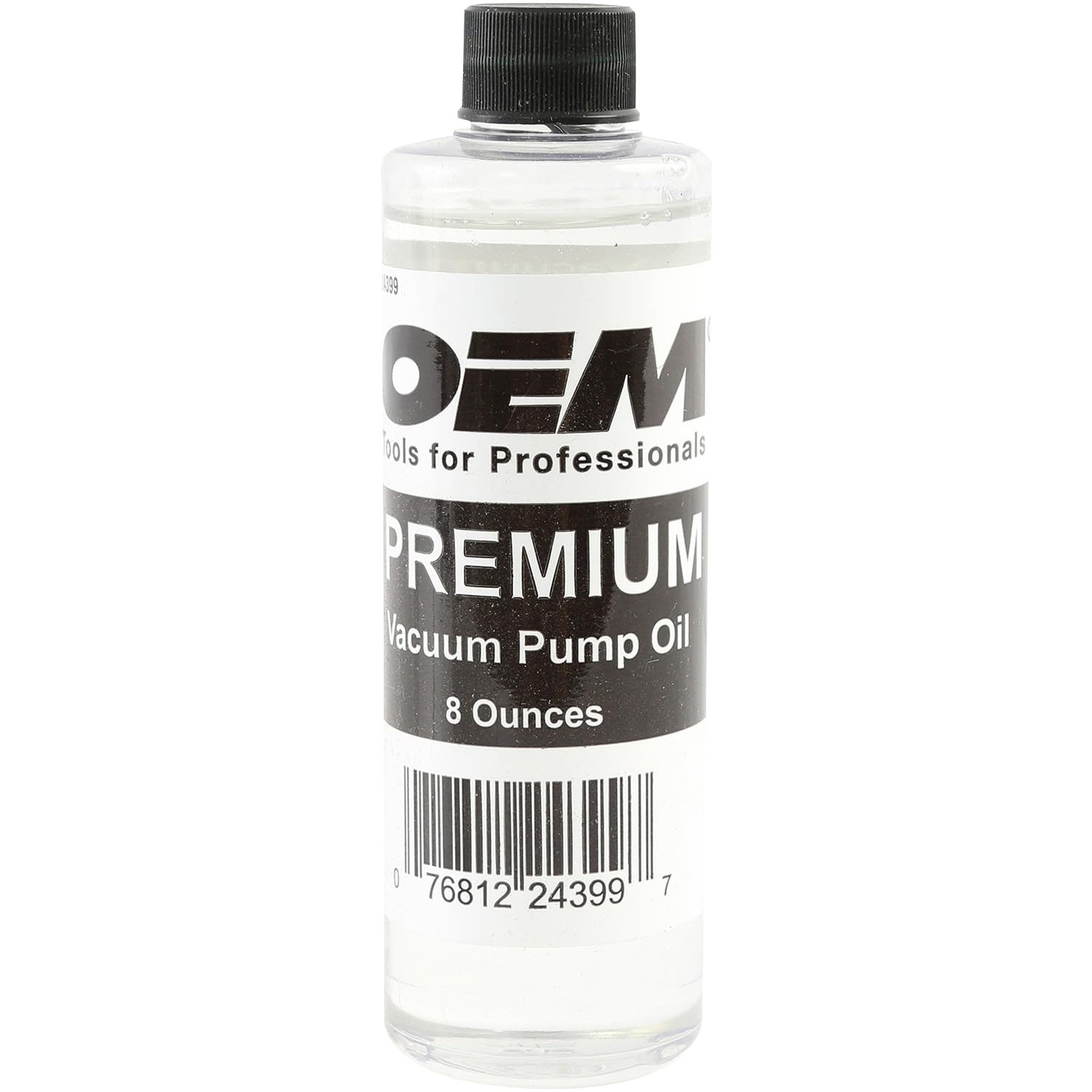
The OEMTOOLS 24399 uses a hydrotreated base oil that achieves a flash point of 415°F and a pour point of -10°F. Those numbers matter because a high flash point means the fluid resists vaporizing inside the pump during long evacuation cycles, maintaining the internal seal that allows the rotor to pull below 500 microns. The 225 SUS viscosity at 100°F places it squarely in the ISO 46 range that most rotary vane AC pumps demand.
Users running this oil in Robinair and older automotive AC pumps report consistent performance without the varnish buildup that plagues unrefined mineral oils. The 8-ounce bottle covers a single oil change for most 3–5 CFM pumps, which encourages the discipline of fresh oil every service. The clear amber color also makes visual contamination checks through the sight glass straightforward.
At this price point, you get a chemically stabilized oil that meets or exceeds the purity requirements of premium pump brands without paying the name-brand markup. It is the most balanced option for any technician who changes oil regularly and wants predictable pull-down performance.
Why it’s great
- 415°F flash point prevents oil vaporization under load
- Hydrotreated base reduces sludge and acid formation
Good to know
- 8 oz bottle only — frequent changers will need multiple units
2. TSI Supercool 33713 Vacuum Pump Oil

The TSI Supercool 33713 is a full synthetic ISO 46 fluid (46 cSt at 40°C) that includes conditioners, inhibitors, and anti-wear agents — ingredients typically absent from budget hydrotreated oils. The non-misting formulation reduces oil carry-over into the exhaust, which keeps the pump interior cleaner and extends the life of the exhaust filter. For Fieldpiece VP85 users, this oil is a direct drop-in replacement that matches or exceeds the OEM spec.
Reviewers running chamber vacuum sealers and commercial freeze dryers note that the synthetic base handles continuous cycling better than mineral blends. The oil remains clear and thin at lower temperatures, reducing drag on cold starts, and the anti-wear package protects the vane tips during the first few seconds of operation before full lubrication is established.
The 32-ounce bottle delivers roughly four oil changes for a standard 5 CFM pump, making the per-change cost competitive with basic mineral oils. If you own a high-duty-cycle pump or want maximum vane protection, the synthetic formulation justifies the additional investment.
Why it’s great
- Full synthetic ISO 46 with anti-wear and corrosion inhibitors
- Non-misting formulation reduces oil loss through exhaust
Good to know
- Overkill for occasional home use with frequent oil changes
3. Mastercool 90032 Vacuum Pump Oil
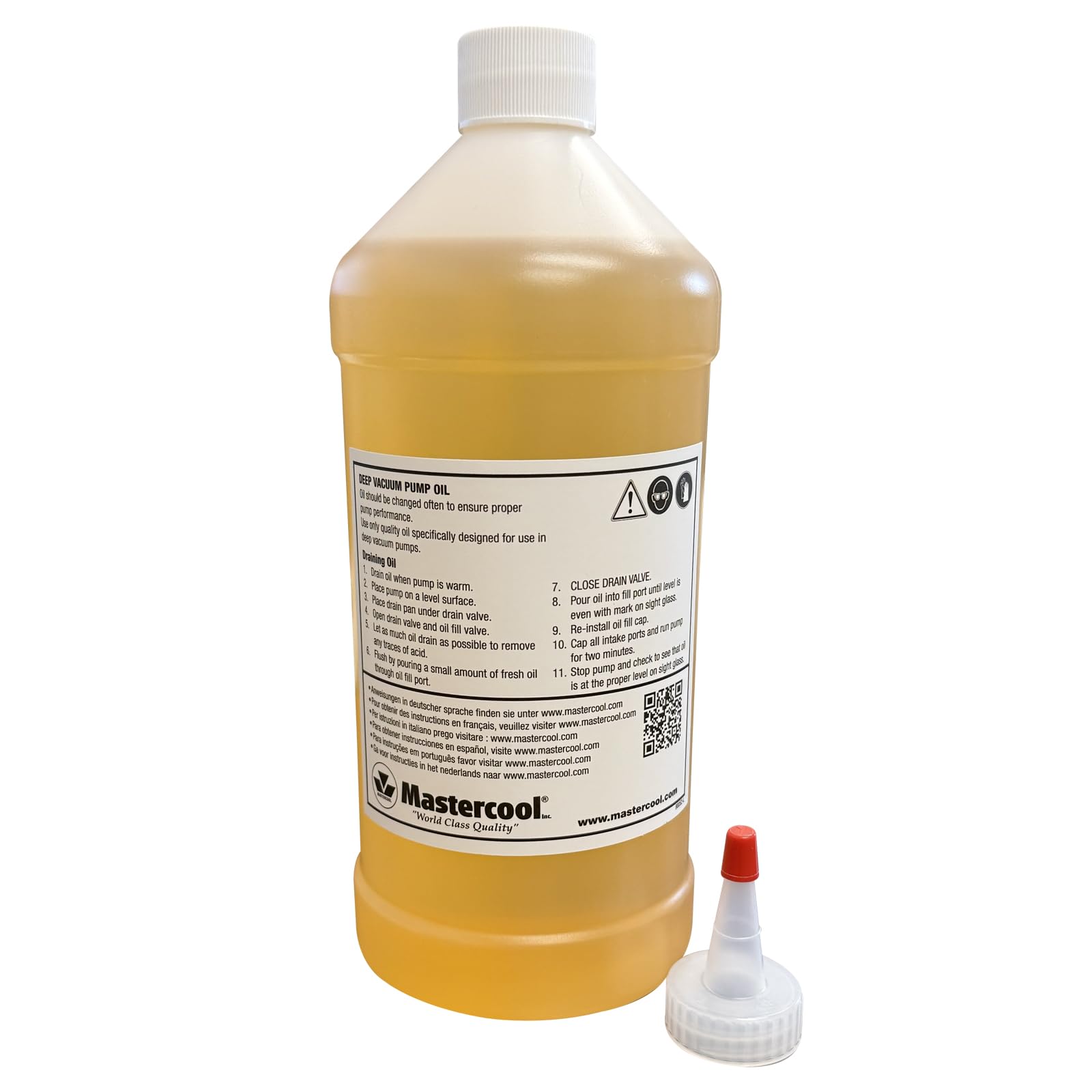
The Mastercool 90032 is a high-viscosity ISO 46 fluid built specifically for deep vacuum evacuation. It is thermally stable enough to maintain consistent viscosity across the temperature range common to automotive AC service, and its clear formulation makes it easy to spot contamination through the sight glass without draining the pump. The included dispensing spout eliminates the funnel fumbling that usually leads to spills on the service cart.
Technicians report that this oil allowed their pumps to pull below 400 microns on ice machines and residential AC systems after a single oil change, confirming that the formulation supports the tight clearances needed for deep vacuum work. The 32-ounce bottle provides enough fluid for multiple changes, and the wide mouth spout snaps on securely without cross-threading.
For the blend of thermal stability, clarity, and packaging convenience, the Mastercool 90032 offers one of the lowest per-ounce costs among purpose-designed vacuum pump oils. It is a strong choice for any technician who values a clean, spill-free oil change process.
Why it’s great
- Thermally stable formulation tested for below-400 micron pulls
- Built-in dispensing spout reduces mess and waste
Good to know
- Clear oil makes visual checks easy but shows color change earlier than dyed oils
4. Robinair Premium High Viscosity Low Moisture Vacuum Pump Oil (2 Pack)

This Robinair 2-pack delivers high viscosity paired with low moisture content — a critical combination for freeze dryer pumps that run for 20+ hours per cycle. Moisture-laden oil loses its sealing ability and forces the pump to work harder, generating heat that further degrades the fluid. Robinair’s formulation maintains high viscosity at elevated temperatures while staying thin enough at room temperature for reliable cold starts.
Harvest Right freeze dryer owners consistently rate this as the preferred aftermarket oil, noting that it keeps the pump running quieter and cooler than the factory-fill fluid. The low moisture baseline means the oil absorbs more water before reaching saturation, extending the interval between changes. Running two quart bottles in a gallon-size pump gives you a full service cycle with one purchase.
If you run a freeze dryer or a commercial AC recovery station that operates for extended periods, the 2-pack format and low-moisture chemistry make this the most practical choice for ensuring consistent vacuum quality.
Why it’s great
- Low moisture content handles 20+ hour freeze dryer cycles
- Two quart bottles provide one complete fill plus a spare
Good to know
- No dispensing spout included — use a clean funnel
5. Robinair 13119 Premium High Vacuum Pump Oil

Robinair’s 13119 is bottled specifically to maintain viscosity at the higher running temperatures that develop in continuous-duty AC service. The oil is tested for minimal moisture content before bottling, giving it a starting advantage in keeping pump internals corrosion-free. Its excellent cold-weather properties make it easier to start a pump that has been sitting overnight in an unheated shop.
Technicians who swapped from generic pump oil to this Robinair fluid report immediately faster pull-down times and lower ultimate micron readings. The small pint size (473 mL) is intentional — it matches the exact capacity of most 5 CFM Robinair pumps, so you empty the entire bottle into the pump without guessing how much is left over. The single-bottle format encourages fresh oil every job rather than stretching a quart across multiple changes.
This is the reference standard for Robinair-branded pumps, but its low-moisture chemistry and tight viscosity curve make it equally effective in any ISO 46 pump. It is the safest choice for anyone who wants guaranteed compatibility and proven performance.
Why it’s great
- Bottled with verified low moisture content for corrosion protection
- Pint size matches 5 CFM pump capacity exactly
Good to know
- Higher per-ounce cost compared to quart or gallon bottles
6. FJC 2200 Vacuum Pump Oil

The FJC 2200 is a mineral-based vacuum pump oil that includes a purple dye for easier sight-glass monitoring. The dye is a practical feature — when the oil darkens from contamination, the color shift is obvious even under dim shop lights, giving you a clear visual signal to change the fluid. The quart bottle is formulated for fleet and plant maintenance environments where multiple pumps are serviced regularly.
Users running this in both FJC and Robinair pumps confirm that it meets the viscosity requirements for standard automotive AC evacuation. The included funnel simplifies filling, though the bottle’s gallon-jug shape can be misleading — it contains 32 ounces, not a gallon. At this price per quart, it is one of the most economical options for high-frequency changers who cycle through oil quickly and do not need synthetic-grade protection.
If your pump sees intermittent use and you change oil before every job, the FJC 2200 delivers adequate sealing and lubrication at the lowest per-quart cost in this guide. The dye alone makes contamination checks faster than inspecting clear oil.
Why it’s great
- Purple dye makes oil contamination instantly visible through sight glass
- Includes a funnel for clean pouring
Good to know
- Mineral base may oxidize faster than hydrotreated or synthetic fluids
7. Stearns Packaging ST0005-DB-PB70 Vacuum Pump Oil

The Stearns ST0005 is a full-gallon bottle of silicone-based vacuum pump oil designed to provide better cold-weather starting than conventional mineral fluids. Silicone oils have inherently lower viscosity variability across temperature swings, which means the pump turns over more easily at 30°F and maintains consistent sealing as the oil warms up to operating temperature. This property is especially valuable for outdoor AC service or unheated freeze dryer rooms.
Harvest Right freeze dryer users with years of experience on this oil report that the pump runs noticeably quieter and cooler compared to factory-recommended oils. The gallon format gives you roughly eight full oil changes for a standard 5 CFM pump, making the per-change cost the lowest in this lineup. The silicone chemistry also resists oxidation better than mineral oils, which translates to longer oil life between changes.
Because silicone oils have different additive packages than typical ISO 46 fluids, confirm your pump manufacturer approves silicone-based lubricants before switching. For compatible pumps, the ST0005 delivers the lowest long-term operating cost.
Why it’s great
- Silicone base offers superior cold-weather pump starting
- Gallon bottle provides eight changes at a very low per-change cost
Good to know
- Silicone chemistry requires pump compatibility verification before use
FAQ
How often should I change AC vacuum pump oil?
Can I use motor oil or transmission fluid in my vacuum pump?
Final Thoughts: The Verdict
For most users, the best ac vacuum pump oil winner is the OEMTOOLS 24399 because its hydrotreated base, 415°F flash point, and ISO 46 viscosity deliver reliable deep-vacuum performance at the lowest per-change cost for standard rotary vane pumps. If you want maximum vane protection and longer oil life in a high-cycle pump, grab the TSI Supercool 33713 synthetic. And for bulk users who own freeze dryers or operate multiple pumps, nothing beats the per-gallon value of the Stearns ST0005 silicone-based oil.