
The hum of a traditional air conditioner often drowns out conversation, sleep, and peace of mind. An inverter-driven system solves this by varying compressor speed instead of cycling on and off, delivering consistent temperature without the jarring restart noise. This technology fundamentally changes how a room feels — no cold blasts followed by stale stillness, just a steady, silent cool.
I’m Min — the co-founder and writer behind Gadgets Feed. For this guide, I’ve analyzed compressor types, BTU-to-room ratios, SEER2 ratings, and decibel specs across nine models, cross-referencing thousands of customer reports to separate marketing claims from real-world performance.
Whether you’re outfitting a bedroom, a home office, or a large living area, finding the right ac with inverter comes down to matching cooling capacity, efficiency, and noise profile to your specific space.
How To Choose The Best AC With Inverter
Choosing an inverter AC means prioritizing steady cooling over on-off cycling. The compressor’s ability to ramp up and down directly affects energy consumption, noise, and humidity control. Three factors separate a good purchase from a regret: cooling capacity, efficiency certification, and installation type.
Match BTU to Your Room Size
British Thermal Units measure cooling power. A 12,000 BTU unit typically handles up to 550 square feet, while 8,000 BTU covers roughly 300 square feet. Oversizing leads to short cycling and poor humidity removal; undersizing forces the compressor to run flat-out constantly. Measure your room’s length and width, then multiply for square footage — this is the single most important spec check before buying.
Prioritize Efficiency Ratings
Inverter technology already cuts energy use, but the CEER (Combined Energy Efficiency Ratio) or SEER2 (Seasonal Energy Efficiency Ratio 2) tells you exactly how much. A CEER above 12 is excellent for portable units; window models often hit 13 or higher. Higher numbers mean lower annual electricity costs, especially in regions with long cooling seasons.
Decide Between Window, Portable, and Mini Split
Window units seal the window gap, block outside noise, and are generally more efficient per BTU than portables. Portable units offer flexibility for apartments or rooms without suitable windows, but dual-hose models drastically improve efficiency over single-hose designs. Mini splits require permanent installation but deliver the quietest operation and highest SEER2 ratings, ideal for whole-room or multi-room setups.
Quick Comparison
On smaller screens, swipe sideways to see the full table.
| Model | Category | Best For | Key Spec | Amazon |
|---|---|---|---|---|
| ZAFRO Smart Inverter Portable | Portable | Drainage-free cooling | CEER 12.8 | Amazon |
| Midea 12,000 BTU U Shaped | Window | Ultra quiet operation | 32 dBA noise level | Amazon |
| Albott Mini Split 12,000 BTU | Mini Split | Year-round heating & cooling | SEER2 18 | Amazon |
| Midea Inverter Window with Heat | Window | Heating + cooling combo | CEER 13.3 | Amazon |
| LG Dual Inverter 12,000 BTU | Window | Smart home integration | 44 dBA sleep mode | Amazon |
| Whynter ARC-1230WN 14,000 BTU | Portable | Large room portable cooling | 14,000 BTU / 12,000 BTU SACC | Amazon |
| ZAFRO U Shaped Window | Window | Saddle design with view | 32 dB noise level | Amazon |
| Portable Air Conditioner 16,000 BTU | Portable | WiFi app control | 16,000 BTU | Amazon |
| Portable AC 10,000 BTU | Portable | Budget-friendly portable | 10,000 BTU | Amazon |
In‑Depth Reviews
1. ZAFRO Smart Inverter Portable Air Conditioners, 12000 BTU
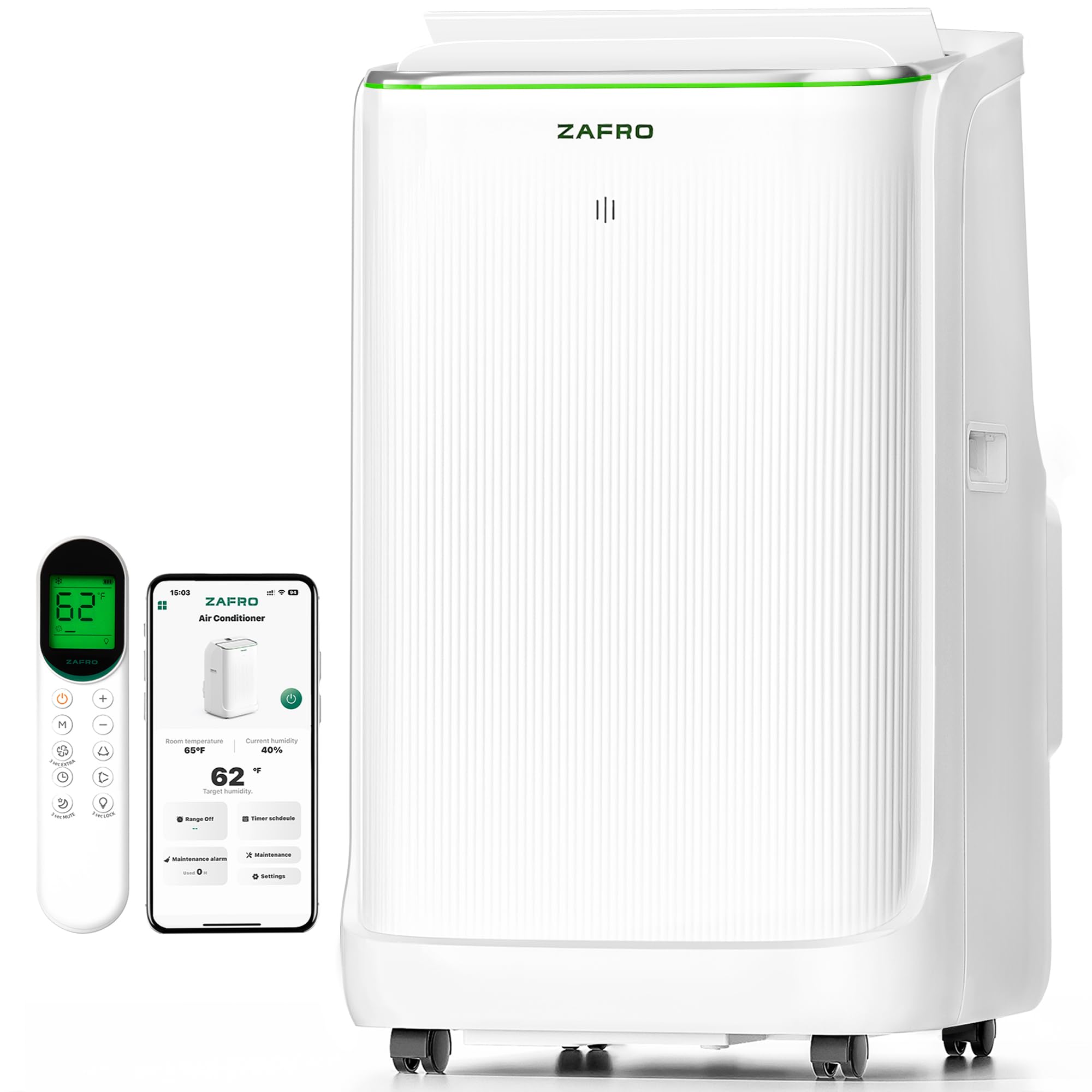
The ZAFRO dual-hose portable delivers inverter-driven efficiency that rivals many window units, with a CEER of 12.8 that drastically cuts electricity draw compared to standard portable ACs. The dual-hose design prevents the negative pressure issues that plague single-hose units, meaning hot air is exhausted through one hose while intake air comes through the second — no sucking warm air back through door cracks. You get genuine 12,000 BTU cooling (8,000 BTU SACC) for rooms up to 600 square feet.
Self-evaporating technology handles condensate removal for up to 72 hours in sub-90% humidity, so you aren’t emptying a water bucket every afternoon. The inverter compressor operates as low as 42 dB, which is quieter than a library and barely noticeable during sleep. Smart app control, 4-way oscillation, and six modes (including a dedicated Eco and Extra mode) give you precise tuning for any scenario.
This unit balances premium inverter performance with a price point that undercuts many similarly spec’d portables. The window panel kit could be sturdier — some users note gaps that require additional sealing foam — but the overall value proposition, energy savings, and nearly silent operation make it the strongest all-around pick for most buyers.
Why it’s great
- CEER 12.8 delivers exceptional energy efficiency for a portable unit
- Dual-hose design eliminates negative air pressure and improves cooling
- Self-evaporating system — no manual draining for days
Good to know
- Included window panel may need extra sealing for a tight fit
- App indicator light control requires remote first
2. Midea 12,000 BTU U Shaped Smart Inverter Window Air Conditioner
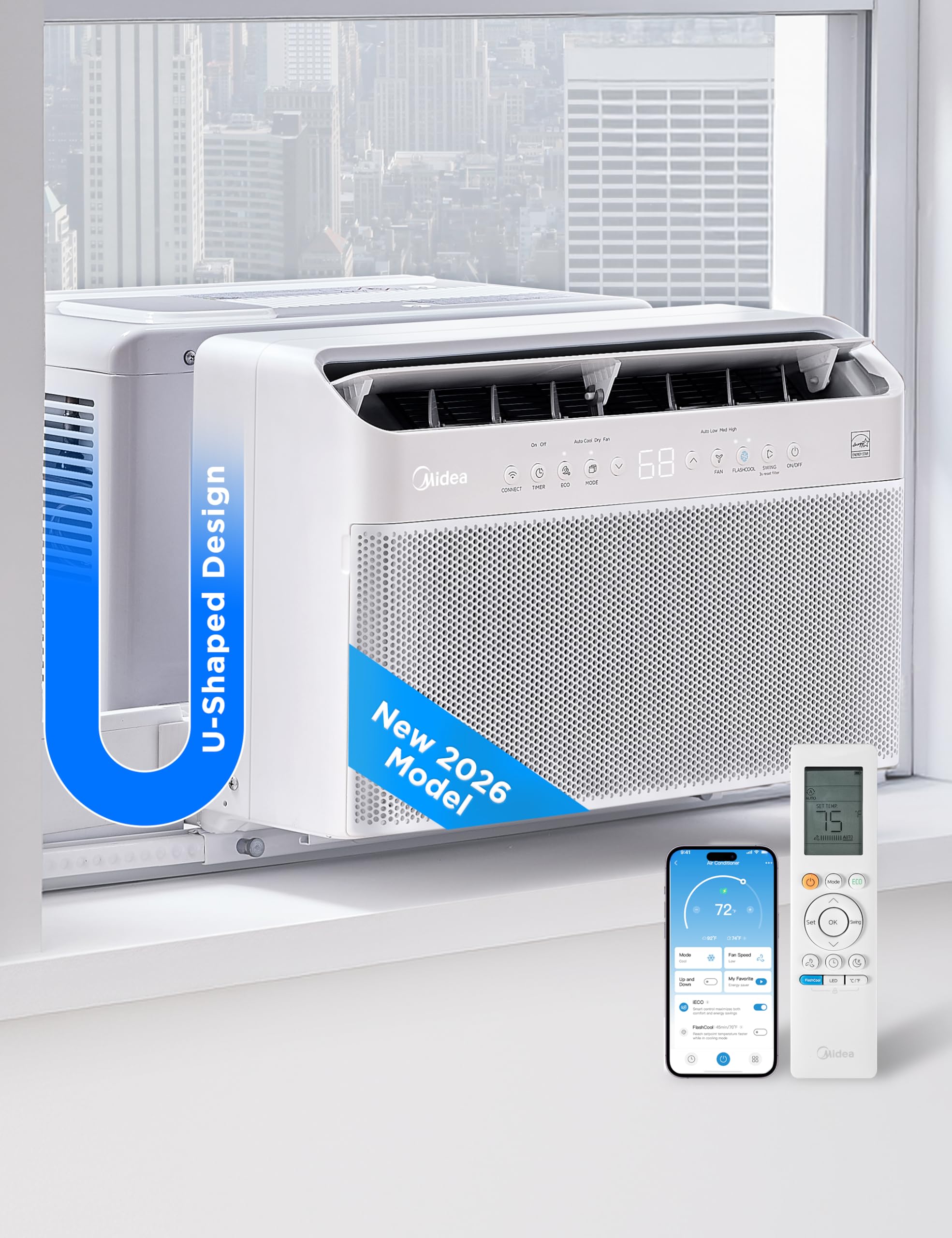
Midea reimagined the window AC form factor with a U-shaped design that positions the noisy compressor outside the window frame, achieving a whisper-quiet 32 dBA — roughly the volume of a quiet library. This is 9x quieter than traditional window units, and the gap left by the U-shape allows you to close the window sash against the unit, blocking outside noise and maintaining security with an anti-theft lock mechanism.
The DC inverter technology delivers over 37% energy savings compared to conventional window ACs, and it was the first window unit to earn ENERGY STAR certification. At 12,000 BTU, it covers up to 550 square feet, and the SmartHome app works with Alexa and Google Assistant for voice control. Cool air reaches every corner thanks to 4-way airflow direction, and the washable filter slides out easily for cleaning.
Installation is genuinely DIY-friendly with the included quick-snap bracket, though double-hung windows between 22 and 36 inches width are required. The U-shaped design preserves your view and lets natural light in — something no traditional window unit can do. If noise and energy bills are your top concerns, this is the unit that sets the standard.
Why it’s great
- 32 dBA operation is virtually silent — 9x quieter than traditional units
- Over 37% energy savings with DC inverter technology
- Window closes over the unit for security and sound insulation
Good to know
- Only fits single-hung or double-hung windows 22″ to 36″ wide
- Minimum window opening height of 13.75″ required
3. Albott Mini Split Air Conditioner and Heater, 12,000 BTU
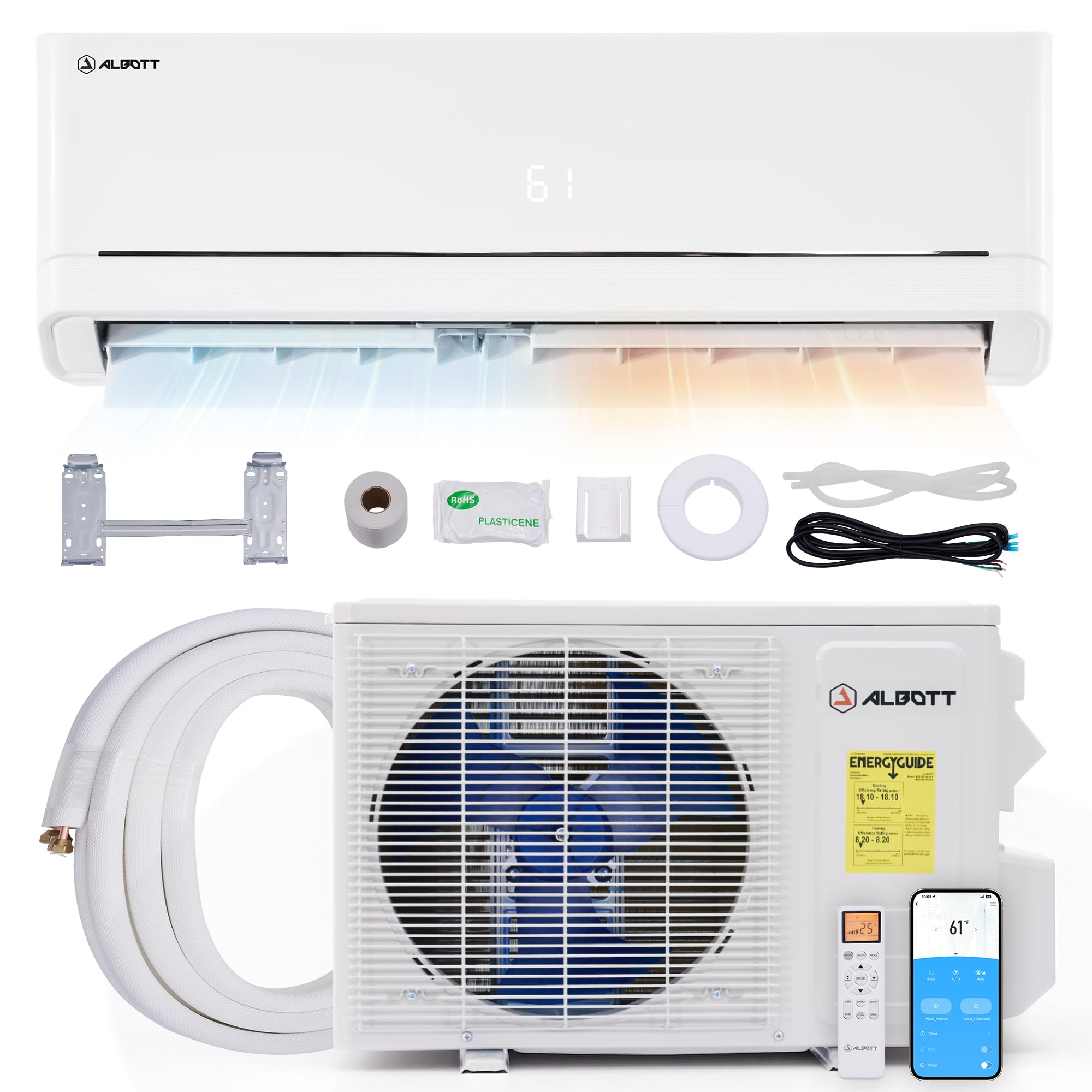
For those willing to tackle a DIY mini split installation, the Albott 12,000 BTU system delivers heating and cooling performance that rivals brands costing three times as much. The SEER2 18 rating means it converts electricity into cooling with exceptional efficiency — far better than any portable or window unit. It operates in extreme temperatures from 5°F to 122°F, making it a true four-season solution for garages, home additions, or entire floors up to 750 square feet.
The inverter heat pump technology produces barely 29 dB of indoor noise — you’ll hear the air moving before you hear the compressor. Self-cleaning function, washable mesh filters, and removable air blades simplify maintenance. App and remote control let you switch between cool, heat, dehumidify, and fan modes with a 24-hour timer. The 5-year compressor warranty and 7-year parts warranty provide long-term peace of mind.
Installation requires a 3-inch wall hole, a vacuum pump, and basic HVAC knowledge — not a beginner project. If you have the skill or a friend who does, this is the savvy long-term investment.
Why it’s great
- SEER2 18 efficiency massively reduces operating costs
- Heating function down to 5°F — true year-round comfort
- 29 dB indoor noise is nearly silent
Good to know
- Requires vacuum pump, gauges, and mechanical skill for installation
- No mounting template included in the box
4. Midea Inverter Window Air Conditioner with Heat, 12,000 BTU

Midea’s window inverter AC with integrated heat pump is the closest you can get to a mini split in a window form factor. It provides 12,000 BTU of cooling and supplemental heating down to 41°F outdoor temperature, plus dehumidification, all wrapped in a CEER 13.3 rating that beats most window units on the market. The inverter compressor ramps smoothly instead of cycling, maintaining temperature within a tighter band and cutting energy use by up to 35% versus standard models.
Five modes — Cool, Heat, Fan, Dry, and ECO — plus a 24-hour timer cover every season. The low 45 dBA noise level on the quiet setting means you can hold a conversation or watch TV without raising your voice. Smart control via the Midea SmartHome app, Alexa, and Google Assistant allows remote scheduling and temperature adjustments. The washable front filter slides out for quick cleaning, and the auto shutoff and defrost control protect the heat pump during colder months.
Installation is heavier than standard window ACs — two people are recommended — but the payoff is a dual-function unit that replaces both a window cooler and a space heater. For apartment dwellers or rooms without central HVAC, this is the most space-efficient way to get both cooling and heat in one package.
Why it’s great
- CEER 13.3 provides outstanding efficiency for a window unit
- Integrated heat pump delivers supplemental warmth in cooler months
- Dehumidifier mode effectively pulls moisture from the air
Good to know
- Heat pump stops working below 41°F outdoor temperature
- Heavy unit — two-person installation strongly recommended
5. LG 12,000 BTU Dual Inverter Smart Window Air Conditioner
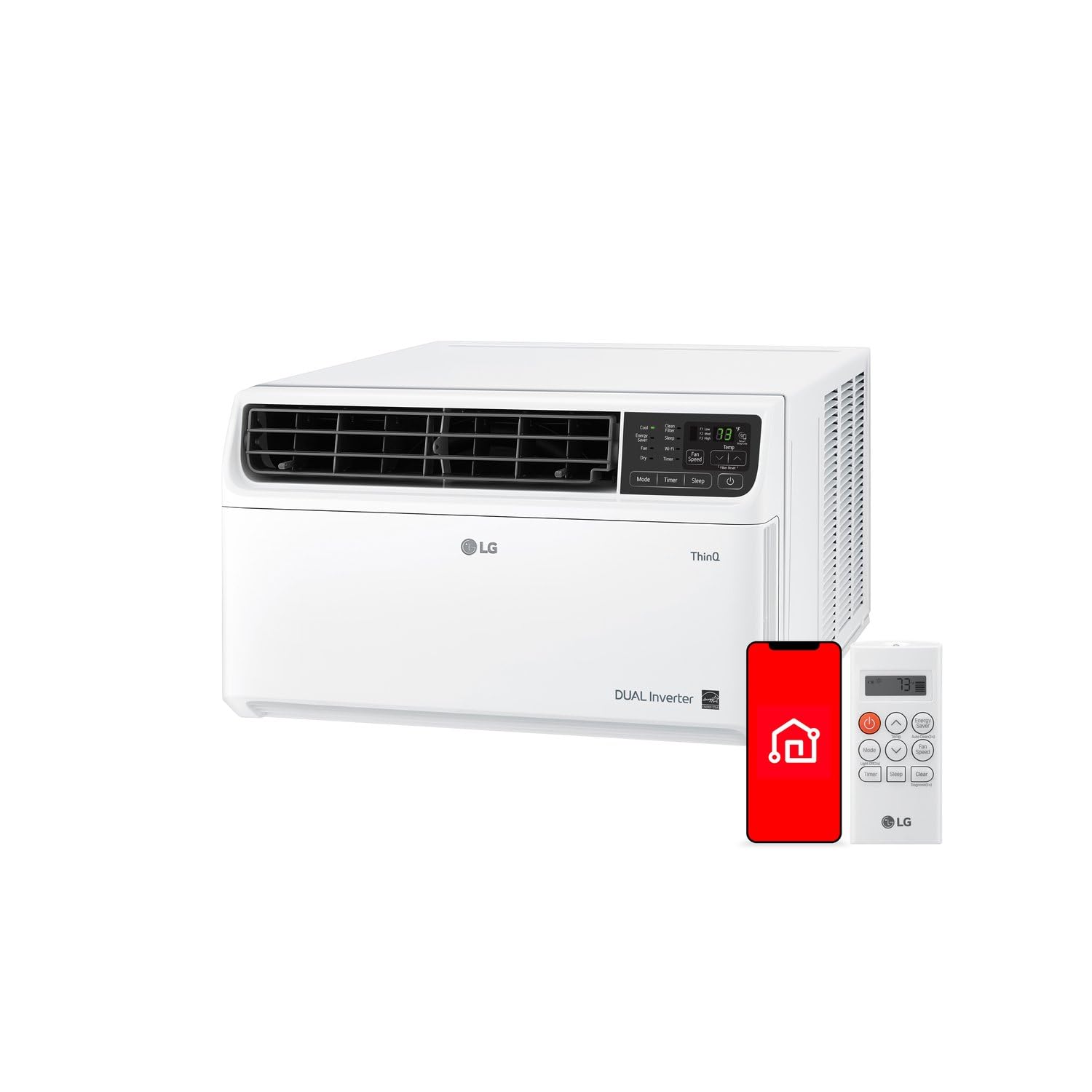
LG’s Dual Inverter compressor technology delivers a unique combination of near-silent operation and aggressive energy savings. In sleep mode, the unit runs at just 44 dBA — soft enough for deep sleep — while achieving up to 35% more efficiency than the ENERGY STAR requirement. At 12,000 BTU, it cools rooms up to 550 square feet, with 4 cooling speeds and 4 fan speeds plus Auto Cool for precise temperature targeting.
The LG ThinQ app provides full remote control, including start/stop, mode changes, and temperature adjustments from anywhere. Voice commands work with Amazon Alexa and Hey Google, so you can adjust settings hands-free. The washable filter captures dust and pet dander, and the aluminum alloy core resists corrosion over years of use. The bright white finish and low-profile design fit seamlessly into modern window frames.
The trade-off is installation: the unit is heavy at roughly 100 pounds and requires removing the AC from its housing to install the chassis first, then sliding the unit back in — a two-person job at minimum. Side clips and alignment can be fiddly, but once installed, the performance and silence justify the effort. This is the premium brand choice for buyers who want LG reliability and smart home integration.
Why it’s great
- Dual Inverter technology achieves 44 dBA in sleep mode
- Up to 35% more efficient than ENERGY STAR standards
- LG ThinQ app with Alexa and Google Assistant support
Good to know
- Very heavy unit (~100 lbs) requires two people to install
- Installation process is more involved than standard window ACs
6. Whynter ARC-1230WN 14,000 BTU NEX Inverter Dual Hose Portable AC

Named Forbes Vetted’s 2024 “Best Portable Air Conditioner Overall,” the Whynter ARC-1230WN combines a 14,000 BTU ASHRAE rating (12,000 BTU SACC) with an inverter-driven dual-hose system that delivers 20% more cooling and 40% more efficient operation than single-hose portables. It covers up to 600 square feet, making it suitable for open-plan living areas, large master bedrooms, or home offices where a window unit isn’t feasible.
The patented “hose-in-hose” design uses a single extendable unit for both exhaust and intake, preventing heat leakage and simplifying setup. The built-in dehumidifier extracts up to 87 pints of moisture per day with an auto-drain function. Three operational modes — Cool, Dehumidify, and Fan (3 speeds) — give you full control, and the NetHome Plus app enables WiFi scheduling and voice control via Alexa and Google Assistant. The noise level is remarkably low for its cooling capacity, producing just a gentle white noise that doesn’t disrupt conversation.
At this tier, you’re paying for build quality, genuine dual-hose efficiency, and a brand with a strong reputation for portable AC reliability. The window kit extends to 82 inches and fits most sliding windows, though you may need to cut the extension panel for narrower frames. If portable cooling is your only option and budget allows, this is the unit that performs closest to a window-mounted system.
Why it’s great
- 14,000 BTU capacity handles large rooms up to 600 sq ft
- Dual-hose design with auto-drain function eliminates bucket emptying
- Inverter compressor provides quiet, stable cooling
Good to know
- Window kit extension panels may need cutting for shorter windows
- Heavy unit at ~77 lbs — wheels help but lifting is required
7. ZAFRO U Shaped Inverter Window Air Conditioner, 12000 BTU
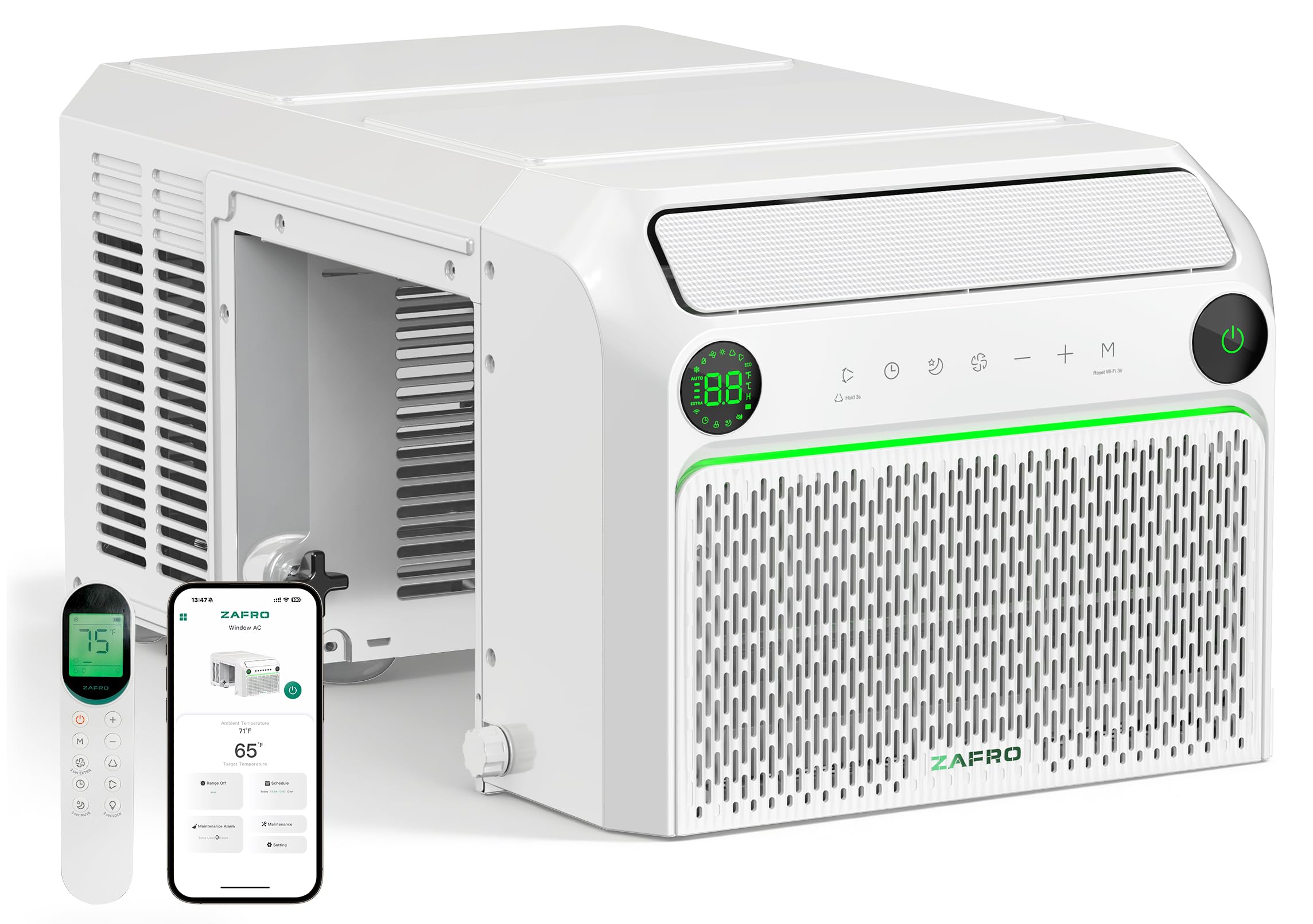
ZAFRO’s take on the U-shaped window AC brings inverter-driven cooling and a saddle design that places the compressor outside your window, achieving a 32 dB noise floor that rivals the Midea U. At 12,000 BTU (8,100 BTU DOE), it cools medium to large rooms quickly, and the inverter compressor holds temperature within ±1°F fluctuation — no more waking up shivering or sweating.
The unit includes a built-in condensate pump, which is a rarity in this form factor and eliminates the need for gravity drainage. Six modes — Cool, Dehum, Fan, Eco, Sleep, and Mute — cover every scenario, and the dehumidifier can extract up to 70 pints of moisture per day. App control via the ZAFRO app, voice control with Alexa/Google Home, and a backlit remote provide multiple control paths. The estimated annual energy cost of just highlights the inverter’s efficiency.
Installation requires a minimum 16-inch window opening and fits single/double-hung windows from 24 to 48 inches wide. At roughly 80 pounds, one person can manage the install, though help is easier. The built-in window lock and child lock safety features add peace of mind. The only catch is limited online documentation about the heat function’s specifics — but as a cooling-only unit, it’s exceptionally quiet and effective.
Why it’s great
- 32 dB operation with built-in condensate pump
- Inverter technology maintains ±1°F temperature stability
- Estimated annual energy cost of only
Good to know
- Heat function specifics are not well documented
- May not appear on ZAFRO’s official website yet
8. Portable Air Conditioner 16,000 BTU with WiFi App Control
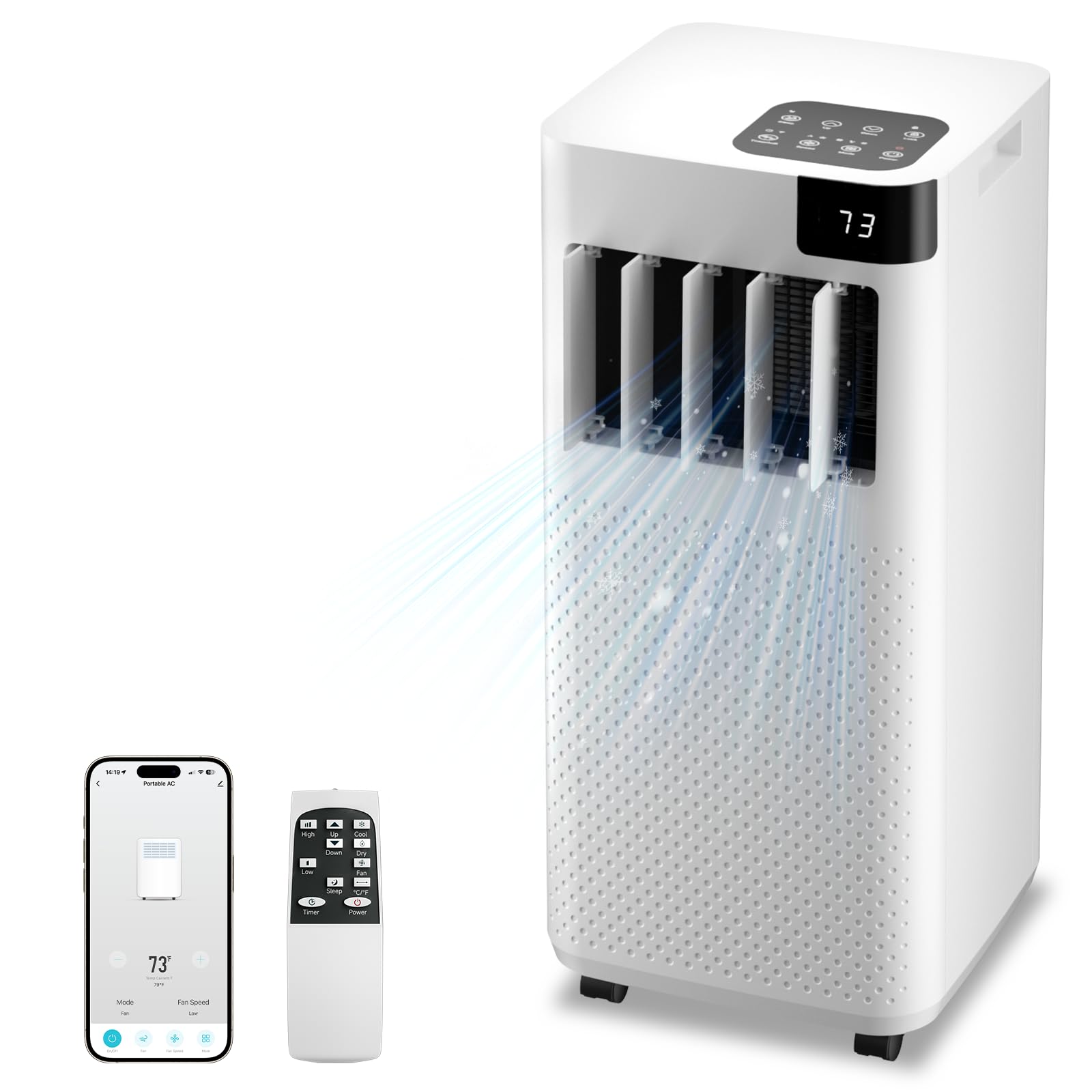
When only maximum portable cooling power will do, this 16,000 BTU unit from Augsmile delivers strong, consistent airflow at 450 m³/h for rooms up to 850 square feet. The inverter compressor reduces startup noise and power spikes, operating at just 40 dB — unusually quiet for a unit this size. Five modes (Cool, Fan, Dehumidifier, Sleep, and Timer) give flexibility for changing conditions, and the sleep mode dims the LED display for a darker room.
WiFi connectivity through a dedicated app lets you turn on the AC before you arrive home, set schedules, and adjust fan speeds remotely. The leak-proof design uses a stable internal structure to prevent water spillage, and the included window kit supports tool-free setup in 10 minutes for sliding windows between 25 and 50 inches. Smooth-rolling casters and side handles make it easy to move between rooms.
Annual energy consumption is listed at 1,158 kWh per year, which is reasonable for a 16,000 BTU portable — though efficiency isn’t its headline feature. The real draw here is raw cooling capacity for large spaces that other portables can’t touch. If you need to cool a basement, open-concept living space, or workshop, this unit brings the BTUs to do it without a window installation.
Why it’s great
- 16,000 BTU cools very large rooms up to 850 sq ft
- 40 dB noise level is remarkably quiet for this power class
- WiFi app control with 24-hour timer
Good to know
- Annual energy consumption is higher than smaller units
- Some users report poor instruction manuals
9. Portable Air Conditioners, 10,000 BTU 3 in 1 AC Unit
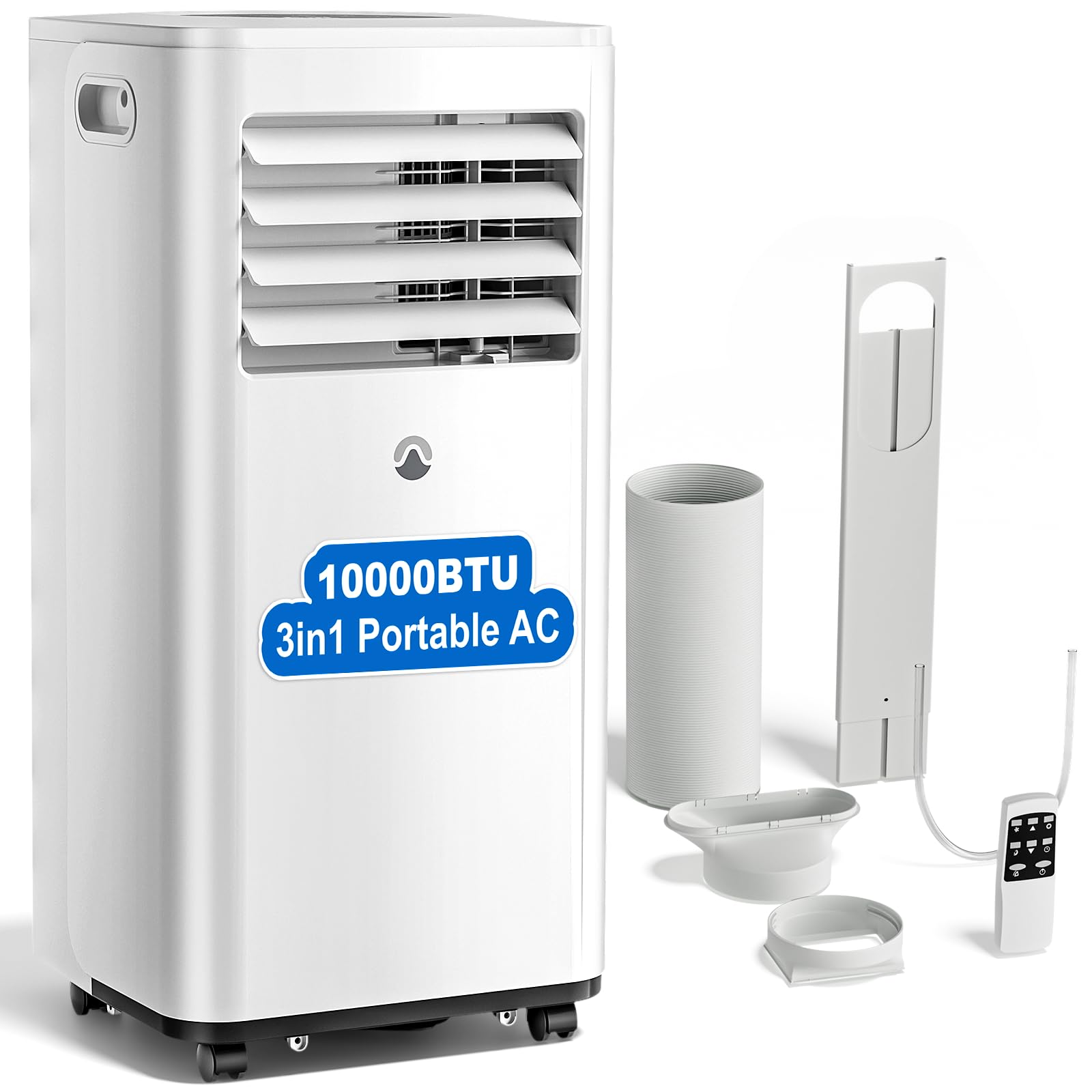
For budget-conscious buyers who still want inverter-like features, this 10,000 BTU portable AC from FTOCASE hits the sweet spot of affordability and function. It cools rooms up to 450 square feet and combines air conditioning, fan, and dehumidifier modes in one compact chassis. The high CEER 7.0 rating is above the federal minimum, offering decent energy savings for an entry-level unit.
Sleep mode drops noise below 50 dB — not silent, but tolerable for a bedroom or home office. The 24-hour timer and remote control allow you to set cooling schedules without leaving your seat. The top LED display is readable day or night, and the built-in water-full alert prevents unexpected shutdowns. Assembly is straightforward: most users report setup in under 30 minutes using the included window kit.
Build quality and noise isolation are not at the level of premium inverter units — you’ll hear the compressor cycle — but for the price point, this unit provides reliable supplemental cooling for small apartments, garages, or dorm rooms. The 360° caster wheels and hidden side handles make it easy to move between spaces. If your budget is tight and you need a functional portable AC with basic inverter-like features, this is the sensible starting point.
Why it’s great
- Affordable entry point for inverter-style portable AC
- Three functions: AC, fan, and dehumidifier in one unit
- CEER 7.0 provides better efficiency than non-inverter budget options
Good to know
- Noise level above 50 dB is noticeable — not ideal for light sleepers
- Window insulation kit is basic; additional sealing may be needed
FAQ
Does an inverter AC really save enough electricity to justify the higher cost?
Can I leave a portable inverter AC running 24/7 without damaging it?
What is the difference between an inverter window AC and a U-shaped AC?
Do all inverter ACs require WiFi or smart app control to function?
Can a portable inverter AC cool a room as effectively as a window inverter unit?
Final Thoughts: The Verdict
For most users, the ac with inverter winner is the ZAFRO Smart Inverter Portable because it delivers the best balance of energy efficiency (CEER 12.8), quiet 42 dB operation, and drainage-free convenience across rooms up to 600 square feet. If you want ultra-quiet window-unit performance with a view, grab the Midea U Shaped. And for year-round heating and cooling with the highest efficiency on this list, nothing beats the Albott Mini Split.