
Our readers keep the lights on and my morning glass full of iced black tea. As an Amazon Associate, I earn from qualifying purchases.
Specs are compiled from manufacturer listings and verified buyer reviews and can change over time — please confirm the key details on the product page before buying.
An access door is It’s the difference between tearing out drywall to reach a shutoff valve and flipping it open with a screwdriver in seconds.. The challenge is picking one that disappears into the wall, opens wide enough to work behind, and survives years without hinge cracks.. This guide breaks down the best access doors for plumbing, electrical, and HVAC access — with honest notes on the cutout sizes each one really needs before you pick up a saw.
I’m Min — the founder and writer behind Gadgets Feed. This guide is built by comparing the manufacturers’ published specifications and the patterns across verified customer reviews, so you get each pick’s real strengths and trade-offs instead of marketing spin.
If you are patching a wall or ceiling and want a clean, serviceable opening, these are the access doors worth the time and money before you commit to a rough opening.
Our Picks at a Glance


How To Choose The Best Access Doors
Before you buy an access door, the single most important decision is knowing where it will go — ceiling, wall, or floor — and what lives behind it. A water shutoff valve behind a bathroom sink needs a smaller panel than a massive HVAC junction, and a ceiling panel needs to support its own weight without sagging.
Measure the rough opening, not the door
The biggest mistake buyers make is assuming the stated size is the hole you cut. A panel listed as “24 x 24” almost always needs a bigger cutout — sometimes by a quarter inch or more — because the mounting flange sits outside the hole. Always check the manufacturer’s rough opening spec before cutting, and cut slightly wider than the marked outline if you want a forgiving fit.
Match the material to the abuse
Plastic panels are lightweight and easy to cut, but they can crack if opened and closed repeatedly. Steel panels (typically galvanized or galvannealed) resist corrosion and handle heavy use, making them the default choice for basements and commercial work. Aluminum with galvanized steel is a middle ground — rust-resistant and lighter than solid steel, though it can dent if treated roughly.
Pick the latch that matches your access needs
A screwdriver latch is the most common and secure option — it keeps the door shut against curious kids but opens with a common flathead. Cam latches work the same way but twist. Key locks add security for areas you do not want anyone opening, while spring-loaded or no-latch doors are fine for light-duty ceiling access where a screwdriver is not always handy.
Quick Comparison
| Model | Best For | Material | Panel Size | Latch Type | Amazon |
|---|---|---|---|---|---|
| BOZZON Insulated Panel★ Best Overall | Insulated wall or ceiling access | Impact-resistant plastic | 16.25 x 31.25 in | Tool-free (flat object) | Amazon |
| Premier FL-1000 10×10Best Value | Basement shutoff covers | 15-gauge galvanized steel | 10 x 10 in | Screwdriver latch | Amazon |
| Donext 16×16 Key Lock | Secure keyed access | Metal | 16 x 16 in | Key lock | Amazon |
| VEVOR 24×24 | Large plumbing access | Galvanized steel | 25.2 x 25.2 in | Screwdriver latch | Amazon |
| Linhdor Elite 1000 | USA-made commercial installs | 18-gauge galvannealed steel | Rough opening 20-1/4 in spacing | Cam latch | Amazon |
| Joogto Thicken 18×18 | Ceiling and attic access | Aluminum + galvannealed steel | 18 x 18 in | Screwdriver lock | Amazon |
| Premier 2002 24×24 | Attic and large ceiling openings | Steel | 24 x 24 in | Screwdriver latch | Amazon |
In‑Depth Reviews
1. BOZZON Insulated Access Panel 14 x 29
Our pick — over 4.5★ from 450+ verified ratings; the strongest balance of quality and price.
The rare panel that keeps cold drafts out while hiding plumbing access.
Most access doors are just holes in the wall — this BOZZON is a thermal barrier that swings open 180 degrees so it sits nearly flat against the wall while you work. It ships as a 16.25 x 31.25-inch overall panel with a 14 x 29-inch mounting size, and the 7mm foil-backed insulation is what wins people over: buyers report it maintains warmth in cold weather and blocks excess noise, which makes it a smart pick for an exterior wall or a room where you notice temperature swings. At just 3 pounds it is dramatically lighter than the 4.5-pound Donext metal panel below — That 50% weight gap matters when you’re holding it overhead against a ceiling..
Installation is genuinely tool-light: this panel can be surface-mounted or flush-mounted, requires no framing, screws, latches, or fasteners, and opens with any flat object — a screwdriver, knife, or butter knife. Owners mention using two under a bathroom sink for water shutoffs, where the exact dimensions made it a simple pop-in fit, and one notes it “works perfectly” for accessing a jacuzzi tub pump. The catch is durability: while the plastic is impact-resistant and UV-stabilized so it won’t fade in the sun or corrode, some owners find the hinge brittle, so treat it gently on a ceiling install where gravity works against you.
What keeps this at the top is the combination of insulation, an easy pop-in fit, and a clean look that customers note belongs on the wall rather than calling attention to itself. The door is completely removable for better access when you need both hands inside, and the maker backs it with a Lifetime Warranty. The trade-off for that thermal performance is a plastic build that demands a lighter touch than the steel panels below.
Why owners praise it
- 7mm foil-backed insulation blocks cold and cuts noise
- Opens 180 degrees and is fully removable for wide access
- No framing or fasteners required — true pop-in install
- UV-stabilized plastic resists fading and corrosion
Who should pass
- Plastic hinge can break if forced — not for heavy abuse
- Some owners found the insulation less effective than expected
- Large size needs a saw cut slightly larger than the outline
Reach for this if: you want an insulated, low-profile access door that installs without framing and stays nearly invisible on the wall or ceiling.
Look elsewhere if: you need a bulletproof metal door for a high-traffic commercial space — the plastic hinge is the one weak point.
2. Premier Flush Access Panel 10×10 Steel
A heavy-duty steel shutoff cover that installs nearly flush with the wall.
The defining spec here is the 15-gauge galvanized steel — that is a genuinely thick, corrosion-resistant body that owners describe as “well made and very sturdy” and perfect for “residential or light commercial use.” It is built for flat surfaces including drywall, plaster, tile, or masonry, with a 5/8-inch flange and a 1-1/4-inch deep mounting frame that lets it sit almost completely flush. Reviewers point out it works excellently as a water shut-off cover in basements, with minimal protrusion from the wall. The white prime coat can be installed as-is or painted to match your trim.
The screwdriver latch secures the door tightly, and the continuous concealed hinge opens to 110 degrees for maintenance access. Two honest caveats from owners: the door swings to the hinge side and can block the hinge-side screw holes when open, so mount using the other three sides, and the keyhole lock area can scratch if you are rough with the screwdriver. The other thing to watch is sizing — shoppers say “the door is 8×8 but requires a 9in-ish hole in the wall,” so measure your rough opening carefully before cutting. If you need a true 8×8 hole, this is not the model.
For a basement shutoff or a shower valve that rarely needs service, this is the value king — thick steel, a clean low-profile look, and enough rust resistance that it will outlast the wall around it. It beats the plastic BOZZON above on sheer durability but gives up the insulation and the tool-free opening.
Where it shines
- Thick 15-gauge galvanized steel resists corrosion and impact
- White prime coat installs as-is or paints to match trim
- Flush fit works on drywall, tile, plaster, or masonry
Mind the details
- Door blocks hinge-side screw holes when open — mount on other 3 sides
- Keyhole area can scratch metal if you slip with a screwdriver
- Requires a larger cutout than the nominal size
Best for: a basement water shutoff or shower valve cover where you want thick steel that will never crack.
Not for: anyone expecting the stated size to equal the cutout — this one needs a roughly 9-inch hole for an 8×8 door.
3. Donext 16×16 Metal Access Door with Key Lock

A keyed metal door that replaces cracked plastic panels for good.
The reason to buy this Donext is the key lock mechanism — owners say it is the upgrade they made after a plastic access panel “cracked with repeated opening and closing.” This 16×16 metal door is built with support legs that keep it stable and fixed in place during heavy use, so it won’t shift or move once installed. At 4.5 pounds it is the heaviest panel in this lineup — At 50% heavier than the 3-pound BOZZON, it feels denser and more substantial in hand.. The versatile white finish accepts paint or wallpaper so it blends into your decor.
Installation is straightforward — buyers describe measuring the opening, adding 1/8 inch, cutting with a multi-tool, and adding plywood strips for strength. It embeds into walls, ceilings, or floors, and buyers report it works perfectly for accessing shower plumbing from below. The honest limitations: this is not a heavy-duty commercial door, so it needs a frame for structural support, and the paint is thinner than what you get on standard commercial boxes — fine for aesthetics, not for mechanical abuse or aggressive cleaning.
The keyed access makes this the right choice when you want to control who opens the door — a rental property, a shared utility room, or a meter that should stay locked. It is more secure than the screwdriver-latch panels below, but that security costs you convenience: you need the key every time, and the door is not as thick as some owners wanted.
What stands out
- Key lock gives real access control
- Support legs keep the panel stable during heavy use
- Sturdy metal build replaces cracked plastic panels
- Paintable white finish blends into any decor
Keep in mind
- Needs a framed opening for structural support
- Paint is thinner than commercial-grade boxes
- Not built for mechanical abuse or aggressive cleaning
Choose it if: you want a keyed, lockable access door for plumbing or electrical that will outlast a plastic panel.
skip it if: you need a heavy-duty commercial door that survives constant abuse — this is built for looks and function, not punishment.
4. VEVOR 24×24 Galvanized Steel Access Door

Big steel access with a paper template that kills cutout guesswork.
This VEVOR solves the biggest access-door headache — the cutout — by shipping a 1:1 paper installation template. You mark the opening, cut, and the 24.2 x 24.2-inch installation size (the overall panel is 25.2 x 25.2 x 0.6 inches) fits without the usual sizing panic. The body is thickened galvanized steel with a matte baked-paint finish for rust resistance, and owners say it feels “well built” and exceeded expectations based on the price. At 7.2 pounds, it outweighs the steel panels above, signaling genuinely thick metal..
The 24-inch size makes this the go-to for reaching “a lot of plumbing controls” at once — owners mention using it for shower access and basement plumbing runs, and it “should last forever as it is well made.” The frame uses smooth welding with stiffening ribs to resist warping, and the detachable door panel makes maintenance easy. The screwdriver latch means no keys to lose. The catch: owners note the rough opening has to be 24.25 x 24.25 inches — slightly larger than the nominal 24-inch spec — so do not cut exactly 24 inches or you will need extra trim. The door is also on the lighter/thinner side for a 24-inch span, so it is a value pick rather than a premium one.
For a big opening at a sensible price, this is the panel to beat on sheer coverage per dollar. It does not have the insulation of the BOZZON or the commercial polish of the Elite models, but for basement and ceiling access it is a sturdy, rust-resistant workhorse with a template that makes install genuinely low-maintenance.
What owners love
- 1:1 paper template makes the cutout precise and easy
- Thick galvanized steel with matte baked-paint finish
- smooth welded frame with stiffening ribs resists warping
- Detachable door panel simplifies maintenance
Watch out for
- Rough opening needs to be 24.25 x 24.25 in, not 24 in
- Door feels light/thin for a 24-inch span
- Feels larger than expected in tighter spaces
Ideal for: covering a large plumbing or electrical area where you want thick steel and a template that makes cutting simple to use.
Think twice if: your wall cavity cannot spare the extra quarter-inch — this needs a 24.25-inch rough opening, so measure twice.
5. Linhdor Elite 1000 USA-Made Access Door
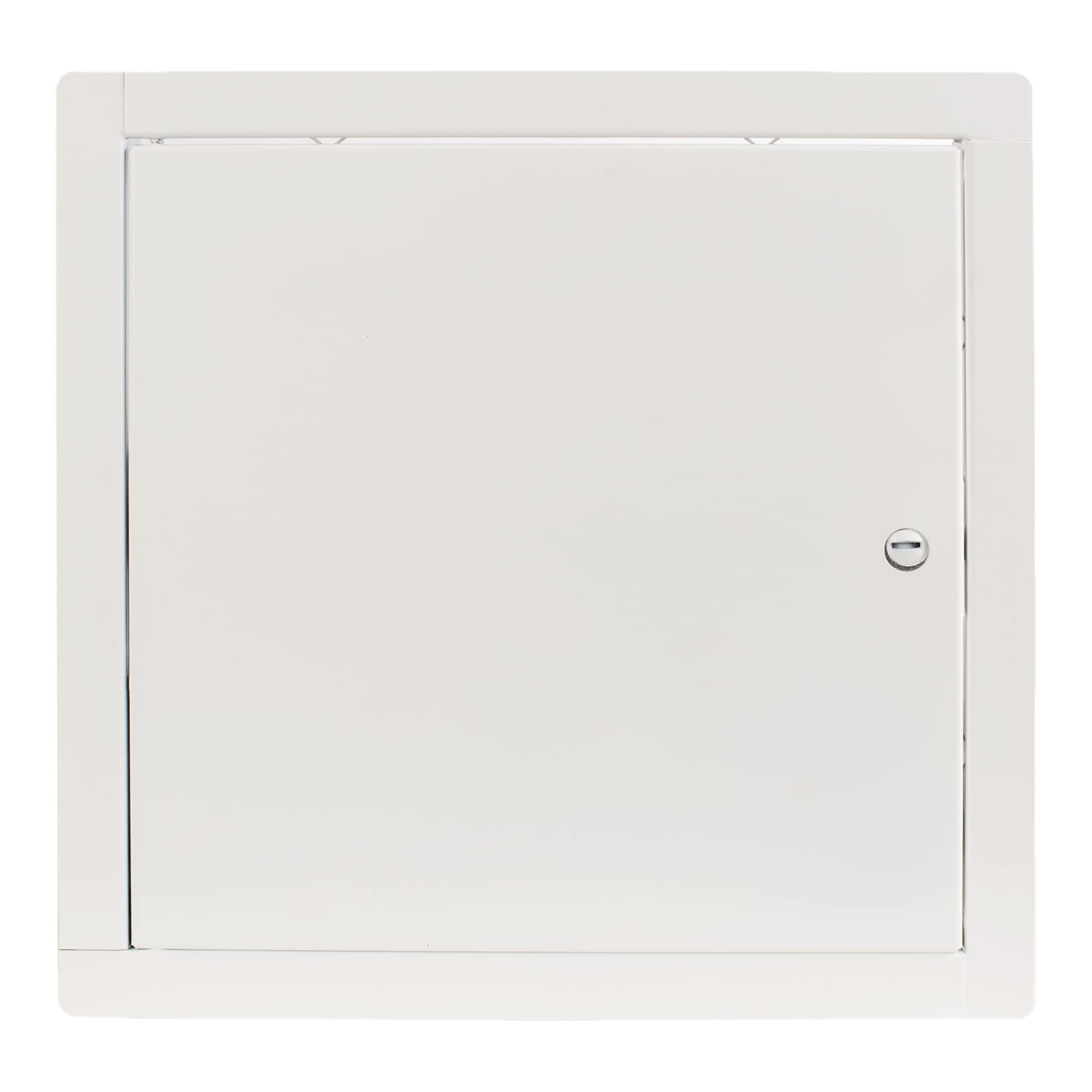
A USA-made steel door whose hinges swing wide for serious work access.
The headline here is construction: an 18-gauge steel frame and 18-gauge steel door, manufactured in the USA, with rust-resistant galvannealed steel that keeps the panel from corroding over time. That domestic build quality is evident — owners call it “professional-grade” and “superb” from an American manufacturer. The panel opens to 165 degrees on two stainless steel pin hinges, which gives you a much wider work area than the 110-degree Premier above — a real advantage when you are reaching deep into a wall or ceiling cavity. It installs between 2x4s at 20-1/4 inch spacing with parallel framing supports.
The latching system is the most refined in this lineup: strong 14-gauge 304 stainless steel cam latches with a large screwdriver slot, plus machine door catches on the top and bottom to prevent the door from pushing inward. Customers note using a “common screwdriver” to open and close it, and the recessed design keeps the door flush with the drywall for a clean finished look. Owners love that it replaced flimsy plastic spring doors and that the accurate hole size means the cutout matches the spec. The catch is installation: it is built for new construction with studs to mount to — in an existing remodel, you may need to cut drywall and add 2×4 cutoffs, which is more labor than the pop-in panels above.
If you need a door that will pass a government inspection requiring a USA-made product, or you simply want commercial-grade steel that swings wide, this is the panel. It lacks the insulation of the BOZZON and the key lock of the Donext, but no other door here matches its combination of domestic origin, 165-degree swing, and stainless hardware.
Why it stands out
- USA-made 18-gauge steel frame and door
- Opens a full 165 degrees for a wide work area
- 14-gauge 304 stainless steel cam latches resist wear
- Rust-resistant galvannealed steel construction
The honest trade-off
- Needs parallel framing — harder retrofit than pop-in panels
- No insulation layer for exterior walls
- Remodel installs may require added 2×4 blocking
Best for: new construction or stud-framed openings where you want a wide-swinging, USA-made steel door that will outlast the building.
Not ideal for: a quick retrofit into an existing wall with no studs — you will be cutting blocking before this one goes in comfortably.
6. Joogto Thicken 1mm 18×18 Access Panel

Thickened 1mm metal that solves the flimsy-panel problem for good.
This Joogto is built to a 1mm thickness specifically to solve the fragile-panel complaints that plague thinner access doors — it is made of aluminum with galvannealed steel for rust resistance, and the smooth welding technology gives it smooth, even joints with no sharp corners. The result is a panel that owners describe as “good quality” and easy to install, with a clean look that one buyer chose over repairing and matching drywall ceiling texture after a shower leak. It is sized at 18 x 18 inches with a 17.5 x 17.5-inch hole size and a 1.18-inch inset depth, so it sits flush with the ceiling or drywall.
The surface uses advanced baked paint technology for a uniform color with no bubbles or residual marks, and the outer frame has two stiffeners for added stability. Reviewers point out it works well for garage attic access and fits 24-inch on-center truss joists. The manufacturer offers a low-maintenance after-sales policy — if you are not satisfied, they mail a free replacement part. The honest catches: the lock works with a screwdriver but the key tends to fall out in both open and locked positions, and the latch is short enough that it may vibrate loose over time. Buyers also note that corners can be vulnerable, so handle the packaging carefully on delivery.
For a ceiling or attic opening where a thick, rust-resistant panel matters, this is a smart mid-range pick. It beats the plastic BOZZON on rigidity and beats the thinner VEVOR on metal gauge, though it lacks the insulation and the 180-degree swing of the top pick.
What you get
- 1mm thickened metal resists bending and warping
- Aluminum + galvannealed steel resists rust
- smooth welded frame with two stiffeners
- Baked paint finish with uniform color, no bubbles
Minor gripes
- Key falls out easily in open or locked position
- Short latch can vibrate loose over time
- Corners are vulnerable during shipping
Pick it for: an attic or ceiling access panel where a thick 1mm metal build gives you confidence the door will not flex or crack.
Pass if: you want to keep a key stored in the panel — this one drops it, so plan to keep the screwdriver handy instead.
7. Premier Flush Access Panel 24×24 Series 2002

The premium 24×24 that blends into textured ceilings and eggshell paint.
This is the premium version of the Premier 10×10 — same brand, same screwdriver latch, but scaled up to a 24 x 24-inch door with a 24-3/8 x 24-3/8-inch rough wall opening. The steel body is thick and sturdy, and owners specifically note that the mounting flanges are deep enough to hit studs even after 5/8-inch Sheetrock, which is a real advantage over shallower models. The matte finish is the standout — shoppers say it matches textured ceilings and eggshell paint so well that a painted panel and an unpainted one “both blend in well” in the same attic.
Installation is made easier by adjustable tabs that accommodate different wall thicknesses plus screw holes for backer wood, so the door can be removed via the tabs if you need full access. The screwdriver latch opens with a common flathead, and the continuous hinge keeps the door aligned through years of use. Owners describe it as a “quality matches the price” purchase, super simple to install, with solid mounting hardware. The honest trade-off: this is the most expensive panel in the lineup — the price stings at first, but the build quality and the finish justify it for a visible ceiling location where you cannot hide an ugly door.
For a large attic opening or a ceiling access point that guests will actually see, this is the door that disappears best. It does not carry the insulation of the BOZZON or the key lock of the Donext, but its deep mounting flanges and premium matte finish make it the most finished-looking large panel here.
What makes it premium
- Deep mounting flanges reach studs through 5/8-inch Sheetrock
- Matte finish blends with textured ceilings and eggshell paint
- Adjustable tabs fit different wall thicknesses
- Thick steel with quality powder coating
Before you buy
- Premium price — the cost matches the build quality
- No insulation layer for thermal protection
- Rough opening is 24-3/8 in, slightly larger than the door
Best for: a visible ceiling or attic access where a premium matte finish that disappears into the texture is worth the extra cost.
Skip if: you are on a tight budget for a hidden basement panel — the value picks above cover that job just fine.
Understanding the Specs
Rough Opening vs. Overall Size
The single most confusing spec on any access door is the difference between two numbers: the overall size (the full panel including the mounting flange) and the rough opening (the actual hole you cut). A panel listed as 24 x 24 almost always needs a slightly larger cutout — sometimes a quarter inch or more — because the flange has to sit outside the hole to hold the door in place. Always look for the manufacturer’s stated rough opening before you cut, and when in doubt, cut slightly wider than the marked outline. Cutting too small is a much bigger headache than cutting a touch big, since you can shim a slightly oversized hole but not an undersized one.
Hinge Swing and Latch Types
The hinge swing determines how much working room you get behind the open door. Budget panels often open 90 to 110 degrees, which is fine for a quick shutoff reach, while higher-end models swing 165 to 180 degrees so the door lies nearly flat against the wall — a real advantage when you need both hands inside the cavity. The latch type matters just as much: screwdriver latches (the most common) keep the door securely shut but open with any flathead; cam latches twist closed and often use stainless steel for longer wear; key locks add access control for rental properties or utility rooms. There is no single best latch — the right one depends on whether you prioritize quick access or keeping people out.
Material and Finish Options
Your material choice is really a durability versus convenience trade-off. Plastic panels are lightweight, easy to cut, and often include insulation, but they can crack under repeated opening and closing or heavy abuse. Galvanized and galvannealed steel is the default for basements and commercial spaces because it resists corrosion and handles impact — the thicker the gauge number (lower number = thicker metal), the more rigid the door. Aluminum blends rust resistance with lighter weight but can dent. The finish matters for appearance: white prime coats can be painted to match your trim, while matte baked-enamel finishes are designed to look good on their own and resist fingerprints on textured ceilings.
Insulation and Thermal Performance
If your access door sits on an exterior wall, an uninsulated steel panel turns into a cold spot and a condensation magnet in winter. Insulated panels add a foam or foil-backed layer — often 7mm thick — that slows heat transfer and adds a modest soundproofing benefit. This is a meaningful upgrade for rooms where you notice temperature swings near the wall, or for attic access where you want to keep conditioned air inside the living space. The trade-off is that insulated panels are usually plastic-bodied, which means you give up some of the rigidity of solid steel. If thermal performance matters more than dent-resistance, an insulated plastic panel is the smarter buy for an exterior wall.
FAQ
What size hole do I need to cut for a 24×24 access door?
Can an access door be installed in tile or masonry, or only drywall?
Plastic or steel access panel — which lasts longer?
How do I open an access door without a key?
Do access panels need framing or studs to install?
Is an insulated access panel worth it for interior walls?
What is the difference between flush-mount and surface-mount panels?
Can I paint an access door to match my wall?
Final Thoughts: The Verdict
For most buyers, the access doors winner is the BOZZON Insulated Panel because it combines a 180-degree swing, tool-free opening, and 7mm insulation into one panel that installs without framing — and It holds a 4.7-star rating across 400+ owners, the highest in this lineup.. If you want thick steel that never cracks for a basement shutoff, grab the Premier FL-1000 10×10. And for a keyed, lockable access point in a rental or utility room, the Donext 16×16 is the one to reach for.
How We Picked
We do not accept paid placement. Every pick is matched to a real buyer and a real use-case; we do not hands-on test units.
Sources & Methodology
Specifications: manufacturer listings and product documentation. Review insights: verified customer reviews, as of September 2026. Pricing: not shown on this page (it changes often); check the current price via the retailer link.
As an Amazon Associate, Gadgets Feed earns from qualifying purchases. This does not affect which products we feature.