
Our readers keep the lights on and my morning glass full of iced black tea. As an Amazon Associate, I earn from qualifying purchases.
You want to know one thing: is the number on the screen real? Most home weather stations stop being accurate within a few weeks. You end up with a forecast that is basically a guess. This guide is for anyone who needs a reading you can trust — for a greenhouse, a curious kid, or just deciding if you need a coat — not a decorative gadget that makes up the weather.
I’m Min — the founder and writer behind Gadgets Feed. This guide is built by comparing the manufacturers’ published specifications and the patterns across verified customer reviews, so you get each pick’s real strengths and trade-offs instead of marketing spin.
If you manage a garden, monitor a basement, or just want a morning glance at the day, this breakdown of the best accurate weather station will show you which models deliver data you can actually rely on.
Quick Picks
- La Crosse Technology S77925-INT Wireless Color Weather Station — Best Value
- Raddy WM6 Weather Station with 2000mAh Rechargeable Battery — Cord-Free Champion
- U UNNI Weather Station Indoor Outdoor Thermometer Wireless, Home Atomic Clock — Display King
- Sainlogic Smart WiFi Weather Station — Full-Weather Pro
How To Choose The Best Accurate Weather Station
Picking the right station means looking past the marketing and staring at three things: how it sends data, how accurate the sensors actually are, and whether the screen makes sense for your space. Ignore the gimmicks and focus on these specs to find the model that works for your home.
Transmission Range and Frequency
The outdoor sensor talks to the display using a radio signal, typically on 433 MHz. Look for a range of at least 200 feet in open air — but note that walls and metal roofs cut that number in half. If the sensor sits on a porch or across the yard, a longer range like 330 feet ensures you do not lose connection every time a window is closed.
Sensor Accuracy and Calibration
The temperature and humidity sensors inside the outdoor unit determine whether you get real data or a random guess. Many budget stations claim accuracy of ±1°C, but buyers often find they are off by 3–4 degrees. Look for reviews that mention verified accuracy against a known local station. A station that takes 7–10 days to calibrate its barometer (as La Crosse does) is actually a good sign — it means it is learning your altitude, not just guessing.
Power Source and Screen Visibility
A station that must be plugged in all the time dims or resets when the power flickers. The best models offer a rechargeable battery backup (like the 2000mAh Raddy WM6) or alkaline battery slots so the clock and settings survive a blackout. For the screen, look for adjustable brightness and wide viewing angles. A high-contrast display with large fonts matters more than flashy colors — you need to read those numbers from across the room, not squint up close.
Quick Comparison
On smaller screens, swipe sideways to see the full table.
| Model | Best For | Transmission Range | Power / Battery Backup | Extra Sensors | Amazon |
|---|---|---|---|---|---|
| La Crosse S77925-INT | Reliable atomic clock + daily temp/humidity tracking | — | AC power + 3x AA backup | Expandable (optional multi-channel sensor) | $59.95$74.99Amazon |
| Raddy WM6 | Cord-free wall mount with rechargeable battery | 330 ft | Built-in 2000mAh Li-ion (up to 45 days) | Up to 3 remote sensors | Amazon |
| U UNNI Home Station | Budget-friendly with lots of on-screen info | 330 ft | AC power only (battery for backup only) | 1 sensor included, 3 channels | Amazon |
| Sainlogic Smart WiFi | Full monitoring with wind, rain, and 2-year data logs | Wireless (2.4G Wi-Fi) | AC power + 3x AAA backup | Wind speed + direction, rain gauge, AI forecast | $119.99$169.99PrimeAmazon |
In‑Depth Reviews
1. La Crosse Technology S77925-INT Wireless Color Weather Station

You get a bright, colorful screen and a clock that sets itself — the most dependable daily driver here.
This station puts the data you check most — indoor and outdoor temperature and humidity — in a colorful, uncluttered display that stays readable across a room, as long as you place it at or below eye level. It runs on AC power, but if the power goes out, three AA batteries (not included) keep the clock and settings alive. The atomic clock syncs to the WWVB signal each night, so you never adjust for daylight saving time, and a crescendo alarm (an alarm that increases in volume gradually) wakes you without a jolt.
Where this La Crosse really earns its value is in the barometer. The unit takes 7–10 days to calibrate to your home’s altitude, and once it does, you get a 24-hour pressure history graph and trend arrows that make short-term forecasting surprisingly reliable. Buyers report it works consistently 40 feet away through multiple floors — holding a solid connection where some other stations drop out. The included sensor is single-frequency, so if you want to add a second outdoor sensor, you need to buy the multi-channel version separately. At 8.98 inches wide, it takes up more counter space than the compact U UNNI, but the brighter screen and better build justify the larger footprint.
Two quick trade-offs: the screen washes out when viewed from above, so wall-mount it at standing eye level for the best angle. And while the display is colorful, some users note the background has a slight orange-green tint that makes dimmed numbers harder to read. For the accuracy and the clean interface, these are minor asks.
Why it’s great
- Self-setting atomic clock with automatic daylight saving adjustment — you never touch the time
- 24-hour barometric pressure graph and trend arrows that help you predict weather shifts
- Owners mention strong 40-foot transmission through floors and walls
Good to know
- Screen readability drops when viewed from above — best mounted at or below eye level
- Only one sensor included; adding a second outdoor sensor requires a different multi-channel model
Best for: Homeowners who want a colorful, easy-to-read display with reliable atomic time and a learning barometer.
Skip if: You need a compact footprint — at 8.98 inches wide it is larger than most desktop stations.
2. Raddy WM6 Weather Station with 2000mAh Rechargeable Battery
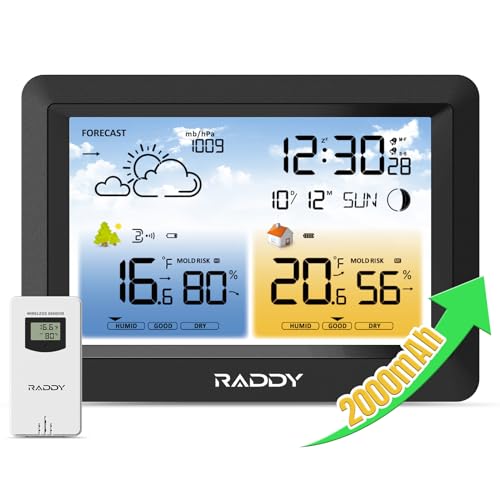
You can mount it on any wall with zero cords visible — the Raddy WM6 runs for up to 45 days on a single charge of its built-in 2000mAh battery.
Most weather stations are shackled to a wall outlet by a power adapter. The Raddy WM6 solves that with a built-in 2000mAh rechargeable battery that lasts up to 45 days on a single charge — one reviewer noted the battery icon dropped from 4 bars to 3 after an entire month of use. That cord-free design means you can velcro it to an RV wall, hang it in a hallway, or set it on a nightstand without ugly wires. It supports up to three remote sensors (sold separately) with a 330-foot transmission range, so you can monitor a greenhouse, a baby’s room, and the garden all from one display.
The atomic clock uses WWVB technology (the same radio signal from Colorado that sets millions of clocks automatically) to grab the exact time every day, and you get a dual alarm that can differentiate weekdays from weekends — a small touch that matters if you want a lazy Saturday sleep-in. The screen has four brightness levels and a touch-sensitive bar that lights it up for 15 seconds at night, which means you are not blinded by a full-brightness display in a dark bedroom. On the catch, the build quality is mixed: some users report a misaligned button and a manual that is nearly impossible to follow for custom settings like timed backlight dimming. The atomic clock sync is also hard to verify in areas far from Colorado, though most customers note it works fine.
For the price, this is the most flexible station for placement, and the rechargeable battery is a genuine upgrade over the AC-only competition. If you value a clean wall look over a super-polished instruction booklet, this is your pick.
Why it’s great
- Built-in 2000mAh rechargeable battery gives up to 45 days of cord-free operation
- Supports up to 3 remote sensors with 330-foot range for multi-room or multi-building monitoring
- Dual weekday/weekend alarm and touch-activated night light are thoughtful extras
Good to know
- Build quality concerns: some units arrive with misaligned or stiff buttons
- The manual is poorly translated and makes it hard to set custom backlight schedules
Best for: Anyone who wants a clean, cord-free wall mount with the flexibility of a rechargeable battery.
Skip if: You want a polished setup experience — the manual and button quality may frustrate you.
3. U UNNI Weather Station Indoor Outdoor Thermometer Wireless, Home Atomic Clock
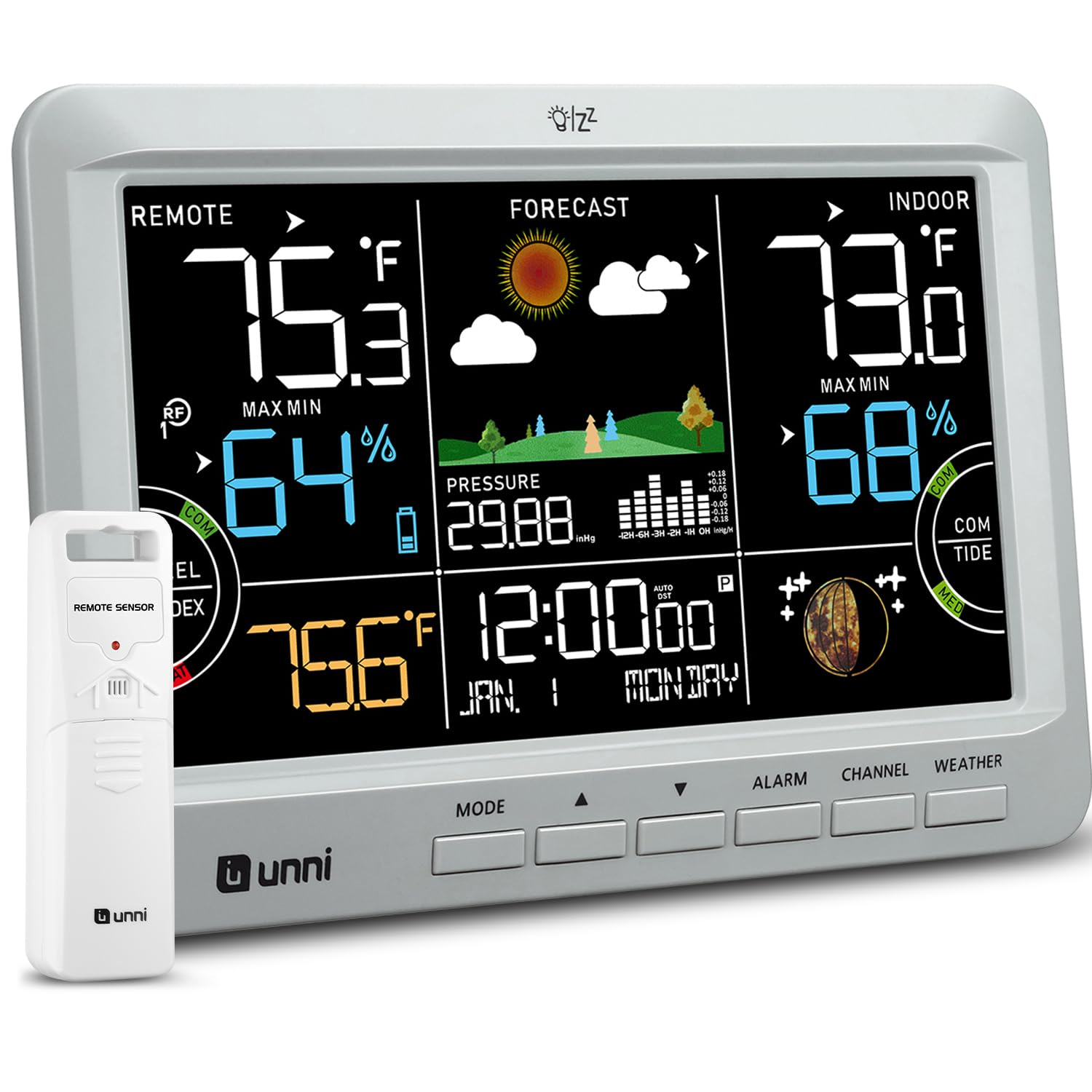
The U UNNI packs more weather info on one 7.5-inch screen than any other station here — for less money.
If you want the most information on a single screen at the lowest price, this U UNNI station delivers. At 7.5 inches diagonally, it shows indoor and outdoor temperature and humidity, barometric pressure, dew point (the temperature at which moisture in the air starts to condense into dew), heat index (how hot it feels when humidity is factored in), moon phase, tide level, and even a mold risk indicator — something few stations at any price offer. The black background and bold white fonts make the numbers pop, and the brightness adjusts at a touch. Reviewers point out the temperature readings are within 2°F of other known-accurate stations, which is solid at this price tier.
Where the U UNNI falls short of the Raddy or La Crosse is power flexibility. This station must be plugged into an AC outlet to keep the display backlight on; the three AAA batteries you need to buy separately only serve as a memory backup so you do not lose time and settings during a brief outage. The included outdoor sensor broadcasts on 433 MHz with a claimed 330-foot range, but it is not weatherproof, so you need to place it under an eave or in a sheltered spot. Some buyers also report the atomic clock setup can be finicky — one reviewer still had incorrect time after several attempts — though most have no trouble getting the WWVB signal overnight.
For the price, the sheer amount of readable data is unmatched. But be honest with yourself: if you need a waterproof sensor or a station that can run unplugged, spend up to the Raddy or La Crosse.
Why it’s great
- Huge 7.5-inch display with adjustable brightness shows dew point, heat index, mold risk, and moon phase all at once
- Buyers verify temperature accuracy within 2°F of reference stations — impressive for the price
- Patent-pending 330-foot wireless transmission updates readings every 30 seconds
Good to know
- Display requires AC power at all times — no rechargeable battery for cord-free placement
- Included outdoor sensor is not weatherproof; must be sheltered from rain and direct sun
Best for: Budget-conscious buyers who want the most weather data on one large, readable screen.
Skip if: You need a station that can run on battery power or requires a waterproof outdoor sensor.
4. Sainlogic Smart WiFi Weather Station
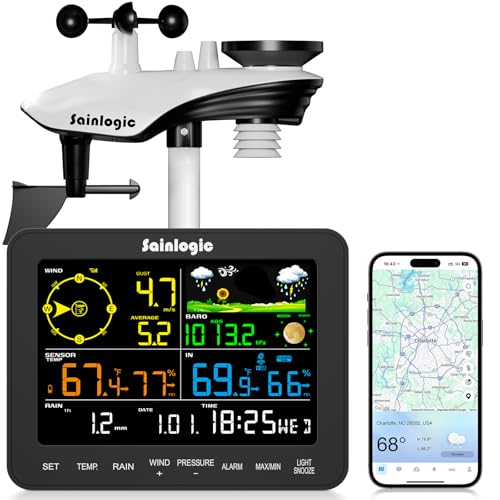
The only station here that measures wind speed, direction, and rainfall, and stores 2 years of data you can export to Excel.
This Sainlogic station is for the person who wants more than just indoor/outdoor temps. It includes a wind vane and anemometer for wind speed and direction, a rain gauge that the manufacturer claims is accurate to ±1mm for rainfall under 15mm, and a display console that stores up to two years of weather data. You can connect it to your phone via the Weatherseed app (2.4G Wi-Fi only) to receive AI-driven alerts for frost, high winds, or sudden pressure drops — useful for gardeners and farmers who need to act fast. The data can be exported in Excel format for long-term analysis, and you can pull up to 30 days at a time.
The downside is consistency. While the station itself is packed with features, multiple shoppers say that the Wi-Fi connection blanks out frequently, requiring manual resets. One buyer mentioned the rain gauge failed during a storm, and the included AAA batteries lasted only three weeks in the outdoor sensor. The build quality also draws mixed feedback: some units arrive with hairline cracks on the rain funnel or buttons that skip or freeze. When the app connection works, users say the data is impressive — but getting it to stay connected is the real challenge. Unlike the simpler La Crosse or Raddy stations that just work out of the box, this one demands patience and a good 2.4G Wi-Fi signal near the sensor array.
For weather nerds and serious gardeners who want logs, alerts, and full wind/rain data, this is the only option here that ticks all of those boxes. But if you just want a reliable morning temperature read, the simpler stations above will save you the headache.
Why it’s great
- Includes wind speed/direction sensor and rain gauge with ±1mm accuracy — the only full-weather station on this list
- Stores up to 2 years of weather data and exports to Excel for trend analysis
- AI-driven smartphone alerts for frost, winds, and pressure changes via the Weatherseed app
Good to know
- Wi-Fi connection is inconsistent — many users report frequent disconnects that require manual resets
- Build quality concerns: hairline cracks on rain funnel and unresponsive buttons reported by multiple buyers
Best for: Gardeners, farmers, and weather hobbyists who need wind, rain, and long-term data logging.
Skip if: You want a zero-fuss, plug-and-play station — the Wi-Fi and build issues may test your patience.
Understanding the Specs
Transmission Range and Frequency
The outdoor sensor and indoor display talk to each other using a radio signal on 433 MHz or 868 MHz (the exact frequency depends on your region). A range of 200–330 feet in open air is standard, but walls, metal siding, and concrete cut that distance roughly in half. If you plan to place the sensor in a backyard shed or across a wide deck, aim for a station that claims at least 300 feet. Stations that update every 30 seconds (like the U UNNI) give you near-real-time data, while slower updates are fine for casual monitoring.
Power Source and Battery Backup
Most stations need AC power to keep the backlight on, but the difference maker is how they handle a power outage. A station with a built-in rechargeable battery (like the 2000mAh in the Raddy WM6) keeps the display running for weeks without a plug. Stations that only use alkaline batteries as a memory backup (like the U UNNI) will shut off the screen the instant power drops — the batteries just save your clock and settings. If you live in an area with frequent flickers or want to mount the station away from an outlet, prioritize a unit with a rechargeable battery or a large battery compartment (3x AA or AAA).
Atomic Clock (WWVB Synchronization)
An atomic clock does not contain an actual atom — it receives a radio signal from the WWVB transmitter in Fort Collins, Colorado, which broadcasts the official US time. The station syncs overnight and automatically adjusts for daylight saving time, so you never touch the time setting. However, reception can be weak if you live far from Colorado or inside a metal building. Some stations (like the La Crosse) take 7–10 days to calibrate the barometer too, which is normal because the sensor is learning your altitude.
Additional Sensors and App Connectivity
A basic station tracks indoor/outdoor temperature and humidity. A more advanced one adds wind speed and direction (anemometer), a rain gauge, and barometric pressure. If you need data logging — recording temperatures over weeks or years — look for a station with a memory card, built-in storage, or a Wi-Fi connection to a phone app. Only Wi-Fi models (like the Sainlogic) can push alerts to your phone; simpler stations display everything on the screen but do not call you when the garage hits freezing temperatures.
FAQ
How accurate are consumer weather stations compared to official weather service data?
Do I need a weather station with a rain gauge and wind sensor?
Can I mount the outdoor sensor in direct sunlight or rain?
What does atomic clock mean and does it work everywhere?
How often should the outdoor sensor batteries be replaced?
Can I add extra sensors to monitor different rooms or buildings?
What is the difference between a weather station and a simple thermometer?
Will the display work if the power goes out?
How does the barometer on a home station work?
What is the difference between dew point and humidity shown on the display?
Final Thoughts: The Verdict
For most buyers, the best accurate weather station is the La Crosse Technology S77925-INT because it delivers the best balance of a bright, readable display, reliable atomic time, and a self-calibrating barometer that actually gets smarter over the first week. If you want a cord-free wall mount and rechargeable battery so you can hang it anywhere without a cable, grab the Raddy WM6. And for serious gardeners and weather hobbyists who need wind speed, rainfall data, and two-year logs that export to Excel, nothing on this list beats the Sainlogic Smart WiFi Weather Station.
How We Picked
We do not accept paid placement, and we did not hands-on test every unit. Instead, we match each pick to a real buyer and use-case by comparing the manufacturers’ published specifications against the patterns in verified customer reviews — so you get each pick’s real strengths and trade-offs instead of marketing copy.
Sources & Methodology
Specifications: manufacturer listings and product documentation. Review insights: verified customer reviews, as of June 2026. Pricing: not shown on this page (it changes often); check the current price via the retailer link.
As an Amazon Associate, Gadgets Feed earns from qualifying purchases. This does not affect which products we feature.
Product prices and availability are accurate as of the date/time indicated and are subject to change. Any price and availability information displayed on Amazon at the time of purchase will apply to the purchase of this product. As an Amazon Associate I earn from qualifying purchases.
CERTAIN CONTENT THAT APPEARS ON THIS SITE COMES FROM AMAZON. THIS CONTENT IS PROVIDED "AS IS" AND IS SUBJECT TO CHANGE OR REMOVAL AT ANY TIME.
Amazon and the Amazon logo are trademarks of Amazon.com, Inc. or its affiliates.