
A clicking lifter at a stoplight isn’t just annoying — it’s the sound of an engine begging for better lubrication. Choosing the wrong viscosity or base oil type speeds up wear, creates sludge, and silently drags down fuel economy over thousands of miles. The seal between a cold start and a clean shutdown hinges entirely on the molecular stability of the fluid in your sump.
I’m Min — the co-founder and writer behind Gadgets Feed. I’ve spent hundreds of hours cross-referencing viscosity charts, API service categories, and real-world customer feedback to separate marketing claims from measurable protection in this guide.
The goal is a single, actionable answer you can trust. Whether you drive a turbocharged daily commuter, a high-mileage pickup, or a precision-engineered European sedan, this guide to the best aceite de motor cuts through the noise to deliver data-driven recommendations for every driving scenario.
How To Choose The Best Aceite De Motor
Picking the right motor oil isn’t about brand loyalty — it’s about matching the fluid’s physical properties to your engine’s specific tolerances. A wrong viscosity choice can starve bearings on a cold morning or shear into uselessness under high heat. Here are the non-negotiable factors.
Viscosity Grade — The Owner’s Manual Is Law
The first number (e.g., 5W in 5W-30) measures flow at cold temperatures; the second number (30) measures thickness at 100°C. Modern engines with variable valve timing and hydraulic tensioners are engineered for a specific SAE grade. Using a thicker oil than recommended can delay actuation and reduce fuel economy by increasing parasitic drag.
Base Oil Type — Conventional vs. Full Synthetic
Conventional oil (Group I/II) works for gentle driving in moderate climates but oxidizes quickly under heat, forming sludge. Full synthetic (Group III/IV) uses engineered molecules that resist thermal breakdown, flow better at subzero temperatures, and maintain film strength for oil-change intervals that can exceed 10,000 miles. For turbocharged or direct-injection engines, synthetic is the minimum standard.
API Certification and OEM Approvals
Look for the API donut on the bottle. API SP is the current gasoline-engine standard, offering protection against low-speed pre-ignition (LSPI) and timing-chain wear. Some cars require dexos1 Gen3 (GM), Ford WSS-M2C947, or BMW Longlife-01 — using an uncertified oil can void the warranty. Always cross-check the bottle’s spec list against your manufacturer’s requirement.
Quick Comparison
On smaller screens, swipe sideways to see the full table.
| Model | Category | Best For | Key Spec | Amazon |
|---|---|---|---|---|
| Mobil 1 Extended Performance 5W-30 | Full Synthetic | Long OCI up to 20K miles | API SP, ILSAC GF-6 | Amazon |
| Motul 8100 ECO-lite 0W-20 | Full Synthetic | Modern GM/Ford/Chrysler engines | dexos1 Gen3, API SP | Amazon |
| Liqui Moly Special Tec LL 5W-30 | Synthesis Technology | European/BMW long-life apps | BMW Longlife-01 | Amazon |
| Liqui Moly Special Tec AA 5W-20 | Full Synthetic | American & Asian 5W-20 engines | 5W-20, 5L jug | Amazon |
| Royal Purple 51130 10W-30 | Full Synthetic | High-mileage wear protection | 10W-30, 5 qt. | Amazon |
| Maxima Pro Plus+ 10W-40 | Synthetic | Motorcycle wet-clutch systems | Ester-fortified, JASO MA2 | Amazon |
| Valvoline Daily Protection 10W-40 | Conventional | Older engines, budget OCI | API SP, 5 qt. | Amazon |
In-Depth Reviews
1. Mobil 1 Extended Performance Full Synthetic 5W-30

Mobil 1 Extended Performance is the benchmark for a reason — it uses a Triple Action+ Formula that simultaneously manages oxidation, deposit control, and wear prevention across a staggering 20,000-mile oil-change interval. The 5W-30 viscosity hits the sweet spot for the vast majority of modern gasoline engines, offering easy cold-start flow down to -40°F while maintaining film strength at 500°F internal temperatures. ILSAC GF-6 compliance means this oil actively fights low-speed pre-ignition (LSPI) in turbocharged direct-injection engines, a problem that can crack pistons.
Real-world data backs up the chemistry. Users report that a 6,000-mile drain interval yields oil that still looks amber and clean on the dipstick, not the black, fuel-laden sludge you’d see from conventional oil at half that mileage. The 1-quart bottle format makes topping off between changes straightforward without measuring. For a family sedan, a crossover, or a light truck that’s driven under mixed highway and stop-and-go conditions, this oil delivers the highest protection-per-dollar ratio on the market.
The only catch is that it comes as a 6-pack of 1-quart bottles rather than a single 5-quart jug, which some find less convenient for a full drain-and-fill. But given its certification depth and proven thermal stability, that’s a minor packaging trade-off for engine longevity that can exceed 200,000 miles with consistent use.
Why it’s great
- Certified for 20,000-mile intervals under normal driving
- Triple Action+ formula controls deposits, oxidation, and LSPI
- Proven track record of keeping high-mileage engines clean internally
Good to know
- Packaged as 6 individual quart bottles, not a single jug
- On the premium side compared to mid-range synthetics
2. Motul 8100 ECO-lite 0W-20
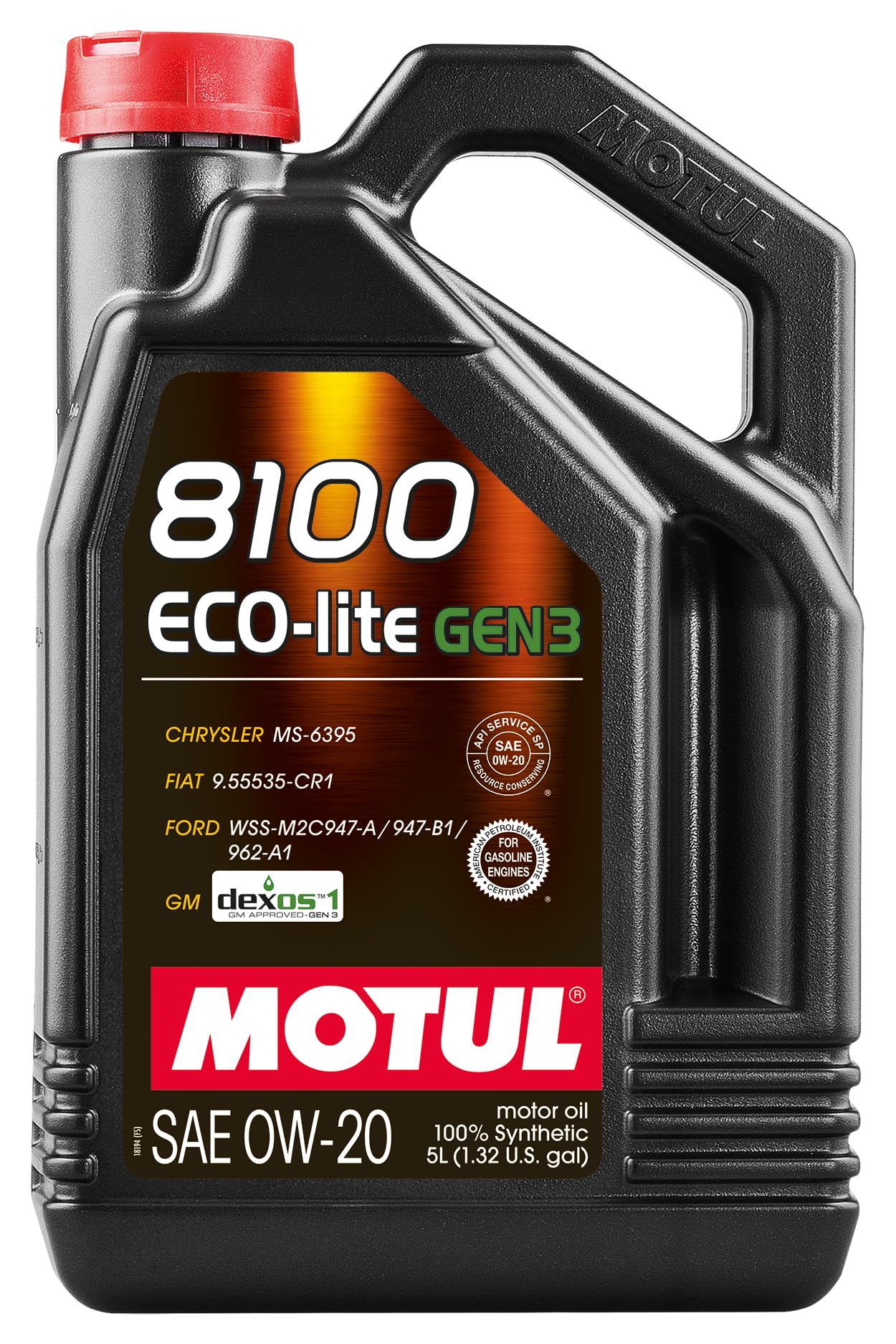
Motul 8100 ECO-lite is a 100% synthetic 0W-20 engineered for the latest generation of GM, Ford, Chrysler, and Asian engines that specify thin oil for fuel economy. The advanced low-friction formula reduces parasitic drag inside the engine, and real-world users report a measurable 3-MPG improvement in city driving on vehicles like the Subaru Crosstrek and Honda CR-V. This isn’t a placebo — the 0W-20 grade allows the oil pump to move fluid with less resistance, directly reducing the energy required to spin the crankshaft.
Certification-wise, it carries both API SP and GM dexos1 Gen3 approval, which means it meets the strictest standards for timing-chain wear prevention and LSPI suppression. Owners of turbocharged engines like the Ford EcoBoost or GM LTG series should note that this oil’s 433°C flash point is exceptionally high, indicating strong resistance to vaporization under boost. Users also observe that after 6,000 miles the drained oil is a light amber color, whereas conventional synthetics often drain black — a direct sign of superior detergency and oxidation control.
The 5-liter jug format is perfectly sized for most 4-cylinder and V6 engines that take 4.5 to 5.0 quarts. The only downside is the price has crept up recently, putting it closer to boutique ester-based oils. Still, for anyone driving a modern vehicle requiring 0W-20, this is the oil that delivers the cleanest internal environment and the best fuel-economy gains without sacrificing protection.
Why it’s great
- Up to 3 MPG improvement reported in stop-and-go driving
- dexos1 Gen3 certified for modern GM and Ford turbo engines
- Exceptional cleanliness — drained oil is visibly cleaner than competitors
Good to know
- Higher price point than Mobil 1 or Pennzoil equivalents
- 0W-20 is too thin for engines requiring 5W-30 or thicker
3. Liqui Moly Special Tec LL 5W-30

Liqui Moly Special Tec LL 5W-30 is the German-engineered solution for BMW, Mercedes, and VW/Audi engines that demand a Longlife-01 or VW 502.00 approved oil. The “LL” stands for Long Life, meaning this oil is formulated to maintain its viscosity and additive package over extended drain intervals — typically 10,000 to 15,000 miles as specified by European manufacturers. Its synthesis technology base oil offers stability against aging that conventional synthetics can’t match, which is critical for engines with variable valve timing that relies on consistent oil pressure.
BMW N55 and B58 owners have reported that switching to this oil quiets the hydraulic valve adjusters and eliminates the “lifter tick” that sometimes appears after 5,000 miles on cheaper oils. The 5W-30 viscosity is thick enough to protect the rod bearings on tuned engines running extra boost, yet thin enough to flow through the VANOS actuators at cold startup. One user with a 2001 X5 and a 2017 X5 confirmed it reduced misfires and smoothed out the idle on both, a testament to the oil’s detergent package keeping VANOS solenoids clean.
The 5-liter jug is precisely the volume needed for most BMW inline-6 engines. The price has increased recently, reflecting global supply pressures on Group III base stocks, but for an owner who wants to maximize the life of a European engine, there is no better off-the-shelf choice that meets OEM specs without going to a dealer.
Why it’s great
- Approved for BMW Longlife-01, VW 502.00, and Mercedes MB 229.5
- Eliminates lifter tick and smooths VANOS operation
- Engineered for extended 10K+ mile intervals
Good to know
- Premium pricing relative to non-European synthetics
- Not suitable for engines requiring 0W-20 or 10W-40
4. Liqui Moly Special Tec AA 5W-20

Liqui Moly Special Tec AA 5W-20 is the Asian-American variant of the German brand’s lineup, tailored specifically for Honda, Toyota, Kia, Ford, and Chrysler engines that call for a 5W-20 grade. The fully synthetic formula is engineered for optimum aging stability, meaning it resists oxidation and viscosity breakdown longer than standard synthetic blends. The 5-liter jug (169 fluid ounces) is essentially a 5-quart bottle packaging, which is convenient for the average 4.5- to 5-quart sump capacity found on Honda K-series and Toyota 2GR engines.
Owners of Honda CR-Vs with over 240,000 miles reported a dramatic reduction in engine noise and a 6-MPG average improvement after switching from conventional oil to this full synthetic. The same user noted no new leaks appeared after the switch, debunking the myth that synthetic oil causes seals to fail on high-mileage engines — the truth is that the detergents clean out existing sludge that was plugging the leaks. Another owner of a Ram 1500 with the 5.7 Hemi said it stopped the notorious lifter tap that plagues that engine, a strong indicator that the anti-wear additive package (likely ZDDP) is robust.
This oil is not suitable for European engines that require a thicker 5W-30 or 0W-40, but for the vast market of American and Asian cars that spec 5W-20, it is arguably the best option available. The low burn-off rate means you won’t need to top off between changes, and the engine will run quieter at both idle and cruise.
Why it’s great
- Very low oil consumption between changes
- Quiets valvetrain noise on high-mileage Honda and Hemi engines
- Excellent aging stability at high temperatures
Good to know
- Only available in 5W-20 — verify your owner’s manual
- 5-liter bottle uses metric volume, not exactly 5 quarts
5. Royal Purple 51130 High Performance 10W-30

Royal Purple 10W-30 occupies a unique space — it’s a full synthetic that performs like a higher-grade oil while meeting the 10W-30 spec, making it ideal for engines that are starting to show age or that run hot under load. The proprietary Synerlec additive technology bonds to metal surfaces at a molecular level, providing a sacrificial layer that reduces friction even during the momentary oil starvation of a cold start. Users running this in Jeep Wranglers with over 150,000 miles noted smoother idle and less valvetrain chatter, and one Cub Cadet mower owner observed cooler operating temperatures after the switch.
The 5-quart jug is straightforward for a full oil change, and the API licensing ensures compatibility with catalytic converters and ethanol-blended fuels. Royal Purple’s formulation also includes superior corrosion protection, which is often overlooked but critical for engines that sit for long periods or operate in humid environments. One reviewer described it as the bridge between Mobil 1 and premium boutique oils like Amsoil, offering 90% of the extreme-duty protection at a significantly lower price point.
If you’re driving a truck or SUV with a V8 engine that has passed the 100,000-mile mark, this oil’s film strength can help seal minor ring wear and reduce blow-by. It’s not the cheapest synthetic on the shelf, but the protection it provides against metal-on-metal contact in high-mileage engines makes it a worthwhile investment for extending engine life.
Why it’s great
- Synerlec additive technology bonds to surfaces for instant protection
- Proven to quiet valvetrain noise in high-mileage V8s
- Superior corrosion and ethanol-fuel compatibility
Good to know
- 10W-30 is too thick for modern engines spec’ing 5W-20 or 0W-20
- Higher cost than mid-range synthetic blends
6. Maxima Pro Plus+ 10W-40 Synthetic

Maxima Pro Plus+ 10W-40 is not a passenger car oil — it’s a JASO MA2 certified motorcycle oil designed for wet-clutch systems found in most sportbikes, cruisers, and dual-sports. The ester-fortified synthetic formula provides extreme shear stability, meaning the oil molecules don’t break down under the high RPM and clutch-slipping stresses of aggressive riding. Motorcycle transmissions share engine oil with the gearbox and clutch, so the oil must resist high-pressure shearing that would cause viscosity loss — this oil maintains its grade.
Riders of Suzuki V-Strom 650s and Honda CBR600RRs universally report that shifting becomes “buttery smooth” after switching to Maxima Pro Plus+. The surface-active chemistry clings to engine surfaces, ensuring oil film remains on cam lobes and bearings during the split-second of startup before the oil pump primes. One KX450F owner noted that the clutch feel — both engagement and feathering — was noticeably improved, with less grab and more predictable modulation. This is critical because many friction-modified car oils can cause clutch slippage in bikes.
The 1-gallon jug is a convenient volume for motorcycles that take 2.5 to 4 quarts per change. For any rider who wants their bike to shift like new for years, this is the oil to run.
Why it’s great
- JASO MA2 certified for wet-clutch motorcycles
- Ester-fortified formula resists high-RPM shear
- Noticeably smoother gearbox shifting and clutch feel
Good to know
- Not suitable for cars or trucks — lacks API gasoline engine certification
- 10W-40 may be too thick for late-model bikes calling for 10W-30
7. Valvoline Daily Protection 10W-40 Conventional
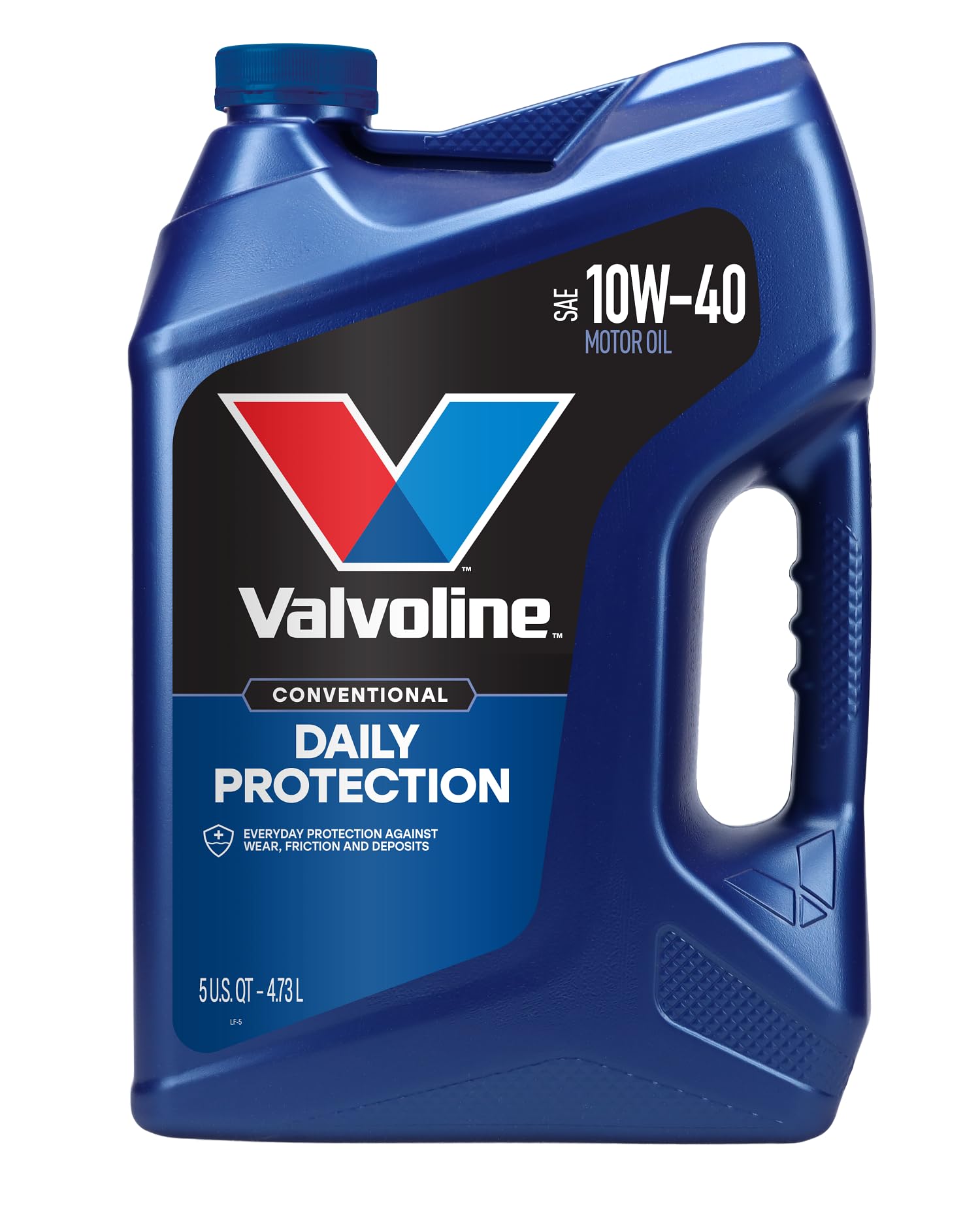
Valvoline Daily Protection 10W-40 is a conventional oil that still manages to carry the latest API SP certification, making it a rare budget-friendly option that doesn’t compromise on modern protection standards. The low-friction technology helps maintain fuel efficiency even with a conventional base stock, while the added detergents actively prevent sludge and deposit formation — the typical Achilles’ heel of cheap oils. This is a strong choice for older vehicles that were designed before synthetics became standard, or for equipment like lawn mowers and generators where a premium synthetic would be overkill.
Reviewers consistently mention using this oil for years with no oil-related engine concerns. One user noted it works perfectly in his lawn mower after years of use in his car, which speaks to the versatility of the 10W-40 viscosity in air-cooled engines that run hot. The 5-quart jug format is ideal for a full oil change on most 4-cylinder and V6 cars and trucks that specify 10W-40. The flash point of 394°F is actually decent for a conventional oil, indicating it won’t boil off as quickly as some cheap options when the engine gets hot.
The trade-off is that conventional oil oxidizes faster than synthetic, so you should stick to a 3,000 to 4,000-mile oil change interval. For a low-mileage daily driver or a secondary vehicle that doesn’t see extreme temperatures, this oil provides reliable protection without the synthetic premium. If you need oil for an older carbureted engine or a small engine that burns oil, this is the most cost-effective way to maintain API SP standard protection.
Why it’s great
- API SP certified at a conventional oil price point
- Added detergents fight sludge formation effectively
- Versatile for both automotive and small engine use
Good to know
- Requires shorter 3,000-4,000 mile oil change intervals
- 10W-40 is too thick for modern engines requiring 5W-30 or 0W-20
FAQ
Can I switch from conventional to synthetic oil in a high-mileage engine?
What happens if I use 5W-30 instead of 5W-20?
Is it safe to mix brands of the same viscosity?
Final Thoughts: The Verdict
For most users, the best aceite de motor winner is the Mobil 1 Extended Performance 5W-30 because it offers the strongest balance of protection, certification depth, and 20,000-mile capability for the widest range of gasoline engines. If you want to maximize fuel economy and keep a modern GM or Ford engine spotless internally, grab the Motul 8100 ECO-lite 0W-20. And for a high-mileage European car that demands precise OEM approval, nothing beats the Liqui Moly Special Tec LL 5W-30.