
The Acer Palmatum Shishigashira, often called the Lion’s Head Maple, is revered for its tightly curled, crinkled leaves that create a dense, tufted canopy unlike any other Japanese maple cultivar. Finding a healthy, well-established specimen requires more than just clicking a listing — the quality of the root system, the branching structure, and the nursery’s shipping protocol all determine whether your tree thrives or struggles in its first season.
I’m Min — the co-founder and writer behind Gadgets Feed. I’ve spent dozens of hours analyzing nursery stock, comparing customer reports on leaf retention and transplant shock, and cross-referencing hardiness zone claims against real-world reviews for this specific cultivar.
After sorting through dozens of listings and hundreds of verified buyer reports, I’ve identified the live specimens that consistently arrive healthy and true-to-type. Whether you’re adding an accent tree to a rock garden or expanding a maple collection, this guide to the best acer palmatum shishigashira will help you choose the right plant for your landscape.
How To Choose The Best Acer Palmatum Shishigashira
Shishigashira maples are distinct from other Japanese maples due to their slow growth (often 6–12 inches per year) and dense, pom-pom-like leaf clusters. Choosing the wrong starter size or ignoring state shipping restrictions leads to disappointment. Focus on three factors to get a tree that establishes quickly.
Starter Size vs. Container Volume
A 2.5 QT pot typically yields a tree 12–18 inches tall, while a 7-gallon nursery pot can hold a 3–4 foot specimen with a developed root ball. Larger containers reduce transplant shock but cost more to ship. For Shishigashira’s slow habit, starting with a gallon-sized plant saves a year of growth compared to smaller plugs.
Shipping Windows and Dormancy
Live maples shipped between November and April often arrive dormant — bare branches with no leaves. This is normal and actually reduces stress. Trees shipped in active growth (May-October) must be kept watered and shaded during transit. Check whether the nursery ships dormant and whether they use fabric grow bags or plastic pots.
Grafted vs. Own-Root Specimens
Many Japanese maples are grafted onto robust rootstock. A graft union should be clean and well-healed. Some buyers report disappointment when grafted plants fail to match the parent cultivar’s growth pattern. Own-root Shishigashira are rarer and more expensive but eliminate the risk of rootstock suckers overtaking the crown.
Quick Comparison
On smaller screens, swipe sideways to see the full table.
| Model | Category | Best For | Key Spec | Amazon |
|---|---|---|---|---|
| Brighter Blooms Bloodgood | Premium | Established landscape specimen | 3-4 ft. height, pre-shipping warranty | Amazon |
| Simpson 7 Gal Red Maple | Premium | Largest root volume on arrival | 7 gal nursery pot, 4 ft. height | Amazon |
| New Life Emperor 1 | Mid-Range | Late frost resistance | 2.5 QT fabric grow bag | Amazon |
| New Life Crimson Queen | Mid-Range | Weeping dwarf form | 2.5 QT fabric grow bag, 8-10 ft. mature | Amazon |
| New Life Seiryu Upright | Mid-Range | Unique upright laceleaf form | Trade gallon pot, 15 ft. mature height | Amazon |
| New Life Inaba Shidare | Mid-Range | Purple-red leaf retention | Trade gallon pot, 8-10 ft. mature | Amazon |
| Simpson 3 Gal Red Maple | Budget | Compact starter for small gardens | 3 gal nursery pot, 2 ft. height | Amazon |
In‑Depth Reviews
1. Brighter Blooms Bloodgood Japanese Maple Tree

The Bloodgood is the most widely planted red Japanese maple in North America, and Brighter Blooms ships a 3-4 foot specimen with a well-developed root ball. Customer reports confirm trees arriving between 4 and 6 feet tall despite the listed range, often with straight central leaders and branching already beginning to fill out.
The included warranty provides peace of mind for first-time maple buyers. Several reviewers noted leaf browning during transit, which is typical for a tree shipped during active growth, but the replacement policy handled those cases quickly. The Bloodgood’s vigorous growth rate (12-18 inches per year once established) makes this the fastest path to a shade-height specimen.
Restrictions apply — cannot ship to AZ, AK, or HI due to agricultural laws. The tree ships in a nursery pot with moist soil, and buyers in zones 5-8 report excellent hardiness. For anyone wanting a large, established red maple with minimal fuss, this is the most reliable choice on the list.
Why it’s great
- Largest starter size (3-4 ft) with warranty backing
- Popular Bloodgood cultivar with proven landscape performance
- Buyers consistently report trees arriving larger than listed
Good to know
- Cannot ship to AZ, AK, or HI
- Leaves may brown from transit stress in hot months
- Premium price point reflects larger size and warranty
2. Simpson Nursery Japanese Red Maple 7 Gal
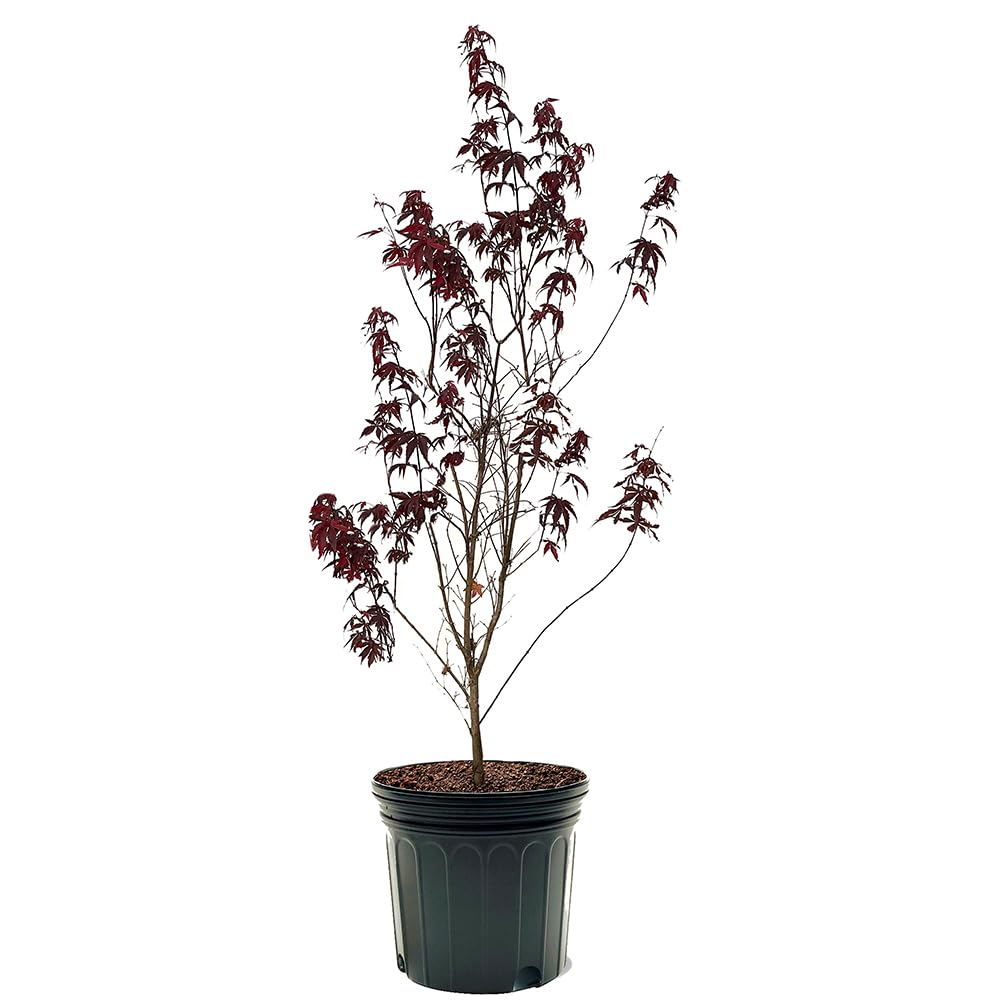
The 7-gallon container volume here dwarfs nearly every competitor — most listings ship in 2.5 QT or trade gallon pots. Simpson Nursery’s specimen typically stands 4 feet tall at shipment with a root system that significantly reduces transplant shock. Multiple verified buyers reported trees arriving “larger than advertised” with dense, healthy foliage.
The deep burgundy leaf color persists through summer without fading to green, which is a common complaint with cheaper red maple stock. The tree’s compact, spreading habit suits small gardens or focal-point plantings. Simpson ships with detailed care instructions covering watering, mulching, and spring fertilization schedules.
Like many nurseries, Simpson cannot ship to CA, AZ, AK, or HI. The 25-pound shipping weight reflects the substantial soil volume. For buyers who want the largest possible root system without moving up to field-grown B&B stock, this 7-gallon option delivers the best transition into the landscape.
Why it’s great
- Massive 7-gallon root ball for minimal transplant shock
- Consistent deep burgundy color, not greenish-red
- Buyers confirm trees exceed listed height and fullness
Good to know
- Shipping restrictions to CA, AZ, AK, HI
- Heavy package (25 lbs) requires assistance
- Listed as generic red maple, not a specific named cultivar
3. New Life Nursery Emperor 1 Japanese Maple
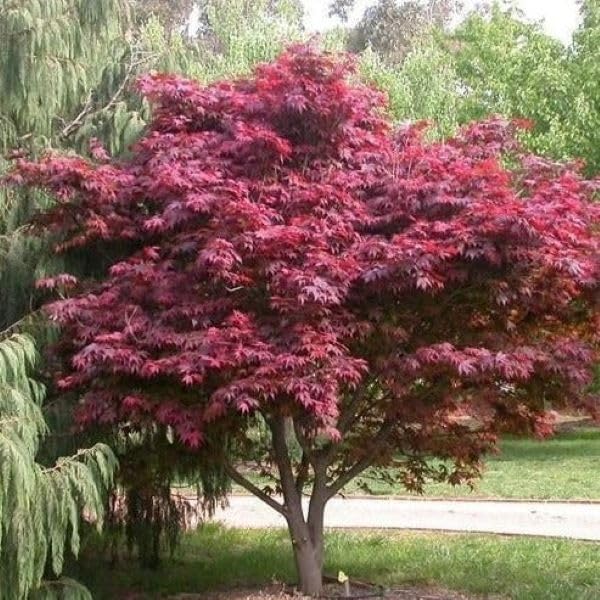
The Emperor 1 cultivar was specifically bred for later spring leaf emergence, making it substantially more resistant to late frost damage than Bloodgood or other early-budding varieties. New Life Nursery ships this in a 2.5 QT fabric grow bag rather than a plastic pot, which encourages air root pruning and prevents spiraling roots common in container-grown maples.
Verified buyers report trees arriving 3 to 3.5 feet tall with black-red bark and healthy branching structure. The autumn color transition to brilliant scarlet is consistently praised across seasons. Full sun exposure deepens the dark red foliage, while partial shade yields a slightly greener tone.
Some buyers noted the starter size feels small for the price point. That’s a fair observation — the Emperor 1 grows slower than Bloodgood, so the 2.5 QT size represents a younger tree. However, the frost resistance trait alone makes it the smart choice for zone 5 gardens where April freezes are common.
Why it’s great
- Late bud break avoids spring frost damage
- Fabric grow bag prevents root circling
- Brilliant fall scarlet color on all reports
Good to know
- Smaller starter than Bloodgood at similar price
- Some buyers expected a more mature tree from photos
- Slow growth requires patience for landscape impact
4. New Life Nursery Crimson Queen Japanese Maple

Crimson Queen is the classic weeping laceleaf maple, and New Life ships it in a fabric grow bag at 2.5 QT size. The low-branching, cascading habit reaches 8-10 feet at maturity, making it ideal for patios, entryways, or small-space gardens where an upright tree would overwhelm the area.
The dissected leaves hold their deep crimson color throughout summer, a trait that separates quality Crimson Queen stock from inferior red laceleaf varieties that fade to green by July. Multiple buyers described the plant as “beautiful and healthy” on arrival, with well-formed branching even at the starter size.
A small number of buyers reported dormant trees that failed to leaf out the following spring. This risk exists with any shipped bare-root or dormant maple, and the problem appears linked to graft failure rather than the cultivar itself. Inspect the graft union for clean healing before planting.
Why it’s great
- Classic weeping laceleaf form for small spaces
- Crimson color holds all summer, not just spring
- Fabric grow bag promotes healthy root structure
Good to know
- Some dormant trees did not survive to spring
- Graft union quality varies between shipments
- 2.5 QT size needs 2-3 years to reach landscape presence
5. New Life Nursery Seiryu Upright Laceleaf Japanese Maple

Seiryu is an exceptionally rare dissectum that grows upright rather than weeping, reaching 10-15 feet with a broad, multi-branched canopy. New Life ships this in a trade gallon pot, and buyers report trees arriving 28-40 inches tall with bright green laceleaf foliage tipped in reddish tones during spring emergence.
The summer leaf color is a uniform light green — distinctly different from the red and purple cultivars dominating this list. This makes Seiryu a valuable contrast plant in a maple collection. Autumn brings a spectacular range from gold to light yellow with crimson suffusion on exposed leaves.
Some buyers received grafted specimens that died within weeks, with one reporting the graft union failed without warning. This is a known risk with grafted dissectums. Inspect the graft immediately upon arrival and plant at the correct depth — the union should sit 1-2 inches above soil line.
Why it’s great
- Unique upright laceleaf form unlike any other dissectum
- Stunning multicolor autumn display
- Light green summer foliage contrasts red maples
Good to know
- Graft failure reported by some buyers
- Slower to establish than red upright varieties
- Trade gallon pot is smaller than 2.5 QT containers
6. New Life Nursery Inaba Shidare Weeping Laceleaf
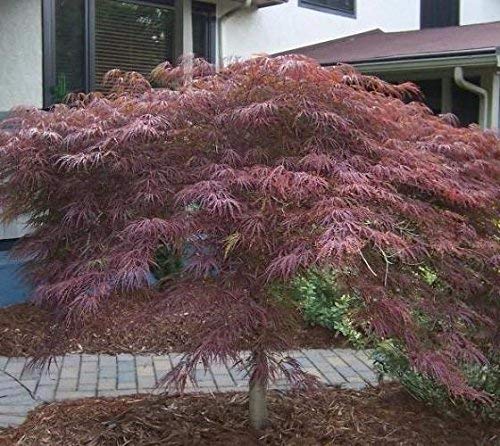
Inaba Shidare produces larger, more intricate laceleaf foliage than Crimson Queen, with a deeper purple-red tone that intensifies into crimson in fall. New Life ships in a trade gallon pot, and buyers consistently report trees arriving 28-32 inches tall with vibrant color and vigorous growth after planting.
The weeping form reaches 8-10 feet at maturity, matching Crimson Queen in size but offering a distinctly different leaf texture and color depth. Buyers in zones 5-9 report success in full sun to partial shade, with the most intense purple tones developing in morning sun with afternoon shade protection.
A recurring complaint involves grafted specimens — some buyers received trees where the graft union failed or the rootstock overtook the scion. Check product descriptions carefully; New Life does not always explicitly state whether the tree is grafted. Own-root Inaba Shidare is rare, so budget for potential replacement if grafting fails.
Why it’s great
- Large, intricate purple-red laceleaf foliage
- Vigorous growth reported across multiple zones
- Fall transition to crimson is consistently praised
Good to know
- Grafting issues reported by some buyers
- Trade gallon pot is smaller than many competitors
- Requires careful watering in first summer
7. Simpson Nursery Japanese Red Maple 3 Gal

Simpson Nursery’s 3-gallon red maple offers the most affordable entry point into Japanese maple ownership on this list. Despite the budget-friendly position, buyer reviews are overwhelmingly positive — trees arrive well-packaged with moist soil, and multiple customers reported receiving specimens larger than the advertised 2-foot height.
The compact growth habit suits container cultivation or small garden beds where space is limited. The deep red foliage provides classic Japanese maple aesthetics, and the 3-gallon root ball gives a head start over smaller plug-size competitors. Simpson ships with clay soil, which retains moisture well but requires amending for best long-term drainage.
Like Simpson’s larger 7-gallon option, this tree cannot ship to CA, AZ, AK, or HI. The generic “Japanese Red Maple” listing means the specific cultivar is not guaranteed — you may receive a Bloodgood, a Tamukeyama, or another red-leaved variety. For buyers who prioritize budget and don’t need a named cultivar, this is a solid starter.
Why it’s great
- Most affordable entry point for a potted Japanese maple
- Buyers consistently report trees larger than 2 ft advertised
- 3-gallon container provides good root development
Good to know
- Specific cultivar not guaranteed (generic red maple)
- Cannot ship to CA, AZ, AK, or HI
- Clay soil requires amending for drainage
FAQ
How fast does Acer Palmatum Shishigashira grow?
Can Shishigashira handle full sun in zone 8?
Should I prune a young Shishigashira after planting?
Why did my shipped maple arrive with no leaves?
What is the difference between Shishigashira and Bloodgood?
Final Thoughts: The Verdict
For most users, the best acer palmatum shishigashira winner is the Brighter Blooms Bloodgood because it offers the largest established size, a warranty, and the most reliable transition into the landscape for gardeners who want immediate impact. If you need late-frost resistance for a zone 5 garden, grab the New Life Emperor 1. And for the best root system possible at shipment, nothing beats the Simpson Nursery 7 Gallon Red Maple.