
Our readers keep the lights on and my morning glass full of iced black tea. As an Amazon Associate, I earn from qualifying purchases.
Specs are compiled from manufacturer listings and verified buyer reviews and can change over time — please confirm the key details on the product page before buying.
The best way to refresh a tired wool sweater or hand-dye a skein of yarn is with an acid dye that permanently bonds to protein fibers. This guide compares three powder dye sets on color payoff, included extras, and ease of use for wool, silk, and alpaca. You will see which kit suits a beginner stocking a first dye bath and which gives you the richest palette for yarn experiments.
I’m Min — the founder and writer behind Gadgets Feed. This guide is built by comparing the manufacturers’ published specifications and the patterns across verified customer reviews, so you get each pick’s real strengths and trade-offs instead of marketing spin.
You can get rich, permanent color on wool, silk, or alpaca at home without paying for a professional studio. The key is knowing how acid reacts with protein fibers, so here is a focused look at the best acid dyes for wool that deliver exactly that.
Our Picks at a Glance
How To Choose The Best Acid Dyes For Wool
Your choice of acid dye for wool depends on three things: the fibers you plan to dye, the color range you want, and if you need extras like citric acid (a mild acid that helps the dye bond) and a scouring agent (a cleaner that preps the wool). Get these right, and your first dye bath turns out great; get them wrong, and it is a frustrating mess.
Check the fiber compatibility first
Acid dyes only work on protein fibers — animal-based materials like wool, silk, alpaca, mohair, and angora, plus nylon. They will not bond to cotton or other plant fibers. If you knit or weave with wool yarn, any of the kits here will work, but verify the material list before you buy so you are not wasting a batch on the wrong fabric.
Count the included chemicals
A complete starter kit should include the dye powder plus the acid you need to set the color. Citric acid crystals are the standard companion, and a low-foam scouring agent like Synthrapol helps clean the fiber before dyeing. Sampler kits often include these chemicals in small amounts, which is perfect for testing a few colors before committing to a full-size jar.
Quick Comparison
| Model | Best For | Color Palette | Included Acid | Fiber Types | Amazon |
|---|---|---|---|---|---|
| Jacquard Acid Dye 4 Color Set★ Best Overall | Full Coverage Dyeing | Basic Colors | Citric Acid | Wool, Silk, Nylon, Alpaca | Amazon |
| WashFast Autumn Acid Dye Sampler | Small to Medium Batches | Autumn Tones | Citric Acid | Wool, Silk, Alpaca | Amazon |
| WF Jewels Acid Dye Sampler | Jewel-Tone Yarn Dyeing | Purples and Berries | Citric Acid | Wool, Silk, Alpaca | Amazon |
In-Depth Reviews
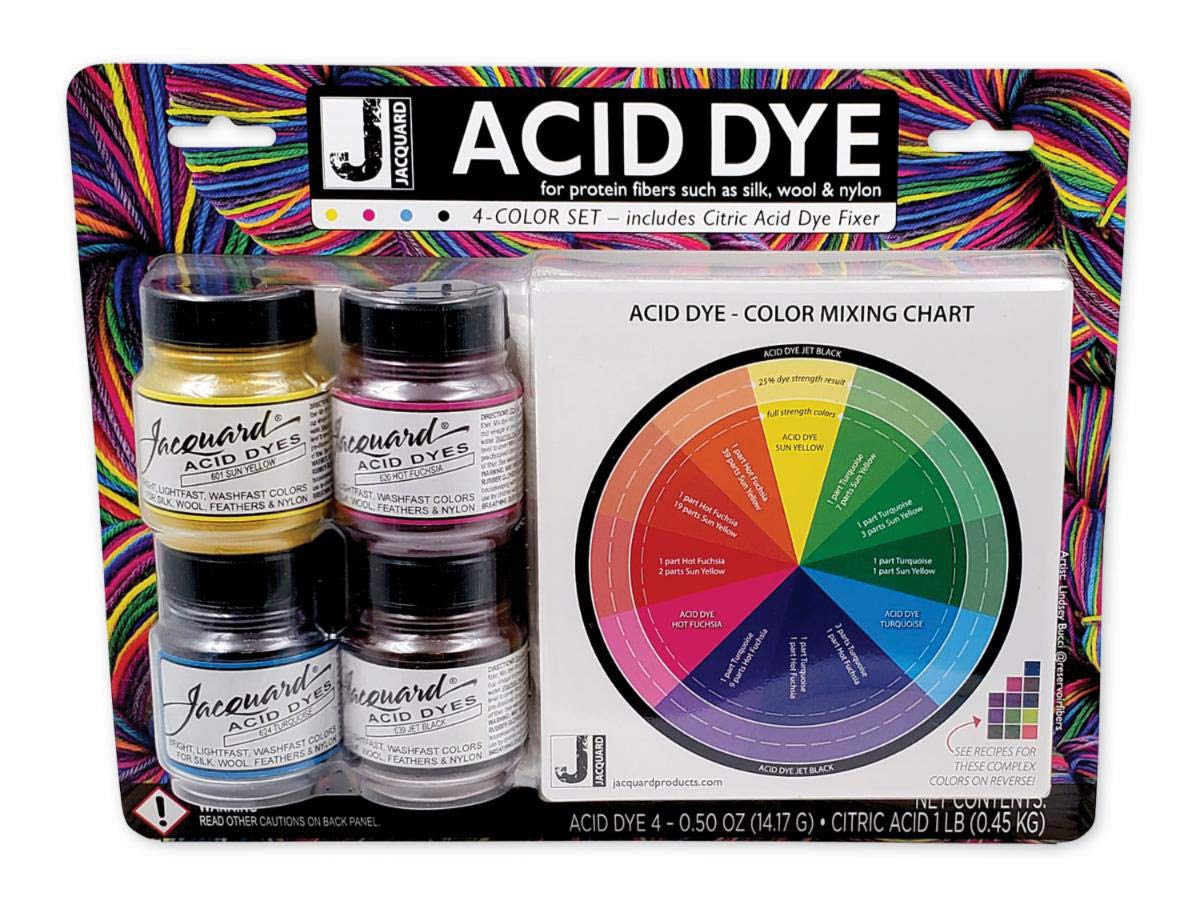
1. Jacquard Acid Dye 4 Color Set
Our pick — 4.5★ from 300+ verified ratings; the strongest balance of quality and price.
A full-coverage 4-color kit that lets you control the depth of every shade you create.
This set uses a self-leveling formula (a dye that spreads evenly so you get uniform colors) when you submerge wool in the dye bath. Heat the water to 180 degrees F, add the wet fabric and your acid, and the dye “magnetizes” to the fibers — so it pulls out of the water completely, leaving you with clean water for disposal.
The real strength here is control. Use less dye and more water for pastels, more dye and less water for deeper bolds colors, and you can even create a concentrated solution for silk painting or add thickener for screen printing. The 1.4-pound powder set includes citric acid, so you do not need to hunt down a separate acid to start your first batch.
What wins people over is even coverage — the top quality buyers single out again and again, with color payoff close behind. Buyers report real success refreshing wool dresses: “Nice even dye and the process was pretty simple.” A long-time wool dyer with decades of experience calls these predictable, repeatable, and luscious, better than the limited and dangerous natural dyes.
Why It Impresses
- Self-leveling formula delivers even color across the whole garment
- Includes citric acid for a complete first dye session
- Works on wool, silk, nylon, alpaca, cashmere, even cosplay wigs
The Fit Notes
- Color selection is mixed — owners mention primary colors are absent from the set
- Instructions are thin; several owners wish for more guidance
Grab it when: you want a complete 4-color starting point with the acid included and the flexibility to mix your own shades.
Look elsewhere if: you specifically need primaries or a step-by-step tutorial book — the palette leans basic and the directions are brief.
2. WashFast Autumn Acid Dye Sampler
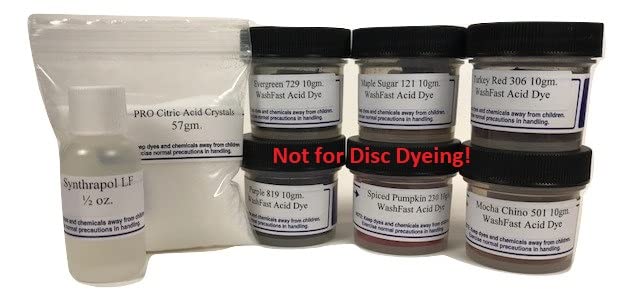
A smart little sampler that packs five seasonal colors plus every chemical you need.
This is a wonderfully compact way to test acid dyeing before you invest in full-size jars. Inside you get five 10-gram powders — Maple Sugar, Spiced Pumpkin, Mocha Chino, Turkey Red, and Evergreen — plus Purple, alongside 57 grams of citric acid crystals and a half-ounce of low-foam Synthrapol for scouring. That is essentially a complete dye studio in a box.
The kit is designed for small to medium amounts of protein fibers, which makes it ideal for dyeing a few skeins of wool yarn or a single garment. It also works on silk, alpaca, and mohair. If a color is unavailable when you order, the maker replaces it with another shade in the same color family.
Customers note the colors are “so vibrant” and call it an affordable gateway into acid dyeing. The kit gives you enough to complete several batches or to mix up six bottles of dye concentrate for fiber painting, so it stretches further than the small jar sizes suggest.
Smart testing ground: five seasonal shades plus the exact acid and scouring agent you need, all in one low-risk kit for trying acid dyes on wool.
Before you commit: the 10-gram jars are small by design — this is a sampler, not a bulk supply, so it suits experiments over large production runs.
Reach for this if: you want to sample several autumn-inspired shades and confirm your technique before buying bigger jars.
skip it if: you already know your palette and need volume — the sampler’s charm is variety, not quantity.
3. WF Jewels Acid Dye Sampler

Seven vibrant shades of purple and berry for hand-dyed yarn with serious depth.
This sampler leans hard into the jewel end of the spectrum with six 10-gram powders — Deep Orchid, Deep Purple, Purple, Lavender, Iris, and Raspberry — plus 57 grams of citric acid and a half-ounce of Synthrapol. That is seven items total and a very purple-forward palette that hand-dyers tend to love.
The fibers are what you would expect from a PRO Chemical acid dye: wool, silk, angora, mohair, alpaca, soy silk, and nylon. The granular-powder form dissolves into a dye bath easily, and because it is a permanent protein-fiber dye, the color resists washing out.
Reviewers point out using it on mohair with great success, and even a first-time dyer who over-concentrated the solution found the yarn still came out “absolutely beautifully.” Reviewers also note the jewel-tone colors come out vivid across shades like berry, lavender, and royal purple.
For the violet obsessed: if your stash is full of purple and berry tones, this kit gives you six distinct shades to play with plus the chemicals to set them.
A fair caveat: the palette is narrow — anyone seeking a full rainbow should pair this with a complementary set rather than expect broad color coverage.
Best when: you hand-dye yarn or mohair and want a range of rich purples and berries to experiment with.
Not the one for: neutral or earthy palettes — this set is unapologetically saturated jewel tones.
Understanding the Specs
Why Protein Fibers Matter
Acid dyes bond only to animal-based fibers like wool, silk, alpaca, and mohair, plus nylon. The acid in the dye bath lowers the pH, which opens up the fiber and lets the dye molecules “magnetize” and permanently attach. That is why these same powders work on a wool sweater, a silk scarf, and a nylon cosplay wig — but not on cotton.
What Synthrapol Does
Synthrapol is a low-foam scouring agent that cleans the fiber before you dye it. Removing oils and dirt from the wool helps the dye take evenly, so the color looks uniform instead of blotchy. Sampler kits include a half-ounce bottle of it, which is enough for several loads of fiber prep.
FAQ
Will acid dye work on cotton or plant fibers?
What temperature should the dye bath be for wool?
Do I need to buy citric acid separately?
How much wool can a sampler kit dye?
What is the difference between a dye set and a sampler?
Can I mix acid dye colors together?
Is acid dye permanent on wool?
Which kit is best for dyeing yarn specifically?
Final Thoughts: The Verdict
If you want one dependable pick, the acid dyes for wool winner is the Jacquard Acid Dye 4 Color Set because it pairs a self-leveling formula with included citric acid and a 1.4-pound powder supply. If you want to test multiple seasonal shades before committing, grab the WashFast Autumn Sampler. And for jewel-toned yarn experiments, the WF Jewels Sampler is the one to reach for.
How We Picked
We do not accept paid placement. Every pick is matched to a real buyer and a real use-case; we do not hands-on test units.
Sources & Methodology
Specifications: manufacturer listings and product documentation. Review insights: verified customer reviews, as of August 2026. Pricing: not shown on this page (it changes often); check the current price via the retailer link.
As an Amazon Associate, Gadgets Feed earns from qualifying purchases. This does not affect which products we feature.