
Our readers keep the lights on and my morning glass full of iced black tea. As an Amazon Associate, I earn from qualifying purchases.
Specs are compiled from manufacturer listings and verified buyer reviews and can change over time — please confirm the key details on the product page before buying.
Choosing a hybrid guitar really means choosing two instruments at once. You want unplugged resonance you can hear across a quiet room, plus a pickup system that keeps that same voice intact when you run a cable to a PA or an acoustic amp. One solid-top Yamaha does this more completely than anything else here, and the rest of the pack splits into nylon players, carbon-fiber travelers, and small-body strummers. Below are the specs that actually change how each guitar feels and sounds, so you can match one to your hands instead of guessing.
I’m Min — the founder and writer behind Gadgets Feed. This guide is built by comparing the manufacturers’ published specifications and the patterns across verified customer reviews, so you get each pick’s real strengths and trade-offs instead of marketing spin.
Start with the body wood and the electronics, because those two choices decide how the guitar behaves on stage and in the living room. Here is the honest shortlist of the acoustic electric hybrid guitar done well.
Our Picks at a Glance

How To Choose The Best Acoustic Electric Hybrid Guitar
The whole point of a hybrid is that it has to sound good two ways: strummed with no cable, and plugged into an amp or PA. A guitar that only sings when amplified defeats the purpose. Read the spec sheet in two halves: the acoustic build first, then the onboard electronics.
Start with the top wood
A solid top means the wood is one continuous piece rather than a laminated sandwich, and it tends to open up and resonate more as you play. The Yamaha picks here both use solid Sitka spruce (a stiff, bright-sounding spruce variety). A laminate top, like the spruce on the Fender FA-125CE, stays stable and predictable, which is why it suits a beginner who wants consistency over time. Neither is a defect — they are different trade-offs.
Then read the preamp
The preamp is the small control panel built into the side of the guitar that shapes your plugged-in sound. A 3-band EQ gives you separate bass, middle, and treble dials. The Yamaha System 66 adds an adjustable mid-range frequency control — a sweep dial for the tone band where acoustic guitars often sound boxy — plus a chromatic tuner that reads every note. Cheaper systems often give you just a volume knob and a basic tuner, which is enough for practice but limiting on a stage.
Match the body to where you play
A dreadnought is the big, deep body that projects the most volume — great for strumming in a group. A concert or small body is shallower and easier on the shoulder, better for fingerstyle and long seated sessions. A thinline nylon model is slimmer still and gives you that soft classical voice. Weigh shoulder comfort, seated playing, and group volume before you weigh color.
Quick Comparison
| Model | Best For | Top Wood | Body Size | Electronics | Amazon |
|---|---|---|---|---|---|
| Yamaha FGX800C★ Best Overall | All-round stage and couch guitar | Solid Sitka spruce | Dreadnought cutaway | System 66, 3-band EQ, tuner | Amazon |
| Fender FA-125CE BundleBest Starter Bundle | First guitar with everything included | Laminate spruce | Dreadnought cutaway | Piezoelectric pickup | Amazon |
| Washburn Bella Tono Vite S9VBest Studio Feel | Comfortable studio and home playing | Spruce | Small studio cutaway | Barcus Berry LX4 preamp | Amazon |
| Ibanez GA5FMTCE | Nylon-string fingerstyle | Flamed maple | Thinline | Ibanez undersaddle pickup | Amazon |
| Fender CD-60SCE All-Mahogany | Warm all-mahogany strumming | Solid mahogany | Dreadnought cutaway | Fishman Classic preamp | Amazon |
| Ibanez AEG50 | Plugged-in gigging on a budget | Spruce | Acoustic-electric body | Ibanez electronics | Amazon |
| Yamaha FSX800C | Small-body fingerstyle comfort | Solid Sitka spruce | Concert cutaway | System 66, 3-band EQ, tuner | Amazon |
| Enya X3 PRO | Travel and outdoor weather-proofing | Carbon fiber | 41-inch full size | Enya SP1 AcousticPlus, Bluetooth | Amazon |
| Martin LX1E Little Martin | Overhead-bin and campfire travel | Solid Sitka spruce | Travel / small | Fishman Isys T | Amazon |
| Taylor GS Mini-e Mahogany | Small body, big voice | Mahogany | Small | Onboard acoustic-electric | Amazon |
| Taylor 114ce-S | Grand Auditorium stage work | Spruce | Grand Auditorium | Expression System 2 | Amazon |
In‑Depth Reviews
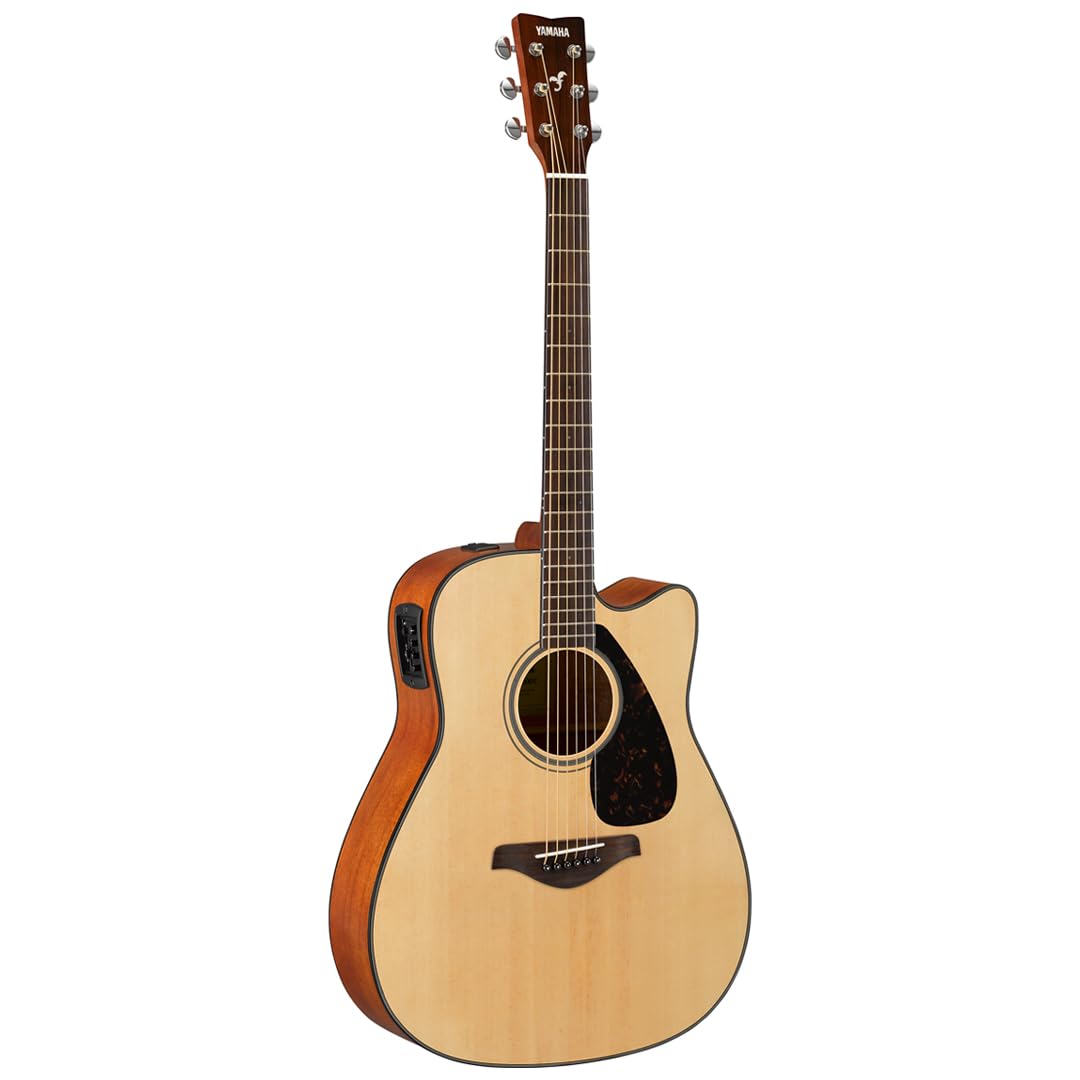
1. Yamaha FGX800C Solid Top Cutaway Acoustic-Electric Guitar, Dreadnought
Our pick — 4.5+★ from 250+ verified ratings; the strongest balance of quality and price.
A solid spruce top and a seriously flexible preamp make this the one to beat.
The top wood is where the money went, and you can hear it. This guitar uses a solid Sitka spruce top — meaning a single piece of stiff, bright-sounding spruce rather than a glued-up laminate — paired with nato back and sides for a slightly warmer balance. Strum it with no cable attached and it still has enough projection to carry a small room. That matters because most hybrids only really come alive once amplified.
Plug in and you get a genuine two-in-one instrument, thanks to the System 66 preamp. That preamp pairs an under-saddle piezo pickup (a thin sensor resting beneath the saddle that reads string vibration) with a 3-band EQ. It also adds an adjustable mid-range frequency control you can sweep to kill the boxy honk acoustic guitars often develop through a PA. A precision chromatic tuner is built in, so you can tune silently on stage. Rosewood on both the fingerboard and bridge keeps the played feel familiar, and diecast tuners hold pitch instead of drifting.
The catch is entirely predictable for a dreadnought: it is a big body, so smaller players and anyone with shoulder trouble will feel the size during long seated sessions. And while the sound quality is what wins people over, build-quality opinions are genuinely split — a reminder to inspect the setup when it arrives rather than assume it left the factory perfect. The adjustable truss rod gives you a way to dial the neck relief back in yourself or via a tech.
solid top cutaway
- Solid Sitka spruce top for resonance that grows as you break it in
- System 66 gives you 3-band EQ, a sweepable mid control, and a chromatic tuner in one panel
- Cutaway body lets you reach the upper frets for lead lines
- Adjustable truss rod so the neck can be corrected over the seasons
- Rosewood fingerboard and bridge for a familiar, broken-in feel
needs setup time
- Full dreadnought depth is a lot of body for small or seated players
- Setup can vary unit to unit, so budget a quick inspection
- Natural finish won’t suit players chasing a flashier look
first acoustic: you want one guitar that holds its own unplugged and gives you real tone-shaping control when you plug into a PA or acoustic amp.
prefer smaller body: a deep dreadnought body sits heavy on your shoulder all evening.
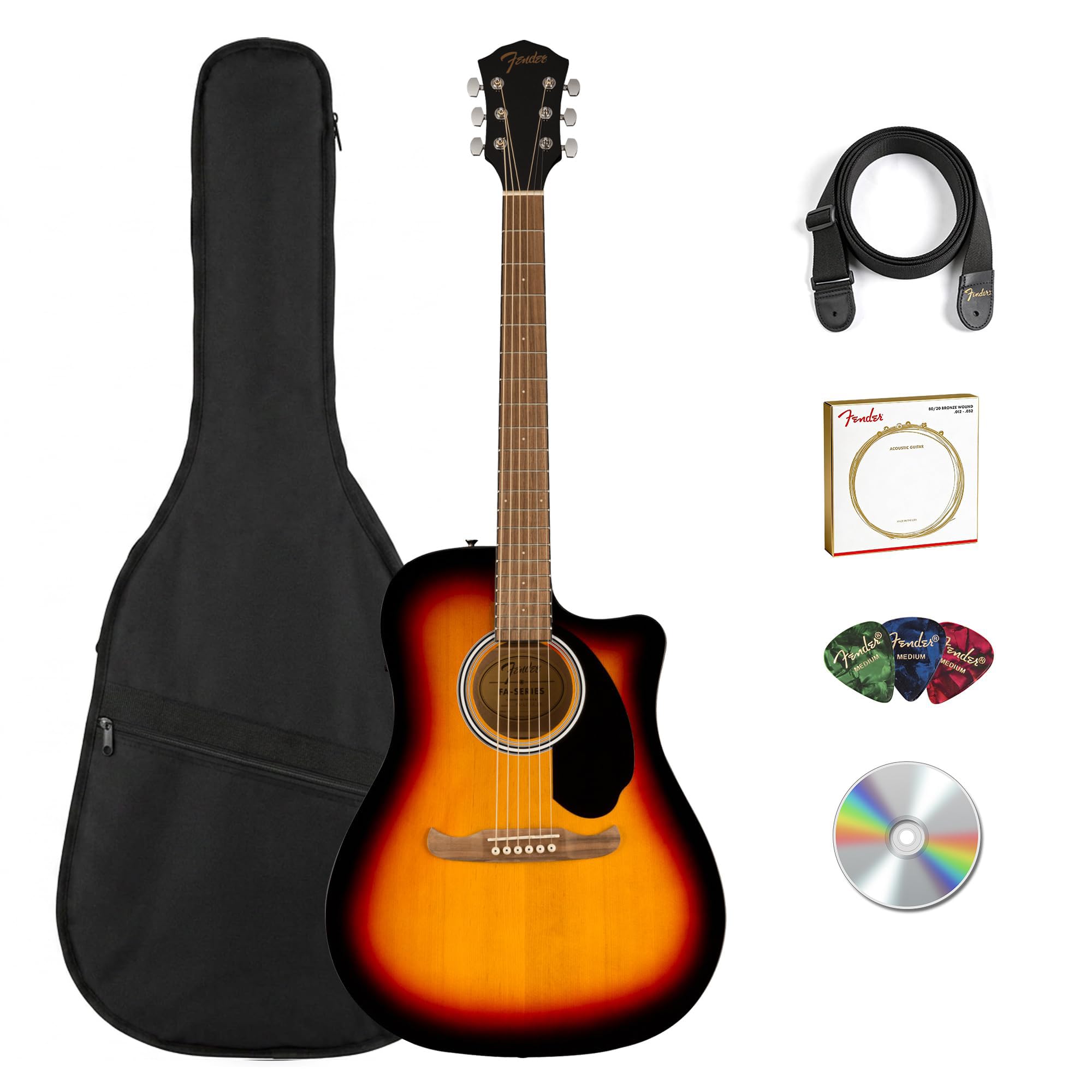
2. Fender FA-125CE Dreadnought Cutaway Acoustic-Electric Guitar – Sunburst Bundle
The starter kit that hands you everything you need in one box.
For anyone buying their first acoustic-electric, the bundle is the story. You get a gig bag for storage and transport, a strap for standing play, a spare set of strings, picks, and an Austin Bazaar instructional DVD, all bundled with the guitar itself. Nothing else here requires a second purchase before you can sit down and play. That single detail takes away the most common reason a first guitar ends up gathering dust.
The build is designed to be forgiving. A laminate spruce top (spruce that’s glued up in layers rather than a single solid piece) combined with basswood back and sides produces a warm, balanced tone, and laminates hold their shape predictably as conditions change. The nato C-shaped neck — a gently rounded profile that fills your palm without cramping it — pairs with a walnut fingerboard for smooth fretting. There is also the Viking bridge, which Fender uses for tonal support and a bit of visual character.
Here is the honest caution: durability is genuinely mixed in the feedback. Sturdy for plenty of owners, but some report a neck issue over time, which is the one thing to check when the box arrives and the reason to treat the gig bag as real protection rather than decoration. The cutaway lets you reach higher frets as you progress. For the price bracket, this is a low-risk way to start that doesn’t feel like a toy.
starter buy: a complete first guitar setup — guitar, bag, strap, strings, picks, lessons — in one purchase, no add-ons required.
want solid wood: check the neck carefully on arrival, since durability reports are split.
3. Washburn Bella Tono Vite S9V Studio Cutaway Acoustic Electric Guitar
Small-body comfort with a boutique-looking walnut back you won’t hide.
The first thing you notice is the shape. Washburn calls this a studio body design, built for focused sound and a very comfortable feel — think a smaller, closer-to-you body that doesn’t swallow your shoulder. That is the guitar you reach for on the couch, and it is why the physical footprint matters as much as the tone. Compared with the full dreadnoughts up top, this one is far easier to tuck into a corner and play for an hour without shifting around.
The tone is all about the woods and pickup. Figured walnut back and sides give it a distinctive grain pattern that lifts the gloss charcoal burst finish, and the ebony fingerboard carries an exotic wood vine inlay pattern that’s a genuine visual signature. On the electric side, an onboard Barcus Berry LX4 preamp and pickup system handles the plugged-in signal. It ships strung with D’Addario EXP-16 light phosphor bronze strings, so the first strum already feels considered rather than thrown on.
Buyers report it holds tune well and plays easy under the fingers — a low, light setup that makes barre chords less of a chore. One number to flag: the listed shipping dimensions run notably larger than the other compact pick here. Check the actual case and body size before you assume it will drop into a standard gig bag slot.
studio slim body: figured walnut, vine inlays, and a Barcus Berry preamp give it a look and voice that don’t blend into the crowd.
limited low end: confirm the shipped footprint and case fit if portability is central to your plan.
recording use: seated home players and fingerstylists who prize a focused, comfortable body over sheer dreadnought volume.
need big volume: you need a guitar that disappears into a backpack-size case.
4. Ibanez GA5FMTCE Thinline Nylon Acoustic-electric Guitar – Open Pore Berry
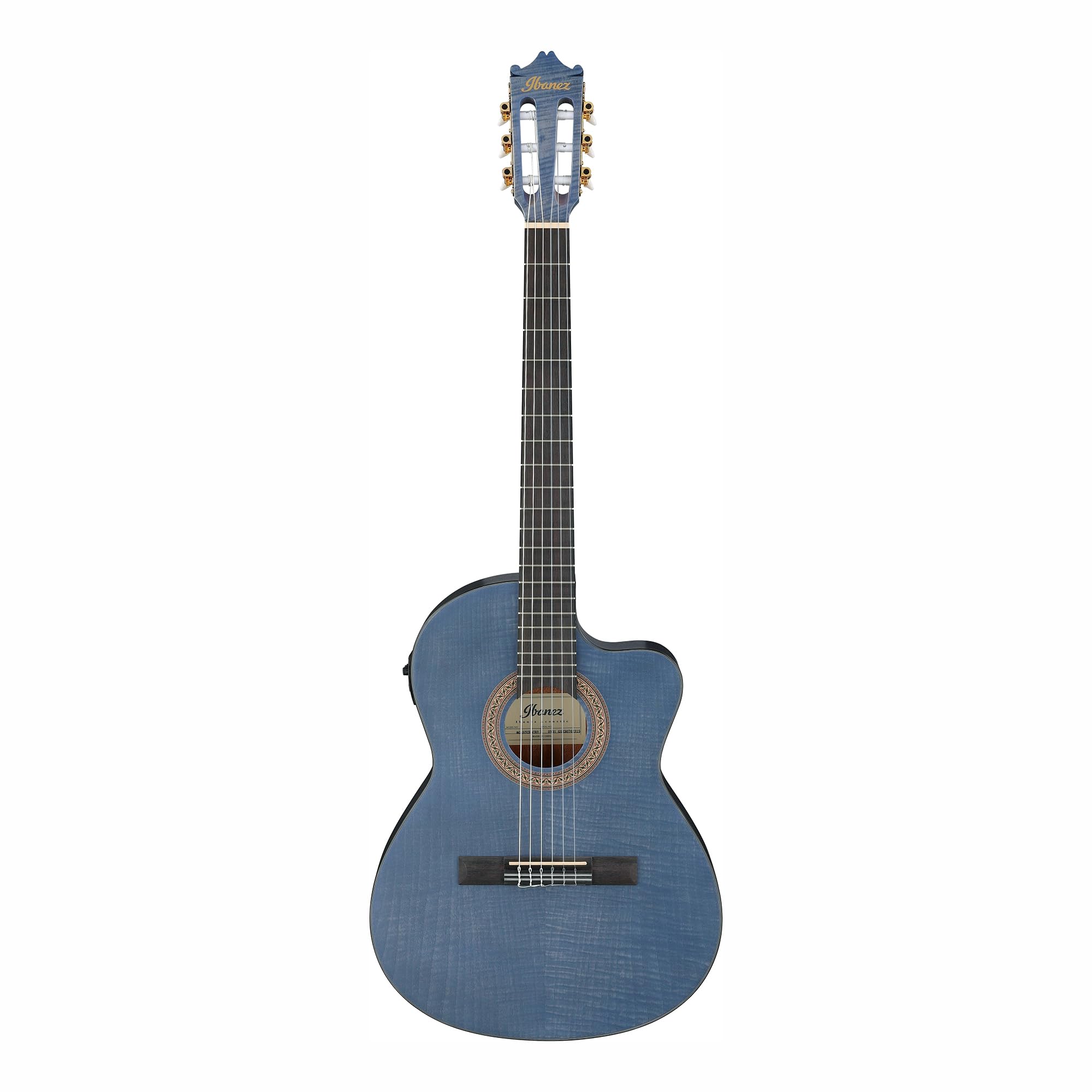
Soft nylon strings meet a slim body built for on-stage comfort.
If steel strings have always chewed up your fingertips, this is the alternative worth knowing about. It’s a nylon-string acoustic-electric, so the strings are soft under your fretting hand — the feedback here repeatedly praises how easy it is on the fingers and how great it feels in your hands. Classical players and anyone with hand fatigue will find this dramatically kinder than a steel-string dreadnought.
The build leans toward the exotic. A flamed maple top sits over laminate sapele back and sides, with an okoume neck and a purpleheart fingerboard that also serves as the bridge material. The open pore Berry finish skips the thick gloss so the wood grain shows through. On the electric side an Ibanez undersaddle pickup translates the nylon voice to an amp, which is exactly what you want for a plugged-in classical gig.
The thinline body is the trade-off to understand. Its shallower profile is what keeps it comfortable for long sets, but a slim body simply moves less air than a deep one, so expect a quieter unplugged voice than the dreadnought picks. The tuning keys get specific praise for being smooth and accurate, which matters on nylon strings that can wander while they settle in.
fingerstyle pick: you want nylon softness and a slim, stage-friendly body that won’t fight your fingertips.
want steel strings: you need maximum unplugged volume from a deep, resonant body.
5. Fender CD-60SCE All-Mahogany Dreadnought Cutaway Acoustic Electric Guitar
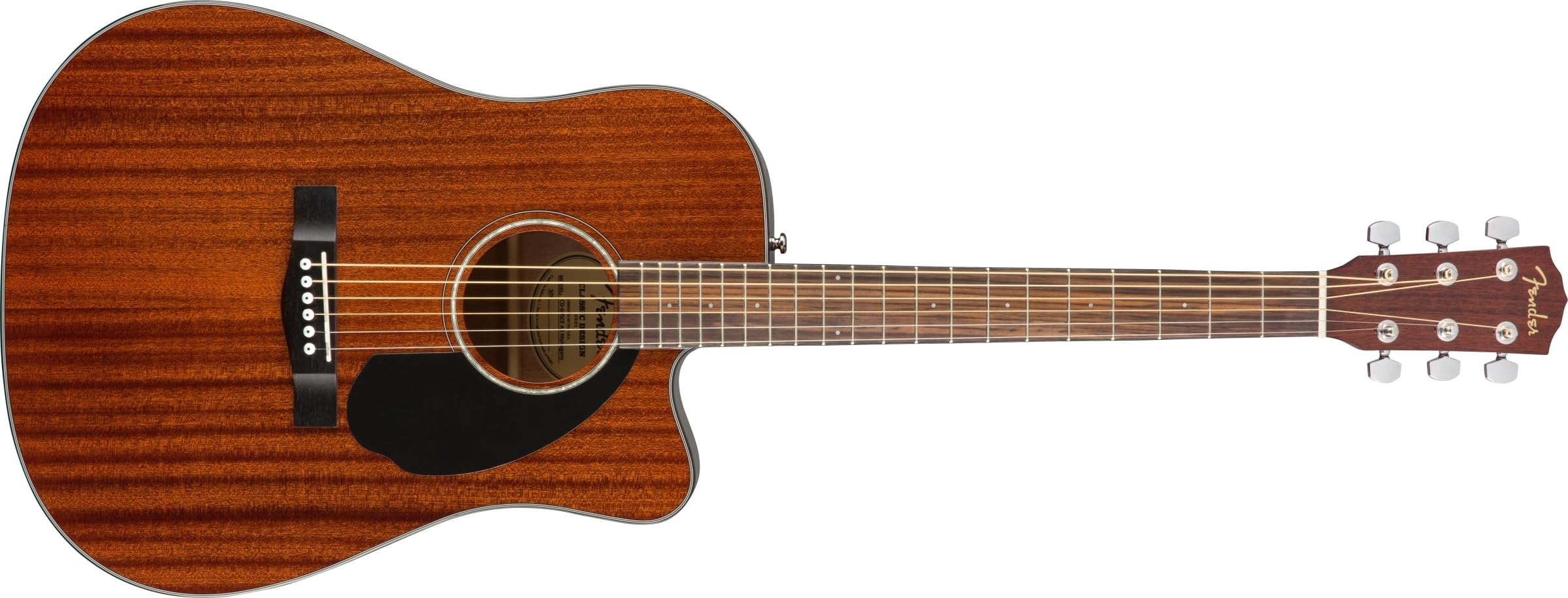
All-mahogany warmth with a Fishman heart and a neck that plays easy.
Wood choice sets the mood here, and it’s mahogany from front to back. The solid mahogany top uses scalloped X-bracing — a pattern of braces carved thinner at the edges to let the top flex more freely — and mahogany back and sides complete the picture. The result is a warm, even voice that suits singer-songwriters and strummers who want body without brittle brightness. If you’ve compared this to the solid spruce Yamaha above, that’s the real exercise: spruce for sparkle and projection, mahogany for roundness and warmth.
The plugged-in half is handled by a Fishman Classic Design pickup and preamp, a well-known name in acoustic amplification, and there’s a built-in tuner that’s earned praise for accuracy. A two-year warranty backs the whole thing. The neck is where Fender leans on comfort — rolled fingerboard edges smooth the transition where your hand moves along the fretboard, so it feels broken in rather than sharp on the first day.
One thing to keep on your radar: tuning-holding comes up mixed, so expect to settle new strings and give the tuners a fair shake before you judge. Otherwise, learners and intermediate players report it as easy to play, and it’s a full-size dreadnought with real presence when you dig in.
all mahogany warmth: all-mahogany with scalloped X-bracing gives a warm, balanced voice that flatters vocals.
muted highs: will it stay in tune? Give new strings a settling period and check the tuners, since that’s the one area with mixed feedback.
warm strumming: warm mahogany tone plus a comfortable rolled-edge neck is exactly the feel you’re chasing.
want bright tone: you want the bright, cutting projection of a spruce top instead.
6. Ibanez AEG50 Acoustic-Electric Guitar – Indigo Blue Burst High Gloss
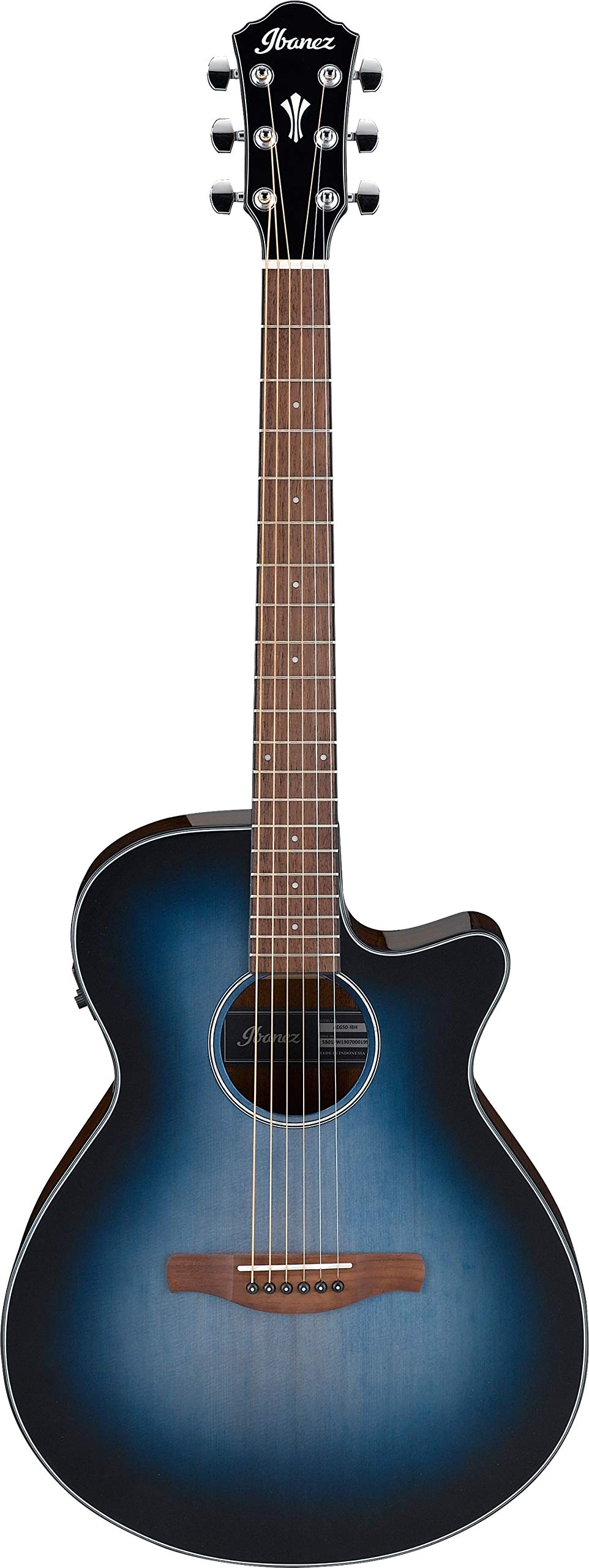
Built to sound just as good through an amp as it does on the couch.
This is the one for the player who knows they’ll spend most of their time plugged in. The 1/4″ TS connector (the standard mono guitar jack) feeds cleanly into amps and effects pedals, and the feedback specifically calls out that it plays well with both. If you’re layering in a reverb pedal or running into a small combo amp, this guitar was clearly designed with that signal path in mind.
The acoustic foundation is spruce top with sapele back and sides, a classic pairing that gives a bright, articulate starting tone. A walnut fingerboard and nyatoh neck keep the fretboard comfortable, and it ships with Ibanez IACSP6C strings and Ibanez Advantage bridge pins. The indigo blue burst high gloss finish is the kind of color that actually gets noticed on a stand.
Two honest notes. Body thickness comes up as mixed — some players find the profile not quite what they expected — so if you like a deep body, check the specs against your preference. And build quality is also mixed. Neither is a dealbreaker, but both are reasons to inspect the instrument on arrival. The rich colors and built-in tuner get solid praise.
stage looks: the gigging player who wants a clean pedal-friendly jack and a spruce voice that survives amplification.
need pro preamp: body thickness and build consistency are dealbreakers you can’t compromise on.
7. Yamaha FSX800C Small Body Solid Top Cutaway Acoustic-Electric Guitar, Ruby Red

The concert-size sibling that keeps the solid top but drops the bulk.
You get the same electronics in a smaller body. This is the concert-body version of the FGX800C, so it carries the identical System 66 preamp — under-saddle piezo pickup, 3-band EQ, adjustable mid-range frequency control, and a precision chromatic tuner — but sits lighter against you. If the full dreadnought up top felt like too much guitar, this is the fix without giving up the sound-shaping panel.
The acoustic build holds up to the name. Solid Sitka spruce top, nato back and sides, rosewood fingerboard and bridge, diecast tuners, and an adjustable truss rod for dialing in neck relief. At 4.4 pounds the body is easy to hold for long practice stretches, and the ruby red finish makes it one of the more distinctive colorways in this lineup.
What you give up is volume. A smaller body simply doesn’t move as much air, so the unamplified voice won’t match a dreadnought in a jam session — plugged in, that gap closes. This is the pick for fingerstyle players, smaller framed players, and anyone who plays seated more often than standing. The guitar also comes in a smaller shipped footprint than the larger dreadnought models, which helps if storage is tight.
small body comfort
- Same capable System 66 preamp as the flagship pick — full EQ plus chromatic tuner
- Solid Sitka spruce top for resonance in a more manageable concert body
- Adjustable truss rod for seasonal neck adjustments
- Lighter body weight makes long practice sessions less tiring
less bass
- Concert body projects less than a dreadnought when played unplugged
- Ruby red won’t suit players who want a traditional natural finish
couch playing: fingerstyle and seated players who want solid-top tone and full preamp controls in a body that won’t overpower them.
need dreadnought: strummers who need dreadnought-level volume at an unplugged jam.
8. Enya X3 PRO Carbon Fiber 41-Inch Smart Acoustic-Electric Travel Guitar
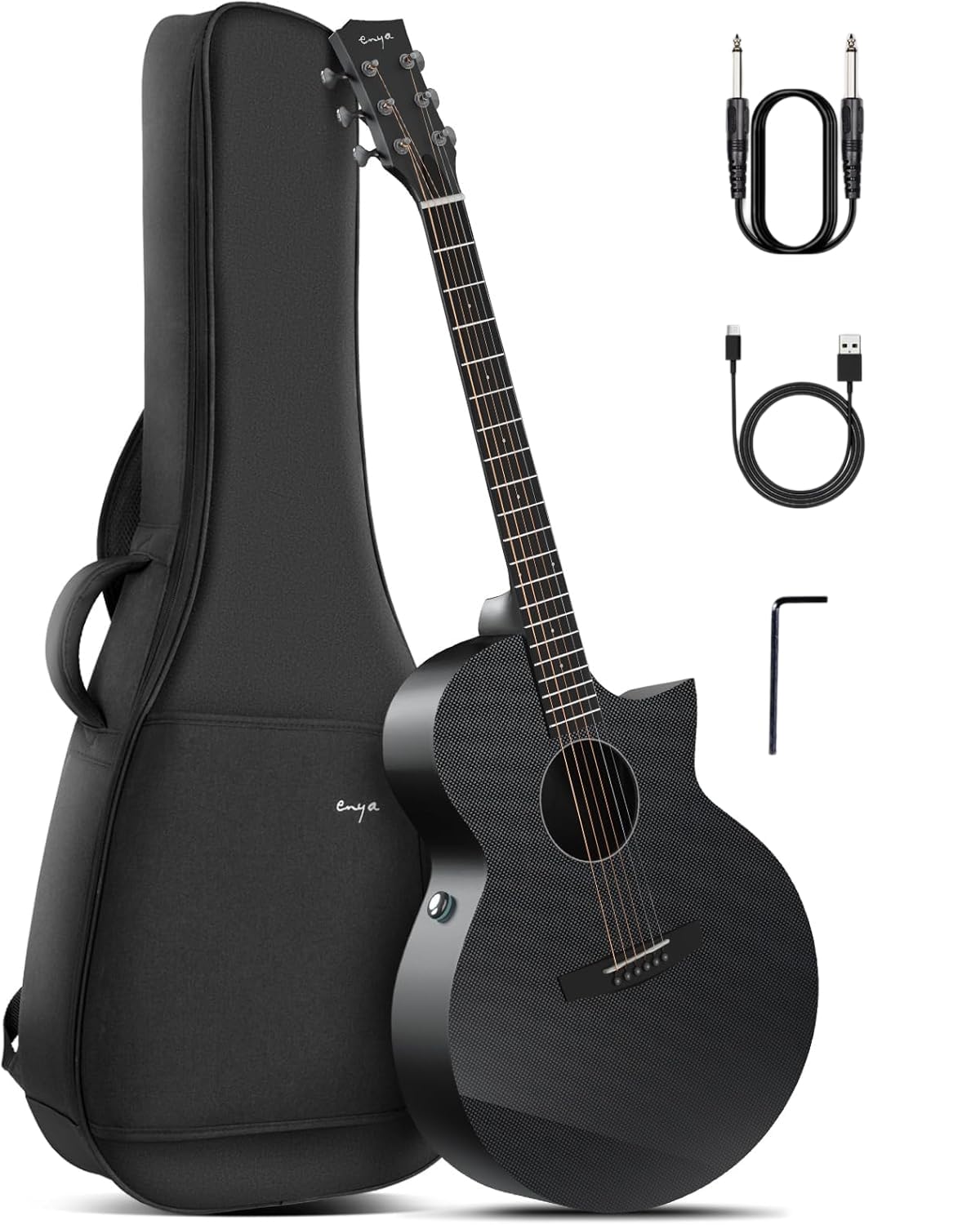
Carbon fiber, built-in effects, and Bluetooth in one weather-proof package.
Wood guitars hate humidity swings and temperature changes; carbon fiber doesn’t care. The Enya X3 PRO is built entirely from carbon fiber, so it resists humidity, temperature shifts, and cracking in a way no wooden instrument in this roundup can. That makes it the obvious companion for camping, beach trips, and road travel — the conditions that would have you babying a solid spruce guitar.
Then there’s the “smart” part. The AcousticPlus SP1 pickup system runs reverb, chorus, delay, and wah directly from the guitar, so you need no amp or pedals to add color to your sound. It also functions as a Bluetooth speaker, which is unusual and genuinely useful for playing along to backing tracks or practicing with a metronome. The improve neck system and R.S.B carbon fiber technology are aimed at richer resonance and louder projection, and the kit arrives with a thickened gig bag, instrument cable, USB-C charging cable, and adjustment wrench.
One honest caution: the electronics generally work well, but some owners have had them fail over time, and action height gets mixed reviews — so budget for a professional setup if the frets feel high out of the bag. When it’s right, the tone is genuinely striking for the material. As owners put it, it sounds “like a boutique instrument.” That mix of travel-ready durability plus effects makes it wholly unlike the traditional wooden picks here.
travel guitar: frequent travelers and outdoor players who want weather-proof carbon fiber plus on-board effects and Bluetooth without carrying an amp.
want wood tone: action may need attention out of the bag, and electronics reliability has occasionally been an issue.
9. Martin LX1E Little Martin Solid Sitka Spruce/Mahogany HPL Acoustic/Electric

Small enough for the overhead bin, voiced bigger than its size suggests.
Martin’s smallest guitar is the travel solution that actually fits where you need it. Sized as a travel guitar, it’s been described by owners as perfect for the overhead bin on airplanes — the specific pain this small body solves. Rather than buy a second guitar for trips, this one slips into the cabin with you. The warm satin finish keeps the look subdued and easy to live with.
Under the hood, it pairs a solid Sitka spruce top with mahogany high-pressure laminate (HPL) back and sides. HPL is a dense, resin-bonded laminate that holds its shape through humidity and temperature shifts, which is why it makes sense on a guitar that travels. A Fishman Isys T system handles the electric side so you can plug into a PA when you get where you’re going. The Richlite fingerboard and bridge give a smooth, durable playing surface, and it stays in tune reliably.
Yes, it’s a small body, so the acoustic volume has limits — that’s the physics of the form, not a flaw. What it will do is make the guitar you actually take with you. Setup from the shop is usually solid, and the sound quality and ease of play are consistently praised. Campfire, hotel room, back porch: this is the one that goes.
compact spruce top: solid Sitka spruce top with HPL back and sides — stable enough to travel, resonant enough to be a real guitar, not a toy.
small projection: small-body volume is modest unplugged, so treat it as a portable instrument, not a dreadnought substitute.
practice guitar: air travel and keeping a guitar within reach on the road are your priorities.
need full size: you need big, room-filling unplugged volume as your main instrument.
10. Taylor GS Mini-e Mahogany Acoustic-electric Guitar – Natural

A small body that punches well above its footprint in tone.
Taylor’s GS Mini line is the small-body guitar that made the format respectable, and the mahogany version leans warm. A mahogany top over sapele laminate back and sides gives you a tight, focused voice — more midrange punch than the spruce choices here, which cuts through in a mix. The ebony fingerboard is a premium touch, giving the neck a smooth, dense feel under your fingers.
For this hybrid lineup, the small body is the point. It’s easier to hold for long sessions, fit into a corner, and carry to a friend’s house, while still giving you an acoustic-electric pickup for plugging in. The overall package arrives with a gig bag so it’s ready to move. If the concert-size Yamaha was almost right, this is the step up in wood quality.
The catch is small-body physics again — the GS Mini can’t deliver the chest-thump of a full dreadnought when played unplugged. For players who value comfort and clarity over sheer volume, that’s an easy trade to accept. The sound quality and easy playing are exactly what gets praised, from beginners up.
travel pick: players who want a genuinely portable acoustic-electric with a warm mahogany voice and a premium ebony fretboard.
want full scale: like any small body, it trades some unplugged volume for comfort and portability.
11. Taylor 114ce-S Acoustic-electric Guitar – Natural Sapele

The serious stage tool with Taylor’s proprietary amplified system.
For a player whose hybrid guitar lives on a stand, plugged into a house PA most nights, this is the one with the most purposeful electronics. Taylor’s Expression System 2 is their proprietary pickup and preamp design, and it’s the sort of system built for players who care how the guitar sounds through a system, not just in a room. A spruce top over sapele back and sides keeps the acoustic foundation bright and balanced.
The premium shows in the neck and fingerboard. A maple neck and Macassar ebony fingerboard sit over a fixed West African Crelicam ebony bridge, and the whole guitar ships with a gig bag. The Grand Auditorium body shape is the balance for many players — a touch smaller than a dreadnought but with more depth than a true small body, which makes it a natural fit for stage and studio work.
Given the electronics focus, it is the least beginner-oriented pick here, and the setup and polish reflect that intent. If you’re mostly a living-room strummer, the wooden picks up top will serve you just as well for less outlay. But if amplified tone is the priority, this is the system designed for it.
sapele grand auditorium: Expression System 2 electronics and a Grand Auditorium body make it a stage-first hybrid.
pricey for some: casual strummers happy with a simpler preamp can save by choosing a less specialized model.
versatile player: your main use is amplified performance and you want Taylor’s dedicated Expression System 2 handling the signal.
on tight budget: you rarely plug in and would be paying for a stage tool you won’t use.
Understanding the Specs
Solid Top vs. Laminate Top
A solid top is a single continuous piece of wood, and it tends to vibrate more freely and “open up” as it ages, giving richer resonance. A laminate top is glued up in layers, which makes it more stable and predictable across changing humidity — handy for a first guitar you don’t want to fuss over. Neither is broken; they’re different bets on resonance versus stability.
Preamp and EQ
The preamp is the side-mounted control panel that shapes your plugged-in signal. A 3-band EQ gives you separate low, mid, and high dials. An adjustable mid-range frequency control adds a sweep knob for the midrange band, where acoustic guitars often develop a boxy sound through a PA. A chromatic tuner reads any note in the scale so you can tune without a separate device.
Body Size and Projection
A dreadnought is the large, deep body that projects the most unplugged volume. A concert or small body is shallower and easier on the shoulder, better for fingerstyle and seated playing but quieter unplugged. A thinline body is slimmer still. Match the body size to where you play, not to what looks prettiest on the wall.
Pickup Type
An under-saddle piezo pickup is a sensor that sits beneath the bridge saddle and reads string vibration, which is the most common acoustic-electric design. An undersaddle pickup in a nylon-string guitar does the same job for softer strings. The pickup converts string movement into an electrical signal your amp or PA can reproduce.
FAQ
Can I plug an acoustic-electric hybrid guitar straight into a PA system?
Is a solid top worth it over a laminate for an acoustic-electric?
What do the EQ and mid-range controls on the preamp actually do?
Will a nylon-string guitar still work plugged into an acoustic amp?
Is a carbon fiber guitar like the Enya X3 PRO good for travel and outdoor use?
Does a small-body guitar still sound good, or is it just for practice?
What is the difference between a dreadnought and a concert body for plugged-in playing?
How do I keep an acoustic-electric guitar in tune after changing strings?
Do I need an amp to use an acoustic-electric guitar at home?
Can the Enya X3 PRO’s built-in Bluetooth replace a separate amp for practice?
Is a travel-size guitar like the Little Martin hard to play for an adult?
Final Thoughts: The Verdict
For most players, the winner is the Yamaha FGX800C. It pairs a solid Sitka spruce top with the System 66 preamp — a 3-band EQ, an adjustable mid-range frequency control, and a chromatic tuner — so it sounds right both unplugged and through a PA. That solid-top-plus-System-66 pairing is why it sits at 4.5+ stars across 200+ owners.
If you want an everything-included first guitar, grab the Fender FA-125CE Bundle — gig bag, strap, strings, picks, and a lesson DVD in one box. For a weather-proof travel companion with built-in effects and Bluetooth, the Enya X3 PRO is the one to reach for. And if nylon softness suits your hands, the Ibanez GA5FMTCE thinline gives you that classical feel on stage.
Whichever you pick, match the body size to where you actually play and the preamp to how often you plug in.
How We Picked
We do not accept paid placement. Every pick is matched to a real buyer and a real use-case; we do not hands-on test units.
Sources & Methodology
Specifications: manufacturer listings and product documentation. Review insights: verified customer reviews, as of November 2026. Pricing: not shown on this page (it changes often); check the current price via the retailer link.
As an Amazon Associate, Gadgets Feed earns from qualifying purchases. This does not affect which products we feature.