
Our readers keep the lights on and my morning glass full of iced black tea. As an Amazon Associate, I earn from qualifying purchases.
Specs are compiled from manufacturer listings and verified buyer reviews and can change over time — please confirm the key details on the product page before buying.
If you plug an acoustic guitar into a plain electric amp, you usually get a thin, quacky sound and a feedback squeal the moment you turn up — that is exactly why acoustic amps exist as a separate purchase. An acoustic amp is built to reproduce the natural voice of a piezo pickup or a microphone without coloring it, and the right one for you depends on whether you perform on battery power, in a bedroom, or through a house PA.
I’m Min — the founder and writer behind Gadgets Feed. This guide is built by comparing the manufacturers’ published specifications and the patterns across verified customer reviews, so you get each pick’s real strengths and trade-offs instead of marketing spin.
Here is the short version before the details: the Fender Acoustasonic 40 is the strongest all-round choice for most players, the JOYO AC-40S is the one to grab if you busk without an outlet, and the BOSS ACS-Live is the ceiling if your budget stretches. Below you will find the full breakdown of the best acoustic guitar amp options for practice, small venues, and street performance.
Our Picks at a Glance

How To Choose The Best Acoustic Guitar Amp
Choosing an acoustic amp is less about the logo on the front and more about matching three things: how loud you need to be, whether you have a wall socket nearby, and whether you sing through the same box. Get those three right and almost any well-reviewed amp will serve you for years.
Wattage decides the room, not the bedroom
Watts are the measure of how much clean volume the amp can push before it starts to distort. A 40-watt amp is comfortable in a coffee shop or a living room, while a 100-watt amp is the one you reach for when a crowd is talking over you. If you only ever play at home, lower wattage keeps things simple and light.
Battery power versus mains power
A rechargeable battery means you can set up at a farmers market, a park, or a pub garden with no outlet in sight. The trade-off is that runtime drops as you turn the volume up, so a battery amp rated for a full evening at moderate volume may only give you a couple of hours at full tilt.
Channels, inputs, and phantom power
A second channel with an XLR input is what lets you plug in a microphone and sing while you play. Phantom power is a small voltage sent up the microphone cable — it is what a condenser mic needs to work, and without it you are limited to dynamic mics. If you perform solo with vocals, this feature matters more than almost anything else.
Acoustic voicing and effects
Acoustic amps are tuned to keep the sparkle and body of a piezo pickup rather than the midrange crunch of an electric. Built-in reverb, chorus, and delay save you from buying pedals, and a phase switch or feedback suppression lets you stand in front of the speaker without a howl.
Quick Comparison
| Model | Best For | Wattage | Channels | Battery | Amazon |
|---|---|---|---|---|---|
| Fender Acoustasonic 40★ Best Overall | All-round home and small-venue playing | 40W | 2 (instrument + XLR mic) | No | Amazon |
| JOYO AC-40SBest for Travel | Busking and outdoor performance | 40W stereo | 2 (guitar + mic) | Yes, up to 6 hours | Amazon |
| Coolmusic BP40DMost Channels | Small bands with multiple instruments | 80W | 6 inputs | Yes, 6-8 hours | Amazon |
| Yamaha THR5A | Bedroom practice and travel | 10W (5W battery) | 1 | Yes, battery option | Amazon |
| Coolmusic BP80 | Outdoor gigs with no outlet | 100W | 6 inputs | Yes, 6-8 hours | Amazon |
| Fishman Loudbox Micro | Portable home practice and studio | 40W | 2 (instrument + mic) | No | Amazon |
| Vox VX50AG | Intimate gigs with tube warmth | 50W | 2 (instrument + mic) | No | Amazon |
| Fishman Loudbox Mini BT | Performers who need PA integration | 60W | 2 | No | Amazon |
| BOSS ACS-Live | Full feature set for gigging players | 60W | 2 | No | Amazon |
In‑Depth Reviews
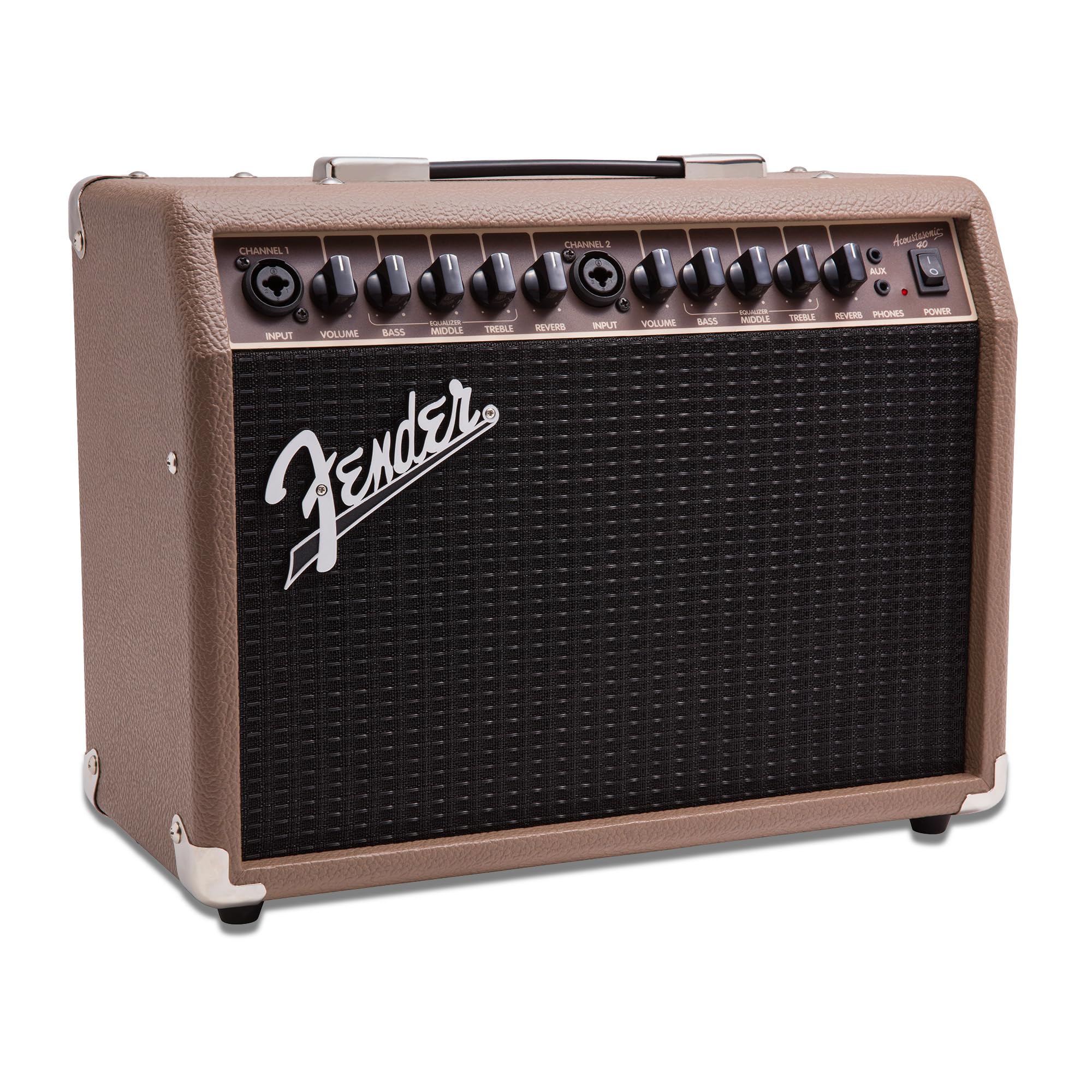
1. Fender Acoustasonic 40-Watt Acoustic Guitar Amplifier
Our pick — over 4.5★ from 700+ verified ratings; the strongest balance of quality and price.
The singer-songwriter’s default box — one input for the guitar, one for the voice.
If you play acoustic and sing at the same time, this is the amp to start with. It runs 40 watts through a pair of 6.5-inch speakers, and the front panel gives you a standard quarter-inch jack for your instrument plus an XLR input for a microphone. That means your guitar and your vocal each get their own path into the box instead of fighting over one.
What makes it interesting under the grille is a “whizzer” cone — a small supplementary speaker cone attached to the voice coil of the 6-inch speaker. In plain terms, that adds a bit of high-end sparkle so fingerpicked strings keep their detail instead of turning muddy. The instrument channel also carries built-in reverb, which is the effect most acoustic players leave on permanently. At 40 watts it delivers plenty of volume for a coffee shop or a small room, and it holds up outdoors too.
The cabinet is compact enough to carry in one hand and it weighs 10 pounds, so it will not wreck your back loading in and out. One long-term owner replaced a 20-year-old Acoustasonic Jr. and found the new box smaller and lighter at the same 40 watts, with no loss in volume or quality. The recurring gripe across the review pages is a hiss or buzz when the amp is powered on, plus an audible thump on shutdown — the sort of thing you notice in a quiet recording room but forget about at a gig. If you plan to track with it, expect to work around that noise floor.
The case for it
- 40 watts with dual 6.5-inch speakers for balanced acoustic tone
- Separate XLR mic input so you can sing and play through one amp
- Built-in reverb on the instrument channel with three tone controls per channel
- 10 pounds and compact for easy carry to practice or a small venue
What to weigh
- Audible hiss and a power-off thump show up in quiet settings
- No battery, so you need a wall socket every time
- 40 watts is plenty for a small room but not a loud full band
Reach for this if: you want a dependable one-box solution for acoustic guitar plus vocals at home or in a small venue.
Think twice if: you busk with no power available, or you need a dead-quiet amp for recording.
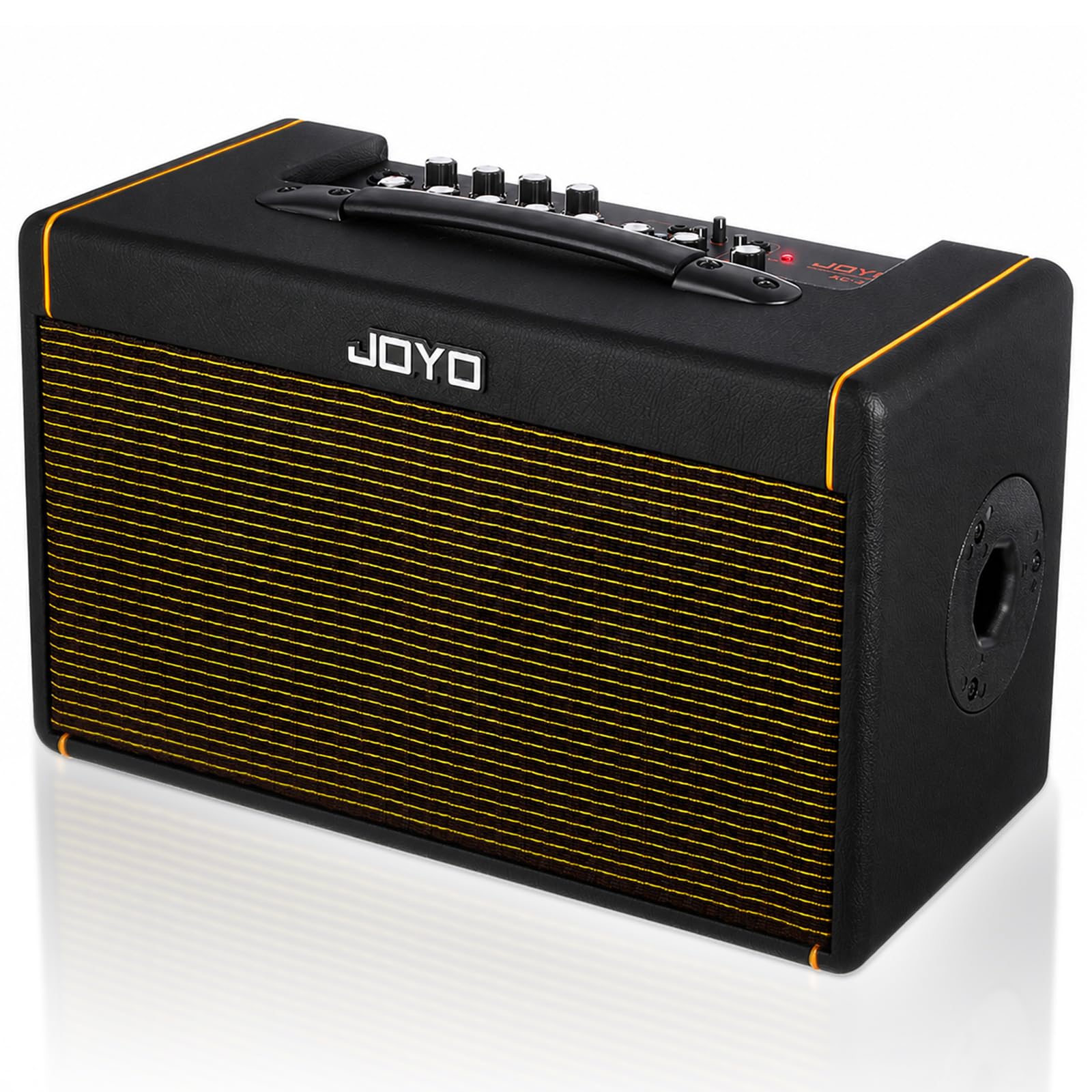
2. JOYO 40W Acoustic Guitar Amp Portable Stereo Amplifier with Bluetooth
Stereo sound and a rechargeable battery in a box light enough to sling in the car.
The battery is the headline here — a built-in 14.8V / 4.4Ah rechargeable pack runs up to 6 hours at moderate volume, and you can plug in and keep playing while it charges. For anyone who sets up at a market stall or a park bench, that is the difference between playing and packing up early. Buyers report the battery carried a full two-hour acoustic gig without drama.
It is voiced specifically for acoustic guitar rather than being a general-purpose combo. Two 6.5-inch speakers run in stereo rather than mono, which spreads the sound out instead of pointing it at one spot. The guitar channel starts with a three-band EQ (bass, mid, treble) and then adds chorus, delay, and reverb that you can stack or run one at a time — real effects, not a single token knob, so you do not need to buy pedals to sweeten your tone. The mic channel has its own bass, treble, and reverb controls.
For creators there is a USB-C port that handles direct recording to your phone or computer with no interface in between, plus Bluetooth 5.0 for backing tracks and an AUX input. It weighs 8.6kg (18.9 lbs), which is portable but not featherweight, and it has a standard speaker-stand mount for street performers. One honest caveat: the guitar channel is built for acoustic-electric guitars with most modern active and passive pickups, but low-output passive pickups may not drive it enough — in that case you need an external preamp.
Where it earns its place: this is the only pick here that pairs stereo acoustic voicing with a battery, USB-C recording, and Bluetooth in one cabinet, which makes it the natural choice for a solo performer who never knows if there is an outlet.
The honest trade-off: no phantom power, so condenser mics are off the table — you are limited to standard dynamic microphones for vocals.
Suits the busker and the market-stall player: anywhere the nearest socket is a walk away.
Not the one for you if: your guitar has a low-output passive pickup or you sing through a condenser mic.
3. Coolmusic BP40D Powered Acoustic Guitar Amplifier
Six inputs and real 80-watt power in a cabinet you can still carry alone.
Here is the number that separates this amp from the cheaper end of the list: 80 watts, double what the Fender Acoustasonic 40 puts out. That extra headroom is why it cuts through bar chatter and outdoor noise where a smaller amp starts to strain. It drives two 6.5-inch woofers plus two 2-inch tweeters, so the sound stays clear even when you push the volume.
The input count is the other reason people buy it. Four instrument inputs and two auxiliary inputs let you connect two guitars or keyboards, two microphones, and two phones or computers at once — enough for a small band to plug straight in. The microphone interface carries 48V phantom power, which means it will run condenser mics as well as dynamic ones, and each input has independent volume plus a three-band EQ so everyone can be balanced on the spot.
Owners run this on a rechargeable battery for 6-8 hours depending on volume after a five-hour charge, and it works on mains power too, so you are never stuck. That said, an electrical engineer who reviewed it flagged the weight and size as the real cost — it is a 15-pound box, not a throw-it-in-a-backpack amp. The recurring complaint elsewhere is the lack of onboard amp modeling or overdrive, so if you wanted electric-guitar-style grit, look elsewhere. For pure acoustic and vocal work, the faithful sound and the channel count are the payoff.
Where it wins
- 80 watts pushes clean volume past a small-room amp
- Six inputs cover two instruments, two mics, and two aux sources
- 48V phantom power runs condenser microphones
- 6-8 hours of battery and mains operation both available
The trade-offs
- Heavy at roughly 15 pounds for carrying to and from gigs
- No amp modeling or overdrive onboard
- The EQ can run bassy, so expect to dial the low end down
The pick for a duo or small band: when more than one person needs to plug into the same box.
Look past it if: you want a compact amp to carry in one hand or you need electric-guitar distortion.
4. Yamaha THR5A Mini Acoustic Guitar Amplifier

A desktop practice amp that simulates studio microphones on your guitar signal.
At 10 watts on mains power and 5 watts on battery, this is not the amp you take to a noisy bar. It is the amp you keep on a desk. The thing that justifies its price is mic modeling — it simulates classic tube condenser and dynamic microphones on your guitar signal, then stacks studio-grade effects on top, which gives you a recording-studio-style tone straight from the amp rather than a flat digital copy of one. It also ships with the Cubase AI production software, so you can go from practicing to recording without buying anything else.
Fingerpickers tend to love what it does with reverb and delay, and owners describe playing one through a GS mini at home and bringing it out for small get-togethers thanks to the handle on top. It accepts batteries, so it travels. The size — a compact desktop footprint weighing 2kg — is the whole point, and it still produces more depth and richness than you would guess from 10 watts.
The honest catch is durability and scale. Repeat owners have replaced one after roughly two years, and the volume ceiling is real — it is a home practice and quiet-setting amp, not a performing amp. balance: writing, looping, and practicing at home with genuinely musical tone.
Read of it: the mic modeling is the reason to buy it — it is the closest thing here to plugging your guitar into a studio chain, and no other amp on this list offers that specific simulation of classic condenser and dynamic microphones.
Know before you buy: it runs 10 watts on mains power and drops to 5 watts on battery, so it is a practice companion rather than a gigging amp.
Perfect if your playing happens at a desk and you want studio-style tone plus recording software in one small box.
Wrong fit if you need to fill a room or stand up to repeated heavy use over many years.
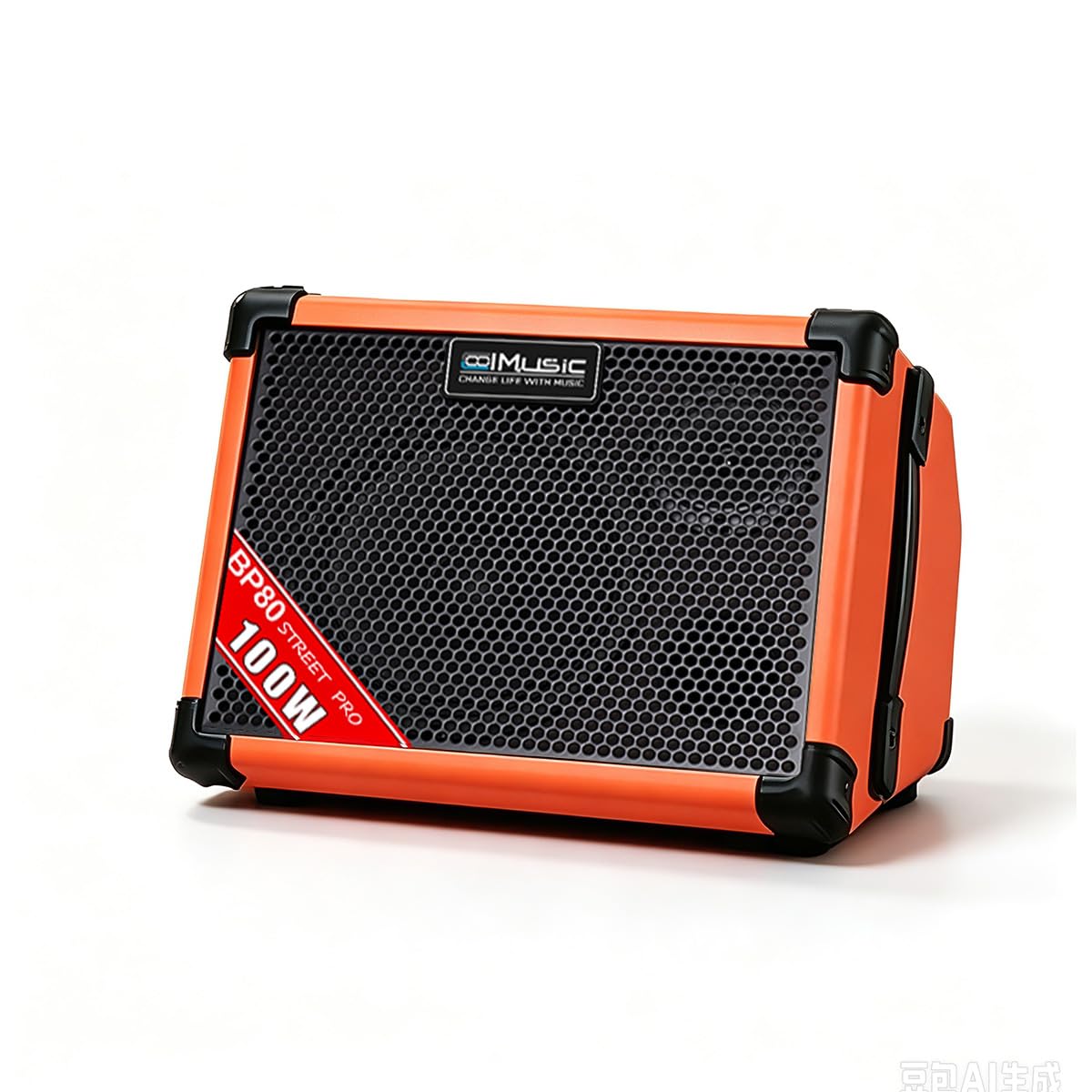
5. Coolmusic BP80 Battery Powered Acoustic Guitar Amplifier
The loudest box on this list, and it still runs on its own battery.
When an audience is talking over you and you have no wall socket, this is the amp that wins. It puts out 100 watts through an 8-inch woofer and a 3-inch tweeter, runs 6-8 hours on a charge depending on volume, and charges in five hours. Owners running it at outdoor venues on battery reported turning the volume down rather than up, with audience and staff commenting on the sound.
Like its smaller sibling, it carries six inputs — four instrument inputs and two auxiliary inputs — so it can host two instruments, two microphones, and two phones or computers at once. The mic interface includes 48V phantom power for condenser mics, and there are independent EQ adjustments with low, mid, and high frequency control. Bluetooth handles backing tracks and karaoke, and the master control, headphone input, and DI output give you options for routing to a desk.
The trade-offs are weight and honest wattage. It is a heavy amp to move around — an owner compared it directly against a 29-pound Carvin and a 16-pound Roland Cube, landing in between — and one buyer felt it played more like the loudness of a mid-tier amp rather than the full 100 watts on the label. The bass response is on the strong side, which you can tame with the EQ. Battery life also shrinks as you turn up, though owners using it for a three-hour set finished with plenty of charge left.
Why buyers pick it
- 100 watts through an 8-inch woofer and 3-inch tweeter
- 6-8 hours of battery, mains operation also supported
- Six inputs with 48V phantom power and independent EQ
- Bluetooth, headphone out, and DI output for flexible routing
What to know
- Heavy to carry, which shows up on every load-in
- Bass-forward voicing needs EQ adjustment for balance
- Rated loudness may feel lower than the wattage suggests to some ears
The one for outdoor sets with no power: loud enough to beat crowd noise on battery alone.
skip it if: you need something you can tuck under one arm or you prefer a leaner low end from the start.
6. Fishman Loudbox Micro 40-watt Acoustic Combo Amp

A lunchbox-sized Fishman that sounds bigger than its single 5.25-inch speaker should.
Fishman built its name on acoustic amplification, and this is the smallest way into that sound. It runs 40 watts through a single 5.25-inch speaker, with two channels — one for the instrument and one for a microphone — plus digital reverb and chorus, a master volume, and a 1/8-inch auxiliary input. There is also a balanced XLR D.I. output, which lets you send your guitar straight to a PA or recording interface when the room is bigger than the amp.
Owners describe a crisp response that tracks the touch of your fingers, and they use it for nylon-string classical guitars as well as acoustics and passive electrics. One long-time player takes it on senior music tours because it weighs 12.3 pounds and moves easily. The recurring complaint is a practical one: getting plugged in means an AC cord to the wall and a DC adapter to the AC brick before the instrument, so set-up takes a moment longer than a single lead. A less common gripe involved a unit arriving without its power cord, which is a shipping issue rather than an amp issue.
Why it holds its position: the D.I. output is the quiet feature that matters most — it turns a small practice amp into something that can feed a house PA, which is why it gets used in studios and small gigs rather than just at home.
The thing to plan for: no onboard battery, so every session needs a power source and a slightly longer set-up.
Pick this if you want genuine Fishman acoustic tone in a box small enough to live on a shelf and light enough to carry to rehearsal.
Choose differently if you need battery freedom or the deepest low-end thump from a bigger speaker.
7. Vox VX50AG 50-Watt Acoustic Guitar Amp

The one on this list with a tube in the preamp, and you can hear it.
Vox takes a different route to acoustic amplification with a NuTube-equipped preamp — a small vacuum-tube-style component that adds harmonic warmth to the signal before it reaches the speaker. The result is a rounder, warmer tone than the solid-state amps here produce, and players describe it as warm and punchy. Output is 50 watts through an 8-inch coaxial speaker with a tweeter, and the bass reflex structure strengthens the low end so your guitar has body without boom.
Both the instrument and mic channels get independent volume, EQ, and effects, and the instrument channel carries a phase switch that reduces feedback — the squeal you get when you stand in front of an amp too close. The mic channel provides phantom power, so a condenser mic is an option. There are also aux in, phones out, and line out jacks for routing to a mixer.
The caveat owners raise is durability confidence rather than sound. One review put it plainly: if it lasts a couple of years it is worth the price. That is not a reported failure rate — it is a player thinking out loud about a tube-equipped design. Treat it as an amp to handle with care and it rewards you with tone the solid-state boxes cannot match.
What earns it a spot
- NuTube preamp for warm, tube-flavored acoustic tone
- 50 watts through an 8-inch coaxial speaker with tweeter
- Phase switch cuts feedback on the instrument channel
- Phantom power on the mic channel and line out for a PA
The fine print
- Tube-equipped design raises long-term durability questions
- No battery power onboard
- 50 watts suits intimate venues more than loud rooms
The tone-first choice: for players who want warmth and detail over raw wattage, in bars and breweries rather than big halls.
Consider a different amp if: you want the reassurance of pure solid-state longevity or the option to play unplugged from the mains.
8. Fishman Acoustic Guitar Amplifier (PRO-LBT-500)

Sixty watts, two channels, and D.I. outputs that slot straight into a house system.
This is the amp that scales with you from the living room to a PA-equipped venue. It runs 60 watts across two channels with reverb and chorus effects, a master volume, and phase control, plus a quarter-inch input, a mic input, and both quarter-inch and 1/8-inch auxiliary inputs. The D.I. output is what makes the difference on stage — it lets you hand your signal to a front-of-house desk without miking the cabinet, and owners point out the XLR outputs make integrating with larger PA systems straightforward.
Bluetooth is on board for backing tracks, and owners mention it pairs quickly. Weighing 21.2 pounds, it is a serious piece of gear rather than a desktop toy, but the cabinet is compact enough that performers working in tight spaces still find it manageable.
One practical warning if you are buying outside the United States: an overseas 220V owner found no internal voltage switch, so a heavy external step-down transformer is required. That is worth checking before ordering. Otherwise, this is the balance for a working player who wants Fishman tone and flexible outputs without stepping up to the flagship price bracket.
Holds its place because: the combination of Bluetooth, two channels, and a balanced D.I. output makes it the most flexible amp here for players who sometimes play through their own speaker and sometimes through a venue’s PA.
Watch this: no battery, so you need mains power, and the 220V voltage question outside the US needs a transformer.
Best for the gigging singer-songwriter: someone who needs one amp that works solo at home and hands off to a PA on stage.
Avoid the mismatch if: you play off-grid on battery or you are outside the US and want a plug-and-play voltage setup.
9. BOSS ACS-Live Combo Amplifier for Acoustic Guitar and Vocals

The full stage rig in one cabinet — harmonies, a looper, and stereo output.
Everything the other amps here do, this one does with extra features stacked on top. The 60-watt bi-amp design splits the signal between a custom 6.5-inch woofer and a dome tweeter, and the dual channel configuration gives you discrete analog input electronics with three-band EQ on each channel — one for your guitar, one for your voice. Acoustic Resonance technology on the guitar channel works to restore the natural tone of stage guitars fitted with piezo pickups, which is the complaint that sends most players shopping for an acoustic amp in the first place.
The feature list is what justifies the premium tier. Automatic vocal harmony generates harmonies in real time by analyzing the key and chords coming from your guitar input, so you can add a second and third voice without another singer. There is a built-in looper for layering parts while you practice or perform, chorus on the guitar channel, delay and echo on the mic channel, and independent reverb on both. Anti-feedback controls on each channel keep things clean, and dual XLR D.I. outputs let you send each channel separately or mixed to a PA.
Players describe a sound that seems larger than the cabinet, and one owner summed it up simply: it is the best acoustic amp they have ever owned. The honest note is weight — the aspect where owners split most is exactly that — and the looper has a quirk where you cannot delete the last loop without erasing everything. Neither is a reason to walk away from a rig this capable if your set relies on harmonies, loops, and stage routing.
The case for the premium: no other amp here combines vocal harmony, a looper, per-channel anti-feedback, and separate D.I. outputs — it replaces several pedals and a separate vocal processor in one box.
Plan around this: it is a heavier cabinet to move, and the looper’s last-loop limitation takes some getting used to.
This is the gigging performer’s amp: when your set depends on harmonies, loops, and flexible output routing rather than a simple guitar-and-mic setup.
If you only strum at home: the extra processing is more amp than that job needs.
Understanding the Specs
Wattage and how loud it really is
Watts measure how much clean volume the amplifier can produce before the sound starts to distort. A 40-watt acoustic amp handles a coffee-shop set comfortably, while an 80-watt or 100-watt amp is what lets you ride above background conversation. Wattage does not scale neatly with loudness — it takes a significant increase in power for a noticeable jump in volume, so a 40-watt and an 80-watt amp are not as far apart as the numbers suggest.
Speaker size and tone
Bigger speakers move more air, so they generally produce a fuller low end. An 8-inch woofer with a dedicated tweeter can deliver more body than a single small driver, while a coaxial speaker with a tweeter built into the center gives a more compact cabinet and tighter sound. Plastic or composite cabinets tend to be lighter, while wood enclosures weigh more but can shape the tone differently.
Channels, inputs, and phantom power
A channel is an independent path for a signal — a two-channel amp lets you plug in a guitar and a microphone and control each separately. Phantom power supplies a small voltage up the mic cable for condenser microphones, which cannot work without it. If you only sing through a dynamic microphone, you do not need phantom power, but having it keeps your mic options open.
Battery power and runtime
A rechargeable battery makes an amp truly portable, but runtime shrinks as you push the volume. An amp rated for a full evening at moderate volume may last only a couple of hours at full blast, so plan for the loudest part of your set rather than the quietest. Most battery amps can also run on mains power while connected, which means a low battery does not have to end the performance.
FAQ
Can I use a regular electric guitar amp for an acoustic guitar?
What does phantom power do on an acoustic amp?
How long does a battery-powered acoustic amp actually last?
Is 40 watts enough for a small gig?
What is a whizzer cone and why does it matter?
Can I plug a microphone and a guitar into the same amp?
How do I stop my acoustic amp from feeding back?
Does the BOSS ACS-Live really create vocal harmonies on its own?
Will a passive pickup work with a battery-powered acoustic amp?
What is the difference between a two-channel and a six-input acoustic amp?
Final Thoughts: The Verdict
For most players, the acoustic guitar amp worth building a setup around is the Fender Acoustasonic 40 — 40 watts, dual 6.5-inch speakers, a whizzer cone for high-end detail, and a separate XLR input for a microphone, all in a 10-pound cabinet. It carries the highest rating on this list, and its 40 watts and 10-pound cabinet cover practice, small venues, and outdoor sets.
If you busk or play anywhere without a socket, the JOYO AC-40S is the one to reach for, since its rechargeable battery runs up to 6 hours and it adds stereo speakers, Bluetooth, and USB-C recording. When the room is loud and the crowd is louder, the Coolmusic BP80 steps in with 100 watts on battery power. And if your set leans on harmonies, a looper, and separate D.I. routing, the BOSS ACS-Live is the amp that replaces half a pedalboard.
One honest nudge before you decide: the Fender holds the top score here, but the Coolmusic BP80 and BP40D carry more owner ratings, so if you want 80-100 watts or six inputs instead of a 10-pound cabinet, that headroom is worth weighing against the rating. Otherwise, match the amp to how you actually play and you will not go far wrong.
How We Picked
We do not accept paid placement. Every pick is matched to a real buyer and a real use-case; we do not hands-on test units.
Sources & Methodology
Specifications: manufacturer listings and product documentation. Review insights: verified customer reviews, as of September 2026. Pricing: not shown on this page (it changes often); check the current price via the retailer link.
As an Amazon Associate, Gadgets Feed earns from qualifying purchases. This does not affect which products we feature.