
Tracking down an elusive gas or refrigerant leak by smell alone is frustrating, unreliable, and potentially dangerous. A quality acoustic leak detector uses advanced sensor technology to convert invisible gas concentrations into clear audio and visual cues, allowing you to pinpoint the exact source of a leak in minutes rather than hours of guesswork.
I’m Min — the co-founder and writer behind Gadgets Feed. I’ve spent hundreds of hours analyzing technical specifications, customer reports, and sensor performance data to separate the truly sensitive, durable detectors from the false-positive-prone gadgets that waste your time.
Whether you are a homeowner checking a gas stove connection or an HVAC technician hunting a micro-leak on a refrigeration line, choosing the right tool matters. This guide covers every crucial spec — sensor type, sensitivity in oz/yr, alarm modes, and battery life — so you can confidently select the best acoustic leak detector for your specific situation.
How To Choose The Best Acoustic Leak Detector
A common mistake is assuming every gas sniffer works the same way. In reality, the sensor technology inside the detector dictates what type of gas it can find, how small a leak it can detect, and how often it will trigger false alarms. Understanding these core differences is the first step toward a smart purchase.
Sensor Type Drives Everything
Catalytic bead sensors are affordable and detect a wide range of combustible gases but consume power and have a shorter lifespan. Heated diode sensors offer exceptional sensitivity — down to 0.03 oz/yr — making them the professional standard for refrigerant micro-leaks. Infrared (NDIR) sensors provide the longest life (often 10 years) and resist contamination, but they come at a higher cost. Ultrasonic detectors listen for the sound of escaping gas, handling both pressure and vacuum leaks, but they struggle with the smallest leak rates.
Sensitivity and the oz/yr Metric
The maximum sensitivity rating, measured in ounces per year (oz/yr), tells you the smallest leak the detector can reliably catch. A unit rated at 0.1 oz/yr is suitable for most HVAC and residential gas work. A rating of 0.03 oz/yr or lower is necessary for finding virtually invisible micro-leaks on automotive AC systems or sealed refrigeration circuits.
Alarm Feedback and Probe Design
Visual, audible, and vibration alarms provide layered feedback as you zero in on a source. A flexible gooseneck probe of 14 to 18 inches lets you reach behind appliances and into tight engine compartments. A tip light or laser pointer further helps locate the leak in dimly lit basements or mechanical rooms.
Quick Comparison
On smaller screens, swipe sideways to see the full table.
| Model | Category | Best For | Key Spec | Amazon |
|---|---|---|---|---|
| Elitech ILD-200 | Premium | HVAC technicians needing long-term reliability | 0.14 oz/yr IR sensor, 10-year lifespan | Amazon |
| Fieldpiece DR58 | Premium | Detecting micro-leaks in all refrigerants | 0.03 oz/yr heated diode sensor | Amazon |
| Fieldpiece DR82 | Premium | Professionals wanting ultra-long sensor life | 0.03 oz/yr NDIR sensor, 10-year life | Amazon |
| INFICON Whisper | Premium | Finding pressure/vacuum leaks in noisy areas | Ultrasonic detection with headphones | Amazon |
| TOPTES RT-389 | Mid-Range | DIY users wanting USB-C rechargeability | 0.1 oz/yr, TFT color display | Amazon |
| UEi CD100A | Mid-Range | Quick combustible gas checks in tight spaces | 18-inch flexible gooseneck | Amazon |
| VIVOHOME Freon Detector | Mid-Range | Entry-level HVAC and automotive AC work | 0.1 oz/yr sensitivity, <3 sec response | Amazon |
| Forensics Detectors FD-91 | Mid-Range | Homeowners checking natural gas leaks | 10ft drop-rated, 7-year sensor life | Amazon |
| YoLink Smart Kit | Mid-Range | Whole-home water leak prevention system | LoRa range, auto shut-off valve | Amazon |
In‑Depth Reviews
1. Elitech HVAC Refrigerant Leak Detector ILD-200

The Elitech ILD-200 makes our top pick because it delivers infrared sensor performance at a mid-range price, giving HVAC technicians a serious tool that resists false readings from background contaminants. Its NDIR sensor offers a claimed 10-year lifespan, which eliminates the recurring cost of replacing heated diode or catalytic sensors every few seasons. The maximum sensitivity of 0.14 oz/yr is sufficient for finding the vast majority of residential and commercial refrigerant leaks on systems running R-410A, R-22, or R-134a.
The 2.8-inch screen includes a peak hold display that locks the highest concentration reading, which is extremely useful when you are moving the probe along a complex coil assembly. Users consistently report that this detector finds leaks that soap bubbles and cheaper electronic sniffers completely miss, particularly on indoor evaporator coils and hard-to-reach brazed joints. The adjustable sensitivity levels (High/Medium/Low) let you cast a wide net initially and then dial in to confirm the exact leak point.
One common caution from long-term owners involves the sensor filter: it must be kept clean and dry, as excessive moisture or dust can degrade response time. The unit runs on batteries, and while battery life is adequate for a full day of work, keeping spares on hand is wise for extended jobs. The included protective case and the responsive US-based technical support team further reinforce the value proposition for professionals who rely on their gear daily.
Why it’s great
- Infrared sensor provides excellent resistance to false positives from soap, oil, and cleaning agents
- 10-year sensor lifespan drastically reduces long-term ownership costs
- Peak-hold display and adjustable sensitivity speed up leak pinpointing
Good to know
- Not rated for micro-leaks below 0.14 oz/yr; very slow leaks may require a heated diode alternative
- Filter element requires periodic replacement and careful handling to maintain peak sensitivity
2. Fieldpiece DR58 Heated Diode Refrigerant Leak Detector

When your diagnostics demand finding a leak smaller than 0.03 ounces per year, the Fieldpiece DR58 is the tool experienced HVAC technicians reach for. Its heated diode sensor provides roughly 20 times the sensitivity of a standard bubble test, allowing it to detect R-410A micro-leaks on outdoor condenser coils that no other method could reveal. The IP54-rated housing protects the sensor from moisture and oil contamination, making it durable enough for daily commercial use.
The backlit LCD screen displays leak size and intensity numerically, while the LED tip illuminates the search area and the audible beep increases in frequency as you approach the source. The 17-inch flexible probe extends into tight spaces behind refrigerators, under dashboards, and around compressor housings. Powered by a USB-rechargeable battery, the DR58 delivers up to 18 hours of runtime on a full charge, easily covering a full work week without recharging.
Owners note that the extreme sensitivity can occasionally trigger a brief reading near strong odors like dryer sheets or soap residue, which requires a quick recalibration in fresh air to confirm the false positive. The sensor itself has a 300-hour operational life before needing replacement, a trade-off for its exceptional detection capability. For professionals who need to certify a system as truly leak-free, the DR58’s ability to sniff out the tiniest refrigerant loss justifies its price point.
Why it’s great
- Ultra-high 0.03 oz/yr sensitivity catches leaks invisible to bubbles and lower-end sensors
- IP54 moisture and oil resistance keeps the tool working reliably in harsh mechanical rooms
- USB rechargeable battery with 18-hour runtime eliminates battery waste during long jobs
Good to know
- Heated diode sensor has a finite lifespan of roughly 300 hours before replacement is needed
- Can false-alarm near strong ambient scents; requires fresh-air zeroing to verify readings
3. Fieldpiece DR82 Infrared Refrigerant Leak Detector

The Fieldpiece DR82 combines the ultra-sensitivity of a 0.03 oz/yr detection floor with the contamination immunity of a non-dispersive infrared (NDIR) sensor, creating the most advanced portable sniffer in this lineup. Unlike heated diode units, the NDIR sensor is not consumed by use — Fieldpiece rates its service life at a full 10 years, making the DR82 a long-term investment for serious HVACR professionals. It works with CFC, HCFC, HFC, HFO, and A2L mildly flammable refrigerants, future-proofing your toolkit as the industry transitions.
Visual feedback is handled by a large backlit LCD that clearly shows leak concentration levels, while an LED at the tip of the 17-inch flexible probe helps you navigate dark attic spaces or shaded compressor compartments. The audible beep speeds up as you approach the leak source, and the entire tool is IP54-rated against moisture. USB-C charging provides over 10 hours of continuous operation, meaning you can work through a full shift without hunting for an outlet.
Professional users consistently report that the DR82 eliminates the false positives that plague cheaper detectors, particularly when used around evaporator coils treated with UV dye or cleaned with chemical sprays. The only criticism is that the filter tip is quite restrictive out of the box; some users open the filter pinhole slightly to improve airflow without sacrificing sensitivity. If your work demands the absolute lowest false-positive rate combined with decade-long sensor durability, the DR82 is the clear choice.
Why it’s great
- 10-year NDIR sensor lifespan with no performance degradation over time
- 0.03 oz/yr sensitivity finds micro-leaks across all common and A2L refrigerants
- USB-C rechargeable with 10+ hour run time and IP54 protection for daily pro use
Good to know
- Highest price in the lineup; primarily designed for full-time HVAC professionals
- Stock filter tip can restrict air intake; minor modification may improve responsiveness
4. INFICON Whisper Ultrasonic Leak Detector

The INFICON Whisper takes a completely different approach: instead of sniffing gas molecules, it listens for the high-frequency sound created by gas or air escaping through an orifice. This makes it uniquely capable of detecting both pressure leaks and vacuum leaks in any gas, including nitrogen, compressed air, and refrigerants. It is also the only technology in this guide that can detect electrical arcing and malfunctioning steam traps, expanding its utility beyond HVAC into general industrial maintenance.
The kit includes high-quality headphones that block ambient noise, allowing you to hear the distinct hiss of a leak even on a noisy rooftop or next to a running compressor. The built-in laser pointer helps you visually mark the exact leak point once you’ve located the sound source. Power comes from two D-cell alkaline batteries, which provide exceptionally long runtime, and the unit ships in a rugged carrying case that protects the electronics during transport.
Customer feedback highlights a critical limitation: the Whisper does not publish a sensitivity rating in oz/yr, and users report it struggles to find very small, slow leaks — those losing only a few PSI over 30 minutes may go undetected. It excels at rapidly locating larger leaks that would take much longer to find with a contact sensor or bubble solution. For technicians who need to quickly identify significant system breaches before finishing with a sniffer for micro-leaks, the Whisper is a powerful complement to a traditional detector.
Why it’s great
- Detects pressure and vacuum leaks in any gas, plus electrical arcing and steam trap failures
- Included headphones and laser pointer make pinpointing leaks quick in noisy environments
- Made in the USA with rugged construction and long battery life from D-cells
Good to know
- Cannot reliably detect micro-leaks with very slow leak rates; best paired with a sniffer for final confirmation
- Ultrasonic technology requires a learning curve and patient scanning technique
5. TOPTES RT-389 Rechargeable Refrigerant Leak Detector
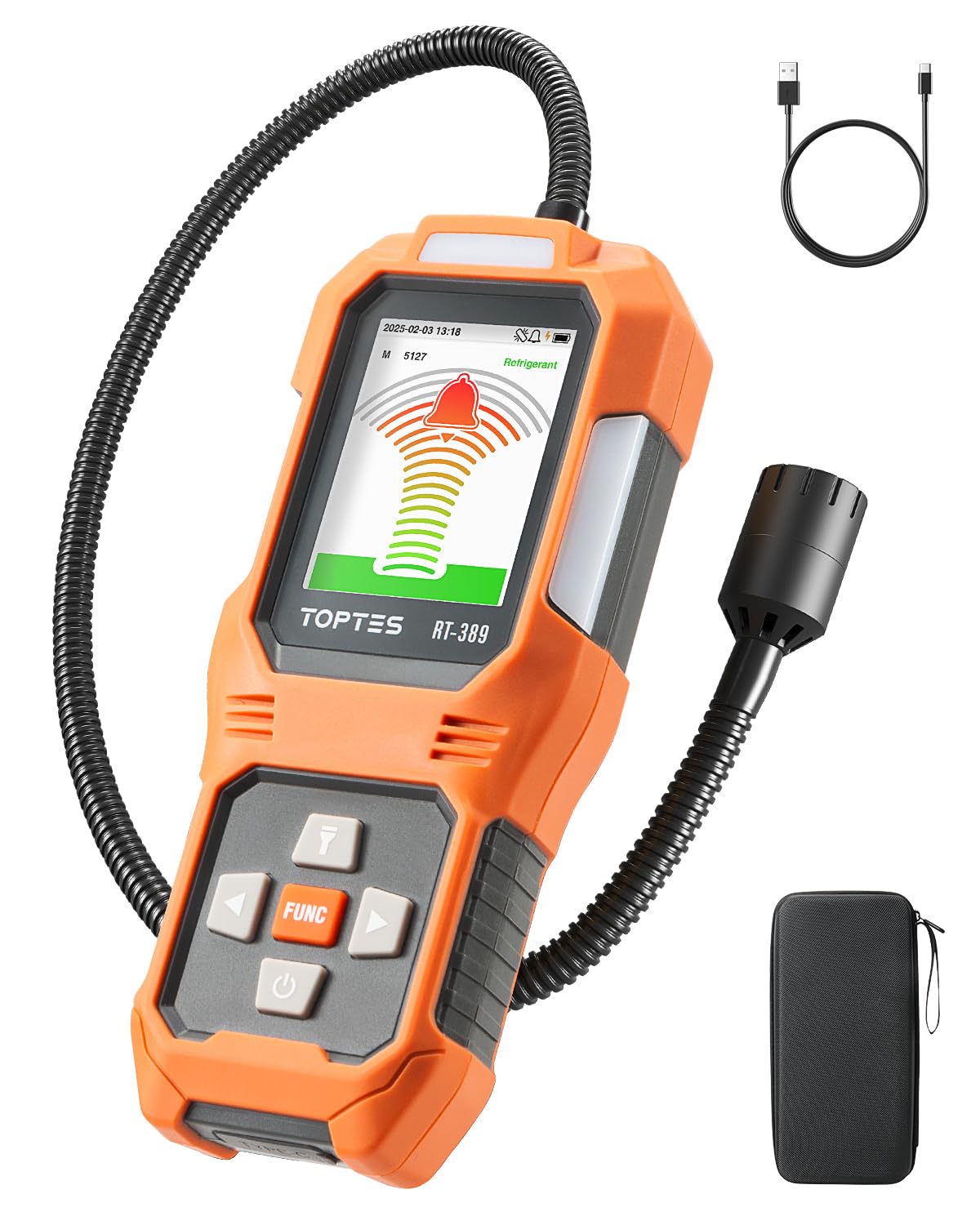
The TOPTES RT-389 stands out by combining a modern feature set — USB-C rechargeability, a 2000mAh battery lasting over 8 hours, and a bright TFT color display — with a sensitivity rating of 0.1 oz/yr that suits most residential and automotive AC work. Its advanced Japanese semiconductor sensor offers three adjustable sensitivity modes, allowing you to sweep a wide area on High and then switch to Low for precise pinpointing of the leak source. The 14.5-inch flexible gooseneck probe reaches into cramped engine bays and behind built-in appliances with ease.
Three independent alarm types (sound at 90dB, visual on-screen, and vibration) can be toggled on or off individually, which is useful when working in quiet environments or when you need silent confirmation via vibration alone. The dual display modes — a funnel chart for real-time PPM readings and a curve graph for tracking concentration trends — provide more data than most detectors in this price range. Users report that the unit found pinhole leaks in home AC condensers and refrigerator lines that had eluded soap tests, potentially saving thousands in unnecessary repairs.
Some users note a learning curve with the sensitivity settings, and the detector can briefly show a false reading near cleaning chemicals or soapy water if not zeroed properly in fresh air. The rugged engineering plastic housing is rated as waterproof, explosion-proof, and dustproof, adding confidence for use in basements and garages. For the DIY enthusiast who wants professional-grade features without the professional price tag, the RT-389 delivers impressive value.
Why it’s great
- USB-C rechargeable 2000mAh battery provides over 8 hours of continuous use
- TFT color display with dual view modes (funnel chart and trend graph) offers superior data visibility
- Triple alarm system (sound, light, vibration) with independent control for flexible use
Good to know
- May trigger briefly near chemical fumes or soap residue if not zeroed in clean air first
- Some users report a short learning curve to master the three sensitivity modes
6. UEi Test Instruments CD100A Combustible Gas Leak Detector

The UEi CD100A has been a trusted tool for HVAC technicians and homeowners for years, known for its simple, reliable operation and ability to detect a wide range of combustible gases including methane, propane, butane, natural gas, LPG, acetone, and ammonia. Its straightforward design — power on, let it warm up for 10 seconds, then sweep the 18-inch flexible gooseneck — makes it immediately usable without a steep learning curve. The tip light at the end of the probe is invaluable for illuminating dark areas around furnaces and water heaters.
Feedback is delivered through an increasing tick rate that speeds up as gas concentration rises, providing an intuitive audio cue that requires no screen watching. The unit does not auto-zero, which professional users appreciate because it prevents the detector from ignoring a persistent low-level leak. The CD100A is remarkably sensitive, often detecting concentrations as low as 50 ppm, but this sensitivity can be a double-edged sword: it may pick up tiny, insignificant gas odors that lead to unnecessary worry if not confirmed with a soap solution.
The main drawbacks are the lack of a digital PPM readout — it is a qualitative leak finder, not a quantitative gas analyzer — and reports of the on/off switch being fragile on some units. The 15-hour battery life from two C-cells is adequate for regular use, and the compact size fits easily into a service bag. For quickly locating a propane leak on an RV stove or a natural gas leak behind a kitchen range, the CD100A remains a favorite for its no-nonsense effectiveness.
Why it’s great
- 18-inch flexible gooseneck with tip light reaches deep into furnace and appliance compartments
- Non-auto-zero design prevents the detector from ignoring small, persistent leaks
- Detects a broad range of combustible gases including propane, methane, and LPG
Good to know
- No digital PPM readout; provides qualitative tick-rate feedback rather than numeric concentration
- Extreme sensitivity can detect harmless ambient gas traces; always confirm with bubble solution
7. VIVOHOME HVAC Refrigerant Freon Leak Detector

For homeowners and entry-level HVAC enthusiasts who need to check their own AC system or refrigerator without investing in a pro-grade tool, the VIVOHOME refrigerant detector offers a compelling entry point. It uses a semiconductor sensor to detect a full range of refrigerants — including R-134a, R-410A, R-1234yf, R-22, and other CFCs, HCFCs, HFCs, and HFOs — with a maximum sensitivity rating of 0.1 oz/yr. The 16.9-inch probe gives decent reach into condenser units and behind appliances.
The 9-level concentration display on the digital screen works alongside an audible alarm that increases in frequency as you get closer to the leak source. Three adjustable sensitivity levels allow you to start with a broad scan and then narrow down the exact location. The unit requires 30 seconds of warm-up time and runs on four AAAA batteries (not included), which is a small inconvenience given the affordable price point. A carrying case is included for storage and transport.
Users generally report successful leak detection on home AC units and refrigerators, but experienced HVAC techs note that it has a 3-to-5-second response delay compared to more expensive models, and it may not match the sensitivity of an Inficon or Fieldpiece sniffer on very tiny leaks. The 500-hour sensor lifespan is reasonable for occasional use but may be short for daily professional work. As a budget-friendly entry into the world of refrigerant detection, the VIVOHOME delivers on its core promise without breaking the bank.
Why it’s great
- Comprehensive refrigerant support includes R-1234yf, R-134a, R-410A, and all common blends
- 0.1 oz/yr sensitivity is adequate for detecting most residential AC and refrigerator leaks
- Three sensitivity levels and a 9-level concentration display aid in leak localization
Good to know
- Response time has a noticeable 3-to-5-second delay, requiring slow, methodical scanning
- 500-hour sensor life is suitable for hobbyist use but not heavy daily professional work
8. Forensics Detectors FD-91 Gas Leak Detector

The Forensics Detectors FD-91 is purpose-built for finding combustible and flammable gas leaks — natural gas, methane, propane, butane, gasoline fumes, acetone, ethanol, and more — using a Made-in-Japan catalytic sensor that is methane-calibrated for accurate readings. Its red ABS housing is designed to survive a 10-foot drop onto concrete, making it a rugged choice for inspectors and technicians who work on active construction sites or in tight crawl spaces. The large color LCD displays gas concentration alongside ambient temperature, a useful extra for documentation.
Users consistently report that the FD-91 found tiny natural gas leaks behind ranges and at fireplace shutoff valves that were completely undetectable by smell alone. The unit includes features like manual zeroing, high/low sensitivity toggling, and a mute function for the audible alarm. It ships with a cloth carry case and three AAA batteries, so it is ready to use out of the box. The sensor carries a 7-year rated lifespan, and the unit comes with a 1-year limited warranty, adding peace of mind for infrequent but critical use.
The primary drawbacks are the display brightness — some users find the LCD difficult to read in direct sunlight — and the need for a small screwdriver to open the battery compartment. The response time is not instant; users note it is slightly slower than pro-level units, requiring a patient sweeping motion. If your primary concern is natural gas or propane safety in a residential or light commercial setting, the FD-91 offers proven reliability and exceptional physical durability at a very accessible price.
Why it’s great
- 10-foot drop-rated ABS housing survives the bumps and drops of real-world inspection work
- Made-in-Japan catalytic sensor with 7-year lifespan and methane calibration for accurate readings
- Detects a wide range of combustible gases including natural gas, propane, gasoline, and acetone
Good to know
- Display can be hard to read in bright sunlight; may require shading with your hand
- Battery compartment requires a screwdriver to open, which is inconvenient for quick changes
9. YoLink DIY Automatic Water Leak Detection & Shut-Off Starter Kit

The YoLink Starter Kit takes a fundamentally different approach to leak detection by focusing on whole-home water protection rather than pinpointing a single gas or refrigerant leak. It includes a smart valve controller, a valve operator, a hub, and four water leak sensors that communicate over the LoRa wireless protocol, providing a range of up to a quarter mile and the ability to function during WiFi and power outages. When a sensor detects water, the system can automatically close the main water valve, stopping damage before it starts.
Setup is genuinely DIY-friendly: the valve operator mounts onto an existing lever-handle ball valve without plumbing modifications, and the sensors pair to the hub via QR code scanning. The system works with Alexa and Google Assistant, allowing voice control and integration into broader smart home routines. Each sensor runs on AAA batteries that last up to two years, and the hub supports up to 300 devices, making the system highly scalable for large homes or multi-unit properties.
Users who have installed the kit for insurance compliance or personal peace of mind consistently praise its reliability, noting that the device-to-device pairing ensures the valve closes even without an internet connection. The only real caveat is that the valve operator requires a compatible lever-handle valve and access to a power outlet near the main water line. For homeowners who have suffered a water damage event — or want to prevent one — the YoLink kit provides an comprehensive, proactive solution that no single gas sniffer can match.
Why it’s great
- Automatic main water shut-off on leak detection, even during WiFi/power outages, via LoRa D2D pairing
- Four included leak sensors with 2-year battery life; system scales to 300+ devices per hub
- Simple DIY installation with no plumbing modifications; works with Alexa and Google Assistant
Good to know
- Requires an existing lever-handle main valve and a nearby power outlet for the valve operator
- System detects water on the floor, not gas or refrigerant; it is a whole-home protection tool, not a pinpoint sniffer
FAQ
Can an acoustic leak detector find a water leak inside a wall?
What does 0.03 oz/yr sensitivity actually mean in practice?
Why does my leak detector go off even when there is no leak?
Final Thoughts: The Verdict
For most users, the best acoustic leak detector winner is the Elitech ILD-200 because it combines infrared sensor longevity with proven sensitivity at a price that sits between entry-level and professional gear. If your work demands finding the absolute smallest refrigerant micro-leaks, grab the Fieldpiece DR58 for its 0.03 oz/yr detection floor. And for whole-home water leak prevention with automatic shut-off, nothing beats the YoLink Smart Starter Kit.