
Our readers keep the lights on and my morning glass full of iced black tea. As an Amazon Associate, I earn from qualifying purchases.
Specs are compiled from manufacturer listings and verified buyer reviews and can change over time — please confirm the key details on the product page before buying.
If you are tired of your voice bouncing off bare walls during video calls or your home theater sounding like a tin can, the fix is simpler than you think. Acoustic wall coverings tame echo and reverb by absorbing sound energy instead of letting it ricochet around the room.
I’m Min — the founder and writer behind Gadgets Feed. This guide is built by comparing the manufacturers’ published specifications and the patterns across verified customer reviews, so you get each pick’s real strengths and trade-offs instead of marketing spin.
You will find The right balance of sound absorption, style, and damage-free installation is what separates the best acoustic wall coverings. by comparing the top acoustic wall covering options here.
Our Picks at a Glance
How To Choose The Best Acoustic Wall Covering
Before you buy, you need to separate two ideas that get mixed up constantly. Soundproofing stops sound from moving between rooms, while acoustic treatment cleans up the sound inside your room by killing echo.
Know Your Material: Foam vs. Felt vs. Polyester Fiber
Classic studio foam is cheap and familiar, but denser materials do more real work per inch. Felt tiles and high-density polyester fiber panels absorb a wider range of frequencies without the dated egg-crate look, and they resist crumbling and yellowing over time.
Check the NRC Number
The Noise Reduction Coefficient (NRC) tells you how much sound a panel absorbs on a 0 to 1 scale. A panel rated 0.95 absorbs nearly all the sound that hits it, while a rating near 0.60 leaves half the energy bouncing around. Higher is better for echoes.
Plan the Installation, Not Just the Panels
Self-adhesive tiles are the easiest path for renters, but they need a clean, smooth, dry wall to hold. Bigger mounted panels look like furniture and can be fixed with construction glue or screws. Measure your wall first, then match the mounting style to your wall condition and your landlord’s rules.
Quick Comparison
| Model | Best For | Material | Thickness | Coverage | Amazon |
|---|---|---|---|---|---|
| VIVELDA Felt Tiles★ Best Overall | Damage-free echo control | Felt / Polyester | 0.35 in | 12 sq ft | Amazon |
| Amantech Hexagon FoamDecor Favorite | Decorative budget setups | Polyester Fiber | 0.4 in | — | Amazon |
| Temgcuam 54-Pack FoamBudget Champion | Big coverage on a budget | Polyurethane Foam | 1 in | 54 sq ft | Amazon |
| Dailycooper Y-Line Foam | Studio-style density | Polyester Fiber | 0.4 in | 7.5 sq ft | Amazon |
| AUSLET Pyramid Foam | Deep 2-inch absorption | Polyurethane | 2 in | 36 sq ft | Amazon |
| TONOR Dual-Layer Panels | Large premium felt look | Polyester Fiber | 0.72 in | 4400 sq in | Amazon |
| Wood-Look Veneer Panels | Furniture-style aesthetics | Polyester + Veneer | — | — | Amazon |
| AudioSilk Room Kit | Studio-grade recycled PET | Recycled PET | 0.4 in | — | Amazon |
| Art3d Wood Slat Panels | Warm walnut statement walls | MDF + Polyester | — | 31.5 sq ft | Amazon |
In‑Depth Reviews
1. VIVELDA Large Felt Bulletin Board 48 x 36 Inch
Our pick — over 4.5★ from 800+ verified ratings; the strongest balance of quality and price.
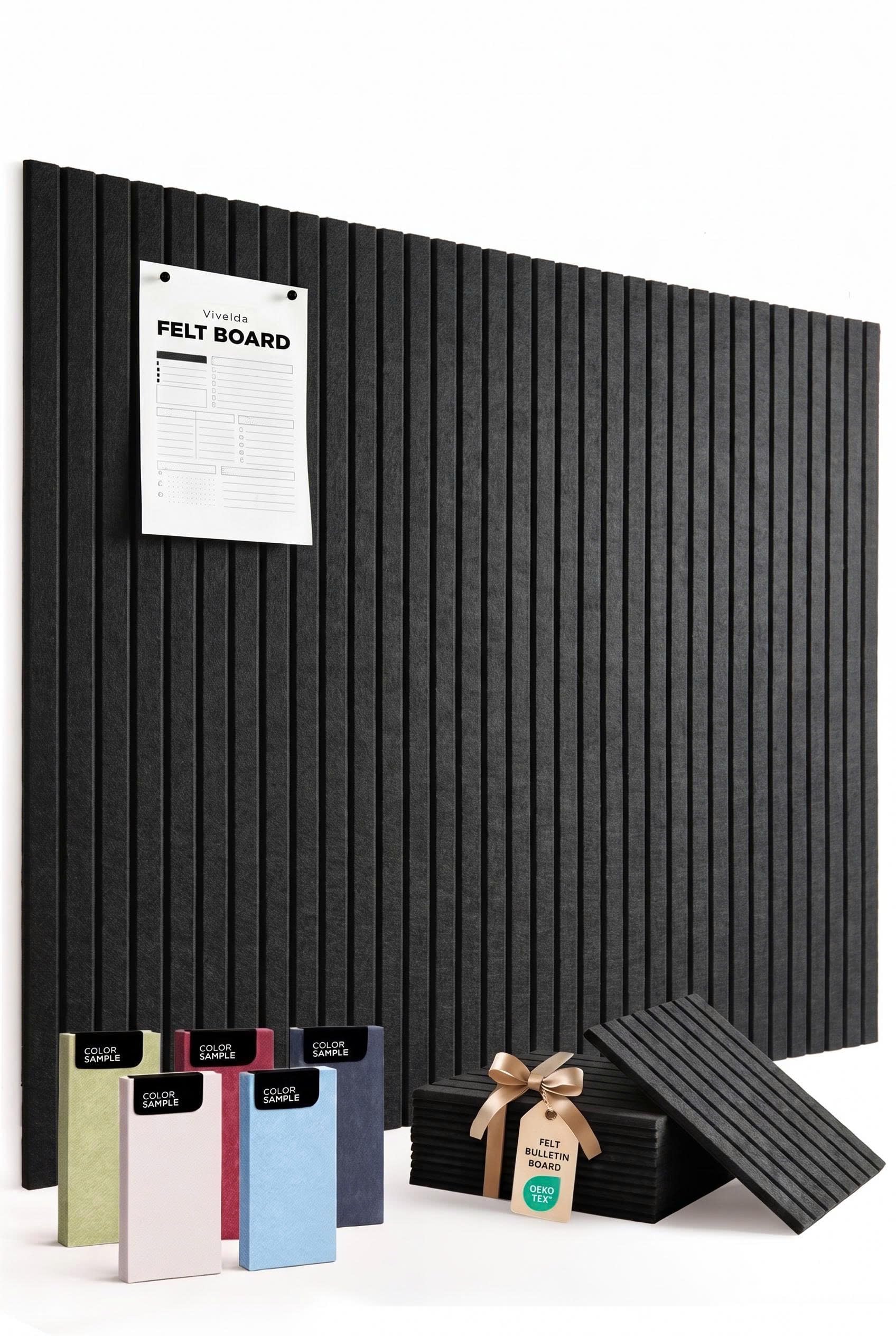
The felt tile that kills echo without a single screw hole.
You get a feature wall that looks like intentional decor and leaves your walls untouched—no drilling or sticky residue. Each of the 12 felt tiles measures 11.8 x 11.8 inches, so you can assemble a full 48 x 36 inch board or invent your own layout. Slat grooves and beveled edges line up tile-to-tile into one smooth wall that photographs beautifully.
You get an NRC of up to 0.95 — meaning nearly all the sound that hits it gets absorbed rather than bounced. At 0.35 inches thick and 150g per tile, the panels are dense enough to noticeably quiet a home office during calls. The set ships with 60 double-sided adhesive tabs that remove cleanly when you pull straight down, so the cork-board alternative is genuinely renter-friendly, and the felt is OEKO-TEX Standard 100 certified free of formaldehyde, phthalates, and lead.
Owners talk about this as architectural panels rather than bulletin boards: it has been used to build a full soft wall in a special education classroom and to dampen sound in an office. As buyers put it: “This is my second time buying these bulletin boards and we love them.” Push pins leave tiny holes that do not self-heal, so treat it as a pin board with care.
Why it wins: The most-mentioned point is the appearance, with owners praising how the slatted design looks like a premium statement wall rather than studio foam.
Watch out: The wall attachment is the most mixed aspect — the tabs hold firmly, but several owners suspect removal could damage paint if not pulled exactly straight down.
Reach for this if: you want real echo reduction with a refined, modern look and zero drilling commitment.
Look elsewhere if: you need to cover a huge wall cheaply, since the 12-tile set covers just 12 square feet.
2. Amantech 12 Pack Hexagon Acoustic Panels
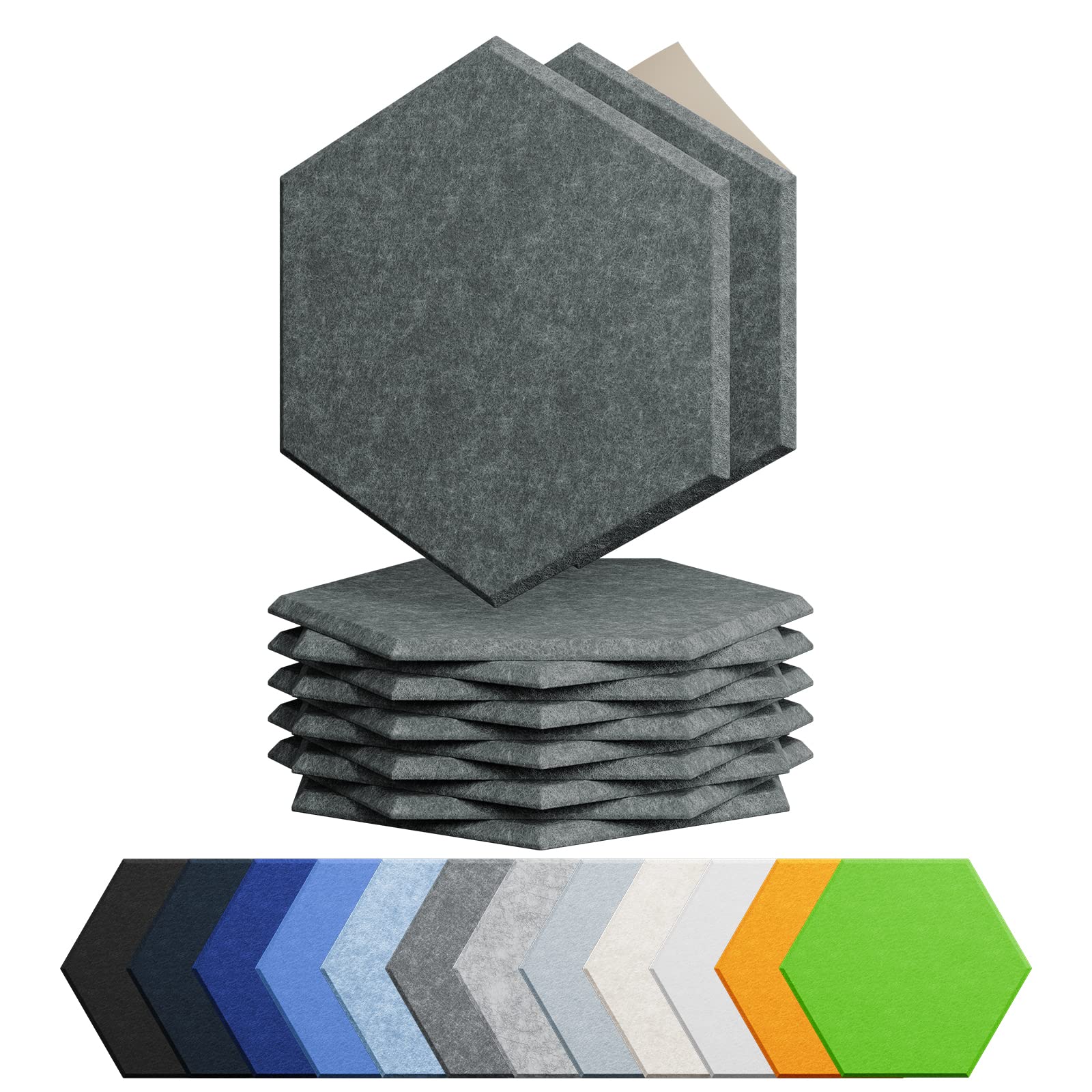
A honeycomb pattern that cleans up echo while looking like modern art.
The hexagonal honeycomb shape is the hook here — it tiles into a geometric wall pattern that reads as intentional design, not a recording booth. The panels are 12 x 0.4 x 10.23 inches and made of 100% polyester fiber that is odorless, non-toxic, and formaldehyde-free. In the Moonlight Gray finish, they bring a soft, modern texture to a home office or gaming wall.
Peel the protective layer off the glue backing and press them up — no tools required. A knife easily cuts them into custom shapes for tricky corners. Buyers report they work very well for their true intended purpose: absorbing echo rather than blocking sound from coming in, which is exactly what a panel this thin should do. The effectiveness and noise cancellation are the two most-praised aspects, with one happy owner using them to quiet a noisy fridge and another finding them a big help for band practice.
Be honest about the adhesive — it is the most mixed point. Some panels stick well while others can come loose, so on rough or textured walls you may want to add a stronger tape. They tame reverb, not block loud neighbors.
What wins people over: The combination of a fashionable hexagonal look and reliable echo absorption at a budget-friendly price.
The trade-off: Adhesion is hit-or-miss depending on your wall surface, and color accuracy gets mixed notes.
Best for: renters and streamers who want a stylish, tool-free echo fix in a small room.
Think twice if: you have textured or damp walls, where the self-adhesive backing may not hold.
3. Temgcuam 54 Pack Acoustic Foam Wall Panels
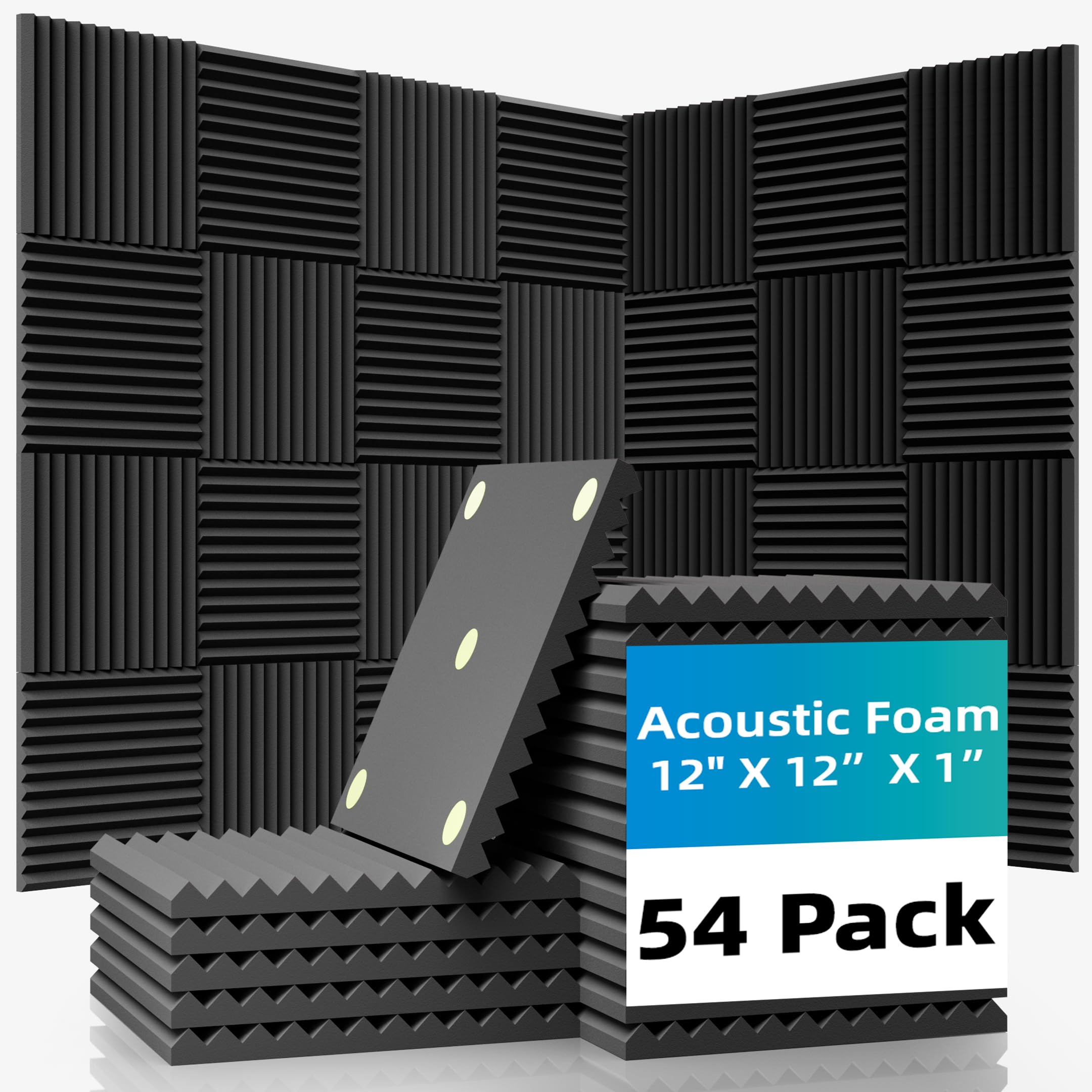
Fifty-four panels of 1-inch wedge foam for the biggest bang-per-buck coverage.
When you have a whole room to treat on a tight budget, this 54-pack is the most square footage per dollar in the lineup. Each panel is 12 x 12 x 1 inches of high-density polyurethane foam with a wedge-cut surface that breaks up sound waves and dampens echoes. The lightweight tiles mount fast with the included premium adhesive pads — no drilling required.
It is 4.5x the panel count of the VIVELDA set, so you can actually cover a full wall or ceiling instead of an accent section. Owners mention a noticeable difference in a room that had a lot of echo, and the panels stay in place well once the adhesive grabs. Quality and functionality are the two most-praised aspects, with buyers happily using them for movie rooms, offices, and recording.
The catch is the included adhesive — it is the most mixed point in the data. On smooth, clean, dry walls it holds fine, but some customers note it does not stick at all, especially on ceilings, and a minority found the squares cut unevenly. Buy a roll of stronger tape with this one if your surface is anything but ideal, and let the vacuum-packed panels expand for a day before judging their look.
Why it stands out: You get 54 panels of real acoustic foam for the price of one premium panel—so you can cover a large wall without blowing your budget.
Keep in mind: The adhesive is inconsistent and the foam’s appearance gets mixed reviews, so this is a function-first buy.
Grab this if: you want maximum echo-killing coverage for a home theater or game room without spending big.
Pass if: you refuse to buy extra adhesive or you want a polished, furniture-grade look.
4. Dailycooper 12 Pack Self-Adhesive Acoustic Panels

High-density polyester foam that punches well above its 0.4-inch profile.
Density is the spec that separates this panel from cheap foam, and at 9.4 lb/ft³ it is built to absorb rather than just look the part. The unique Y-lined surface with beveled edges reduces echoes, reverb, and flutter echoes — the rapid-fire repeats that make a room sound boxy. It is made of 100% polyester fiber that is flame retardant, odorless, and safe to breathe and touch.
Each of the 12 panels measures 12 x 10 x 0.4 inches, covering roughly 7.5 square feet total. The self-adhesive backing means no tape or extra glue, and a knife trims them for custom layouts. The appearance is the most-praised aspect, with owners noting they blend cleanly with decor and can be arranged creatively — one buyer cut them to match a specific look and was thrilled with the result.
The honest note: adhesion and sound absorption are both mixed in the review data. Some owners find the sticky backing solid, while others swap in Velcro for a more secure hold. It tames echo in studios and gaming spaces but won’t block outside noise.
What impresses: The 9.4 lb/ft³ density delivers studio-style absorption in a slim panel that looks like art.
The fit note: Adhesion is the most common mixed point — on imperfect walls, plan to reinforce with your own strips.
Ideal for: home studio owners who want dense absorption without bulky 2-inch foam.
skip it if: you need wide coverage, since 12 panels cover only 7.5 square feet.
5. AUSLET 36 Pack Pyramid Acoustic Panels

Two inches of pyramid foam for serious echo control across 36 square feet.
Thickness is what makes this the heavyweight of the foam options. At 2 inches from base to peak, the pyramid profile gives sound waves far more material to get lost in than a 0.4-inch tile ever could. The 36-pack covers a full 36 square feet, and the high-density polyurethane is flame-retardant and environmentally friendly for safe home use.
The panels arrive vacuum-compressed and expand to full size quickly thanks to the foam’s resilience — most owners see them puff up within minutes. The 2-inch depth is the reason one buyer measured a roughly 42% reduction in kitchen noise above their home theater, and another found the density superior to alternatives. You can even stack them for double thickness on problem walls.
This is echo absorption, not sound blocking—set your expectations accordingly., and the adhesive is not included — the product text says to use double-sided tape or spray adhesive separately. Quality is the most-cited aspect but it is mixed, with a few owners finding odd tiles in their pack. One owner frames it perfectly: get good echo dampening, but treat the included tiles as a quality gamble.
Why it is worth it: The rare 2-inch depth and 36-square-foot coverage make it the most serious foam option here.
Plan ahead: No adhesive ships in the box, and quality control is variable enough that some owners got a thinner tile or two.
Choose this for: home theaters and studios where deep absorption matters more than quick peel-and-stick install.
pass on it if: you want a tool-free, all-in-one kit — you will need to buy mounting tape or nails separately.
6. TONOR Dual-Layer Thickened Acoustic Wall Panels

Big 47-inch felt panels whose double-layer core takes the edge off noisy neighbors.
This is the panel that looks like a design choice first and sound treatment second. Each of the 4 panels measures a generous 47.2 x 23.6 x 0.72 inches, and the dual-layer thickened structure disperses echo and noise better than single-layer felt. Made of 100% high-density polyester fiber, it is safe to breathe and touch for the whole family.
Installation is genuinely a peel-and-stick job — the strong adhesive backing needs no extra tape. The classic stripe pattern reads as upscale wall decor for studios, living rooms, and home theaters. Owners are emphatic about the noise reduction, with the most-praised aspects being quality and noise level: loud neighbors and bass get noticeably muffled, and the felt-like appearance draws compliments.
It reduces echo noticeably but won’t fully block sound. The product text notes these reduce sound rather than fully insulate, and One owner measured over 50% reduction in washer and dryer noise after covering 95% of the wall.. Seams between panels are the recurring minor gripe, and 4 panels cover a smaller area than the count suggests.
Why it leads: Owners consistently report a quieter, calmer room — the quality and noise-level praise outranks everything else in the data.
The caveat: Reviewers point out that seams between panels are the main complaint, so align them carefully to avoid visible gaps.
Reach for this if: you want premium-feeling felt panels that genuinely quiet a loud apartment.
Look elsewhere if: you are covering a large wall, where the 4-pack footprint leaves gaps.
7. 6 Pack Acoustic Panels with Wood Looking Veneer
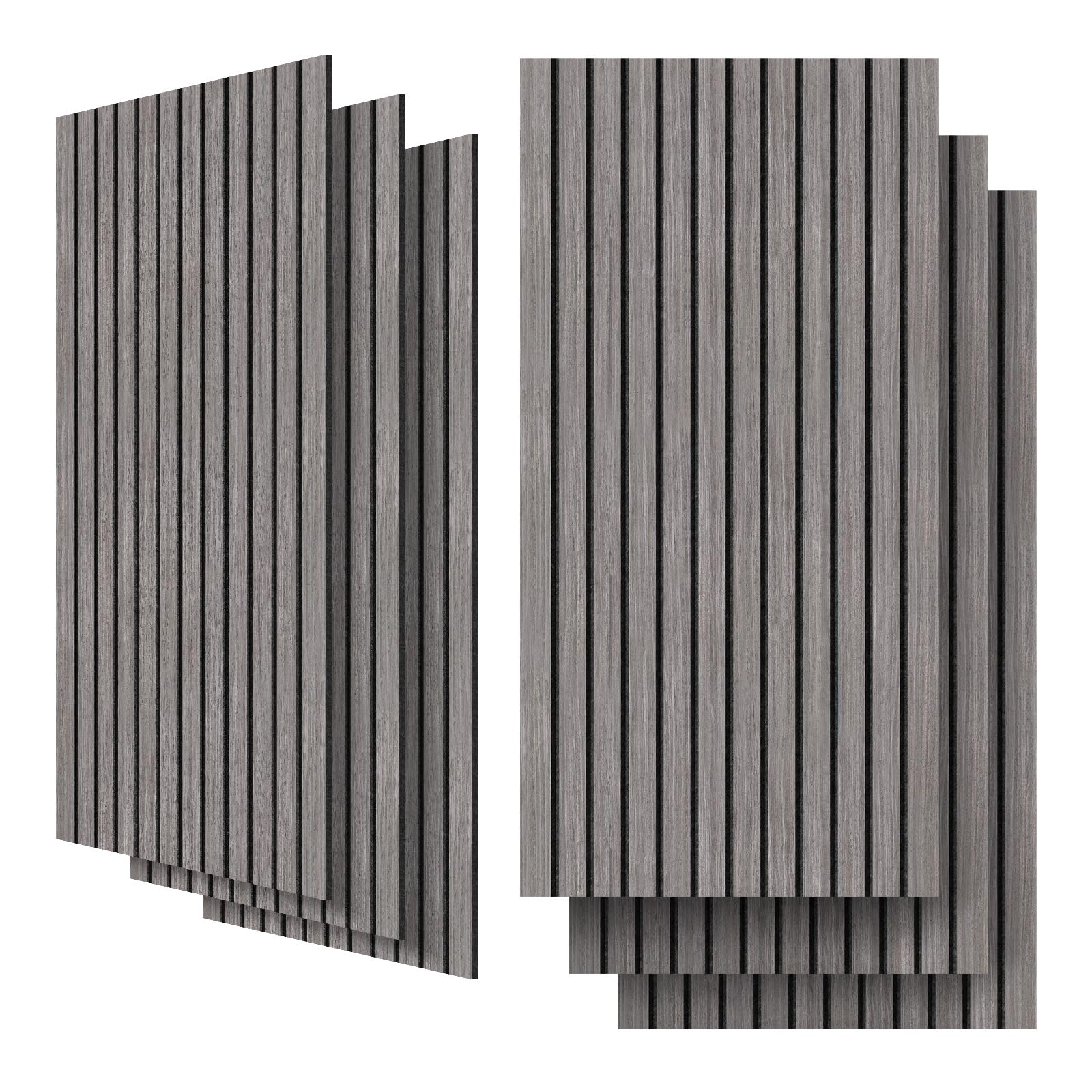
Slatted wood aesthetics that bend and cut for a furniture-grade finish.
The clever trick here is that the wood slat look is actually a flexible veneer over polyester fiber, not rigid lumber. That means you can bend it, cut it easily, and mount it in places where heavy wood slats would never fit. Each panel is 47.2 x 23.6 inches, and the 6-pack gives you substantial wall presence with a warm, natural finish.
Installation flexes to your situation: construction adhesive glue, nails, or 3M double-sided tape all work. The sound-absorbing core targets reverberation, noises, and echoes across halls, meeting rooms, and recording spaces. Appearance and value for money are the two most-praised aspects — owners call them sleek, aesthetically pleasing, and easy to cut and recut around crooked ceilings.
The honest trade-off is in the name: it is a wood-looking veneer, not a real wood slat, and some owners wish it had actual wood grain. One buyer was clear that it muffles sound on the other side of the wall but does not do soundproofing duty. Expect it to tame echo, not block sound, and you’ll get a stylish, effective panel.
What owners love: The looks and the value — it photographs like a premium slat wall at a fraction of real wood cost.
Set your expectations: It is veneer over fiber, and it absorbs echo rather than blocking sound transfer.
Best for: podcasters and home offices that want a sleek, wood-toned acoustic wall without the carpentry.
Not for: anyone expecting real wood slats or true soundproofing between rooms.
8. AudioSilk 4 Pack Room Kit Acoustic Panels

Studio-grade recycled PET panels that perform like foam twice their thickness.
The material story here is the strongest in the lineup. These panels are made from post-consumer recycled PET with an NRC of up to 0.91, and they deliver much higher performance than equivalent acoustic foam. There is no harsh chemical smell, no shrinkage or peeling, and they stay firmly in place once mounted.
Each panel measures 45.7 x 22.8 x 0.4 inches in the Natural finish, a soft tone that blends into a minimalist office. Installers report it goes up in seconds with removable sticky strips sold separately, and it can be removed and replaced without marks — perfect for rented project studios. The free acoustic treatment advice is a genuine bonus for first-time buyers. Owners say it tightens the sound of a room, shortens reverb, and tames flutter echo.
The major recurring note is that these panels are noticeably thin — yet the feedback is that they perform close to foam at half the thickness. A few owners found them thinner than expected and a touch fragile-feeling during handling. It kills reflections, not soundproofing—loud neighbors will still be heard.
Why it earns its spot: Owners rave about the acoustics and the clean look, calling it better than foam with a recycled, no-odor build.
The honest caveat: Thin panels feel delicate before mounting, and mounting hardware does not ship with them.
Choose this for: project studios and rented spaces where removable, mark-free treatment is non-negotiable.
it’s not for you if: you want thick, heavy panels with included hardware from the start.
9. Art3d 6-Pack Wood Slat Wall Panels
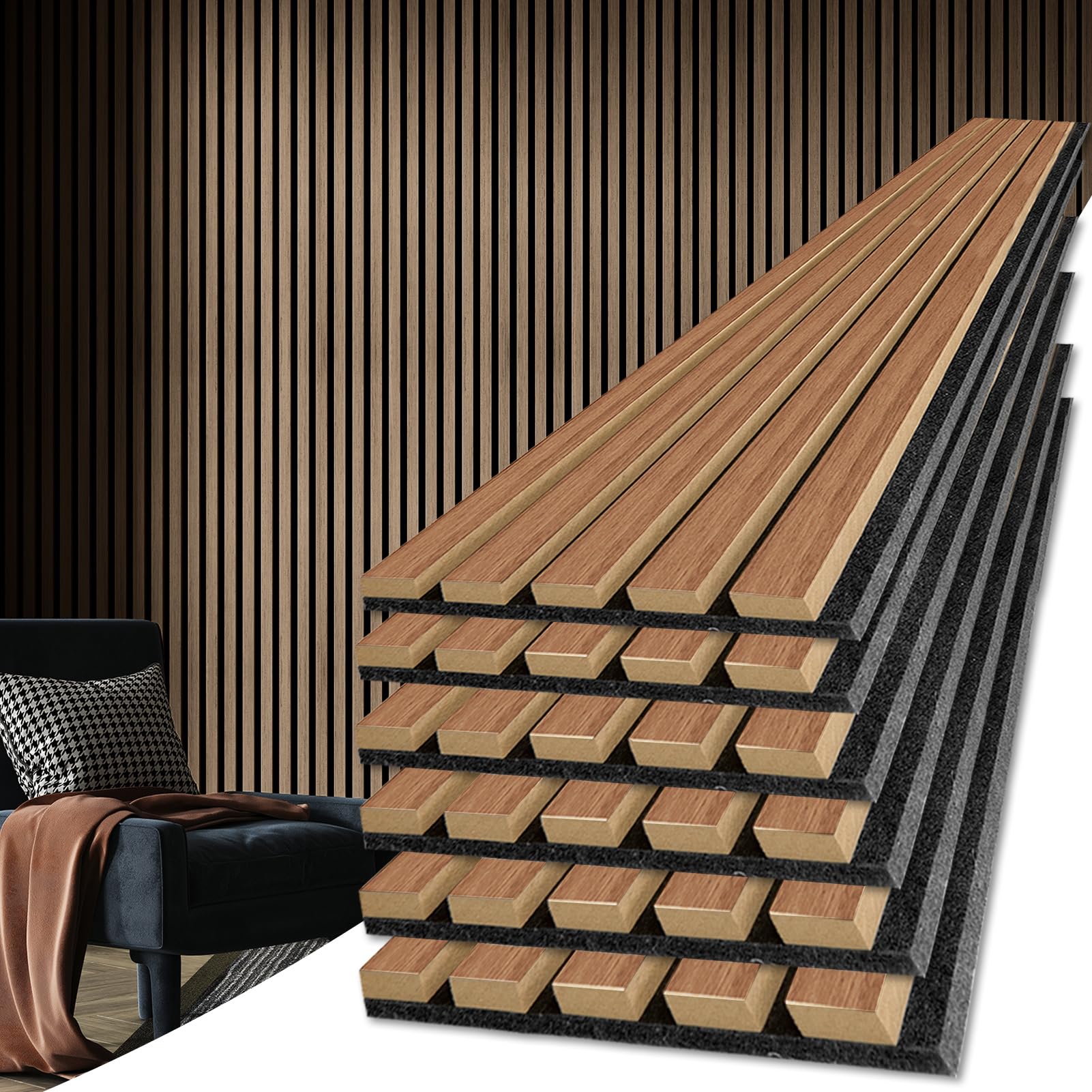
Fluted walnut slats that turn a plain wall into a warm, quiet showpiece.
This is the acoustic covering that doubles as the centerpiece of the room. The six fluted panels are 94.5 x 7.9 inches each, covering about 31.5 square feet, with a walnut finish that brings a natural, warm elegance to a home, office, or studio. The structure pairs MDF with high-density polyester fiber for low TVOC emissions and real sound absorption.
Owners describe transformations — a bathroom, a closet door, an accent wall — all made possible by panels that mount with basic tools and cut easily to fit. The 94.5-inch length reaches floor to ceiling in most rooms. The two most-praised aspects are quality and appearance, with buyers repeatedly calling the walnut tone beautiful and the reduction in echo significant.
The main hesitation in the data is value for money, which is the most mixed aspect. These are a premium spend, and ordering a sample pack first is specifically suggested by the maker before committing to a full order. Sharp edges after cutting are a minor DIY note — sand them. You are paying for a furniture-grade look with acoustic benefits, not maximum absorption per dollar.
What wins people over: The look — a pleasing walnut finish and easy install that owners describe as a drop-dead gorgeous result.
Weigh the cost: Value is the most mixed aspect, so order a sample first and budget for the premium price.
Reach for this if: you want a statement slat wall that quietly improves room acoustics and photographs like a renovation.
Look elsewhere if: pure sound absorption per dollar is your only metric, where foam covers far more area for less.
Understanding the Specs
NRC: The Echo-Killing Score
NRC stands for Noise Reduction Coefficient, a 0-to-1 rating of how much sound a panel absorbs. A rating of 0.95 means 95% of the sound energy hitting it is absorbed rather than reflected. For normal rooms, aim for an NRC of 0.80 or higher; the difference between 0.60 and 0.95 is the difference between a still-boxy room and a dead-quiet one.
Density and Thickness: Why They Matter
Denser materials absorb more sound per inch, and thicker panels give sound waves more material to travel through before bouncing back. A 2-inch pyramid foam is a different beast from a 0.4-inch tile. Check the density in lb/ft³ or kg/m³ to compare foam options — higher numbers equal more absorption and a heavier, more solid feel.
FAQ
Will acoustic wall panels stop sound from traveling to my neighbor’s room?
What does NRC 0.95 actually mean for a home office?
Can I stick acoustic panels on textured or popcorn walls?
Will removing peel-and-stick panels damage my paint?
How many panels do I need to fix a bad echo?
Is foam or felt better for acoustic treatment?
Do wood slat panels actually absorb sound?
Can acoustic panels be cut to fit my wall size?
What determines whether a panel is fire safe?
How do I clean acoustic panels without damaging them?
Final Thoughts: The Verdict
For most buyers, the acoustic wall covering winner is the VIVELDA Felt Tiles because it delivers genuine NRC 0.95 echo absorption with a modern, statement-worthy look and clean removal. If you want a premium felt wall that visibly quiets a loud space, the TONOR Dual-Layer Panels are the crowd favorite. And for a warm, furniture-grade statement wall, the Art3d Wood Slat Panels turn acoustics into a design centerpiece.
How We Picked
We do not accept paid placement. Every pick is matched to a real buyer and a real use-case; we do not hands-on test units.
Sources & Methodology
Specifications: manufacturer listings and product documentation. Review insights: verified customer reviews, as of August 2026. Pricing: not shown on this page (it changes often); check the current price via the retailer link.
As an Amazon Associate, Gadgets Feed earns from qualifying purchases. This does not affect which products we feature.