
Hard surfaces in a home, office, or studio create a sonic nightmare of slap echo, reverb, and reflected noise that warps speech clarity and wrecks music reproduction. Acoustical insulation is the engineered solution—dense polyester fiber or closed-cell foam panels that absorb vibrational energy rather than reflecting it, converting airborne sound into negligible heat. The specific metric that separates effective panels from decorative phonies is the Noise Reduction Coefficient (NRC), with serious materials scoring 0.80 or higher.
I’m Min — the co-founder and writer behind Gadgets Feed. I sift through hundreds of noise-dampening SKUs, cross-referencing material density, thickness, coverage area, and real-world NRC claims to identify the panels that actually kill echo without killing your budget.
Whether you are treating a podcast booth or taming a noisy living room, choosing the right material thickness and density is the difference between a dead-silent room and a wasted wall. This guide breaks down the top-rated options to help you find the best acoustical insulation for your specific space and noise issue.
How To Choose The Best Acoustical Insulation
Acoustical insulation is not a one-size-fits-all product. The right choice depends entirely on whether you need to absorb vocal reflections in a home theater, reduce mechanical drone in a car, or simply dampen reverb in a recording space. Three criteria define the winner: material density, panel thickness, and the NRC rating.
Material Density and Composition
High-density polyester fiber—typically 5.9 oz/ft² or higher—delivers superior sound absorption compared to open-cell polyurethane foam. Denser materials trap more air molecules and dissipate vibrational energy across a wider frequency range. Products listing a weight of 1800 g/m² or above are serious contenders; lighter panels often function as decorative art with minimal acoustic benefit.
Panel Thickness vs. Frequency Range
Thicker panels absorb lower frequencies more effectively. A 0.4-inch (10 mm) panel is excellent for taming mid-to-high frequency chatter and sibilance, but it will barely touch deep bass from subwoofers or industrial HVAC hum. For full-spectrum treatment, panels of 0.72 inches (18 mm) or more are necessary. Dual-layer constructions, like those sandwiching a high-density core with a softer face, offer the widest absorption bandwidth in a single product.
NRC Rating — The Spec That Matters
The Noise Reduction Coefficient is the industry-standard single number, ranging from 0.00 (total reflection) to 1.00 (total absorption). An NRC of 0.95, as claimed by several premium polyester panels, means 95 percent of incident sound energy is absorbed. Any product below 0.80 NRC is marginal for critical listening or speech clarity applications. Always verify the NRC against the product’s thickness and density—cheap foam rarely achieves published ratings.
Quick Comparison
On smaller screens, swipe sideways to see the full table.
| Model | Category | Best For | Key Spec | Amazon |
|---|---|---|---|---|
| TONOR Dual-Layer Thickened | Premium Panel | Critical listening rooms | 0.72-inch dual-layer polyester | Amazon |
| TONOR Wood Slatwall | Design Panel | Home decor with acoustics | MDF + polyester fiber composite | Amazon |
| Soon Global 8-Pack | Premium Panel | Large wall coverage | 48×32-inch high-density polyester | Amazon |
| Ekkogo 12-Pack | Mid-Range Panel | Echo reduction on a budget | 5.9 oz/ft² density, NRC 0.95 | Amazon |
| Amantech 12 Pack | Mid-Range Panel | Self-adhesive hexagon decor | 0.4-inch polyester fiber | Amazon |
| VEVOR Sound Dampening Blanket | Budget Barrier | Temporary door/room blocking | 96×80-inch woven polyester | Amazon |
| GOSCHE Sound Deadener | Budget Mat | Vehicle noise/vibration | 394 mil closed-cell foam | Amazon |
In‑Depth Reviews
1. TONOR Dual-Layer Thickened Acoustic Wall Panels

The TONOR Dual-Layer panel is the most serious acoustical treatment in this roundup, packing two bonded layers of high-density polyester fiber into a 0.72-inch thickness that absorbs far more low-mid bass energy than standard 0.4-inch panels. Each of the four large tiles covers 47.2 x 23.6 inches, translating to roughly 31 square feet of coverage per pack—enough to treat an entire wall in a small studio or home theater. The self-adhesive back removes the need for construction glue or spray adhesive, and the 100 percent polyester fiber construction carries no odor and meets Class A fire safety standards.
The dual-layer architecture is the key differentiator here. A standard single-layer panel of similar thickness cannot match the broadband absorption of this bonded sandwich design. Reviewers consistently report a roughly 50 percent reduction in perceived noise from appliances and adjacent rooms after installing full coverage, and podcasters note they can run microphone gain at lower levels without picking up room reflections. The reinforced corners during shipping ensure the tiles arrive without crushed edges.
For anyone building a critical listening room, vocal isolation booth, or home theater where dialogue clarity matters, this is the product that delivers professional-grade results without professional installation costs. The only real consideration is that the self-adhesive backing is strong enough to damage delicate drywall paint upon removal, so careful planning of placement is advised.
Why it’s great
- Dual-layer 0.72-inch thickness absorbs deeper frequencies than competitors
- Self-adhesive peel-and-stick backing speeds installation
- No odor, formaldehyde-free, flame-retardant polyester fiber
Good to know
- Adhesive may peel paint on removal
- Stripe pattern is purely aesthetic, not functional
2. TONOR Wood Slatwall Panels
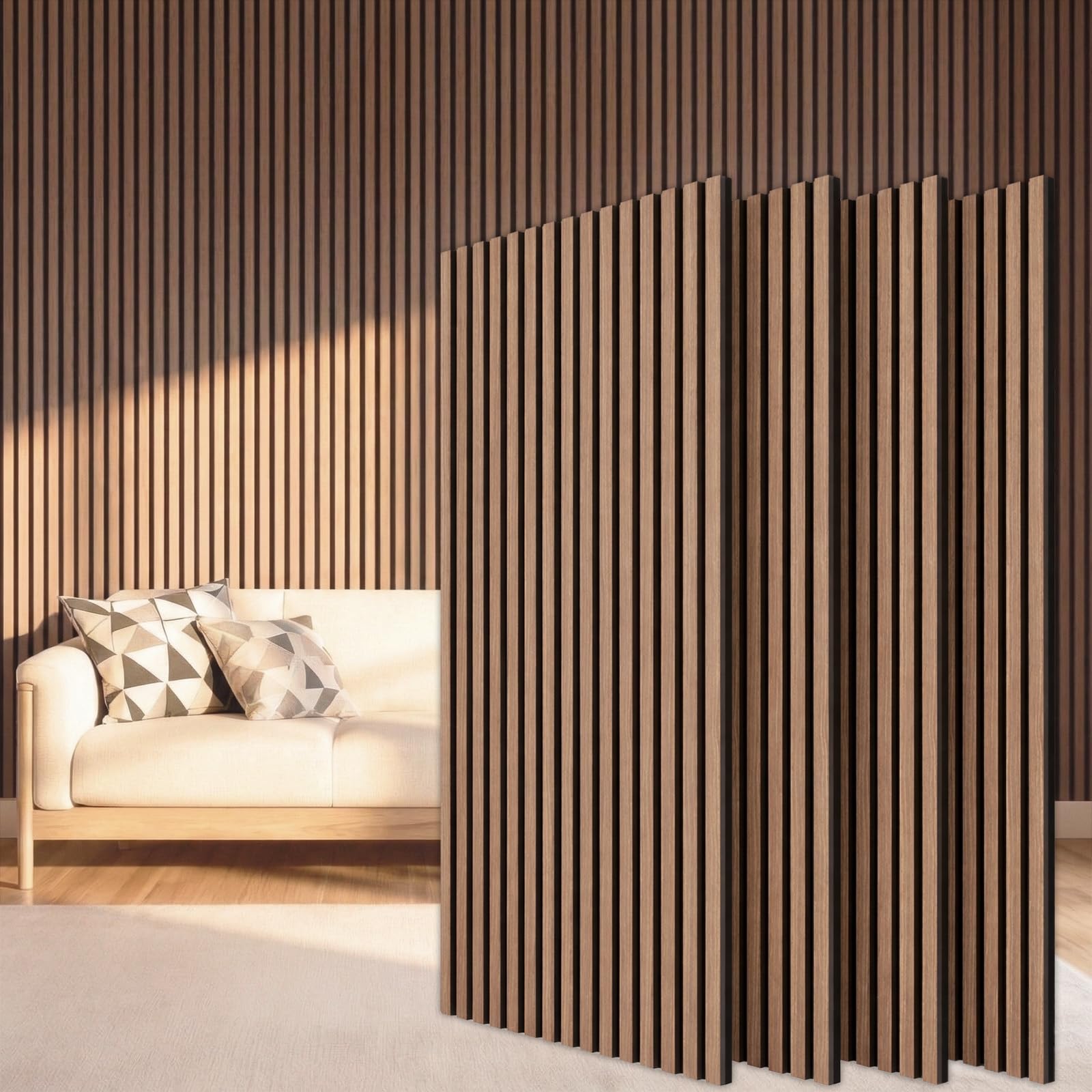
The TONOR Wood Slatwall Panels bridge the gap between architectural design and genuine acoustical function by layering real wood veneer over a high-density polyester fiber core. Each 47.2 x 23.6-inch panel consists of solid MDF slats spaced over a black felt backing that absorbs mid-to-high frequency reflections while the wood slats disperse remaining energy. This hybrid construction means you get measurable echo reduction—enough to deaden a hollow-sounding office or living room—without sacrificing the warm, natural aesthetic that bare acoustic foam cannot provide.
The kit includes all mounting hardware for screw attachment, which is the recommended method for permanent installations. The panels weigh 6.17 pounds each, making them substantial enough to resist bowing but light enough for a single person to handle. Reviewers consistently praise the ease of cutting with a jigsaw for outlets and custom lengths, though the wood strips are only adhered at the ends, so careful handling is required when cutting near edges.
For homeowners who refuse to cover their walls in utilitarian foam but need real acoustical performance, these slat panels are the most elegant solution on the market. The trade-off is that the wood slats primarily treat high frequencies, while the felt core does the heavy lifting on midrange absorption—deep bass below 100 Hz is still better handled by dedicated bass traps.
Why it’s great
- Real wood veneer blends with premium interior design
- Hybrid slat-and-felt design absorbs echo across a useful frequency range
- Includes hardware for screw-mount installation
Good to know
- Wood slats are only glued at panel edges—can separate when cut
- Limited low-frequency absorption below 100 Hz
3. Soon Global 8-Pack Acoustic Panels

The Soon Global panels offer the largest per-panel footprint in this list at 48 x 32 inches each, enabling you to cover a large wall surface with just eight tiles. The high-density polyester fiber core is identical in composition to professional studio panels, providing effective absorption across the vocal and lower-mid frequency range. What sets these apart visually is the curated artist-designed surface patterns—each panel features a unique graphic that transforms a standard acoustical treatment into a feature wall.
Installation is handled by the 50 included transparent double-sided adhesive dots. While this avoids the mess of spray glue, the dots are not as secure as full-backing adhesive, and heavier panels may sag over time in humid environments. Several reviewers recommend supplementing with a few construction-grade adhesive spots at the corners. The material cuts cleanly with a sharp utility knife, though some users note the density makes straight cuts labor-intensive without a straightedge guide.
This is the ideal option for office conference rooms, therapy spaces, or creative studios where acoustics matter but sterile gray foam is unacceptable. The artistic surface is a genuine differentiator, but the adhesive method means you should plan for permanent placement.
Why it’s great
- Massive 48×32-inch panels minimize seams on large walls
- Artist-designed surfaces double as decor
- High-density polyester construction similar to pro studio panels
Good to know
- Adhesive dots less secure than full adhesive backing
- Cutting requires a very sharp blade and a steady hand
4. Ekkogo Acoustic Panels 12-Pack

Ekkogo delivers the highest published NRC rating in this segment at 0.95, backed by a material density of 5.9 oz/ft² (1800 g/m²) that puts it on par with commercial-grade acoustical tiles. The 12-pack of 12×12-inch beveled-edge squares covers 12 square feet, making it a perfect starter kit for a small vocal booth, home office corner, or room with a single reflective wall. The panels are made from polyethylene terephthalate (PET) felt derived from recycled ocean plastic, carrying an odorless and formaldehyde-free guarantee.
Installation requires a separate construction adhesive or strong double-sided tape—no adhesive is included. This is actually a positive for professionals who prefer spray adhesive over pre-applied tape that loses grip over time. The 0.4-inch thickness is ideal for killing slap echo from speech and computer fan noise but will not significantly dampen low-frequency drum or subwoofer energy.
For the budget-conscious buyer who refuses to compromise on density, this is the smartest entry point into true acoustical treatment. The beveled edges create a clean grid pattern on the wall, and the white color reflects light well, keeping rooms from feeling compressed.
Why it’s great
- NRC 0.95 rating with verified 5.9 oz/ft² density
- Made from recycled ocean plastic, odorless and formaldehyde-free
- Beveled edge design creates professional grid appearance
Good to know
- No adhesive included—separate purchase required
- 0.4-inch thickness cannot absorb low-frequency bass
5. Amantech 12 Pack Acoustic Panels

The Amantech hexagon panels prioritize ease of installation above all else—each 12 x 10.23-inch tile comes with a pre-applied adhesive backing that sticks securely to flat painted walls, wood, or glass. The hexagonal honeycomb pattern creates a modular visual that looks far more intentional than plain squares, and the beige color integrates with warm-wall interiors better than stark white or charcoal tiles. The polyester fiber core is 0.4 inches thick, providing legitimate echo reduction in the speech frequency range.
The self-adhesive backing is surprisingly strong—reviewers report panels staying put after months without edge lifting. However, the lightweight felt construction (only 2.88 ounces per panel) means the material is soft and susceptible to denting if pressed by furniture or bump-ins. The beige color shows smudges more readily than darker options, though the felt texture hides minor marks well.
This is the right choice for apartment renters or office workers who cannot use construction glue but still need noticeable echo reduction in their immediate workspace. The hexagon arrangement allows for creative patterns that break up the monotony of rectangular foam, and the adhesive is strong enough to hold even on slightly textured walls.
Why it’s great
- Pre-applied self-adhesive backing for instant installation
- Hexagon shape enables creative, non-rectangular wall patterns
- Lightweight panels easy to reposition during installation
Good to know
- Soft felt material dents under pressure
- Beige color shows smudges more than dark panels
6. VEVOR Sound Dampening Blanket

The VEVOR blanket operates on a completely different acoustical principle than the foam panels above—it is a mass-loaded barrier designed to block sound transmission rather than absorb reflections. The woven polyester fabric is thick and heavy (8.8 pounds for the 96×80-inch sheet), with metal grommets along the edges for hanging over doorways, windows, or open archways. It reduces noise transmission by roughly 5-10 dB, enough to take the edge off gaming sounds or conversations without achieving true soundproofing.
The blanket is water-resistant and built with double-lock Z-stitching instead of glue, meaning zero off-gassing odor and superior edge durability. It folds down compactly for storage and can double as a moving blanket or light-blocking curtain when not used for acoustics. The big caveat is that it is not a substitute for rigid wall panels in a permanent installation—it works by adding mass to a thin door or window, not by absorbing reverb inside the room.
For apartment dwellers or renters who cannot modify walls, this is the most effective temporary solution for reducing noise transfer through hollow doors. It will not fix echo inside the room, but it will make the room quieter from the outside.
Why it’s great
- Mass-loaded barrier design blocks sound transmission through doors
- Oversized 96×80-inch coverage for standard door frames
- Water-resistant, odorless, and durable Z-stitch construction
Good to know
- Does not absorb echo or reverb—only blocks transmission
- Heavy at 8.8 pounds, requires sturdy curtain rod
7. GOSCHE 394 mil Sound Deadener for Car

The GOSCHE sound deadener is a dedicated automotive solution, using 10mm thick closed-cell foam to dampen panel vibrations and block road noise inside a vehicle cabin. Unlike home acoustical panels that absorb airborne sound, this material works by adding constrained-layer damping to metal panels—when applied to car doors, floor pans, or the firewall, it reduces the resonance that amplifies tire roar and engine drone. The 394 mil (10 mm) thickness is serious enough to make a measurable difference in cabin noise perception.
The peel-and-stick adhesive is aggressive and long-lasting; reviewers report zero adhesion loss after nine months through heat, cold, and car washes. A clever installation trick from the community involves spraying Windex on both the surface and the foam to slide it into position before the adhesive sets permanently. The 16 square feet of coverage is sufficient for two car doors or the rear cargo area of an SUV.
For anyone who spends significant time driving and wants a quieter cabin without upgrading to a luxury vehicle, this is the most cost-effective acoustical modification you can make. It is not intended for home wall use but excels at its specific automotive mission of vibration dampening.
Why it’s great
- 10mm closed-cell foam provides genuine vibration dampening
- Strong adhesive withstands extreme temperature cycling
- Easy to cut and shape with scissors for custom fit
Good to know
- Designed for vehicle use, not home wall treatment
- Does not absorb airborne sound—only structural vibration
FAQ
What is the difference between sound absorption and sound blocking?
How many acoustic panels do I need for a 10×10 room?
Can I use acoustical foam panels to soundproof a room from noisy neighbors?
Final Thoughts: The Verdict
For most users, the best acoustical insulation winner is the TONOR Dual-Layer Thickened because its 0.72-inch dual-layer construction absorbs a wider frequency range than any single-layer panel at a similar price. If you want a design-forward aesthetic that also reduces echo, grab the TONOR Wood Slatwall. And for a budget-friendly entry into true acoustical treatment, nothing beats the density and NRC 0.95 rating of the Ekkogo 12-Pack.