
Our readers keep the lights on and my morning glass full of iced black tea. As an Amazon Associate, I earn from qualifying purchases.
Specs are compiled from manufacturer listings and verified buyer reviews and can change over time — please confirm the key details on the product page before buying.
If your acrylic paint dries flat, fades fast, and gives you almost no working time to blend, the fix is not a new paint set — it is a gel medium. A gel medium is a clear acrylic binder you mix into your paint to change how it behaves: thicker for knife work, slower to dry for blending, more transparent for glazes, or stickier for collage.
I’m Min — the founder and writer behind Gadgets Feed. This guide is built by comparing the manufacturers’ published specifications and the patterns across verified customer reviews, so you get each pick’s real strengths and trade-offs instead of marketing spin.
Below are nine artists’ mediums tested by owners in the studio, not the showroom, so you know what each one does to your paint before you open the jar. This guide breaks down the acrylic medium options that actually hold a peak and dry clear.
Our Picks at a Glance

How To Choose The Best Acrylic Medium
Your project decides which medium you buy. A medium made to speed up a fast pour is the wrong pick for a slow glaze, and a heavy gel built for knife peaks will fight you if you want a thin, even coat over a whole canvas.
Dry time tells you what the medium is built for
A “dry time” is how long the medium stays workable before it sets — your blending window. A medium listed at one hour sets fast, which suits quick collage work and pours where you want the surface to lock quickly. A medium listed at 48 hours stays open far longer, so you get days of working time for blending transitions or building raised texture you plan to reshape.
Finish decides whether your color deepens or flattens
A gloss medium cures shiny and can make your paint colors read deeper and more saturated. A matte medium dries to a flat, wax-like look and cuts glare, which is what you want when a glossy surface is stealing attention from the color. Satin sits between the two. If you are pouring a fixative that will sit over a wet painting, look at the finish label before the jar size.
Formula and volume: how far will it actually go
A medium that advertises it can be thinned with water at a set percentage stretches further per pour than one that sprays on neat. A larger jar at a mid-range price beats a small tube when you plan to use it as a gesso alternative on multiple canvases. Match the volume to your habit: pour painters burn through medium fast, while glaze and collage artists work a jar slowly.
Quick Comparison
| Model | Best For | Form | Finish | Dry Time | Amazon |
|---|---|---|---|---|---|
| Liquitex BASICS Gloss Gel Medium, 250ml (8.4oz) Tube★ Best Overall | Everyday mixed-media | Gel | Gloss (satin finish label) | 1 hour | Amazon |
| Falling in Art Clear Gel Acrylic Medium, 500ML/16.9OzBest Volume | Collage and impasto texture | Gel | Satin | — | Amazon |
| Liquitex Professional Gloss Heavy Gel Medium, 237ml (8-oz)Top Performer | Heavy texture and image transfer | Gel | High-Gloss | 48 hours | Amazon |
| Golden Artist Colors – Soft Gel Gloss – 8 oz Jar | Glazes and collage adhesive | Soft gel | Gloss | — | Amazon |
| GOLDEN Matte Medium, 8 fl. oz. Bottle | Cutting shine on acrylics | Liquid | Matte | 24 hours | Amazon |
| Handy Art Acrylic Gel Medium, 32 oz | Bulk palette-knife work | Gel | Transparent | — | Amazon |
| Winsor & Newton Galeria Acrylic Matte Medium, 8.4-oz (250ml) | Flat washes and thin coats | Liquid | Matte | 1.5 hours | Amazon |
| Pouring Masters 32 Oz Acrylic Pearlescent Effects Medium | Iridescent pour finishes | Liquid | Metallic | — | Amazon |
| Matte Medium by GOLDEN, 32 fl. oz. Jar | Studio-scale priming and gluing | Liquid | Matte | 24 hours | Amazon |
In‑Depth Reviews
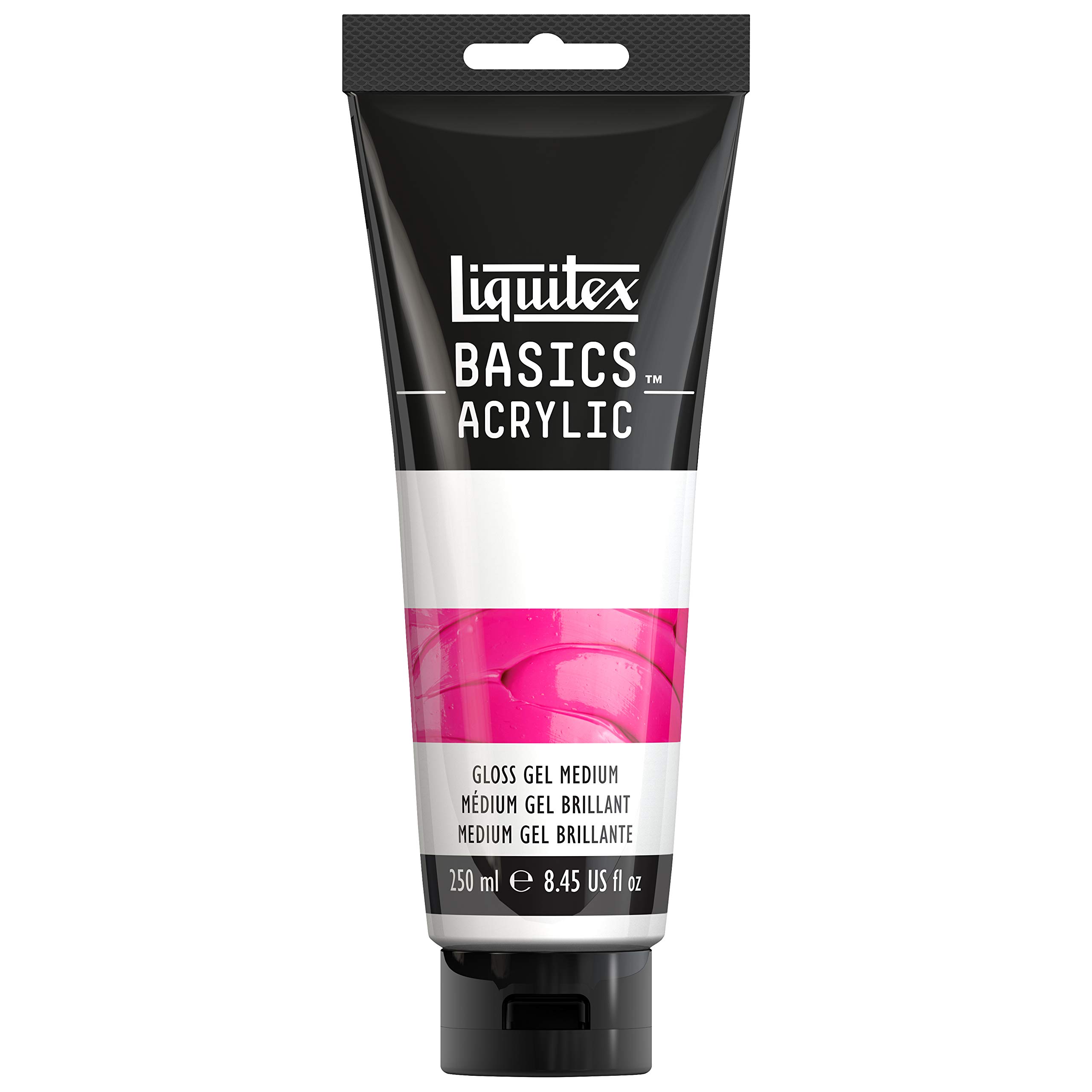
1. Liquitex BASICS Gloss Gel Medium, 250ml (8.4oz) Tube
Our pick — over 4.5★ from 650+ verified ratings; the strongest balance of quality and price.
The squeeze-tube workhorse that thickens paint and throws a gloss shinier than most pro-level mediums.
What you get in this 8.45-fluid-ounce tube is a gloss gel medium built to make your paint go further without wrecking it. Squeeze it into fluid or medium-body acrylic and it thickens the mix, deepens color and transparency, and gives brush and knife marks more presence. That one-hour dry time is the part most painters feel first — it stays open long enough to blend but locks down fast enough that a collage layer does not slide.
The finish here is the surprise. Owners consistently find it glows shinier than mediums sold at professional price points, so a thin coat over paint lifts the color and throws a pearlescent sheen. It stays fully intermixable with other Liquitex products, and you can thin it with up to 25% distilled water if you want a looser glaze. Mix it with the matte gel in the range and you build a custom satin on your own. A cross-medium contrast worth knowing: this one is a one-hour medium, and the Liquitex Professional Gloss Heavy Gel further down the list runs a 48-hour dry time — that is a 48.0x difference in working time, so pick by the blending window you actually need.
The trade-off is tack, and it is worth planning around. Buyers report that it “stayed tacky for a while” even though the adhesive hold for collage is strong, so give a thick application real curing time before stacking sheets or framing. The other honest note is the shine itself — if you are after a flat, non-reflective finish, this is the wrong medium and you should look at a matte pick instead. Wrong finish, not a defect.
What wins people over
- Buyers praise the formula’s consistency above all.
- A one-hour dry time keeps the blending window realistic without leaving a tacky surface for long.
- Bright, deep gloss that punches above its price tier.
- Thins with up to 25% water, so a single tube stretches across several projects.
Where it nudges you to look elsewhere
- Thick applications can stay tacky longer than expected.
- If you need matte, this is the wrong finish entirely.
- Tube form suits small pours but not large batch mixing.
The easy call: grab this if you want one medium for thickening, glazing, and collage on a mixed-media desk.
Look past it if: you need a matte finish or want to build heavy raised peaks with a palette knife.
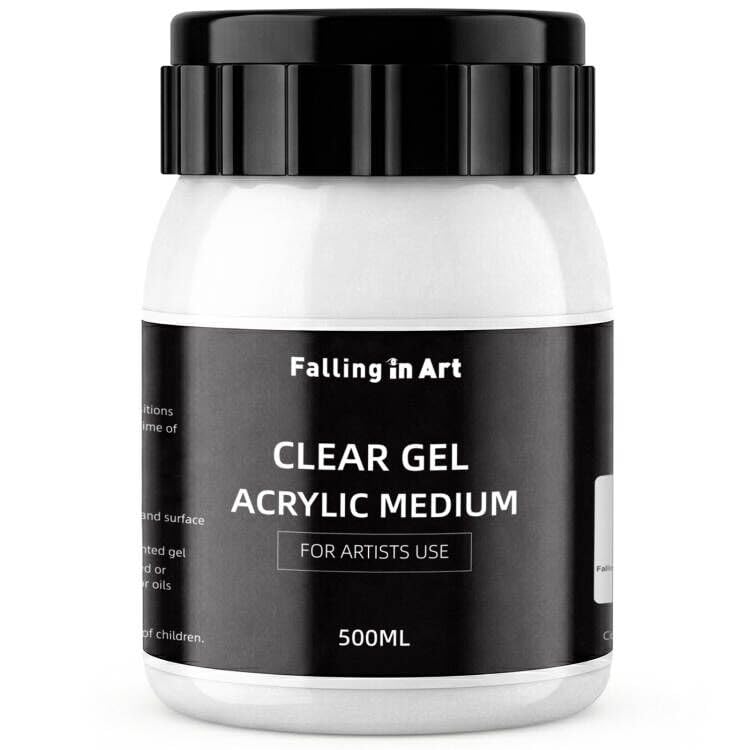
2. Falling in Art Clear Gel Acrylic Medium, 500ML/16.9Oz Gloss Gel Medium
A huge tub of thick, creamy gel that holds knife peaks and glues collage paper without a fight.
Where the Liquitex Professional jar gives you 237 ml, this Falling in Art tub pours out 500 ml — more than double the volume for a pour painter who is going to burn through it on a single session. That volume sits in a 16.9-fluid-ounce container with a hole-and-lock cap, and its grip on thick paint is the headline: the creamy body retains brush strokes and peaks when you build them, so knife texture stays raised instead of settling flat.
Its second job is glue. This clear gel doubles as an adhesive strong enough for heavy collage objects or for folding sand and grit into a mixed-media piece, and you can use it as a nearly clear ground on canvas in place of gesso. The timing is friendly — buyers describe it as drying more quickly than expected, and the finish behaves well for palette-knife work.
Here is the trade-off you need to know before you buy. Clarity is mixed across the reviews: owners mention that it “dries crisp” in thin layers, but the same people note it is not transparent in heavy application — thick pours go cloudy. Treat this as a thin-to-medium-layer medium, and you get the transparency the reviews rave about. Build it up to impasto heights, and you accept a softer, milkier look.
Read before you pour: the tub is the biggest capacity in this comparison at 500 ml, which suits artists who spread it across canvas, wood, and mixed surfaces without rationing. It is also the medium that dries full clear only when you keep layers thin.
The honest caveat: thick application turns this one translucent rather than crisp, so plan your transparency around layer depth rather than fighting it.
Matches your bench: pick this for collage-heavy work and impasto texture where you want a big jar that lasts.
Easier to pass on: if your entire practice is thin, glass-clear glazes, you want a medium that stays transparent at every layer.
3. Liquitex Professional Gloss Heavy Gel Medium, 237ml (8-oz)
The extra-heavy gel that fixes cracked pours, transfers photos onto wood, and holds razor-sharp texture for two full days.
This is the medium for anyone who wants to sculpt with paint rather than spread it. The extra-heavy body holds a palette-knife peak and dries to a transparent-to-translucent high-gloss finish, so textural work keeps its shape and its shine. It is fully intermixable with the rest of the Liquitex Professional line, and it carries an ASTM D4236 conforming label for educational use.
The 48-hour dry time is what separates this from almost everything else here — the same company’s BASICS tube sets in one hour, a 48.0x gap. That long window is why it shines for two jobs: image transfer, where you need the layer to stay soft enough to rub off, and crack repair, where you pile it into the split in a dried pour painting and paint right over it once it clears. For transferring a laser-printed artwork onto wood, the timing advice from real users is blunt: give it long, more than half a day, and the surface comes out cleanly. It also takes plastic stencils well, leaving crisp raised detail.
Quality is the reputation here, and the finish is genuinely high-gloss. The honest limits are three. Strong as a first choice for texture, it is not the medium for tight budget mixing, so the small 8-ounce jar is the sticking point if you pour in volume. It is not waterproof once dry. And long dry times ask for patience, not shortcuts — rushing the moisture out of a thick layer is how transfers fail.
The standout spec: 237 ml of extra-heavy gel with a 48-hour working window is what makes image transfer and heavy impasto possible instead of frustrating.
Who this suits best: transfer artists, crack-repair painters, and anyone building raised texture who wants a single jar to handle all three.
Reach for this when: the project needs time — transfers, repairs, layered texture you will reshape across a day or two.
Skip the urge to rush: short, impatient dry schedules will not give this medium the window it is built around.
4. Golden Artist Colors – Soft Gel Gloss – 8 oz Jar
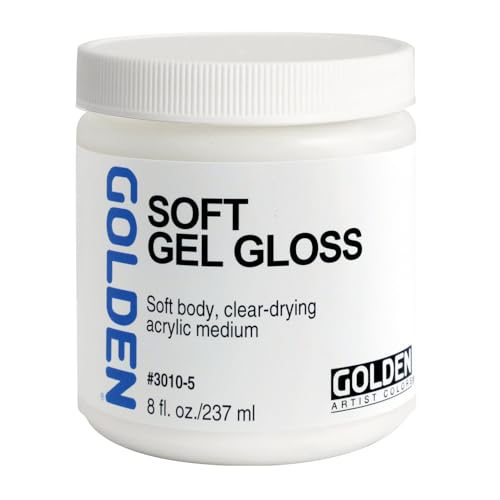
Golden’s soft-body gloss — the medium painters reach for when they want one jar that glazes, extends, and glues.
Alongside the heavy gels on this list, Golden’s Soft Gel Gloss is the flexible mid-weight option: it extends color, adjusts sheen, increases translucency, and adheres collage elements without the thick, sculptural build that a heavy gel brings. The result is a softer, more fluid mix you can spread and work. When cured it carries chemical, water, and UV resistance — a durability point you do not always see named on a medium label.
The application range is where it earns a place. Close to a 3 x 2.75 x 2.75 inch jar with a straightforward pour, it suits journalling, card-making, and transfer work as readily as it does glazing a finished canvas. Watercolourists, in particular, use it to seal a surface so water pools and resists instead of sinking straight through the paper, and a little goes further than you would expect from the modest size.
Two cautions from the field. Because it is soft-body rather than heavy, it will not hold the tall, sculptural peaks a heavy gel produces — the trade-off for the smooth, even glide. And the jar lid is a maintenance point: customers note that the rim gums up if you leave residue, risking a weak seal and a dried-out jar, so wipe the thread before you close it. Both are small housekeeping details rather than flaws in the material itself.
Why painters keep it stocked
- It glazes, extends color, and glues in the same jar.
- A little product goes a long way, so the 8-ounce jar lasts.
- Chemical, water, and UV resistance once dry.
- The finish brings out color without leaving visible drying lines.
Small things to bear in mind
- Soft-body means no tall impasto peaks.
- The rim gums up if you don’t keep the lid clean.
- For writing or stamping directly on the surface, matte is the better choice than gloss.
The one-jar solution: ideal for journalling, cards, transfers, and glaze work where one flexible medium has to cover everything.
Pass if you build height: sculptors after dramatic knife texture want a heavy gel, not a soft one.
5. GOLDEN Matte Medium, 8 fl. oz. Bottle

A liquid matte that kills glare, layers paper flat, and stands in for gesso when you need a clear ground.
If the glare on your acrylics keeps pulling light away from the color, this is the answer: the 237 ml bottle dries to a toothy, translucent, wax-like finish that lowers sheen without dulling the paint. It pours as a liquid rather than a gel, so it mixes evenly into color and spreads in flat, even films. It carries a 24-hour dry time, which keeps it workable through a session.
The second role here is grounding. Owners use it as an almost-clear primer on canvas in place of gesso, giving the paint a slightly toothy surface to grip without a white layer underneath. The same liquid also serves as a plain collage adhesive and page-glue, which is why the versatility count sits behind only quality in the review traits.
Where it asks for a decision: matte finish removes the gloss that gives some strokes texture and depth, and this low-sheen look is a deliberate choice rather than a fault. It is not waterproof, and the current price sits at the higher edge for a small bottle, so a studio that uses it by the litre should look at the large jar version instead. For small-canvas work and journaling, though, it is the cleanest matte you will mix.
Standout detail: a liquid medium with a 24-hour window that dries flat and wax-like is rare at this size — most matte options come as gels that fight thin coats.
The catch to weigh: it is a small bottle at a premium-tier price, so heavy users will outgrow it faster than they expect.
Right for you if: you want a flat, glare-free finish and a clear ground roll in one bottle.
Better avoided if: you only ever paint glossy, in which case a gloss medium keeps your color bolder.
6. Handy Art Acrylic Gel Medium, 32 oz, Increase Viscosity, Transparent Finish

A quart of creamy medium that glues collage paper and matches pricier brands without draining the studio budget.
At 32 ounces in a resealable wide-mouth quart, this jar is built for palette-knife work and wide brushes, and its texture is the drawing card. It spreads like meringue — light, creamy, and easy to move — thickens paint to add body, and dries to a clear matte-satin that holds collage paper firmly. It carries an AP-certified non-toxic label and is free of latex, dairy, casein, soy, egg, gluten, peanuts, and tree nuts, which matters if students or households with allergies are around the paint.
Two quirks surface in use. Buyers describe the surface as “meringue-like” and easy to spread, but they also note that fresh collage layers can slide or lift while the paper is soaking in moisture — hold the sheet down for the first minute. And on transparency, the same honest caveat keeps coming up: thick applications do not dry clear, so keep transfer layers thin if visibility is the goal. On plain collage with thick paper, none of that matters.
The texture is the reason you would pick this over a premium name, and the volume reason you would buy it again. Compare the 32-ounce container with the 8-ounce jars on this list — if you mix large batches, the difference in how often you reorder is the whole point. It is not the medium for a thin, glass-clear glaze; it is the medium for taking glue and texture off your supply list.
Reasons owners restock it
- It works as a glue, a texture builder, and a glaze component.
- Creamy, meringue-like body spreads easily with a knife or silicone tool.
- Works as well as premium brands for collage and image transfer, according to owners.
- AP-certified non-toxic and free of common allergens.
Honest notes on using it
- Thick layers dry less transparent than a thin coat.
- Fresh collage paper can slide or lift while the adhesive is wet.
- Consistency is thicker and less clear than some competing mediums.
Ideal match: collage artists, classrooms, and mixed-media makers who want a big, affordable jar of creamy adhesive-texture.
Not the right call if: you need crisp transparency at heavy layers — keep this one for thin coats.
7. Winsor & Newton Galeria Acrylic Matte Medium, 8.4-oz (250ml) Jar

A liquid matte built for homemade washes and flat washes — the mixing medium for painters who thin paint to a glaze.
Winsor & Newton sells this as a liquid matte medium, not a gel, which is exactly what you want when the goal is a thin, even wash rather than texture. It creates a flat, even finish, maintains the brilliance of your color, and boosts transparency, adhesion, and durability. At a 1.5-hour dry time it stays open a touch longer than the fastest medium here, giving you a small extra blending window.
Mixers love it because it acts as a flow extender: add it to color thinned with water and you build a runny glaze or a controlled ink-like wash without losing the body of the paint. It sits well in a 250 ml jar for someone working on a smaller scale, and it is forgiving to blend into custom shades.
The honest risks with a liquid matte are on the label and the seal, and buyers have run into both. Users report that it takes a considerable amount to shift a heavily glossy paint flat, so the matte shift is not instant on a high-gloss finish — mix larger ratios for a strong matte. Two buyers reported shipping leaks because the jar travelled without individual packing, so check the seal on arrival. It is still a solid, well-priced flat medium for anyone who mixes washes and glazes regularly.
Why it earns a place: a genuinely liquid matte with a 1.5-hour window suits wash-making better than any gel on this list.
What to plan for: matte conversion needs a generous proportion, and the jar relies on its own packing for safe transit.
Suits you if: you make your own acrylic washes, glazes, or flat-color mixes and want a matte that pours and flows.
Not the pick for: push-and-sculpt texture work, which wants a heavy gel’s body.
8. Pouring Masters 32 Oz (Quart) Acrylic Pearlescent Effects Medium

The pour painter’s shine medium — a quart that lays down a pearl shimmer and quietly transforms every color it touches.
Pouring Masters built this for fluid art and it shows: 32 fluid ounces in a single bottle is enough for multiple pours on canvas, wood, or board, and it is formulated to add shimmering, sparkling, iridescent metallic effects to your acrylic paint. It flows easily and improves the consistency of a pour, so colors blend into softer, more predictable movement. It can also be thinned with up to 30% water if you want an even looser consistency.
It earns attention for what buyers call a “pearl finish” — you can use it alone or as a third coat over a tinted base to make an existing color shift and shimmer, and painters note it hugs the high and low points of texture, catching the light across the surface. It is also transparent when thin, letting the base color read through.
The trade-off is body. Thickness comes up mixed in the reviews — reviewers point out it is very thick and dries fast, which is fine for controlling rework but can make thin, even pours harder to smooth out. It is not waterproof, so keep it for indoor work. A note repeated by its own painters: test a small patch first, since the pearlescent shift is easier to dial in once you see how it reads on your specific base color.
What stands out: a single quart of pearlescent medium covers multiple pour projects, and it can be thinned with up to 30% water when a runnier mix is needed.
Where to expect a compromise: this is very thick, and mixed reviews on thickness mean you should test before committing a whole canvas.
Made for you if: you pour fluid art and want a pearlescent shimmer that shifts color without mixing multiple products.
Pass on it if: you need a clear, texture-free medium for glazing flat color — this one is built to shine and to stay thick.
9. Matte Medium by GOLDEN, 32 fl. oz. Jar, Professional Acrylic Medium, Semi-Transparent

Golden’s big matte — the studio jar that grounds a canvas, glues a page, and cuts glare across the whole board.
This is the same liquid matte science as the small Golden bottle, poured into a 946 ml jar that makes sense for anyone working through medium by the session. It extends color, lowers gloss, and increases film integrity, drying to a toothy, translucent, wax-like finish — and it can be used as an almost-clear ground in place of gesso. A couple of artists use it to extend gesso and to prime unprimed paper before painting.
Where the smaller bottle handles journals and cards, this container fits canvases and large boards. It adds strong adhesion for collage and holds color brilliance while flattening the surface to a soft, consistent matte. If you are proud of a run of framed artwork you want to stay glare-free under light, this is the jar that gets you there.
Two honest points. Matte remains a deliberate look, not the only correct one — painters who prize glaze depth will still want a gloss for some pieces. And matte options always carry the transparency-versus-coverage balancing act: heavy layers shift what the color underneath reads as. The big jar pays off only if you use medium regularly, since a 24-hour cure and a large volume reward patience and steady output.
Why the big jar pays off
- Shoppers say the formula is reliable across batches.
- Functions as a glaze extender, collage adhesive, and clear canvas ground.
- A 946 ml jar carries a studio through repeated sessions without reordering.
- Dries clean and even, reducing glare without dulling color.
Worth checking first
- Matte is a strong look — not every painting benefits from flat sheen.
- Large jar suits heavy users, not casual buyers — 24-hour cure rewards patience.
- Value is mixed in the reviews, with some painters wanting a lower price per ounce.
Buy it when: you work at a studio scale and want one large jar for priming, gluing, and cutting sheen.
Look elsewhere if: you paint only occasionally, since the jar is generous and the cure patient.
Understanding the Specs
Dry time in hours
Dry time tells you how many hours the medium stays workable — the window you have before the surface sets. A one-hour medium suits fast collage work and pours, while a 48-hour medium gives you days of reshaping time for glazes and raised texture. Match the number to the pace of your work, not the brand.
Finish type
Finish labels — Gloss, Matte, High-Gloss, Satin, Metallic — describe how the dried surface reflects light. Gloss deepens color and adds shine, matte cuts glare to a flat, wax-like look, and metallic throws a pearlescent shimmer across whatever is under it. Pick the finish you want to live with on the finished piece, since the medium sets before you can change your mind.
Volume and dilution
Volume tells you how far a jar goes — a 500 ml tub covers more pours than an 8-ounce tube. Dilution limits, from 25% to 30% water, show how much you can thin the medium before losing its body. Pair a large volume with a thinnable formula when you plan to stretch it across multiple projects.
Clarity in layers
Clarity is how transparent the medium stays as you build it up. Most gels dry clear in thin coats but go cloudy when you pile them thick, which is the single most common complaint about the whole category. If transparency matters at every depth, keep layers thin or choose a ratio designed for build-up.
FAQ
Does acrylic medium change the color of my paint?
Can I thin acrylic medium with water?
How long does acrylic medium stay tacky before it is fully dry?
Is acrylic medium the same as Mod Podge?
Does a gel medium or a liquid medium give me clearer results?
Can I use acrylic medium as a primer instead of gesso?
How do I stop medium spilling if the jar ships loose?
Is acrylic medium safe for students and children?
Will gel medium hold heavy collage objects?
Can I mix medium into fully dry paint on the canvas?
Final Thoughts: The Verdict
For most painters, the best acrylic medium is the Liquitex BASICS Gloss Gel Medium, 250ml — it thickens paint, glues collage, and throws a gloss shinier than most pro-level mediums, all from a single 250ml tube. If you want days of working time for image transfer and heavy texture, the Liquitex Professional Gloss Heavy Gel with its 48-hour dry time is the one to reach for. And for studio-scale priming and gluing, the GOLDEN Matte Medium 32 fl. oz. jar is the pick to keep stocked.
How We Picked
We do not accept paid placement. Every pick is matched to a real buyer and a real use-case; we do not hands-on test units.
Sources & Methodology
Specifications: manufacturer listings and product documentation. Review insights: verified customer reviews, as of September 2026. Pricing: not shown on this page (it changes often); check the current price via the retailer link.
As an Amazon Associate, Gadgets Feed earns from qualifying purchases. This does not affect which products we feature.