
The difference between a flat, lifeless painting and one that grabs your eye from across the room often comes down to the medium beneath the brush. Texture, sheen, body, and adhesion — acrylic mediums and gels give you total control over these properties, turning a simple tube of paint into a sculptural, layered, or fluid tool. Whether you are building thick impasto peaks, creating translucent glazes, or gluing down mixed-media components, the right gel or medium determines whether your piece holds its form or sags into a puddle.
I’m Min — the co-founder and writer behind Gadgets Feed. I’ve analyzed dozens of these acrylic additives, comparing viscosity, drying transparency, archival stability, and real-world performance across hundreds of verified buyer reports to separate the formulas that actually deliver from those that disappoint.
This guide breaks down the top performers across seven distinct use cases, from budget-friendly bulk options to professional-grade gels trusted by working artists. The goal is simple: help you find the very best acrylic mediums and gels for your specific technique, surface, and budget.
How To Choose The Best Acrylic Mediums And Gels
Acrylic mediums and gels are not one-size-fits-all. Your choice depends on whether you want to add body, improve flow, change sheen, or glue things down. The wrong consistency will ruin your planned effect — a runny liquid medium cannot hold a knife peak, and a stiff gel cannot create a smooth pour.
Viscosity: The Body of the Medium
This is the single most important spec. Gels come in soft, regular, and heavy (or extra-heavy) body. Soft gels spread easily and work for glazing and collage. Heavy gels and impasto mediums keep the shape of your brush or palette knife, creating visible three-dimensional texture. Check the product description for a consistency cue — if it says “holds a peak,” it is heavy body. If it says “levels,” it is a soft gel or liquid.
Finish: Matte vs. Gloss vs. Satin
Matte finishes absorb light and reduce glare, making them ideal for collages and surfaces where you want a natural, non-reflective look. Gloss finishes increase color depth and saturation, making pigments appear richer — perfect for glazes and pouring work. Satin falls in between. An important note: some impasto mediums dry with a slight sheen even when labeled matte, so check user reviews for real-world finish reports.
Drying Transparency and Film Integrity
Most quality mediums dry clear or semi-transparent, but cheaper formulas can dry milky or yellow over time. Professional-grade gels from established brands like Golden are formulated with UV-resistant acrylic polymers to maintain clarity for decades. Look for “archival” or “non-yellowing” claims if you are working on fine art meant to last.
Volume and Value
Mediums are heavy — shipping a 32 oz jar costs more than the product itself in some cases. If you do large-scale pours, classroom projects, or heavy collage work, the cost per ounce dramatically favors bulk containers. Smaller 8 oz jars are fine for detail work or testing a new brand before committing to a liter.
Quick Comparison
On smaller screens, swipe sideways to see the full table.
| Model | Category | Best For | Key Spec | Amazon |
|---|---|---|---|---|
| Golden Soft Gel Gloss 8 oz | Soft Gel Gloss | Glazing and collage | Soft body, UV-resistant | Amazon |
| Golden Matte Medium 8 oz | Liquid Matte Medium | Extending color, reducing gloss | Toothy translucent finish | Amazon |
| Prima Art Basics 3D Matte Gel 8 oz | Heavy Gel Matte | Mixed media and dimensional texture | Heavy body, matte, archival | Amazon |
| Mont Marte Impasto Medium 500ml | Impasto Medium | 3D surfaces, brush stroke retention | Holds peak, dries clear matte | Amazon |
| Handy Art Gel Medium 32 oz | Thick Gel Medium | Impasto and collage on a budget | 32 oz bulk, AP non-toxic | Amazon |
| PEBEO Matt Gel 250 ml | Matt Gel Tube | Fine detail and glass painting | Non-yellowing, translucent matte | Amazon |
| Nicpro Pouring Medium 69oz | Pouring Medium Gloss | Large-scale fluid art and pours | 69 oz with pump, crack-resistant | Amazon |
In‑Depth Reviews
1. Golden Soft Gel Gloss 8 oz
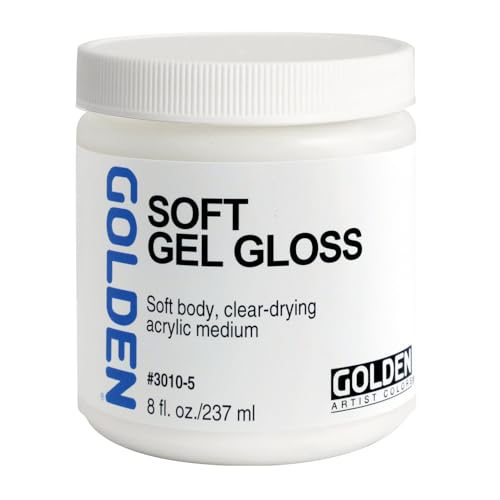
Golden’s Soft Gel Gloss is the industry benchmark for a reason: it delivers a clear, glossy film with outstanding flexibility and UV resistance after drying. This is the go-to medium for creating transparent glazes that deepen color without muddying it, or for adhering collage elements to canvas with a bond that won’t crack over time. The soft body spreads easily by brush or palette knife but does not hold a sharp peak — it levels slightly, making it ideal for smooth, even coatings.
What stands out in real-world use is how well it performs as a transfer medium for image lifting. Artists report brushing it over magazine clippings, letting it dry, and then removing the paper backing to reveal a clear, flexible decal that sticks to most surfaces. It works beautifully on canvas, wood, and paper without warping the substrate. Made by an employee-owned company with decades of acrylic chemistry experience, this jar offers professional-grade reliability that cheaper alternatives cannot match.
One detail to note: because of the gloss finish, writing or stamping over dried Soft Gel Gloss can be tricky — the glossy surface resists some pens and inks. For hybrid journaling or mixed-media where you plan to write over the medium, a matte finish would serve you better. That said, for pure visual depth and archival permanence, this is the premium choice.
Why it’s great
- Clear, flexible, UV-resistant film that won’t yellow.
- Excellent for image transfers and decal creation.
- Professional-grade formula made in the USA with decades of expertise.
Good to know
- Gloss surface is difficult to write or stamp over.
- Does not hold a peak — unsuitable for sculptural impasto.
- Pricier than generic alternatives per ounce.
2. Golden Matte Medium 8 oz

Golden’s Matte Medium is a liquid, not a gel, and that distinction is critical. It flows like thin cream and dries to a translucent, toothy, wax-like matte finish that feels smooth to the touch. This is the definitive medium for paper collage and bookbinding — artists consistently praise its ability to glue down thin paper and tissue without wrinkling or puckering, while maintaining a completely non-reflective surface. The toothy texture also provides an excellent ground for pastel, charcoal, or graphite over the dried medium.
Unlike heavy gels that bulk up the surface, this medium sits thin. You can use it to extend a small amount of expensive acrylic paint across a large canvas without altering the color, or as a nearly clear ground on raw canvas in place of gesso. The matte finish mutes the gloss of straight acrylic paint, which helps when you want a uniform, low-sheen surface across mixed materials. Multiple reviewers mention using it as a glue for layering book pages and napkins with zero visible residue.
One limitation: because it is a liquid medium, it cannot create three-dimensional texture. If you want peaks, ridges, or knife marks, you need a gel or impasto medium. Also, while it dries fairly fast (thin layers in 20-30 minutes), thicker applications can remain tacky longer than expected. Stick to thin layers for best results.
Why it’s great
- Excellent adhesive for paper collage without wrinkling.
- Dries to a toothy matte finish that accepts further media.
- Thin consistency extends paint without altering color.
Good to know
- No texture-building capability — it levels flat.
- Thick applications may stay tacky longer than gels.
- Small 8 oz jar is consumed quickly in heavy use.
3. Prima Art Basics 3D Matte Gel 8 oz

Prima Marketing’s Art Basics 3D Matte Gel is a heavy-body gel with a surprising dual personality: it creates dimensional texture AND acts as a structural adhesive for heavy mixed-media elements. Artists report using it to glue down beads, wood veneers, small metal pieces, and even ceramic shards on canvas — the hold is strong enough that once cured, the elements are effectively cemented in place. The gel dries to a flexible, permanent matte film that remains slightly rubbery, which helps absorb shock without cracking.
Texture-wise, this gel holds a clean peak when applied with a palette knife. You can build thick layers for stencil work or dimensional backgrounds without worrying about sagging. The matte finish is genuinely non-reflective, which reviewers appreciate when they want texture without a glossy glare. It also dries fairly fast — thin layers in 15 minutes, thicker peaks in an hour or so — allowing you to build complex layers in a single sitting.
There is one practical annoyance: the gel is tenacious on skin. Once it dries on your fingers, it is extremely difficult to wash off without scrubbing. Wearing gloves during application is strongly recommended. Also, because it is a heavy-body gel, it does not self-level — brush marks and knife ridges will remain exactly as applied, so you must be deliberate with your tool strokes.
Why it’s great
- Holds a peak for sculptural 3D texture.
- Excellent adhesive strength for mixed-media components.
- Dries fast with a genuine matte, non-reflective finish.
Good to know
- Extremely difficult to wash off hands once dry.
- Does not level — every stroke stays visible.
- 8 oz bottle may feel small for large-scale projects.
4. Mont Marte Impasto Medium 500ml

Mont Marte’s Impasto Medium is designed specifically for artists who want dramatic, visible brush and palette knife strokes that remain frozen in place after drying. Unlike soft gels that settle, this medium refuses to level — reviewers consistently note that when you scoop it with a knife, it stands up in a stiff mound and retains that shape through the curing process. The 500ml (17 oz) can is generously sized for the price, giving you plenty of material to practice impasto techniques without worrying about cost.
The real advantage here is drying speed. Thin layers dry to the touch in about an hour, and even thick, sculptural peaks are fully cured within 24 hours. This is noticeably faster than many premium gels, which can take up to 48 hours for heavy applications. The medium mixes cleanly with acrylic paint without dulling or shifting the pigment, and it dries to a matte finish — though some users report a slight sheen in direct light, so a final matte varnish may be needed for a fully flat appearance.
One trade-off: the product is not labeled as archival or UV-resistant. For student work, practice pieces, or decorative projects, this is not an issue. But if you are creating a piece meant to last decades in a sunlit room, a professional-grade impasto gel from Golden or Liquitex would offer greater long-term clarity and flexibility. Cleanup with water is easy when the medium is still wet, which is a welcome convenience.
Why it’s great
- Outstanding peak retention for impasto technique.
- Fast drying — thick peaks cure in 24 hours.
- Excellent value in a large 500ml can.
Good to know
- Not labeled archival or UV-resistant.
- Can dry with a slight sheen despite matte labeling.
- Requires thorough mixing to avoid separation in the can.
5. Handy Art Gel Medium 32 oz
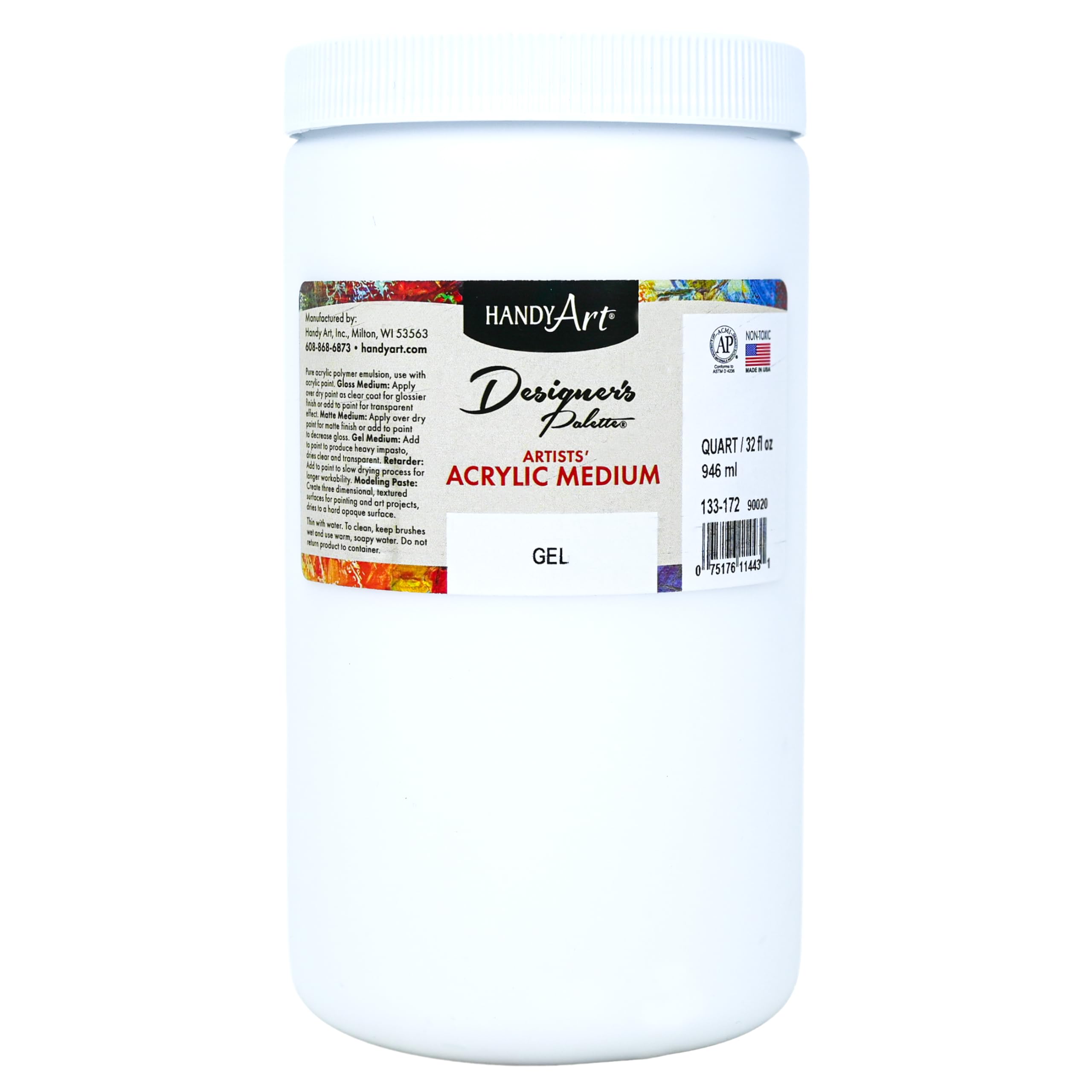
Handy Art’s Gel Medium offers a massive 32 oz (2 lb) jar of thick, creamy gel at a price that undercuts most competitors by a wide margin. The consistency sits between a soft gel and a heavy gel — it is thick enough to use with a palette knife for moderate texture, but pliable enough to spread with a brush for collage work. When dry, the film is clear with a matte finish, though some users note it is slightly less transparent than premium brands, with a faint haze in very thick applications.
This medium shines in high-volume scenarios: classroom projects, community art workshops, or any situation where you are going through gallons of medium. It mixes well with acrylic paint for impasto effects and works as a strong adhesive for paper and lightweight fabric collage. The wide-mouth quart jar accommodates palette knives and wide brushes easily, which speeds up workflow. AP non-toxic certification means it is safe for use by students and children under supervision.
The compromise comes in the refined behavior. Compared to Golden or Prima gels, Handy Art’s formula is less forgiving — it can warp thin paper if applied too wet, and the cured film has slightly less flexibility, which could lead to cracking on flexible substrates like canvas that is stretched tight. For rigid surfaces like wood panels, Masonite, or heavy paper, it performs admirably. This is a workhorse medium, not a luxury one.
Why it’s great
- Exceptional value at 32 oz for a budget-friendly price.
- Versatile medium consistency — works for texture and collage.
- AP non-toxic, safe for classroom and student use.
Good to know
- Slightly less transparent than premium brands when thick.
- Cured film is less flexible; may crack on stretched canvas.
- Can warp thin paper if applied too wet.
6. PEBEO Matt Gel 250 ml

PEBEO’s Matt Gel comes in a tube format that gives you precise control over small amounts — a distinct advantage for detail work, fine-line stenciling, and painting on glass or ceramic surfaces. The gel squeezes out smoothly and applies with a brush without sagging, and it dries to a truly matte, translucent finish that does not attract fingerprints. Reviewers specifically praise its performance on smooth, non-porous surfaces like glass vases and tiles, where many other gels struggle to adhere.
One clever use case mentioned by buyers: applying the gel over glossy stickers and printed labels to kill the shine and make them blend into a matte surface. This works surprisingly well, turning shiny commercial elements into cohesive parts of a mixed-media piece. The gel is also non-yellowing, which is important when used on white or light-colored backgrounds where yellowing would be immediately visible. It mixes cleanly with acrylic paints to increase transparency while maintaining a matte finish.
The tube format does limit volume — 250 ml is fine for small projects and detail work, but you will go through it quickly if you are covering large areas or building thick texture. Also, the gel is soft-bodied and does not hold a sharp peak, so it is not suitable for heavy impasto. Think of it as a precision tool for controlled applications rather than a bulk medium for large surfaces.
Why it’s great
- Tube format allows precise, waste-free dispensing.
- Excellent adhesion on glass, ceramic, and other smooth surfaces.
- Non-yellowing formula maintains clarity over time.
Good to know
- Limited volume — not economical for large-scale projects.
- Soft gel consistency cannot hold sculptural peaks.
- Tube packaging makes it hard to gauge remaining product.
7. Nicpro Pouring Medium 69oz
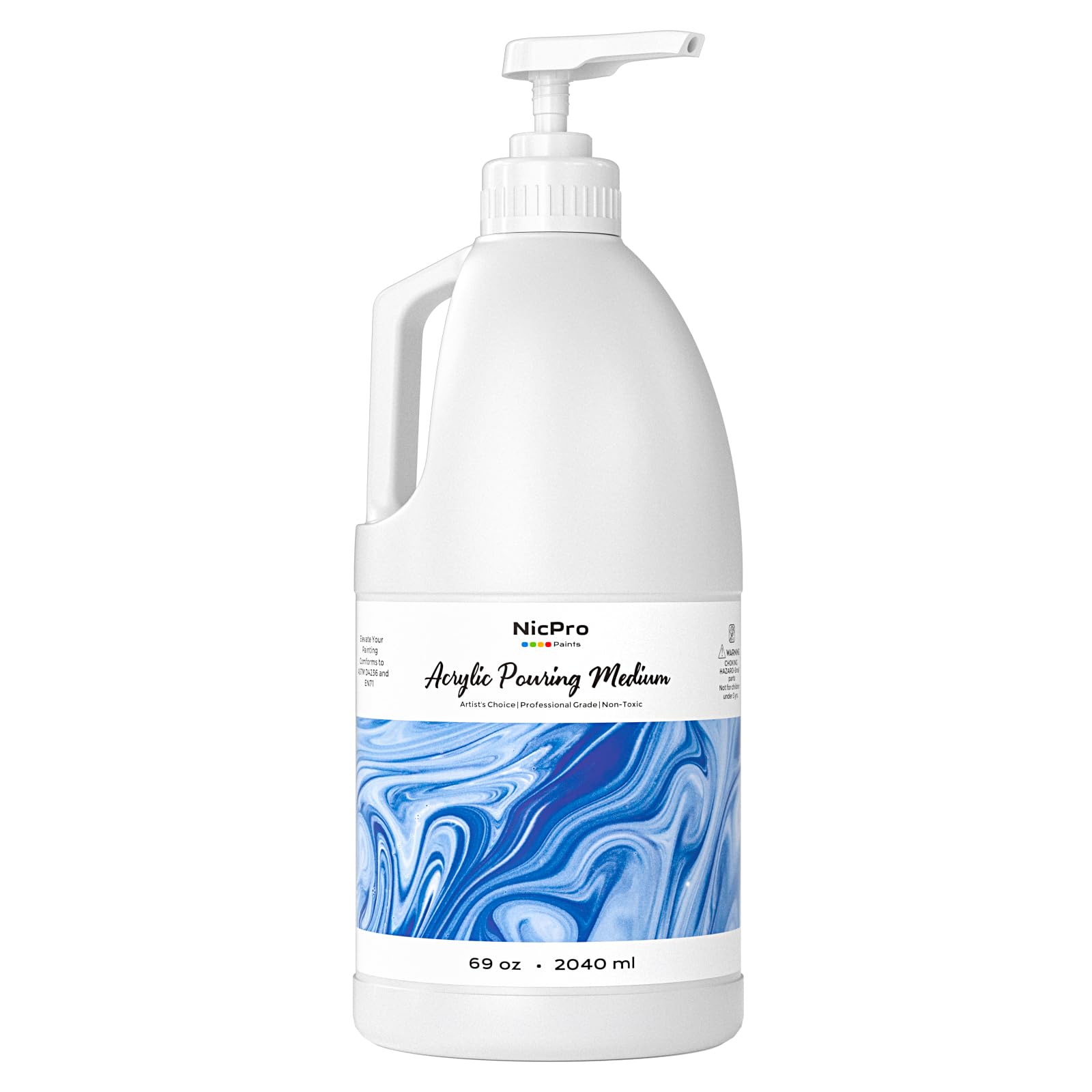
Nicpro’s Pouring Medium is the volume king: a jumbo 69 oz (2040 ml) bottle with a built-in pump dispenser that turns messy fluid-art preparation into a clean, measured process. This medium is formulated specifically for acrylic pouring — it reduces the viscosity of the paint dramatically, creating a thin, self-leveling fluid that spreads across canvas in smooth waves. The gloss finish produces that high-shine, resin-like look that pour painters chase, and the formula is designed to resist cracking as the paint cures.
The built-in pump is a genuine workflow improvement. One press delivers a consistent shot of medium, so you can mix paint-to-medium ratios by pump count rather than estimating volumes. This is particularly useful in classroom or workshop settings where multiple batches need to be consistent. Non-toxic certification (ASTM D4236 and EN71) makes it safe for use by teens and adults in group settings. The bottle is translucent, so you can see your remaining supply at a glance.
The trade-off: this is a very wet, thin medium. It is excellent for dirty pours, flip cups, and swipes where you want cells and flow, but it is too thin for glazing techniques where you need controlled transparency without runniness. Advanced artists looking for a gel medium to create fine-art glazes will find this too liquid. For its intended purpose — high-volume, accessible pouring — it outperforms everything in its price tier.
Why it’s great
- Massive 69 oz volume with a convenient pump dispenser.
- Creates smooth, crack-resistant cells and flows.
- Non-toxic and safe for classroom or group use.
Good to know
- Too wet for controlled glazing or fine-art applications.
- Gloss finish may not suit all aesthetic preferences.
- Large bottle is heavy and takes up significant storage space.
FAQ
Can I use acrylic gel medium as a glue for collage?
What is the difference between acrylic medium and acrylic gel?
How do I prevent my acrylic pours from cracking?
Do acrylic mediums yellow over time?
Final Thoughts: The Verdict
For most users, the best acrylic mediums and gels winner is the Golden Soft Gel Gloss 8 oz because it delivers the most versatile balance of clarity, flexibility, and professional-grade reliability across glazing, collage, and mixed-media techniques. If you want heavy-body texture and adhesive strength for dimensional art, grab the Prima Art Basics 3D Matte Gel. And for high-volume acrylic pouring without breaking the bank, nothing beats the Nicpro Pouring Medium 69oz.