
An acrylic nail emery board isn’t just an abrasive stick — it’s the single tool that determines whether a full-set application looks sculpted or sloppy. The right grit rips through hard acrylic overlay without peeling the natural nail plate, while the wrong one leaves a surface too rough to bond with gel topcoat. This guide breaks down which boards actually survive contact with acrylic monomer and which crumble under pressure.
I’m Min — the co-founder and writer behind Gadgets Feed. I’ve analyzed the grit densities, board thicknesses, and adhesive durability across dozens of acrylic nail files to find the boards that professional techs refuse to share.
After researching hundreds of user reports on wear rate, dust generation, and washability, this guide delivers the definitive verdict on the acrylic nail emery board that balances coarse aggression with board longevity.
How To Choose The Best Acrylic Nail Emery Board
Grit number isn’t a suggestion — for acrylic, 80 grit is the only starting point. Boards rated 100 or 180 grit will gum up immediately on fresh acrylic monomer because the abrasive particles aren’t aggressive enough to shear through the polymerized resin. Stick with 80 grit on both sides if you’re filing full-coverage tips or removing bulk acrylic overlay, then switch to a finer 180 grit board only for edge sealing and contour refinement.
Board Substrate: Foam core vs. Solid PP
Foam-core boards flex slightly under pressure, which reduces the chance of pressure-fracturing an acrylic nail during shaping. Solid PP (polypropylene) boards are stiffer and transfer more force directly into the acrylic, making them faster for bulk removal but riskier for thin natural nails underneath. Professional techs typically keep a foam-core 80/80 board for client work and a solid PP version for tip blending on forms.
Washability and Reusability
Acrylic dust clogs the grit pores faster than nail powder alone. A washable board lets you rinse away debris with soapy water and extend the file’s lifespan from one use to several weeks. Look for boards labeled “washable and sanitizable” — these use a waterproof adhesive between the grit layer and the core that doesn’t delaminate when wet. Non-washable boards have a paper-based grit that sheds particles after the first rinse.
Quick Comparison
On smaller screens, swipe sideways to see the full table.
| Model | Category | Best For | Key Spec | Amazon |
|---|---|---|---|---|
| ForPro Zebra Foam Board | Premium | Salon bulk acrylic removal | 80/80 grit foam core | Amazon |
| HomeyEra 80/80 50-Pack | Mid-Range | Heavy gel and acrylic shaping | 80/80 grit PP board | Amazon |
| Professional Electric Nail Drill | Premium | Full acrylic removal speed | 35000RPM 3600mAh | Amazon |
| AhaTopia 80/80 100-Pack | Budget | High-volume home or classroom use | 80/80 grit curved shape | Amazon |
| Astraxe Sapphire Black File | Mid-Range | Portable travel and touch-ups | 5-inch stainless steel | Amazon |
| HomeyEra 100/180 50-Pack | Mid-Range | Natural nail finishing after acrylic | 100/180 grit dual | Amazon |
| COSLUS C20 Nail Drill | Mid-Range | Beginner electric filing | 0.2 lb cordless pen | Amazon |
In‑Depth Reviews
1. ForPro Professional Collection ForPro Zebra Foam Board

The ForPro Zebra Foam Board is the gold standard for busy nail salons. Its cushioned foam core absorbs the shock of aggressive filing, reducing client discomfort during thick acrylic removal while the 80/80 grit maintains consistent bite across dozens of uses. Each board measures 7 inches long and 0.75 inches wide — slightly narrower than the HomeyEra boards but intentionally sized for precise edge work on sculpted acrylic extensions.
The washable and sanitizable construction sets it apart from cheaper paper-based boards. Techs report that a single ForPro board survives an entire week of client appointments when rinsed with disinfectant between uses. The adhesive between the grit layer and foam core does not delaminate even after repeated soaking, a failure point common on generic 80-grit boards that bubble and peel after one wet wipe.
At 50 boards per pack, this is the most cost-effective solution for professionals who need a board that doesn’t disintegrate mid-fill. The aggressive 80/80 coarseness is unforgiving on natural nails — this is strictly for acrylic removal and bulk shaping, not for buffing. Pair it with a finer 180-grit board for finishing work.
Why it’s great
- Cushioned foam core reduces vibration and client discomfort
- Washable and sanitizable without losing grit adhesion
- 50-count ideal for high-volume salon use
Good to know
- 80/80 grit is too aggressive for natural nail buffing
- Narrow width requires a more experienced hand for wide nail beds
2. HomeyEra 80/80 Grit Nail Files (50 Pack)
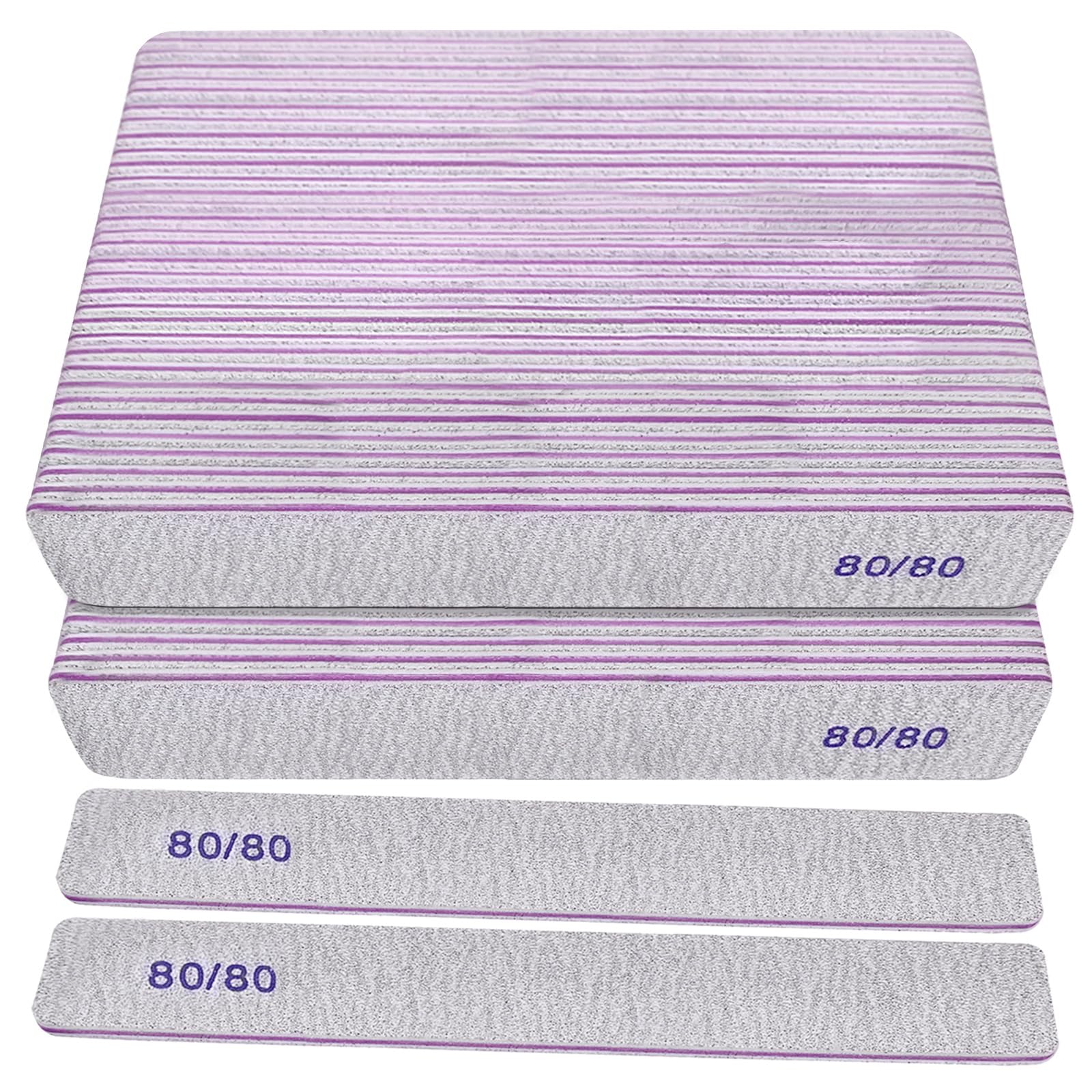
HomeyEra’s 80/80 grit nail files offer the widest board in this comparison at 1.18 inches across, making them ideal for techs who want maximum surface contact during acrylic filing. The solid PP core is stiffer than foam, which translates into faster bulk removal on thick acrylic overlays — every stroke shears more material away compared to a foam board of equivalent grit.
Users consistently praise the boards’ reusability. The washable sandpaper and EVA sponge construction holds up to repeated rinsing, and multiple reviews note that a single board lasts an entire month of home use. The 7.1-inch length gives ample leverage for both the grip of a dominant hand and the precision of the nondominant guide hand, a detail often overlooked on shorter boards that force a cramped filing angle.
The 50-pack makes this a no-brainer for budget-conscious techs who still demand professional-grade coarseness. The only caveat is that the PP core transmits more vibration to the fingertip than a foam board — wearers with sensitive joints may prefer the cushioned ForPro. This board works equally well on dog claws for pet groomers, as several confirmed uses on corgi and larger dog nails attest.
Why it’s great
- Widest filing surface at 1.18 inches for faster bulk removal
- Solid PP core transfers more force directly into acrylic
- Reusable and washable without grit shedding
Good to know
- Stiffer core increases vibration feedback to the hand
- 80 grit can gouge natural nail if not used with light pressure
3. Professional Grade Electric Nail Drill Kit 35000RPM
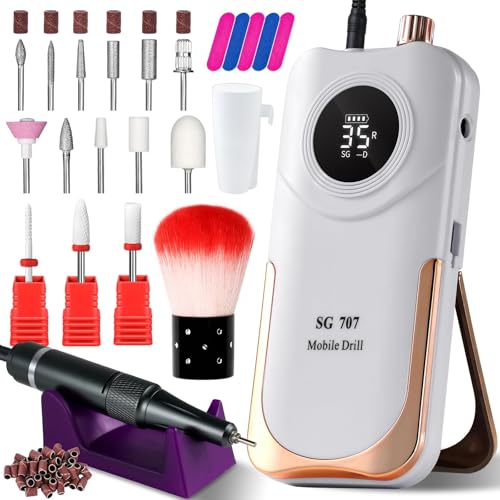
When the volume of acrylic nails you process exceeds the lifespan of any manual emery board, this cordless electric nail drill shifts the game entirely. The 35000 RPM brushless motor, paired with a 3600mAh battery, delivers 8 to 10 hours of continuous runtime on a single charge — enough to grind through full-set removals for an entire work week without plugging in. The aluminum alloy handle dissipates heat effectively, keeping the grip cool even during prolonged use at maximum speed.
The kit includes 14 drill bits, 50 sanding strips, and 5 nail buffers, covering everything from bulk acrylic removal with a carbide bit to fine contouring with a sanding band. The reversible rotation feature lets you file in both directions, matching the natural curve of the nail on either hand without awkward wrist angles. Users report that the belt clip and tripod stand make the machine easy to store and retrieve mid-service, a thoughtful ergonomic touch for busy salon stations.
Beginner techs should start at the lowest speed setting — the 35000 RPM top end can remove an entire acrylic overlay in under two minutes if applied at full torque. The kit’s included alignment guide helps novices avoid over-filing into the natural nail. This is not a replacement for a manual emery board for fine finishing, but it eliminates the need for coarse manual filing on every single set.
Why it’s great
- 3600mAh battery lasts 8-10 hours of continuous filing
- Reversible rotation for ambidextrous nail shaping
- 14 bits and 50 sanding bands included for every filing task
Good to know
- High RPM requires practice to avoid over-filing natural nails
- Bulkier than a manual emery board for touch-up kits
4. AhaTopia 80/80 Grit Nail Files (100 Pack)

At 100 boards per pack, AhaTopia delivers the highest board count in this review, making it the go-to choice for nail schools, high-volume home salons, or techs who prefer a fresh board per client. The 80/80 grit is genuinely aggressive — multiple users describe it as the toughest grade they’ve ever worked with, comparing it to industrial sandpaper. The curved half-moon shape fits more naturally in the palm than rectangular boards, improving control during heavy acrylic filing.
The construction uses the same three-layer sandwich of sandpaper, EVA sponge, and PP board as the HomeyEra files, but the slightly thinner profile at 0.2 inches makes the AhaTopia board more prone to bending under heavy pressure. Techs who bear down hard may find the board flexes more than they prefer, though the lightweight trade-off makes these files feel less fatiguing during extended shaping sessions. Users report that one board easily survives a full acrylic removal plus shaping without losing its bite.
The dust generation is exceptional — several reviews specifically recommend wearing a respirator mask when using these boards because the aggressive grit creates a fine acrylic powder cloud. This is a sign the grit is working correctly, not a defect. If you’re a professional who burns through boards quickly, the 100-pack ensures you’ll never ration a file. The curved shape does limit stacking storage compared to straight rectangular boards.
Why it’s great
- Highest board count at 100 pieces for bulk buying savings
- Curved half-moon shape improves ergonomic grip
- Extremely aggressive 80/80 grit for fast bulk removal
Good to know
- Thin 0.2-inch profile flexes more than thicker boards
- Heavy dust generation requires mask or ventilation
5. Astraxe Professional Sapphire Black Nail File
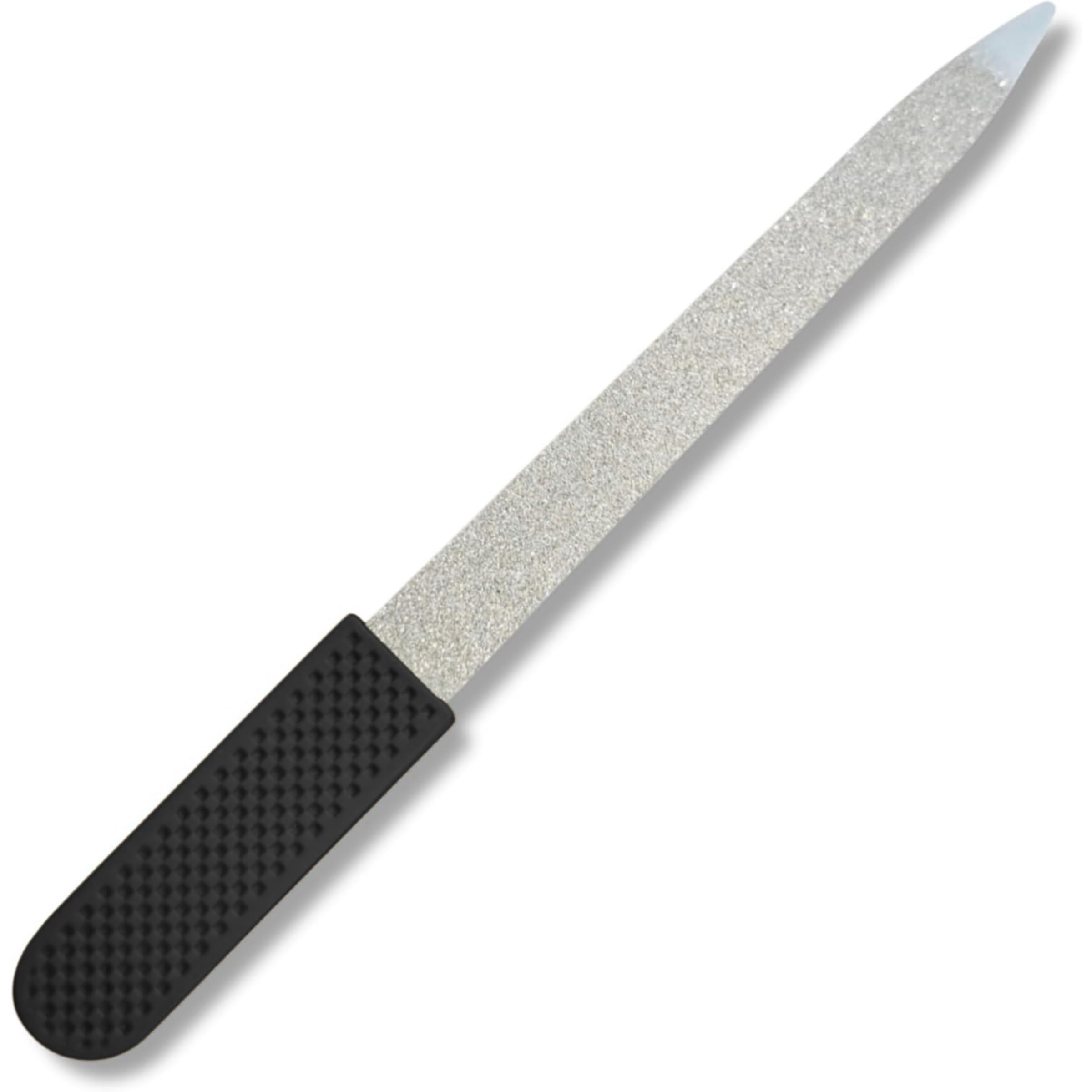
The Astraxe Sapphire Black file is a stainless steel board with a sapphire coating that stays sharp far longer than traditional emery abrasives. At 5 inches, it’s significantly shorter than the 7-inch emery boards, making it ideal for touch-up kits, travel bags, or quick contour adjustments between sets. The double-sided design provides one coarse and one fine grit surface, allowing the user to shape with the coarse side and smooth edges with the fine side using the same tool.
The ergonomic non-slip handle is a standout feature — the soft plastic grip prevents the file from rotating in the hand during use, a common frustration with metal nail files that lack texture. Users consistently report the file stays sharp after dozens of uses, unlike disposable emery boards that dull after a single acrylic removal. The sapphire coating resists corrosion from acetone and alcohol wipes, keeping the file sanitary without degrading the abrasive surface.
However, some users find the fine side too smooth for effective filing. A 1-star review specifically notes both sides felt “too smooth to file your nails,” indicating the sapphire grit may not be aggressive enough for heavy acrylic work. This file is best suited for light shaping and finishing on already-filed nails, not for bulk acrylic removal. If your primary need is cutting through thick overlay, stick with 80-grit emery boards.
Why it’s great
- Sapphire coating resists corrosion and stays sharp longer than paper grit
- Non-slip handle provides excellent grip control
- Compact 5-inch size fits easily in a travel pouch
Good to know
- Fine side may be too smooth for some users’ preference
- Not suitable for bulk acrylic removal — finishing tasks only
6. HomeyEra 100/180 Grit Nail Files (50 Pack)
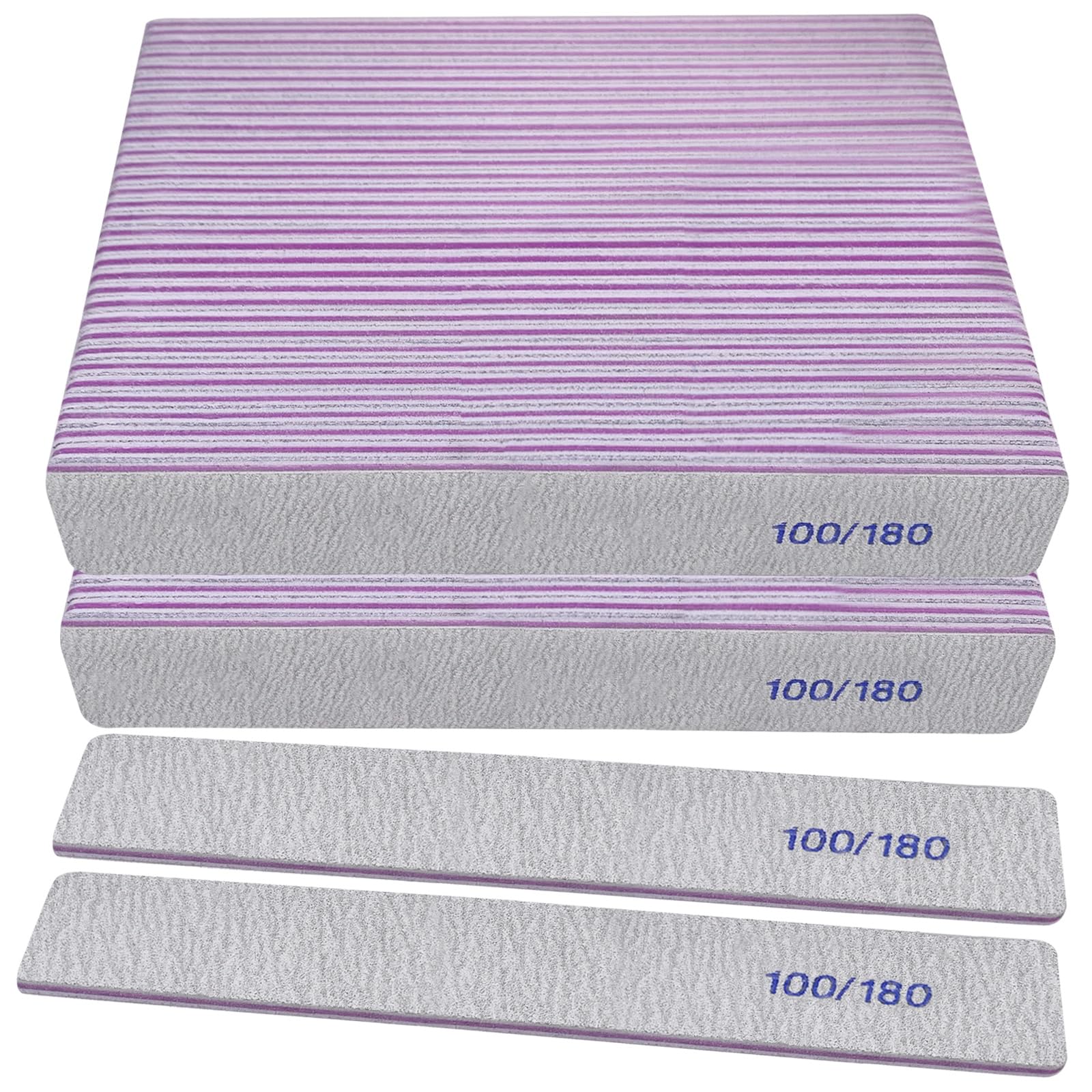
The 100/180 grit combination on these HomeYera boards fills the gap between coarse acrylic removal and final polishing. The 100-grit side is aggressive enough to blend tip seams and refine acrylic shapes after bulk removal with an 80-grit board, while the 180-grit side removes surface scratches and prepares the nail for gel topcoat application. This dual-purpose design means one board can handle both steps, reducing tool changes mid-service.
Construction quality mirrors the 80/80 HomeYera boards — the same thick PP board core and washable sandpaper adhesive. Users consistently highlight the boards’ thickness and sturdiness compared to flimsy drugstore files, noting they survive repeated use on natural nails and gel polish without shedding grit. The 100-grit side doesn’t load up with acrylic dust as quickly as 80-grit boards, meaning fewer pauses to brush debris away during shaping.
These are not a replacement for an 80-grit board on fresh acrylic overlay. Attempting to remove a full set of acrylic tips with 100 grit will take significantly longer and may cause the file to skate rather than cut. Keep these as your second file in a two-step filing system — start with 80 grit for bulk removal, then switch to 100/180 grit for shaping and finishing. The 50-pack provides plenty of spares for the inevitable loss between salon chair and kit bag.
Why it’s great
- Dual 100/180 grit covers shaping and finishing in one board
- Thick, sturdy construction withstands repeated use
- 100-grit side resists dust loading better than 80 grit
Good to know
- Not aggressive enough for bulk acrylic removal
- Requires a separate 80-grit board for first-stage filing
7. COSLUS C20 Cordless Nail Drill

The COSLUS C20 is the lightest electric nail drill in this review at only 0.2 pounds, roughly the weight of two standard emery boards. The pen-shaped design makes it approachable for users who have never held a rotary tool before — the trigger-style speed control and forward/reverse switch feel intuitive rather than intimidating. The included six bits and sanding bands cover basic acrylic removal, cuticle cleaning, and callus reduction in a single kit.
The battery life reports are realistic: users get approximately 4 hours of runtime from a 2-hour charge, enough for one full manicure with acrylic removal and shaping. The cordless design eliminates the cord drag that full-size drills cause, giving beginners the freedom to adjust hand position without fighting a power cable. The lowest speed setting is gentle enough for natural nail prep, reducing the risk of gouging that higher-torque drills can cause.
However, the motor lacks the torque needed for heavy acrylic bulk removal. Multiple users note that the slow speed setting, while safe, extends filing time to over an hour per hand — impractical for a commercial setting. The charging cable is also notably short at 12 inches, limiting placement during charging. For occasional home use and beginner practice, the C20 is a solid entry point. For daily professional acrylic work, the larger 35000 RPM drill is a better investment.
Why it’s great
- Lightest drill at 0.2 lb reduces hand fatigue for beginners
- Intuitive trigger speed control and forward/reverse switch
- Cordless design eliminates cable management frustration
Good to know
- Low torque extends filing time to over an hour per hand at slow speed
- Short 12-inch charging cable limits placement during power-up
FAQ
Can I use an 80-grit acrylic nail emery board on natural nails?
How many times can I reuse a washable emery board before replacing it?
Final Thoughts: The Verdict
For most users, the acrylic nail emery board winner is the ForPro Zebra Foam Board because the cushioned foam core and salon-grade 80/80 grit deliver professional cutting speed without the vibration fatigue of solid-core boards. If you want the widest filing surface for faster shaping, grab the HomeyEra 80/80 50-Pack. And for bulk trading speed against electric power, nothing beats the Professional Electric Nail Drill Kit for removing full acrylic sets in minutes.