
Our readers keep the lights on and my morning glass full of iced black tea. As an Amazon Associate, I earn from qualifying purchases.
Specs are compiled from manufacturer listings and verified buyer reviews and can change over time — please confirm the key details on the product page before buying.
The biggest worry with an acrylic tarantula enclosure isn’t the spider escaping—it’s spiderlings, fruit flies, or crickets sneaking through unseen gaps. The best designs use micro-ventilation holes measured in fractions of a millimeter and sealed, one-piece acrylic walls that resist warping and splitting. This guide focuses on 9 enclosures that get those fundamentals right, matching each to the size and species you’re actually keeping.
I’m Min — the founder and writer behind Gadgets Feed. This guide is built by comparing the manufacturers’ published specifications and the patterns across verified customer reviews, so you get each pick’s real strengths and trade-offs instead of marketing spin.
To keep a jumping spider, mantis, or tree-dwelling tarantula healthy, you need an acrylic tarantula enclosure that matches ventilation size, door style, and height to your pet’s habits—here’s which one fits your setup.
Our Picks at a Glance

How To Choose The Best Acrylic Tarantula Enclosure
The right enclosure depends less on brand and more on three checks: ventilation hole size, tank height, and door seal. Get those right, and feeding, cleaning, and watching your spider become easy routines.
Match the Height to Your Spider’s Lifestyle
Arboreal tarantulas and jumping spiders live up high—they climb, web, and build hammocks near the ceiling. For them, a taller tank like a 5″ x 5″ x 10″ or a 6″ x 6″ x 12″ gives the vertical space they need to feel secure. A terrestrial spider that prefers the ground won’t use that height, so a wider, shorter footprint suits it better.
Vent Hole Size Is a Security Decision
Tiny spiderlings can squeeze through gaps you can barely see. Vent holes around 1/16th of an inch or roughly 1mm will keep slings and fruit flies inside while still allowing airflow. If the holes are bigger, you’ll need mesh lining or a different tank for baby spiders.
Pick a Door Style You Can Live With
Magnetic doors snap shut fast and feel secure, but the snap can startle a sensitive spider. Latch and knob designs close more quietly. Front-opening doors make feeding and decorating easier without reaching over the top, while top feeding ports let you drop food in without disturbing the web structure.
Quick Comparison
| Model | Best For | Dimensions | Closure Type | Vent Style | Amazon |
|---|---|---|---|---|---|
| CourtyardAid Jumper Habitat★ Best Overall | Small adult jumpers | 5″ x 5″ x 10″ | Magnetic side door | 290 holes, 0.1″ across | Amazon |
| NANEEZOO Magnetic CageBest Value | Budget arboreal T’s | 5.9″ x 5.9″ x 9.05″ | Sliding magnetic lid | Side and top holes | Amazon |
| ZENWUKONG Dual-DoorPremium Pick | Adult jumpers, active keepers | 6″ x 6″ x 9″ | Dual magnetic doors | 264 micro-vents, 0.8mm | Amazon |
| NANEEZOO Front-Door Tower | Pink Toe tarantulas | 6″ x 6″ x 12″ | Magnetic front door | Side and top holes | Amazon |
| Cycodo Knob-Latch Terrarium | Quiet, escape-proof setups | 5″ x 5″ x 8″ | Knob latch | Four-sided, 1mm holes | Amazon |
| smartang Cylinder Tank | DIY vertical habitats | 6″ x 6″ x 12″ | Front latch door | Top and side cross vents | Amazon |
| Harhana Large Habitat | Active species needing length | 6″ x 6″ x 11.5″ | Locking front door | Five vent sets | Amazon |
| KAKOOTI 12″ Breeding Kit | Juvenile Ts, starter kits | 12″ x 7″ x 6″ | Sliding magnetic lid | Top and side holes | Amazon |
| MYGIIKAKA Clamshell Tank | Budget, larger reptiles | 13.78″ x 7.48″ x 7.87″ | Hook and locking handle | Two side vent banks | Amazon |
In‑Depth Reviews
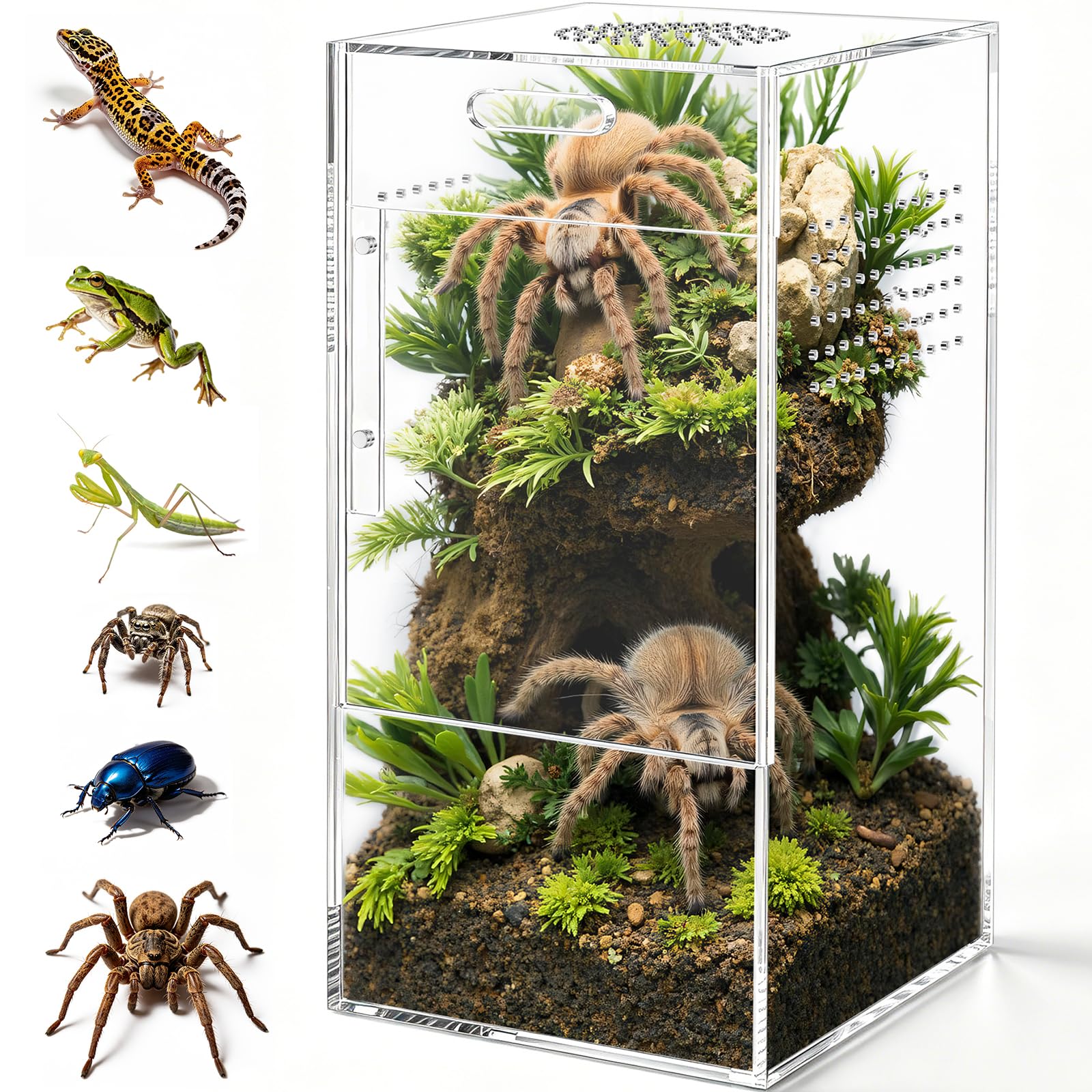
1. CourtyardAid Pre-Assembled Jumping Spider Enclosure
Our pick — over 4.5★ from 250+ verified ratings; the strongest balance of quality and price.
The crowd favorite that shows up ready to use and keeps tiny slings locked in tight.
This is the enclosure that removes the two biggest setup frustrations: it arrives fully assembled, and its base is sealed so substrate and water stay put from day one. The size—5″ x 5″ x 10″—gives a young or small adult jumper real room to climb, with 250 cubic inches of interior space for decorations and enrichment.
What wins people over is the safety net. The 290 micro ventilation holes are 0.1 inches across, positioned low for intake and high for exhaust, creating a steady bottom-to-top airflow. As owners put it: “Vent holes are small enough that slings wont get out. They’re 1/16th of an inch. no gaps on the door either!” That sealed design plus four non-slip pads underneath means it won’t slide or tip when you open the magnetic side door.
The side-opening door is a smart touch for webbing spiders—it slides open horizontally instead of lifting from the top, so hammocks built in the upper corners stay intact while you feed or mist. Clear, scratch-resistant acrylic keeps the view crisp from every angle, and it weighs only 1.3 pounds, so it’s easy to move. The trade-off is the strong magnets: they snap shut with a loud click that can startle a nervous spider, and you’ll want to guide the door closed rather than let it fly. It’s also not meant for tiny slings without a mesh cover, since the door gap, while small, isn’t zero.
What owners rave about
- Fully assembled with a sealed, leak-free base
- High, small vent holes keep spiderlings and fruit flies contained
- Tall 10-inch profile suits arboreal jumpers that web near the top
Who should think twice
- Strong magnets snap loudly, which can frighten sensitive spiders
- Not for unhatched slings without an added mesh cover
The definitive pick for: owners of young to small adult jumping spiders who want a leak-proof, ready-out-of-the-box home with real vertical space.
Reach for a different tank if: you’re raising tiny slings—the small door gap means you’d need to add mesh for full security.
2. NANEEZOO Magnetic Acrylic Reptile Cage (6″x6″x9″)
The budget box that newcomers to tarantulas keep coming back to for more.
There’s a persistent myth that cheap acrylic enclosures are everywhere for a few dollars, and newcomers quickly learn that’s outdated. This is the cage that proves the myth wrong—it’s affordable but genuinely well-built, with a sliding lid and magnetic closure that keeps spiders where they belong. At roughly 5.9″ x 5.9″ x 9.05″ and 1.4 gallons, it’s sized right for a smaller arboreal tarantula or a sub-adult Pink Toe.
Cross ventilation is the standout. Owners praise the constant airflow from holes on both sides and the top, something many budget tanks simply skip. The 360-degree view stays clear because the acrylic is flush with no gaps in the corners, and the magnetic lid clicks shut with reassuring strength. One keeper noted the panels are a little thin, so long-term warping is the open question—time will tell.
The size draws mixed reactions, which is really about matching it to your spider. It’s ideal for a juvenile or smaller arboreal species, but a large adult will feel cramped. Handlers who have used pricier boutique brands say this holds up well at a fraction of the cost, which is why it keeps showing up in multiple-buy orders.
Why it earns the value badge: it delivers strong magnets, real cross ventilation, and flush seams at an entry-level price—the things owners of costlier tanks pay double for.
The honest limit: the acrylic runs thin and the size suits small-to-mid arboreals, not big adults.
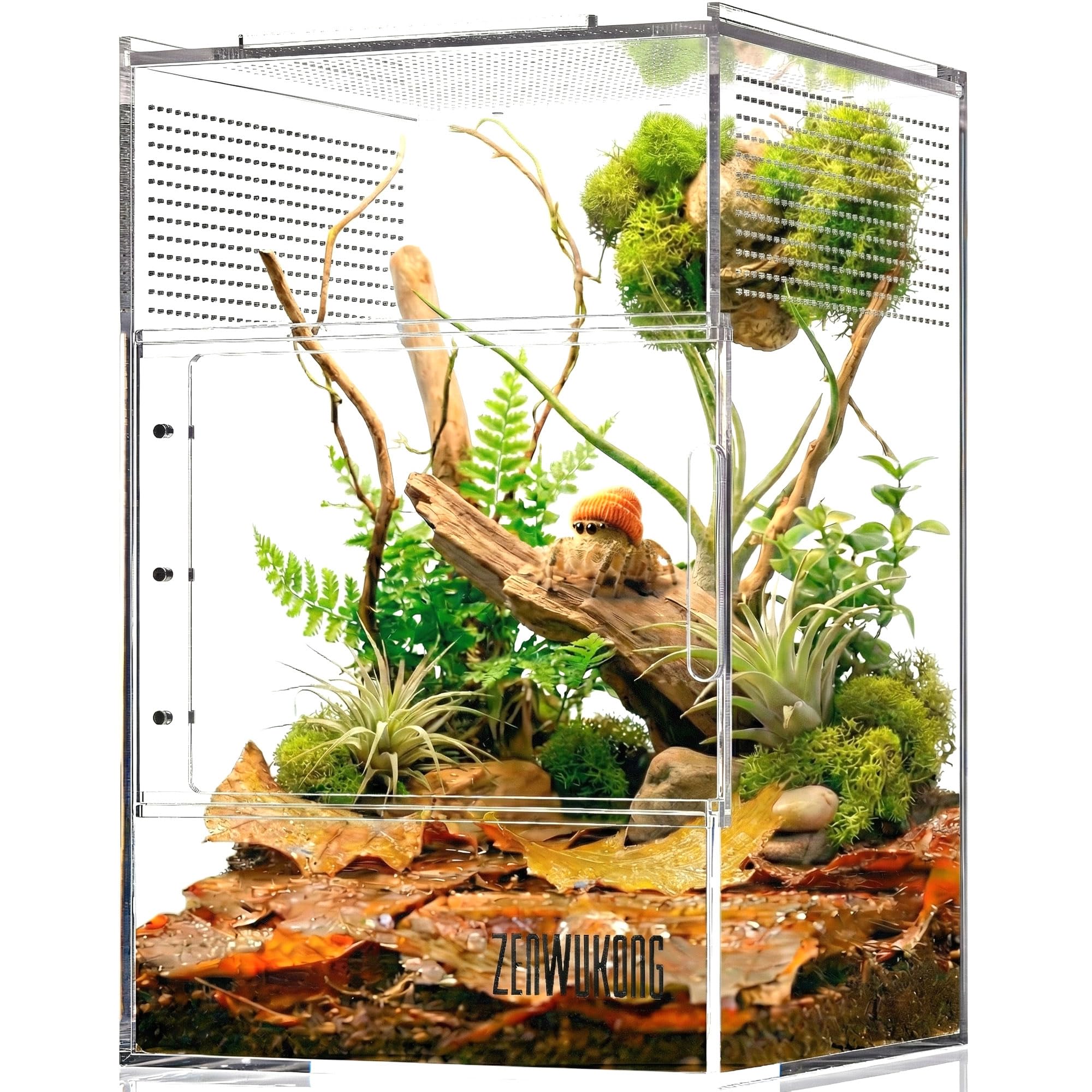
3. ZENWUKONG Dual Magnetic Door Enclosure (6x6x9 inch)
The adult-jumper haven with vent holes fine enough to jail fruit flies.
If your adult jumping spider has outgrown its starter cube, this enclosure gives it room to roam with a 6″ x 6″ x 9″ footprint. The maker claims the optical-grade acrylic offers 98% light transmittance, so you see your pet almost as clearly as through glass. It arrives fully assembled—no tools or DIY needed.
The defining detail is the airflow system: 264 precision micro-vents at 0.8mm each deliver 360-degree circulation while physically blocking fruit flies from escaping. That’s a huge quality-of-life win if you feed flightless fruit flies, because you stop losing your feeder colony to the tank. Dual magnetic doors let you reach in from the front and the top, making feeding and decorating genuinely quick.
The trade-off is that those magnets, while secure, aren’t the strongest on the market—they hold the doors shut well, but some owners note they feel on the lighter side. The 0.8mm vents also mean this is an adult-spider home, not a sling nursery. A few units have arrived with lightly chipped edges, so inspect yours on arrival. For a beginner starting with a juvenile or subadult jumper, this is about as painless as it gets.
The standout feature: 264 micro-vents at 0.8mm each keep fruit flies from escaping while allowing steady airflow, and the clear acrylic gives you a full 360-degree view of your pet.
Watch out for: weaker-than-expected magnets and vents sized too large for tiny spiderlings.
4. NANEEZOO Front Opening Acrylic Tarantula Enclosure (6″ x 6″ x 12″)

The 12-inch tower built for Pink Toes and other tree-dwelling tarantulas that climb high.
Arboreal tarantulas like the Pink Toe need height, and this one delivers it in a 6″(W) x 6″(D) x 12″(H) barrel-shaped tank that’s noticeably taller than the standard jumper cube. It’s a one-piece, all-in-one design—no assembly, no worries about warping or deformation over time. The water-tight base holds substrate and even standing water without leaking.
Ventilation here is engineered for a moisture gradient: top and side holes create strong cross airflow that keeps the upper area dry while allowing humidity to collect near the bottom—exactly the setup Avicularia species want. The magnetic front door snaps open for feeding and decorating, and buyers report the latch is strong and secure.
The catch is that the vent holes run slightly large. Tiny spider slings can squeeze through, so this is a home for established juveniles and adults, not newborns. One keeper who uses it as a planted terrarium reports their isopods and plants are thriving in it, which says a lot about the humidity control. It’s sturdy enough that it hasn’t been knocked over, and the clear acrylic makes it a clean addition to a desktop.
The right home for: medium to large arboreal spiders that need vertical climbing space and a humid-dry gradient.
Skip it for: slings—the air holes are big enough for a baby spider to escape through.
5. Cycodo Warp-Proof Knob-Latch Terrarium (5″x5″x8″)

The unusually quiet enclosure that trades magnetic snaps for a twist-knob seal.
Every other tank on this list relies on magnets, which is exactly what this one avoids. Cycodo replaces the magnet with a hand-tightened knob latch, eliminating the loud snap that can startle a spider and the slow weakening magnets experience over time. It’s a genuinely quieter, more durable way to shut the door—note if your spider is easily spooked.
The thickened, high-purity acrylic resists warping over months of use, keeping the 360-degree view clear. It arrives fully assembled and ready from the start, and the one-piece construction means no panel seams for a spider to exploit. Ventilation runs across all four sides with holes at a precise 1mm, small enough to block fruit flies and tiny spiderlings.
The layout adds a front-opening door plus a top feeding port, so you can drop food in without pulling the whole habitat apart. The main gripe owners have is that the round top feeding hole doesn’t have its own latch—it lifts off easily and some have taped it down. One noted the front door screw needs a slight adjustment for smooth turning. For the price, owners consistently compare its quality to tanks costing more than double.
The quiet advantage
- Knob latch closes silently, unlike magnetic snaps
- Thickened acrylic resists warping and stays clear
- 1mm four-sided vents block fruit flies and slings
The honest quirks
- Top feeding port lacks its own latch and can flop open
- Front door screw may need a small turn adjustment
Choose this for: skittish spiders that react to vibration and keepers who want a warp-proof tank they’ll use for years.
Be ready to tweak: the unlatched top port will likely need a bit of tape or a DIY fix.
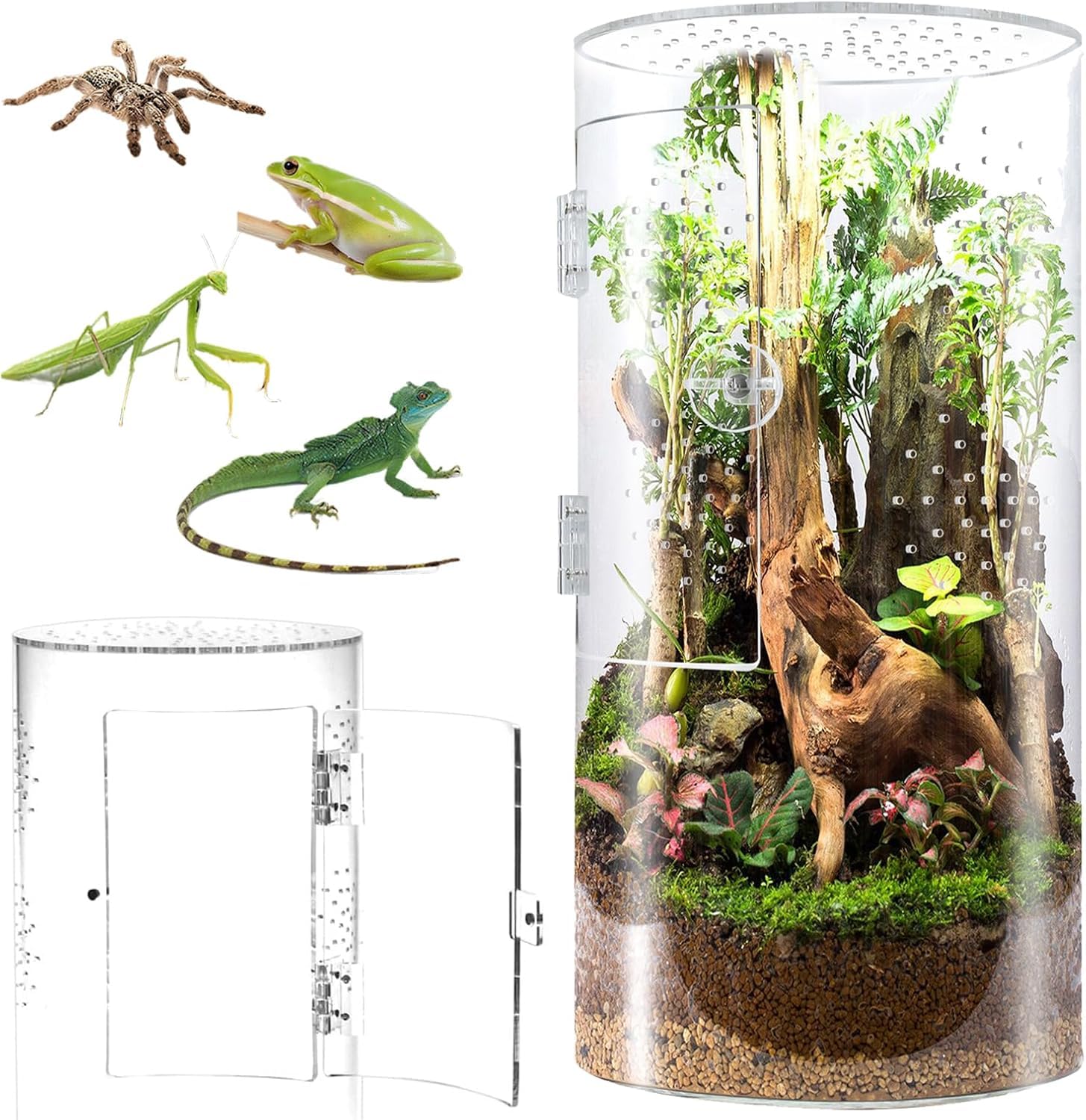
6. smartang Front Opening Cylinder Enclosure (6″x6″x12″)
The round, no-assembly tank that gives arboreal spiders 12 inches to build upward.
Most acrylic enclosures are square, but this one breaks the mold with a round cylindrical profile that’s structurally sturdier than a box. At 6″ x 6″ x 12″ with roughly 30.5cm of height, it gives jumping spiders and arboreal species real vertical territory for hammocks and webbing. The round shape isn’t just for looks—owners say it feels more rigid than comparable square tanks and needs zero assembly.
Instead of a magnetic door, it uses a traditional latch on the front. That’s a deliberate choice: the maker argues magnetic suction creates a vibration that can frighten pets, so the latch closes more gently. The front door measures 6.2in x 3.5in, big enough for comfortable feeding and cleaning, and a horizontal opening helps prevent escapes. The sealed bottom is waterproof with enough depth for soil and plants, and the top and sides form cross ventilation.
Quality is the most-praised feature here, and the tank genuinely suits juvenile tarantulas and jumping spiders. The recurring note is size—some owners find it smaller than expected, and a few report warping after several months. There’s also a small gap between the wall and the front sliding panel that one keeper had to seal with plastic wrap after a tiny sling escaped. It’s an excellent value, just not one to trust with newborn spiderlings.
The appeal: a round, latch-closing tank that’s sturdier than square designs and built for tall webbing structures.
The catch: a small front-panel gap means very tiny slings can slip out—worth sealing for babies.
7. Harhana Large Acrylic Terrarium (11.7x6x6 Inch)

The long, one-piece tank that offers jumpers more floor-to-ceiling exploring than the cubes.
While most enclosures in this class are compact towers, this one stretches things out with an 11.7″ x 6″ x 6″ footprint that gives an active spider a longer runway to explore. The one-piece rectangular design is leak-proof and arrives ready to use—no complicated setup, just unpack and introduce your pet. At 1.5 pounds, it’s light enough to move but solid enough to feel permanent.
The acrylic panels are the selling point. High-quality acrylic resists clouding and warping, giving you a distortion-free view into the habitat. It’s built to resist yellowing and scratches for years. Five sets of ventilation holes keep air moving, and the deep, waterproof base gives you room for substrate without leaks.
Escape-proofing gets consistent praise—the snug locking door keeps even very small spiders inside, with no gaps along the seams. The honest limit is the door itself: at roughly 6.5″ x 4″, it’s narrow for large hands, and reaching in to place rigid decorations like bark sheets is fiddly. Some owners planned to add magnets to improve the latch. One arrived cracked in transit, though the well-packed majority were flawless.
Best for: you, if you want a wider horizontal space and prefer acrylic that stays clear and resists scratches over time.
The limitation: the front door is small for big hands, making decor placement a careful process.
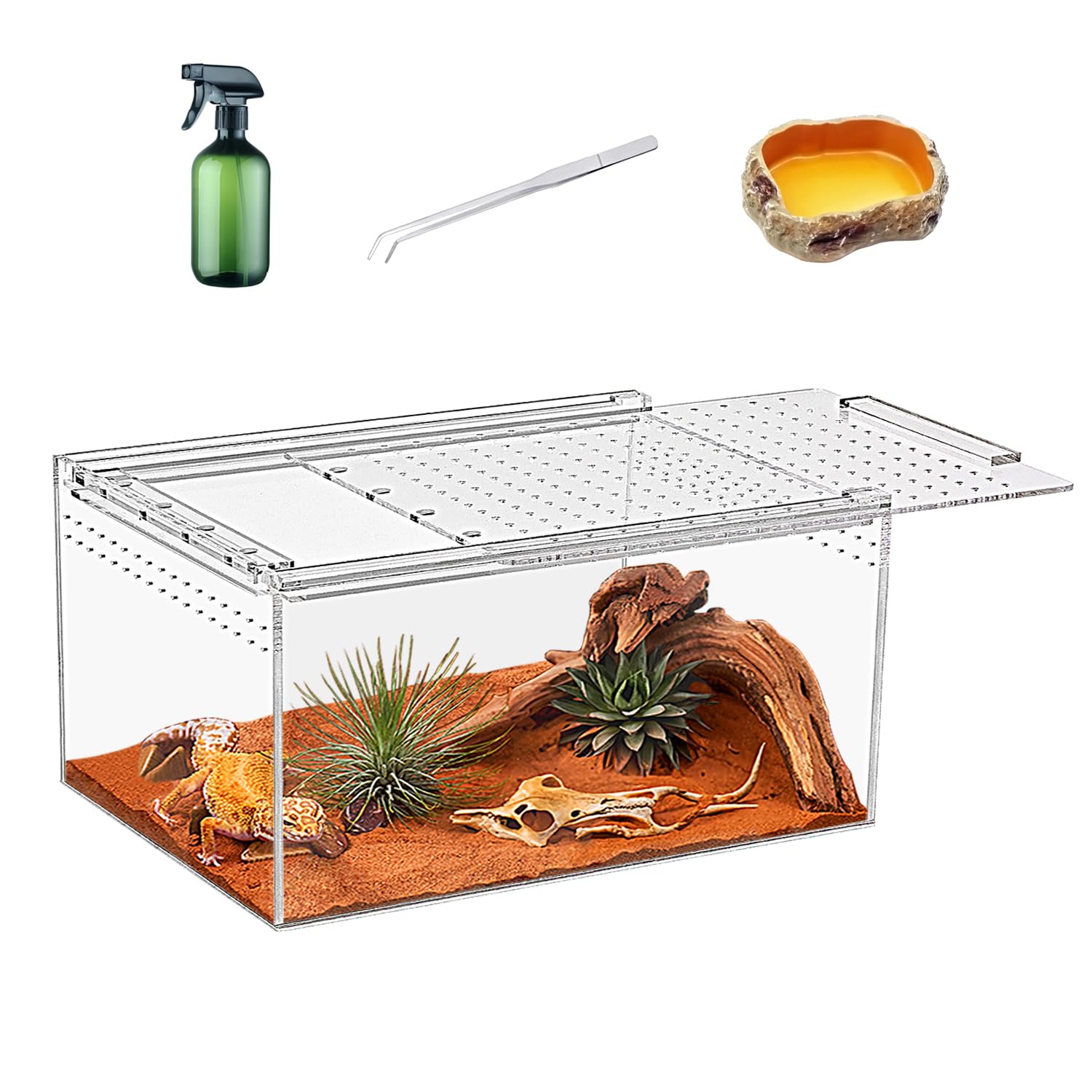
8. KAKOOTI Reptile Terrarium Kit (12″x7″x6″)
The wide, low kit that arrives with feeding tools and suits juvenile tarantulas best.
This is the most horizontal option in the lineup—a 12″ x 7″ x 6″ tank with a 2.2-gallon capacity that spreads out rather than up. That shape makes it a natural fit for juvenile tarantulas and other ground-loving invertebrates that don’t need climbing height. It’s the only pick here that arrives as a kit, bundling a bowl, a long tweezer, and a spray bottle alongside the enclosure itself.
The top slides open with a magnetic closure, and crucially, it uses more than two magnets along the lid. As one buyer described: “Love how it has more than 2 magnets for the lid as well. Lid slides easy and snaps into place nicely.” That extra magnet spread means a stronger, more even seal that’s harder for a spider to push against. The all-round transparent acrylic gives a full 360-degree view, and ventilation holes run across the top and sides.
Owners mention the build feels solid, panels stay crisp with minimal warping, and the lid seals tightly enough to hold spiderlings. The 6-inch height is the real limit—this is a terrestrial tank, not an arboreal one, so tree-dwelling species will feel cramped. Its wide footprint also uses more shelf space than a taller tower. For housing a juvenile tarantula with room to grow, it’s a well-made, good-value starter—skip it if your pet needs vertical climbing space.
What comes in the box
- Enclosure plus bowl, long tweezer, and spray bottle
- Multiple magnets along the lid for a secure, even seal
- Wide 12-inch footprint suits juvenile and ground-dwelling species
What to know before buying
- Low 6-inch height means arboreal spiders won’t thrive here
- Wide shape takes up more shelf space than a tower design
Grab this kit if: you’re starting with a juvenile tarantula and want feeding tools included in the box.
Look elsewhere if: your spider is arboreal—this low, wide tank won’t give it the height it needs.
9. MYGIIKAKA Acrylic Jumping Spider Terrarium (13.78″x7.48″x7.87″)

The biggest box in the budget tier, with a clamshell top that pops open in seconds.
If you’re keeping something larger than a spider—a mantis, small frog, or even a baby reptile—this is the value play. At 13.78″ x 7.48″ x 7.87″, it’s the largest enclosure here by a wide margin, giving small animals real room to move. It does require simple assembly: you peel off a protective film and fit the panels together, held by rubber bands that owners say do a solid job of keeping everything in place.
The top uses a clam-shell design that’s easy to open and close, and a locking handle keeps the resident secure. Ventilation runs along two sides for fresh airflow, plus a feeding hole on top so you can add food without fully opening the tank. Owners find it easy to assemble, and it disassembles just as simply for storage when you’re not using it.
The honest trade-offs come with the budget price. The locking handle feels a little flimsy to some, though the door stays shut unless actively turned or pulled. The protective film is notoriously hard to peel—bringing tweezers helps. Size feedback is split: some find it nice and roomy, others note the vent holes run a bit big for the smallest spiders. For a mantis, caterpillar, or small reptile, though, it’s a dependable, low-cost home.
The value case: the most interior space in the lineup at a budget price, with tool-free assembly and storage-friendly breakdown.
Before you buy: vent holes lean large for tiny slings, and the peel-away film takes patience to remove.
Understanding the Specs
Vent Hole Diameter
The size of each ventilation hole is your first line of defense against escapes. Holes around 1/16th of an inch (about 0.8mm to 1mm) keep spiderlings and feeder fruit flies inside while still circulating air. Anything larger, and you’ll be adding mesh for baby spiders.
Height Versus Footprint
Arboreal species—jumping spiders, Pink Toes, mantises—need vertical space measured in inches of height, not floor area. A 12-inch tower gives them room to web and climb; a wide, low tank suits terrestrial tarantulas that stay near the ground.
FAQ
What vent hole size keeps tarantula slings inside?
Is a magnetic door or a latch better for a nervous spider?
What height does an arboreal tarantula actually need?
Can an acrylic enclosure warp or cloud over time?
Which tanks arrive ready to use with no assembly?
Will fruit flies escape from my jumping spider enclosure?
Can I keep a mantis in a tarantula enclosure?
What is the difference between a top-opening and front-opening tank?
Final Thoughts: The Verdict
For most keepers, the acrylic tarantula enclosure winner is the CourtyardAid Jumper Habitat because it arrives fully assembled with a sealed base and vent holes small enough to hold slings. If you want quiet, vibration-free closure that won’t startle a sensitive spider, the Cycodo Knob-Latch Terrarium is the one to reach for. And for a tree-dwelling Pink Toe that needs real height, the NANEEZOO Front-Door Tower gives arboreal species the 12-inch climb they need.
How We Picked
We do not accept paid placement. Every pick is matched to a real buyer and a real use-case; we do not hands-on test units.
Sources & Methodology
Specifications: manufacturer listings and product documentation. Review insights: verified customer reviews, as of September 2026. Pricing: not shown on this page (it changes often); check the current price via the retailer link.
As an Amazon Associate, Gadgets Feed earns from qualifying purchases. This does not affect which products we feature.