
Our readers keep the lights on and my morning glass full of iced black tea. As an Amazon Associate, I earn from qualifying purchases.
Specs are compiled from manufacturer listings and verified buyer reviews and can change over time — please confirm the key details on the product page before buying.
Ski vibration, freezing cold, and blinding snow glare kill most cameras. You want smooth footage from first chair to last run, but getting it is hard. This guide picks the cameras that survive a full ski day and keep your turns looking sharp, without the marketing fluff.
I’m Min — the founder and writer behind Gadgets Feed. This guide is built by comparing the manufacturers’ published specifications and the patterns across verified customer reviews, so you get each pick’s real strengths and trade-offs instead of marketing spin.
Whether you are a weekend skier mounting a camera to your helmet or a backcountry skier building a season kit, this list highlights the most reliable action camera for skiing options.
Quick Picks
- Xtra Edge Action Camera — Best Overall
- AKASO Brave 8 Lite 4K60 Action Camera — Best Value
- DJI Osmo Action 5 Pro Adventure Combo — Top Performer
- DJI Osmo Action 6 Enhanced Combo — Premium Pick
- GoPro HERO13 Black Bundle — Most Versatile
How To Choose The Best Action Camera For Skiing
Skiing combines cold, high vibration, fast motion, and moisture like snow, slush, and fog. A camera that works at the beach can fail halfway down a black diamond. Check these specific specs before you buy.
Image Stabilization For Slope Vibration
Ski chatter on hardpack or uneven snow shakes the mount. Without electronic image stabilization (EIS — software that smooths out jitters), your footage looks like a seismograph. Pick cameras with “HyperSmooth,” “HorizonSteady,” or “SuperSmooth” stabilization — these actively correct roll-axis and up-down motion so turns look steady. Basic “anti-shake” alone may fail on anything but groomed runs.
Waterproof Rating And Cold Resistance
You cannot use an external case on a helmet mount with gloves on. The camera must be waterproof to at least 33 feet (10 meters) without a housing, so it survives falling snow, slush, or a dip in a creek. The battery’s low-temperature rating matters too — some batteries lose half their runtime below freezing. A removable battery lets you swap in a warm spare from your jacket when the first one dies in the cold.
Mounting Versatility And Field Of View
On a helmet, the camera sits about 6 inches above your eyes. The field of view (FOV — how wide the camera sees) decides if footage looks natural or distorted. A wide FOV of around 150 degrees captures your ski tips and terrain ahead without curving the horizon. The mount should feel secure and let you switch between horizontal and vertical shots without tools, even with thick gloves on a chairlift.
Quick Comparison
| Model | Best For | Video Resolution | Battery Life | Waterproof Depth | Amazon |
|---|---|---|---|---|---|
| Xtra Edge Action Camera | Long single-session runs | 4K | 160 minutes | 52 ft | $179.00$299.00Amazon |
| AKASO Brave 8 Lite | Budget all-day skiing kit | 4K60 | 90 minutes | 33 ft | $189.99$199.99Amazon |
| DJI Osmo Action 5 Pro | Extreme cold and backcountry | 4K/120fps | 4 Hours | 20m | $364.00$429.00Amazon |
| DJI Osmo Action 6 | Premium 8K creation | 8K | 4 Hours | Waterproof | $421.00$496.00Amazon |
| GoPro HERO13 Black | Ecosystem & accessory heavy use | 5.3K HDR | 1.5 Hours | 33 ft | $544.99Amazon |
In‑Depth Reviews
1. Xtra Edge Action Camera
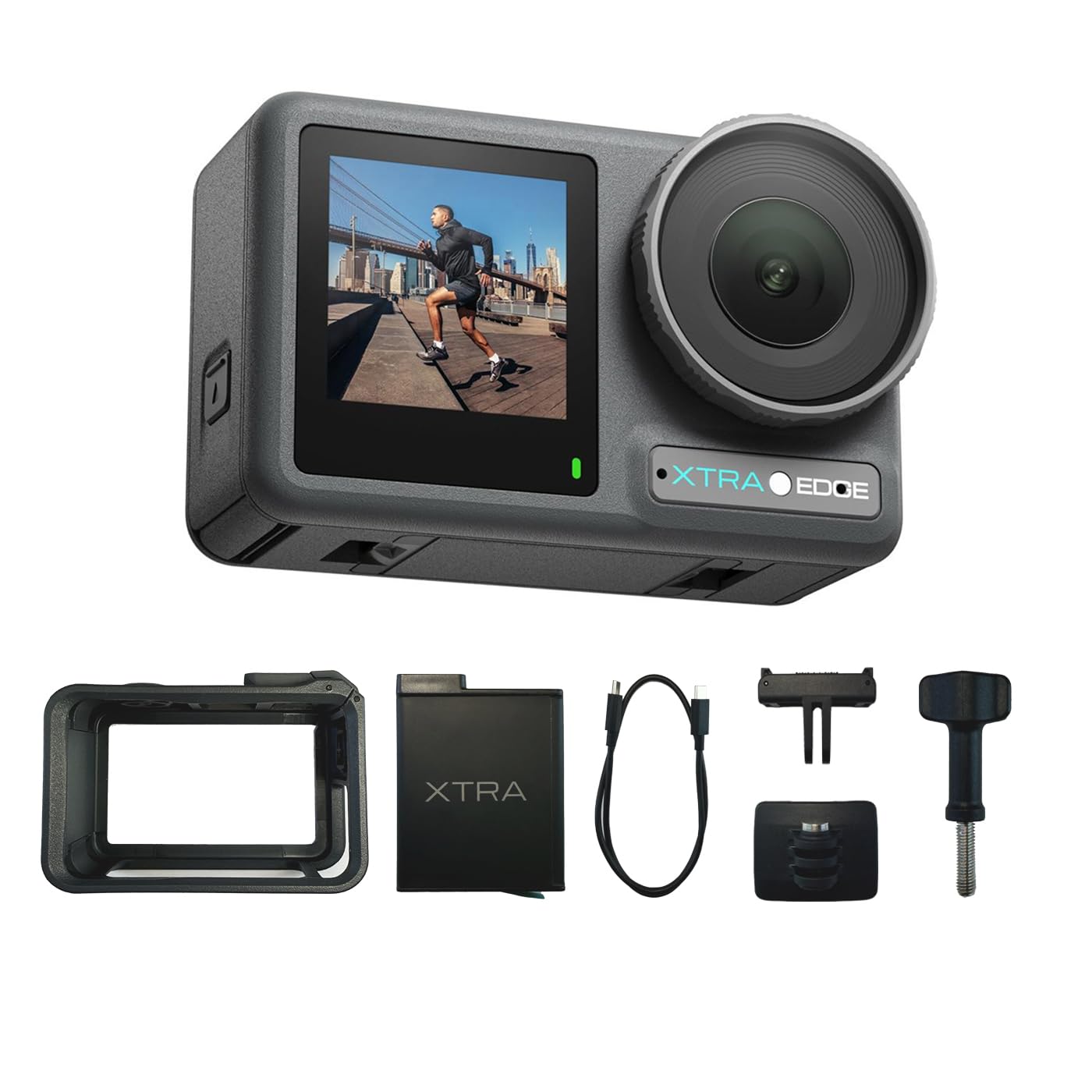
Keeps recording all day so you never stop for a battery swap.
You do not want to stop midway down the mountain when the snow is perfect. The Xtra Edge delivers 160 minutes of continuous recording — buyers report the battery lasts around 160 minutes (2 hours 40 minutes), enough for most single-session ski days. That is 160 minutes versus the AKASO Brave 8 Lite’s 90 minutes, so you can ski a full day without stashing spare batteries in your jacket.
The 1/1.3-inch sensor (a larger image sensor that gathers more light) captures rich color even in flat winter light. The Hyper Stabilization (EIS that cancels vibration) smooths out the chatter from rigid boots and hardpack chop. Waterproof to 52 feet (16 meters) without a housing, it survives a full day of snow, slush, and thaw without moisture damage.
The Universal Quick Mount uses a magnetic lock — you switch between horizontal and vertical footage while wearing mittens, a big help when fumbling on a chairlift. The bundle includes a cold-resistant battery, a dual-orientation protective frame, and a dual-facing mount adapter, covering basic helmet and POV (point-of-view) setups from the start.
Why It Works On The Mountain
- 160-minute average battery life outlasts most ski days
- Waterproof to 52 feet without an external housing
- Magnetic quick mount works with thick gloves on
What To Know Before Buying
- Night footage is dimmer than the DJI Osmo Action 6
- Battery recharge time is slower than the HERO13’s
Grab it if: you want one camera that handles a full day of resort skiing without needing a battery swap or a waterproof case, and you are not shooting in near-darkness.
Look elsewhere if: you need 8K resolution or the ability to record continuously while charging.
2. AKASO Brave 8 Lite 4K60 Action Camera
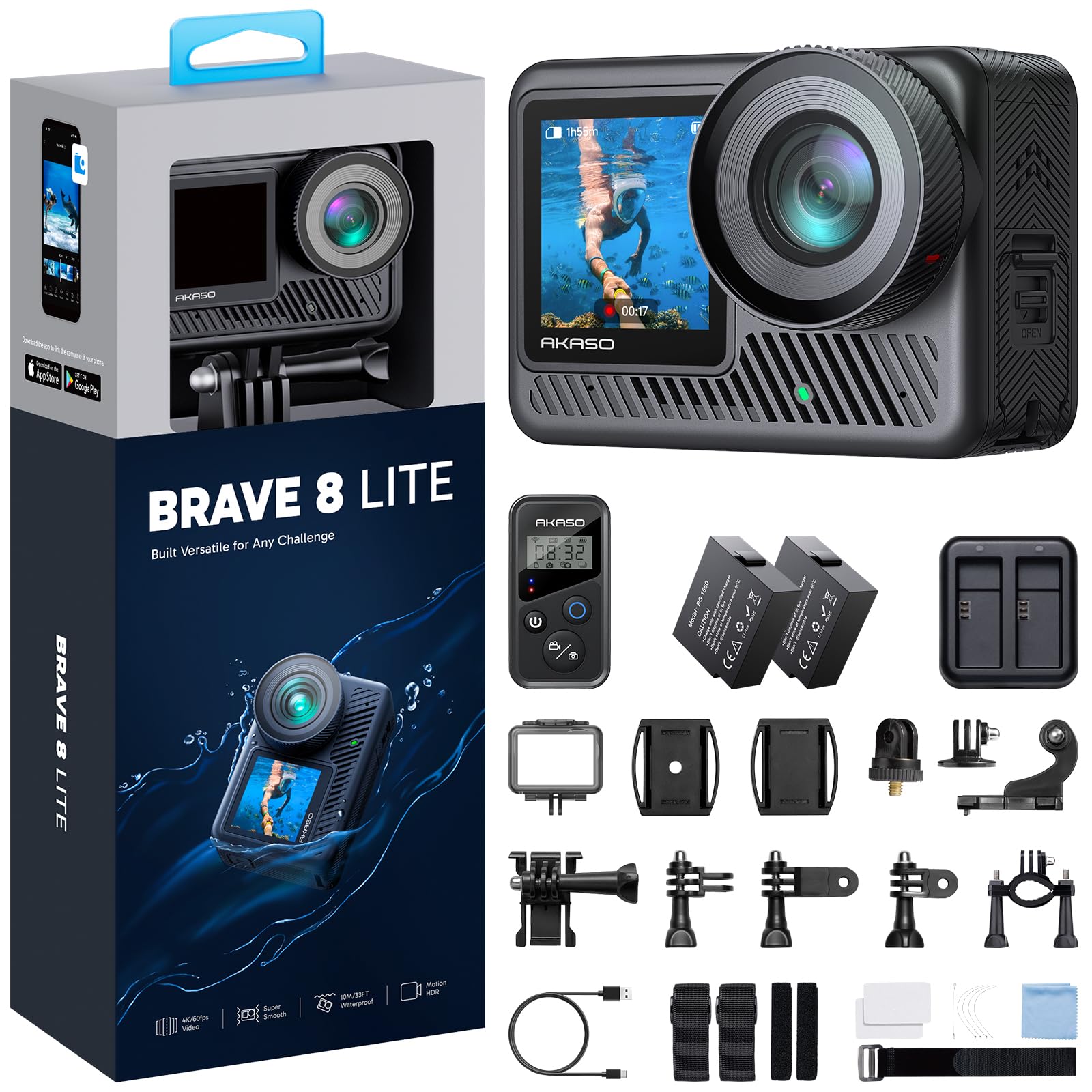
A full kit that gets you skiing without the premium price tag.
It shoots 4K60 UHD (ultra-high-definition at 60 frames per second) from a 1/2-inch CMOS sensor, with HDR (high dynamic range — balancing bright snow and dark tree shadows) to handle harsh winter light. The dual-screen design — a front screen for self-recording and a rear touchscreen for menus — makes lining up a helmet mount shot much easier than single-screen cameras. Owners mention the swipe menu is intuitive and the hyperlapse mode (time-lapse video) is fun for capturing a quick descent from summit to base.
The included kit comes with two rechargeable 1550mAh batteries (the amount of power each holds), a visual remote control, and a bike handlebar clamp mount that also fits ski poles for a low-angle POV. Waterproof to 33 feet without a housing, it handles snow and slush fine. One reviewer noted that transferring many files simultaneously can cause the camera to heat up, so they transfer a few at a time — a minor workflow shift. Battery life is 90 minutes per cell, which is shorter than the Xtra Edge’s 160 minutes, so you will need that second battery for a full ski day.
The 5X digital zoom (magnifying the image electronically) and 8X slow motion add versatility for isolating a specific turn or spray. For the price, the accessory bundle saves you from buying mounts and spare batteries separately.
What Makes It A Good Deal
- Includes two batteries and a remote control
- Dual screens for easy selfie-framing on a helmet mount
- HDR video helps with snow glare
Where It Cuts Corners
- 90-minute battery life per cell falls short of Xtra Edge’s 160 minutes
- Lens heats up during sustained 4K recording, per buyer reports
Best for: skiers who want a fully accessorized kit, dual batteries, and a remote control without spending premium money — especially if you are new to action cameras.
skip it if: you need all-day recording from a single battery or if you plan to shoot in very low light conditions.
3. DJI Osmo Action 5 Pro Adventure Combo

The camera that shrugs off sub-zero cold while others die.
Most action cameras lose half their battery life at freezing temperatures. The Osmo Action 5 Pro uses a 1950mAh Extreme Battery that records up to 4 hours in normal conditions and still delivers 3.6 hours at -20°C (-4°F). That means you can start a run at a frozen summit and still be recording at the lodge. The Adventure Combo includes three batteries and a multifunctional battery case, so you can go a full weekend without a wall outlet.
The 1/1.3-inch sensor with 2.4 µm pixels (small light-capturing units) and 13.5-stop dynamic range (a measure of how well the camera captures both bright whites and dark shadows) handles the snow landscape — bright slopes and tree shadows resolve together without blown highlights or crushed blacks. The 360-degree HorizonSteady stabilization keeps the horizon level even in deep powder or side hits, so your footage does not make viewers dizzy. It is IP68 rated to 20 meters underwater — wet snow, rain, and slush are no threat.
The dual OLED touchscreens are visible in bright sunlight reflecting off snow. Voice control triggers recording and mode switching from one meter away, so you keep your hands on your poles during a fast descent.
Why It Dominates Winter
- Up to 4-hour battery life, 3.6 hours at -20°C
- 13.5-stop dynamic range handles snow glare
- HorizonSteady keeps horizon level in any rotation
The Trade-Off
- Generates noticeable heat after several minutes of recording
- Premium price compared to the AKASO Brave 8 Lite
Reach for this if: you ski in genuinely cold conditions, backcountry settings, or need reliable battery life that does not collapse in freezing weather.
Consider something else if: your skiing is limited to warm-climate indoor slopes or spring conditions only — you probably do not need the cold-weather extreme battery.
4. DJI Osmo Action 6 Enhanced Combo
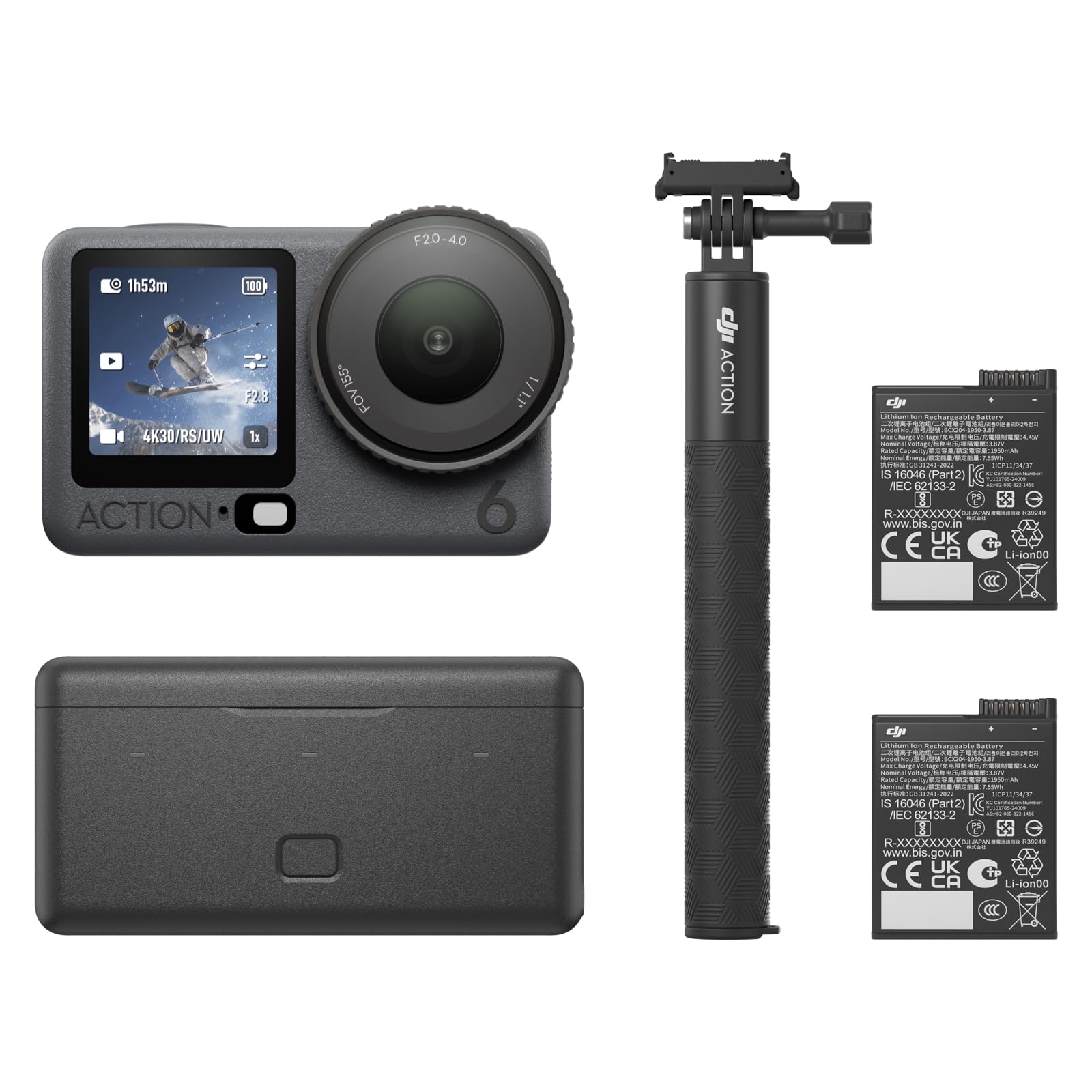
8K detail plus a lens that adapts to changing mountain light.
The Osmo Action 6 features a 1/1.1-inch square sensor that shoots true 8K video for cropping in editing or creating ultra-sharp POV shots. The variable aperture (the lens opening that controls light) of f/2.0 to f/4.0 is rare in action cameras — you open it wider in flat winter light or stop it down on blazing white slopes without relying on digital ND filters (neutral density — which reduce light artificially). One reviewer who took it diving in the Florida Keys noted exceptional underwater image quality, which translates well to the bright-white ski environment.
RockSteady 3.0 and 360-degree HorizonSteady both work up to 4K/60fps, correcting horizontal tilts and roll-axis shakes. The camera is waterproof without a housing. At 4 hours of battery life per Extreme Battery (two in the Enhanced Combo), you can ski multiple days without a power bank. The 1.5m Extension Rod lets you capture dynamic third-person skiing shots that look cinematic, not just a fixed helmet view.
Direct dual-microphone support for DJI Mic transmitters (clip-on wireless mics) means you can interview ski partners on the lift without a separate receiver, with pro-level audio that cuts through wind.
what separates it
- 8K resolution for crop-friendly editing
- Variable aperture (f/2.0–f/4.0) for adaptation to snow light
- 4-hour battery per cell with cold-resistant design
Where It Is Not Perfect
- The larger sensor offers minimal advantage for horizontal-only shooters
- Aftermarket cases may limit touchscreen use
Choose this if: you want the highest resolution for post-production flexibility, and you value being able to adjust aperture on the mountain.
Pass if: you never edit footage and do not need 8K — the Osmo Action 5 Pro delivers 95% of the real-world use for less money.
5. GoPro HERO13 Black Bundle

A 50-piece accessory kit ready for any mount you can dream up.
The HERO13 Black shoots 5.3K HDR video from a 1/1.9-inch sensor, with HyperSmooth 6.0 stabilization and 360-degree Horizon Lock (keeping the horizon level through any rotation). You get up to 4K120 (120 frames per second) or 2.7K240 for 8-times slow-motion — great for capturing a powder spray in detail. The 1900mAh Enduro battery provides up to 1.5 hours of 5.3K recording, which is shorter than the DJI Osmo Action 5 Pro’s 4 hours, so you will need battery swaps during a long ski day.
This bundle includes a 64GB microSDXC card (a memory card for storing video) and a 50-piece accessory kit covering helmet mounts, adhesive mounts, clips, and straps — essentially everything to mount the camera on a helmet, chest strap, ski pole, or backpack strap without buying extra parts. One buyer from South Florida reported the camera overheated after one use, though that was in warm, humid conditions, not cold mountain air.
Wi-Fi 6 support enables fast wireless file transfers to your phone in the lodge. The GoPro Quik app edits and uploads quickly for sharing a run before you take your boots off. The camera is waterproof to 33 feet without a housing, so it survives a typical ski day, though you should rinse it after salt or chlorinated water exposure.
Why It Is A Strong Choice
- 5.3K HDR video with excellent stabilization
- Fifty-piece accessory kit covers every ski mounting scenario
- Wi-Fi 6 for fast lodge-to-phone transfers
What Holds It Back
- Battery life of 1.5 hours is short by premium standards
- Some users report overheating in warm conditions
Best for: skiers who want the full GoPro ecosystem, rely on the huge third-party mount market, and do not mind swapping batteries once or twice per day.
Not for: anyone who needs a single battery to last a full day on the mountain or who skis in sustained warm temperatures where overheating is a risk.
Understanding the Specs
Image Stabilization (EIS)
Electronic image stabilization (EIS — software that cancels camera shake) is the most critical spec for skiing. Without it, vibration from every turn amplifies into shaky footage. Look for systems named HyperSmooth (GoPro), HorizonSteady (DJI), or SuperSmooth (AKASO) — these use gyroscopes (sensors that detect motion) and software to predict and cancel shakes. A basic “anti-shake” label may only reduce small hand tremors, not heavy ski vibration on hardpack snow.
Battery Life In Cold Conditions
Lithium-ion batteries lose significant capacity below freezing. A camera rated for 3 hours at 70°F may deliver only 90 minutes on a 20°F slope. Some manufacturers now publish a “cold-resistant” rating — for example, DJI claims its Extreme Battery delivers 3.6 hours at -20°C. If a camera does not mention cold performance, plan to swap batteries from an inside pocket where body heat keeps them warm.
Waterproofing Without A Housing
You never need a bulky external case for skiing — it adds weight, traps moisture, and makes mounting harder. The standard is an IP68 rating (a measure of dust and water resistance) or built-in waterproof depth of at least 33 feet (10m). That means the camera survives falling snow, splashes, slush, and short submersion. Anything less than 33 feet risks failure if wet snow gets into a port.
FAQ
Can I use any action camera for skiing in sub-freezing temperatures?
How do I mount an action camera on a ski helmet?
What resolution should I record in for skiing?
How important is image stabilization for skiing?
Does the AKASO Brave 8 Lite overheat during long recording sessions?
Can I use voice control while skiing?
What is the difference between RockSteady and HorizonSteady stabilization?
How do I transfer footage from the camera to my phone at the lodge?
Is the GoPro HERO13 better than the DJI Osmo Action 6 for skiing?
Can I use an action camera for other winter sports like snowboarding or ice skating?
Final Thoughts: The Verdict
For most skiers, the action camera for skiing winner is the Xtra Edge Action Camera because it combines 160 minutes of battery life, waterproofing to 52 feet, and decent stabilization at a price that does not hurt. If you ski seriously cold backcountry and need battery life that survives freezing temperatures, grab the DJI Osmo Action 5 Pro. And for maximum resolution and mount versatility straight from the start, the GoPro HERO13 Black Bundle is your pick.
How We Picked
We do not accept paid placement. Every pick is matched to a real buyer and a real use-case; we do not hands-on test units.
Sources & Methodology
Specifications: manufacturer listings and product documentation. Review insights: verified customer reviews, as of July 2026. Pricing: not shown on this page (it changes often); check the current price via the retailer link.
As an Amazon Associate, Gadgets Feed earns from qualifying purchases. This does not affect which products we feature.
Product prices and availability are accurate as of the date/time indicated and are subject to change. Any price and availability information displayed on Amazon at the time of purchase will apply to the purchase of this product. As an Amazon Associate I earn from qualifying purchases.
CERTAIN CONTENT THAT APPEARS ON THIS SITE COMES FROM AMAZON. THIS CONTENT IS PROVIDED "AS IS" AND IS SUBJECT TO CHANGE OR REMOVAL AT ANY TIME.
Amazon and the Amazon logo are trademarks of Amazon.com, Inc. or its affiliates.