
Our readers keep the lights on and my morning glass full of iced black tea. As an Amazon Associate, I earn from qualifying purchases.
Specs are compiled from manufacturer listings and verified buyer reviews and can change over time — please confirm the key details on the product page before buying.
If you are fighting wet filament, foggy safes, or damp electronics, the fix is switching your desiccant from silica gel to activated alumina. It pulls moisture faster, holds more of it, and recharges in your oven instead of ending up in the trash. This guide breaks down the best Activated Alumina Desiccant options by how they perform in real storage setups, not just on paper.
I’m Min — the founder and writer behind Gadgets Feed. This guide is built by comparing the manufacturers’ published specifications and the patterns across verified customer reviews, so you get each pick’s real strengths and trade-offs instead of marketing spin.
You’ll see which alumina beads dry fastest, which canisters fit your filament spool, and which bulk bags give you the most recharge cycles for your money.
Our Picks at a Glance
![Dry & Dry [6 LBS] Activated Alumina Desiccant Beads](https://m.media-amazon.com/images/I/410g0jC3R2L.jpg)
How To Choose The Best Activated Alumina Desiccant
Activated alumina is a porous form of aluminum oxide that traps water vapor in its structure. It works differently from silica gel because it holds onto moisture even when the air around it gets warm, which is why it is the standard for industrial compressed-air drying. For home use, you are mostly deciding between loose beads for bulk bins and ready-made canisters for filament spools.
Match the form to your storage
Loose beads give you the most freedom to fill a filament dryer, a large bin, or a custom container, but you need a mesh bag or a dedicated cartridge to keep them contained. A sealed canister with a metal mesh is easier if you just want to drop something into the center hole of a 1 kg spool and forget about it. Think about whether you are protecting one AMS unit or a whole shelf of storage boxes before you pick a size.
Check the recharge routine you can actually live with
Every alumina product needs heat to push the trapped water back out, but the temperature and time vary wildly between brands. Some makers ask for 2 hours at 200–250°C, others want 350–600°F, and a few specify 8 hours. A batch that works great in a toaster oven may be a headache if you only have a convection oven you also cook dinner in, so match the regeneration steps to your kitchen setup before committing to a huge bag.
Quick Comparison
| Model | Best For | Form | Weight | Recharge Temp | Amazon |
|---|---|---|---|---|---|
| Slice Engineering 2lb★ Best Overall | Versatile Rechargeable | Loose Beads | 1.9 lb | Toaster Oven Safe | Amazon |
| Dry & Dry 6 LBSAlso Great | Best Overall / Bulk Drying | Loose Beads | 6.36 lb | 350–600°F | Amazon |
| Wisesorb 7.5 LBS | Premium Bulk Performer | Loose Beads | 7.5 lb | 200–250°C | Amazon |
| Fonday 6LBS | Certified Kitchen-Safe Bulk | Loose Beads | 6 lb | 400–500°F | Amazon |
| Wisesorb 4 LBS | Compact Bulk Refill | Loose Beads | 4 lb | 200–250°C | Amazon |
| Eazy2hD 6 Pack | Drop-In Spool Canisters | Sealed Canisters | 1.28 lb | 200–250°C | Amazon |
In‑Depth Reviews
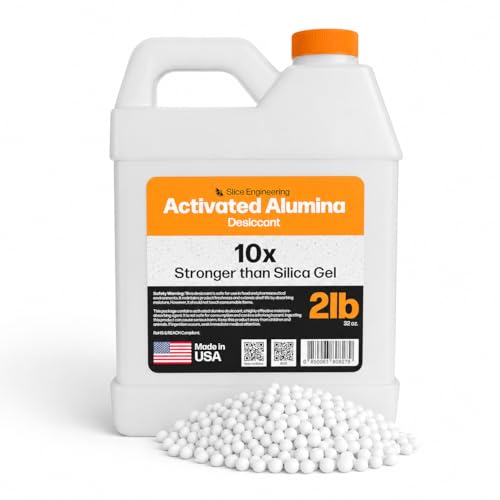
1. Activated Alumina Desiccant Beads for 3D Printer Filament (2lb)
Our pick — over 4.5★ from 350+ verified ratings; the strongest balance of quality and price.
A smaller US-made batch that proves the alumina advantage before you commit to bulk.
This 2 lb jar from Slice Engineering is the perfect entry point if you are not ready to stock 6 pounds of beads. It is made in a Florida facility, and the brand leans hard into the safety angle — owners mention recharging it “in a toaster oven without concern of poisoning yourself like indicating Silica,” which is a genuine advantage for anyone who has worried about the cobalt chloride in traditional color-changing silica.
Owners find the moisture absorption superior to silica gel packets and confirm one bottle comfortably fills an AMS unit plus four extra pods, with a second jar bought for batch swapping while the first recharges. The star of the show is the infinite reusability — unlike silica, which degrades with each recharge, this alumina renews cleanly, which is why the reviews frame it as “buy once, re-use forever.” The 2 lb weight makes it easy to split between several small dry boxes or safes.
The honest catch is that it does not change color when saturated, which earned some negative feedback from buyers who expected an indicator. You will need a hygrometer to know when to recharge, and the value-for-money verdict is mixed — some find it pricey for the size. But for a first alumina purchase that you can test in a toaster oven without a huge commitment, this is the safest bet to start with.
Entry-Level Appeal
- Recharges safely in a toaster oven without toxic fumes
- US-made quality with fair-wage production in Louisiana
- One jar fills an AMS plus four pods
Know Before You Buy
- No color-change indicator to signal saturation
- Smaller 1.9 lb weight means more frequent recharging for heavy users
Perfect for beginners: Start here if you want to test alumina’s drying power in your existing toaster oven before investing in a 6 lb bulk bag.
A heads-up: The lack of a color indicator means you should pair it with a cheap hygrometer to avoid running it past its limits.
2. Dry & Dry [6 LBS] Activated Alumina Desiccant Beads
The heavy-duty bag that crushes humidity fast enough to convert silica loyalists.
Buyers report their AMS humidity meter dropping from ambient levels to 8% within a couple of hours of filling it with these beads. In a Bambu Lab AMS, passive drying pulled readings from 20% down to 2% overnight, prompting users to switch from silica to alumina.
Each bag carries 6.36 pounds of durable 3~5 mm beads, and the maker says the material absorbs up to 10X more moisture than silica gel over its lifetime. That capacity pairs with genuine value — buyers repeatedly note this is better priced than the color-changing silica alternatives sold for the same 3D printing purpose. Recharging asks for 350-600°F in the oven for 2 hours, though one owner warns the higher end of that range demands a spotlessly clean oven to avoid grease contamination, and a fine white dust can appear after repeated cycles.
Reviewers consistently praise its quality and humidity control, calling it the most effective bulk alumina option for serious filament storage. It does not change color to tell you when it is saturated, so you will want a separate hygrometer to time your recharges. The draw is the sheer drying power per dollar, which is why the review pages sum it up: “humidity dropped down to 8% within a couple hours.”
Why It Wins
- Massive 6.36 lb supply for filling multiple dry boxes and AMS units
- Drops AMS humidity from 20% to 2% in 12 hours passively
- Rechargeable at 350-600°F for endless reuse
The Trade-Offs
- No color-change indicator, so you need a hygrometer
- High-temp recharge risks grease contamination if oven is dirty
- Can shed fine white dust after repeated cycles
The bulk buy: Grab this if you want the strongest drying performance for the money across a whole filament collection.
Reach for it when: You have an oven you can dedicate to 2-hour recharges at serious heat without worrying about food residue.
3. Wisesorb 7.5 LBS Activated Alumina

Industrial-spec beads that push dry boxes down to single-digit humidity and hold there for weeks.
This is the bag for people who treat filament drying like a science. Wisesorb specifies the performance directly: at 77°F and 90% relative humidity, each bead absorbs more than 30% of its own weight in water vapor, and the 3–5 mm beads are rated to withstand crushing even in high-temperature, corrosive environments. Owners in humid climates report dry boxes holding below 10% relative humidity, with one CFS setup dropping from 15% to 5%.
What sets this apart from the Dry & Dry bag is the extended longevity and the cleaner recharge chemistry. Buyers mention it stays below 10% humidity for weeks at a time, and the regeneration process asks for 8 hours in the oven at 200°C-250°C — a lower, gentler heat than many competitors require. The trade-off is that it costs more upfront than silica or other alumina options, and there is no true color indicator; owners note the beads darken slightly as they load up, but the change is subtle enough that most mix in some color-changing silica just to time their recharges.
With one of the larger review pools in this list, the consensus is that this is the superior long-term value despite the higher entry price — buyers repeatedly call it “insanely dry” and say they will buy again. Where the Dry & Dry bag wins on raw speed, this one wins on sustained, weeks-long performance and gentler reactivation.
The longevity king: The 7.5 lb weight and 30% absorption capacity make it the best value over many recharge cycles, if you can handle the higher upfront cost.
A fair warning: Recharging needs a full 8-hour oven session, which is a bigger time commitment than the 2-hour cycles of most rivals.
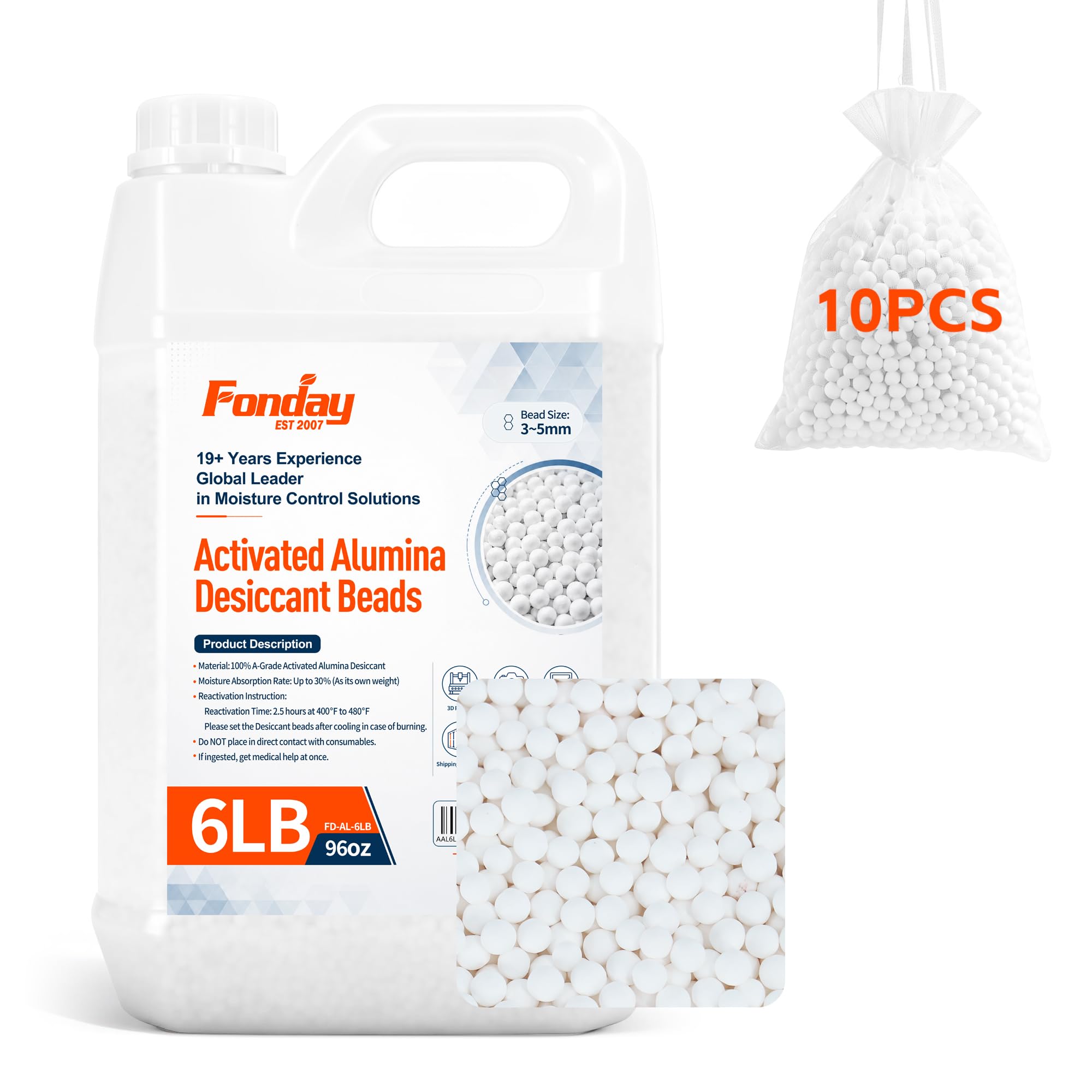
4. 6LBS Fonday Activated Alumina Filament Drying Desiccant
A triple-certified 6 lb bag that handles both filament drying and flower pressing with equal ease.
Fonday brings the strongest safety paperwork to this list: the beads carry Climate Pledge Friendly, SGS SDS, and EU REACH certifications, which translates to carbon-neutral production and verified chemical safety for household use. For anyone who wants the drying power of alumina but worries about having it near food or in a kitchen oven, this is the batch that checks those boxes on paper.
Performance holds up in real use. AMS customers note humidity dropping from 20% to 1-2% overnight, with filament bins staying at 10-11% relative humidity even through a Texas summer. The most surprising use case comes from flower pressing — the beads dry roses and day lilies in days inside a simple 9×11 container with no bad smell, which makes this a dual-purpose buy for crafters.
Regeneration runs at 400-500°F for 2-2.5 hours, and the 6 lb weight ships with five mesh bags so you can split it across multiple projects immediately. The main gripe is practical rather than performance-based: the packaging lacks pour spouts, making it messy to transfer beads into your dryers. There is also no color indicator, so a separate hygrometer remains essential for tracking saturation.
Certified confidence: If chemical safety certifications matter to you, the SGS and EU REACH marks make Fonday the most defensible choice for kitchen-adjacent use.
Hands-on note: Plan to supply your own funnel or scoop, because the lack of pour spouts on the bag is the most common frustration.
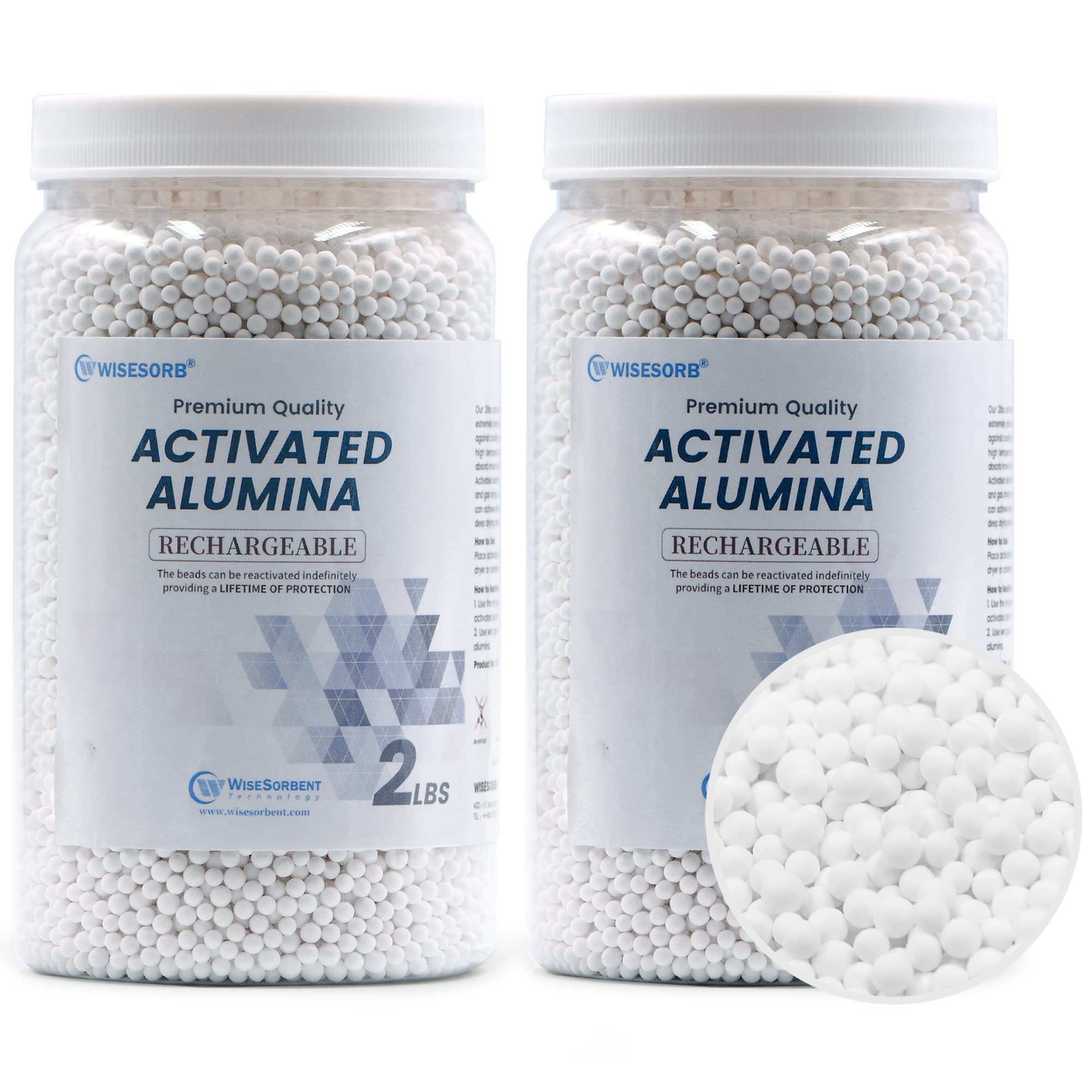
5. Wisesorb 4 LBS Activated Alumina
The same Wisesorb performance in a smaller bag for single-bin setups and tighter shelves.
This 4 lb version delivers the identical industrial-grade alumina as its 7.5 lb sibling — same 3–5 mm beads, same 30% weight absorption at 90% RH, same 8-hour recharge at 200-250°C — but in a size that makes sense if you protect one or two dry boxes rather than a whole workshop. Swapping silica for these beads in airtight Bambu Lab bins dropped humidity by 4-5%.
A filament container that hovered around 15% relative humidity with silica now sits between 8 and 10% with these beads. Buyers describe it as “a huge leap above silica desiccant beads” and appreciate that it maintains that lower level consistently. It ships as two 2 lb packs, which gives you natural batch-swapping ability — recharge one while the other stays on duty.
The recurring negative is the packaging: the container it arrives in is poor quality and not suitable for reuse, so you will need your own storage jars or mesh bags. Like the larger Wisesorb bag, there is no built-in saturation indicator, which pushes most owners to mix in color-changing silica just to track when recharging is due.
Right-sized performer: Choose this 4 lb option when you want Wisesorb’s industrial drying power without committing to the full 7.5 lb investment.
A packaging caveat: The arrival container is single-use, so budget for your own airtight storage or mesh bags from day one.
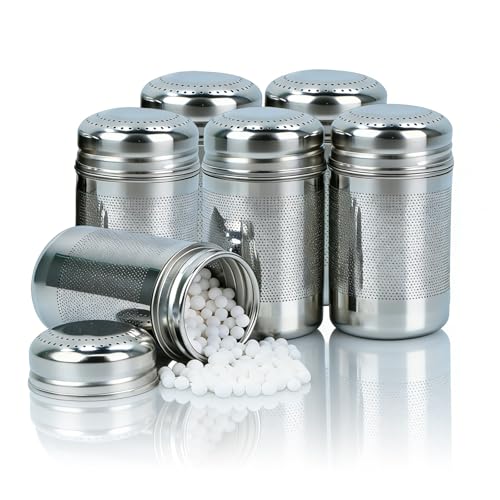
6. Eazy2hD Activated Alumina Desiccant, 6 Pack
Pre-loaded steel canisters that drop into spool centers with zero mess or measuring.
This is the only pick on the list that skips loose beads entirely. Each stainless steel canister fits precisely into the center hole of most 1 kg filament spools, with a fine metal mesh and heat-resistant epoxy seal keeping the alumina dust safely contained. The 6-pack approach means you can leave one canister in every active spool and never touch the beads directly.
Real-world drying results are strong: Reviewers point out these pulling filament humidity down to 10% from a 40% ambient level. The canisters rest cleanly in the center of spools and run without issues inside an AMS 2 Pro. At just 1.28 pounds for the whole set, this is dramatically lighter than the bulk bags — a 5x gap versus the Dry & Dry 6 lb option — but the trade-off is less total capacity per dollar.
Refreshing is straightforward: put the sealed canister in the oven at 200-250°C for 2 hours and it returns to full drying power. Owners note the canisters run slightly smaller in diameter than typical spool openings, which is harmless since they still sit inside well, and some 3D print small end caps to take up the slack. The alumina handles 99% RH without crumbling, which gives it a longevity edge over silica in humid climates.
No-Mess Design
- Sealed steel canisters keep dust fully contained
- Fits center hole of most 1 kg spools and AMS 2 Pro
- Drops humidity from 40% ambient down to 10%
Consider This
- No humidity indicator, so monitoring requires a hygrometer
- Canisters are bulky for small, tight storage spaces
The tidy solution: Pick this if you value convenience over capacity and want a dust-free canister system for every spool you own.
skip it if: You are drying large bins or safes where loose bulk beads give you far more surface area for the money.
Understanding the Specs
Absorption Capacity & Bead Size
Activated alumina’s real advantage shows up in its weight-based capacity — the Wisesorb bags absorb more than 30% of their own weight in water vapor at 90% relative humidity. Bead size matters too: the 3–5 mm beads used across most of these picks balance surface area for fast drying against physical strength so they do not crush into dust inside your dry box.
Recharge Temperature & Time
Every alumina product needs heat to release trapped moisture, but the routine varies wildly. The Dry & Dry bag wants 350-600°F for 2 hours, Fonday specifies 400-500°F for 2-2.5 hours, and the Wisesorb and Eazy2hD options run cooler at 200-250°C for 2 to 8 hours. Match the regeneration demands to your actual oven before you buy a large quantity, because a batch you cannot easily recharge is wasted money.
FAQ
How is activated alumina different from silica gel?
Will loose alumina beads fit inside my Bambu Lab AMS?
Can I recharge activated alumina in a toaster oven?
Why does my activated alumina not change color when saturated?
How long does a batch of activated alumina last before recharging?
Is activated alumina safe to use around food or in a kitchen oven?
How much activated alumina do I need for filament storage?
Can activated alumina be used for compressed air drying?
Why does activated alumina cost more than silica gel?
Final Thoughts: The Verdict
If you want one dependable pick, the activated alumina desiccant winner is the Dry & Dry 6 LBS because it pairs the fastest drying response with the strongest value per pound. If you want industrial-grade longevity and gentler 8-hour recharges, grab the Wisesorb 7.5 LBS. And for a dust-free, drop-in experience on every spool, the Eazy2hD 6 Pack canisters are the one to reach for.
How We Picked
We do not accept paid placement. Every pick is matched to a real buyer and a real use-case; we do not hands-on test units.
Sources & Methodology
Specifications: manufacturer listings and product documentation. Review insights: verified customer reviews, as of September 2026. Pricing: not shown on this page (it changes often); check the current price via the retailer link.
As an Amazon Associate, Gadgets Feed earns from qualifying purchases. This does not affect which products we feature.