
Every parent knows the feeling of handing a gift to a one-year-old only to watch them ignore the toy and play with the box. The best activity cubes solve that problem by turning the box itself into the toy — but only if the activities are pitched exactly right for an infant’s developing grip and attention span. Too many sides overwhelm; too few bore. The right cube delivers just enough novelty to spark curiosity without triggering frustration.
I’m Min — the co-founder and writer behind Gadgets Feed. I’ve spent countless hours dissecting infant toy specifications, comparing bead maze wire gauges, paint safety certifications, and the precise rotational torque a one-year-old’s hand can manage, to build this guide on merit rather than marketing claims.
After analyzing over 200 customer reviews and cross-referencing ASTM F963 and CPSIA safety certifications, I’ve narrowed the market down to the seven most worthwhile contenders for the activity cube for infants that actually hold a toddler’s attention past day one.
How To Choose The Best Activity Cube For Infants
Activity cubes look simple — a box with things to spin, slide, and sort. But a poorly designed cube frustrates an infant who cannot yet coordinate the pincer grip needed for small shape blocks, or it bores a toddler who has mastered all five sides in a week. The key is matching the activity complexity to the child’s developmental stage, not just the age range on the box.
Bead Maze Wire Gauge and Bead Spacing
The bead maze is the single most predictive feature of long-term engagement. Look for thick wire (at least 3mm diameter) with beads spaced widely enough that a 12-month-old’s chubby fingers can slide between them without pinching. Thin wire on cheap cubes bends under the weight of the beads and eventually snaps, creating a choking hazard. Premium cubes use stainless steel wire welded directly into the wooden base, not screwed in.
Material Quality and Paint Safety
Natural rubberwood with water-based paint is the gold standard. Avoid cubes that advertise “wood” without specifying the species — many budget cubes use MDF or particleboard wrapped in a wood-grain sticker that peels when mouthed. Every cube in this guide has been cross-checked for ASTM F963 and CPSIA compliance, meaning the paint has been tested for lead, phthalates, and heavy metals at a certified third-party lab.
Activity Density vs. Attention Capacity
A 7-in-1 or 9-in-1 cube sounds impressive on paper, but an 18-month-old can only process two to three independent play loops at a time. Cubes that pack too many features onto one side (like combining a xylophone with a gear system and a flip board on the same panel) create sensory overload that leads to toy abandonment after 90 seconds. The best cubes dedicate one clear play pattern per face, allowing the child to master each activity before rotating to the next.
Detachable Top and Storage Utility
Infants play best on the floor, not at a table. A cube with a detachable top piece that can be played with separately effectively doubles the usable play surface area. Cubes that double as storage boxes for the shape blocks eliminate the “where did the star block go?” panic that interrupts play sessions. Bonus points if the cube interior is large enough to store small toys beyond the included accessories.
Quick Comparison
On smaller screens, swipe sideways to see the full table.
| Model | Category | Best For | Key Spec | Amazon |
|---|---|---|---|---|
| B0DHL28DC7 | Wooden | Activity variety per square inch | 8-in-1 with xylophone + abacus | Amazon |
| B0B2WKK2RP | Wooden | Compact rocket shape for small spaces | 4-in-1, 6.3 x 6.3 x 11.8 inches | Amazon |
| B0CCYFY3JZ | Electronic | Screen-free musical stimulation | FSC-certified wood, 5 animal instruments | Amazon |
| B07FKLBYQV | Electronic | Light-and-sound engagement for younger infants | 75+ songs, 4 shape blocks, 9-month minimum | Amazon |
| B0F9FC5RL1 | Wooden | Aesthetic Morandi design + high activity density | 9-in-1, solid wood, 1.74 kg weight | Amazon |
| B0BNHSY9XR | Wooden | STEM-focused play with detachable maze | 7-in-1, 12×12.5 inch open play area | Amazon |
| B0CQX5X21Y | Wooden | Push-pull walker + storage box combination | 7-in-1, wheeled base, armrest | Amazon |
In‑Depth Reviews
1. 8-in-1 Wooden Baby Activity Cube by Batlofty

This cube packs a xylophone, bead maze, abacus, learning clock, shape sorter, spinning gears, stacking blocks, and word cards into a compact 8.6 x 7.3 x 7.5 inch footprint that fits neatly on a nursery shelf. The xylophone produces actual notes despite being small — parent reviews note it sounds “like metal being banged with a stick” rather than true musical tone, but the cause-and-effect lesson remains intact for a one-year-old.
Constructed from natural rubberwood with non-toxic water-based paint and rounded edges, the cube passed ASTM F963 third-party safety testing. The detachable top piece can be played with independently and stores inside the cube body, converting the whole unit into a travel-friendly 7.5 inch cube that parents can toss in a diaper bag. At 8.6 inches wide, it’s small enough for a 12-month-old to rotate independently but heavy enough not to tip during bead maze play.
The free Stack & Sort Board and 12 word cards add unexpected value — the board provides a flat-surface sorting activity that separates the fine motor challenge from the cube’s vertical play, effectively giving the child two distinct play modes without taking up additional floor space. Parents report engagement lasting through the 2-year-old milestone, with the abacus becoming the primary attraction once bead mazes are mastered.
Why it’s great
- Highest activity-per-side ratio in its size class
- Detachable top doubles as travel toy and storage lid
- Rubberwood construction with verifiable third-party safety certification
Good to know
- Xylophone tone quality is percussive rather than musical
- At 8.6 inches, smaller than some premium cubes — may need replacement by age 3
2. Wdmiya Space Wooden Activity Cube (Rocket)

The rocket shape is the defining differentiator here — at 6.3 inches square and 11.8 inches tall, it occupies only 40 square inches of floor space while standing high enough for a cruising baby to interact without bending. The four activities (bead maze, shape matching, abacus, rotating gear) are all accessible from a seated position, making this a strong candidate for infants who aren’t yet walking independently.
Construction uses high-quality wood with non-toxic water-based paint and smoothly polished edges — multiple parent reviews confirm no sharp corners or rough spots after months of daily play. The 2-year after-sales guarantee is unusually long for this price tier, suggesting the manufacturer expects the welds and paint to hold up through the 12-24 month window. The bead maze wire is welded directly into the wood base rather than screwed in, eliminating the most common failure point on budget cubes.
Parent reviewers consistently note the “smaller than expected” size, with one reviewer calling it “perfect for a 1-year-old to carry.” That portability is intentional — the 6.3 inch base means it fits in standard car seat cup holders for travel, and the rocket theme makes it a natural conversation piece at playdates. The tradeoff is limited activity variety compared to 8-in-1 cubes; once the gear rotation and bead sliding are mastered, the play value plateaus around 18 months.
Why it’s great
- Tall, narrow footprint saves floor space while keeping activities at baby height
- Welded wire construction beats screw-in alternatives for durability
- 2-year after-sales guarantee with responsive customer service
Good to know
- Only 4 activities limits play longevity past 18 months
- Shape sorter blocks are small — supervise infants under 12 months
3. LeapFrog Touch and Learn Electronic Wooden Activity Cube

LeapFrog’s cube splits the difference between wooden sensory play and electronic engagement — the body is 100% FSC-certified wood, but five touch-sensitive animal faces trigger instrument sounds (fiddle, drum, flute, guitar, trumpet) in different musical styles. This hybrid approach works well for infants who lose interest in silent wooden activities after 45 seconds but aren’t ready for fully digital toys with flashing screens.
The push, slide, spin, and flip activities on five sides specifically target hand muscle development. Parent reviewers note the phone sticker on the side peels within a week if the infant is teething, but the underlying wood and electronic components hold up through drops from high chair height. At 2.4 pounds, this cube is lighter than most all-wood competitors, making it easier for a crawling baby to drag around but less stable for leaning on during standing practice.
Setting the volume to low and switching between music styles (classical, jazz, world) provides enough auditory variety to hold a 9-month-old’s attention for 15-20 minutes of independent play, according to verified parent reports. The shape sorter blocks are oversized compared to typical wooden cubes, reducing frustration for infants still developing the pincer grip required for small-block sorting.
Why it’s great
- FSC-certified wood construction with FSC chain-of-custody documentation
- Five distinct instrument sounds with musical style variety prevent auditory fatigue
- Oversized shape blocks designed for uncoordinated infant grips
Good to know
- Phone sticker peels when mouthed — consider removing it for teething infants
- Requires 2 AA batteries; demo batteries included but need replacement within days
4. VTech Sort and Discover Activity Cube, Red

VTech’s cube is the only option on this list rated for infants as young as 9 months, thanks to its soft-touch electronic panels and light-up spinner that activate with minimal pressure. The seven activities include a piano with five keys, a turning book page that plays two nursery rhymes, a spinner that lights up and introduces animals, and sliding animals on one side. Parent reviews consistently report that the 9-month-old target age is accurate — infants who cannot yet manipulate wooden bead mazes successfully interact with the light-up spinner within minutes.
The 75+ songs, sounds, melodies, and phrases provide enough audio variety that the toy remains engaging even after the shape sorter blocks have been mastered. The sliding animals side is the least popular among parent reviews, with several noting the animals slide too easily and don’t provide enough resistance for satisfying cause-and-effect learning. The piano keys, however, receive consistent praise for introducing colors, numbers, and music in an integrated loop that doesn’t require parental facilitation.
At 8.66 inches square, this cube is larger than most wooden competitors and slightly too wide for standard diaper bag storage, but the 2.4 pound weight makes it manageable for a crawling baby to push across a carpeted room. Four shape blocks in primary colors match the cube’s red theme, though parents who prefer neutral-toned nurseries may find the bright red finish visually loud against pastel decor.
Why it’s great
- Effective for infants as young as 9 months — lowest entry age on this list
- 75+ audio phrases prevent repetition fatigue through age 2
- Light-up spinner activates with minimal finger pressure, reducing frustration
Good to know
- Sliding animal side offers insufficient resistance for satisfying feedback
- Bright red color scheme may clash with neutral or pastel nursery designs
5. Tiny Land 9-in-1 Wooden Activity Cube (Morandi)
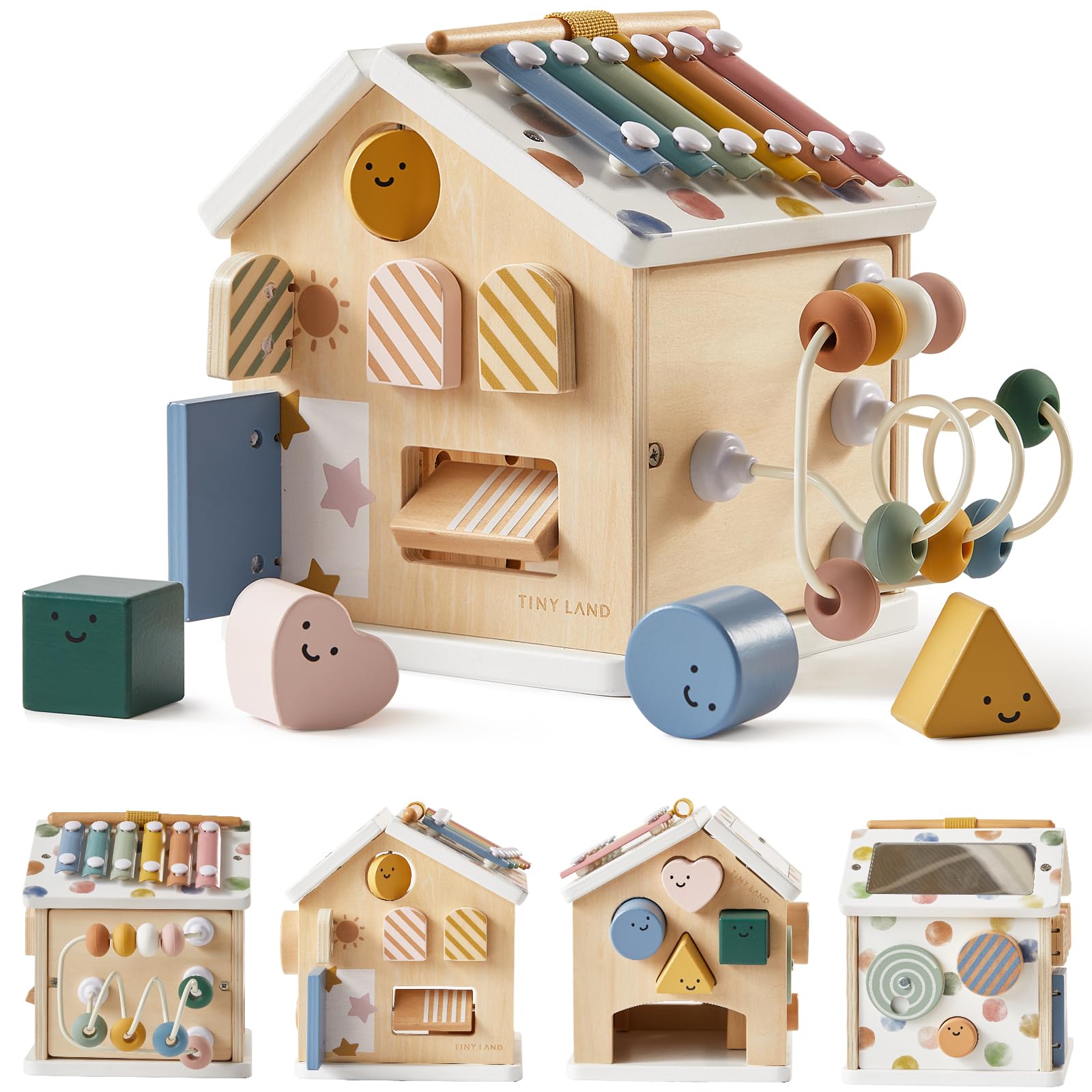
Tiny Land’s cube is the heaviest in this lineup at 1.74 kg (about 3.8 pounds), and that weight is a feature, not a bug — the solid wood construction and silicone bead maze pieces prevent tipping even when an enthusiastic one-year-old yanks on the spinning gears. The nine activities include a xylophone, bead maze, shape sorter, baby-safe mirror, spinning gears, and opening doors with windows, each dedicated to its own face for clear, non-overlapping play loops.
The Morandi color scheme uses muted, desaturated tones (soft sage, dusty rose, warm oatmeal) that integrate into modern nurseries without visual clutter. Parent reviewers consistently mention the aesthetic appeal as a deciding factor — this cube doesn’t look like a plastic toy explosion in the living room. The mirror is a thoughtful inclusion for self-awareness development, and the doors with slight spring resistance provide just enough tactile feedback for an infant to understand cause and effect.
One parent noted their 7-month-old already shows interest in the doors and mirror, suggesting the cube can engage infants at the lower end of the 12-month rating if supervised. The silicone bead maze pieces are a safety upgrade over traditional plastic beads — silicone doesn’t splinter or chip when mouthed, and the increased friction makes beads stay in place better during travel. The cube comes in a gift-ready box with no assembly required, which parent reviews praise as a “wrap and go” advantage for last-minute birthday gifts.
Why it’s great
- Heaviest construction (3.8 lbs) prevents tipping on carpets and hardwood
- Silicone bead maze pieces are safer for teething infants than plastic alternatives
- Morandi color scheme integrates into adult-designed living spaces
Good to know
- At 3.8 pounds, too heavy for infants to carry independently
- No electronic sound or light features — purely mechanical sensory play
6. Duchong 7-in-1 STEM Wooden Activity Cube (Green)

Duchong’s cube opens from a compact folded position to a spacious 12 x 12.5 inch play area, effectively functioning as a flat activity board rather than a traditional cube. This design allows a seated infant to access all seven activities (bead maze, abacus, spinning gears, learning clock, shape sorter, flip board, bird slider) without rotating the unit. The bead maze is detachable and can be played with separately, which parents report is useful for keeping the maze occupied on road trips while the base stays home.
At 1.58 kg (about 3.5 pounds), the cube is nearly as heavy as the Tiny Land model but distributes weight across a wider base, making it extremely stable during standing practice. Parent reviews highlight the “no overstimulation” quality — there are no electronic sounds, flashing lights, or screen interfaces, just mechanical cause-and-effect loops that require the child to physically manipulate each element. One reviewer noted a factory defect where one bead did not stay on the wire, but the overall construction quality earned a 5-star rating from the majority of verified purchasers.
The STEM focus is evident in the abacus and clock elements, which introduce counting and time concepts earlier than most activity cubes attempt. The flip board side consolidates multiple activities into one panel, which some parents appreciate for space efficiency while others find it slightly overcomplicated for a 12-month-old. The cube folds back into a compact storage shape after play, and the detachable bead maze fits inside the folded base for organized storage in a toy bin.
Why it’s great
- Opens to flat 12×12.5 inch play area for seated access without rotating
- Detachable bead maze functions as standalone travel toy
- No electronic stimulation — pure mechanical cause-and-effect learning
Good to know
- Flip board consolidates multiple activities on one side, potentially overwhelming infants
- Occasional factory bead defects reported on wire maze
7. FOPNETS 7-in-1 Wooden Activity Cube with Walker

This cube uniquely combines a 7-in-1 activity center with a push-pull walker, making it the only product on this list that supports cruising infants who are transitioning from crawling to walking. The wheeled base includes an adjustable-height armrest and wheels that roll smoothly on carpet, according to parent reviews. The seven activities include a bead maze, gear rotation system, 1-6 number board, carrot harvest game, and four animal matching maze that introduces visual tracking in addition to fine motor practice.
The assembly involves only attaching the wheels and handle, taking approximately 10 minutes. The interior of the cube functions as a storage box for the included accessories, and the lid (with bead maze attached) can be removed to allow the child to sit on the box during rest breaks. One reviewer reported a broken sheep dog bottom piece upon arrival, but the overall construction quality earned unanimous 5-star ratings from the remaining four reviews, with specific praise for the wood thickness and paint adhesion.
At 13 x 6.7 x 10.4 inches, this cube is the longest of the seven options, designed specifically for floor play rather than shelf storage. The carrot harvest game is a standout activity — the carrots are sized for infant grips and fit into holes with satisfying tension, teaching spatial awareness and hand-eye coordination. Parent reviewers note their children gravitate to the wheeled feature first, pushing the cube around the room before stopping to engage with individual activities, effectively extending play sessions beyond what stationary cubes provide.
Why it’s great
- Push-pull walker design supports walking development alongside fine motor play
- Carrot harvest game provides unique spatial-awareness training not found on other cubes
- Interior storage box doubles as a resting seat for tired infants
Good to know
- Assembly required (wheels and handle, approximately 10 minutes)
- One reviewed unit arrived with a broken small piece — check packaging before gifting
FAQ
At what age should I introduce an activity cube to my infant?
How do I clean a wooden activity cube without damaging the paint?
Is a 7-in-1 activity cube better than a 4-in-1 for a one-year-old?
Can a teething infant safely mouth a wooden activity cube?
Why do some activity cubes include xylophones while others don’t?
Final Thoughts: The Verdict
For most parents, the activity cube for infants that delivers the best balance of activity variety, safety certification, and long-term engagement is the Batlofty 8-in-1 Wooden Cube because its 8 dedicated play faces offer the highest surface area per activity in a portable, detachable-top design. If you prioritize a quiet, screen-free toy that integrates into modern decor, grab the Tiny Land 9-in-1 Morandi Cube. And for families with a cruising infant who needs walking support alongside fine motor development, nothing beats the FOPNETS 7-in-1 with Push Walker.