
Wrist-based optical heart rate sensors on cheap wearable bands are notorious for locking onto your cadence instead of your pulse, spiking to 180 during a brisk walk or stubbornly reading 90 bpm while you’re sprinting up a hill. That unreliable data turns every workout into a guessing game and makes sleep stage analysis a lottery. The real solution lies in knowing exactly which sensor architecture, sampling rate, and strap placement delivers correlation-tested results.
I’m Min — the co-founder and writer behind Gadgets Feed. I’ve spent hundreds of hours cross-referencing optical sensor datasheets, validating user-reported accuracy against independent stress-test reviews, and mapping the connectivity quirks of Bluetooth and ANT+ protocols in the fitness tracking ecosystem.
Whether you need a dedicated armband for HRV training or an everyday band that monitors sleep, stress, and activity, this guide breaks down the only seven wearables that earn the title of best activity tracker that tracks heart rate without the fluff.
How To Choose The Best Activity Tracker That Tracks Heart Rate
The wrong tracker gives you spurious spikes that derail training zones. Three criteria separate a reliable heart rate monitor from a cosmetic gadget.
Sensor Architecture: Optical vs. Electrical
All wrist-based trackers use photoplethysmography (PPG) — green and red LEDs that measure blood volume changes. The sensor’s sampling rate (measured in Hz) determines how many reads the watch takes per second. Most budget trackers sample once every 1–2 seconds, which misses the peak of a sprint interval. Premium devices and dedicated armbands push continuous per-second reads. Chest straps like the Polar H10 use electrical ECG sensing, which directly measures the heart’s electrical activity and delivers clinical-grade RR-interval data for HRV analysis. For zone-based training, look for at least 25 Hz continuous sampling.
Strap Type and Placement
Wrist-mounted optical sensors move during wrist flexion at the gym or while biking in aero position. Armband-style monitors (placed on the forearm or bicep) stay more stable and sit closer to major arteries, reducing motion artifact. The COROS and Scosche armbands use a fabric wrap that doesn’t slide, while the Polar H10 uses a silicone-dotted chest strap that must sit directly below the pectoral muscle. If you do pull-ups, kettlebell swings, or yoga, an armband outperforms any wrist tracker for HR consistency.
Data Output and Connectivity
Heart rate is useless if your app, watch, or bike computer can’t read it. Bluetooth BLE is universal, but ANT+ connectivity unlocks direct pairing with Garmin watches, Wahoo computers, and Peloton equipment. The Polar H10 supports both Bluetooth and ANT+ simultaneously along with 5 kHz for gym equipment. The COROS armband uses Bluetooth only, which limits pairing to one or two devices. For multi-device streaming — watch, phone, and trainer all at once — look for dual-channel Bluetooth or ANT+ support.
Quick Comparison
On smaller screens, swipe sideways to see the full table.
| Model | Category | Best For | Key Spec | Amazon |
|---|---|---|---|---|
| Polar H10 | Chest Strap | ECG-level accuracy and HRV | 400-hour battery (CR2025) | Amazon |
| Garmin HRM 600 | Chest Strap | Running dynamics and pool swim | Rechargeable, 2-month life | Amazon |
| COROS HR Monitor | Armband | Multi-sport Bluetooth streaming | 38-hour run time, 80-day standby | Amazon |
| Scosche Rhythm+ 2.0 | Armband | ANT+ and Bluetooth dual streaming | 24-hour continuous battery | Amazon |
| Bestinn Fitness Tracker | Wrist Watch | All-day health and 120+ sports modes | 1.58″ HD, always-on display | Amazon |
| FITVII FINO 2 | Wrist Watch | Budget health monitor with BP | 180 mAh, IP68, 89+ watch faces | Amazon |
| MorePro AIR2 | Wrist Watch | Comfortable entry-level wearable | Bluetooth LE 5.2, 128 MB storage | Amazon |
In‑Depth Reviews
1. Polar H10 Heart Rate Monitor Chest Strap
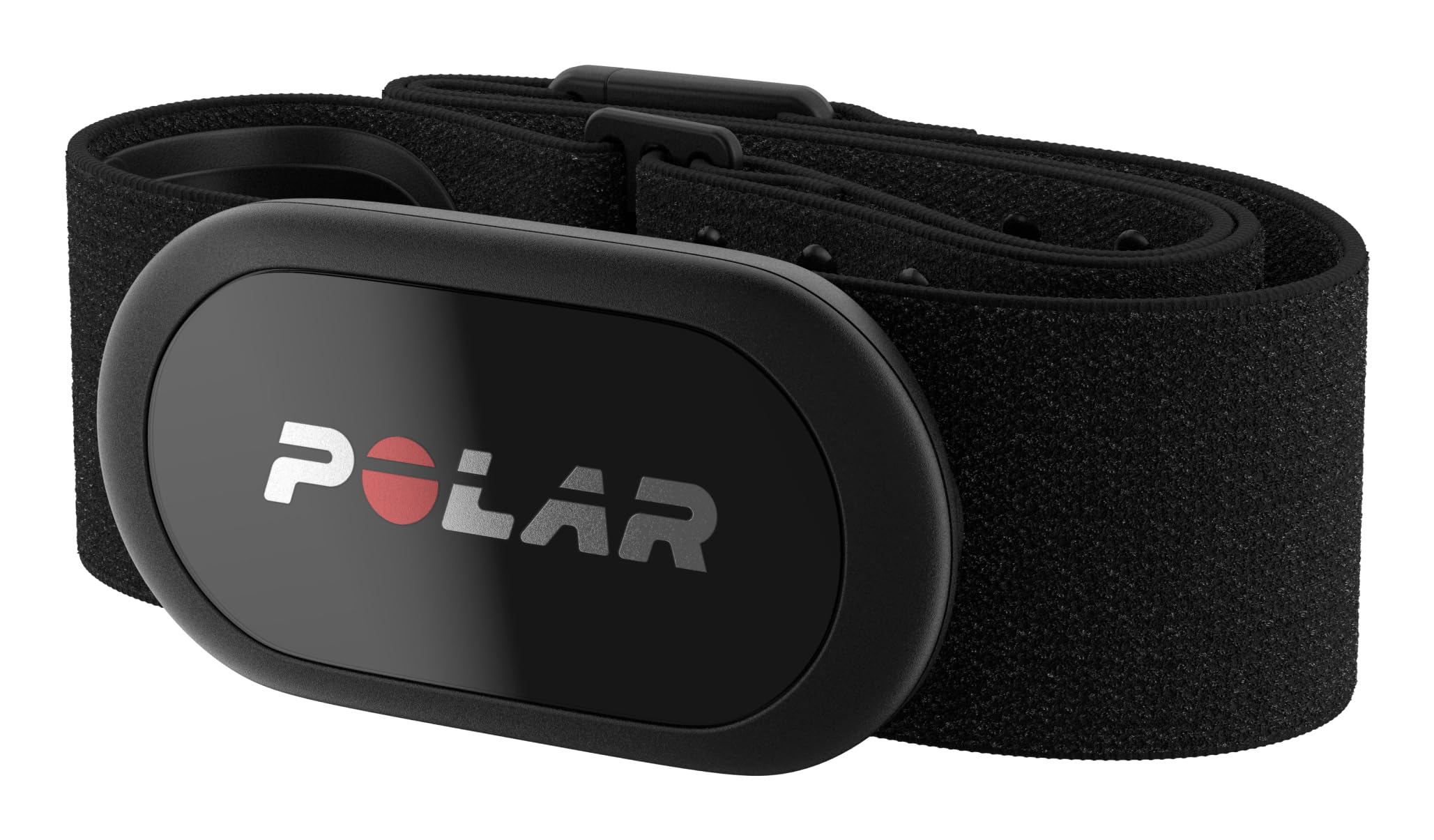
The Polar H10 remains the reference benchmark for consumer heart rate monitoring, validated in multiple studies against 12-lead ECG during stress tests with a correlation of 92.9% during running and 99.3% during cycling. Its electrical ECG sensor captures RR-interval data at 1000 Hz, making it the go-to device for HRV analysis in apps like HRV4Training and Elite HRV.
Connectivity is the richest in this entire guide — Bluetooth BLE, ANT+, and 5 kHz all active simultaneously, allowing you to stream to a Garmin watch, a Peloton bike, and a phone all at once. The included Pro Chest Strap uses silicone dots and a new buckle design that prevents the slippage that plagued older straps. The CR2025 battery achieves an average of 400 hours of operation, though some users report shorter life when leaving the sensor active continuously.
The only notable trade-off is the chest strap format itself — some athletes find the band restrictive during deep breathing in yoga or during long-distance cycling in an aggressive aero position. Replacement straps are necessary every 6–12 months as the electrode fabric degrades with sweat exposure. Despite that consumable cost, no other monitor in this list offers the same clinical-grade precision for heart rate variability.
Why it’s great
- ECG accuracy validated against 12-lead stress tests
- Three simultaneous wireless protocols (BLE, ANT+, 5 kHz)
- 400-hour battery life on a replaceable coin cell
Good to know
- Chest form factor uncomfortable for some body types
- Strap electrodes degrade and need periodic replacement
2. Garmin HRM 600

The HRM 600 delivers what no wrist-based tracker can — running dynamics data including vertical oscillation, ground contact time balance, and stride length. These metrics require a chest-mounted accelerometer, and Garmin’s pod captures them with six-axis motion sensing while simultaneously logging heart rate at per-second intervals. For runners who obsess over form efficiency, this is the only wearable on this list that quantifies how much you slow down on each foot strike.
Its rechargeable lithium-ion battery eliminates the hassle of coin-cell replacements, lasting up to two months with daily use and charging via the same cable as most Garmin watches. The HRM 600 also stores heart rate data directly — useful for team sports or swimming where you cannot wear a watch on your wrist, syncing automatically to the Garmin Connect app after your session. The strap is machine-washable and available in two sizes (XS–S and M–XL) to reduce slipping during high-intensity intervals.
The downside is ecosystem lock-in. Advanced running dynamics only display on compatible Garmin watches (Forerunner series, Fenix series). Outside Garmin Connect, you get basic heart rate data through Bluetooth, but not the full running-form metrics. The premium price also positions it above the Polar H10 for casual athletes, so if you don’t own a Garmin watch, you are paying for features you cannot unpack.
Why it’s great
- Running dynamics (vertical ratio, GCT balance, stride length)
- Rechargeable battery with two-month endurance
- Standalone recording storage for swim and team sports
Good to know
- Full metrics require a compatible Garmin watch
- No HRV/RRi data output for third-party analysis apps
3. COROS Heart Rate Monitor Armband
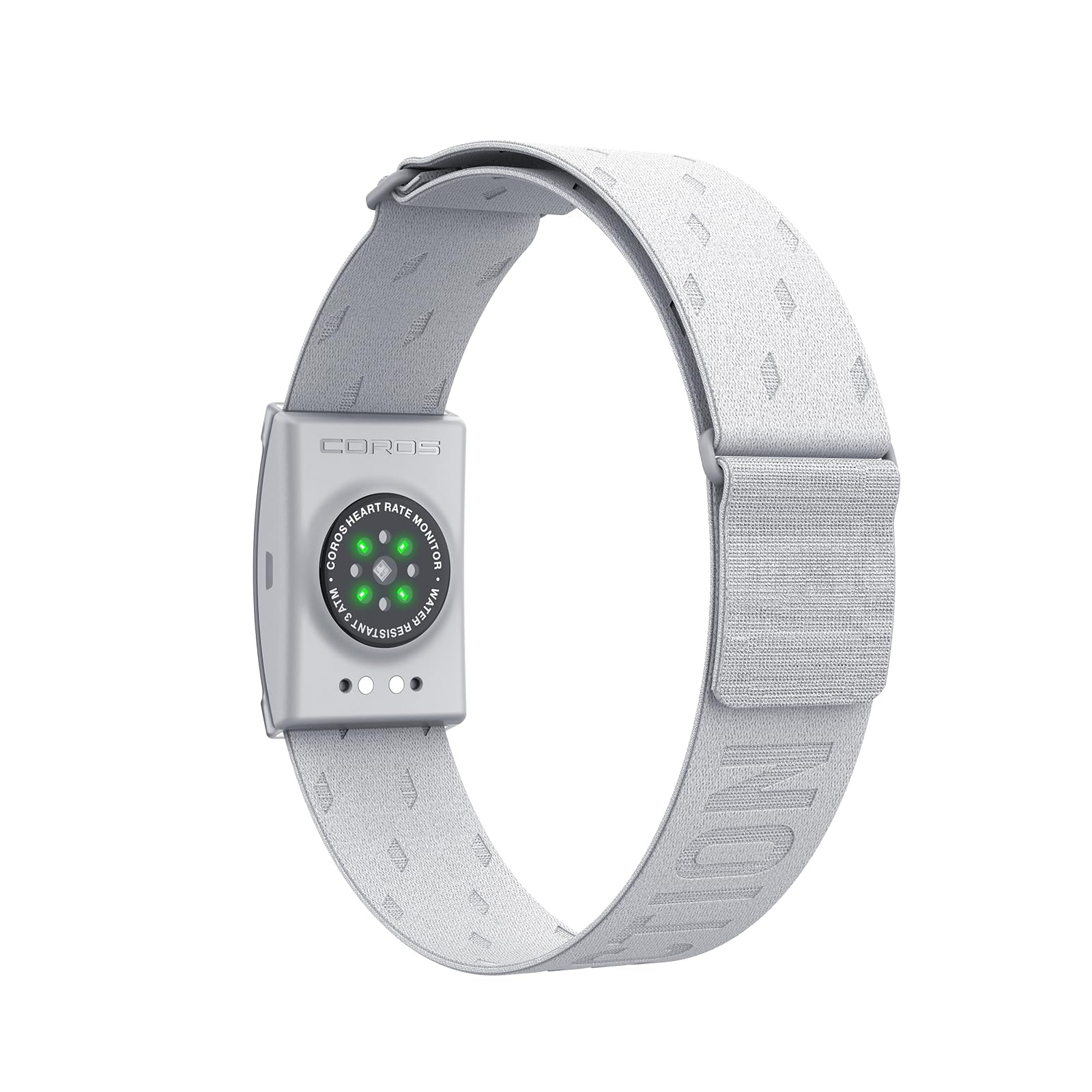
The COROS armband solves the two biggest complaints against optical heart rate monitors — forgetting to power it on and battery anxiety. Built-in wear detection automatically powers the sensor when you strap it on and shuts it down when removed, meaning zero interaction before a workout. The 38-hour operating time and 80-day standby are generous enough that even if you train two hours daily, you recharge less than once a month via the magnetic puck.
Sensor accuracy benefits from the armband’s placement on the bicep or forearm, away from wrist flexion that corrupts optical readings. The nylon band is soft and breathable, avoiding the sticky discomfort of silicone, and the textured inner surface grips securely without sliding even during heavy kettlebell swings or muddy trail runs. It pairs with up to three devices simultaneously over Bluetooth, including COROS watches, phones, and smart trainers, though it does not support ANT+ — a limitation if you use older Garmin or Wahoo hardware that lacks Bluetooth BLE.
The trade-off comes in data granularity. COROS designed this as a workout HR monitor, not a 24/7 lifestyle tracker. It records during activity but provides no continuous daily heart rate graphs, sleep staging, or step counting. If you want a device that also functions as a daily step counter or sleep tracker, the COROS armband is too narrow in scope. For serious athletes who only care about accurate workout heart rate, it is nearly flawless.
Why it’s great
- Auto wear-detection powers on/off without buttons
- 38-hour battery and 80-day standby
- Breathable fabric armband, no silicone irritation
Good to know
- No daily/24/7 heart rate tracking outside workouts
- Bluetooth only — no ANT+ compatibility
4. Scosche Rhythm+ 2.0 Armband

The Rhythm+ 2.0 is the only armband in this guide that offers both Bluetooth BLE and ANT+ simultaneously, making it the universal bridge between any device ecosystem — pair it with a Garmin watch via ANT+ while streaming to a phone app via Bluetooth without breaking either connection. Its optical sensor samples at a rate that captures HRV and RR-interval data, outputting raw R-R timestamps compatible with Morpheus Training, Welltory, and HRV4Training for recovery analysis.
The IP68 waterproof rating means the armband survives rain, sweat, and full submersion up to one meter for 30 minutes, so open-water swimmers and triathletes can wear it through a whole session. Battery life reaches 24 hours of continuous use, which typically spans a full week of daily training before needing a recharge. The silicone strap is lighter and less bulky than the COROS fabric band, though users with sensitive skin may prefer the breathable alternative.
Accuracy is excellent for steady-state cardio but lags slightly during high-intensity intervals compared to chest straps — expect a 2–3 second delay on rapid HR changes, which matters if you train by exact zone thresholds. Some users report occasional wild readings (e.g., 195 bpm during a moderate walk) that require recalibration or repositioning. The button is also stiff and harder to press mid-workout. Still, as a no-compromise universal armband, it uniquely supports the widest number of devices.
Why it’s great
- Simultaneous Bluetooth + ANT+ for universal pairing
- IP68 waterproof for swim training
- HRV/RRi data output for recovery apps
Good to know
- 2–3 second latency on interval HR changes
- No auto-power off; battery drains if left on
5. Bestinn Activity Fitness Tracker Watch

The Bestinn tracker converts a typical wrist-worn wearable into a high-resolution dashboard with its 1.58-inch always-on TFT display, offering over 250 watch faces and a customizable dial system that includes both classic analog and futuristic digital layouts. The always-on clock mode means you do not need to flick your wrist to see the time, a feature usually reserved for premium AMOLED smartwatches.
Health monitoring runs 24/7 across heart rate, blood oxygen, and blood pressure, with the Da Fit app storing trend data for all three metrics over daily, weekly, and monthly views. Sleep staging tracks light, deep, and awake time, presenting patterns that help adjust evening habits. The 120+ sport modes cover everything from kickboxing to rowing, and each session logs calorie burn, distance, and pace via the phone’s connected GPS for route mapping.
Battery life is improved over earlier Bestinn models — owners report charging every 5–7 days with always-on display activated. The magnetic charger clicks securely but requires careful cable alignment. The blood pressure monitor should be understood as a wellness indicator rather than a clinical instrument — some users find it inconsistent against a medical cuff. For an all-day lifestyle tracker with a vibrant display and deep health feature set at a mid-range price, this watch covers more ground than any armband or chest strap.
Why it’s great
- Always-on 1.58-inch TFT display with 250+ faces
- 120+ sport modes with connected GPS tracking
- Continuous heart rate, SpO2, and BP monitoring
Good to know
- Blood pressure readings vary from medical standards
- Magnetic charger cord alignment can be finicky
6. FITVII FINO 2 Slim Fitness Tracker

The FINO 2 is one of the slimmest wrist-worn trackers in the 40-millimeter class, with a profile thin enough to clear dress shirt cuffs and fit wrists under 140 mm. Its 1.45-inch TFT touch screen uses higher color saturation than typical budget panels, and the FitCloudPro app offers more than 89 watch face styles including user-uploaded photos for full customization.
Health features punch above the price tier with 24/7 heart rate, blood oxygen, sleep stage analysis, and blood pressure monitoring — the same sensor suite found on trackers costing twice as much. The sleep monitor records falling-asleep time, waking patterns, and light/deep sleep durations, displaying them in daily, weekly, and monthly graphs. An IP68 rating allows ocean swimming and showering without removing the device, and the 180 mAh battery holds charge for roughly five to seven days under mixed use.
The biggest caveat is blood pressure and SpO2 accuracy — multiple users report that both metrics are unreliable compared to dedicated medical devices, with blood pressure particularly prone to inconsistency based on sensor position on the wrist. The step counter also resets mid-day in some units, losing around 100 steps per reset. For the price, it is a capable daily activity tracker, but heart rate and sleep tracking should be considered directional rather than precise.
Why it’s great
- Ultra-slim design fits small wrists and under cuffs
- IP68 waterproof for ocean swimming
- 89+ watch faces with photo custom upload
Good to know
- Blood pressure and SpO2 accuracy is inconsistent
- Step counter can lose ~100 steps on reset
7. MorePro AIR2 Health Fitness Tracker
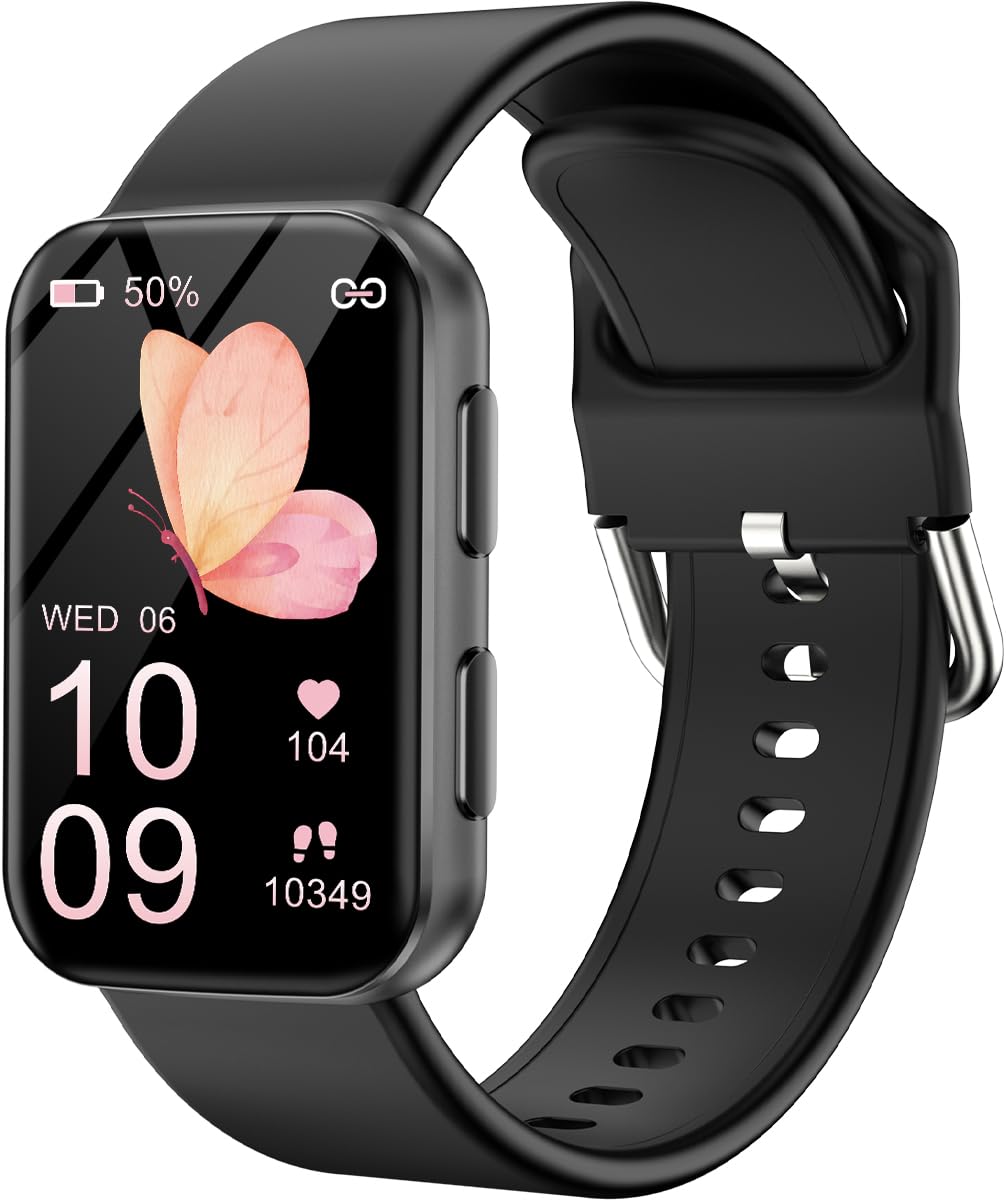
The MorePro AIR2 is an entry-level wearable that prioritizes ease of use and battery performance over raw sensor accuracy. Its Bluetooth LE 5.2 chip ensures stable pairing with Android 7 and iOS 13+ devices, and the 128 MB onboard storage buffers activity data before syncing to the app. The package includes two bands — one silicone and one nylon — letting users swap between sport-ready and casual looks without buying separate accessories.
Health tracking covers the full set: continuous heart rate, blood oxygen, blood pressure estimation, and sleep staging with awake, light, and deep phase breakdown. The 1.57-inch HD LCD screen is legible outdoors, and the seven-day battery life is consistent even with continuous heart rate monitoring enabled. Step tracking, distance, and calorie counts update in real time across 100+ sport modes, and the connected GPS uses your phone’s antenna to record route maps without draining the watch battery.
Accuracy falls off for metrics beyond heart rate and step count — blood oxygen and blood pressure are useful for spotting trends but should not be trusted for clinical decisions. Some users report sleep tracking starting only at midnight, missing early-sleep time if you go to bed before 12 AM. At this price point, the AIR2 delivers a polished software experience and robust build quality that outpaces generic no-name trackers, making it a solid entry point into the world of heart rate wearables.
Why it’s great
- Two included bands (silicone + nylon) for versatility
- Bluetooth LE 5.2 for stable, low-power connectivity
- Seven-day battery with continuous HR monitoring
Good to know
- SpO2 and BP are trend-only, not medically accurate
- Sleep tracking may miss pre-midnight sleep time
FAQ
Can an optical wrist tracker replace a chest strap for zone training?
What does HRV data from a heart rate monitor actually tell me?
Final Thoughts: The Verdict
For most users, the activity tracker that tracks heart rate winner is the Polar H10 because it delivers clinical-grade ECG accuracy, unmatched connectivity (Bluetooth + ANT+ + 5 kHz), and the only HRV data output that serious athletes can rely on for recovery analysis. If you want a comfortable armband with auto-wear detection, grab the COROS armband. And for all-day lifestyle tracking with a vibrant always-on display, nothing beats the Bestinn fitness tracker.