
Our readers keep the lights on and my morning glass full of iced black tea. As an Amazon Associate, I earn from qualifying purchases.
Specs are compiled from manufacturer listings and verified buyer reviews and can change over time — please confirm the key details on the product page before buying.
If you are here, you probably already know the one thing that matters most: you want a fitness tracker that actually stays alive longer than a weekend trip without needing its charging cable. Hunting for a wall plug mid-workout gets old fast. This guide picks only trackers that log steps, sleep, and heart rate for days or weeks per charge.
I’m Min — the founder and writer behind Gadgets Feed. This guide is built by comparing the manufacturers’ published specifications and the patterns across verified customer reviews, so you get each pick’s real strengths and trade-offs instead of marketing spin.
Every product here has a battery life of at least a week, and many blow well past that mark, giving you a practical, honest look at the best options in the activity tracker with long battery life category.
Our Picks at a Glance
How To Choose The Best Activity Tracker With Long Battery Life
A big battery number on the box isn’t the whole story. Key specs reveal real-world performance from your commute to a multi-day hike.
Battery Life Claims vs. Real-World Use
Manufacturers often list a “typical” battery life that assumes you are not using features like an always-on display, continuous GPS, or frequent heart-rate checks. If you use these features, expect battery life to fall below the headline number. Choose a battery 20-30% longer than your longest trip to build in a buffer.
Display Technology and Power Draw
A bright AMOLED screen is vivid in sunlight but drains more power than a MIP display. Some trackers like the Garmin Instinct series use a solar charging lens to top up the battery, which can extend your time between charges significantly if you spend time outdoors.
GPS and Sensor Load
Built-in GPS drains battery heavily. A tracker with multi-band GPS uses more power but is more accurate. Similarly, sensors that track SpO2 (blood oxygen levels) continuously will also shorten battery life. Many trackers let you toggle these on or off, so you can decide between maximum data and maximum endurance for a given day.
Quick Comparison
| Model | Best For | Battery Life | Display | GPS | Amazon |
|---|---|---|---|---|---|
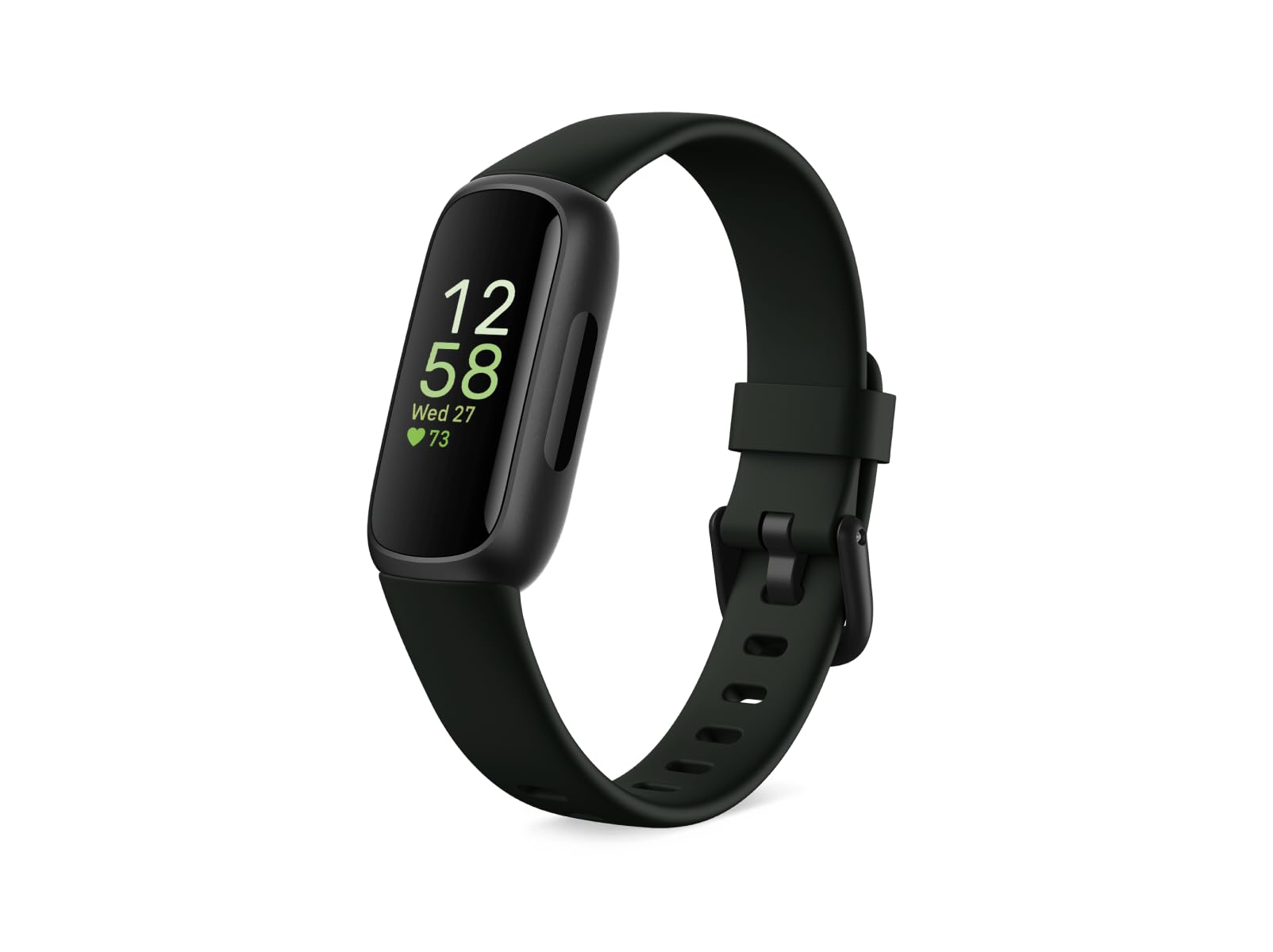
| Fitbit Inspire 3★ Best Overall | Budget-friendly & simple tracking | 10 days | Touch Display | No GPS | Amazon |
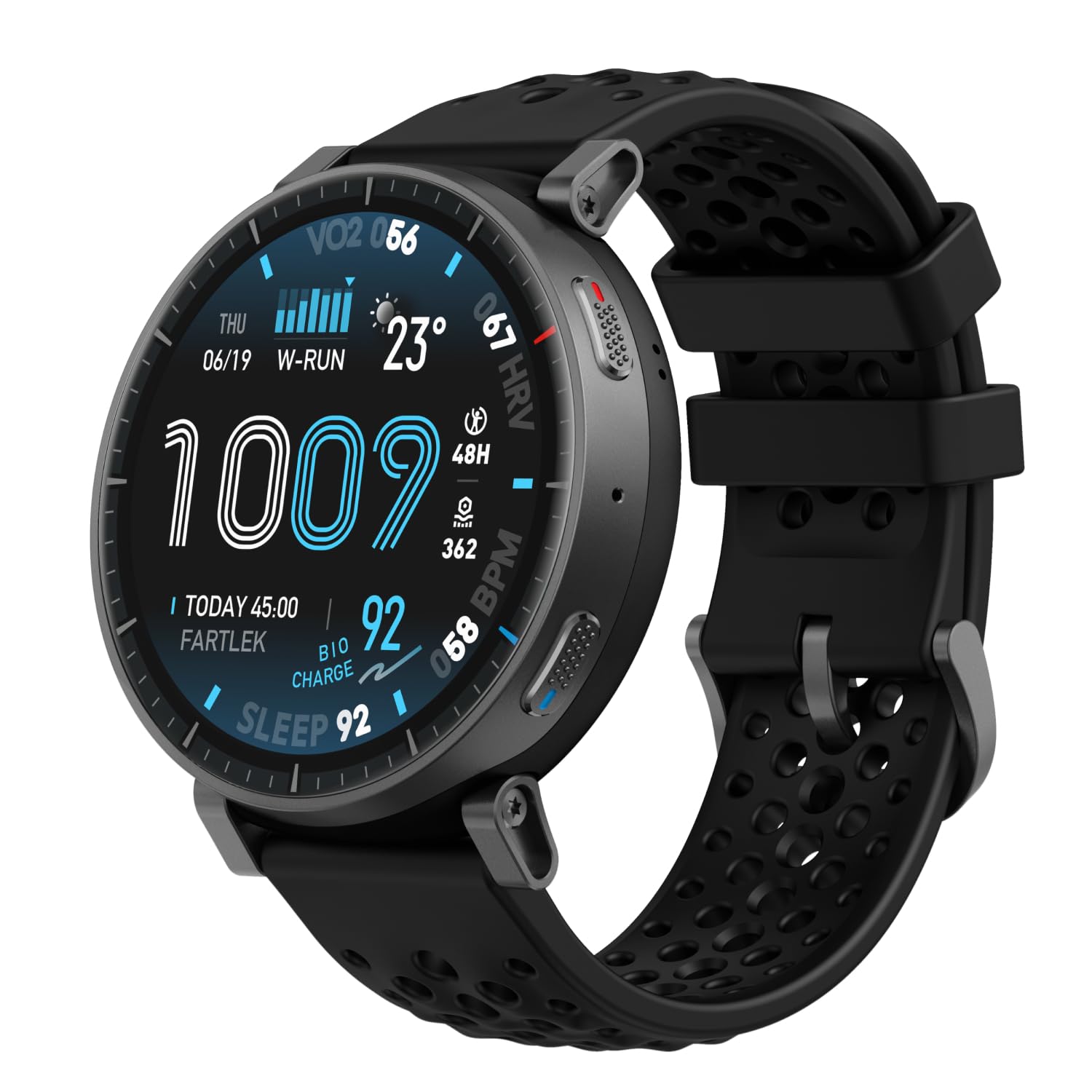
| Amazfit Active MaxAlso Great | All-around value & battery champ | 24 days | 1.5″ AMOLED | GPS | Amazon |
| Garmin Instinct 3 | Rugged outdoor use & solar | Unlimited (solar) | 0.9″ MIP Solar | Multi-band GPS | Amazon |
| Amazfit T-Rex 3 Pro | Adventure & premium build | 27 days | 1.5″ AMOLED | Dual-band GPS | Amazon |
| Garmin vívoactive 5 | Health & fitness daily driver | 11 days | AMOLED | GPS | Amazon |
| RENPHO Lynx Smart Ring | Discreet & sleep-focused tracking | 7 days | No Display | No GPS | Amazon |
| Victormont Smart Ring | Compact & no-subscription tracking | 7 days | No Display | No GPS | Amazon |
In‑Depth Reviews
1. Fitbit Inspire 3
Our pick — over 4★ from 24,500+ verified ratings; the strongest balance of quality and price.
A simple, affordable band that nails the basics of health tracking for over a week.
The Fitbit Inspire 3 proves you do not need a big touchscreen or a hefty price tag to get a solid week of tracking. It is a slim, comfortable band with a resin case and silicone strap that you can wear 24/7 without noticing it. Despite its size, it packs in features like a Daily Readiness Score, Active Zone Minutes, 24/7 heart rate, automatic exercise tracking for 40+ exercise modes, and a Stress Management Score.
Sleep tracking is a strong point here. It provides automatic sleep tracking, a daily Sleep Score, a smart wake vibrating alarm, and sleep mode that helps you improve your sleep quality. It also offers SpO2 monitoring, menstrual health tracking, and irregular heart rhythm notifications. One reviewer noted that the fit is very comfortable for sleeping, which is the key to getting accurate sleep data. It includes a 3-month trial of Google Health Premium, which open up deeper insights.
The small touch screen is not a full color AMOLED like the pricier options. There is no built-in GPS, so you need to carry your phone to track routes. The 10-day battery is good, but it will not survive a two-week vacation without a charge.
Where It Delivers Value
- Very comfortable for 24/7 wear, especially during sleep
- Excellent battery life of 10 days for the price
- Comprehensive health tracking with stress and sleep scores
Where It Falls Short
- No built-in GPS, so it relies on a connected phone
- Small screen is not as readable in bright sunlight as an AMOLED
Perfect for: The budget-conscious user who wants reliable step, sleep, and heart rate tracking without a lot of complexity.
pass on it if: You need a color display, built-in GPS, or a battery that lasts more than 10 days.
2. Amazfit Active Max Smart Watch
The smartwatch that gives you a month’s worth of tracking without hunting for a charger.
If you want the absolute best battery life without sacrificing a crisp, colorful screen, this is the one. The Amazfit Active Max delivers up to 24 days of battery life, meaning you can wear it for weeks before even thinking about its magnetic charging base. That endurance beats the Fitbit Inspire 3’s 10 days by a wide margin, so you are not tethered to a routine. It pairs that long life with a 1.5-inch AMOLED display that hits 3,000 nits of brightness, which makes it perfectly readable even under direct sunlight on a trail run.
Beyond the battery, this activity tracker is packed with features that make it a true companion. You get built-in GPS, 4GB of onboard storage for music and offline maps, and over 170 sport modes. The BioCharge energy monitoring score helps you decide when to push harder and when to rest, which is a feature more common on much pricier watches. Buyers report that the Zepp Coach running plans are surprisingly good at adapting to your performance, giving it a feel of a personal trainer on your wrist.
The catch is that the included charging base does not come with a USB-C cable, so you need to supply your own USB plug. Also, at 24 days, it is still shorter than the solar-powered options below if you are an ultra-light hiker. For the price, however, this blend of features and longevity is tough to top.
Why It Leads the Pack
- Exceptional 24-day battery life keeps you going for weeks
- Bright 1.5″ AMOLED display is clear in any light
- Includes offline maps, GPS, and 4GB of storage for music
The Trade-Offs
- Charging base does not include a USB-C cable
- Battery life drops if you use always-on display or continuous GPS
Best for: Anyone who wants a feature-rich smartwatch with excellent battery life and a top-tier screen without paying a premium.
Look elsewhere if: You need unlimited battery life through solar charging or a ruggedized chassis for extreme outdoor abuse.
3. Garmin Instinct 3 Solar

The watch built for endless adventures, powered by the sun itself.
If your adventures take you off the grid for weeks at a time, the Garmin Instinct 3 is the tracker you strap on and forget about. Its solar charging lens can deliver unlimited battery life in smartwatch mode (assuming you spend 3 hours a day outside in 50,000 lux conditions). That makes it fundamentally different from every other tracker here. It also features a metal-reinforced bezel and a fiber-reinforced polymer case that meets MIL-STD-810 for thermal and shock resistance, so a drop on a rock face is not the end of the world.
This is not just a tough shell. It has multi-band GPS with SatIQ technology (a system that automatically adjusts positioning to boost battery life without sacrificing accuracy). The built-in LED flashlight with variable intensities and strobe modes is a surprisingly useful tool for early morning runs or late-night camp setup. Reviewers consistently praise its ruggedness and the confidence that comes from never worrying about battery life, even on long treks. The 10 ATM water rating (meaning it can withstand pressure down to 100 meters) means you can swim or dive with it.
The trade-off for that incredible battery and durability is the display. It uses a 0.9-inch MIP (memory-in-pixel) display rather than a bright AMOLED, which is perfectly readable but less colorful. You also get a 28-day battery life without solar charging, which is still fantastic, but the solar feature is what makes it unique.
The Unstoppable Pros
- Unlimited battery life with solar charging in the right conditions
- Built to survive drops, water, and extreme temperatures
- Multi-band GPS and a built-in LED flashlight
Where It Compromises
- Display is a smaller, lower-resolution MIP screen, not AMOLED
- Requires daily outdoor exposure to achieve “unlimited” battery claim
Reach for this if: You are a serious hiker, climber, or adventurer who needs a tracker that can last through multi-day trips without a power source.
skip it if: You prefer a large, colorful touchscreen and spend most of your time indoors or in the gym.
4. Amazfit T-Rex 3 Pro
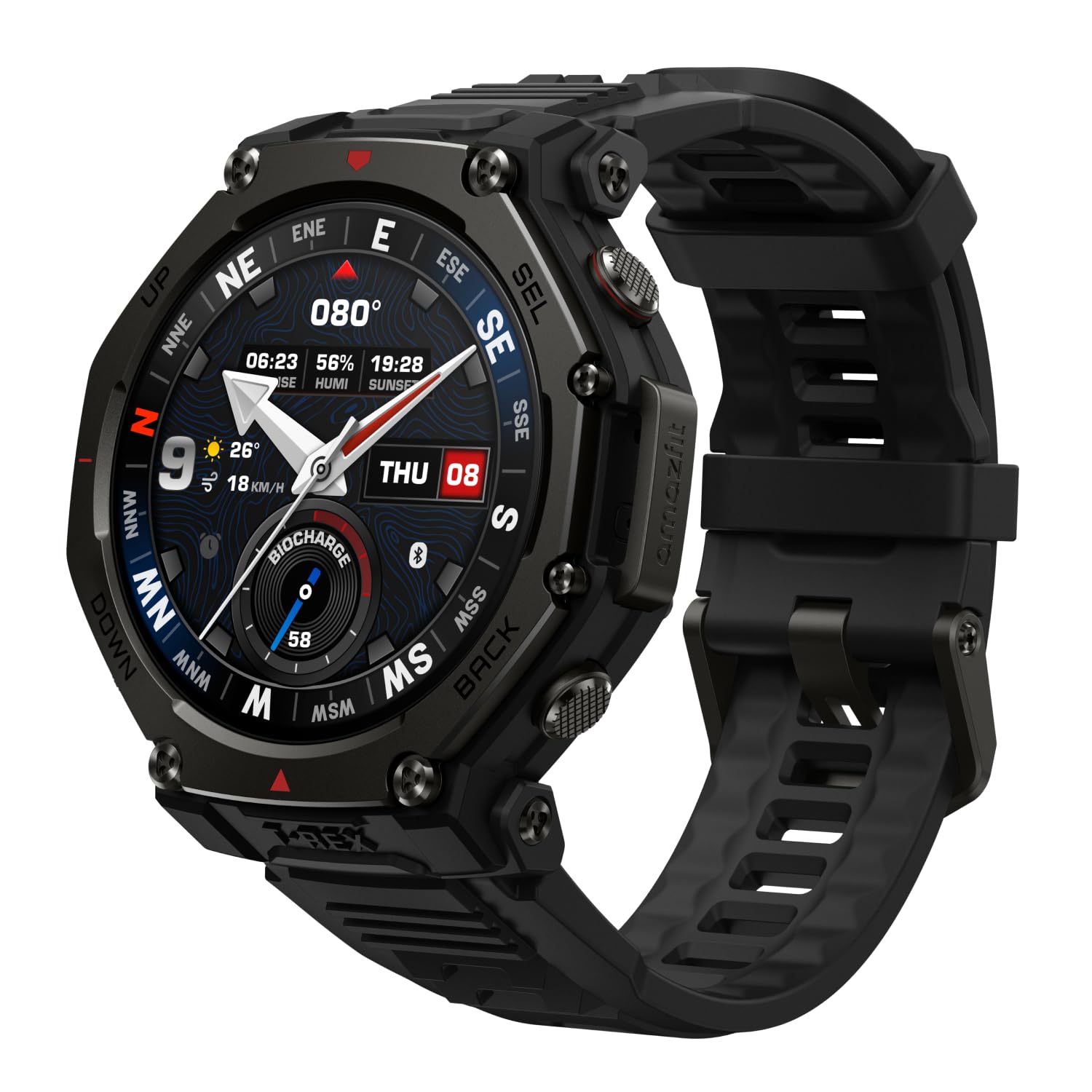
A rugged beast with a premium AMOLED screen that refuses to quit for almost a month.
The Amazfit T-Rex 3 Pro is the answer if you want a rugged outdoor watch but still want the gorgeous, bright screen of a modern smartwatch. It features a sapphire glass display over a 1.5-inch AMOLED panel that hits 3,000 nits, a titanium alloy bezel and buttons, and a 48mm case. It offers an impressive 27 days of battery life (the spec lists 27 days), which is slightly better than the Active Max and a huge leap from the Garmin vívoactive 5’s 11 days. It is water-rated to 10 ATM and certified for diving to 45 meters.
For navigation, it packs dual-band GPS support from six satellite systems, plus offline maps with POI search and auto rerouting. That is a serious capability for backcountry exploration. It also includes a built-in two-color LED flashlight (red for low-light preservation, white for clarity, plus an SOS mode). Reviewers highlight the durability of the sapphire crystal, noting that it resists scratches even after heavy use. With 180+ sport modes and HYROX training support, it covers everything from a casual swim to a competitive race.
The main downside is that its 27-day battery life is based on typical use, and activating continuous GPS tracking will drop that significantly. It is also a large watch (48mm), so it might feel bulky on smaller wrists. The charging time is listed at 3 hours, which is a bit longer than some competitors.
The Heavy Hitters
- Sapphire glass and titanium build offer top-tier durability
- Long 27-day battery life with a brilliant AMOLED display
- Advanced dual-band GPS and offline navigation features
Things to Consider
- Large 48mm case may not suit all wrist sizes
- Charges slowly at 3 hours compared to some rivals
Grab it for: The best blend of a premium, scratch-resistant AMOLED screen, rugged construction, and long battery life for outdoor activities.
Pass if: You need unlimited solar charging or prefer a lighter, smaller watch for everyday wear.
5. Garmin vívoactive 5

A polished daily driver that turns your health data into actionable insights.
Do not let the 11-day battery life fool you—the Garmin vívoactive 5 is a masterclass in making every milliamp count. It offers a bright, colorful AMOLED display and a comprehensive suite of health metrics that go far beyond steps. You get Body Battery energy monitoring, a personalized sleep score with HRV status, stress tracking, and a morning report that summarizes your readiness for the day. It also features automatic nap detection, which logs your nap length and tells you how it affects your energy levels.
This tracker is built for varied fitness, with over 30 built-in sports apps including walking, running, cycling, HIIT, swimming, and golf. A standout feature is the wheelchair mode, which tracks pushes instead of steps, and includes strength, cardio, and yoga workouts. The Garmin Coach provides free adaptive training plans for running, and you can download music from Spotify, Amazon Music, or Deezer directly to the watch for phone-free listening. Owners mention that the Garmin Connect app gives them a level of personalization and data depth that other apps often miss.
The 11-day battery life is a solid week and a half, but it falls short of the 24-27 day champions in this list. If you use the always-on display mode, that drops to 5 days, which is the biggest trade-off. It is also not as rugged as the Instinct 3 or T-Rex 3 Pro, so it is better suited for the gym and daily life than a mountain expedition.
Why It Shines
- Excellent health monitoring with Body Battery and sleep coaching
- Bright AMOLED display and music storage for on-the-go listening
- Inclusive features like wheelchair mode and nap tracking
The Limitations
- Battery life drops to 5 days with always-on display
- Not as durable as rugged outdoor-focused alternatives
A strong pick for: Anyone who prioritizes deep health analytics and sleep tracking over extreme battery endurance.
Avoid if: You need more than 11 days of battery life, especially with GPS use.
6. RENPHO Lynx Smart Ring

A sleek titanium ring that tracks your sleep and activity, powered by a clever charging case.
If a wristband is not your style, the RENPHO Lynx Smart Ring offers a discreet alternative that still delivers a 7-day battery life. It is crafted from a titanium alloy with a PC resin interior, and it is 5ATM waterproof, so you can wear it while swimming or hiking. The real convenience comes from the included charging case, which doubles as on-the-go power storage. You get a full week of tracking from the ring, and the case gives you a full extra charge when you are out, so you never arrive at a hotel with a dead ring.
This smart ring tracks your sleep stages, heart rate, blood oxygen (SpO2), stress levels, steps, distance, and calories burned. It connects to the Renpho Health App without any subscription fees, and it syncs with Apple Health and Google Health Connect. Customers note the sleep tracking data matches what they see from more expensive ring trackers, making it a great value. It is an HSA/FSA eligible device, which is a nice bonus for some buyers.
The 7-day battery life is the baseline for this list, and while the charging case compensates well, you will need to pop it on the charger every week. The ring’s wider and thicker ergonomic profile might take a few days to get used to, especially if you are new to wearing rings. Also, it lacks a display, so you check your stats on your phone.
What Makes It Smart
- Includes a charging case for extra battery on the go
- No app subscription fees for accessing your data
- 5ATM waterproof and durable titanium build
The Ring’s Reality
- 7-day battery is shorter than most smartwatches here
- Requires a few days to get used to the feel on your finger
A good match for: Those who prefer a minimalist, non-wrist wearable and want a simple, subscription-free health tracker.
Not for you if: You want a visible display, GPS, or a battery that lasts more than 7 days without a case.
7. Victormont Smart Ring Pro
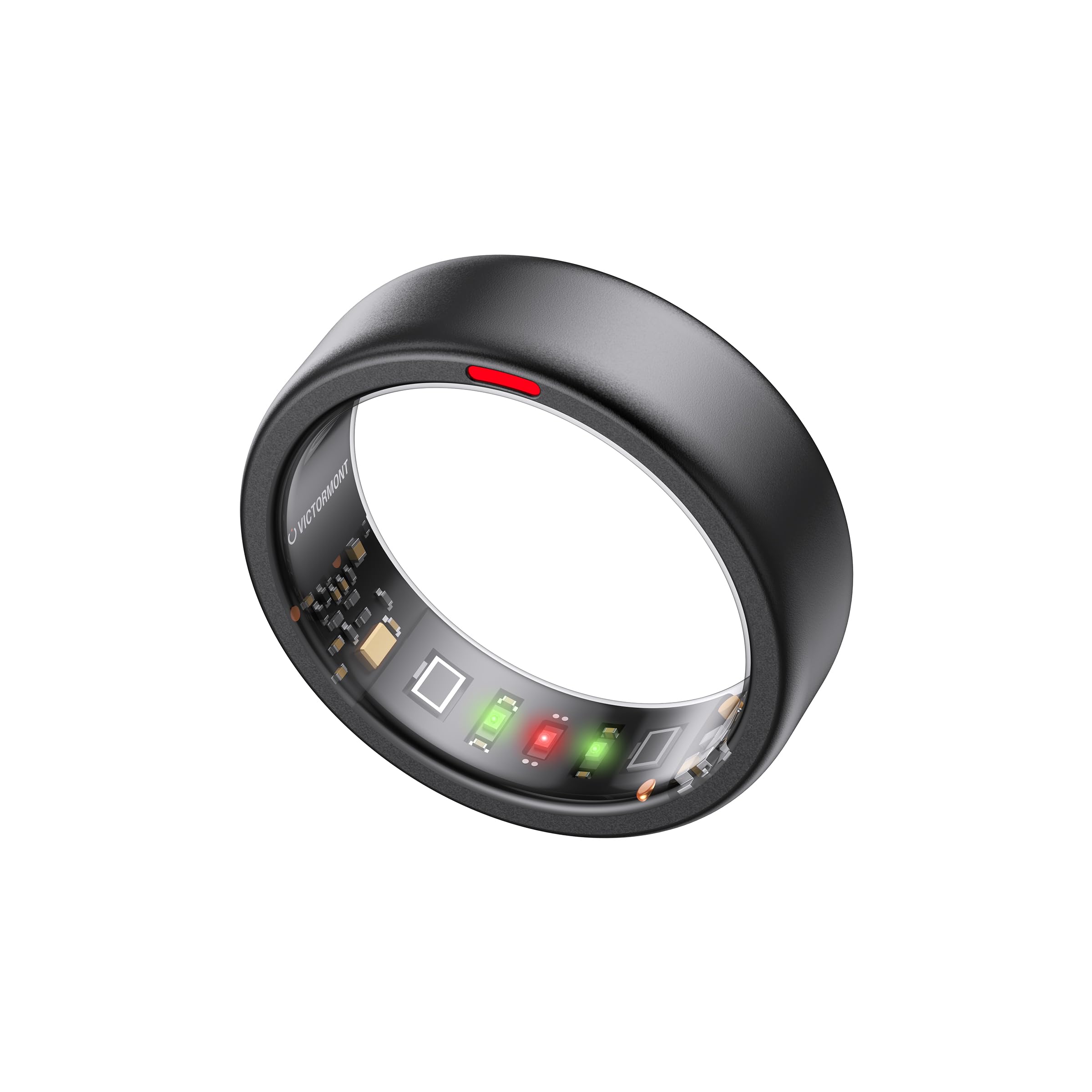
A solid, affordable ring that gives you the core metrics without a recurring fee.
The Victormont Smart Ring Pro is a straightforward, no-frills entry into the smart ring space. It offers a 7-day battery life, which matches the RENPHO Lynx, but its selling point is a clean, subscription-free app experience. You get tracking for sleep, heart rate, activity, SpO2, and stress trends without any hidden costs. The ring is made from durable titanium alloy and weighs about 3 grams, making it almost unnoticeable on your finger after a short adjustment period.
It is IP68 water resistant, which means it can handle hand washing, workouts, and light water exposure, though it is less rugged in water than the RENPHO’s 5ATM rating. The ring syncs periodically via Bluetooth to save power, and it comes with a charging dock. Buyers mention that the Victormont app is intuitive and provides a clear daily “readiness” score, making it easy to understand your body’s status for the day. It is also HSA/FSA eligible.
A potential downside is that the ring has a slightly thicker and wider profile than a traditional wedding band, and the manufacturer recommends using a sizing kit to get the right fit. The 7-day battery is the minimum for this guide, and while it lasts a week, you will need to remember to charge it on a regular schedule. Unlike the RENPHO, it does not come with a charging case, so you are reliant on the dock.
The Core Strengths
- No subscription fees for any health data or features
- Lightweight titanium build (approx. 3g) for comfortable 24/7 wear
- HSA/FSA eligible for qualified buyers
The Trade-Offs
- No charging case, so you rely on the included dock
- Battery life is on the shorter end at a flat 7 days
Reach for it if: You want a simple, affordable smart ring with no ongoing subscriptions and a focus on basic sleep and activity data.
Choose something else if: You need a charging case for travel or require a longer battery life than a single week.
Understanding the Specs
Battery Life
This is the number you care about most, but it is rarely a single fixed value. The “typical” battery life assumes a certain use pattern—like moderate notifications, no always-on display, and limited GPS. If you plan to use GPS tracking for long hikes or leave the screen on always, expect your battery life to drop by 30-50% or more. Look for a tracker that gives you a buffer of a few extra days beyond your longest trip to ensure you never end up with a dead device.
GPS and Sensor Suite
Built-in GPS is a standout for runners, cyclists, and hikers because it tracks your route without needing your phone. More advanced trackers use multi-band GPS or dual-band GPS to lock onto satellites faster and maintain accuracy under tree cover or between tall buildings. Sensors like a heart rate monitor, SpO2 (blood oxygen) sensor, and accelerometer all draw power. Many trackers let you turn off continuous monitoring to save battery, so you can choose between data depth and endurance.
FAQ
How do I get the longest battery life from my activity tracker?
Is a solar-powered tracker worth the extra cost?
How does a smart ring compare to a wrist-based tracker for battery life?
Will using GPS continuously kill my battery faster?
What does the “always-on display” battery impact look like?
Can I wear a tracker in the shower or while swimming?
What is the difference between AMOLED and MIP displays for battery life?
Will my tracker still track heart rate and sleep without a subscription?
How do I choose the right size for a smart ring?
Does a bigger battery always mean a better tracker?
Final Thoughts: The Verdict
Across the board, the activity tracker with long battery life winner is the Amazfit Active Max because it offers a class-leading 24-day battery with a brilliant AMOLED screen and a full feature set at a very competitive price. If you want unlimited battery life and ultimate durability for the trail, grab the Garmin Instinct 3 Solar. And for a premium, rugged option with a sapphire screen that matches the Active Max’s battery life, the Amazfit T-Rex 3 Pro is a fantastic choice.
How We Picked
We do not accept paid placement. Every pick is matched to a real buyer and a real use-case; we do not hands-on test units.
Sources & Methodology
Specifications: manufacturer listings and product documentation. Review insights: verified customer reviews, as of July 2026. Pricing: not shown on this page (it changes often); check the current price via the retailer link.
As an Amazon Associate, Gadgets Feed earns from qualifying purchases. This does not affect which products we feature.