
Our readers keep the lights on and my morning glass full of iced black tea. As an Amazon Associate, I earn from qualifying purchases.
Specs are compiled from manufacturer listings and verified buyer reviews and can change over time — please confirm the key details on the product page before buying.
Gas that has been sitting in a lawnmower, boat, or snow blower for months can turn into a sticky varnish that clogs carburetors and stops engines from starting at all. The right additive breaks down that old residue, rehydrates stale fuel, and prevents fresh gas from going bad during storage. This guide compares the top seven treatments that actually revive old gas and keep engines reliable through the off-season.
I’m Min — the founder and writer behind Gadgets Feed. This guide is built by comparing the manufacturers’ published specifications and the patterns across verified customer reviews, so you get each pick’s real strengths and trade-offs instead of marketing spin.
If you are storing a boat for winter or reviving a generator that has not run in a year, finding the right additive for old gas depends on understanding stabilizer chemistry, treatment ratios, and which formula tackles varnish versus water contamination for your specific engine type.
Quick Picks
- Ethanol Shield Fuel Stabilizer 1 Gallon — Best Value for Volume
- Sea Foam Motor Treatment 16 oz, Pack of 3 — Best Overall
- Ethanol Shield Fuel Stabilizer 24 oz (2 Pack) — Water Fighter
- Star Brite PRO Star Gasoline Stabilizer — Seasonal Shortcut
- Quicksilver Quickstor Fuel Treatment — Marine Grade
- Chevron Techron Protection Plus Powersports — Small Engine Specialist
- K-100 Gas Treatment W/Revitalizer — Rescue Bottle
How To Choose The Best Additive For Old Gas
Not all gas treatments work the same way. Some products are designed to clean deposits from fuel that is already stale, while others prevent fresh gas from degrading in the first place. Understanding the key differences helps you pick the right formula for your exact situation.
Stabilizer vs. Cleaner — Know the Difference
A fuel stabilizer slows the chemical breakdown of gasoline so it stays fresh during storage. A fuel system cleaner dissolves existing gum, varnish, and carbon deposits that have already formed in the carburetor or injectors. Many top products combine both functions, but if you are treating gas that has already turned thick and sticky, you need a cleaner that actively dissolves varnish rather than just a plain stabilizer.
Water Handling and Ethanol Fuel
Modern gasoline with ethanol attracts moisture from the air, and that water separates from the fuel, settles at the bottom of the tank, and can cause corrosion or zero start situations. The best additives for old gas either absorb that water so it burns safely or use a phase separation inhibitor to keep the fuel and ethanol blended together. If you own boat engines or small engines stored in humid conditions, this feature matters more than anything else.
Treatment Ratio and Bottle Size
Every product has a specific amount you must add per gallon. Some formulas treat fuel at a ratio of 1 ounce per 5 gallons, which stretches a single bottle across several tanks. Others require higher concentrations. Check how much fuel you typically store, then pick a bottle size and a treatment ratio that covers your needs without wasteful overuse.
Quick Comparison
| Model | Best For | Stabilizer Duration | Bottle Size | Item Weight | Amazon |
|---|---|---|---|---|---|
| Ethanol Shield (1 Gal) | Mass storage up to 3 years | Up to 3 years | 128 oz | 8 pounds | $73.99Amazon |
| Sea Foam Motor Treatment (3 pk) | Multi-engine fuel & oil cleaning | Up to 2 years | 16 oz each | 1 pound | $29.99Amazon |
| Ethanol Shield (24 oz 2 pk) | Water removal & ethanol protection | Not specified | 24 oz each | 3.16 pounds | $38.99Amazon |
| Star Brite PRO Star | One-step stabilization & fogging | Up to 1 year | 12 oz | 0.98 Pounds | $22.92Amazon |
| Quicksilver Quickstor | Marine OEM stabilizer | Up to two years | 12 OZ | 0.3 Kilograms | $15.99$17.99Amazon |
| Chevron Techron Protection Plus | Small engine cleaning & stabilization | Up to 2 years | 10 oz | 10.5 ounces | $12.75Amazon |
| K-100 Gas Treatment | Water removal & gum dissolving | Not specified | 8 oz | 7.8 ounces | $12.21Amazon |
In‑Depth Reviews
1. Ethanol Shield Fuel Stabilizer 1 Gallon

This 128-ounce jug keeps fuel fresh for up to 3 years across a fleet of machines.
This gallon-sized bottle holds 128 ounces of stabilizer, and at that scale it is built for people who own multiple engines or store large fuel supplies. It treats a significant volume of gas per bottle, which makes it the most economical pick if you are winterizing several machines at once. The manufacturer says the formula stabilizes fuel for up to 3 years, so you can fill a tank at the end of the season and not worry about it until the next project.
Buyers report that you can treat ethanol-blended gas, which easily mixes with water and makes engines run poorly. This product works in all 2 and 4-cycle engines (2-stroke and 4-stroke, meaning both small hand-held and larger mower engines) and prevents water issues while conditioning rubber and plastic components. Reviewers also note that a zero turn mower and a motorcycle both started immediately after winter storage with no unusual exhaust odor.
Compared to the 24-ounce two-pack from the same brand, this gallon jug offers a much lower cost per ounce without sacrificing the same water-fighting and corrosion-preventing chemistry. The trade-off is you need a funnel and steady hand to pour from the big bottle — not as convenient as a smaller squeeze bottle for single-tank use.
Why you might buy it
- Huge 128 oz container stretches across many engines
- Stabilizes fuel for up to 3 years of storage
- Works in all 2 and 4-cycle engines
What to consider
- Large jug is harder to pour for small single-tank jobs
- Not a fast-acting varnish cleaner for fuel that is already fully stale
Reach for this if: you store multiple machines or large fuel cans each season and want one bottle to cover everything.
Look elsewhere if: you only have one small engine and prefer a smaller, easier-to-pour bottle.
2. Sea Foam Motor Treatment 16 oz, Pack of 3

One formula that cleans fuel injectors, treats your oil, and stabilizes gas for up to 2 years.
Sea Foam is not just a fuel stabilizer for old gas — it also cleans fuel injectors and carburetor restrictions while it treats the fuel. The maker says it keeps gas or diesel fresh for up to 2 years, so it works as both a reviver for stale fuel and a preventive stabilizer for long-term storage. The three-pack gives you 48 ounces total, which is a solid value for households with a car, a lawnmower, and a generator.
Owners mention that their mechanic highly recommended it, and one reviewer noted their 2015 Ford F-150 with 96,000 miles runs very smooth after regular treatment. Another owner noted they use it for lawn equipment and outdoor tools, and it keeps them running great. Because it also works as an oil treatment, you can pour some into the crankcase to clean sludge and deposits, not just the fuel system.
Sea Foam is bulkier than a single 10-ounce Chevron Techron bottle at 1 pound per pack compared to 10.5 ounces, but it covers more use cases — fuel system, oil, and stabilizer all in one can. That three-role versatility is why it tops this list.
The three-role advantage: cleans your fuel system, treats your oil, and stabilizes gas for up to 2 years in a single formula.
Pick this if: you want one product that handles cleaning old gas, stabilizing fresh gas, and maintaining your oil system across multiple engines.
The only catch: the three-pack costs more upfront than a single smaller bottle, so it is overkill if you just need to stabilize one tank of gas.
3. Ethanol Shield Fuel Stabilizer 24 oz (2 Pack)

A phase separation inhibitor (a chemical that stops ethanol and water from separating from the gas) so water burns instead of rusting your tank.
Ethanol Shield targets the specific problem of water contamination in ethanol-blended gasoline. It includes a phase separation inhibitor that keeps ethanol and fuel from separating, and it also helps bond 2-cycle oil (oil for 2-stroke engines) to the gasoline-ethanol mix. Reviewers report it works even when added to gas that already has water in it — one buyer mentioned it saved an old power washer and a snow blower that would not start before the treatment.
Customers note that the product was recommended by “Chickanic,” a popular small-engine YouTuber, and it revived a 372 clone chainsaw that had year-old 25:1 fuel (a 25:1 fuel-to-oil ratio). The engine went from needing 10 to 12 pulls to starting in just 4 pulls after treatment. Another reviewer in humid East Texas uses it in a seldom-driven truck to burn off water and prevent rust.
At 3.16 pounds for the two-pack, this is noticeably heavier than the Chevron Techron bottle at 10.5 ounces, but the extra weight comes with more water-fighting chemistry per bottle. If your old gas smells like varnish but also has visible water droplets, this is the formula to grab.
What stands out
- Phase separation inhibitor stops ethanol from separating
- Bonds 2-cycle oil to ethanol-blended gas
- Reviewers report reviving engines with year-old fuel
Watch out for
- Two 24 oz bottles are heavy and take up more shelf space
- Not rated for a specific stabilizer duration in the specs
Stick with this if: ethanol fuel in your area is known to attract water, or you store equipment in a humid garage.
Pass if: you only use ethanol-free gas and do not struggle with water in the tank.
4. Star Brite PRO Star Gasoline Stabilizer
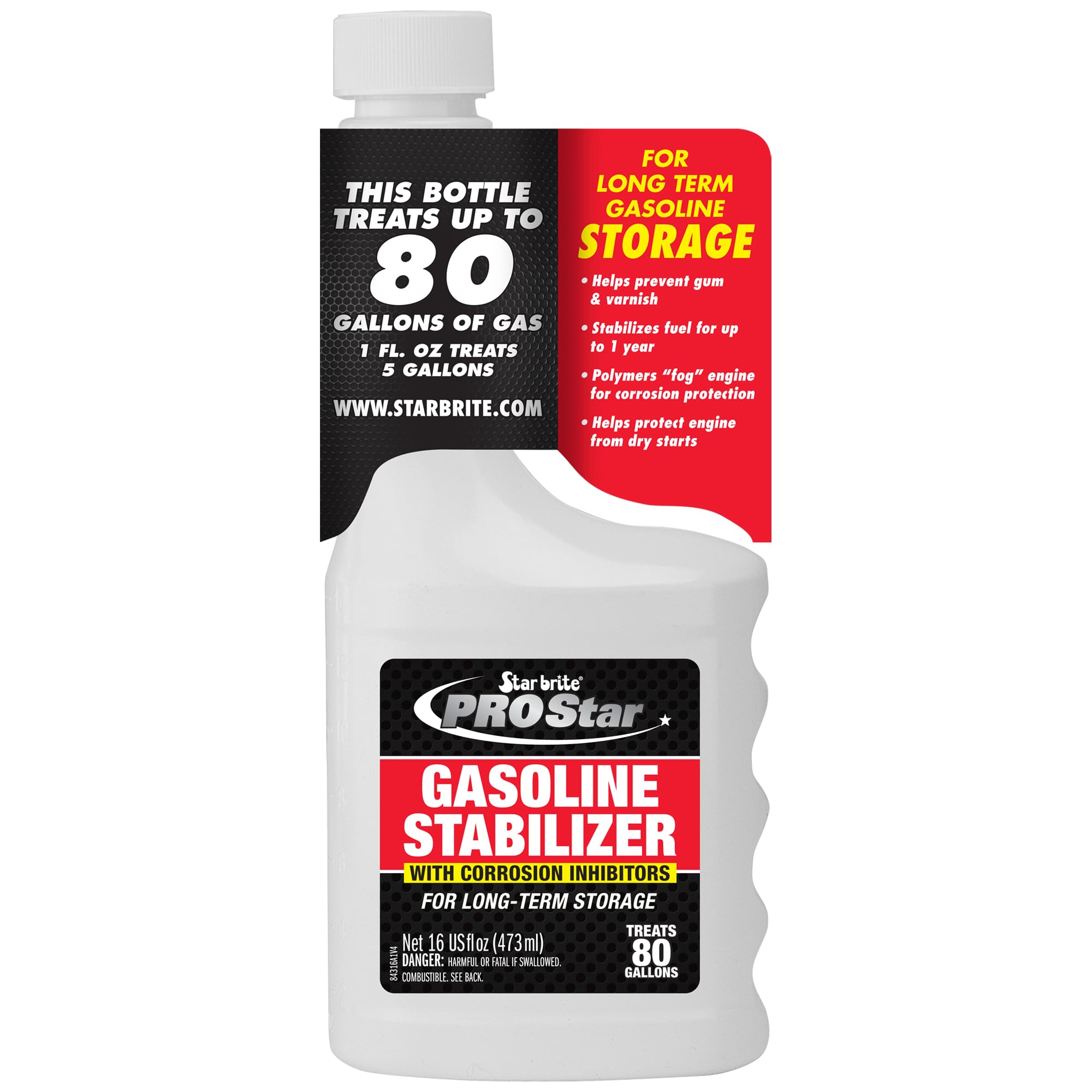
One 12-ounce bottle that stabilizes fuel and fog-protects the engine internals in a single step.
Most stabilizers only treat the gas itself. Star Brite PRO Star combines fuel stabilization with fogging protection (a process that coats the inside of the engine cylinder with oil vapor to prevent rust during months of sitting). Add 1 oz per 5 gallons of fuel, fill the tank, and run the engine for 10 minutes, and you have stabilized the gas and fogged the engine in a single step. The maker says it keeps gas fresh for up to 1 year.
Reviewers point out using this product to winterize boats, golf carts, pressure washers, and lawn mowers. One owner reported they have used it for 10 years and never had a fuel-related issue. Another called it the best stabilizer they have ever used, noting it saves time because you do not need to remove the spark plug for traditional fogging.
This formula works with ethanol blends like E-10 (gasoline with up to 10% ethanol). At 0.98 pounds, it is almost identical in weight to the Sea Foam three-pack (1 pound), but each bottle is a smaller 12 oz size designed for a single season, not bulk treatment.
Two steps in one: stabilizes the fuel and fog-protects the cylinder, so you store the engine in one quick procedure.
Reach for this if: winterizing boats, generators, or mowers and you want the cylinder fogging included without extra work.
skip it if: you need a cleaner for gas that is already varnished — this is a stabilizer, not a varnish dissolver.
5. Quicksilver Quickstor Fuel Treatment and Stabilizer

The Mercury Marine-engineered stabilizer meets OEM specs (original equipment manufacturer standards) so boat owners can store with warranty confidence.
This product meets Mercury Marine original equipment manufacturer specifications, so it is the exact formula that Mercury recommends for their outboard and inboard engines. It stabilizes fuel for up to two years at a ratio of 1 oz treats 5 gallons, and it prevents both regular and ethanol-blended gas from breaking down and oxidizing (reacting with oxygen and turning into gum). Quicksilver designed it for long-term storage of boats, generators, lawnmowers, and other powersports equipment.
Shoppers say that they use all three Quicksilver steps on every boat fill-up and have never had an issue. Another reviewer says it is the best fuel stabilizer available for boats and that they use it every year when winterizing their vessel. One owner specifically notes you should make sure you have fresh gasoline in the tank when adding the stabilizer for best results.
Unlike the Star Brite PRO Star, this formula does not include fogging protection — it focuses purely on fuel stabilization. If you store a boat with a Mercury engine and want to stick with OEM-recommended chemistry, this is the straightforward choice.
Why boat owners choose it
- Meets Mercury Marine OEM specs for warranty-friendly storage
- Stabilizes fuel for up to two years
- Fights oxidation in both regular and ethanol-blended gas
What it lacks
- No built-in fogging protection for engine internals
- Concentrated 1 oz per 5 gallons means small bottle runs out fast on big tanks
Choose this for: Mercury or Quicksilver marine engines where OEM-spec chemistry gives you confidence during layup.
Switch if: you want the convenience of a stabilizer and a fogger in one bottle, which the Star Brite offers instead.
6. Chevron Techron Protection Plus Powersports and Small Engine Fuel System Treatment

An alcohol-free and emulsifier-free formula that cleans carbon deposits without attracting extra moisture.
Chevron Techron Protection Plus is a unique formula because it is alcohol-free and emulsifier-free, which means it does not contribute to water uptake in the fuel. That is a big deal for small engines and powersports equipment that sit for months between uses. The maker states it stabilizes fuel up to 2 years so you can store with confidence, and it also cleans carbon deposits, dissolves gum and varnish buildup, and helps prevent new deposit formation.
Buyers report using it in a 2008 Hayabusa 1340cc for preventive maintenance, and another owner said they use it in all of their equipment and have never had a fuel-related issue, even after equipment sits for extended time. One customer observed it frees stuck top rings and cleans carbon deposits on pistons, which is the kind of deep-cleaning action you want when reviving gas that has turned to varnish.
At 10.5 ounces, this bottle is lighter than the K-100 treatment (7.8 ounces) but packs more cleaning chemistry per ounce because of its Techron detergent base. The alcohol-free design separates it from many ethanol-focused competitors.
Why alcohol-free matters: alcohol-based additives can pull extra moisture into the tank, so this formula keeps water out while still cleaning gum and varnish.
Best for: motorcycle, ATV, snowmobile, and lawn equipment owners who want a non-water-attracting stabilizer that also deep-cleans deposits.
Note: if you need to remove existing water from a fuel tank, pick the K-100 or Ethanol Shield instead.
7. K-100 Gas Treatment W/Revitalizer Stabilizer/Octane Booster 8oz

The 8-ounce bottle that eliminates water and dissolves gum so dead engines can fire up again.
K-100 is famous among small-engine owners for its ability to start engines that absolutely will not fire. The formula eliminates water and water-related problems, dissolves gums and varnishes, and revitalizes stale fuel for extended storage. One buyer summed it up perfectly: “Countless times- engine won’t start, pour in some k100 and boom fires up…phase separation in ethanol based fuel mixed with water in fuel is a deadly combination. Use k100- problems solved.”
Buyers also report that a Honda dealership recommended this product for an E 2000 inverter generator, and it worked well clearing up the carburetor. Another reviewer uses it for marine engines and says it absorbs water in the fuel and makes it burn with no bad effects like you get from alcohol. At 7.8 ounces, it is the smallest bottle in this lineup, but the concentrated cleaning action means a little goes a long way.
Compared to the Chevron Techron at 10.5 ounces, K-100 is lighter and smaller, but its water-absorbing ability makes it the better choice when you suspect water contamination is the root cause of the no-start situation.
What it does best
- Eliminates water in ethanol fuel so the engine can actually burn it
- Dissolves gums and varnishes that clog carburetors
- Burns cleanly with no ash deposits
Limitations
- Smallest bottle at 8 oz — runs out fast if you have many engines
- No specific stabilizer duration listed in the specs
Grab this if: your engine has been sitting for months with water-contaminated fuel and you need a single-shot rescue treatment.
Another option: for longer-term stable storage of clean fuel, the Sea Foam or Quicksilver offers a known duration guarantee.
Understanding the Specs
Stabilizer Duration
This is the length of time the manufacturer says the additive will keep fuel from degrading. Durations range from up to 1 year (Star Brite PRO Star) to up to 3 years (Ethanol Shield 1 Gallon). If you store equipment for a full off-season, look for at least a 2-year guarantee so you do not have to retreat the tank mid-storage.
Treatment Ratio
Each product tells you how many ounces to add per gallon of fuel. For example, Quicksilver Quickstor and Star Brite both work at 1 oz per 5 gallons, which means a 12-ounce bottle treats 60 gallons of gas. Higher ratios stretch the bottle further, but some formulas require more product per gallon to achieve their cleaning effect.
FAQ
Can I use an additive to fix gas that has already turned into varnish?
Does ethanol-blended gas need a different additive than ethanol-free gas?
How long does treated old gas stay usable?
Will a fuel additive remove water from the gas tank?
How much additive do I need per gallon of old gas?
Can I use stabilizer in a generator that I run every month?
Is there a difference between an octane booster and a fuel stabilizer?
Can I mix different brands of fuel additives together?
Final Thoughts: The Verdict
For the majority of shoppers, the additive for old gas winner is the Sea Foam Motor Treatment three-pack because it cleans the fuel system, treats the oil, and stabilizes gas for up to two years in one formula, making it the most versatile option for households with multiple engines. If you want to combine fuel stabilization with engine fogging in a single step for winter storage, grab the Star Brite PRO Star. And for tackling water-contaminated ethanol fuel that has already killed an engine, the standout is the K-100 Gas Treatment.
How We Picked
We do not accept paid placement. Every pick is matched to a real buyer and a real use-case; we do not hands-on test units.
Sources & Methodology
Specifications: manufacturer listings and product documentation. Review insights: verified customer reviews, as of July 2026. Pricing: not shown on this page (it changes often); check the current price via the retailer link.
As an Amazon Associate, Gadgets Feed earns from qualifying purchases. This does not affect which products we feature.
Related Guides
Product prices and availability are accurate as of the date/time indicated and are subject to change. Any price and availability information displayed on Amazon at the time of purchase will apply to the purchase of this product. As an Amazon Associate I earn from qualifying purchases.
CERTAIN CONTENT THAT APPEARS ON THIS SITE COMES FROM AMAZON. THIS CONTENT IS PROVIDED "AS IS" AND IS SUBJECT TO CHANGE OR REMOVAL AT ANY TIME.
Amazon and the Amazon logo are trademarks of Amazon.com, Inc. or its affiliates.