
Our readers keep the lights on and my morning glass full of iced black tea. As an Amazon Associate, I earn from qualifying purchases.
Specs are compiled from manufacturer listings and verified buyer reviews and can change over time — please confirm the key details on the product page before buying.
A rough idle, sluggish acceleration, or a sudden drop in fuel economy often points to one thing — gunked-up injectors. The right pour-in cleaner can restore lost power more affordably than a mechanic visit, but the bottle choices are dizzying. This guide cuts through the marketing to show you which formulas actually dissolve deposits and which rely on weak solvents, so you pick the one that matches your car’s age and driving habits.
I’m Min — the founder and writer behind Gadgets Feed. This guide is built by comparing the manufacturers’ published specifications and the patterns across verified customer reviews, so you get each pick’s real strengths and trade-offs instead of marketing spin.
The crowd favorite — the highest-rated and most-reviewed option — is a PEA-based concentrate that owners say makes even high-mileage engines purr, and it anchors this list of the best additive to clean fuel injectors.
Our Picks at a Glance


How To Choose The Best Additive To Clean Fuel Injectors
Not all fuel-system cleaners are created equal — some use strong solvents that dissolve carbon in minutes, while others rely on weak carriers that barely touch tough deposits. You need to match the chemistry to your engine’s needs.
The Chemistry: PEA vs. PIB vs. Mineral Spirits
Polyether amine (PEA) is the gold-standard detergent because it handles high combustion-chamber temperatures without breaking down. Polyisobutylene (PIB) works at lower temperatures but can leave sticky residue. Mineral-spirit-based products are the weakest — they clean light gum but struggle with baked-on carbon. Look for PEA if you have a modern direct-injection engine or want a single treatment to restore lost power.
Treatment Ratio and Bottle Size
A 4-ounce bottle that treats one full tank is a different approach than a 16-ounce bottle that treats 160 gallons over multiple fill-ups. Smaller concentrated bottles deliver a stronger dose per tank, which is better for a one-time deep clean. Larger bottles with a lower concentration work well as ongoing maintenance — you pour a small amount every few fill-ups to keep deposits from forming in the first place.
Engine Compatibility
Most gasoline additives are safe for all four-stroke engines, but direct-injection engines (GDI) build carbon on intake valves more aggressively and need a PEA-based formula. Carbureted engines in motorcycles, lawn mowers, and boats benefit from a product that also handles ethanol-related corrosion. Always check the label for “safe for all gasoline engines” or “for direct injection” before pouring.
Quick Comparison
| Model | Best For | Volume | Treatment Coverage | Detergent Type | Amazon |
|---|---|---|---|---|---|
| Red Line SI-1★ Best Overall | Best Overall | 4 oz | 1 bottle per tank | PEA (30-50%) | Amazon |
| BG 44KPremium Pick | Professional-Grade Clean | 11 oz | 1 can per 20 gal | Detergent | Amazon |
| Quicksilver QuickleenTop Performer | Marine & Outboard | 12 oz | 1 oz per 5 gal | Detergent | Amazon |
| Liqui Moly Truck Series | Large Trucks | 500 ml | 1 bottle per tank | Detergent | Amazon |
| Liqui Moly Jectron | Smooth Idle | — | — | Detergent | Amazon |
| Star Brite Star Tron Ring Clean | Ethanol Deposit Removal | 16 oz | Treats 160 gal | Enzyme + Detergent | Amazon |
| STP Super Concentrated | Budget Boost | 12 oz | — | Detergent | Amazon |
| Berryman 7516 | High-Mileage Revival | 15 fl oz | — | HEST Solvent | Amazon |
| STA-BIL Small Engine Pro | Small Engines (6-Pack) | 16 oz each | — | Detergent + Corrosion Inhibitor | Amazon |
In‑Depth Reviews
1. Red Line 60102 SI-1 Complete Fuel System Cleaner
Our pick — over 4.5★ from 9,500+ verified ratings; the strongest balance of quality and price.
The PEA powerhouse that nearly 10,000 owners swear by for restoring lost power.
This 4-ounce bottle delivers a potent dose of PEA (polyether amine) detergents — the same chemistry mechanics trust for deep carbon removal. One full bottle per tank is all it takes, and the results speak for themselves: engine deposits dissolve gradually without causing oil breakdown, and injectors, carburetors, and combustion chambers all come clean.
What wins people over is the sheer effectiveness — the thing they praise most, by a wide margin. Buyers report smooth idling, consistent throttle response, and a noticeable jump in fuel economy after a single treatment. As one long-term owner put it, the product keeps an AP1 S2000 intake and throttle body “near spotless” even at 90,000 miles. The bottle includes a clear additive so you can see the color when pouring, and it’s shelf-stable across seasons.
There is one caveat: the cleaner works so aggressively that on very neglected engines, it can dislodge a large chunk of debris and temporarily clog a fuel system component. One owner found this on a push mower — the engine died a minute after adding it, but the carb clean resolved the issue. For routine maintenance, this is not a concern.
Why it leads the list: The highest PEA concentration per dollar means you get professional-grade cleaning in a single affordable bottle. The treatment works out to roughly one bottle per tank, with no guesswork.
Reach for this if: You want the most effective single-treatment cleaner for any gasoline engine — modern direct-injection, old carbureted, or anything in between.
Look elsewhere if: You prefer a slow, maintenance-style additive you can pour a little at a time over many fill-ups.
2. BG 44K Fuel System Cleaner Power Enhancer (2 Pack)
The dealership-favorite can that cleans valves and injectors in one tank.
Each 11-ounce can treats up to 20 gallons of gasoline — one can, one fill-up, and the detergent rapidly cleans injectors, valves, and combustion chambers. This is the same formula shops have used for over 40 years, and the two-pack gives you a second dose for a follow-up treatment or a second vehicle.
The most-discussed aspect is the functionality — owners consistently note that the engine runs smoother and that sluggish acceleration disappears. On a 2017 F150 with the 3.5 EcoBoost, the product reportedly resolved a hard-idle symptom that felt like a misfire. MPG improvements are a recurring theme, and several owners call it “the best out there.” One caveat: opinions on carbon removal specifically are mixed, so this is not the strongest option for heavy carbon buildup on direct-injection valves.
Given the two-pack, the price is mid-range territory, but the professional reputation means you are paying for results rather than marketing fluff. Use it every six months as preventative maintenance.
What owners love
- Rapidly cleans injectors, valves, and combustion chambers in one tank
- Two-pack gives you a second treatment or covers a second vehicle
- Professional-grade formula trusted by dealerships for decades
What to note
- Carbon removal results are mixed — not strongest for heavy direct-injection buildup
- Strong fumes; wear gloves and avoid inhaling the product
Best for: The owner who wants a dealership-level clean without the appointment price — especially for modern DI engines with rough idle.
Think twice if: You need a maintenance additive you can use at every fill-up; this is a high-dose shock treatment meant for every 6 months.
3. Quicksilver Quickleen Engine and Fuel System Cleaner
The marine specialist that also works brilliantly on any gas engine.
At 1 ounce per 5 gallons of gasoline, this 12-ounce bottle stretches across 60 gallons — making it a cost-effective maintenance option. It quickly removes carbon deposits from carburetors, injectors, intake valves, spark plugs, piston crowns, and cylinder heads. The formula also prevents engine knocking and piston seize-up, a key concern for outboard motors that sit idle for months.
Owners of Mercury outboards, in particular, report dramatic turnarounds. A 75hp Merc that sat for a year with power loss and intermittent miss was restored to proper running condition after a “shock treatment” of 3 ounces per gallon. The thing most praised is effectiveness — it beats out competing marine additives for sheer cleaning power. However, the product does not contain fuel stabilizer, so you will need a separate stabilizer for winter storage.
Best use: Pour a small amount at every fill-up to keep carbon from forming, or triple the dose for a one-time deep clean on a neglected engine.
Reach for this if: You run a boat, jet ski, or any marine engine — or you want a versatile cleaner that works on cars too.
Look elsewhere if: You need a fuel stabilizer in the same bottle; this is strictly a cleaner.
4. Liqui Moly Jectron Gasoline Fuel Injection Cleaner (2 Pack)

Germany’s answer to rough idle — a targeted injector cleaner that delivers smoother running.
Liqui Moly’s Jectron is formulated specifically to lower fuel consumption, promote cleaner combustion, smooth out idle, and sharpen throttle response. The two-pack gives you a treatment for two vehicles or two consecutive tanks for a deeper clean. Quality is the most-praised aspect, followed closely by effectiveness.
A real-world example: one owner poured a bottle into a Can-Am Spyder that was missing and acting like it was running out of gas. After a couple of miles, the machine ran well again. Another owner runs it through their truck and reports increased mileage while towing with a noticeable power bump. The main trade-off is that it quiets lifters only to a degree — not as aggressive as some solvent-based alternatives for very noisy valvetrains.
What stands out
- Noticeable improvement in idle smoothness and throttle response
- Two-pack delivers excellent value for two vehicles or two treatments
- German-engineered formula with strong reputation for quality
One limitation
- Lifter noise reduction is moderate — not the strongest option for noisy valvetrains
Best for: Anyone who wants a proven, quality-focused injector cleaner for routine maintenance — especially European car owners.
Think twice if: You need an aggressive one-shot solvent for heavily carbon-fouled direct-injection engines.
5. Liqui Moly Truck Series Complete Gasoline System Cleaner

A truck-sized dose of cleaning that also prevents corrosion in the fuel system.
The 500 ml bottle from Liqui Moly is designed for big gas engines — it cleans the injection system, intake valves, and combustion chamber in one go, while preventing corrosion. It also helps normalize fuel compensation and exhaust emissions values, which is a bonus if you have a check-engine light related to fuel trims.
Owners call it “A+ product, no snake oil,” pointing to the screw-on funnel that makes pouring mess-free and the green-hued liquid that smells like proper fuel detergent. The most-praised aspect is effectiveness — particularly for direct-injection engines where carbon buildup is common. A recurring note: the container can arrive slightly dented in shipping, though leaks are rare. One owner uses it every 2-3 months across multiple trucks and reports it cleans deposits from inferior gas effectively.
At 1.1 pounds for the bottle, it is heavier than small 4-ounce cleaners, but the coverage per bottle is correspondingly larger.
Standout feature: The screw-on funnel is a small but appreciated touch — no funnel hunting, no spilling.
Reach for this if: You drive a truck, large SUV, or any vehicle with a big gas tank and want a maintenance additive you pour every 2-3 months.
Look elsewhere if: You need a single small bottle for a compact car — the 500 ml size is more than needed for small tanks.
6. Star Brite Star Tron Ring Clean Plus Deposit Control

The enzyme-based cleaner that targets ethanol-related deposits specifically.
This 16-ounce bottle treats 160 gallons of gasoline — a 10:1 ratio (1 oz per 10 gal) that makes it exceptionally economical for ongoing maintenance. It uses a proprietary enzyme package combined with advanced deposit-control compounds to remove existing deposits and prevent new ones from forming. The formula is specifically designed to dissolve the gunk caused by ethanol-blended fuel, a common issue in marine and small engines.
Performance is the aspect owners praise most — vehicles and outboards run smoothly and start like new after treatment. One owner reports increased horsepower during acceleration, and several note that it works as well as the pricier Yamaha product. The bottle is compact enough for a glove box, and regular use every 4 to 5 fill-ups keeps injectors and intake ports clean.
The weight comes in at 10.4 ounces, which is comparable to the STP concentrate but with a longer treatment range per ounce.
Why it stands out
- Treats 160 gallons per bottle — exceptional value for routine use
- Enzyme formula specifically tackles ethanol-deposit problems
- Compatible with all gasoline engines, including marine outboards
One note
- Not a one-time shock treatment; designed for periodic maintenance, not deep carbon removal
Best for: The owner of a boat, jet ski, or small engine who runs ethanol-blended fuel and wants ongoing protection.
Think twice if: You need a quick, aggressive cleaner for a badly neglected fuel system — this works best as a regular additive.
7. STP Super Concentrated Fuel Injector Cleaner
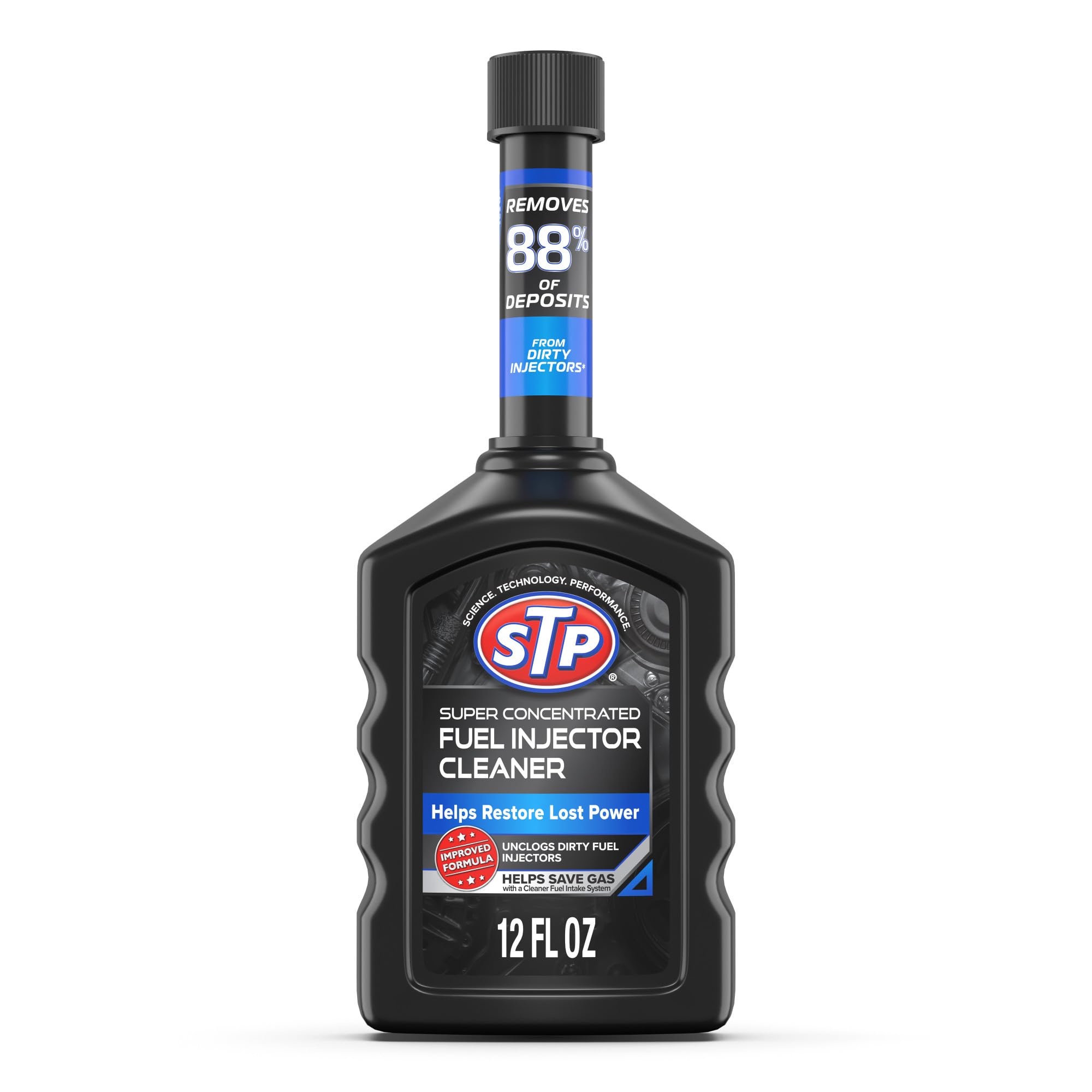
The budget-friendly pour that reportedly bumped one car from 33 to 39 MPG.
STP’s Super Concentrated formula uses a high-quality carrier of active ingredients and is made with jet fuel — a distinctive base that contributes to its cleaning power. The 12-ounce bottle is larger than most single-use cleaners, making it a strong value pick. It is safe for all gasoline engines and is made in the USA.
Performance is the aspect that gets the most praise. One owner reported that their 3-year-old car used only for short trips jumped from 33 MPG to 39 MPG after a single treatment, with no highway driving needed. Another owner of a 2011 Jetta noticed improved throttle response after some driving. The bottle size is a practical advantage — it is not frequently offered in retail stores, so the larger container is a rare find for those who want enough product for a big truck or multiple treatments.
At 12 ounces, this is the heaviest of the single-bottle cleaners on this list, weighing 12 ounces versus the Star Brite’s 10.4 ounces.
Why it works: The jet-fuel base provides strong solvent action against deposits, while the super-concentrated formula means a little goes a long way.
Reach for this if: You want a proven, affordable cleaner that delivers measurable MPG gains — especially for a car that does mostly short trips.
Look elsewhere if: You need a PEA-based detergent for direct-injection carbon issues; STP uses a different chemistry.
8. Berryman 7516 High Mileage Fuel System Rejuvenator

The high-mileage specialist that uses strong solvents to dissolve fuel residue and carbon.
Berryman’s 15-ounce pour can uses “HEST” — High Energy Solvent Technology — an exclusive formula that uses strong solvents rather than weak carriers like mineral spirits or kerosene. This makes it a potent choice for high-mileage engines that have years of accumulated deposits. It is designed to restore lost power, reduce rough idle and hesitation, restore octane requirements, and improve overall drivability.
The most-praised aspect is functionality. One owner used B12 Chemtool (from the same maker) on a Victory Hammer motorcycle that had sat for over 3 years. A concentrated solution of 1 ounce per gallon cured the hesitation — saving a fuel filter replacement. Another owner of a 2007 RAV4 with piston-ring issues saw oil consumption drop from 1 quart per 300 miles to 1 quart per 1000 miles after one treatment. The product also disperses moisture and stabilizes gasoline, and works on both 2-stroke and 4-stroke engines including marine and small gas engines.
There is a mixed verdict on value for money — some find it pricey per ounce, but given the aggressiveness of the solvent, one treatment can replace multiple bottles of weaker cleaners. Owners recommend using it before an oil change because the solvent can temporarily loosen enough carbon to trigger a misfire.
What makes it effective
- HEST solvents are stronger than mineral-spirit carriers found in many competitors
- Works on all gas engines — 2-stroke, 4-stroke, marine, small equipment
- One treatment can dramatically reduce oil consumption on ring-fouled engines
To be aware of
- Strong solvents can cause a temporary misfire as loosened carbon burns off
- Best used right before an oil change, not as a routine top-up
Best for: High-mileage engines with heavy carbon deposits, oil consumption, or rough idle — the strongest solvent option here.
Think twice if: You want a gentle maintenance additive you can use at every fill-up without worry; this is a shock treatment.
9. STA-BIL Small Engine Pro Multi-System Additive (6-Pack)

A six-bottle arsenal that keeps mowers, trimmers, and generators starting reliably.
Each of the six 16-ounce bottles is a multi-system additive designed specifically for small engines. It cleans out gum and varnish from carburetors and injectors while providing corrosion inhibitors that protect against ethanol damage. The formula also lubricates internal engine components and quiets noisy engines — a common issue with older lawn equipment.
Owners of lawn mowers, generators, and snow blowers report that it helps engines start faster and idle smoothly after even long storage periods. One owner of a 2004 7hp self-propelled mower still runs it on the same machine with this additive. The easy-pour bottle features a precise, spill-free design, which matters when you are working with small fuel tanks. It does take some time to clean out heavy lacquer buildup inside carburetors, so patience is required for deeply neglected equipment.
With 96 total fluid ounces across the six-pack, this is the largest volume in the lineup — suited for households with multiple small engines.
Best use: Pour a measured amount into every gas can you fill for your mower, trimmer, chainsaw, or generator — it cleans and protects in one step.
Reach for this if: You maintain multiple pieces of gas-powered outdoor equipment and want a single additive that cleans, lubricates, and stabilizes fuel.
Look elsewhere if: You only need a single treatment for a car or truck — this is designed for small engines and comes in a bulky six-pack.
Understanding the Specs
PEA (Polyether Amine) Detergent
PEA is the most effective detergent chemistry for fuel injectors because it withstands the high heat inside a combustion chamber without breaking down. It actively dissolves carbon deposits on intake valves, piston crowns, and injector tips. Products with a high PEA concentration — like the Red Line SI-1 — deliver a deep clean in a single tank. Lower-cost alternatives often use PIB or mineral spirits, which work on light gum but struggle with baked-on carbon.
Treatment Ratio
The treatment ratio tells you how much fuel one bottle or can covers. A concentrated 4-ounce bottle that treats one full tank delivers a high dose per gallon, ideal for a one-time shock treatment. A larger bottle like the 16-ounce Star Brite that treats 160 gallons is a maintenance additive — you pour a small amount every few fill-ups. Matching the ratio to your typical driving or storage pattern ensures you get the right cleaning strength without wasting product.
Ethanol Protection
Ethanol-blended fuel attracts moisture and leaves behind gummy deposits as it ages. Additives with corrosion inhibitors and enzyme packages — like STA-BIL Small Engine Pro and Star Brite Star Tron — neutralize ethanol’s harmful effects. This is especially important for seasonal equipment (boats, mowers, generators) where fuel sits for months. Without protection, ethanol can damage rubber seals, metal fuel lines, and carburetor components over time.
Shock Treatment vs. Maintenance
A shock treatment uses a high concentration of detergent in a single tank to aggressively dissolve years of accumulated carbon. Products like the Berryman 7516 and the Red Line SI-1 are designed for this purpose — they will visibly improve performance after one fill-up. Maintenance additives, like the Star Brite or STP, are poured in small amounts at every fill-up to prevent deposits from forming in the first place. Neglected engines need a shock treatment first, then maintenance going forward.
FAQ
Can I use an injector cleaner in a direct-injection engine?
How often should I add a fuel injector cleaner?
Will a fuel injector cleaner fix a misfire?
Is it safe to use a PEA-based cleaner in a carbureted engine?
Can I use a fuel injector cleaner in a boat or marine engine?
What is the difference between a fuel system cleaner and a fuel stabilizer?
Can a fuel injector cleaner improve gas mileage?
Will an injector cleaner damage oxygen sensors or catalytic converters?
How long does it take for a fuel injector cleaner to work?
Can I use a fuel injector cleaner in a motorcycle?
Final Thoughts: The Verdict
If you want one dependable pick, the best additive to clean fuel injectors is the Red Line 60102 SI-1 because its high PEA concentration tackles carbon deposits in any gasoline engine — modern direct-injection or old carbureted — in one treatment. If you want a maintenance additive you can use at every fill-up, the Star Brite Star Tron Ring Clean treats 160 gallons and is especially good for ethanol-related buildup. And for a high-mileage vehicle that needs a more aggressive solvent clean, the Berryman 7516 uses HEST solvents to restore lost power and reduce oil consumption.
How We Picked
We do not accept paid placement. Every pick is matched to a real buyer and a real use-case; we do not hands-on test units.
Sources & Methodology
Specifications: manufacturer listings and product documentation. Review insights: verified customer reviews, as of July 2026. Pricing: not shown on this page (it changes often); check the current price via the retailer link.
As an Amazon Associate, Gadgets Feed earns from qualifying purchases. This does not affect which products we feature.