
The proper chemical treatment targets these specific noise sources, restoring hydraulic lash adjuster function and depositing a friction-reducing layer on metal surfaces to deliver a measurable decibel drop at idle and under load.
I’m Min — the co-founder and writer behind Gadgets Feed. My analysis of these seven additives focuses on the core chemistry, real-world third-party reviews, and the specific noise profiles each formula addresses best, from valvetrain chatter to rod knock suppression.
After combing through hundreds of verified owner reports and technical specifications, I’ve identified the formulas that consistently deliver a quieter cabin and smoother powertrain. This guide breaks down the best additive to quiet engine noise for every vehicle type and budget tier.
How To Choose The Best Additive To Quiet Engine Noise
Engine noise typically falls into three categories: valvetrain clatter from insufficient oil flow to lifters, piston slap from excessive cylinder-to-wall clearance, and low-frequency knocking from bearing wear. The right additive targets one or more of these root causes without simply thickening your oil into a temporary band-aid. Here’s what separates a true performance enhancer from a stopgap.
Friction Modifier Chemistry
The most effective noise-reducing additives use micronized solid lubricants—molybdenum disulfide (moly), polytetrafluoroethylene (PTFE), or boron nitride. These particles mechanically fill microscopic surface imperfections and create a low-friction boundary layer that survives even after the oil drains off. This means quieter cold starts and reduced metallic contact during high-load acceleration. Products relying solely on viscosity index improvers will mask noise for a few hundred miles before the oil shears down and the rattle returns.
ZDDP Content for Flat-Tappet Engines
If you drive a pre-1988 vehicle or a high-performance pushrod motor with a flat tappet camshaft, the ZDDP (zinc dialkyldithiophosphate) level in your oil is critical. Modern API SN oils drastically reduced ZDDP to protect catalytic converters, but your cam lobes and lifters need 1,200 to 1,400 ppm to prevent spalling and the metallic clicking that precedes catastrophic lobe failure. A dedicated ZDDP booster restores those levels and eliminates the tapping noise at its source.
Additive Compatibility with Your Oil Type
Not all formulas play nice with synthetic or high-mileage oils. Some PTFE-based treatments can clog oil filter pores or interfere with oil flow in engines running ultra-low-viscosity synthetics (0W-20, 5W-20). Synthetic ester technologies, on the other hand, chemically bond to metal surfaces and remain stable at high temperatures. Always check whether the additive is meant for conventional, synthetic, or both—and never exceed the recommended dosage rate to avoid seal swelling or foaming issues.
Quick Comparison
On smaller screens, swipe sideways to see the full table.
| Model | Category | Best For | Key Spec | Amazon |
|---|---|---|---|---|
| Liqui Moly Cera Tec | Ceramic Additive | Gas/Diesel Engine Noise Reduction | Ceramic friction coating | Amazon |
| BG Motor Oil Additive (3-Pack) | MOA Formula | Rod Knock & Varnish Prevention | Prevents oil oxidation | Amazon |
| Lubegard Bio/Tech | Synthetic Ester | Lifter Noise & Cold Start | LXE synthetic wax ester | Amazon |
| Liqui Moly Motor Oil Saver | Seal Conditioner | Oil Leaks & Noisy Valvetrain | Seal swelling agent | Amazon |
| Tufoil Fluoramics | PTFE/Moly Blend | Valvetrain Chatter & Friction Reduction | 0.5-micron PTFE particles | Amazon |
| zMAX Transmission Formula | Transmission Additive | Automatic/Manual Shift Smoothness | Micro-lubricant | Amazon |
| REV-X Zinc ZDDP | ZDDP Booster | Flat-Tappet Cam & Lifter Noise | 3,000 ppm ZDDP ratio | Amazon |
In‑Depth Reviews
1. Liqui Moly Cera Tec (300 mL)

Liqui Moly Cera Tec deposits a microscopic ceramic layer on engine internals that fills in surface roughness from normal wear, dramatically reducing the metallic tapping and rattling noises that plague high-mileage engines. In a 2019 F-150 Platinum with the 5.0L Coyote, owners report the persistent tapping sound vanished within 35 miles of adding the 300 mL dose. The ceramic particles bond directly to metal surfaces rather than simply thickening the oil, which means the quieting effect lasts for several oil changes.
The formula is engineered for both gasoline and diesel engines, making it a versatile pick for a mixed fleet. A 2012 Toyota Tundra 5.7L user reported smoother idle and improved fuel economy after adding Cera Tec every few oil changes, with oil analysis confirming no adverse effect on viscosity or additive depletion. The break-in period is roughly 50 to 200 miles depending on engine condition, after which the full noise reduction and friction drop materialize.
Some owners note that the 300 mL bottle treats up to 5 quarts of oil, so larger engines (6.0L+) may require two bottles for optimal coverage. It is not a fix for mechanical damage like a spun bearing or broken piston ring—but for valvetrain clatter, injector tick, and general engine harshness, this is the most potent single-dose solution on the market.
Why it’s great
- Eliminates valvetrain tapping in as few as 35 miles
- Ceramic coating lasts multiple oil change intervals
- Compatible with both gasoline and diesel engines
Good to know
- Large-displacement engines may need two bottles
- Won’t repair major mechanical wear like rod knock
2. BG Motor Oil Additive (3-Pack)

BG Motor Oil Additive (MOA) is known in professional shops for its ability to silence rod knock in engines with moderate bearing wear. A former GM technician documented a case where MOA completely eliminated the rod knock in a KIA 2.4L after only 20 miles of driving. The additive fortifies the oil’s boundary lubrication properties, keeping a slick film on metal surfaces even after the engine is turned off—this residual protection prevents the dry-start clatter that accounts for most cold-start engine noise.
Each 11 fl. oz. can treats up to 6 quarts of oil, and the three-pack offers excellent value for owners who want to run MOA every oil change. Long-term users spanning 30 years report that it keeps engines internally clean with any oil type—synthetic or conventional—without acting as a thickener the way STP-style additives do. The formula also prevents oil oxidation and varnish buildup, which are root causes of sticky lifters and ticking valvetrains.
One unique feature confirmed by a BG product demonstration: after draining all oil from a friction tester, the surface treated with MOA remained measurably slicker than untreated oil alone. This translates to real-world noise reduction during the critical first seconds of cold startup. The only catch is that BG products are sometimes harder to find in retail stores, though the Amazon availability makes it a straightforward purchase.
Why it’s great
- Documented rod knock elimination in as little as 20 miles
- Residual film protects during dry starts
- Prevents sludge and varnish that cause lifter tick
Good to know
- Three-pack bulk may be more than a single-vehicle owner needs
- Best results require consistent use every oil change
3. Lubegard Bio/Tech Engine Oil Protectant

Lubegard Bio/Tech leverages proprietary LXE (liquid wax ester) technology that chemically bonds to metal surfaces and won’t drain off overnight. This makes it arguably the best additive for eliminating lifter noise and valvetrain clatter on cold starts—the moment when 90% of engine wear occurs because oil has fully drained into the pan. A 2002 Toyota Solara V6 with 188,000 miles saw “dramatic improvement” in engine sound and transmission quality after a single treatment.
The 32-ounce bottle treats roughly 6 quarts of oil, providing multiple treatments for the price of a single premium dose. Users report not only quieter engines but also a 1.5–2 MPG fuel economy improvement and reduced oil consumption between changes. The additive is fully compatible with modern VVT (variable valve timing) systems and does not interfere with oil flow passages or trigger check engine lights.
One detail that sets Lubegard apart is its cold-weather performance: the ester technology maintains boundary lubrication even at sub-zero temperatures where conventional friction modifiers become sluggish. A long-term Toyota Sienna owner with over 100,000 miles of Lubegard use attributes the engine’s survival of a pinhole oil cooler hose leak to the residual protection the additive provides. It is not the cheapest per-ounce option, but the scientific backing and consistent results justify the mid-range position.
Why it’s great
- LXE technology bonds to metal surfaces for cold-start protection
- Eliminates lifter noise, especially in cold weather
- Improves fuel economy by reducing internal friction
Good to know
- Larger bottle may be oversized for small engines
- Full noise reduction may take 200–500 miles to peak
4. Liqui Moly Motor Oil Saver (2-Pack)

Liqui Moly Motor Oil Saver targets a very specific noise source: valvetrain clatter caused by hardened, shrunken oil seals that allow excessive oil consumption and air entrainment. A BMW 5 Series owner with a small oil pan gasket leak reported that after adding one can and driving the specified mileage, the leak slowed and eventually stopped completely. A Honda CRV with a crank seal leak so bad it left driveway spots every night also went dry after one treatment—no drips in over a year.
This additive works by reconditioning rubber seals throughout the engine, swelling them back to their original dimensions and restoring proper oil retention. It is particularly effective for engines with plastic valve seats, like the Nissan Xterra 2013, where an owner saw oil consumption drop from 1 quart per 1,500 miles to zero after 1,300 miles of use. The quieting effect comes from restoring proper oil volume at the valvetrain, eliminating the starvation-related ticking that many high-mileage drivers mistake for lifter failure.
Notably, this is a long-duration treatment: users report that a single 300 mL bottle can treat a 4-cylinder or V6 engine, with a half-bottle maintenance dose at subsequent oil changes sufficient to maintain seal pliability. The two-pack provides excellent value for households with multiple vehicles. The main limitation is that it will not reduce noise from worn bearings or cam lobes—seal shrinkage is the primary target.
Why it’s great
- Stops oil leaks by reconditioning hardened seals
- Eliminates valvetrain ticking caused by oil starvation
- Two-pack provides multiple treatments
Good to know
- Only addresses noise from seal-related oil loss
- Delivery can take 2–3 weeks from Amazon
5. Tufoil Fluoramics Engine Treatment

Tufoil has been a staple in the engine additive world since the 1980s, built on a proprietary blend of PTFE particles (0.5 microns) and high molybdenum disulfide content. It was once recognized by Guinness World Records as the world’s slipperiest liquid, and the chemistry backs up the claim: the microscopic particles mechanically fill surface asperities in the cylinder walls, bearing surfaces, and valvetrain, creating a low-friction boundary layer that dramatically reduces mechanical noise. A 1993 Toyota pickup owner reported that Tufoil “quieted valvetrain noise that Seafoam didn’t touch” on the first use.
The 8-ounce bottle is incredibly concentrated—one bottle treated a 6.7L diesel, a 2.4L Honda, and two 25-horsepower diesel tractors. Users report noticeable noise reduction within 30 minutes of driving, with engine smoothness and power delivery improving as the PTFE fully distributes. A Honda Civic owner with 240 wheel horsepower saw both valvetrain and transmission synchronizer noise drop, along with a 1.5 MPG city improvement in a 2005 Escalade.
There are two critical caveats: Tufoil should not be used in motorcycles with wet clutches (the PTFE can cause clutch slippage) or in synchromesh transmissions. The initial dose is 8 oz per 5 quarts of oil, then 4 oz for subsequent oil changes. Some users find the thick consistency messy to pour, but the noise reduction and friction reduction are among the best in class for older engines with high valvetrain clatter.
Why it’s great
- 0.5-micron PTFE particles quell valvetrain noise within 30 minutes
- Extremely concentrated—treats multiple vehicles per bottle
- World-record friction reduction backed by decades of use
Good to know
- Not safe for wet-clutch motorcycles
- Thick consistency can make measuring messy
6. zMAX Transmission Formula
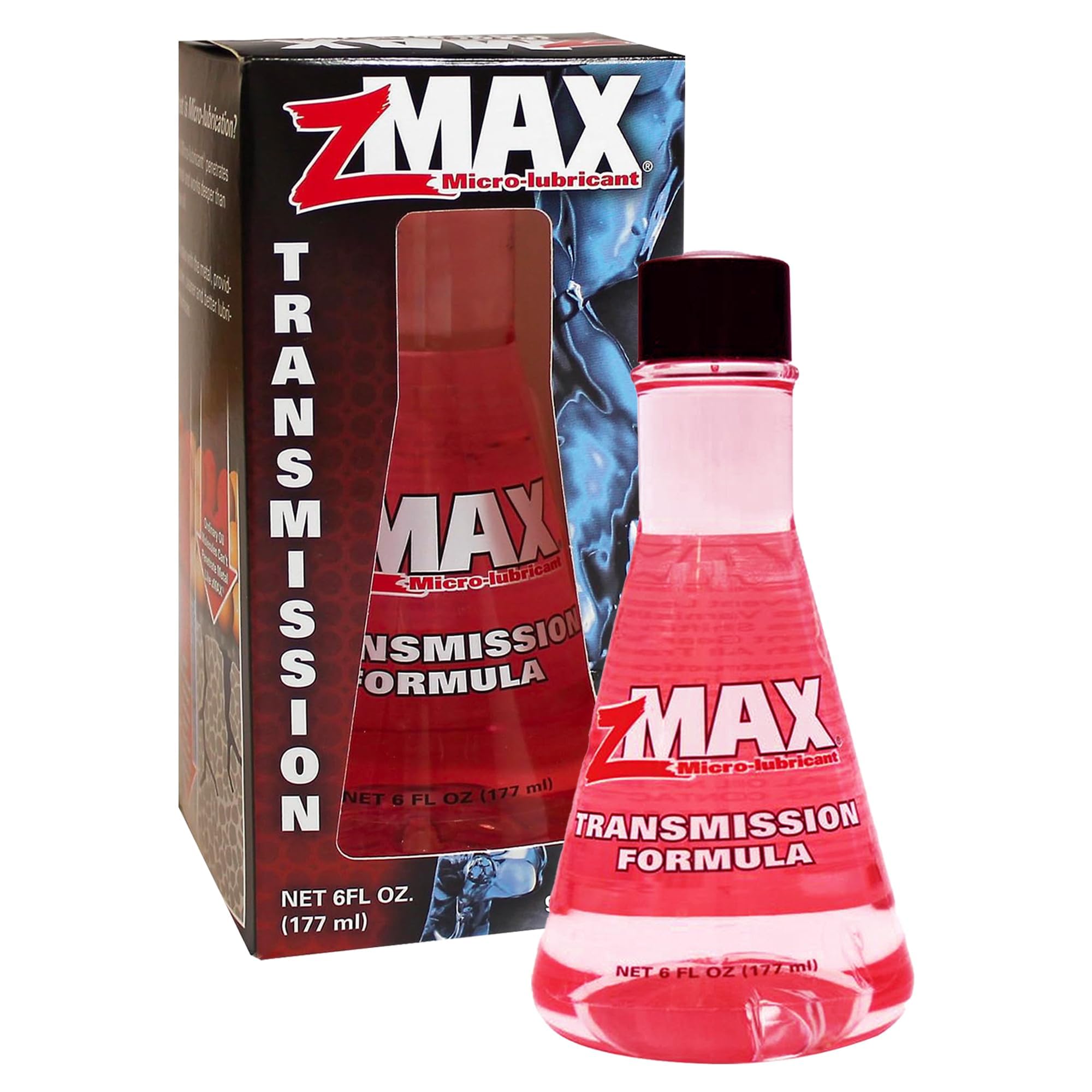
While zMAX is marketed as a transmission additive, its micro-lubrication technology—tiny PTFE-like particles that soak into metal surfaces—also makes it effective for reducing noise in automatic and manual transmissions. A 2014 GMC Acadia owner with 109,000 miles reported hard 1-2 and 2-3 shifts after a fluid flush; zMAX cleaned the shift points “perfectly within 30 minutes” by removing varnish from the transmission solenoids. The noise reduction comes from the lubrication of bearings, gears, and the hydraulic system, which eliminates the whining and clunking that often accompanies aged transmission fluid.
The 6-ounce bottle treats one transmission fluid change, and the formula is compatible with both automatic and manual transmissions (though not CVTs). zMAX is also the official micro-lubricant of Speedway Motorsports, indicating the motorsports industry trusts its friction-reducing properties under extreme conditions. A 2016 Taurus SHO owner with 80,000 miles saw hard downshifts disappear within 20 miles of adding zMAX, describing the result as “the best spent.”
It’s important to note that zMAX is not a traditional engine oil additive—it’s designed for the transmission oil circuit. If your engine noise originates from the transmission (whining in park, clunking on engagement, hard shifts), this is a targeted and affordable fix. For engine-specific valvetrain clatter, you would need a different product from this list. The economical price makes it an easy first step before pursuing more expensive transmission repairs.
Why it’s great
- Cleans varnish on solenoids for immediate shift improvement
- Reduces transmission whine and gear noise
- Extremely affordable single-dose treatment
Good to know
- Not designed for engine valvetrain noise
- Not compatible with CVT transmissions
7. REV-X Zinc ZDDP Oil Additive (5-Pack)

REV-X Zinc ZDDP is the essential additive for any engine with a flat tappet camshaft and lifter setup—pre-1988 GM small blocks, Ford 302/351W, Chrysler LA-series engines, and even modern crate motors that still use flat tappets. Modern API SN motor oils have ZDDP levels reduced to around 800 ppm, but flat tappet engines require 1,200 to 1,400 ppm to prevent the metal-on-metal contact that produces a characteristic tapping noise and eventually leads to cam lobe spalling. This additive restores that critical zinc and phosphorus protection.
The five-pack of 2 fl. oz. bottles is designed for convenience: each bottle treats 6 quarts of oil to deliver a precise 3,000–3,200 ppm ZDDP concentration, far exceeding what even high-zinc oils provide. Users report that engines run cooler due to reduced friction, and the metallic clicking that signals cam/lifter distress disappears after one treatment. The single-use flasks eliminate measuring errors and keep the additive fresh until needed—important because ZDDP can degrade over time in an opened container.
It is also useful for engine break-in where a fresh camshaft and lifters need immediate boundary protection. A military vehicle owner uses it in an M35A2 Multi-Fuel engine, confirming its compatibility with non-standard lubricants. The only limitation is that this is a single-purpose additive: it restores ZDDP levels and does nothing for noise caused by varnish, seal shrinkage, or general friction beyond cam/lifter protection. For owners of flat tappet engines, however, it is the difference between a quiet valvetrain and an expensive rebuild.
Why it’s great
- Restores ZDDP to 3,000+ ppm for flat tappet engines
- Convenient single-dose flasks prevent measuring errors
- Eliminates cam/lifter tapping and reduces engine heat
Good to know
- Only addresses noise from ZDDP deficiency
- Not necessary for modern roller cam engines
FAQ
Can an additive fix a rod knock or spun bearing?
How often should I add friction modifier to my engine?
Will ZDDP additive harm my catalytic converter?
Do I need an additive if I already use high-zinc oil?
Final Thoughts: The Verdict
For most users, the best additive to quiet engine noise winner is the Liqui Moly Cera Tec because its ceramic friction coating eliminates valvetrain chatter, injector tick, and general engine harshness with a single dose that lasts multiple oil changes. If you need to silence rod knock and protect against dry starts, grab the BG Motor Oil Additive. And for cold-start lifter noise in high-mileage vehicles, nothing beats the Lubegard Bio/Tech with its LXE synthetic wax ester technology that stays on metal overnight.