
The core struggle for an adult with ADHD isn’t a lack of intelligence or effort—it’s a daily war against an executive function deficit where time blindness, task paralysis, and object permanence issues turn simple routines into monumental hurdles. The right tool acts as an external brain, anchoring you to the present moment and making the invisible passage of time physically visible. This guide focuses solely on the gear that bridges the gap between intention and action without adding another cognitive burden.
I’m Min — the co-founder and writer behind Gadgets Feed. I’ve spent countless hours sorting through hundreds of productivity aids, breaking down their tactile feedback, visual signaling, and cognitive load to find the ones that actually work with the ADHD brain rather than against it.
Whether you need a visual timer to break the grip of hyperfocus or a planner that doesn’t trigger shame from skipped days, this carefully curated list of the best adhd organization tools for adults focuses on tools that reduce friction and build momentum instead of adding to the clutter.
How To Choose The Best ADHD Organization Tools For Adults
Not every tool works for every ADHD brain. The key is matching the tool’s sensory feedback, structure, and flexibility to your specific executive function weaknesses. The wrong tool becomes another dust-collector; the right one becomes a lifeline.
Prioritize Physical and Visual Feedback
Digital notifications are easily ignored. A physical tool demands engagement. A timer with a visible red disk that shrinks as time runs out or a thick, high-GSM card that you physically flip from “To Do” to “Done” creates a tactile memory anchor. Look for tools that utilize touch, sight, and even sound in way your brain cannot swipe away. The weight of the cardstock and the resistance of the paper as you write are measurable specs that directly affect whether the tool feels “real” enough to break through a brain fog.
Look for Undated and Guilt-Free Formats
ADHD is cyclical. A missed week in a dated planner can trigger a cascade of shame that leads you to abandon the entire system. Undated planners, or those with built-in “skip days” permission, are non-negotiable for long-term use. Similarly, tools that allow you to re-write tasks easily—like dry-erase surfaces—let you pivot without the friction of crossing out a whole page. The physical act of rewriting is active processing, not failure.
Focus on Setup Time and Cognitive Load
The best tool is the one you will actually use five minutes from now. A complex bullet journal system with micron pens and washi tape adds overhead. The winning tools are those with a dead-simple default mode: flip a switch to start a timer, pick up a pre-printed card to write a task, or glance at a fridge-mounted calendar instead of unlocking a phone. If a tool requires a manual to start, it has already failed the ADHD test.
Quick Comparison
On smaller screens, swipe sideways to see the full table.
| Model | Category | Best For | Key Spec | Amazon |
|---|---|---|---|---|
| Roterunner Purpose Planner | Premium Notebook | Deep weekly planning & goal setting | 192 pages, 100GSM no-bleed, B5 | Amazon |
| YOOLANSA 3-in-1 Visual Timer | Visual Timer | Building time awareness & task transitions | 60-min visual dial, dry-erase board | Amazon |
| The ADHD Planner for Adults | Guided Workbook | Emotional regulation & habit tracking | 90 undated days, daily check-off | Amazon |
| Mind Design Daily Planner System | Card System | Daily task capture & prioritization | 120 checklist cards, wood stand | Amazon |
| Jack Pomodoro Timer | Focus Timer | Pomodoro method & hyperfocus management | 6 presets, USB-C, vibration mode | Amazon |
| 5-in-1 Executive Functioning Workbook | Science Workbook | Building lasting routines with science backing | 323 pages, 30-day gradual system | Amazon |
| AUVIREC Magnetic Calendar 3-Pack | Fridge Board | Family scheduling & zero-digital distraction | Nano-PET surface, ships flat | Amazon |
In‑Depth Reviews
1. Roterunner Purpose Planner Notebook B5

The Roterunner Purpose Planner has earned a place as a top-tier system specifically because it solves the “which book do I write this in” problem for the ADHD brain. It integrates a 6-month undated weekly dashboard with 93 numbered dotted note pages, effectively combining a planner, a work notebook, and a life organizer into one lay-flat B5 volume. The 100GSM paper is a critical spec here—it handles fountain pens and markers without bleed-through, encouraging you to actually use the space for brain dumps rather than worrying about ruining the next page.
Designed by an ADHD sufferer, the layout includes 5 Roles & Goals templates, an AM/PM routine tracker, and a habit tracker that avoids the typical over-complication. The two ribbon bookmarks allow you to mark your current week and your master notes page simultaneously, reducing the friction of flipping back and forth. The PU leather soft cover and elastic closure make it portable enough for a backpack, which is essential for a tool that needs to be present when the impulse to plan strikes.
Weekly spreads include space for a “not to do” list, which is a clever ADHD-specific feature that externalizes the urge to take on too many tasks. The B5 size gives you a full week at a glance without requiring an unwieldy A4 binder. This is a premium build that justifies its position through thoughtful structural design rather than mere paper count.
Why it’s great
- No-bleed 100GSM paper handles fountain pens and markers, encouraging brain dumps without paper anxiety
- Undated format eliminates guilt from skipped days, making it forgiving for ADHD cycles
- Two ribbon bookmarks and numbered dotted pages blend free-form notes with structured planning
Good to know
- Elastic closure can feel slack over extended use
- No built-in pen holder, which may lead to the pen walking away
2. YOOLANSA 3-in-1 Visual ADHD Timer with Planning Board
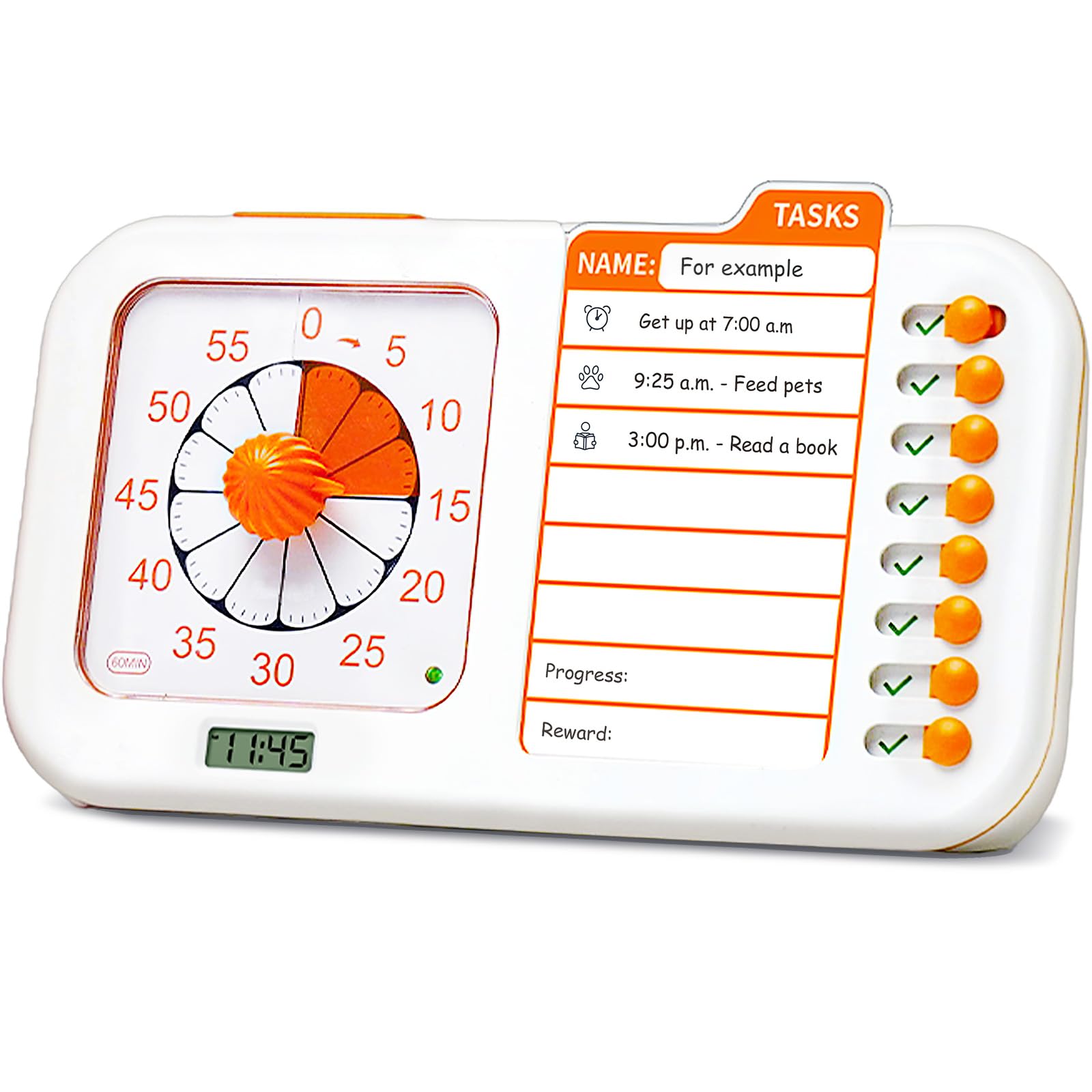
The YOOLANSA 3-in-1 timer is a category-defining tool for adults who struggle with time blindness. Unlike an app timer that lives inside a distracting phone, this unit combines a 60-minute visual countdown dial with a dry-erase planning board and a slide-switch task completion system. The 5-inch screen displays a red disk that physically shrinks as time passes, giving you a concrete visual reference for the passage of time that the ADHD brain cannot ignore.
The silent operation mode is critical for office and library use, while the adjustable alarm provides an audible anchor for task transitions. The dial-based time setting is intuitive—turn clockwise to set, and the countdown starts immediately, removing the friction of menu navigation. The whiteboard space allows you to write the day’s 3 main tasks directly on the unit, keeping your focus locked to a single physical object rather than spread across multiple systems.
This device is recommended for special education contexts but works equally well for adults managing work sprints or home routines. The slide switch for task completion provides a satisfying physical confirmation of progress. The dry-erase surface does require frequent rewriting, but the trade-off for having a dedicated time-and-task hub is worth it for those who struggle with phone-based planning.
Why it’s great
- Visual red disk shrink provides a tangible reference for time passage, directly countering time blindness
- Combines countdown timer, to-do list, and task completion into one distraction-free physical unit
- Silent vibration mode and adjustable alarm make it usable across office, home, and library environments
Good to know
- Dry-erase tasks can be erased accidentally by kids or sleeves, requiring frequent rewrites
- No card-stock inserts for permanent recurring tasks, which would reduce rewriting friction
3. The ADHD Planner for Adults by epic self

Created by an entrepreneur with firsthand ADHD experience, this 90-day undated planner is structured to work with ADHD tendencies rather than against them. The layout avoids information overload by dedicating a spacious daily page that includes only a priority list, a notes section, and an “achievements” area—three zones that prevent the spiral of trying to track ten metrics at once. The hardcover binding lays completely flat, which is crucial for an adult who needs to write without fighting a spine curvature.
The weekly “brain dump” pages are a standout feature for emotional regulation. They provide a dedicated space to purge racing thoughts without judgment, which directly reduces the cognitive load that leads to task paralysis. The undated format is not just a feature; it’s the core philosophy—you pick up wherever you left off without the shame of a gap. Color-coded tabs help you navigate between the goal-setting section and daily pages quickly.
Daily pages include a medication/habit check-off and an emotions tracker, allowing you to correlate your focus levels with physiological states. The 8.5 x 11 inch letter size gives you room to write without feeling cramped, which reduces the tendency to abandon the page mid-entry. Some users note the price point is higher than generic planners, but the ADHD-specific design—like the spacious lines and lack of a separate weekly section that would add bulk—makes it a targeted purchase.
Why it’s great
- Spacious daily pages with only three zones (priority, notes, achievements) reduce decision fatigue
- Weekly brain dump pages provide a judgment-free space for emotional regulation and thought purging
- Undated format and lay-flat hardcover binding support guilt-free daily use over inconsistent weeks
Good to know
- Separate weekly section is not included, which some users prefer for broader time-blocking
- Price can be a barrier for those wanting to trial a new system without commitment
4. Mind Design Undated Daily Planner To Do List Notepads

The Mind Design system strips planning down to its most atomic unit: a single 3×5 inch task card. The kit includes 120 daily checklist cards, 10 goal cards, and 2 legend cards housed in a walnut wood box with a magnetic metal divider. The workflow is simple—write today’s tasks on a card, place it on top of the metal divider as your active list, and move completed cards behind the divider. This physical act of flipping a card from active to complete provides a dopamine hit that a digital checkbox cannot replicate.
The 100GSM cardstock is thick enough to survive pocket carry and repeated handling without tearing. The undated format means each card is a fresh start—no guilt, no carry-over shame. The left margin features circles for priority coding (ABC or color), giving you a structured way to triage without writing a full system. The walnut stand keeps everything visible on your desk, serving as a persistent visual cue that your tasks exist and need attention.
The system excels for adults who feel overwhelmed by the open-ended nature of a notebook. The physical constraint of one card per day forces prioritization by limiting how many tasks you can realistically fit. The magnetic divider holds the active card at a readable angle, making it easy to glance at your top priority without shuffling papers. The main downside is that the cards lack pre-printed labels for time blocks or energy levels, requiring you to create your own legend.
Why it’s great
- Physical card-flipping action provides a tangible dopamine reward for task completion
- 100GSM thick cardstock resists tearing from pocket carry, making it durable for ADHD on-the-go use
- Walnut stand and metal divider keep active tasks visible, reducing the “out of sight, out of mind” problem
Good to know
- Main cards lack pre-printed labels for time-blocking or energy-level tagging
- Back of the card has a thick line at 1/4 page that limits note space for brainstorming
5. Jack Pomodoro Timer – Productivity Cube by Printers Jack

The Jack Pomodoro Timer addresses a specific ADHD pain point: the difficulty of switching tasks and the tendency to hyperfocus for unhealthy durations. This gravity-activated cube has six preset countdowns (3, 5, 10, 25, 30, and 60 minutes) that are activated by simply flipping the cube to the corresponding face. The physical action of flipping the cube serves as a ritual that signals to your brain that a focus block is starting or ending, creating a boundary that is much harder to ignore than a screen notification.
The USB-C rechargeable lithium battery eliminates the need for disposable batteries, and the magnetic base allows you to stick it to a fridge or whiteboard for visibility. The vibration mode is a standout feature for quiet environments—the silent buzz on your desk provides a physical nudge that does not break the flow of others. The four-level brightness adjustment ensures the display is readable in any lighting condition without becoming a distraction.
The Pomodoro button activates a dedicated cycle of 25 minutes of focus followed by 5 minutes of break, repeating four times. This removes the mental load of tracking cycles yourself. The auto-rotating display ensures the timer is always readable regardless of how you place it. However, the timer relies on gravity to switch modes, which means picking it up can inadvertently reset your session—a quirk that requires muscle memory to manage.
Why it’s great
- Gravity-activated flip to switch timers provides a physical ritual that signals task boundaries
- USB-C rechargeable battery and strong magnet base make it a permanent desk fixture
- Silent vibration mode delivers a physical nudge without disrupting workflow or colleagues
Good to know
- Alarm only sounds for 30 seconds then shuts off, with no continuous alarm option
- Power button can be hard to distinguish by touch, leading to accidental resets
6. The Complete 5-in-1 Executive Functioning Workbook for Adults
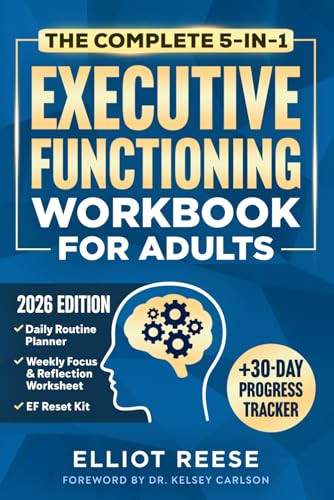
This independently published workbook takes a science-backed, gradual approach to rebuilding executive function over 30 days. The 323-page volume breaks down procrastination, time blindness, and memory lapses into digestible daily exercises that are intentionally short enough to complete within an ADHD attention span. The author avoids overwhelming you with theory—each chapter ends with a concrete action step that you can implement immediately.
The workbook includes a free bonus section with journal prompts, a planner, and a progress calendar, turning a single purchase into a complete system. The reader reviews consistently highlight that the book “stays off the shelf” because the chapter lengths are perfectly calibrated for the ADHD brain. The 9 x 6 inch dimensions make it portable enough to carry in a bag, and the paperback format allows you to fold it open without worrying about spine damage.
The content focuses on emotional regulation and task initiation, which are the two biggest bottlenecks for adults with executive dysfunction. The exercises are designed to build small wins without triggering the shame spiral that often accompanies productivity attempts. While it lacks the tactile gadget appeal of hardware tools, its low-friction entry point makes it an ideal starting point for someone who has never used a specialized ADHD organization tool before.
Why it’s great
- 30-day gradual system with short, digestible chapters designed for ADHD attention spans
- Science-backed strategies for emotional regulation and task initiation, the two biggest roadblocks
- Includes free bonus journal prompts, planner, and progress calendar for a complete system
Good to know
- Workbook format may not be optimal for those who prefer guided digital or tactile tools
- Self-published; the paper quality is functional but not premium like higher-end notebooks
7. AUVIREC Magnetic Calendar for Refrigerator (3-Pack)
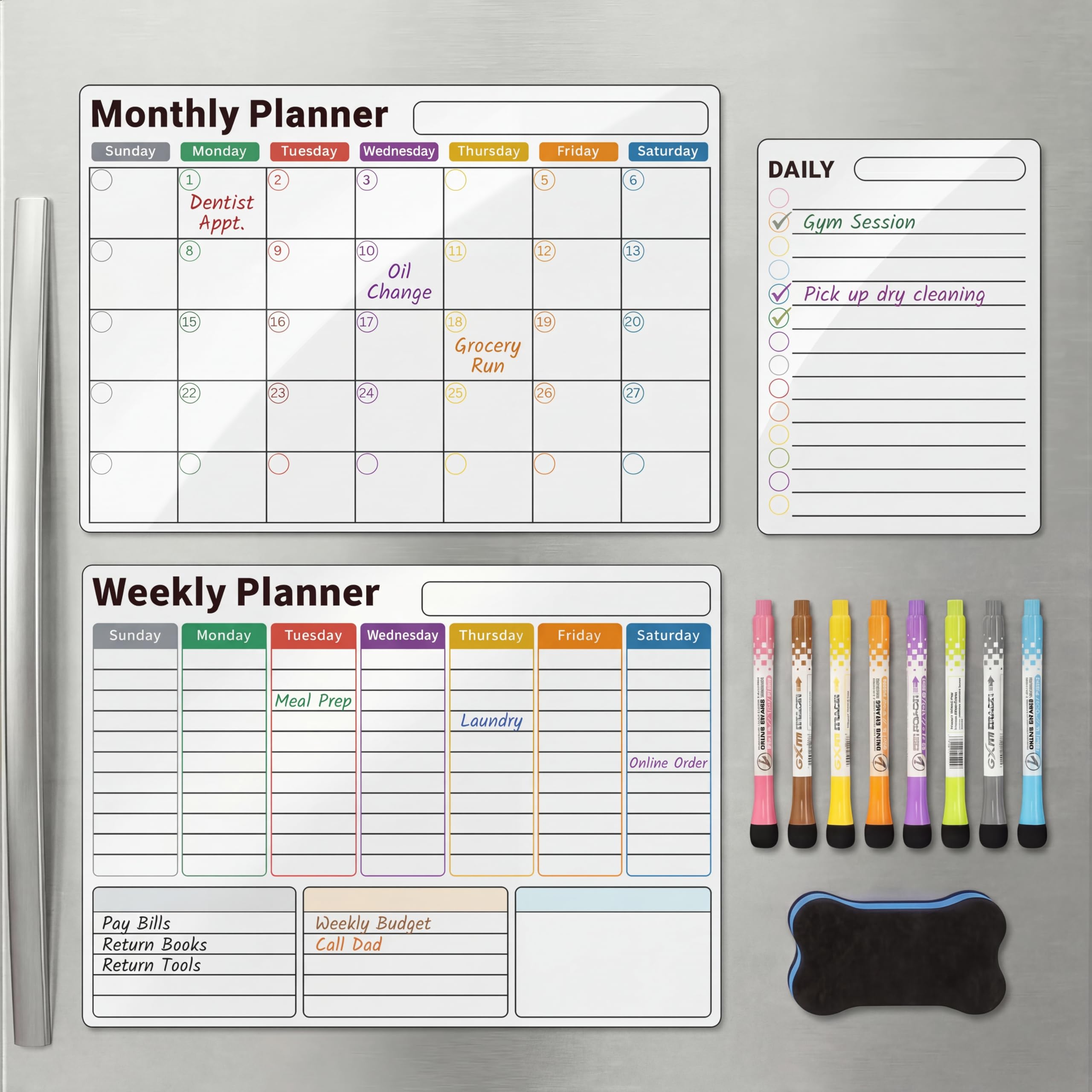
The AUVIREC Magnetic Calendar set tackles the ADHD “out of sight, out of mind” problem by placing your schedule directly in the highest-traffic area of your home: the refrigerator. This 3-pack includes a 17×12 inch monthly planner, a 17×12 inch weekly planner, and a 6×8 inch daily board, giving you three layers of time resolution. The Nano-PET surface is the key spec here—it resists ghosting even after ink has been left on for 40 days, meaning you can write and rewrite without the surface becoming a muddy mess.
The full magnetic backing is thick enough to stay secure on standard or slightly curved metal doors without sliding down, which is a common failure point for cheaper alternatives. The boards ship flat in rigid packaging, which prevents the creases that make a whiteboard surface bumpy and unpleasant to write on. The included 8 fine-tip markers allow for color-coding between different family members or task categories, which helps with visual scanning for priority tasks.
For an adult with ADHD, this system provides a constant, unavoidable visual cue that can replace the need to check a phone calendar. The lined grids help keep handwriting neat, reducing the frustration of trying to read your own scribbled notes. The set is designed for busy households, but for a single adult, you can use the extra boards for specific contexts like meal planning and chore tracking. The markers included are basic, and some users report inconsistent smoothness, which is a minor friction point in an otherwise effective system.
Why it’s great
- Nano-PET surface resists ghosting for 40+ days, keeping the board readable with constant rewrites
- Full-thickness magnetic backing stays secure on fridge doors without sliding down
- Ships flat in rigid packaging, preventing creases that disrupt smooth writing
Good to know
- Included markers can be inconsistent and may not write smoothly on the surface
- Requires a metal door for mounting, limiting placement options for non-fridge users
FAQ
Why should I use a physical planner instead of a digital app for ADHD?
How does a visual timer help with time blindness?
What does “undated” mean and why is it important for ADHD?
Can I combine multiple tools, or should I pick one system only?
Final Thoughts: The Verdict
For most users, the adhd organization tools for adults winner is the Roterunner Purpose Planner because its undated, all-in-one layout of weekly dashboards and dotted note pages provides the flexibility to plan, brain dump, and journal without juggling multiple notebooks. If you need to conquer time blindness with a physical anchor, grab the YOOLANSA 3-in-1 Visual Timer for its combined countdown dial and dry-erase task board. And for the lowest barrier to entry, nothing beats the 5-in-1 Executive Functioning Workbook, which provides a science-backed 30-day framework for building routines that actually stick without requiring any additional setup.