
ABS plastic is everywhere—in automotive trim, plumbing pipes, 3D printed prototypes, and RV fixtures. The trouble is that most general-purpose glues simply sit on its surface, creating a weak bond that fails under stress. The right adhesive chemically welds the plastic, fusing the molecules together for a repair that outlasts the surrounding material.
I’m Min — the co-founder and writer behind Gadgets Feed. I’ve spent hundreds of hours analyzing the chemical composition, application methods, and real-world performance data for every major adhesive formulated for ABS plastic, cross-referencing technical datasheets with user-reported outcomes to separate the solvent-welding experts from the surface-level pretenders.
Whether you need to seal a drainage pipe, repair a cracked bumper cover, or join 3D printed parts, finding the right solution is critical. This guide cuts through the noise to identify the best adhesive for abs plastic for every repair scenario.
How To Choose The Best Adhesive For ABS Plastic
Not all adhesives bond ABS the same way. Choosing the right one depends on whether you need a solvent weld, a gap-filling epoxy, or a flexible cyanoacrylate. Here is how to decide.
Solvent Cement vs. Epoxy vs. Cyanoacrylate
Solvent cement chemically melts the ABS surface, creating a molecular fusion that is permanent and often stronger than the parent plastic. This is the go-to for non-pressure pipe joints and structural repairs on rigid parts. Epoxy, on the other hand, forms a mechanical bond and excels at filling gaps in broken panels where parts may not align perfectly. Cyanoacrylate gel provides instant gripping power on non-porous surfaces and is ideal for 3D printed layers or small, quick fixes where clamping pressure is easy to apply.
Viscosity and Application Consistency
The physical form of the adhesive dictates how it behaves during application. Water-thin cement relies on capillary action to seep into tight seams and is best for acrylic and flush-fit joints. Gel formulas stay put on vertical surfaces and won’t drip off during curing, making them perfect for overhead repairs or angled parts. Paste-like solvent cements, such as the medium-bodied black variants, provide a thicker layer that fills small gaps in pipe fittings while still delivering a true chemical weld.
Quick Comparison
On smaller screens, swipe sideways to see the full table.
| Model | Category | Best For | Key Spec | Amazon |
|---|---|---|---|---|
| Oatey 30916 ABS Extra Special Cement | Solvent Cement | Pipe joints & plumbing repairs | Medium-bodied black cement for 6″ pipe | Amazon |
| Weld-On 773 ABS Medium-Bodied Cement | Solvent Cement | High-strength pipe & fittings up to 8″ | Low-VOC, fast-setting black cement | Amazon |
| Oatey 30252 Medium Black ABS Weld Kit | Solvent Cement | RV panel & automotive plastic repair | Paste consistency for gap filling | Amazon |
| J-B Weld Plastic Bonder Black 2-Pack | Epoxy | Gap filling & structural plastic repair | 3,770 PSI tensile strength | Amazon |
| ARKA Kraftprotz 3D Printer Superglue Gel | Cyanoacrylate Gel | 3D print layer repair & small parts | 1.76 oz XXL tube, no-drip gel | Amazon |
| U-POL Adhesion Promoter Spray | Adhesion Promoter | Surface prep before painting ABS | Anti-clog spray, quick-dry | Amazon |
| Berkland Acrylic Bonding Cement | Solvent Cement (Thin) | Plexiglass & acrylic sheet bonding | Water-thin, crystal clear finish | Amazon |
In‑Depth Reviews
1. Oatey 30916 ABS Extra Special Cement

This is the professional standard for ABS pipe and fitting repairs. The medium-bodied black formula is thick enough to stay on vertical applications yet flows into interference-fit joints on all schedules and classes of ABS pipe up to 6 inches in diameter. It chemically dissolves the plastic surface to create a monolithic weld that, once cured, is permanently watertight and stronger than the original material around the joint.
Formulated specifically for the hot, arid climates common in western states, it handles application temperatures from 40°F to 110°F without losing integrity. The low-VOC composition meets strict SCAQMD 1168/316A requirements, so it is safer for indoor plumbing work without sacrificing the aggressive solvent power needed for a durable bond. Users consistently report that multiple coats effectively seal cracked drainage pipes without needing to cut out and replace the section.
This is not a surface glue—it is a true plastic welder. Apply it with a dauber or brush, seat the fitting with a slight twist, and hold for a few seconds. The joint will be load-bearing within minutes and fully cured in 24 hours. For any plumbing, RV waste line, or structural ABS application, this is the benchmark.
Why it’s great
- Creates a permanent molecular weld that is stronger than the plastic itself
- Medium body prevents dripping on vertical pipe joints
- Low-VOC formula without sacrificing bonding aggression
Good to know
- Not for pressure-rated applications
- Can soften ABS if applied too thickly in one spot
2. Weld-On 773 ABS Medium-Bodied Cement
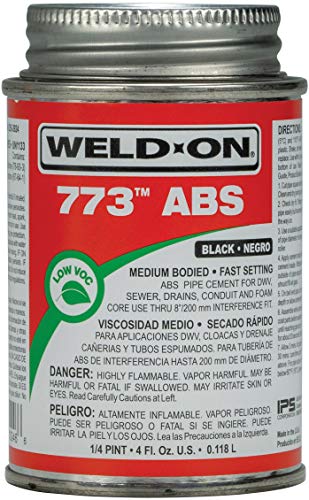
Weld-On is a name synonymous with solvent welding excellence, and the 773 formula lives up to that reputation. This medium-bodied, high-strength black cement is engineered for all rigid ABS pipes and fittings with an interference fit up to 8 inches in diameter. It applies smoothly without running and sets fast enough to hold a joint in under a minute of light pressure.
The low-VOC formula reduces solvent fumes significantly, making it a better choice for indoor or confined-space work compared to older-generation cements. It meets ASTM D2235 and NSF/ANSI 14 standards, and even contributes toward LEED v4 Indoor Environmental Quality credits for contractors tracking sustainability. The 4-ounce can is generous for a handful of joints or a few specialized repairs on dash panels, enclosures, or RV plumbing.
For custom fabricators and tech-minded DIYers who build with ABS sheets or repair 3D printed housings, this cement offers the same capillary action as thinner liquids but with enough body to fill minor gaps. Cured joints exhibit no brittleness—just homogeneous plastic. If you want a top-shelf solvent cement that is easier on the lungs and meets modern code requirements, this is the pick.
Why it’s great
- LEED-compliant low-VOC formula reduces working hazards
- Sets fast for a secure joint in under 60 seconds
- Compatible with all rigid ABS pipe up to 8″ diameter
Good to know
- Not labeled for use on foamed ABS
- Full cure requires 24 hours before pressure testing
3. Oatey 30252 ABS Weld Kit
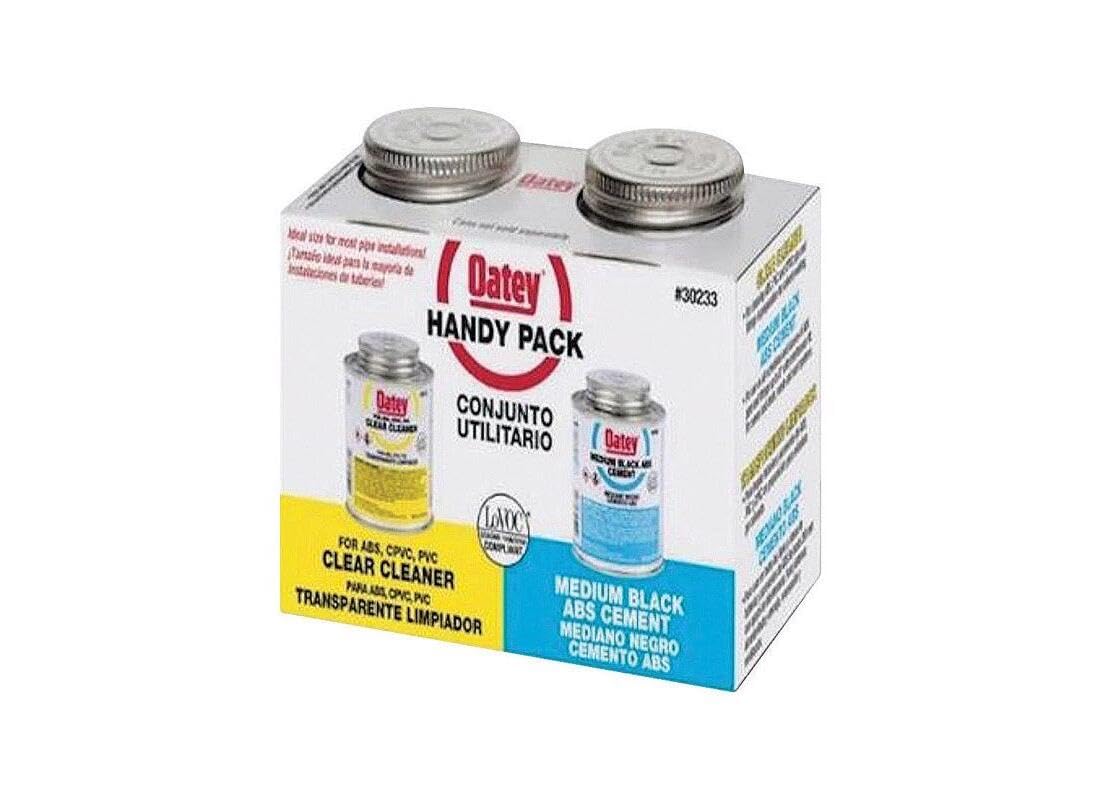
When you need a paste-like solvent cement that stays exactly where you put it, the Oatey 30252 delivers. Its thick consistency is a major advantage for overhead repairs, vertical panels, or filling gaps where loose parts don’t align perfectly. Users report successful repairs on cracked RV door panels, motorcycle side panels, and automotive interior trim where thin cement would simply run off.
The low-VOC formulation keeps application safer in enclosed spaces like garages or small workshops. Because it is a solvent cement, it still chemically fuses with the ABS rather than just coating the surface—the paste format is simply a carrier for the same aggressive solvent that creates a true weld. The 4-ounce container is small enough to carry in a tool bag but holds enough product for several mid-sized repairs.
This is the right choice for non-plumbing ABS repairs where the joint is under little to no pressure but needs to hold against vibration or handling. It dries black, matching most OEM ABS parts, so the repair remains visually discreet. For the price, this offers genuine solvent-welding capability in the most user-friendly form factor for awkward application angles.
Why it’s great
- Paste thickness stays put on vertical and overhead surfaces
- Low-VOC chemistry for safer indoor use
- Dries black to match common ABS part colors
Good to know
- Not intended for high-pressure plumbing applications
- Thicker body means slower capillary penetration into tight seams
4. J-B Weld Plastic Bonder Black 2-Pack
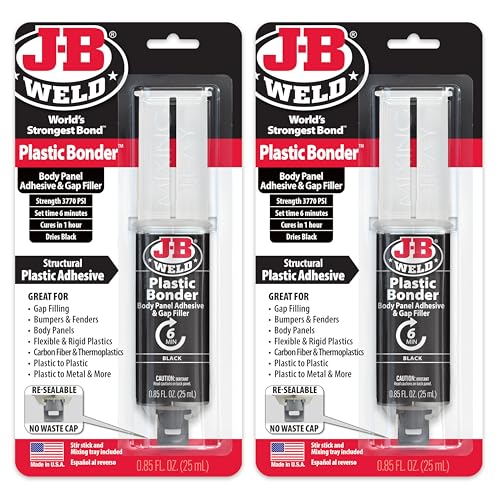
For repairs that require gap-filling strength rather than solvent welding, the J-B Weld Plastic Bonder is the heavyweight champion. This two-part urethane adhesive delivers a staggering 3,770 PSI tensile strength once fully cured, making it a legitimate structural repair solution for broken brackets, cracked bumpers, steering components, and other load-bearing plastic parts.
The dual syringe delivers a precise 1:1 mix ratio, and the re-sealable cap prevents the remaining product from hardening between uses—a common frustration with single-use epoxy sticks. It works on thermoplastics (including ABS), thermoset composites, fiberglass, and coated metals, expanding its utility beyond pure ABS repairs. Set time is 15 minutes, with a full cure at 30 hours, so you have a working window for positioning before the bond locks permanently.
This is not a replacement for solvent cement on pipe joints. But for filling gaps, bridging broken sections where original parts no longer mate flush, or reinforcing hairline cracks in thick panels, the Plastic Bonder outperforms any simple cyanoacrylate. It sands and drills like plastic once cured, enabling post-repair finishing that blends with the original part.
Why it’s great
- Extremely high tensile strength for load-bearing repairs
- Re-sealable syringe cap extends shelf life
- Can be sanded and painted after curing
Good to know
- Not effective on polypropylene or polyethylene plastics
- Chemical odor requires good ventilation during curing
5. ARKA Kraftprotz 3D Printer Superglue Gel
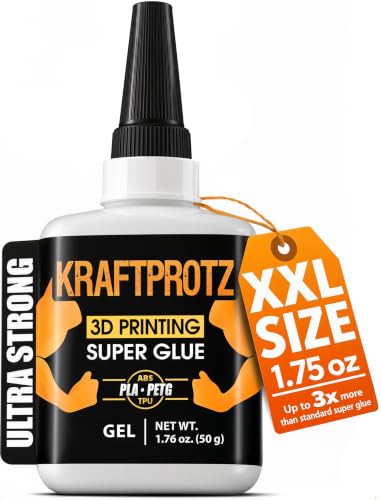
If you are deep into 3D printing with ABS filament, you know the struggle of post-processing seams, repairing layer splits, or gluing multi-part prints together. The ARKA Kraftprotz is a cyanoacrylate gel optimized specifically for PLA, ABS, PETG, TPU, and nylon—a full spectrum of common printing materials. Its thick gel formula eliminates the dripping and run-off that plague thin super glues on vertical print surfaces.
The 1.76-ounce XXL tube delivers about five times the volume of standard glue bottles, which matters when you are gluing large print jobs or running a print farm. The precision tip includes an anti-clog needle that keeps the nozzle open through repeated use. Users consistently report that the bond is stronger than the layer lines of the print itself, meaning the joint will not be the failure point under stress.
The cured adhesive withstands temperatures up to 110°C, which is crucial for prints that may sit in a hot car or near a heated chamber. Because it is a cyanoacrylate, it bonds almost instantly—ideal for quick assembly or tacking parts in place before adding structural reinforcement. For 3D printing enthusiasts who need a reliable, no-drip bond on ABS and other filaments, this is the most practical choice.
Why it’s great
- Gel consistency prevents mess on vertical surfaces
- Heat resistant up to 110°C after full cure
- Anti-clog needle keeps applicator working through many uses
Good to know
- Not a gap filler—requires tight-fitting parts
- Bonds skin instantly; use gloves during application
6. U-POL Adhesion Promoter Spray

Sometimes the best adhesive is not a glue at all—it is the layer that makes paint stick to ABS. The U-POL Adhesion Promoter is a clear spray coating designed to prime bare plastic and metal surfaces so that primer and topcoat actually bond. Without this step, paint peels off ABS components like mirror covers, bumper trim, and body panels within months of exposure to sun and washing.
It dries fast to a smooth, flat finish, and the anti-clog nozzle delivers a consistent spray pattern. While this is not a glue for joining two pieces of ABS, it is an essential tool for anyone refinishing ABS parts that will be painted. Users have reported excellent results on RV plastic panels, motorcycle fairings, and automotive wheels where traditional scuffing alone was insufficient for paint adhesion.
The formula eliminates the need to sand into tight crevices and corners, making it especially valuable for parts with complex geometries. If your goal is to restore or color-match an ABS part rather than structurally weld it, this promoter is the critical first step that separates a lasting paint job from a peeling disappointment.
Why it’s great
- Dramatically improves paint adhesion on smooth ABS surfaces
- Eliminates the need for sanding in hard-to-reach areas
- Dries quickly for same-day painting
Good to know
- Not an adhesive for bonding parts together
- Spray nozzle can be unreliable on rare cans
7. Berkland Acrylic Bonding Cement
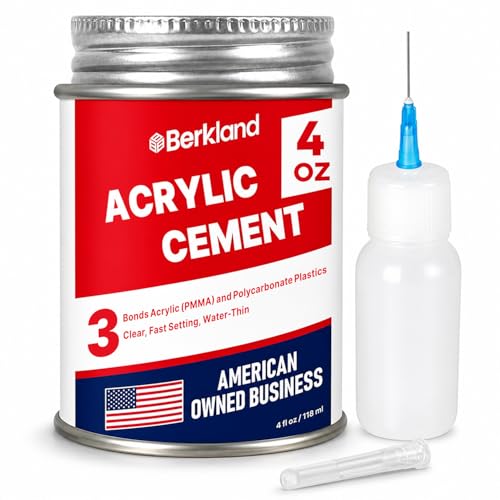
For precise, capillary-action bonding of acrylic and plexiglass sheets, the Berkland Acrylic Cement is a precision tool. Its water-thin formula flows into the tightest joints, creating a crystal-clear, optically seamless bond that is invisible to the eye. This is the go-to cement for display cases, signs, models, and any project where appearance matters as much as strength.
The included applicator bottle with a needle tip gives you pinpoint control for detailed work. It sets in minutes—fast enough to hold joints in place after a short clamp time—and reaches full strength after 24 hours of curing. While it is not specifically marketed as an ABS adhesive, the solvent chemistry works similarly on rigid ABS sheets, especially for thin-gauge material where a thick paste cement would be excessive.
Users note that it bonds PLA 3D prints effectively, suggesting compatibility with amorphous thermoplastics beyond pure acrylic. A minor trade-off is that the lid on the secondary canister can be stubborn to open, and application requires a steady hand to avoid puddles that can mar the surface. For clean, invisible joints on transparent or color-matched ABS sheet projects, this delivers professional-grade results.
Why it’s great
- Capillary action creates invisible, clear bonds on acrylic and ABS sheets
- Fast-setting formula suitable for production and hobby work
- Precision applicator needle for controlled dispensing
Good to know
- Not suitable for thick, gapped joints without capillary action
- May show slight whitening in high-humidity conditions
FAQ
Can cyanoacrylate glue bond ABS plastic effectively?
What is the difference between ABS cement and PVC cement?
How long should I wait before testing a solvent-welded ABS joint?
Final Thoughts: The Verdict
For most users, the best adhesive for abs plastic is the Oatey 30916 ABS Extra Special Cement because it delivers a true molecular weld on pipe fittings, panels, and rigid parts at a fair price. If you need a structural, gap-filling repair for load-bearing parts, grab the J-B Weld Plastic Bonder 2-Pack. And for quick fixes on 3D printed ABS projects where a no-drip gel is essential, nothing beats the ARKA Kraftprotz Superglue Gel.