
Cement board is dense, brittle, and notoriously difficult to bond — regular construction adhesive often delaminates under moisture or thermal swings, leaving tile floors loose and wall assemblies compromised. The right adhesive for cement board must penetrate the board’s porous texture, resist mold, and maintain grip under heavy load without crumbling over time.
I’m Min — the co-founder and writer behind Gadgets Feed. I’ve spent weeks cross-referencing pull-test data, moisture-resistance ratings, and open-time specs to isolate the adhesives that genuinely lock into cement board’s alkaline surface rather than just sitting on top of it.
Whether you are tiling a shower floor, securing cement board to studs, or repairing landscape blocks, this guide breaks down the formulas that actually hold. Here is my researched list for the best adhesive for cement board.
How To Choose The Best Adhesive For Cement Board
Cement board’s high alkalinity and low moisture absorption demand an adhesive that chemically locks rather than surface-bonds. Choosing wrong means popped tiles, cracked grout, or full substrate failure — so matching the formula to the application is everything.
Thinset Mortar vs. Construction Adhesive
For bonding tile directly to cement board, polymer-modified thinset mortar is the standard — it cures through hydration and forms a mechanical bond that matches the board’s expansion rate. Construction adhesives in cartridges work for attaching cement board to framing or for non-tile applications, but they rely on gap-filling and elastomeric properties rather than the chemical cure of cementitious mortars.
Water Resistance & Cure Speed
Wet areas like shower walls and pool surrounds require adhesives rated for continuous moisture exposure — look for waterproof labels and full cure times under 24 hours. Fast-set formulas open in 10-20 minutes and cure to full strength in 3 days, which is critical for submerged pool tile repairs where extended dampness can weaken slower-curing products.
Gap-Filling Capacity & Vertical Slip Resistance
When bonding uneven cement board or filling gaps between boards, a non-sag adhesive with high viscosity prevents slumping on vertical surfaces. Premium polyurethane and hybrid polymer cartridges bridge gaps up to 1/2 inch and maintain hold on overhead applications, while thinner paste formulations are better suited for flat, horizontal tiling.
Quick Comparison
On smaller screens, swipe sideways to see the full table.
| Model | Category | Best For | Key Spec | Amazon |
|---|---|---|---|---|
| Loctite PL Premium Polyurethane | Polyurethane | Cement board to framing | 3X stronger than standard adhesives | Amazon |
| Loctite PL 500 Landscape Block | Hybrid | Outdoor cement block & stone | Gunnable at 0°F to 100°F | Amazon |
| Mapei Adesilex-P10 | Thinset | Glass/mosaic tile on cement board | Non-sag performance | Amazon |
| Custom Building Products AP Thin Set | Thinset | Floor & wall tile over cement board | Exceeds ANSI A118.4 & A118.11 | Amazon |
| Gorilla Max Strength Construction Adhesive | Hybrid | General cement board repairs | 2X stronger than standard Gorilla | Amazon |
| E-Z Patch Pool Tile Thinset | Thinset | Underwater pool tile repairs | Sets in 10-20 minutes | Amazon |
| CUSTOM BLDG PRODUCTS Premier Adhesive/Grout | Acrylic | Light regrouting & tile repair | Cleans up with soap and water | Amazon |
In‑Depth Reviews
1. Loctite PL Premium Polyurethane Construction Adhesive

Loctite PL Premium uses a one-component polyurethane base that expands slightly as it cures, forcing itself into cement board’s porous texture for a true mechanical lock — not just a surface skin. Rated at three times the strength of ordinary construction adhesives, this cartridge-grade glue bonds cement board to wood, concrete, and metal without shrinking, making it the go-to for subfloor and stud-wall attachment. The 30-minute set time gives you enough window to adjust cement board panels before the chemical cure locks them permanently.
Waterproof by design, PL Premium can be applied directly to wet or frozen lumber and still cure fully within 24 hours. Users report excellent results bonding furring strips to concrete block walls and securing cement board to metal framing in damp basements. Unlike solvent-based adhesives, the polyurethane formula has minimal odor and stays paintable, so it blends into finished surfaces without ugly glue lines.
The 12-pack of 10 fl oz cartridges delivers enough volume for large cement board installations — expect to use roughly one cartridge per 4×8 sheet when applied in continuous beads. Some users note the cured adhesive becomes extremely hard and brittle under impact, so it is best suited for compression-bond scenarios rather than flexible joints. A standard caulking gun is required; the thick paste can be difficult to extrude in cold weather without a heavy-duty frame.
Why it’s great
- 3X stronger than standard construction adhesives — locks into cement board’s pores
- Waterproof and paintable with 24-hour full cure for quick project turnover
- Bonds to wet or frozen surfaces without loss of grip
Good to know
- Cured polyurethane is brittle — not ideal for flexible joints or thin-set tile applications
- Requires a caulking gun and can be tough to squeeze in temperatures below 40°F
2. Loctite PL 500 Landscape Block & Stone Construction Adhesive
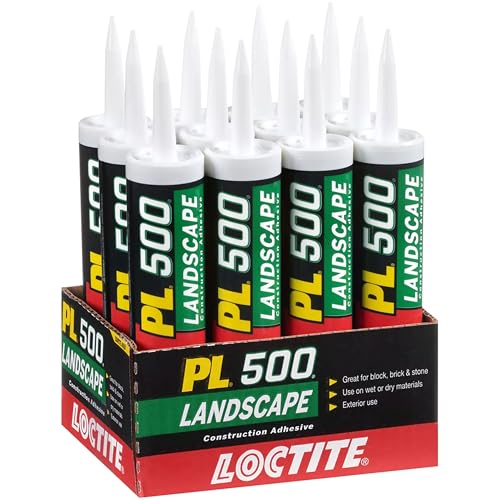
Engineered specifically for outdoor masonry, PL 500 handles the thermal cycling and moisture load that cement board encounters in exterior applications like planter walls, capstone bonding, and retaining wall capping. The hybrid polymer formula stays flexible after cure, reducing crack propagation that rigid adhesives suffer under freeze-thaw cycles. It guns cleanly in temperatures from 0°F to 100°F, so you are not stuck waiting for a warm day to tackle cement block repairs.
Users consistently report that PL 500 outperforms standard construction adhesives on stone and concrete block — one reviewer used it to secure a three-row block retaining wall that outlasted a previous adhesive failure. The gap-filling ability bridges irregular surfaces up to 1/2 inch, which matters when cement board edges do not sit perfectly flush against framing. Each 10 fl oz cartridge covers roughly 15 linear feet of bead, and the 12-pack bundle keeps large landscape projects moving without mid-job supply runs.
Because this is a landscape-focused formula, it dries to a clear or translucent finish that does not clash with stone or cement aesthetics. However, PL 500 is not designed for thin-set tile applications — its flexibility makes it unsuitable as a mortar substitute under ceramic tile. The 24-hour cure time matches most construction schedules, though thick beads over 1/2 inch may require up to 48 hours for full hardness.
Why it’s great
- Gunnable down to 0°F — cold-weather work without adhesive failure
- High flexibility resists cracking from freeze-thaw cycles on cement block
- Excellent gap-filling for uneven cement board and stone surfaces
Good to know
- Not formulated for thin-set tile bonding — only for substrate and masonry attachment
- Thick beads require extra cure time beyond the standard 24 hours
3. Mapei Adesilex-P10 Premium Mosaic & Glass Tile Mortar

Adesilex-P10 is a premium polymer-modified thinset engineered specifically for mosaic and glass tile over cement board backer. The bright white formula eliminates color bleed-through on translucent glass tile, while the non-sag performance keeps sheet-mounted mosaics from sliding down vertical shower walls during installation. Coverage ranges from 11 to 24 square feet per unit depending on trowel notch size, making it efficient for focused tile projects like backsplashes and accent walls.
Mapei’s dry-set mortar cures through hydration, creating a monolithic bond with cement board that matches the substrate’s expansion coefficient — preventing the hairline cracks that plague mismatched materials. Mixing with Keraply additive boosts adhesion for submerged installations, giving it versatility for steam showers and pool surrounds. User reviews praise its easy workability and consistent color from batch to batch, which matters when matching grout joints across multiple bags.
The 160-ounce (10 lb) container is well-suited for small to medium jobs but runs short on large floor installations — expect to order multiple units for anything over 50 square feet. As a dry powder, it requires clean mixing tools and precise water measurement; over-thinning reduces bond strength on vertical cement board. The cure time aligns with standard thinset at 24-48 hours before grouting, so plan for a multi-day workflow.
Why it’s great
- Non-sag formula holds mosaics and glass tile vertically on cement board
- Bright white base prevents show-through on translucent glass tile
- Can be fortified with Keraply for submerged or high-moisture installations
Good to know
- Not economical for large floor areas — small bag size limits coverage
- Requires precise water mixing — over-dilution compromises vertical hold
4. Custom Building Products AP Thin Set Mortar

Custom’s AP Thin Set is the workhorse mortar for cement board tile installations — polymer-modified to exceed ANSI A118.4 and A118.11 standards without needing liquid latex additives. The 25 lb bag mixes with water only, saving cost and complexity compared to two-part thinset systems. It cures faster in cold weather than standard dry-set mortars, maintaining a 3-4 hour open time that gives DIYers room to adjust tile placement without losing bond.
This mortar works for interior and exterior floors, walls, and countertops, bonding ceramic and porcelain tile to cement board, concrete, and existing tile surfaces. Users consistently report good handling characteristics with a smooth, creamy consistency that spreads easily with a 1/4 x 1/4 x 1/4 square trowel. One reviewer noted the bag size felt small mid-project — at 25 lbs, it covers roughly 30-40 square feet at 1/4 inch notch, so measure your area before starting.
The main trade-off is the all-purpose formulation: it performs well across many substrates but lacks the specialized non-sag properties of premium mosaic thinsets. On vertical cement board walls, thicker tiles may sag slightly if not supported during initial cure. The mortar also requires complete bag usage once opened — partially used bags risk moisture absorption that compromises the polymer modification.
Why it’s great
- Meets ANSI A118.4 and A118.11 standards — just add water
- Fast cure in cold weather climates without slowing the project
- Excellent open and adjustment time for precise tile positioning
Good to know
- Not formulated for non-sag vertical applications — heavy tiles may slip
- Opened bags must be used fully or stored in a completely airtight container
5. Gorilla Max Strength Construction Adhesive
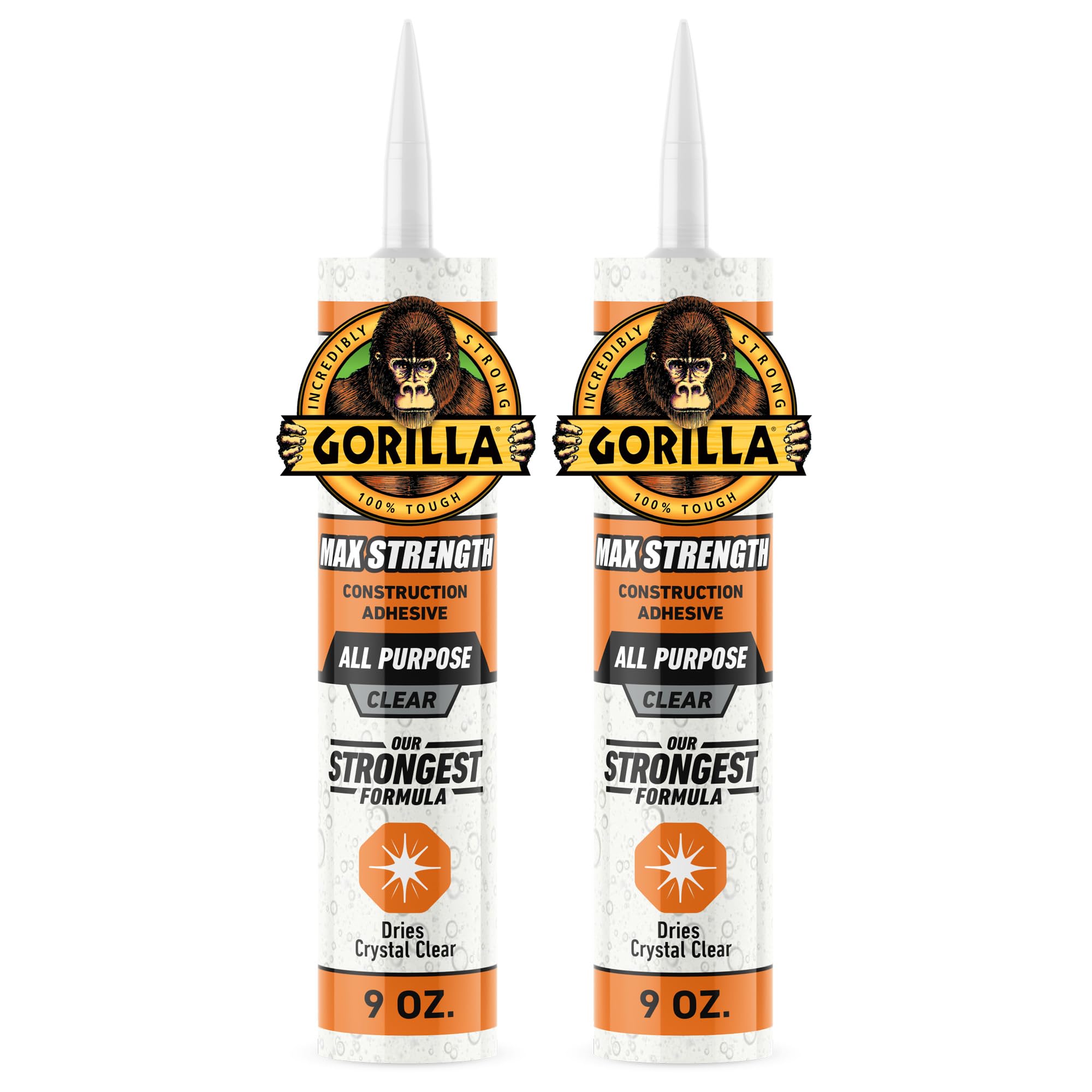
Gorilla Max Strength claims 2X the holding power of the brand’s Heavy Duty formula, and the hybrid polymer chemistry delivers a clear, waterproof bond that works on ceramic, fiberglass, stone, and wood — making it a strong candidate for bonding cement board to wooden framing or repairing cement board edges. The clear finish keeps the adhesive invisible on exposed surfaces, which matters for trim and capstone applications where glue lines would be visible. It also functions as a gap-filling caulk for sealing seams between cement board panels.
Users report exceptional grip on granite, vinyl, and painted surfaces, with one reviewer using it to reinforce a heavy granite tabletop against cement board underlayment. The waterproof rating holds up in outdoor conditions, though UV exposure over 12+ months may cause slight yellowing and surface cracking — an important consideration for exterior cement board installations. The 9 oz cartridge format pairs with standard caulking guns and delivers enough adhesive for small to medium repairs.
The adhesive cures to a hard but slightly flexible state, resisting impact better than brittle polyurethane formulas. However, some users note that achieving strong hold requires generous application — thin beads may not bond reliably to smooth or slick surfaces. The cartridge tube design wastes approximately 2 inches of adhesive at the end, and the hybrid polymer is difficult to remove once cured, so precise application is critical.
Why it’s great
- Dries crystal clear — invisible bond on finished cement board surfaces
- Waterproof and gap-filling for both adhesive and caulk duties
- Strongest Gorilla construction adhesive formula available
Good to know
- UV exposure over extended periods causes yellowing and surface cracking
- Requires generous bead application for reliable hold on smooth surfaces
6. E-Z Patch Pool Tile Thinset Cement

E-Z Patch delivers a specialty thinset mortar formulated specifically for underwater pool tile repairs — a niche application where standard cement board adhesives fail within weeks. The powder mix, combined with water, creates a fast-setting paste that begins curing in 10-20 minutes and reaches full strength in 3 days, even when applied directly to damp or submerged concrete surfaces. The proprietary blend includes modified materials with pozzolans and polymers that improve bond on wet cement board and tile.
Users praise its ease of use for gunite pool repairs, noting that it holds well without draining the pool first — simply clean the area, mix small batches, and back-butter the tile before pressing into place. The 1 lb can is intentionally small for spot repairs, and one reviewer managed to fix multiple loose tiles with a single can. The color-adjustable feature allows adding concrete pigment to match existing grout, blending repairs seamlessly into the surrounding surface.
The fast set time is both a strength and a limitation — you have roughly 10 minutes of working time per batch, so prepping tools and practicing tile placement beforehand is essential. The formula is low-odor and safe for indoor use, but the 1 lb size is purely for repairs, not for installing large areas of pool tile. Mix only what you can apply in one session; leftover wet mix hardens rapidly in the can.
Why it’s great
- Sets in 10-20 minutes underwater — no draining required for pool repairs
- Color-adjustable with concrete pigment for invisible repairs
- Low-odor formula safe for indoor and confined-space applications
Good to know
- 1 lb can is sized only for small spot repairs — not for full tile installations
- Very short working time (10 minutes) requires quick, practiced application
7. CUSTOM BLDG PRODUCTS Premier Adhesive/Grout

This gray acrylic paste from Custom Building Products is a premixed adhesive and grout in one — you apply it directly from the quart tub without mixing, trowel it into tile joints, and wipe away excess with soap and water. It is designed for lighter-duty tile repairs like regrouting shower floors, attaching quarter-round trim, or patching fireplace tile, rather than full cement board substrate installation. The acrylic base bonds to ceramic, wood, and wallboard surfaces but lacks the structural strength of thinset for load-bearing tile floors.
Users successfully refreshed kitchen tile by scraping out old grout lines and applying this paste as a surface update, reporting that it made old floors look new after curing. Another reviewer used it to install tile trim over large gaps in an old house, relying on the product’s dual adhesive-grout nature to both hold the trim and fill the surrounding gap in one step. The ability to dilute it with water for painting onto dirty grout lines adds versatility for restoration work rather than new construction.
The paste requires thick application and a 3-5 day cure before exposure to standing water — in shower floors, it must be sealed to prevent washout during the first week. It is not waterproof in the same sense as polymer-modified thinset, so it should only be used in dry or low-moisture areas unless sealed. The quart container covers roughly 10-15 square feet of grout lines, making it economical for spot repairs but impractical for full-room tiling jobs.
Why it’s great
- Premixed — apply straight from the tub without measuring or mixing
- Acts as both adhesive and grout in one application for trim repairs
- Cleans up easily with soap and water before curing
Good to know
- Not a structural thinset — too weak for full cement board tile installations
- Requires sealing and 3-5 day cure before water exposure in shower floors
FAQ
Can I use regular construction adhesive on cement board?
What is the difference between thinset mortar and construction adhesive for cement board?
How long does cement board adhesive take to cure before I can tile over it?
Final Thoughts: The Verdict
For most users, the best adhesive for cement board winner is the Loctite PL Premium Polyurethane Construction Adhesive because its 3X strength rating and waterproof formulation create a reliable bond for attaching cement board to framing in both wet and dry environments. If you need a premium thinset for tile directly over cement board, grab the Mapei Adesilex-P10. And for budget-friendly all-purpose tiling, nothing beats the Custom Building Products AP Thin Set.