
EVA foam is a closed-cell material that standard super glues and white craft glues simply cannot penetrate — they either sit on the surface and peel off in a day, or chemically melt the foam into a bubbling mess. Finding an adhesive that actually forms a permanent, flexible bond with this slick, compressible surface is the difference between a prop that lasts years and one that falls apart mid-convention.
I’m Min — the co-founder and writer behind Gadgets Feed. I’ve spent hundreds of hours digging into material data sheets, cross-referencing solvent chemistries, and reading through thousands of user reports to find the adhesives that genuinely work on EVA foam without dissolving it.
This guide is built around the real-world failure points that matter most to builders, cosplayers, and DIY enthusiasts shopping for the best adhesive for eva foam — not marketing claims, but actual bond performance on this notoriously tricky substrate.
How To Choose The Best Adhesive For EVA Foam
EVA foam’s closed-cell structure and slight surface oil content make it one of the most difficult materials to bond. The wrong adhesive either sits on the surface like a sticker or chemically eats through the foam. You need to match the adhesive’s chemistry, application method, and working time to your specific project size and skill level.
Contact Cement vs. CA Glue vs. Spray Adhesive
Contact cement forms the strongest permanent bond on EVA foam because it requires coating both surfaces, letting them dry, then pressing them together — the solvent evaporates and leaves a pure rubberized bond layer. CA glue (cyanoacrylate) bonds instantly and is ideal for small parts and tight seams, but it must be specifically labeled “foam-safe” to avoid melting the material. Spray adhesives work best for large surface laminations like covering foam with fabric, but they generally have lower shear strength than contact cement for structural seams.
Open Time and Working Window
The time between applying the adhesive and pressing the parts together — known as open time — determines how much adjustment you get before the bond locks. For large EVA foam armor pieces or curved seams, look for an open time of at least 10-15 minutes. Instant-bond adhesives work well for small repairs but leave zero room for repositioning, which can ruin a carefully fitted seam.
Quick Comparison
On smaller screens, swipe sideways to see the full table.
| Model | Category | Best For | Key Spec | Amazon |
|---|---|---|---|---|
| Beacon Foam-Tac | Contact Cement | Flexible structural seams | UV-blocking formula with adhesion promoter | Amazon |
| 3M Hi-Strength 94 ET | Spray Adhesive | Large surface lamination | 60-minute open time for repositioning | Amazon |
| Bob Smith Industries Super-Gold | Foam-Safe CA Glue | Precision parts and tight gaps | Odorless formula, bonds in 5-15 seconds | Amazon |
| Gorilla Ultimate Spray Adhesive | Spray Contact | Multi-material bonding with instant tack | Adjustable nozzle with 3 spray settings | Amazon |
| S-18 All-Purpose Adhesive | Contact Cement | Rubber-to-metal and marine applications | Water-resistant neoprene-based formula | Amazon |
| Great Planes Pro Foam Safe CA | Foam-Safe CA Glue | Thin-penetrating repair bonds | 20g bottle, water-thin viscosity | Amazon |
| DAP Weldwood Original Contact Cement | Contact Cement | High-strength permanent bonds | 3-pack of 3 oz cans, low-VOC formula | Amazon |
In‑Depth Reviews
1. Beacon Foam-Tac Powerful Glue
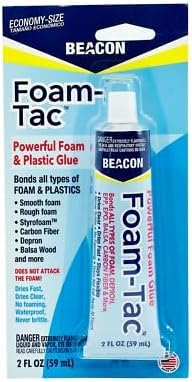
Foam-Tac is a contact cement specifically engineered for EVA, EPP, and EPO foams, which means it does not melt the closed-cell structure the way standard CA glues can. The addition of UV blockers in the formula prevents the bond line from yellowing or becoming brittle when exposed to sunlight — a real advantage for cosplay props that see outdoor convention halls or display shelves near windows.
The adhesion promoter mixed into this formula increases the wetting action on foam’s slick surface, allowing the glue to grip deeper into the cell structure rather than sitting on top. Users report a strong, flexible bond that withstands the natural flexing of EVA foam armor during wear, and the short curing time lets you move to the next seam within minutes of clamping.
Be aware that the glue is extremely thick — almost snot-like straight from the bottle — and does not come with a precision nozzle. Application requires some practice to avoid stringy messes, and a hobby knife helps clean up squeeze-out after the bond sets. For complex curved seams, use sewing pins or rubber bands to hold parts together while curing.
Why it’s great
- Specifically formulated for EVA and similar closed-cell foams — no melting risk
- UV-blocking additives prevent yellowing in sunlight
- Flexible bond that moves with the foam during wear
Good to know
- Extremely thick and stringy — messy to apply without practice
- No precision nozzle included; you will need an applicator or brush
2. 3M Hi-Strength 94 ET Spray Adhesive
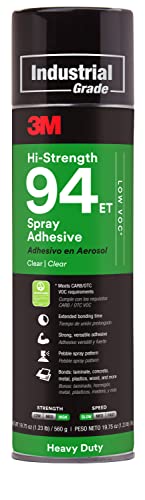
When you are laminating large sheets of EVA foam onto wood, plastic, or another foam surface, spray adhesive becomes the most practical choice. The 3M Hi-Strength 94 ET provides a 60-minute open time, which means you can coat the entire surface and still have nearly an hour to reposition the material before the bond locks — a critical window for large props or upholstery projects.
The aggressive tack from this formula rivals many brush-on contact cements, and the spray pattern allows even coverage without brush strokes or puddles. Users report bonding EVA foam to polyurethane and PVC without delamination, even in cold temperature environments where other adhesives become brittle and lose grip.
The main downside is the heavy solvent odor — this is industrial-strength stuff that requires a well-ventilated workspace and ideally a respirator. The can also has a limited shelf life once opened; after about 18 months, the propellant loses pressure and the nozzle clogs. Plan to use the full can within a single major project rather than storing it between small repairs.
Why it’s great
- 60-minute open time is unmatched for repositioning large foam sheets
- Aggressive tack grips foam even at low temperatures
- GREENGUARD certified with lower VOC than most industrial spray adhesives
Good to know
- Strong solvent fumes require heavy ventilation or a respirator
- Propellant degrades after about 18 months — use quickly once opened
3. Bob Smith Industries Super-Gold Odorless Foam Safe CA Glue
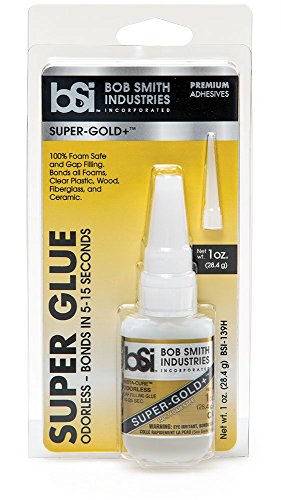
For small EVA foam details, tight seams, and gap-filling applications on scale model terrain or miniatures, a foam-safe CA glue is the fastest path to a strong bond. Bob Smith Industries Super-Gold is specifically formulated to be 100 percent foam-safe — it will not melt or dissolve EVA foam the way standard cyanoacrylates do — and it bonds in 5 to 15 seconds with a clear, odorless cure.
The medium-thickness viscosity flows well into cracks and tight spaces without running everywhere, and the included extender tip gives you precision placement on small parts like cosplay weapon details or D&D terrain pieces. Users note that a single 1 oz bottle lasts through many projects because a little goes a long way on foam, and the odorless chemistry makes it comfortable to use indoors without eye irritation.
The bond strength from CA glue is excellent for rigid parts, but it is not as flexible as contact cement for EVA foam that needs to bend during wear. For armor seams that flex repeatedly, use a contact cement instead. Store the bottle upright and capped tightly — the glue degrades quickly when exposed to moisture in the air.
Why it’s great
- Truly foam-safe — tested on EVA without any melting or chemical reactions
- Odorless and non-fuming for comfortable indoor use
- Flows into tight gaps and dries crystal clear
Good to know
- Not flexible enough for high-stress moving seams in foam armor
- Bottle must be sealed tight or the glue thickens from air exposure
4. Gorilla Ultimate Spray Adhesive
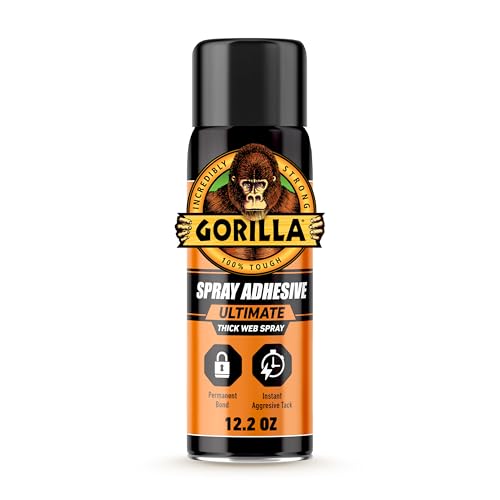
The Gorilla Ultimate Spray Adhesive delivers instant aggressive tack that grabs EVA foam on contact, making it a great option for attaching foam layers to each other or to materials like felt, fabric, and wood. Its adjustable nozzle offers three spray width settings — Low, Medium, and High — so you can control the pattern for narrow edges versus broad panels.
The web-spray formula creates a fine, even coat that resists heat and moisture after curing, which is useful for outdoor foam projects like yard decorations or foam costume pieces worn in humid environments. Users report strong bonds on throw rugs and foam mats, with permanent adhesion that requires quick alignment because repositioning is difficult once the surfaces touch.
The main tradeoff is that the spray pattern covers a wide area even on the narrowest setting, making it messy for small-scale precision work. The bond also lacks the flexibility of dedicated contact cements — on thick EVA foam that bends sharply, the glue line may eventually separate under repeated stress. Best used for flat laminations where the foam will not flex.
Why it’s great
- 3-way adjustable nozzle for controlling spray width on different foam sizes
- Instant aggressive tack grabs foam immediately for fast assembly
- Heat and moisture resistant for outdoor foam projects
Good to know
- Spray pattern is wide even on low — messy for small foam parts
- Less flexible than brush-on contact cement for bending foam seams
5. S-18 All-Purpose Adhesive by RH Adhesives
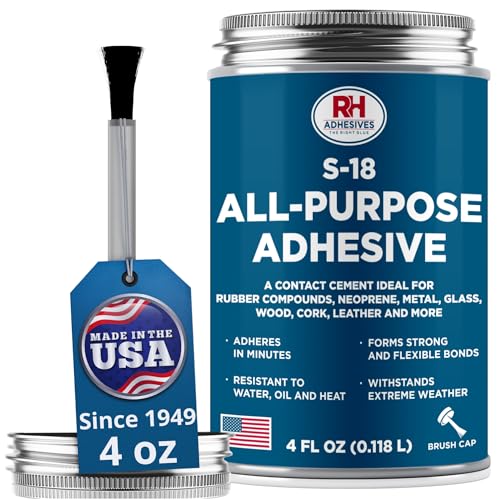
The S-18 from RH Adhesives is a neoprene-based contact cement that has been manufactured in the United States since 1949, and its chemistry is well-suited for bonding rubber, neoprene, and EVA foam to other materials. Because it is a contact cement, you apply it to both surfaces, let the solvent flash off for several minutes, and then press the parts together — the result is a permanent, flexible bond that resists water and oil.
Users have successfully used S-18 for bonding SBR rubber to metal and for repairing neoprene items like yoga mats and foam-backed car protection panels. The formula works well in difficult temperatures and creates a strong film that ages well without becoming brittle, which is important for EVA foam items that undergo temperature swings during shipping or storage.
The 4 oz can is small and the brush-in-lid applicator works for small repairs, but the open time is shorter than modern contact cements — you must join the parts within about 10 minutes, and the glue thickens significantly as the can sits over time. Multiple reviews note that the glue may weaken if the can remains open for months, so buy the smallest size needed for your current project.
Why it’s great
- Neoprene-based formula creates a flexible, water-resistant foam bond
- Proven chemistry in continuous production since 1949
- Strong peel strength for rubber-to-metal and foam-to-metal joints
Good to know
- Short open time — parts must be joined within about 10 minutes
- Adhesive thickens in the can with prolonged storage between uses
6. Great Planes Pro Foam Safe CA Thin Glue

The Great Planes Pro Foam Safe CA Thin Glue is a water-thin cyanoacrylate specially designed for foam RC airplane construction. Its low-viscosity formula wicks deep into tight-fitting seams and hairline cracks, making it ideal for repairing cracked EVA foam parts where you need the glue to penetrate rather than sit on the surface.
The glue bonds in roughly 15 to 30 seconds on foam, and the odorless, non-fuming chemistry means no melting or discoloration on the foam surface — a common issue with standard instant glues. The bottle includes an extra-long applicator tip that reaches into tight spaces on complex foam assemblies, such as servo mounts or control horn attachments.
The bond reaches full strength in about 5 minutes, but the thin viscosity runs easily on vertical surfaces and can drip through loose seams if applied too heavily. It also dissolves paint on contact, so any painted foam should be sanded down to raw material at the bond site. For best results, store the bottle in a cool location to slow the thickening process over time.
Why it’s great
- Water-thin viscosity penetrates deep into hairline cracks in EVA foam
- Odorless and non-fuming — no chemical melting of foam surfaces
- Extra-long applicator tip for precise placement in tight spots
Good to know
- Thin viscosity runs easily on vertical surfaces — apply sparingly
- Will dissolve paint on contact; sand painted areas before gluing
7. DAP Weldwood Original Contact Cement (3-Pack)
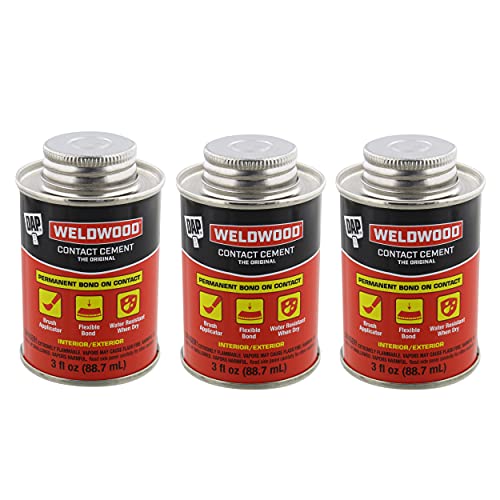
DAP Weldwood Original Contact Cement is a classic solvent-based contact cement that has been a staple in the craft and repair world for decades. When applied properly — coat both surfaces, wait at least 15 minutes for the solvent to flash, then press together — it creates an incredibly strong permanent bond on EVA foam that outperforms most modern spray adhesives in sheer holding power.
The 3-pack of 3 oz cans provides a good supply for small to medium projects, and the low-VOC waterborne formulation in the current production is less aggressive than the original red-label solvent version, though still highly effective. Users report success bonding foam to wood, shoe soles, linoleum, and even heavy door panels, with the bond holding up against repeated stress and movement.
The most significant drawback is the toxicity of the solvent fumes — even the low-VOC version requires a very well-ventilated workspace, and the new metal can lids are disliked by long-time users who preferred the older glass bottle design for reusability. The open time is about 15 to 20 minutes, which is reasonable for most foam projects but requires planning ahead rather than rushing.
Why it’s great
- Permanent, high-strength bond that holds heavy items to EVA foam
- 15-20 minute open time allows careful alignment of foam parts
- Low-VOC waterborne formula is less harsh than original solvent version
Good to know
- Solvent fumes are still potent — requires heavy ventilation
- Small 3 oz cans run out quickly on large foam projects
FAQ
Will standard super glue melt EVA foam?
What is the strongest adhesive for EVA foam seams?
Can I use spray adhesive on EVA foam for costume armor?
How long should I clamp EVA foam after applying contact cement?
Final Thoughts: The Verdict
For most users, the adhesive for eva foam winner is the Beacon Foam-Tac because its UV-blocking, adhesion-promoted contact cement formula is purpose-built for EVA foam and delivers a flexible, permanent bond without melting the material. If you need a spray solution for laminating large surfaces, the 3M Hi-Strength 94 ET provides unmatched open time and repositioning room. And for precision work on small foam parts, nothing beats the foam-safe, odorless bonding of the Bob Smith Industries Super-Gold.