
Our readers keep the lights on and my morning glass full of iced black tea. As an Amazon Associate, I earn from qualifying purchases.
Specs are compiled from manufacturer listings and verified buyer reviews and can change over time — please confirm the key details on the product page before buying.
Loose planks that click every time you walk across them are a special kind of annoying. The right adhesive ends that sound for good, but picking one means sorting through pressure-sensitive, firm-set, and injection formulas. This guide focuses on full-spread glues for gluing down new LVP, plus one repair kit for fixing trouble spots after installation.
I’m Min — the founder and writer behind Gadgets Feed. This guide is built by comparing the manufacturers’ published specifications and the patterns across verified customer reviews, so you get each pick’s real strengths and trade-offs instead of marketing spin.
You will see that some products handle heat better, some grab instantly, and some clean up with just water — the adhesive for lvp flooring that fits your subfloor and installation style is the one that will actually last.
Our Picks at a Glance

How To Choose The Right Adhesive For LVP Flooring
Luxury vinyl plank is forgiving to install, but the adhesive underneath decides whether your floor stays flat or develops hollow spots. Before you buy a gallon, match the glue to your subfloor and to how much patience you have for the drying process.
Pressure-Sensitive vs. Firm-Set
Pressure-sensitive adhesive stays slightly tacky after it dries. You press the plank down and it bonds on contact, but you get a short window to lift and reposition. Firm-set adhesive cures into a harder, more rigid bond that grabs immediately and leaves less room for adjustment.
Know Your Subfloor
Concrete, plywood, and old vinyl tile each need different prep. Some adhesives only bond to properly prepared surfaces, and a few are rated for radiant-heated subfloors up to a specific temperature. Read the compatibility list before you buy, or you will waste a whole bucket.
Quick Comparison
| Model | Best For | Material Type | Container Size | Drying Profile | Amazon |
|---|---|---|---|---|---|
| ROBERTS Universal★ Best Overall | Versatile full-spread jobs | Acrylic Latex | 1 Gal (3.78 L) | Pressure-sensitive | Amazon |
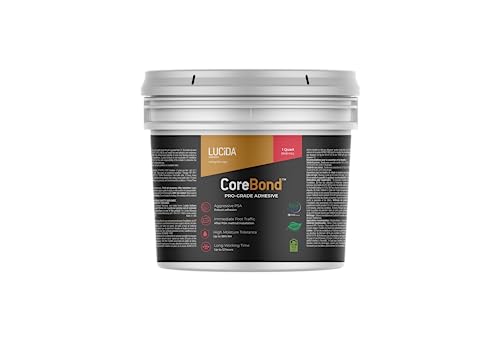
| Lucida CoreBondBest Small Project | Small projects & portability | Vinyl | 1 Quart | ~30 min–1 hr working time | Amazon |
| Floor-Fix Pro Injectafix | Repairing loose spots without removal | Custom Modified Co-Polymer | Repair Kit | 24–72 hrs dry | Amazon |
| Roberts 6399 Firm-Set | Heavy-traffic firm bond | Acrylic PSA | 1 Gal (3.78 L) | 60 min open / 12 hr working | Amazon |
| Henry 695 | DIY roll flooring with slow grab | Vinyl | 1 Gal | 4 hr full cure | Amazon |
| ROMAN PRO-690 | Wet or dry install flexibility | Resin | 1 Gal | 8 hr full cure | Amazon |
In‑Depth Reviews
1. ROBERTS Universal Resilient Flooring Adhesive
Our pick — 4.5★ from 400+ verified ratings; the strongest balance of quality and price.
The versatile full-spread glue that handles heat, trailers, and weekend DIY alike.
This 1-gallon (3.78 L) can is the crowd favorite for good reason: it works on LVT, LVP, VCT, sheet vinyl, and vinyl-backed carpet tile, so one bucket covers nearly any resilient floor project you plan. It is a solvent-free acrylic latex that stays pressure-sensitive, meaning you get high initial strength the moment the plank touches down.
What wins people over is how forgiving the working time is. Owners gluing LVP into trailers describe troweling it on, waiting for the tacky stage, and laying planks in small sections over days while pressing them with weights. The adhesive dries clear, which means your chalk lines stay visible underneath — a real help when you are aligning the first row. The can also carries Microban protection, a built-in safeguard that helps fight the growth of stain-causing buildup inside the product itself.
Check your subfloor first, because this bonds best with properly prepared concrete, APA-rated plywood, steel, marble, terrazzo, and existing well-bonded vinyl tile (excluding self-stick). Radiant-heated subfloors are fine only if the surface stays at or below 85 degrees Fahrenheit. The recurring gripe in reviews is drying time — some planks in low spots took roughly 6 hours to go clear — so give it the night to set before you walk on it. As owners put it, this is “very easy to apply” and the vinyl “adhered nicely.”
Why Owners Reach For It
- One adhesive for LVP, LVT, VCT, and carpet tile
- Dries clear so layout chalk lines stay readable
- Microban protection fights product degradation
What To Plan Around
- Drying time runs long in low spots — about 6 hours
- Not for self-stick tile or subfloors above 85°F
Reach for this if: you want one reliable gallon that bonds multiple vinyl flooring types on concrete or plywood.
Look elsewhere if: you need a bond that sets firm within the hour for same-day foot traffic.
2. Lucida Surfaces CoreBond Pro-Grade Adhesive
A tidy quart that bonds vinyl plank without the commitment of a full gallon.
This is the pick for a single room, a laundry area, or a camper fix where a full gallon would sit half-open in the garage. The 1-quart size covers roughly 40 square feet, and the can lists a working time of about 30 minutes to 1 hour depending on conditions, so you have a real window to seat each plank before the grab sets in.
It is a solvent-free, waterproof formula that handles LVT, vinyl plank without attached backing, PVC, carpet tile, VCT, quartz tile, and fiberglass-backed sheet flooring. Owners used it to lay vinyl tile on a concrete slab and to replace tile inside a motorhome, noting it was easy to apply and easy to wipe up the excess. The clean-up story matters: wet adhesive lifts off with a damp cloth, and dried adhesive comes up with mineral spirits.
The honest trade-off is that stickiness gets mixed reactions — it works perfectly for light residential use, but a few owners found the bond less aggressive than they wanted on trickier substrates. Keep the surface clean and dry, and this quart-sized workhorse delivers. For a small job, it beats hauling a 1-gallon pail around, and it is rated for both residential and heavy-traffic commercial use if you ever scale up.
Editor’s read: Buy it for the convenience — the 40 sq ft coverage and water cleanup make this the least intimidating entry point into glue-down vinyl.
Grab it when: your project is small enough that a quart is plenty and you value easy cleanup over raw bond strength.
Think twice if: you are gluing a large open room — you will need several quarts to finish.
3. Floor-Fix Pro Injectafix Injection Adhesive Kit
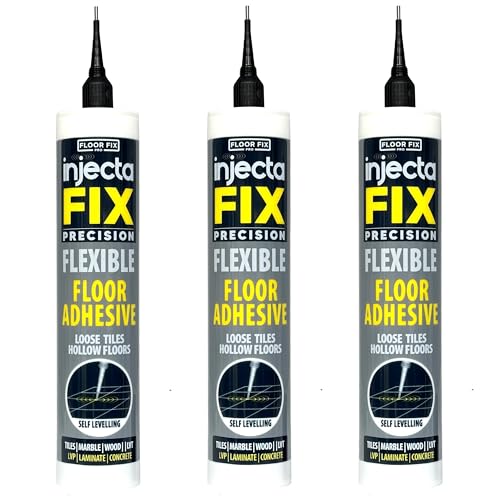
The syringe kit that rebonds hollow planks you would otherwise have to tear up.
This is not a full-spread glue — it is a professional-grade repair system for when a few planks go soft, hollow, or creaky after installation. The kit includes a precision syringe with a 1.8mm stainless steel tip, letting you inject adhesive directly through drilled holes and rebond the loose area without removing the plank. It works on ceramic, marble, stone, vinyl, laminate, engineered wood, LVT, and concrete.
The method takes patience. Owners describe drilling small holes, injecting, and refilling every 5 minutes six or more times to pack air pockets full, then letting it dry 24 to 72 hours under weight to stop the creaking and locking failure. One satisfied user filled roughly 3 spots per tube and used 3 tubes to quiet a whole problem area. The included tips fit a 1/16-inch bit tightly, which keeps the injection clean.
Here is the honest warning: this product splits opinion sharply, and reviews on LVP are the most divided. Some buyers report it works outstandingly, while others call it a waste of money on vinyl plank specifically — a few suspect it is over-thinned glue. The consistency varies from glue-like to watery between tubes, and it dries white rather than fully clear, so leave room to regrout over your holes. If your planks are already lifting badly, this is worth trying before you tear the floor out; if your LVP is brand new and installed wet, you likely do not need it.
The takeaway: A brilliant idea for ceramic and stone repairs, but on LVP it is a gamble — set expectations low and test on one spot first.
Best for: a DIYer facing a few hollow or creaky planks who wants to avoid a full floor replacement.
Not for: anyone wanting a quick fix — the multi-day dry time and hole-drilling routine demand real patience.
4. Roberts 6399 Firm-Set Transitional Adhesive
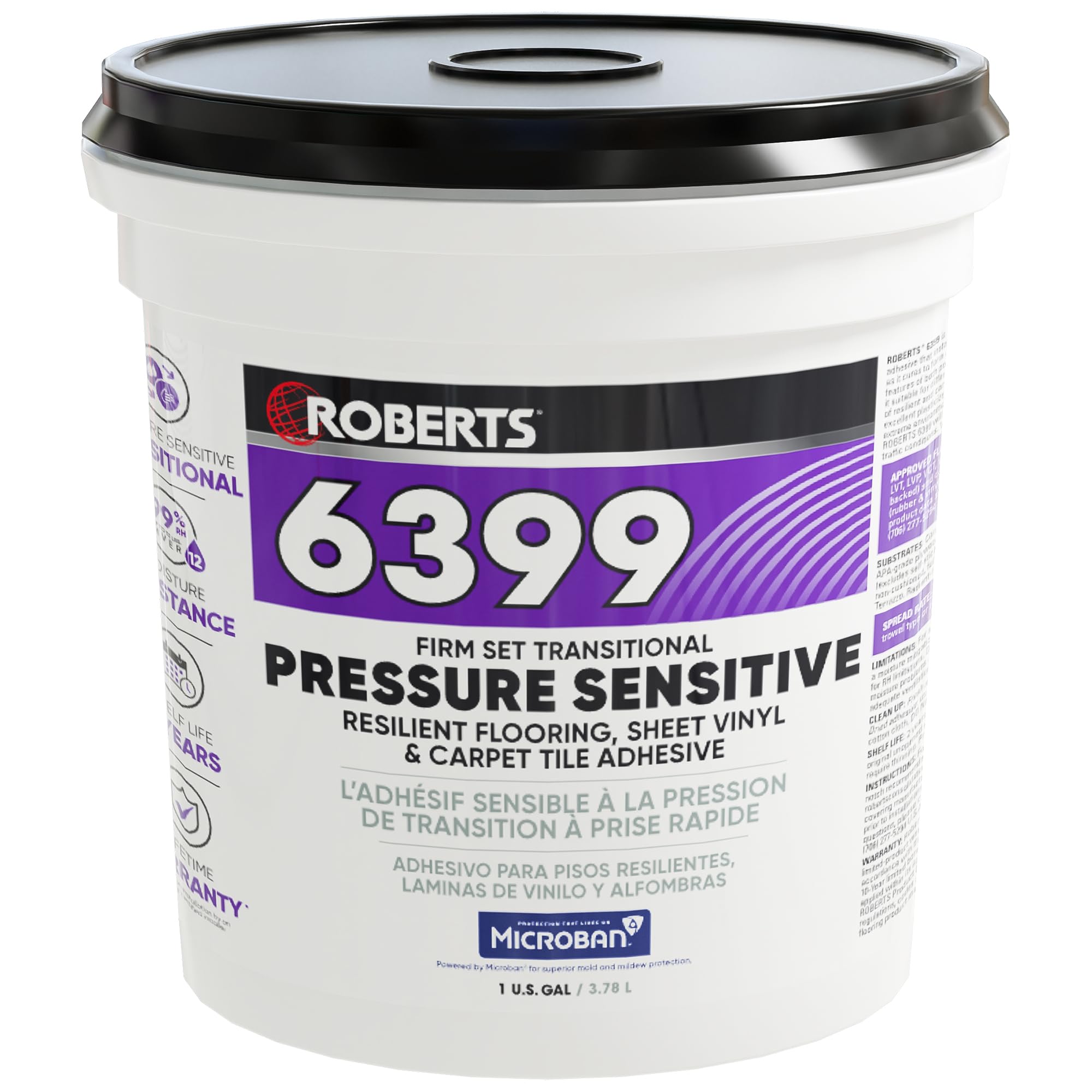
The heavy-traffic firm bond that locks planks down and refuses to let go.
Where the ROBERTS Universal stays tacky and repositionable, this 6399 formula goes the other direction — it is a firm-set transitional adhesive that cures into a rigid, grabby bond. It is built for LVT, LVP, VCT, and carpet tile in spaces that see serious traffic and rolling loads, like entryways, kitchens, and even an aircraft hangar floor coated in epoxy with non-skid flakes.
The spec sheet tells the story of its flexibility. Used as a pressure-sensitive adhesive, it gives you a 60-minute open time and a long 12-hour working window, perfect for a slow, careful DIY day. But flip to a semi-wet installation and the open time drops to 20 minutes with a 40-minute working time — a fast, aggressive schedule for pros who know exactly where each plank lands. Owners confirm the adhesion is “excellent,” noting it instantly locks things in place and grabs both acrylic flooring and carpet pads.
Two practical notes before you buy. First, it is extremely sticky — gloves are non-negotiable, and you will not be repositioning a plank once it touches down, so line everything up the first time. Second, cleanup takes mineral spirits rather than plain water. It also carries Microban protection to fight stain and odor-causing bacteria that can cause product degradation, and it handles radiant-heated floors up to 85°F (30°C).
Where It Excels
- Instant, powerful grab that holds under rolling loads
- 12-hour working time for slow, careful installs
- Microban fights odor and stain-causing bacteria
Where It Bites
- No repositioning once the plank touches the adhesive
- Cleanup needs mineral spirits, not water
Choose this for: high-traffic zones and anyone who wants a firm, permanent set rather than a tacky hold.
skip it if: you are a first-timer who will need to lift and realign planks during the install.
5. Henry 695 Vinyl Flooring Adhesive
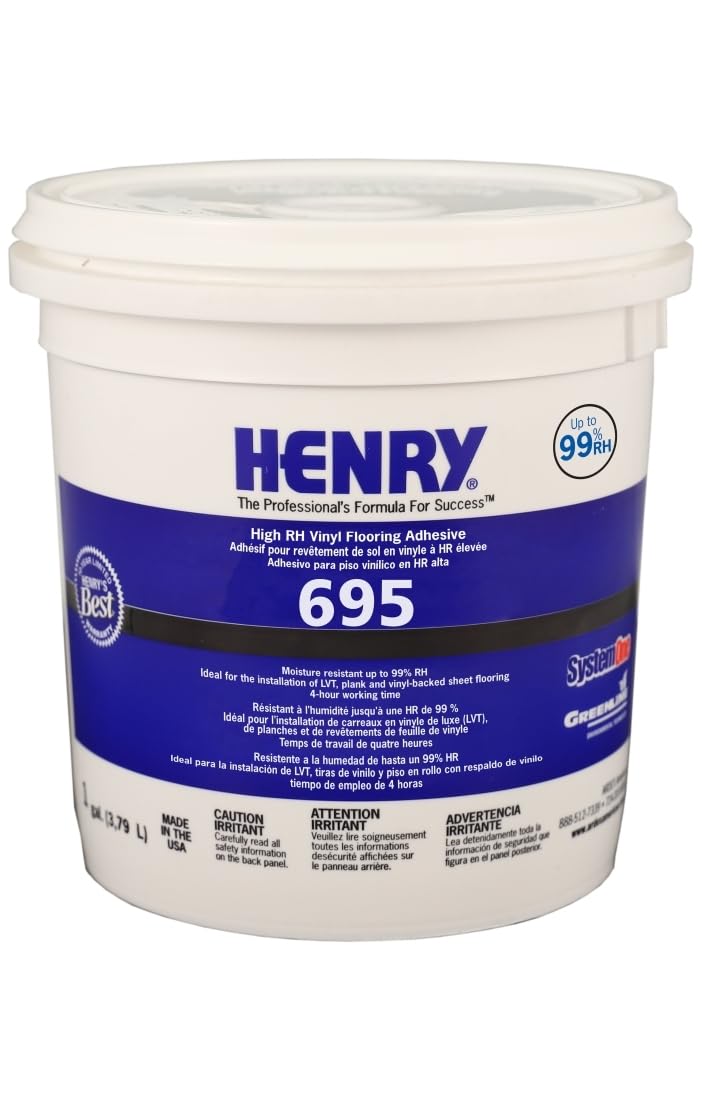
The patient adhesive that gives roll flooring time to sit perfectly before it grabs.
If you are laying sheet vinyl or roll flooring rather than individual planks, Henry 695 deserves a close look. Its defining trait is a slow, forgiving grab — owners describe it as giving enough working time to get the final positioning right, with the “grab” landing just where you want it. The full cure time is listed at 4 hours, which is a comfortable middle ground for a DIY afternoon.
The 1-gallon pail comes in an off-white liquid form and is rated as water resistant, which matters in kitchens and laundry rooms where spills happen. It is made by ARDEX LP, a well-established flooring manufacturer, so you are getting a formula designed for vinyl specifically rather than a multipurpose glue that happens to list vinyl.
The trade-off is value at the gallon level — owners note it is “pretty pricey” relative to the amount you receive, and a few found it hard to source locally. But for the job it does — holding roll flooring down with a gentle, workable tack — the reviews are uniformly positive. If your project is sheet vinyl in a bathroom or a small utility room, this is a dependable, low-stress choice.
Bottom line: A specialist for roll vinyl that trades raw strength for maneuverability, and that trade is exactly what sheet-flooring DIYers want.
Reach for it if: you are gluing down roll or sheet vinyl and want a long window to align your seams perfectly.
Look past it if: you are installing individual click-lock planks — a pressure-sensitive full-spread glue suits those better.
6. ROMAN PRO-690 Pressure Sensitive Flooring Adhesive
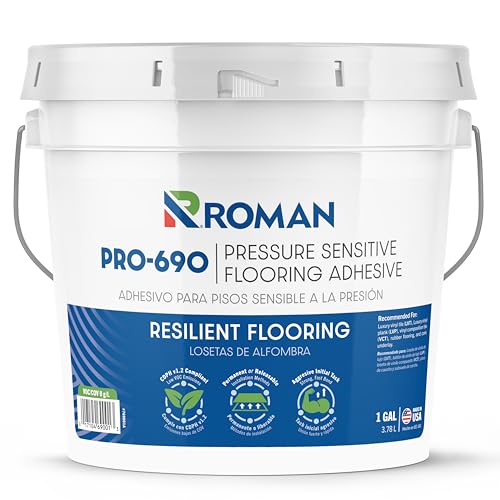
One gallon, two install methods — wet for permanent, tacky for releasable.
Roman PRO-690 is the shape-shifter of this list because it formally supports both installation styles in one pail. Install it wet and you get a strong, permanent bond; let it dry tacky first and you get a pressure-sensitive, releasable hold that still lets you reposition planks. That built-in choice makes it unusually versatile for someone still deciding between a forever-floor and a future-friendly one.
The formula is a water-based resin adhesive with 0 g/L VOC and CDPH v1.2 compliance, which means it meets requirements for LEED low-emitting materials and keeps odor low for occupied indoor spaces. Full cure takes 8 hours, and the maker says light foot traffic is allowed after cure when installed per guidelines. Owners confirm it dries quickly, sticks very well, and holds up — one contractor applied it with a 1/16-inch trowel on a clean basement floor, and another rolled motorcycles, a snow blower, and a lawn mower across rubber tiles glued down with it without anything budging.
Two honest caveats. One owner with asthma sensitivity found that even the low-VOC formula still carried a strong odor during application, forcing them to switch to a permanent wet install to limit exposure. And the tacky stage arrives fast — reviews note it gets very sticky after just 15 to 20 minutes, so keep your planks staged and your trowel moving. For a garage, a workshop, or any room where you want the option of pulling the floor up later, the releasable mode is a genuine advantage.
What Makes It Stand Out
- Wet or tacky install — permanent or releasable bond in one pail
- Zero VOC, low odor, LEED-compliant formula
- Fast tack in 15–20 minutes for quick-paced workers
Heads Up
- Odor still noticeable to sensitive noses despite low VOC
- Tacky stage arrives fast — limited repositioning time
Pick this when: you want the freedom to choose between a permanent floor and a releasable one, especially in garages or rentals.
Pass if: you need a firm-set rigid bond — this stays pressure-sensitive by design.
Understanding the Specs
Pressure-Sensitive vs. Firm-Set
Pressure-sensitive adhesive stays tacky after drying, so you press planks down and they bond on contact but can still be lifted briefly. Firm-set adhesive cures harder and grabs immediately, which suits heavy traffic but leaves zero room for error.
Open Time & Working Time
Open time is how long the glue stays workable after you spread it, and working time is the full window before it sets. Longer times like 12 hours let DIYers go slow, while short 20-minute windows suit professional crews laying planks rapidly.
Coverage & Container Size
A 1-gallon pail handles a full room, while a quart covers roughly 40 square feet and suits small repairs. Check the square-footage rating before buying so you do not run dry mid-row or waste a half-open bucket.
VOC & Odor
VOC stands for volatile organic compounds — the chemicals that create that strong glue smell. Zero-VOC formulas like the Roman PRO-690 keep indoor air cleaner and are LEED-compliant, but even low-odor versions can bother sensitive noses during application.
FAQ
Can I use pressure-sensitive adhesive on radiant-heated subfloors?
How long does LVP adhesive take to dry before I can walk on it?
Should I install LVP wet or let the adhesive get tacky first?
Can I glue LVP over existing vinyl tile?
What is the difference between LVP and LVT adhesive?
How do I fix a hollow or loose LVP plank without removing it?
What is the best adhesive for a garage floor with heavy rolling loads?
Is solvent-free adhesive as strong as solvent-based glue?
How do I clean up excess LVP adhesive?
Can I lay LVP over plywood subfloor?
Final Thoughts: The Verdict
For most people, the adhesive for lvp flooring winner is the ROBERTS Universal because it bonds the widest range of vinyl flooring types with a forgiving, pressure-sensitive hold and clear-drying visibility. If you want a firm-set bond for heavy traffic, grab the Roberts 6399. And for the flexibility of permanent or releasable installation in one pail, the ROMAN PRO-690 is the one to reach for, backed by the strongest owner enthusiasm on this list.
How We Picked
We do not accept paid placement. Every pick is matched to a real buyer and a real use-case; we do not hands-on test units.
Sources & Methodology
Specifications: manufacturer listings and product documentation. Review insights: verified customer reviews, as of September 2026. Pricing: not shown on this page (it changes often); check the current price via the retailer link.
As an Amazon Associate, Gadgets Feed earns from qualifying purchases. This does not affect which products we feature.