
Our readers keep the lights on and my morning glass full of iced black tea. As an Amazon Associate, I earn from qualifying purchases.
Attaching a metal railing, bracket, or threaded rod to a concrete surface is one of the most demanding bonding tasks in construction. The mismatch in thermal expansion, porosity, and sheer weight load means a standard glue will fail, often catastrophically. The right chemical anchor or structural epoxy bridges that gap with a bond that outlasts the materials themselves.
I’m Min — the co-founder and writer behind Gadgets Feed. I’ve spent hundreds of hours cross-referencing technical datasheets, real-world customer reports, and ICC-ES certification standards to isolate the formulations that actually hold when metal meets masonry.
This guide breaks down the six best performers by their curing chemistry, compression strength, and working time to help you pick the right adhesive for metal to concrete without wasting money on a tube that cracks under load.
How To Choose The Best Adhesive For Metal To Concrete
Selecting the wrong anchoring adhesive for a metal-to-concrete bond is a recipe for a pulled-out bolt or a sagging handrail. The three factors that matter most are the resin chemistry, the working time, and the compression strength after full cure. Each product trades off one of these against the others to suit specific jobsite conditions.
Cure Speed vs. Working Time
Fast-curing polyester resins set in under 15 minutes, which is ideal for repetitive anchor installations where you don’t want to wait. Slower epoxy systems offer a gel time of 30 minutes or more, giving you the freedom to adjust threaded rods and level brackets before the bond hardens. For structural loads, always prioritize working time to ensure proper seating.
Compression Strength and Load Rating
The compression strength, measured in PSI, tells you how much downward force the cured adhesive can resist before crumbling. A value of 8,000 PSI is sufficient for handrails and shelves, but anchoring machinery or structural steel demands 12,000 PSI or higher. Check the ICC-ES report for tension and shear loads if the bond must pass an inspection.
Quick Comparison
On smaller screens, swipe sideways to see the full table.
| Model | Category | Best For | Key Spec | Amazon |
|---|---|---|---|---|
| Loctite PL Premium | Polyurethane | Sub-floor & furring strips | 3X stronger than standard adhesive | Amazon |
| AWF PRO Extended Set Epoxy | Epoxy | Precision anchor alignment | 12,300 PSI compression | Amazon |
| Dewalt AC100+ Gold Epoxy | Vinylester | Structural steel & rebar | ICC-ES ESR 2582 certified | Amazon |
| Akona Fast-Setting Epoxy | Epoxy | Moisture-prone walls | Sets in 12 minutes | Amazon |
| Professional Soma Fix S700 | Polyester | Fast DIY anchor jobs | Includes extra nozzle | Amazon |
| Loctite Epoxy Metal/Concrete Syringe | Epoxy Syringe | Small repairs & fixtures | Sets in 5-12 minutes | Amazon |
In‑Depth Reviews
1. Loctite PL Premium Polyurethane Construction Adhesive

The Loctite PL Premium is the gold standard for general construction adhesion, and for good reason. It delivers three times the strength of standard construction adhesives, bonding metal to concrete, wood, stone, and PVC with a waterproof polyurethane formulation that cures in 24 hours. The 10 oz cartridge format fits a standard caulking gun and works even on wet or frozen surfaces without shrinking.
Real-world users report success bonding furring strips to concrete without mechanical support, and the low-odor formula makes it tolerable for indoor work. The clear finish means no ugly squeeze-out, and the 30-minute set time gives you enough window to press metal brackets into position before the grab starts.
This is the choice for large-area applications like subflooring, paneling, or attaching metal tracks to a slab. It’s not a quick-set product — you need to support the load for at least an hour — but the resulting bond is tough and vibration-resistant.
Why it’s great
- 3x stronger than typical construction adhesives
- Waterproof and paintable, works on wet surfaces
- Low odor suitable for enclosed spaces
Good to know
- Requires a caulking gun for application
- Full cure takes 24 hours before load bearing
2. AWF PRO Extended Set Anchoring Epoxy
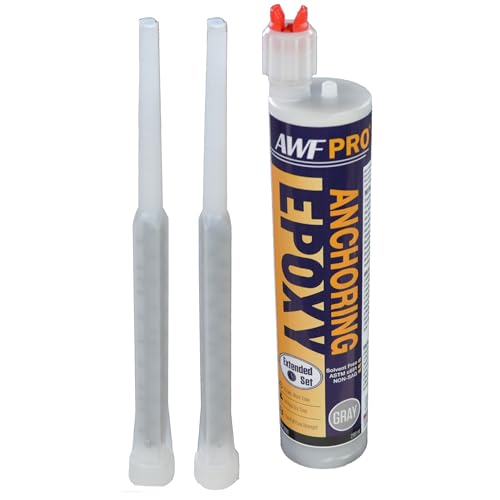
The AWF PRO Extended Set Epoxy is engineered for jobs where you need time to get the alignment right. With a gel time of 35 minutes, you can clean the hole, inject the resin, insert a threaded rod, and still have minutes to adjust level before the epoxy kicks. The fully cured compression strength of 12,300 PSI puts it in the structural-grade category, suitable for doweling and machinery anchoring.
Each 280 mL cartridge comes with two static mixers, so you can switch nozzles between sessions without waste. The high viscosity means it stays in overhead holes without dripping, a critical feature when anchoring above your head. Several users noted the viscous nature requires a firm hand on the caulking gun, but the consistency ensures the epoxy fills the annular space completely rather than running out.
The extended working time is a double-edged sword: you won’t rush, but you also won’t be able to load the fixture for hours. For precision anchor installations where a misalignment of even a few millimeters is unacceptable, this epoxy delivers the control that fast-set products cannot.
Why it’s great
- 35-minute gel time for precise positioning
- 12,300 PSI compression for structural loads
- Includes two static mixers per cartridge
Good to know
- Very viscous, requires steady pressure on the gun
- Extended set time means full cure takes longer
3. Dewalt AC100+ Gold Quik-Shot Acrylic Epoxy

The Dewalt AC100+ Gold is a two-component vinylester adhesive that carries an ICC-ES ESR 2582 evaluation, making it code-compliant for anchoring threaded rods and reinforcing bars into cracked and uncracked concrete. This is the serious contractor’s choice: it bonds reliably in concrete strengths ranging from 2,500 to 8,500 PSI and performs consistently across base material temperatures.
Each cartridge in the case of 12 is a 10 oz quik-shot format that dispenses through a standard caulking gun. The set speed is fast — about one minute of working time — so you must be fully prepared before you pull the trigger. Users emphasize the importance of the drill-blow-brush-blow sequence: one missed blow-out is enough to compromise the bond entirely.
With a full cure time of 50 minutes, this adhesive is ideal for high-volume anchor installations where you can drill all holes, then inject and insert rods sequentially. The 18-month shelf life (from date of manufacture) means you should check the expiration code on the tube; expired product can result in partial curing and anchor pullout.
Why it’s great
- ICC-ES ESR 2582 certified for code compliance
- Works in cracked and uncracked concrete
- Consistent performance in low and high strength concrete mixes
Good to know
- Very fast working time (approx. 1 minute)
- Requires meticulous hole preparation
4. Akona Fast-Setting Anchoring Epoxy

The Akona Fast-Setting Anchoring Epoxy is a moisture-tolerant, high-strength formula designed for concrete walls, floors, and outdoor applications. It sets in just 12 minutes and achieves full cure in 16 hours, which is relatively fast for a two-part epoxy. The gray color blends into concrete surfaces, and the tube format makes application clean and controlled.
Customers report using it to anchor flood barrier brackets and 100-lb boulders with 1/2-inch threaded rods, confirming the bond strength is genuine. The moisture tolerance is a standout feature — you can use this in green concrete or damp conditions where polyester resins would fail. Chemical and solvent resistance adds durability in garage or workshop environments where oils and cleaners are present.
The trade-off is the 12-minute set window. You will need to have your rod or bolt ready and the hole cleaned before you mix. Some users noted the tube sometimes ships with only one mixing nozzle instead of two, so ordering spares is a safe move if you plan multiple installations.
Why it’s great
- Fast setting in 12 minutes for quick work
- Moisture tolerant for damp concrete applications
- Resists chemicals and solvents
Good to know
- May arrive with fewer mixing nozzles than expected
- 12-minute working time can feel tight
5. Professional Soma Fix S700 Chemical Anchor
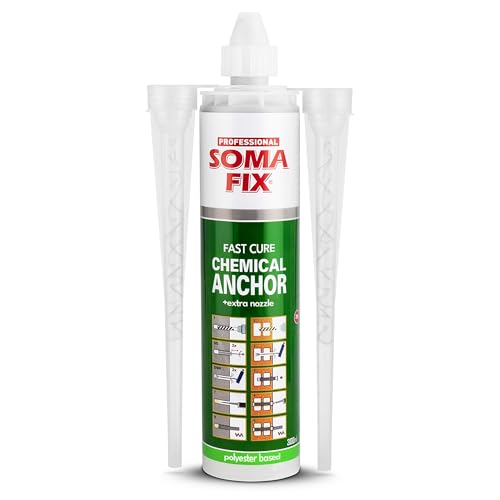
The Soma Fix S700 is a fast-curing polyester resin anchoring adhesive that punches well above its price tier. It bonds metal fasteners to concrete, brick, stone, and granite with no expansion pressure, making it safe for use near edges where mechanical anchors might cause spalling. The 10.1 fl oz cartridge includes an extra mixing nozzle, which is a thoughtful touch for multi-hole jobs.
This is a pure chemical anchor: you drill, clean, inject the resin, and insert the fastener before it cures. Polyester cures faster than epoxy — customers report it hardens in minutes — but it also has lower ultimate strength than high-end epoxies. For non-structural jobs like fixing a loose outdoor railing or anchoring a mailbox post, this is more than sufficient.
The adhesive also works with mesh sleeves for hollow materials, expanding its utility to brick and cavity-wall applications. At this price point, it’s an excellent candidate for DIYers who need a reliable anchor without spending premium money. Just keep in mind that polyester is less resistant to high temperatures and chemicals than epoxy formulations.
Why it’s great
- Includes extra mixing nozzle for multi-hole use
- Fast curing with no expansion pressure
- Good value for DIY anchoring projects
Good to know
- Polyester has lower strength than epoxy
- Less resistant to high heat and chemicals
6. Loctite Epoxy Metal/Concrete Syringe

The Loctite Epoxy Metal/Concrete is a two-part syringe format that dispenses equal parts of resin and hardener through a static mixer. It sets in 5 to 12 minutes to a metallic gray finish that blends with both metal and concrete surfaces. This is not a chemical anchor for structural loads — it’s an adhesive for smaller repairs like attaching brackets, sealing pipe leaks, or bonding fixtures.
Users praise its adhesion to metal, ceramic, and wood, and report impressive results on sink pipes and automotive parts. The cured epoxy can be sanded, drilled, and painted, so it works well as a gap-filler and surface-level repair compound. It is resistant to water and most common solvents, making it suitable for outdoor and plumbing repairs where moisture is present.
The biggest caveat is batch freshness. Several reviews noted that one of the two components had partially hardened inside the syringe, rendering the product unusable. This appears to be a quality-control issue with shelf-aged stock, so buying from a high-turnover seller and checking the expiration date before purchase is strongly advised.
Why it’s great
- 5-12 minute set for fast repairs
- Can be sanded, drilled, and painted
- Water and solvent resistant finish
Good to know
- Quality control issues with stale stock reported
- Not designed for structural anchoring
FAQ
Can I use polyurethane construction adhesive to anchor a metal handrail into concrete?
Is it necessary to clean the dust out of the hole before injecting the adhesive?
Final Thoughts: The Verdict
For most users, the best adhesive for metal to concrete winner is the Loctite PL Premium because it combines three times the strength of standard adhesives with waterproof, low-odor application that works on a huge variety of materials. If you need precision alignment for threaded rods, grab the AWF PRO Extended Set Epoxy with its 35-minute gel time and 12,300 PSI compression. And for code-compliant structural anchoring, nothing beats the Dewalt AC100+ Gold with its ICC-ES certification.