
Our readers keep the lights on and my morning glass full of iced black tea. As an Amazon Associate, I earn from qualifying purchases.
Specs are compiled from manufacturer listings and verified buyer reviews and can change over time — please confirm the key details on the product page before buying.
You do not need a welding torch to fix a cracked bracket, a wobbling mailbox post, or a metal-to-metal joint that keeps letting go. What you need is the right adhesive for the material you are actually bonding. Some metal glues cure hard in minutes, some stay workable for an hour so you can line up parts, and one wrong pick will slide apart overnight and leave you starting over. This guide cuts straight to seven picks that hold.
I’m Min — the founder and writer behind Gadgets Feed. This guide is built by comparing the manufacturers’ published specifications and the patterns across verified customer reviews, so you get each pick’s real strengths and trade-offs instead of marketing spin.
Metal repairs are unforgiving: the surface is smooth, it flexes with heat, and it rarely gives the glue an easy grip. That is why the exact adhesive for metal you choose matters far more than how hard you press it down.
Our Picks at a Glance
How To Choose The Best Adhesive For Metal
Most failed metal repairs do not fail because the glue was weak. They fail because the glue was wrong for the job. A fast-setting epoxy poured onto a bolt that needs ten minutes of alignment will harden before you finish positioning it. A slow paste used to patch a hairline crack in a bracket you handle every day will still be soft when you need it hard.
So the first question is not “which brand” — it is “how much time do I need, and how hot or wet does this joint get.” Answer those two things and the shortlist narrows fast.
Match the cure window to your job
Cure time is the clock that decides everything. A glue that sets in five minutes is brilliant for a clean, well-clamped seam on small metal parts. It is the wrong tool for a large gap you have to build up in layers. A paste with a long working time lets you fill, reposition and clamp, but you may be waiting until the next day before the joint carries any load. Look at the full cure time listed on the cartridge and ask yourself which half of that window you can realistically protect the repair through.
Prep is not optional on metal
Smooth, oily or painted metal is where most bonds fail. Degrease the surface, then roughen it with sandpaper so the adhesive has texture to bite into. Mixed metal parts — a steel bracket on an aluminum frame, for example — also flex and expand at different rates, so an adhesive that tolerates movement will hold longer than a rigid one that cracks under the same stress. Skipping prep is the single most common reason a good adhesive still lets go.
Quick Comparison
| Model | Best For | Form | Full Cure Time | Waterproof | Amazon |
|---|---|---|---|---|---|
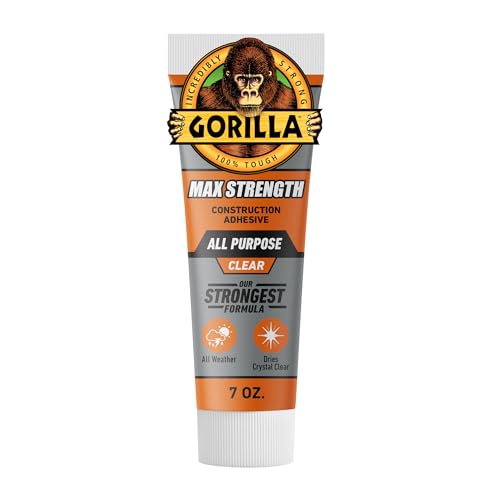
| Gorilla Max Strength Construction Adhesive★ Best Overall | All-round metal and mixed-surface repairs | 7 oz Paste Tube | 24 hours | Yes — works under water | Amazon |
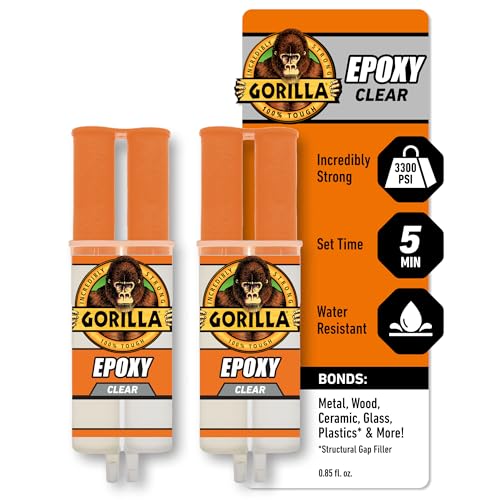
| Gorilla 2 Part EpoxyBest Value | Fast small-part fixes with precise mixing | 0.85 oz Syringe (2-pack) | 24 hours | Water resistant (moderate exposure) | Amazon |
| PC Products PC-7 Epoxy Paste | Long working time and heavy gap-filling | 1 lb Two-Can Paste | 48 hours | Seals water tank leaks | Amazon |
| AOJEL S300 Structural Metal Epoxy | Rebuilding rigid metal with a repairable body | 1.69 oz Dual Syringe | 12–24 hours | Yes | Amazon |
| WXYCRUEYE Metal Repair Glue | Filling holes and patching metal-to-metal | 5.28 oz Tube (3-pack) | 24 hours | Yes | Amazon |
| J-B Weld KwikWeld Steel Reinforced Epoxy | Fast metal-to-metal joints that need to hold now | 25 ml Syringe (3-pack) | 6 hours | — | Amazon |
| 3M Scotch-Weld DP100 Plus | Professional thermal-cycling and mixed-material joints | 48.5 mL Cartridge | 1 hour | — | Amazon |
In‑Depth Reviews
1. Gorilla Max Strength Construction Adhesive
Our pick — over 4.5★ from 12,500+ verified ratings; the strongest balance of quality and price.
The clear, waterproof tube that bonds metal indoors and out without a supporting cast
Start with the number that tells you the most about where this one belongs: a 24-hour full cure. That is half the 48 hours a two-can heavy-duty paste like the PC-7 takes, so a repair you finish on a Saturday morning is load-bearing by Sunday. The 7 oz tube holds enough to run several small jobs before you are hunting for a replacement.
What wins people over is how it behaves after it sets. It dries crisp with a non-foaming formula, so metal-on-metal seams disappear instead of leaving a chalky lump. It is paintable after 2 hours and sandable once cured, which matters if the bracket you fixed is going back into a visible spot. And it genuinely does work under water — the formula is 100% waterproof and bonds on wet surfaces, so a leaking fitting near a tub or a rain-exposed gate latch does not have to be bone dry before you start.
Here is the honest catch: the 24-hour cure wants a dry window, and this is a glue that needs clamping or stabilizing because it tends to slide on smooth surfaces before it grabs. It also covers a lot of ground — metal, wood, ceramic, tile, stone, brick, foam, glass, concrete and more — which is exactly why it is the pick most people should start with. The only thing it will not do is bond instantly. If you need a joint locked in five minutes, the J-B Weld KwikWeld below is the faster route.
What makes it the default pick
- 100% waterproof — bonds on wet surfaces and stays put under water
- Dries crisp with a non-foaming formula for invisible seams
- Paintable in 2 hours and sandable once fully cured
- Bonds metal alongside wood, ceramic, tile, stone, brick, glass, concrete and laminate
Where it asks you to adapt
- 24-hour full cure means the repair cannot be rushed
- Needs clamping or stabilizing — it can slide on smooth metal before it sets
- Very sticky to handle; gloves keep it off your fingers
The short version: this is the one to reach for first if you want a single tube that handles metal, mixed materials and damp conditions without a shopping list.
If you need instant: look at a fast-cure epoxy instead — this one rewards patience, not speed.
2. Gorilla 2 Part Epoxy, Clear, Syringe
Two barrels, one plunger, and a five-minute window to get small metal fixes done
The syringe is the whole point here. Two separate barrels — resin on one side, hardener on the other — meet at a mixing tip so you dispense a true 1:1 ratio without measuring cups or eyeballing. Buyers report the syringe delivers a true 1:1 mix, a 5-minute set and a 3300 PSI bond that cures clear on metal, wood, ceramics and plastics. The 0.85 oz syringe comes as a two-pack, so you get a spare for the next job.
For metal work, the 5-minute set is the feature you either love or fight. On a small joint you can hold by hand or clamp quickly, it is a genuine convenience — you are done and cleaning up while a paste would still be tacky. It also acts as a gap filler, meaning it fills voids and bonds uneven or vertical surfaces instead of sagging off. The clear finish keeps the repair low-profile on tools and automotive trim.
The trade-off is that five minutes does not negotiate. Large areas, long seams or anything needing measured alignment will not wait for you, and the same goes for mixing: if the dispenser bleeds unevenly, you have to over-squeeze to balance the barrels. There is also a strong odor, so open a window while you work. A final note on storage — wipe the cap before it goes back on, because leftover epoxy can glue the cap to the syringe body.
Where it shines: automotive trim, cracked tool handles and any metal-to-metal joint you can clamp in under five minutes. The 24-hour full cure comes after the fast set, so the part is stuck first and reaches full strength later.
Reach for this if you want precise, no-measuring mixing and a repair that sets while you are still in the room.
Look elsewhere if your job is a large panel or a seam you need to reposition more than once — that calls for the long working time of the PC-7 below.
3. PC Products PC-7 Epoxy Adhesive Paste

A thick charcoal paste built for jobs where you need time to get it right
PC-7 is the patient one. Two cans, one pound total, a full cure time of 48 hours — the longest on this list, and double the 24 hours the Gorilla Max Strength cures in. That slow clock is not a penalty. It is the reason you can fill a deep gap, work a thick repair body into a stripped bolt hole, then still have room to align and clamp before things lock up.
The mixed paste behaves like heavy chewing gum: it will not run or slide, so it stays put on vertical surfaces and uneven metal where thinner epoxies drip. Owners mention the charcoal gray paste cures hard but stays flexible, holding metal-to-wood and metal-to-metal joints without crumbling as they flex. It also seals oil, gas and water tank leaks, and its service temperature range runs from -20°F to +200°F, so a repair near an engine bay or an outdoor fitting is within its comfort zone.
The honest catch is handling. Part 2 is described as ultra-sticky, like thick honey, and the paste has to be pressed into the surface rather than spread. Mixing takes patience to get uniform, and the surface itself must be clean or the bond is weak — One buyer found the cured paste tore off a smooth area until they roughened the metal first.. Gloves and disposable sticks are worth having before you start.
Its strengths on the workbench
- 48-hour full cure gives a long, forgiving working window for alignment
- Thick paste that resists running on vertical and uneven metal
- Tolerates -20°F to +200°F service temperatures
- Seals oil, gas and water tank leaks as well as plumbing and masonry cracks
Where it takes work
- Mixing the two cans uniformly takes real patience
- Ultra-sticky paste is awkward to apply without disposable gloves and stir sticks
- Needs a clean, roughened surface or adhesion suffers
Choose this when the job is a big gap, a tank seal or anything that benefits from time to fill, shape and clamp.
Keep looking when you want a grab-and-go fix on a small part — the quick-set syringes will suit you better.
4. AOJEL S300 Structural Metal Epoxy

A syringe epoxy engineered to rebuild rigid metal, not just stick two pieces together
AOJEL takes a different approach to the job. Instead of a glue that clings to the surface, this is a metal-filled epoxy meant to rebuild a repair body you can then drill, sand, file, shape and paint. That makes it the pick for stripped thread holes, worn rigid parts, and brackets or housings that have failed at the metal itself rather than the joint. The 1.69 oz dual cartridge, push rod and spatula come in the box, so you can start as soon as it lands.
The standout spec is the working window: up to 30 minutes at 77°F to fill, build, position, align and clamp, then 3–4 hours to initial set and at least 24 hours before loading. That is generous for any structural job. After full cure the repair is waterproof, oil resistant and heat resistant up to 392°F.
What holds the S300 back is the list of jobs it will not touch. It is for rigid metal only — not flexible or moving parts, not torsion loads, fuel or brake lines, exhaust manifolds, or pressure-critical systems. It also works best on prepared surfaces: degrease, roughen and dry-fit before you mix. If you are chasing a higher cure heat or a cheaper tube, the J-B Weld below cures in 6 hours and is the more budget-friendly way to a fast grab.
The structural case for it
- Up to 30 minutes of working time at 77°F for fill, alignment and clamping
- Cured repair is drillable, sandable, fileable and paintable
- Waterproof, oil resistant and heat resistant to 392°F once fully cured
- Cartridge, push rod and spatula included — no extra applicator needed for standard repairs
Its hard limits, in plain terms
- Rigid metal repairs only — no flexible, moving or torsion-loaded parts
- Not for fuel or brake lines, exhaust manifolds, or pressure-critical systems
- Needs the surface degreased and roughened first
Pick this one if you are rebuilding a rigid metal part — a stripped hole, a cracked casting or a damaged bracket — and want a repair you can machine afterward.
Pass on it if the part flexes or moves; that job needs a different adhesive entirely.
5. WXYCRUEYE Metal Repair Glue

A three-tube workshop putty that fills holes, patches cracks and cures at room temperature
Three tubes, 1.76 oz each, mixed 1:1 with the included pusher and squeegee. The kit is meant for volume — filling holes, patching cracks in metal fences and bumpers, sealing pipes, water tanks, hardware tools and hard plastics. It is a general-purpose repair putty rather than a precision syringe, so the appeal is having enough material on hand to work a bigger job without running short.
Customers note it cures at room temperature into a weld-like patch that resists heat, cold, water, oil and corrosion. Owners who patched a frozen-and-cracked pool pump and a gas tank leak found the repair held once fully cured. Set time is fast — about 5 minutes to initial set, though the full cure takes 24 hours, and the instructions are clear that pressurized items should wait for that full cure before use.
What it handles well
- Three 1.76 oz tubes give plenty of working material for larger jobs than a syringe provides
- Formulated to resist heat, cold, water, oil and corrosion
- Fills holes and patches cracks in metal, aluminum, cast iron and stainless steel
The honest trade-offs
- Not a high-temp exhaust grade — the flange joint it seals is not meant to sit at exhaust temperatures
- Mixing ratio is sensitive and the included spatula is small for big areas
- Gray matter can separate in the tube, so equal parts take care to achieve
Reach for this when you want a multi-tube putty for general metal patching and filling, especially if you need to cover area rather than bond a fine seam.
Skip it for a main exhaust manifold or a joint that runs constantly at high heat.
6. J-B Weld KwikWeld Steel Reinforced Epoxy

The six-hour cure that lets you repair a metal joint and use it the same day
KwikWeld earns its place on the clock. A 6-hour full cure is the fastest on this list — a quarter of the 24 hours the Gorilla Max Strength needs. For a metal-to-metal repair you need back in service today, that gap is the whole reason to buy it. The kit ships as a 3-pack of 25 ml syringes with steel-reinforced epoxy resin, so you get repeat jobs from one order.
The bonding strength is the headline. Metal-to-metal adhesion comes off strong, and buyers describe it as a dark grey paste that can be sanded and painted after curing. In practice it suits chainsaw covers, brackets, small tool frames and any rigid metal part that takes a knock.
Nothing about this is precision work, and that is part of the appeal — the old welding-shop rule applies here: if it did not hold, you probably did not use enough. There is one practical annoyance worth knowing. The tubes do not always fill to the same amount, and a few buyers have found air gaps in the hardener or resin, which throws off the 1:1 ratio and wastes material. Check the two beads flow evenly before you mix.
Best for: rigid metal-to-metal joints where speed matters and ultimate precision does not. The steel-reinforced formula suits parts that get knocked around.
Grab it if you need a metal repair that cures in six hours and can be sanded and painted shortly after.
Think twice if your job calls for the extended working time of the PC-7 or the structural build-up of the AOJEL.
7. 3M Scotch-Weld Epoxy Adhesive DP100 Plus

The 3M engineered for metal that heats and cools, saving parts you would rather not replace
DP100 Plus is the professional-grade option here, and the spec sheet reads like it. A 1-hour full cure is the fastest full cure on the list, and the formula handles thermal cycling — the repeated heat-up-and-cool-down that cracks weaker adhesives on car parts and equipment. The 48.5 mL cartridge is designed to run through a mixing gun for consistent, even dispensing on repeated jobs.
3M built this line for automotive, industrial and specialty-vehicle work, and cites a plastic valve cover well-nut repair that held under engine heat and saved the cost of a replacement cover. It sets quickly with a 2–5 minute window for repositioning and can bond dissimilar materials that would otherwise be difficult to join.
One important caveat: this is sold for industrial and occupational use, not consumer sale, so it assumes you already own the applicator and understand the material. If you want a one-tube fix straight from the drawer, the Gorilla Max Strength or the Gorilla two-part syringe are simpler choices.
Why professionals reach for it
- 1-hour full cure — the shortest on this list
- Built for thermal-cycling applications where heat and cool cycles stress the joint
- UL 94 HB certified
- Bonds dissimilar and difficult materials, including metals, ceramics, glass and many plastics
What it expects from you
- Sold for industrial and occupational use, not consumer sale
- Cartridge design needs a mixing gun for consistent dispensing
- Overkill for simple household metal gluing jobs
The right buy for automotive, industrial and specialty-vehicle work where the joint sees repeated heat cycles and the repair saves a costly part.
Not the right buy for a first-time user sealing a small metal seam — the household picks above will do it for less fuss.
Understanding the Specs
Full Cure Time
Full cure time is how long the adhesive needs to reach its final strength, and it is not the same as the initial set. A glue may grab in five minutes and still not be load-bearing for a full day. Plan your repair around the full cure, not the grab — clamping and keeping the joint dry through that window is what makes the bond last. As a rough rule of thumb across this category, epoxy pastes and syringes at the heavy-duty end tend to run a full day or more, while some fast-cure formulas set overnight.
Two-Part vs One-Part
A two-part epoxy mixes resin and hardener in a set ratio, and the mixed material changes from liquid or paste into a solid through a chemical reaction, not by drying out. That is why it works under water or in a damp spot where an air-drying glue would fail, and why it can fill gaps and bond uneven surfaces. One-part construction adhesives are simpler to use but tend to need air, dry conditions, or a porous surface to set — for metal, a two-part epoxy is usually the stronger choice. Mixing thoroughly, and hitting the stated ratio, matters as much as the product you chose.
FAQ
What makes an adhesive work on metal when so many glues fail?
How long do I need to leave a metal repair before using it?
Can I use these adhesives on aluminum and stainless steel?
Why does my metal glue slide off before it sets?
Is a two-part epoxy stronger than plain super glue on metal?
Can these adhesives handle heat, like near an engine?
How should I prepare a metal surface before applying the adhesive?
Do I need a special applicator gun for these products?
Can I sand, drill or paint the repair after it cures?
Is a longer working time better for difficult repairs?
Final Thoughts: The Verdict
For most people fixing metal, the adhesive for metal winner is the Gorilla Max Strength Construction Adhesive because it handles metal and mixed materials, works under water, and cures overnight without needing a special applicator. If you want a fast, precise fix on a small part, reach for the Gorilla 2 Part Epoxy syringe, whose 5-minute set time lets you finish the job before the epoxy even thinks about hardening. And if the part flexes or moves or you are rebuilding cast metal, look at the AOJEL S300, whose 30-minute working window and drillable cured body make it the strongest fit for structural repairs.
How We Picked
We do not accept paid placement. Every pick is matched to a real buyer and a real use-case; we do not hands-on test units.
Sources & Methodology
Specifications: manufacturer listings and product documentation. Review insights: verified customer reviews, as of September 2026. Pricing: not shown on this page (it changes often); check the current price via the retailer link.
As an Amazon Associate, Gadgets Feed earns from qualifying purchases. This does not affect which products we feature.